
Autonomous Mobile Robot Market Size, Share, Trends & Forecast, 2026–2034
REPORT DETAILS
Autonomous Mobile Robot (AMR) Market Summary
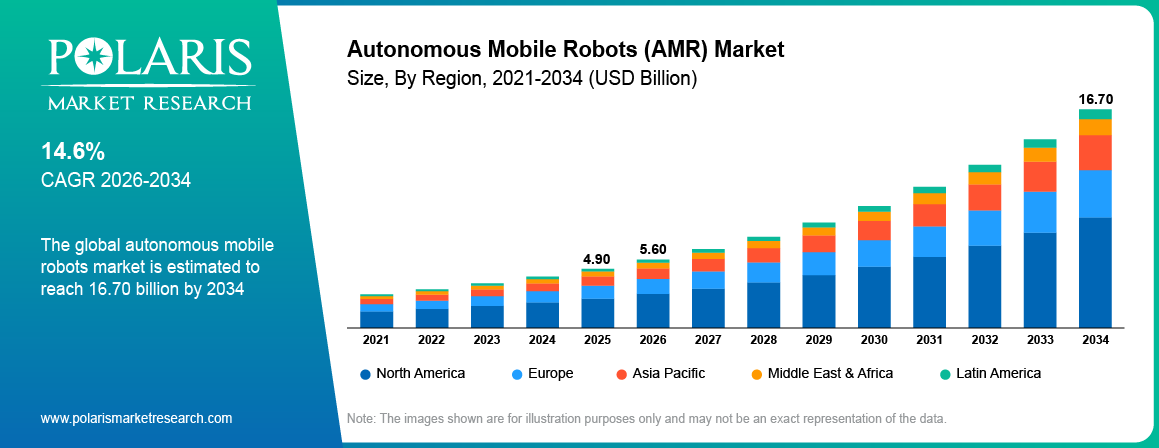
The global autonomous mobile robots market size reached USD 4.90 billion in 2025. The market is expected to register a CAGR of 14.6% from 2026 to 2034. The market for AMR technology is propelled by advances in warehouse automation robots, growth in e-commerce fulfillment centers, and the growing popularity of advanced material handling systems in the manufacturing, logistics, healthcare, and retail industries. AMR technology is widely adopted by companies in order to enhance operational efficiency and increase productivity of warehouses.
Market Statistics
Key Takeaways
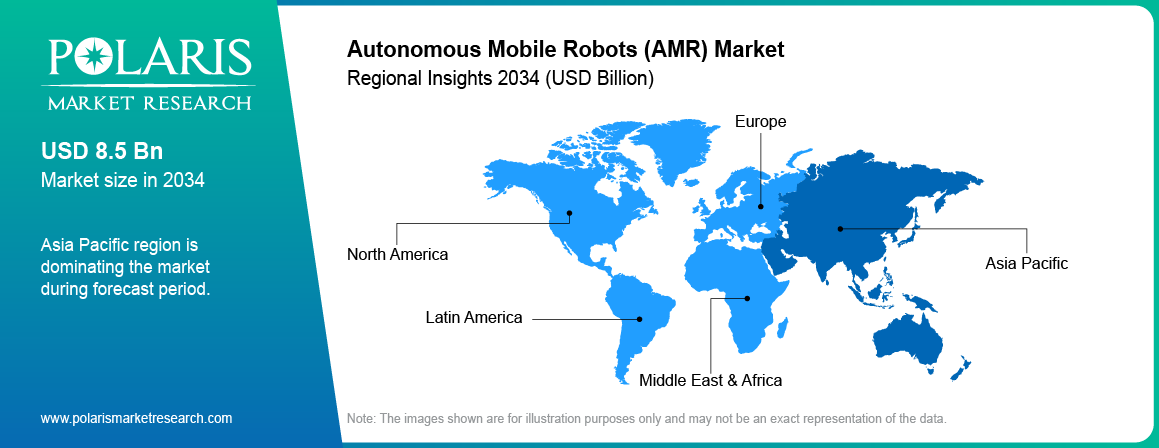
- Asia Pacific dominated the AMR market share with a 41.90% market share in 2025, owing to expanding manufacturing activities and growing warehouse automation investments.
- North America is expected to record a CAGR of 15.1% during the forecast period. Increasing investments in warehouse automation and intelligent logistics solutions in the U.S. and Canada will drive the growth.
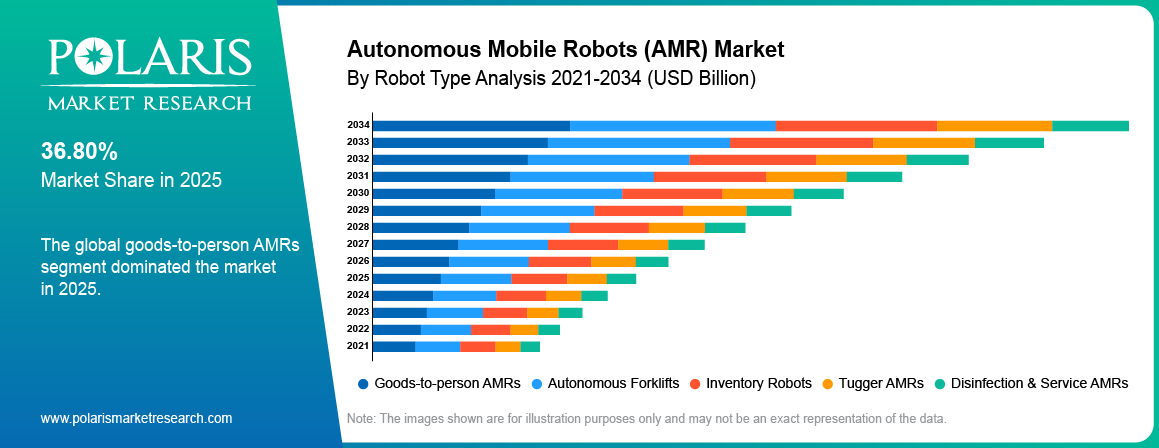
- Goods-to-Person AMRs accounted for the 36.80% market share in 2025, driven by increasing adoption across e-commerce fulfillment centers.
- E-commerce & Retail held the largest end-use segment with a 39.60% market share in 2025, owing to rising demand for automated warehouse operations.
- Manufacturing is expected to register the fastest CAGR of 19.70% during the forecast period due to the increasing adoption of intelligent automation technologies in factories.
- Increasing developments in artificial intelligence, navigation systems, and fleet management systems are helping in driving the market growth.
Note: Figures and projections outlined in this report are the result of Polaris Market Research’s proprietary analytical processes, grounded in the latest available datasets and market observation.
What is an Autonomous Mobile Robot?
An autonomous mobile robot (AMR) is a smart robot that moves around workplaces automatically. AMRs use cameras, artificial intelligence (AI), visual LiDAR, software, and sensors to understand their surroundings. The robots are used in facilities such as warehouses, factories, hospitals, and logistics centers. They are mainly used to transport goods, materials, or supplies. They help businesses save time, reduce manual work, and improve efficiency.
How Do Autonomous Mobile Robots Work?
Autonomous Mobile Robots, or AMRs, work with sensors, video cameras, and artificial intelligence. They observe their environment, draw conclusions, and then take action. Following are a few steps that show how an AMR works.
- The AMR takes a scan or gathers a visual of the environment that it must navigate. AMR will recognize objects or people in its environment and will also know its location within the environment.
- The robot then decides on the safest possible route from one place to another.
- It adapts and avoids obstacles that may be blocking an expected path.
- Instructions are given to an AMR to perform certain tasks through software or computer programs. Then, they complete tasks on its own.
- When one task is completed, a different task can be given to the AMR to perform.
AMRs vs AGVs: What's the Difference?
Although autonomous mobile robots and automated guided vehicles have the same purpose of delivering materials without the need for human guidance and control during transportation, the two technologies differ at the level of their navigation systems and adaptability. AGVs make use of several tools such as magnets, cables, or visual markers on the floor, while AMRs apply different software and hardware to reach their destinations. The differences in the navigation system make AMRs much more flexible compared to AGVs, thus enabling them to adapt to a dynamic working environment.
AMR vs AGV
| Attribute | Autonomous Mobile Robots (AMRs) | Automated Guided Vehicles (AGVs) |
| Navigation method | Onboard sensors, cameras, LiDAR, and SLAM software; builds and updates its own map in real time | Fixed paths—magnetic strips, floor wires, or reflective tape; follows a predefined route |
| Infrastructure requirement | Minimal to none—can be deployed without modifying the facility | Requires physical guidance infrastructure installed in the floor or walls |
| Flexibility / route changes | High—routes can be updated in software as layouts change. | Low—route changes require physical rework of guidance infrastructure. |
| Obstacle handling | Detects and dynamically re-routes around obstacles and people | Typically stops and waits until the path is clear |
| Typical deployment cost | Higher upfront software/sensor cost, lower reconfiguration cost over time | Lower upfront cost, higher cost to reconfigure or expand |
| Best-fit use case | Dynamic, changing environments—e-commerce fulfillment, mixed human-robot warehouses | Stable, repetitive, high-volume transport tasks on fixed routes |
| Scalability across a facility | Scales via fleet-management software with centralized coordination | Scales by adding more fixed-path infrastructure and vehicles |
Source: Polaris Market Research Analysis
Introduction to Autonomous Mobile Robots Market
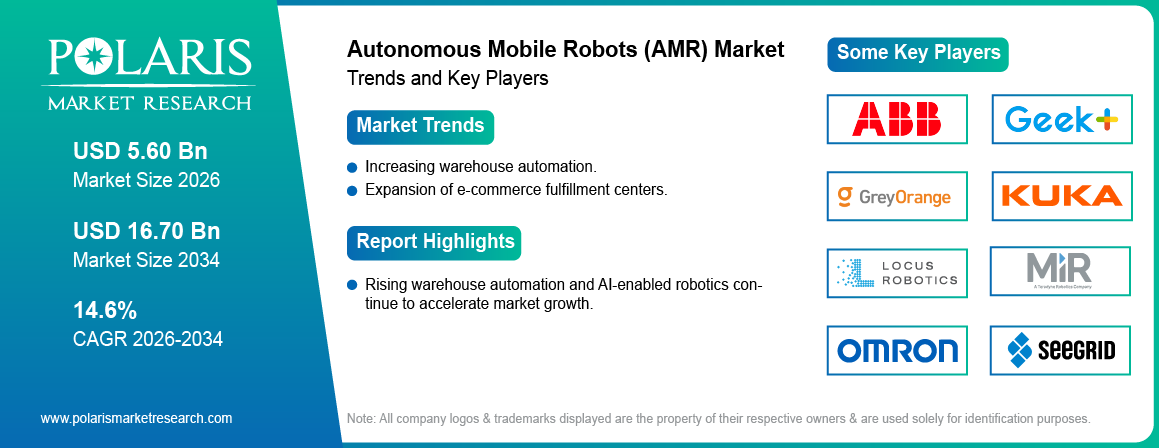
The value chain includes component suppliers, sensor makers, software providers, robot manufacturers, systems integrators, distributors, and end-users. Hardware suppliers offer cameras, batteries, control devices, processors, and navigation equipment, whereas software suppliers provide fleet management systems and navigation algorithms. Systems integrators deliver AMR systems tailored to logistics, manufacturing, health care organizations, and retail distribution centers. The firms are using autonomous mobile robots to increase accuracy in inventory management, cut operational costs, increase safety at the workplace, and improve productivity. These developments continue to create long-term growth opportunities for the market.
Source: Polaris Market Research Analysis
Autonomous Mobile Robots Market Dynamics
How is Warehouse Automation Driving the Market?
Growing warehouse automation is increasing the adoption of autonomous mobile robots across logistics and distribution facilities. According to Ferag, the worldwide spending on automation within warehouses is expected to exceed USD 90 billion by 2033 due to the increasing number of automation applications in such sectors as fashion, retail, beauty, and general merchandising (Source: www.ferag.com). Companies implement AMRs to automate material handling, increase inventory accuracy, and minimize dependence on labor. Such trends keep driving the demand for autonomous mobile robots in warehouses.
How Is E-commerce Expansion Supporting Market Growth?
The exponential rise of online shopping is resulting in an increased demand for efficient logistics services. As per the International Trade Administration (ITA), the global B2C e-commerce market size is estimated to hit USD 5.5 trillion by 2027, expanding at a CAGR of 14.4% (Source: www.trade.gov).Thus, retailers and logistics companies have been using autonomous mobile robots to automate order picking, sorting, and transport within the warehouse.
What Challenges Restrict Market Growth?
The high cost of deploying these solutions continues to be among the primary challenges for growth in the market. The deployment of autonomous mobile robots involves costs related to hardware, software, navigation, and integration into the facilities. Smaller companies usually lack financial resources for the implementation of such projects. It adds to the difficulty of the process of deployment of autonomous robots into warehouses.
What Opportunities Exist in the Market?
The development of artificial intelligence, machine vision, and logistics software solutions has paved the way for new opportunities for market players. In June 2025, ABB introduced the Flexley Mover P603, which is the smallest AI-enabled AMR with a capacity of 1,500 kg, in order to improve the process of intralogistics in production facilities and warehouses (Source: new.abb.com).The expansion of smart factories and the Industry 4.0 concept is adding fuel to the growth of demand for AMRs.
Autonomous Mobile Robots Market Driver Impact Analysis
Market growth is mainly driven by the increasing need for automatization in warehousing, manufacturing, and distribution. Many companies are turning towards robotic systems to optimize storage and retrieval of goods and minimize overall costs. The trend of adopting Industrial 4.0 and digital technologies in manufacturing is expected to grow in developed and emerging economies, thus driving the market growth during the forecast period. Rise in investments in artificial intelligence, machine vision, smart fleet management, and navigation systems has improved the performance of robots in industries. Many organizations are substituting traditional material handling systems with autonomous mobile robots to enhance operational efficiency and ensure safety. Such trends are projected to drive market growth in the future.
| Market Driver | Est. CAGR Impact | Geographic Relevance | Impact Timeline |
| Warehouse Automation | +2.4% | Asia Pacific, Europe, North America | Medium to long term |
| E-commerce Expansion | +2.0% | Global | Short to medium term |
| Labor Shortage | +1.8% | North America, Europe | Long term |
| Integration of AI and Advancement in Navigation | +1.3% | Global | Short to medium term |
| Government Investment | +1.1% | Global | Medium to long term |
* Indicative estimates based on market context and analyst judgment. Figures reflect relative driver weight, not additive CAGR contributions. Source: Polaris Market Research Analysis.
Source: Polaris Market Research Analysis
Autonomous Mobile Robots Market Segmentation Analysis
This report conducts an elaborate analysis of the global autonomous mobile robots market, considering parameters such as component, robot type, navigation technology, payload, battery type, and end use to highlight key segments that generate maximum revenue and show growth.
By Component
The hardware segment dominated with a 64.2% share in 2025, as it is the major part of an autonomous mobile robot. It includes sensors, cameras, batteries, motors, wheels, and control systems. These parts help the robot move and work safely. Sensors and cameras help the AMR detect people, objects, and walls. Batteries provide the power needed for operation. Motors and wheels help the robot move from one place to another. The demand for better hardware is growing as more companies use AMRs, thereby driving the segment growth.
The software segment is expected to grow significantly at a 16.5% CAGR during the forecast period. Software is the system that controls how a robot works. It helps the robot understand its surroundings and move safely. Navigation software helps the robot find the best route. Fleet management software helps control and monitor multiple robots at the same time. Software also helps robots receive tasks and avoid obstacles. As businesses use more AMRs, the need for smart software is increasing, thereby driving the segment growth.
By Robot Type
Goods-to-Person AMRs accounted for the 36.80% market share in 2025 due to their high adoption rate in e-commerce warehouses and distribution centers. Goods-to-person robots help in making the process of picking easier and faster and make warehouses more productive. Growing investments in automated logistics facilities continue to support segment growth.
Autonomous forklifts are projected to grow at the fastest CAGR of 17.8% during the forecast period. Autonomous forklifts are gradually taking the place of traditional forklifts due to efficiency in handling materials and improving safety in the workspace.
Autonomous Mobile Robot Cost Benchmarking Table
| Product | Est. Price Range | Key Cost Driver | Complexity Tier |
| Goods-to-person AMRs | USD 20,000–60,000 | Navigation software | Medium |
| Autonomous Forklifts | USD 80,000–200,000 | Payload capacity | High |
| Inventory Robots | USD 15,000–45,000 | Sensor integration | Medium |
| Tugger AMRs | USD 40,000–120,000 | Vehicle size | High |
Source: Polaris Market Research Analysis
By Navigation Technology
The LiDAR/SLAM segment dominated in 2025 with a 37.21% share, as they provided high accuracy and reliable navigation for AMR. LiDAR guided robots could navigate by seeking the surrounding environment and identifying barriers, obstacles, shelves, and other objects. Moreover, with the SLAM technology, AMR could create maps of the surroundings and identify their location on them. These two technologies enabled autonomous mobile robots to operate in a dynamic work environment while avoiding collisions. Notably, SLAM navigation robots are widely used in logistics-related industries such as warehouses, manufacturing, and other related sectors. This is because it plays a critical role in ensuring that material handling and transportation are achieved efficiently. The rising need for flexible automation and improved material management and handling systems is expected to propel the demand for LiDAR/SLAM-based AMRs during the forecast period.
Natural vision is expected to register the highest growth at a 17.3% CAGR in the coming years. It is due to the ability of utilizing cameras and advanced software to enable a robot’s perception and navigation like that of humans. Natural Vision allows mobile robots to identify objects, navigate through space, and avoid obstacles without relying on conventional guidance technologies. Additionally, it offers greater flexibility and ease of deployment in dynamic working environments. The development and adoption of this robotic technology have been driven by the improving accuracy of artificial intelligence, machine learning, and computer vision solutions.
By Payload
The below 100 kg segment dominated the market in 2025 owing to its extensive use in warehouse picking, healthcare logistics, and retail inventory management. These robots are versatile while handling light materials inside warehouses. Increasing deployment across commercial facilities continues to strengthen segment demand.
The 100–500 kg segment is projected to grow at the fastest CAGR of 16.1% during the forecast period. Manufacturers and logistics companies are increasingly using medium-payload robots for pallet movement and material transportation. Growing warehouse modernization initiatives continue to drive segment growth.
By Battery Type
The lead battery segment dominated the market with a significant share of 38.4% in 2025. The cost-effectiveness and accessibility of these batteries make them suitable for providing a consistent power supply to run robots. Lead batteries are mostly used in applications where the cost is a critical factor, a long-standing solution is required, and frequent charging is not necessary. Moreover, lead batteries are accessible in terms of availability. Thus, the segment is an attractive choice for organizations looking for cost-effective and straightforward automation solutions.
Lithium-ion batteries are expected to be the most prominent segment, with an expected share of 48.6% by 2034. The reason is that they are becoming widely used as they have proven to be more powerful and lightweight than lead batteries. Moreover, lithium-ion batteries can be charged to full capacity quickly, enabling robots to perform their tasks for extended periods without disrupting their operations. The ability to do opportunistic charging should also benefit companies that use warehouse robots. In addition, batteries can be recharged without requiring much maintenance, thus contributing to their potential growth in the market.
By End Use
E-commerce & retail held the largest end-use segment with a 39.60% market share in 2025 owing to increasing automation across fulfillment centers and distribution warehouses. Companies are deploying autonomous mobile robots to improve order fulfillment speed and inventory management. Rising online shopping activities continue to support segment expansion.
The manufacturing segment is projected to grow at the fastest CAGR of 16.8% during the forecast period. Manufacturing companies are adopting autonomous mobile robots into their facilities for automating the in-house logistics process and minimizing operating expenses. In June 2026, Geekplus rolled out 436 moving-type AMRs in several Toyota manufacturing plants in Japan to automate the in-plant material logistics process (Source: www.geekplus.com).
Segment Summary Table
| Segment | Category | 2025 Status | Forecast CAGR | Key Driver |
| Hardware | Component | Largest Share | Moderate | Sensors, controllers, and navigation equipment demand |
| Software | Component | Fastest Growing | High | Fleet management and AI navigation platforms |
| Goods-to-person AMRs | Robot Type | Largest Share | Moderate | Warehouse automation |
| Autonomous Forklifts | Robot Type | Fastest Growing | High | Smart material handling |
| LiDAR/SLAM Navigation | Navigation Technology | Largest Share | Moderate | Precision and reliability in structured environments |
| Natural / Vision Navigation | Navigation Technology | Fastest Growing | High | Infrastructure-free, flexible deployment |
| Below 100 kg | Payload | Largest Share | Moderate | Warehouse picking |
| 100–500 kg | Payload | Fastest Growing | High | Manufacturing automation |
| lead battery | Battery Type | Largest Share | Moderate | Cost-effectiveness and accessibility |
| Lithium-ion batteries | Battery Type | Fastest Growing | High | Faster Charging, lightweight |
| E-commerce & Retail | End Use | Largest Share | Moderate | Online retail expansion |
| Manufacturing | End Use | Fastest Growing | High | Smart factory adoption |
Source: Polaris Market Research Analysis
Source: Polaris Market Research Analysis
Autonomous Mobile Robots Market Regional Analysis
Asia Pacific Market Size and Share
Asia Pacific dominated the autonomous mobile robots market share with 41.90% in 2025, driven by rapid industrial automation and expanding manufacturing activities. China, Japan, South Korea, and India are increasing investments in smart factories, warehouse automation, and robotics technologies. In May 2025, ForwardX Robotics launched their most recent AI-driven AMR solutions at the Automate 2025 event in the U.S., emphasizing intelligent material handling for manufacturing and warehouse automation. Rising e-commerce activities and government support for industrial automation continue to drive regional market growth.
India's smart logistics and automation ecosystem is gaining significant traction as companies implement emerging technologies to help manage material storage, handling, and transportation in a more efficient manner. Automated warehouses, robots, autonomous mobile robots, artificial intelligence, cloud technology, IoT sensors, and tracking systems are all set to revolutionize India’s logistics industry, which is experiencing robust growth. E-commerce and connected systems are also rising, necessitating increased need for faster goods delivery. Additionally, the Indian government has put in place various favorable policies for the logistics industry, including the National Logistics Policy and PM Gati Shakti, to promote smarter logistics and boost the country’s economy.
North America Market Analysis
North America is projected to exhibit a CAGR of 15.1% during the forecast period. The US and Canada are investing heavily in warehouse automation and intelligent logistics solutions. In December 2025, Aptiv and Vecna Robotics teamed up to create advanced autonomous mobile robots (AMRs) that enables AI-driven warehouse and factory automation safely. Labor shortage and the increasing use of AI-driven robotics are motivating organizations to adopt autonomous mobile robots in distribution centers.
Europe Market Analysis
Europe had a significant market share of 27.8% in 2025. This is owing to the widespread use of Industry 4.0 technology. Countries such as Germany, the UK, France, Italy, and the Netherlands are consistently investing in factory automation and smart logistics. In June 2026, Amazon introduced its next generation of the Proteus autonomous mobile robot (AMR) for Europe that helps to automate materials handling and warehouse operations at Amazon fulfillment centers (Source: www.aboutamazon.com).
Latin America Market Size and Share
Latin America has seen consistent market growth at a 13.2% CAGR during the forecast period. Latin America has seen consistent market growth due to investments in logistics infrastructure and warehouse upgrades. Brazil, Mexico, Argentina, and Chile are gradually adopting automation technologies to improve operational efficiency. Growing industrial development is expected to support future market growth.
Middle East & Africa Market Outlook
The Middle East & Africa market is expected to expand steadily at a 12.7% CAGR during the forecast period. Saudi Arabia, the UAE, South Africa, and Israel are increasing investments in industrial automation and smart warehousing. In April 2026, Milvus Robotics launched the SEIT F1500S stacker-type fork autonomous mobile robot (AMR), designed to automate material handling with a 1,500 kg payload capacity and advanced AI-powered perception across the Middle East (Source: whserobotics.com).
Source: Polaris Market Research Analysis
Regulatory Heatmap
| Region/Country | Policy Environment | Key Regulations | Market Implication | Trend |
| U.S. | Favorable | Advanced Manufacturing Initiatives | Supports warehouse automation | Expanding |
| Canada | Developing | Industrial Automation Programs | Encourages robotics adoption | Developing |
| Germany | Favorable | Industry 4.0 Strategy | Accelerates factory automation | Expanding |
| UK | Favorable | Smart Manufacturing Initiatives | Supports industrial robotics | Stable |
| China | Favorable | Made in China 2025 | Promotes robotics deployment | Expanding |
| Japan | Favorable | Society 5.0 | Supports automation technologies | Stable |
| India | Developing | National Manufacturing Mission | Creates long-term opportunities | Developing |
| South Korea | Favorable | Intelligent Robot Development Strategy | Accelerates smart factory adoption | Expanding |
| Australia | Favorable | National Robotics Strategy | Supports robotics and automation adoption across manufacturing, mining, and logistics | Developing |
| Singapore | Favorable | National Robotics Programme (NRP) / Smart Nation Initiative | Accelerates robotics adoption via SME funding, R&D grants, and public robot testbeds | Expanding |
Source: Polaris Market Research Analysis
Key Factors Driving the Autonomous Mobile Robots (AMR) Market Growth
Smart Manufacturing & Industry 4.0 Applications
Rising focus on smart manufacturing and Industry 4.0 automation propels the demand for autonomous mobile robots in the near future. The concept of connected and automated manufacturing has given rise to advanced technologies in factory settings where AMRs play a critical role in transporting goods, raw materials, parts, and machinery between different production units. In fact, robots provide flexibility in the production process without using conveyor belts, as is the case with conventional manufacturing, thus fitting seamlessly into connected and automated settings. Additionally, these robots can connect their onboard computers to other manufacturing systems while also helping to automate production processes, shortening supply chains, and reducing errors. Moreover, AMRs can help create a healthy working environment in factories by eliminating the need for manual labor while also ensuring the safety of the workers.
Healthcare & Hospital Robotics Applications
Healthcare and hospital robotics applications are anticipated to propel the autonomous mobile robots market growth in the coming years. The rising demand for improved patient care and the need to reduce human efforts in hospitals and other healthcare facilities has prompted the adoption of robotic systems. Hospital robots transport various supplies, including pharmaceuticals, laboratory specimens, food, laundry, and waste around hospital facilities. Additionally, various healthcare institutions are utilizing these robots to ensure the timely delivery of critical supplies while also minimizing the amount of walking involved after ensuring these machines avoid walking into people and other obstacles. This, in turn, improves productivity within the healthcare sector while also improving patient care.
Labor Shortages & Workforce Automation Trends
The current trends in workforce automation are fueling the growth of the autonomous mobile robots market. The rising labor shortage is driving manufacturers and other industrial organizations to invest in robotics technology to help them remain competitive in an environment with limited labor supply. AMRs are used to perform tasks that would have been done by humans while also allowing the remaining workers to utilize their skills and expertise to do more specialized jobs. These machines are also crucial in minimizing manual handling of goods and, thus, reducing human efforts. In addition, autonomous mobile robots offer flexibility and can be used in a wide range of tasks, as they are able to avoid obstacles without requiring any additional training.
Cloud Robotics & Fleet Management Systems
Cloud robotics and fleet management systems are driving the market growth globally. Cloud robotics entail the use of interconnected and network-accessible systems that utilize remote servers to offer machine control while also ensuring that the robots meet the individual needs of a company or organization. Additionally, these systems also offer fleet management solutions that allow managers and supervisors to monitor the progress of all autonomous mobile robots, including the location of each machine, the power level, the tasks they are handling, and other crucial data. In addition, fleet management software robotics ensure that these robots minimize traffic or idle time when handling tasks. As a result, the applications of this technology are extensive, as the robots can be used in numerous industries to enhance productivity. Similarly, the use of the cloud in robotics is also pertinent since it can enable companies to monitor and manage robot data efficiently. First, data can be stored within the cloud system, making it easy to access and use when making business decisions.
Collaborative Robots & Human-Robot Interaction
Collaborative robots and human-robot interaction are gaining significant traction, with manufacturers designing robots capable of working alongside humans, as opposed to traditional robots that are programmed to work independently. Collaborative mobile robots use sensors, scanners, and other advanced technologies to allow these machines to navigate their environment while also detecting nearby people and objects. As a result, robots can work with or near humans without causing harm or damaging products due to the advanced technology they utilize. This feature also enhances flexibility since they can quickly change the working pattern depending on the task at hand. This innovation is crucial as it ensures that companies and organizations can maximize their resources while also boosting productivity levels. In addition, human-robot collaboration is projected to rise in the future as robots become more sophisticated, intuitive, and flexible, and the advantages they offer are vast, which makes them desirable in diverse industries.
Technology and Innovation Landscape
There have been technological innovations in the field of autonomous mobile robots. The goal of these innovations is to increase efficiency in navigation and fleet coordination. Firms are utilizing artificial intelligence, machine vision, and software solutions in the cloud for increasing performance of robots.
| Technology | Adoption Stage | Key Development | Market Impact |
| Artificial Intelligence | Growing deployment | Intelligent route optimization | Improves operational efficiency |
| Machine Vision | Mainstream adoption | Real-time obstacle detection | Enhances navigation accuracy |
| Fleet Management Software | Growing deployment | Centralized robot coordination | Improves productivity |
| LiDAR & SLAM | Mainstream adoption | Autonomous navigation | Strengthens warehouse automation |
| IoT Connectivity | Growing deployment | Real-time asset monitoring | Improves operational visibility |
| Edge AI | Early-stage deployment | On-device, low-latency decision-making | Reduces response time in mission-critical operations |
| Digital Twins | Emerging | Virtual facility simulation before deployment | Speeds up fleet planning and layout changes |
Source: Polaris Market Research Analysis
Buyer Use Cases and Market Entry Barriers
The report helps organizations evaluate market opportunities, technology adoption, competitive positioning, and investment potential across major regions.
| Buyer / Investor Type | Primary Use Case | Key Insight Sought | Decision Horizon |
| Corporate Strategy Teams | Market expansion | Regional growth opportunities | 2–5 years |
| Private Equity Firms | Investment evaluation | Market potential | 3–7 years |
| Logistics Companies | Vendor selection | Automation capabilities | 1–3 years |
| Product Managers | Product development | Customer demand | 1–3 years |
| Government Agencies | Industrial planning | Automation trends | 3–7 years |
Source: Polaris Market Research Analysis
What are the barriers to entering the autonomous mobile robots market?
- High capital investment for robotics hardware and software.
- Complex integration with existing warehouse systems.
- Skilled workforce requirements for deployment and maintenance.
- Cybersecurity and data privacy concerns.
- Compliance with industrial safety regulations.
- Strong competition from established robotics vendors.
Competitive Landscape
The market for autonomous mobile robots is moderately fragmented owing to the existence of international robotics firms and automation firms. The competitive environment among market participants involves competition in terms of navigation technology, software, fleet management, and integration. Market players are increasing their product offerings through innovation, collaborations, acquisitions, and international operations. Major firms operating in this market are focusing on AI, autonomous navigation, and fleet management to strengthen their market position.
Competitive Positioning Table
| Company | Est. Market Position | Primary Strength | Geographic Focus | Segment Focus |
| ABB Ltd. | Top 10 | Industrial automation, AI-powered navigation | Global | Manufacturing, intralogistics |
| KUKA AG | Top 10 | Industrial robotics integration | Europe | Manufacturing |
| Mobile Industrial Robots (MiR) | Top 5 | Collaborative AMRs | Global | Warehousing, light manufacturing |
| Geekplus | Top 10 | Warehouse robotics fleets | Asia Pacific | E-commerce fulfillment |
| Locus Robotics | Top 10 | Fulfillment automation software | North America | E-commerce, 3PL |
| Omron Corporation | Regional Leader | Factory automation | Asia Pacific | Manufacturing |
| Seegrid Corporation | Regional Leader | Autonomous vehicles for logistics | North America | Manufacturing, logistics |
| Toyota Industries Corporation | Top 10 | Material handling equipment | Global | Manufacturing, warehousing |
| Vecna Robotics | Emerging Leader | AI-driven warehouse/factory AMRs (Aptiv partnership) | North America | Warehousing, manufacturing |
| Zebra Technologies | Regional Leader | Fleet visibility and asset tracking | North America | Warehousing, retail |
Source: Polaris Market Research Analysis
List of Key Autonomous Mobile Robot Companies
- ABB Ltd.
- Geekplus
- GreyOrange
- KUKA AG
- Locus Robotics
- Mobile Industrial Robots
- Omron Corporation
- Seegrid Corporation
- SSI SCHAEFER
- Toyota Industries Corporation
- Vecna Robotics
- Zebra Technologies
Industry Developments
- July 2026: ABB Robotics expanded its AMR portfolio with the launch of the Flexley® Stack F712. ABB Robotics helps customers automate different material-handling and intralogistics processes by combining autonomous forklifts, tugs, and movers on one single platform. (Source: roboticstomorrow.com)
- June 2026: The OMRON Robotics unveiled their next generation of AMR’s called the LD-150 and LD-300, which have an increased payload capability as well as more effective fleet management at Automate 2026 (source: www.businesswire.com).
- June 2026: KUKA deployed a group of 22 autonomous mobile robots at TPV Displays Polska to automate material handling and enhance production efficiencies in TV manufacturing processes (source: www.kuka.com).
- May 2026: Geek+ and Mindugar signed a strategic partnership to boost the adoption of warehouse automation in Latin America. The deal emphasizes deploying Geek+’s Shelf-to-Person solutions, such as P800 and PopPick, and its high-performance Tote-to-Person system, RoboShuttle Plus (RSP). (Source: automatedwarehouseonline.com)
- March 2026: Hyundai Motor Group announced the launch of the MobED Alliance. With this strategy, Hyundai aims to commercialize an advanced mobile robot platform. MobED Alliance is a collaborative ecosystem that is centered on its next-gen mobile robot platform, MobED (Mobile Eccentric Droid). (Source: hyundai.com)
Premium Insights and Future Outlook
Growing trends toward automation in warehouses and advanced manufacturing are expected to boost market growth. Companies are using artificial intelligence, autonomous navigation, and cloud-based fleet management systems to improve their efficiency. Increasing demand for flexible material handling solutions is expected to create new opportunities throughout the forecast period. Growing investments in warehouse automation technology and robotics as a service (RaaS) will boost market expansion. Further, expanding e-commerce transactions will propel the demand for AMRs. Also, shortages in the workforce and ongoing developments in AI will fuel the market development in the future.
Market Segmentation Outlook
By Robot Type Outlook (Revenue, USD Billion, 2021–2034)
-
Goods-to-person AMRs
-
Autonomous Forklifts
-
Inventory Robots
-
Tugger AMRs
-
Disinfection & Service AMRs
By Component Outlook (Revenue, USD Billion, 2021–2034)
-
Hardware
-
Software
-
Services
By Battery Type Outlook (Revenue, USD Billion, 2021–2034)
-
Lead Battery
-
Lithium-Ion Battery
-
Nickel-based Battery
-
Others
By Navigation Technology Outlook (Revenue, USD Billion, 2021–2034)
-
LiDAR/SLAM
-
Laser Guidance
-
Magnetic Guidance
-
Vision Guidance
-
Inductive Guidance
-
Natural Navigation
-
Others
By Payload Outlook (Revenue, USD Billion, 2021–2034)
-
Below 100 kg
-
100–500 kg
-
500–1,500 kg
-
Above 1,500 kg
By End Use Outlook (Revenue, USD Billion, 2021–2034)
-
E-commerce & Retail
-
Manufacturing
-
Third-party Logistics
-
Healthcare
-
Food & Beverage
By Regional Outlook (Revenue, USD Billion, 2021-2034)
-
North America
-
U.S.
-
Canada
-
Europe
-
Germany
-
France
-
UK
-
Italy
-
Spain
-
Netherlands
-
Russia
-
Rest of Europe
-
Asia Pacific
-
China
-
Japan
-
India
-
Malaysia
-
South Korea
-
Indonesia
-
Australia
-
Vietnam
-
Rest of Asia Pacific
-
Middle East & Africa
-
Saudi Arabia
-
UAE
-
Israel
-
South Africa
-
Rest of Middle East & Africa
-
Latin America
-
Mexico
-
Brazil
-
Argentina
-
Rest of Latin America
Report Scope
| Report Attributes | Details |
| Market Size in 2025 | USD 4.90 Billion |
| Market Size in 2026 | USD 5.60 Billion |
| Revenue Forecast by 2034 | USD 16.70 Billion |
| CAGR | 14.6% from 2026 to 2034 |
| Base Year | 2025 |
| Historical Data | 2021–2024 |
| Forecast Period | 2026–2034 |
| Quantitative Units | Revenue in USD Billion and CAGR from 2026 to 2034 |
| Report Coverage | Revenue Forecast, Competitive Landscape, Growth Factors, and Industry Trends |
| Segments Covered |
|
| Regional Scope |
|
| Competitive Landscape |
|
| Report Format |
|
| Customization | Report customization as per your requirements with respect to countries, regions, and segmentation. |
Autonomous Mobile Robot Market FAQ's
The market size was valued at USD 4.90 billion in 2025. The market is expected to reach USD 16.70 billion by 2034 at a 14.6% CAGR during 2026–2034.
• The global autonomous mobile robots (AMR) market was valued at USD 3.04 billion in 2025 and is projected to witness steady growth during the forecast period.
Asia Pacific dominated the market with a 41.90% share in 2025, driven by rapid industrial automation and warehouse expansion.
Goods-to-person AMRs dominated the market in 2025 owing to their widespread deployment in fulfillment centers.
Major companies include ABB Ltd., Geekplus, GreyOrange, KUKA AG, Locus Robotics, Mobile Industrial Robots, Omron Corporation, Seegrid Corporation, SSI SCHAEFER, Toyota Industries Corporation, Vecna Robotics, and Zebra Technologies.
Warehouse automation, e-commerce expansion, labor shortages, and AI-enabled navigation technologies are driving market growth.
Growing adoption of smart factories and intelligent fleet management systems is expected to create significant growth opportunities.
AMRs are widely used in warehousing, manufacturing, healthcare, retail, logistics, and e-commerce industries.
Autonomous mobile robots are used for material transportation, inventory movement, order fulfillment, picking, sorting, and warehouse-to-workstation deliveries across industrial facilities.
AMRs use sensors and software for efficient navigation. However, AGVs follow predefined routes, tracks, magnetic strips, or fixed guidance systems.
An autonomous mobile robot typically costs $20,000–$100,000 or more. Its cost depends on payload capacity, navigation technology, and software. Also, customization and deployment requirements influence the cost of an AMR.
AI helps AMRs improve navigation and obstacle avoidance. Companies in the market make use of AI tools in order to achieve effective decision-making and to improve overall operational efficiency.
AMRs help warehouses move goods faster and reduce manual work. Their adoption leads to greater accuracy and boosts total productivity.
Rising integration of AI and increasing adoption of cloud-based fleet management will boost AMR adoption. Also, rising emphasis on human-robot collaboration and smart manufacturing will shape the market’s future.
Download Sample Report of Autonomous Mobile Robot Market
Please fill out the form to request a customized copy of the research report.


