
Neural Processor Market Size, Share, and Forecast 2026 to 2034
REPORT DETAILS
Neural Processor Market Summary
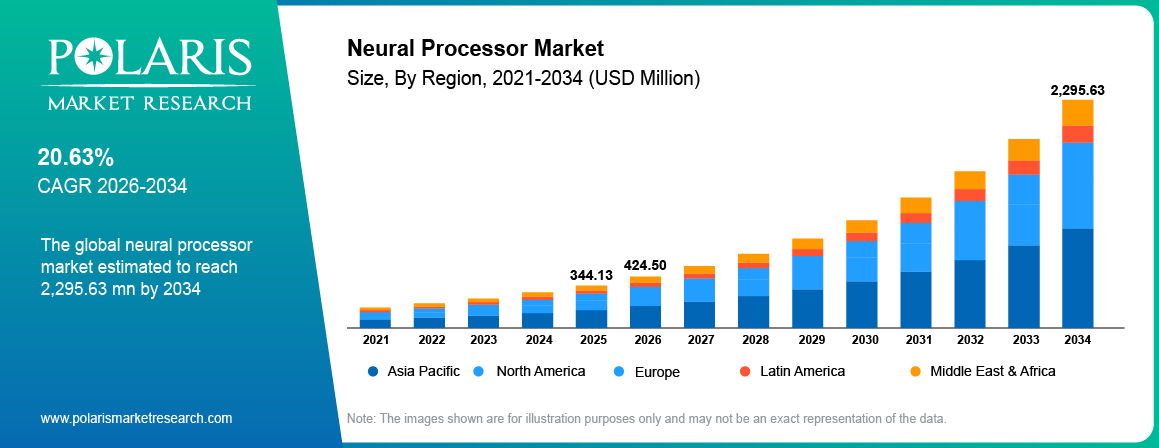
The global neural processor market was valued at USD 344.13 million in 2025 and is projected to reach USD 2,295.63 million by 2034, expanding at a CAGR of 20.63% from 2026 to 2034. Growth is supported by the increasing use of dedicated neural processing units across client and edge devices along with rising on-device AI workloads and higher performance.
Market Statistics
Key Takeaways
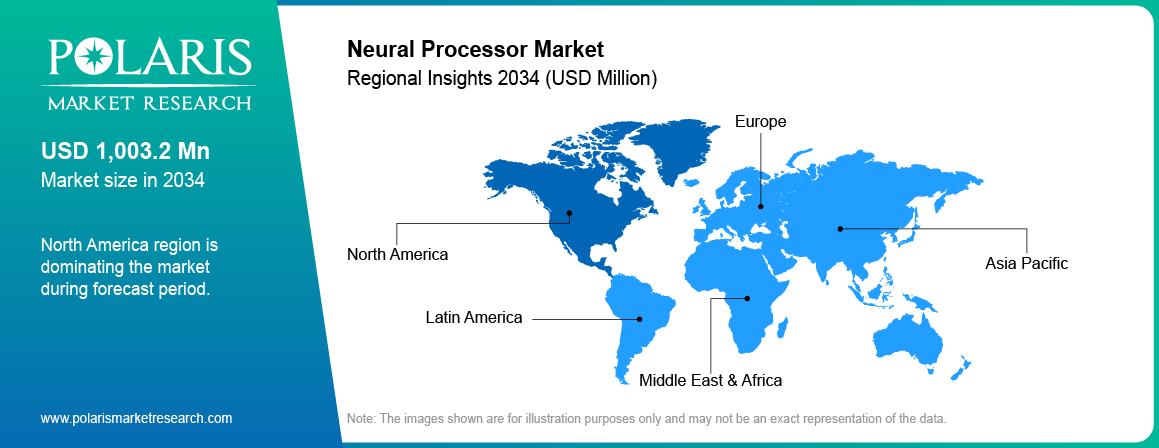
- North America accounted for 36.84% of the global neural processor market in 2025, supported by increasing AI PC adoption, major processor vendors, and growing investment in edge AI hardware.
- Asia Pacific is projected to register 23.78% CAGR during the forecast period due to high smartphone manufacturing activity and the presence of major chip makers developing integrated NPUs.
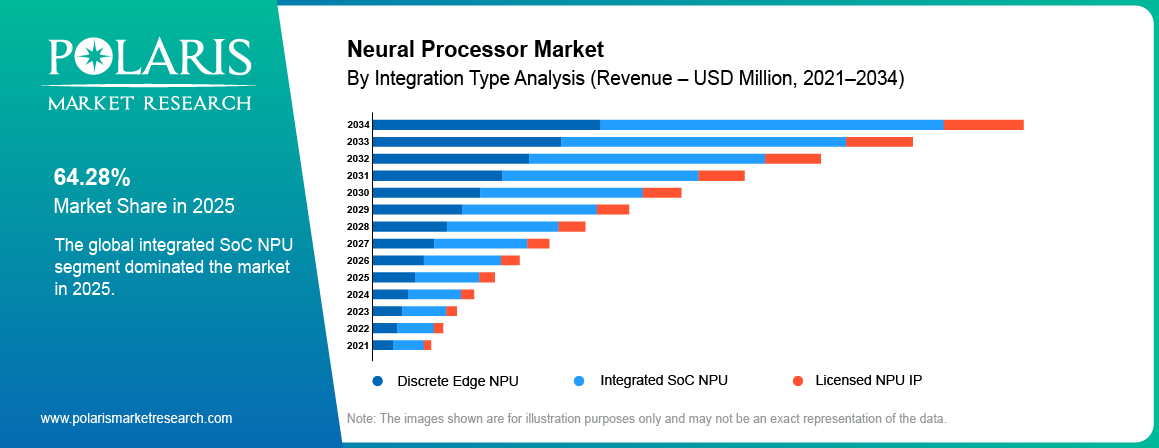
- Integrated SoC NPU share of 64.28% in 2025 as neural processing capabilities become commonplace in smartphones, PCs and other client processors.
- The 40 to 100 TOPS segment is anticipated to register a CAGR of 22.38% during the forecast period owing to the rising demand for higher performance on-device AI processing in AI PCs and edge systems.
- In 2025, Smartphones & Tablets captured 29.44% of the application segment, reflecting the widespread adoption of integrated NPUs for on-device AI workloads.
Note: Figures and projections outlined in this report are the result of Polaris Market Research’s proprietary analytical processes, grounded in the latest available datasets and market observations.
Neural Processor Market Definition
The neural processor market is a neural processing unit market sold or licensed for client and edge devices. The scope includes integrated NPU blocks inside smartphone, PC, embedded, and automotive processors, discrete NPU chips and modules used at the edge, and licensed NPU IP. Data center accelerators are outside this market boundary and are covered under separate AI inference and AI data center categories. Neuromorphic and spiking processors and the broader edge AI accelerator category are also excluded from the defined scope.
An integrated NPU is built into a larger processor and works alongside CPU and GPU resources, while a discrete NPU is supplied as a separate edge device. The market also includes NPU IP, allowing embedded device developers to license an inference engine rather than develop the accelerator architecture independently. This structure creates distinct supply models across client computing, smartphones, automotive systems, industrial equipment, robotics, and smart cameras.
An NPU differs from a GPU mainly in the workload it is designed to handle. NPUs are designed for low-power inference and efficient execution of trained neural networks. On the other hand, GPUs are general-purpose parallel processors used for graphics, training, and computationally intensive AI workloads. This distinction is particularly relevant for NPU vs GPU for AI applications where power consumption and sustained inference efficiency are concerned. Intel’s Panther Lake and Qualcomm’s Snapdragon X2 Elite are examples of the increasing NPU performance in client processors.
NPU market analysis increasingly focuses on the interaction between compute, memory, precision, and software rather than peak throughput alone. Intel's Panther Lake carries a 50 TOPS NPU, while Qualcomm's Snapdragon X2 Elite carries an 80 TOPS INT8 Hexagon NPU. Both exceed Microsoft's 40 TOPS Copilot+ requirement. At the same time, embedded and phone chip designers can use licensed NPU IP when they do not want to develop an accelerator architecture internally.
NPU vs GPU vs CPU: Key Differences
| Parameter | NPU | GPU | CPU |
| Primary role | Efficient inference of trained neural networks | Graphics, AI training, and heavy parallel compute | General-purpose control and light AI tasks |
| Power profile for AI | Lowest power per inference | High power draw at sustained load | Moderate; inefficient for large models |
| Best-suited workloads | Always-on AI, live captions, translation, image enhancement | Generative AI, rendering, model training | Operating system and application logic |
| Typical placement | Integrated in the SoC or supplied as a discrete edge chip | Integrated or discrete | Integrated in the SoC |
| Example | Intel NPU 5 (50 TOPS); Hailo-8 (26 TOPS) | Panther Lake GPU (120 TOPS) | Oryon, Zen 5, and Arm cores |
Source: Polaris Market Research Analysis.
Market Dynamics
Driver Impact Analysis
The table below summarizes how each growth factor, restraint, and opportunity is expected to shape the neural processor market over the forecast period.
| Factor | Type | Impact | Timeframe | Segments Most Affected |
| Rising AI PC adoption and the 40 TOPS Copilot+ threshold | Driver | High | Short to medium term | AI PCs & Laptops; 40 to 100 TOPS |
| On-device language models in smartphones | Driver | High | Short to medium term | Smartphones & Tablets; Integrated SoC NPU |
| Scaling and consolidation of edge NPU specialists | Opportunity | Medium to High | Medium to long term | Discrete Edge NPU; Industrial & Robotics; Smart Cameras & IoT |
| Licensed NPU IP for embedded designs | Opportunity | Medium | Medium to long term | Licensed NPU IP; Below 10 TOPS |
Source: Polaris Market Research Analysis. Impact levels reflect analyst assessment.
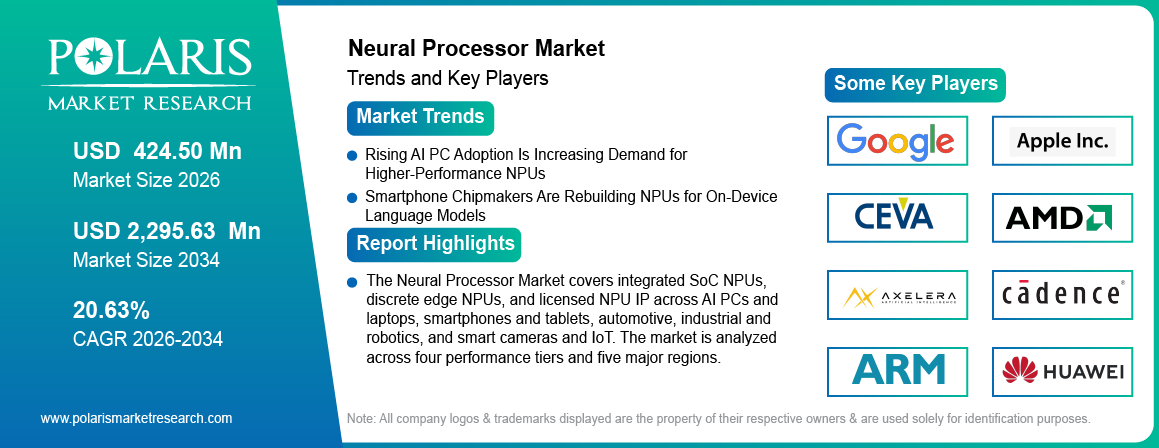
Driver: Rising AI PC Adoption Is Increasing Demand for Higher-Performance NPUs
The shift toward AI-enabled PCs is increasing demand for dedicated neural processing as local AI features increasingly depend on defined NPU performance. For instance, Microsoft's Copilot+ PC specification requires an NPU capable of at least 40 TOPS, together with 16GB of RAM and 256GB of storage. This requirement is moving NPU capability from a differentiating processor feature toward a qualification criterion for AI PCs and is encouraging processor vendors to increase throughput while maintaining integration across CPU, GPU, memory, and software (Source: microsoft.com).
The impact extends beyond processor specifications as Copilot+ functions such as Windows Recall and Live Captions translation depend on local AI processing. PC manufacturers therefore require processors that can meet the performance threshold while supporting the associated AI software environment. The closer connection between operating-system capabilities, processor qualification, and hardware selection is supporting growth in the Copilot+ PC ecosystem.
Driver: Smartphone Chipmakers Are Rebuilding NPUs for On-Device Language Models
Smartphone manufacturers are increasing NPU capabilities as more AI workloads move from cloud-based services to on-device AI processing . Dedicated neural processing supports on-device LLM workloads, imaging, digital assistants, translation, and other AI functions while operating within strict power and thermal limits. This trend is particularly relevant to premium smartphones where manufacturers are using generative AI and assistant capabilities as part of device differentiation.
Qualcomm's Snapdragon 8 Elite Gen 5 Hexagon NPU was reported as 37% faster than its predecessor, while MediaTek's Dimensity 9500 NPU 990 was described as twice as fast with 56% lower peak power than its previous generation. The emphasis on efficiency is increasing demand for processors designed to support always-on AI functions without placing excessive pressure on battery performance (Source: qualcomm.com, mediatek.com).
The mobile NPU race is therefore shifting from peak processing capability toward sustained local inference efficiency. This creates opportunities for chipmakers that combine higher NPU throughput, model support, and energy efficiency within smartphone SoCs, expanding the role of dedicated neural processing across the smartphone NPU market and tablets.
Restraint: TOPS Alone No Longer Differentiates NPU Products
Peak TOPS is becoming a less complete measure of NPU value as client processors increasingly meet or exceed the performance threshold established for Copilot+ PCs. Buyers also need to consider memory capacity, memory bandwidth, supported precision, software compatibility, and the size of models that are processed locally. These factors affect the practical inference performance and make the comparison based on the NPU throughput alone less reliable.
Intel's CES 2026 platform details show that Panther Lake has 180 total platform TOPS, with 120 TOPS coming from the GPU and 50 TOPS from the NPU. Industry analysis also highlights the importance of memory capacity and bandwidth for local language-model workloads. For buyers evaluating TOPS, the NPU therefore needs to be assessed as part of a broader AI compute platform rather than as an isolated performance measure (Source: engadget.com).
The limitation creates a challenge for NPU vendors because a higher TOPS rating does not necessarily translate into better workload performance. This shifts product evaluation toward complete AI compute architecture and lengthens qualification cycles as buyers need to test workloads, software frameworks, and memory behavior before selecting an NPU.
Opportunity: Edge NPU Specialists Are Scaling and Consolidating
The expansion of discrete edge AI is creating opportunities for NPU specialists that provide dedicated inference hardware outside mainstream PC and smartphone SoCs. Industrial equipment, robotics, retail systems, smart cameras, and other edge applications require edge inference where response time, power efficiency, or connectivity constraints make cloud processing less suitable. This is broadening the addressable neural processor market beyond large client processor vendors.
Axelera AI announced more than USD 250 million in new funding in February 2026, and shipped to its 500th customer across defense, industrial manufacturing, retail and robotics. Microchip Technology also completed its acquisition of Hailo in September 2026 and is integrating Hailo’s portfolio of edge AI processors into its embedded semiconductor business. The expansion is fueling growth in the discrete NPU solutions market for industrial and embedded applications (Source: axelera.ai, microchip.com).
The combination of specialist expansion and semiconductor consolidation is creating additional routes for NPU technology to reach edge deployments, broadening adoption of the edge AI processor and other dedicated inference hardware beyond consumer computing platforms.
Opportunity: Licensed NPU IP Lets Embedded Vendors Add AI Without Building the Accelerator From Scratch
Licensed NPU IP provides embedded semiconductor developers with an alternative route to integrate neural inference without designing a complete accelerator architecture internally. This model is relevant to developers that require control over processor integration while seeking to reduce the engineering resources associated with developing an NPU from the ground up. The approach is particularly relevant to microcontrollers, embedded processors, and application-specific devices that use an embedded NPU. NXP’s acquisition of edge NPU company Kinara, completed in October 2025, highlights the strategic importance of dedicated inference technology to embedded semiconductor portfolios. Ceva licensed its NeuPro-M NPU IP to a major US software and AI platform company in July 2026 for a custom AI silicon program (Source: nxp.com, ceva-ip.com).
The IP model broadens NPU adoption by allowing developers to incorporate dedicated inference capabilities into customized processor designs. Suppliers that combine efficient accelerator architectures with mature compilers and development tools can address a broader range of embedded AI designs and expand the addressable NPU market.
Neural Processor Market Segmentation Analysis
The neural processor market is segmented by integration type, performance tier, application, and region. These dimensions distinguish the processor architecture, computing capability, deployment environment, and geographic market landscape.
Integration Type Insights
The Integrated SoC NPU segment accounted for 64.28% of the neural processor market in 2025. This is fueled by the growing integration of specialized neural processing engines directly into the application processors of smartphones, PCs and other client devices. With integrated architectures, AI workloads can be run locally and share the memory and power resources of the system. Some examples of integrated NPU architectures are Qualcomm’s Hexagon NPU, Intel’s NPU 5 and AMD’s XDNA 2. This approach enables on-device inference for generative AI, computer vision and other workloads within the power and thermal constraints of mainstream devices.
The discrete edge NPU segment is likely to register a CAGR of 23.84% over the forecast period, due to rising demand for dedicated AI inference capabilities across industrial manufacturing, robotics, automotive, retail, and other edge environments. Discrete NPUs provide application specific acceleration without adding AI compute to the main application processor. Suppliers for edge AI applications include Axelera AI and Hailo. For example, Hailo has designed discrete accelerator products and NPU-based systems for industrial, automotive, camera and other embedded applications, supporting the proliferation of dedicated edge inference architectures. (Source: hailo.ai)
The Licensed NPU IP segment is expected to register a CAGR of 22.18% during the forecast period, owing to rising demand from embedded and application-specific device developers that prefer to license an inference engine rather than build one. Ceva completed a strategic NPU licensing agreement with a leading PC OEM in the fourth quarter of 2025, with NeuPro NPUs selected as foundational IP for next-generation on-device AI compute architecture (Source: barchart.com).
Performance Tier Insights
The Below 10 TOPS segment accounted for 19.34% of the neural processor market in 2025, supported by demand for always-on AI in microcontrollers, wearables, smart sensors, and low-cost consumer devices. NPUs in this tier prioritize power efficiency and silicon area over peak throughput. For instance, Arm’s Ethos-U85 scales from 128 to 2,048 MAC units, delivering up to 4 TOPS at 1 GHz, and supports transformer-based models at the edge (Source: arm.com, computerweekly.com).
The 10 to 40 TOPS segment accounted for 27.82% of the neural processor market in 2025, fueled by its usability in smartphones, mainstream laptops, and other client devices demanding dedicated on-device AI compute. Processors within this range provide sufficient acceleration for a broad set of AI-enabled features without targeting the highest-performance workloads. The segment also covers devices positioned below or around the 40 TOPS threshold used for Copilot+ PC qualification. Growing adoption of AI-enabled consumer electronics is therefore supporting demand for NPUs that balance AI processing capability with power efficiency, thermal requirements, and device cost.
The 40 to 100 TOPS segment is projected to register a CAGR of 22.38% during the forecast period. The growth is driven by the rising demand for higher-performance NPUs for AI PCs and other next-generation client platforms. Qualcomm’s Snapdragon X2 Elite delivers 80 to 85 INT8 TOPS of NPU performance, while AMD’s Ryzen AI 400 family offers up to 60 TOPS in its mobile processors. The processors target demanding workloads such as generative AI, multimodal applications and local AI inference. The segment is also propelled by the increasing significance of higher NPU performance for premium AI-enabled computing platforms and emerging on-device AI workloads (Source: qualcomm.com, amd.com).
The Above 100 TOPS segment is projected to register a CAGR of 27.16% during the forecast period, driven by demand for local generative AI and multimodal workloads in automotive systems, robotics, and edge servers. Axelera AI’s Europa, rated at 629 TOPS (INT8), began PCIe accelerator shipments in the first half of 2026 , bringing workloads that were previously cloud-only to the edge (Source: bits-chips.com).
Application Insights
The Smartphones & Tablets segment contributed 29.44% of the neural processor market in 2025 owing to the continuous integration of dedicated NPUs into mobile application processors. Smartphone OEMs are turning to local AI processing for generative AI features, image enhancement, language processing, personalization and other compute workloads. Latest mobile processor platforms like Qualcomm’s Snapdragon 8 Elite Gen 5 and MediaTek’s Dimensity 9500 showcase the ongoing evolution of AI engines with stronger capabilities in smartphone chipsets. By adding neural processing capabilities into mobile SoCs, manufacturers can deliver AI functionality without relying heavily on cloud processing and while maintaining device-level power efficiency.
The AI PCs & Laptops segment is expected to grow at an 21.64% CAGR during the forecast period due to growing integration of dedicated NPUs in client processors and increasing demand for local AI capabilities. Qualcomm, Intel, and AMD are among the on-device AI processor suppliers developing NPU-equipped platforms for this market. Intel and AMD continue to expand NPU capabilities across their latest client processor families.
The Automotive segment is anticipated to register a CAGR of 24.76% over the forecast period, owing to rising use of NPUs for driver assistance, in-cabin intelligence, and sensor processing within strict safety and thermal limits. Suppliers are expanding discrete NPU portfolios for the segment, as seen in NXP’s USD 307 million acquisition of Kinara, which adds discrete NPUs for automotive and industrial edge systems (Source: investing.com).
The Industrial & Robotics segment is expected to expand at a CAGR of 23.88% during the forecast period, supported by demand for machine vision, quality inspection, and autonomous robots that need low-latency inference at the edge. Microchip Technology expects its Hailo acquisition to expand its edge AI offering for robotics, advanced vision processing, drones, smart cameras, and industrial automation (Source: audioxpress.com).
The Smart Cameras & IoT segment is projected to grow at a CAGR of 19.46% over the forecast period, as camera makers and connected-device OEMs move video analytics, voice, and sensing workloads onto the device to cut latency and bandwidth use. Ceva’s NeuPro-Nano is designed for this class of device, spanning smart sensors, wearables, consumer electronics, industrial IoT systems, and smart home products (Source: design-reuse-embedded.com).
Regional Analysis
The neural processor market spans North America, Europe, Asia Pacific, the Middle East & Africa, and Latin America, with regional activity shaped by processor design centers, semiconductor manufacturing, smartphone and PC ecosystems, edge AI development, and access to investment.
North America Neural Processor Market Trends
In 2025, North America accounted for 36.84% of the global neural processor market, propelled by leading processor vendors, the rise of AI PCs, semiconductor design capabilities, and established software ecosystems. The US has Qualcomm, Intel, AMD, and Apple, all working on client and mobile processors. Intel states that Panther Lake is its first AI PC NPU platform built on Intel 18A and designed and manufactured in the United States (Source: intel.com).
Continued AI PC development is further supporting demand for higher-performance integrated NPUs across North America. In June 2026, Microsoft and NVIDIA announced a new PC platform for AI, called RTX Spark, that runs AI agents and large language models on Windows PCs locally. The launch helps move to AI-native PCs by providing dedicated compute capabilities for on-device AI processor workloads (Source: nvidia.com).
Europe Neural Processor Market Trends
Europe held a 20.18% share of the global neural processor market in 2025, driven by semiconductor research, the growth of industrial AI and a rising ecosystem of specialized edge AI companies. In March 2025, Eindhoven-based Axelera AI received a grant of EUR 61.6 million (about USD 71.5 million) from EuroHPC for its Titania inference chiplet. The company has since unveiled Europa, an edge AI processing unit rated at 629 TOPS (INT8), reflecting the commercial maturity of specialized edge hardware. Arm in the UK and NXP in the Netherlands also anchor the region's embedded NPU IP and edge silicon supply (Source: datacenterdynamics.com).
Asia Pacific Neural Processor Market Trends
Asia Pacific is projected to grow at 23.78% CAGR during the forecast period, fueled by its established smartphone semiconductor, electronics manufacturing, and device integration ecosystem. Major players in the region for mobile device processor development are Taiwan’s MediaTek and South Korea’s Samsung Electronics. Samsung Electronics' Exynos 2600, announced in December 2025 on its 2nm GAA process, carries an NPU that Samsung says delivers 113% higher AI performance than its predecessor. In August 2026, Samsung also showed zHBM, a concept that stacks high-bandwidth memory above AI accelerators. It targets data-center accelerators and has no production timeline, but it underlines the memory-bandwidth focus now shaping NPU design (Source: gsmarena.com, koreaherald.com).
China, Taiwan, South Korea and other Asian markets provide inputs for semiconductor design, manufacturing, component supply and electronics assembly. The regional NPU activity is closely connected to smartphone shipments and the integration of ever more capable AI engines into mobile processors. MediaTek and Samsung are also continuing to develop on-device AI functions across smartphones, tablets and other connected products, supporting the NPU industry forecast. Huawei's Kirin 9050 Pro, launched in September 2026, includes a Da Vinci NPU that runs a 30-billion-parameter mixture-of-experts model on the device (Source: techradar.com).
Middle East & Africa Neural Processor Market Trends
The Middle East & Africa contributed 4.80% to the global neural processor market in 2025. The region was led by dedicated edge AI semiconductor development. Founded in Tel Aviv and now part of Microchip Technology after its September 2026 acquisition, Hailo offers a proven link between the region and the global discrete NPU ecosystem. Its Hailo-8 processor delivered 26 TOPS and was designed for edge AI applications requiring local inference. The development illustrates the region’s participation in specialized neural processing, particularly for edge computing and embedded AI applications.
Regional NPU activity is particularly relevant to applications requiring AI processing close to cameras, machines, sensors, and connected equipment. Edge inference can support local processing where latency and connectivity requirements make centralized computing less suitable. The Hailo example also links regional edge AI development with the broader global semiconductor ecosystem.
Latin America Neural Processor Market Trends
Latin America accounted for 3.56% of the global neural processor market in 2025, with regional demand connected primarily to the adoption of AI-enabled consumer electronics, computing devices, embedded systems, and connected products. The market is influenced by the availability of processors incorporating dedicated neural engines from global semiconductor suppliers, which enables local device manufacturers and OEMs to integrate AI functionality without developing NPU architectures independently. Smartphones, AI PCs, smart devices, and other connected products therefore represent important channels through which neural processing capabilities can reach the region. The expansion of AI-enabled hardware is expected to support broader awareness and adoption of local inference technologies.
Neural Processor Market Competitive Landscape
The neural processor market includes PC and smartphone processor vendors, discrete edge NPU specialists, and suppliers of licensed NPU IP. Competition is shaped by NPU throughput, power efficiency, supported precision, memory access, software compatibility, processor integration, and the ability to address specific client and edge workloads. Qualcomm, Intel, AMD, Apple, MediaTek, Samsung Electronics, Microchip Technology through Hailo, NXP Semiconductors, Huawei, Arm, Ceva, and Axelera AI are among the leading vendors covered in this report.
Vendor Landscape Snapshot
| Company | Headquarters | Market Positioning | Core NPU Offering | Primary Focus |
| Qualcomm | United States | Leader | Hexagon NPU, 80 to 85 TOPS (Snapdragon X2 Elite) | Smartphones, AI PCs |
| Apple | United States | Leader | Neural Engine, Dual 16-core (A20 Pro) | iPhone, Mac, iPad |
| Intel | United States | Leader | NPU 5, 50 TOPS (Panther Lake) | AI PCs |
| MediaTek | Taiwan | Leader | NPU 990 (Dimensity 9500) | Smartphones |
| AMD | United States | Challenger | XDNA 2, up to 60 TOPS (Ryzen AI 400) | AI PCs, embedded |
| Samsung Electronics | South Korea | Challenger | Exynos 2600 NPU (2nm GAA) | Smartphones |
| Huawei | China | Challenger | Da Vinci NPU (Kirin 9050 Pro) | Smartphones (China) |
| Arm | United Kingdom | Challenger | Ethos-U85 NPU IP, up to 4 TOPS | Licensed NPU IP |
| NXP Semiconductors | Netherlands | Challenger | Discrete NPUs via Kinara (Ara series) | Industrial, automotive edge |
| NVIDIA | United States | Emerging Player | AI PCs | |
| Microchip Technology (Hailo) | United States / Israel | Emerging Player | Hailo-8, Hailo-10, Hailo-15 | Robotics, cameras, industrial |
| Axelera AI | Netherlands | Emerging Player | Metis and Europa AIPUs, up to 629 TOPS | Edge inference |
| Ceva | United States / Israel | Niche Specialist | NeuPro-M and NeuPro-Nano NPU IP | Licensed NPU IP |
Qualcomm, Intel, and AMD form the core of the PC NPU competitive set. Qualcomm's Snapdragon X2 Elite carries an 80 TOPS Hexagon NPU, Intel's Panther Lake carries a 50 TOPS NPU, and AMD's Ryzen AI 400 family is rated at up to 60 TOPS in its mobile processors. These products show how the client NPU market is increasingly defined by explicit performance specifications and integration into broader processor platforms.
Axelera AI stands out among edge specialists with its Europa chip rated at 629 TOPS (INT8) and a customer base across defense, industrial manufacturing, retail and robotics. Microchip Technology's completed Hailo acquisition, together with NXP's Kinara deal, adds edge specialists to larger embedded semiconductor portfolios and is consolidating NPU market share among diversified suppliers.
Neural Processor Market Technology and Innovation Landscape
TOPS (trillions of operations per second) remain the common NPU throughput metric, typically quoted in INT8. Qualcomm's Hexagon NPU uses a 64-bit architecture with increased memory access for larger models, while Intel's Panther Lake pairs a 50 TOPS NPU with substantial GPU compute, reinforcing that NPU performance must be read as part of a combined CPU/GPU/NPU/memory architecture rather than in isolation. Memory bandwidth and supported model size are becoming more important technology differentiators than peak TOPS alone (Source: qualcomm.com).
Technology and Innovation Landscape Snapshot
| Technology Area | Current State | Representative Development | Implication |
| Process node | Client and mobile NPUs moving to 2nm-class nodes | Apple A20 Pro, Exynos 2600 and Snapdragon 8 Elite Gen 6 on 2nm; Intel Panther Lake on Intel 18A | Foundry access sets product cadence |
| Numerical precision | INT8 remains the baseline; lower-precision formats such as INT4 and FP4 are spreading | Hexagon NPU spans INT2 to FP16 precision; NVIDIA RTX Spark supports FP4 | Software stacks must follow lower precision |
| Memory architecture | Capacity and bandwidth gate on-device LLMs | Hexagon NPU 64-bit architecture; Snapdragon X2 Elite up to 228 GB/s | Memory design differentiates beyond TOPS |
| Heterogeneous compute | NPU is one engine within a CPU, GPU and NPU platform | Panther Lake: 180 platform TOPS, of which 50 from the NPU | NPU complements, not replaces, the GPU |
| Discrete edge NPUs | Higher TOPS within tight power envelopes | Axelera Europa at 629 TOPS (INT8); Hailo-8 at 26 TOPS | Consolidation among specialists |
| Licensed NPU IP | Scalable NPU blocks for MCUs and SoCs | Arm Ethos-U85 (128 to 2,048 MACs); Ceva NeuPro-M and NeuPro-Nano | Compiler maturity decides adoption |
| Software ecosystem | OS and framework-level NPU access | Windows ML for NPU access; AMD ROCm 7.2 for Ryzen AI 400 | Tooling drives developer pull |
Source: Polaris Market Research Analysis.
Use Case Analysis
Four application vignettes illustrate NPU deployment across device classes:
- AI PCs and Laptops: Copilot+ features (Windows Recall, Live Captions translation) require an NPU at or above 40 TOPS, directly linking software certification to processor specification.
- Smartphones and Tablets: MediaTek's Dimensity 9500 boasts 2x NPU speed with 56% less peak power than its predecessor, signaling the efficiency focus of always-on mobile AI.
- Industrial and Robotics: Hailo accelerators and vision processors, now part of Microchip Technology, serve robotics, drones, smart cameras and industrial automation.
- Automotive: NXP completed its USD 307 million acquisition of Kinara in October 2025 to add discrete NPUs for automotive and industrial edge systems.
Neural Processor Market Value Chain Analysis
The NPU value chain runs from IP and design through fabrication and packaging to device integration, and most value capture sits with vendors that own the processor platform and its software stack.
| Stage | Role | Representative Participants | Key Dynamic |
| NPU IP and tools | Licensed NPU architectures, compilers, and SDKs | Arm, Ceva, Cadence | Licensing and royalty models; toolchain maturity |
| Processor design | Integrated SoC NPUs and discrete edge NPUs | Qualcomm, Intel, AMD, Apple, MediaTek, Samsung, Huawei, NVIDIA, Axelera AI, Hailo | Platform ownership and software support |
| Fabrication and packaging | Wafer fabrication, packaging, and test | Intel Foundry, Samsung Foundry, TSMC | Advanced-node access sets launch timing |
| Memory | LPDDR and high-bandwidth memory supply | Memory suppliers | Bandwidth and capacity gate on-device LLMs |
| OEM and ODM integration | Device design, certification, and assembly | Acer, ASUS, Dell, HP, Lenovo, Microsoft, smartphone OEMs | Copilot+ certification at 40+ TOPS |
| Software and OS | Runtime, frameworks, and AI features | Microsoft Windows, AMD ROCm, vendor SDKs | Developer tooling drives adoption |
Source: Polaris Market Research Analysis.
Neural Processor Market Premium Insights and Forward Outlook
NPUs and GPUs are complementary rather than substitutive: Intel's Panther Lake draws 120 of 180 platform TOPS from the GPU versus 50 from the NPU, so the NPU is best evaluated as part of a combined CPU/GPU/NPU/memory architecture that strengthens the always-on AI layer rather than replacing the GPU. As client NPUs increasingly clear the 40 TOPS floor, competition is shifting toward memory bandwidth, supported model size, and software optimization. Qualcomm's move to 64-bit NPU addressing and large memory support illustrates this shift toward on-device LLM capacity.
Key Players in the Neural Processor Market
- Advanced Micro Devices, Inc. (AMD)
- Apple Inc.
- Arm Holdings plc
- Axelera AI
- Cadence Design Systems, Inc.
- CEVA, Inc.
- Google LLC
- Huawei Technologies Co., Ltd.
- Intel Corporation
- MediaTek Inc.
- Microchip Technology Incorporated (including Hailo Technologies Ltd.)
- NVIDIA Corporation
- NXP Semiconductors N.V.
- Qualcomm Incorporated
- Renesas Electronics Corporation
- Samsung Electronics Co., Ltd.
- STMicroelectronics N.V.
- Synaptics Incorporated
Industry Developments
- October 2026: Microsoft and NVIDIA launched the first RTX Spark-based Windows PCs, including Microsoft's Surface Laptop Ultra, and opened preorders at a San Francisco event. (Source: HotHardware)
- October 2026: Huawei launched the Mate 90 series in China, with the Kirin 9050 Pro debuting in the Pro Max and higher models; the chip’s Da Vinci NPU is claimed to deliver a 140% AI performance gain and can run a 30-billion-parameter mixture-of-experts model on the device. (Source: BigGo Finance)
- September 2026: Apple has announced the iPhone 18 Pro and iPhone 18 Pro Max with the A20 Pro featuring a Dual 16-core Neural Engine and Neural Accelerators for better on-device AI processing. (Source: Apple)
- September 2026: Qualcomm announced the Snapdragon 8 Elite Gen 6 and 8 Elite Extreme Gen 6 at Snapdragon Summit 2026, with a reengineered Hexagon NPU that adds an Element Accelerator for transformer workloads and, on the standard Gen 6, a 14% NPU performance gain over the Gen 5. (Source: 9to5Google)
- September 2026: Microchip Technology completed its acquisition of Hailo on September 21, adding Hailo's edge AI accelerators, vision processors, and robotics processors to its embedded portfolio. (Source: Jon Peddie Research)
- July 2026: Ceva licensed its NeuPro-M NPU IP to a major US software and AI platform company for a custom AI silicon program. (Source: StockTitan)
- February 2026: Axelera AI raised more than USD 250 million in a round led by Innovation Industries and shipped to its 500th customer, with the funds earmarked to scale production of its Europa edge AI chip. (Source: Business Wire)
- January 2026: Intel launched the Core Ultra Series 3 (Panther Lake) processors at CES 2026, built on Intel 18A with an NPU rated at 50 TOPS. (Source: PCWorld)
- January 2026: AMD introduced the Ryzen AI 400 and Ryzen AI PRO 400 Series with a 60 TOPS XDNA 2 NPU for Copilot+ PCs. (Source: ElectronicSpecifier)
- October 2025: NXP completed its USD 307 million acquisition of Kinara, adding discrete NPUs for industrial and automotive edge AI. (Source: S&P Global AutoTechInsight)
Neural Processor Market Report Segmentation
By Integration Type Outlook (Revenue, USD Million, 2021–2034)
- Integrated SoC NPU
- Discrete Edge NPU
- Licensed NPU IP
By Performance Tier Outlook (Revenue, USD Million, 2021–2034)
- Below 10 TOPS
- 10 to 40 TOPS
- 40 to 100 TOPS
- Above 100 TOPS
By Application Outlook (Revenue, USD Million, 2021–2034)
- AI PCs & Laptops
- Smartphones & Tablets
- Automotive
- Industrial & Robotics
- Smart Cameras & IoT
By Region Outlook (Revenue, USD Million, 2021–2034)
- North America
- US
- Canada
- Europe
- Germany
- France
- UK
- Italy
- Spain
- Netherlands
- Rest of Europe
- Asia Pacific
- China
- Japan
- India
- South Korea
- Taiwan
- Australia
- Rest of Asia Pacific
- Latin America
- Brazil
- Mexico
- Argentina
- Rest of Latin America
- Middle East & Africa
- Saudi Arabia
- UAE
- South Africa
- Rest of Middle East & Africa
Neural Processor Market Report Scope
| Report Attributes | Details |
| Market Size in 2025 | USD 344.13 Million |
| Market Size in 2026 | USD 424.50 Million |
| Revenue Forecast by 2034 | USD 2,295.63 Million |
| CAGR | 20.63% from 2026-2034 |
| Base Year | 2025 |
| Historical Data | 2021–2024 |
| Forecast Period | 2026–2034 |
| Quantitative Units | Revenue in USD Million and CAGR |
| Report Coverage | Revenue Forecast, Growth Factors, Competitive Landscape, Industry Trends, and Strategic Analysis |
| Segments Covered | By Integration Type, Performance Tier, Application, and Region |
| Regional Scope | North America, Europe, Asia Pacific, Latin America, Middle East & Africa |
| Competitive Landscape | Company Profiling, Product Benchmarking, Market Developments, and Strategic Initiatives |
| Report Format | PDF + Excel |
| Customization | Available by Country, Region, and Segment |
Source: Polaris Market Research Analysis
Why Choose Polaris Market Research
Polaris Market Research & Consulting, Inc. applies a defined market boundary for neural processors that separates client and edge NPU hardware from data center accelerators, neuromorphic processors, and the broader edge AI accelerator category. The analysis covers integrated SoC NPUs, discrete edge NPUs, and licensed NPU IP across smartphones, PCs, embedded systems, and other in-scope devices.
The NPU market research framework evaluates the NPU market share by integration type, performance tier, application, and region. Competitive assessment covers processor vendors and specialist edge NPU companies, while company validation helps confirm market participants. Developments such as Microchip Technology's Hailo acquisition and Axelera AI's expansion are incorporated where supported by company-published evidence.
A further focus is specification normalization. TOPS values are treated as vendor-reported specifications rather than independently measured performance, while NPU positioning is assessed alongside integration, application, power efficiency, and intended workload. This approach helps distinguish peak throughput from broader product capability when comparing neural processor platforms.
Research Methodology
Neural processor market research begins with a defined scope covering NPUs sold or licensed for client and edge devices, including integrated NPU blocks, discrete edge NPU chips and modules, and licensed NPU IP. The analysis excludes data center training and inference accelerators, neuromorphic and spiking processors, and the broader edge AI accelerator category. Secondary research draws on NPU market data sources such as vendor launches, product briefs, trade coverage, company disclosures, and relevant competitive evidence.
Company-source validation focuses on selected company releases and product materials, including Qualcomm product information and Axelera AI disclosures. Research for this NPU market report evaluates processor specifications, throughput, integration approach, application positioning, competitive activity, and regional presence. Competitive benchmarking is then used to compare segmentation structures and key-player coverage before the findings are reconciled against the Polaris internal model.
The analysis treats TOPS as a reported specification rather than an independent performance measurement. This distinction is important because peak NPU throughput does not by itself determine real-world AI performance. Senior analysts review source quality, market boundaries, segmentation consistency, company evidence, technical specifications, and forecast assumptions before finalizing the market analysis.
Five-Phase Research Methodology
| Phase | Activity | Output |
| 1. Scope Definition | Define the client and edge NPU boundary; exclude data center, neuromorphic, and edge AI accelerator categories | Market boundary |
| 2. Secondary Research | Review vendor launches, product briefs, trade coverage, and company disclosures | Source log |
| 3. Company-Source Validation | Validate product specifications and company developments against company releases | Evidence validation |
| 4. Competitive Benchmarking & Reconciliation | Benchmark segmentation and key players; reconcile with the Polaris internal model | Polaris internal model |
| 5. Quality and Sourcing Review | Review citations, vendor-reported specifications, scope, and segmentation | Final report and forecast |
Source: Polaris Market Research Analysis
Forecast construction applies the validated market structure across integration type, performance tier, application, and region. Vendor-reported TOPS figures are retained as technical specifications rather than independently measured performance results. The final analysis is reconciled with the Polaris internal model after competitive and source reviews, while claims not supported by company or primary sources are excluded.
Neural Processor Market FAQ's
The global neural processor market was valued at USD 344.13 million in 2025 and is projected to reach USD 2,295.63 million by 2034, growing at a CAGR of 20.63% during the forecast period 2026–2034.
North America led the market in 2025, supported by AI PC adoption, major processor vendors such as Qualcomm, Intel, AMD, and Apple, and strong semiconductor design capability. Asia Pacific remains central to smartphone NPU development, led by MediaTek and Samsung Electronics.
The Integrated SoC NPU segment led the market in 2025, as NPUs are now built into smartphone, PC, and other client processors. Discrete edge NPUs and licensed NPU IP are the other two integration types.
An NPU, or neural processing unit, is a processor designed to run trained AI models efficiently at low power. It sits alongside the CPU and GPU in modern chips and handles on-device AI inference.
An NPU runs on-device AI features such as live captions, translation, background blur, image enhancement, and local AI assistants without draining the battery or loading the CPU and GPU.
A CPU handles general-purpose tasks, a GPU handles graphics and heavy parallel AI workloads including training, and an NPU is built for low-power neural network inference. They are complementary: Intel's Panther Lake draws 120 of its 180 platform TOPS from the GPU and 50 from the NPU.
Most users do not strictly need one, but an NPU is increasingly worth having for video calls, live captions, local AI assistants, and longer battery life under AI workloads. It is also required for Copilot+ PC features.
Generally no. Client NPUs are integrated into the processor, so a new device is needed. Discrete NPUs exist as separate chips and modules, but they are aimed at industrial and embedded edge systems.
Microsoft requires an NPU capable of at least 40 TOPS, along with 16GB of RAM and 256GB of storage, for a PC to qualify as a Copilot+ PC.
TOPS stands for trillions of operations per second and measures peak throughput, typically quoted in INT8. As most client processors now clear the 40 TOPS threshold, buyers also weigh memory bandwidth, supported precision, software compatibility, and sustained efficiency.
The main types are integrated SoC NPUs built into processors, discrete edge NPUs supplied as separate chips or modules, and licensed NPU IP that developers embed in their own silicon.
Key players include Qualcomm Incorporated, Intel Corporation, Advanced Micro Devices, Inc., Apple Inc., MediaTek Inc., Samsung Electronics Co., Ltd., Huawei Technologies Co., Ltd., NVIDIA Corporation, Arm Holdings plc, CEVA, Inc., NXP Semiconductors N.V., Microchip Technology Incorporated (including Hailo), Axelera AI, Cadence Design Systems, Inc., Google LLC, Renesas Electronics Corporation, STMicroelectronics N.V., and Synaptics Incorporated.
Copilot+ PC pricing varies widely by configuration. Dell lists the XPS 13 from USD 699.99 and the XPS 16 from USD 2,399.99, while retailer guides place entry-level models from roughly USD 600 and professional machines above USD 1,000. Prices vary by region, configuration, and promotion.
Recent developments include Microchip Technology's completion of the Hailo acquisition in September 2026, Axelera AI's funding round of more than USD 250 million in February 2026, the January 2026 launches of Intel's Panther Lake and AMD's Ryzen AI 400, and the September 2026 launches of Apple's A20 Pro and Qualcomm's Snapdragon 8 Elite Gen 6.
Growth is driven by rising AI PC adoption under the Copilot+ 40 TOPS threshold and by smartphone chipmakers rebuilding NPUs for on-device language models. Edge NPU specialists and licensed NPU IP add further momentum.
Download Sample Report of Neural Processor Market
Please fill out the form to request a customized copy of the research report.


