
Semiconductor Memory Market Size, Share, Trends and Forecast, 2026–2034
REPORT DETAILS
Semiconductor Memory Market Summary
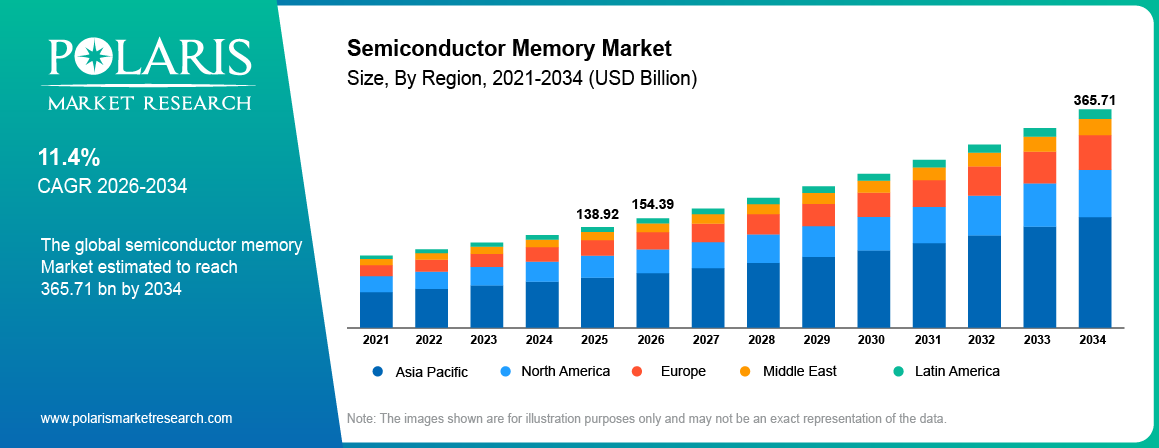
The global semiconductor memory market size was valued at USD 138.92 billion in 2025 and is expected to exhibit a CAGR of 11.4% from 2026 to 2034. The market is witnessing growth due to rising AI adoption and expanding data centers. Increasing demand for high-performance memory in smartphones, automotive systems, and consumer electronics also drives market expansion.
Market Statistics
Key Takeaways
- Asia Pacific held the largest share at 43.07% in the semiconductor memory market in 2025. The dominance is attributed to excellent capabilities of semiconductor production in the region and high demand for memory chips.
- The market in North America is expected to register the highest CAGR of 12.2% during the forecast period, backed by investments in AI infrastructure, data centers, and HBM demand.
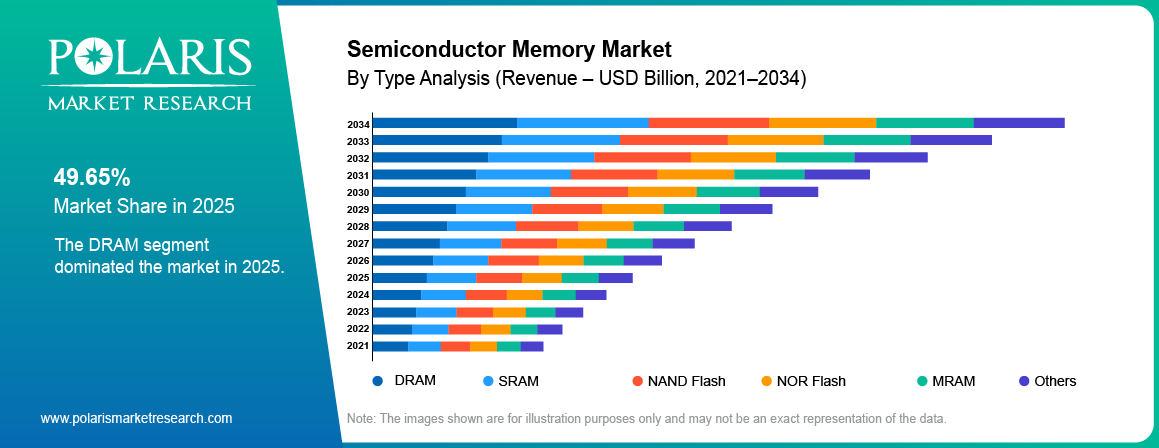
- DRAM held an estimated 49.65% market share in 2025, due to demand for memory in AI servers, PCs, smartphones, and high-performance computers.
- The consumer electronics segment held a 33.65% share in 2025 due to the increasing consumption of smartphones, computers, and other interconnected devices.
- The data centers and cloud segment is expected to experience the highest CAGR of 14.6% during 2026–2034, owing to rising adoption of AI and cloud computing.
Note: Figures and projections outlined in this report are the result of Polaris Market Research’s proprietary analytical processes, grounded in the latest available datasets and market observations.
What is Semiconductor Memory?
Semiconductor memory is an electronic storage technology that stores data and instructions in the integrated circuit for computing, communication, automotive, and consumer electronic devices. The rising adoption of Artificial Intelligence (AI), cloud computing, data centers, and high-performance computing is shaping semiconductor memory market size, share and forecast till 2034.
Semiconductor memory is a kind of electronic memory that reserves digital data by utilizing semiconductor materials, usually silicon. Data is deposited in binary format in this memory, with 1s and 0s, constituting electrical charges. There are two types of memory, namely random access memory (RAM) and read-only memory (ROM). RAM allows data to be accessed on demand, making it suitable for temporary storage. ROM stores data that is permanently stored and cannot be altered during normal operation. It is used for storing firmware and other fundamental information.
The advantages of semiconductor memory include high speed, which enables rapid data retrieval and efficient operations. Applications such as gaming, real-time video, and online transactions all rely on this. Other benefits include lower power consumption. Compared to other kinds of memory such as magnetic storage, semiconductor memory is extremely energy efficient. It is vital for laptops and other mobile devices as it prolongs battery life. Therefore, the semiconductor memory market sales are soaring.
The semiconductor memory market research report offers an in-depth analysis of the industry to support informed decision-making. It offers a meticulous breakdown of various market niches and keeps readers updated on the latest industry developments. Along with tracking the semiconductor memory market on the basis of SWOT and Porter’s Five Forces models, the research report includes graphs, tables, charts, and other pictorial representations to help readers understand the key insights and important data easily.
HBM and AI Memory: How AI Is Reshaping Demand
Artificial intelligence is reshaping demand across the semiconductor memory industry. Processors for AI training and inference need to access large datasets, model parameters, and intermediate calculations at high speed. This is driving demand for HBM, server DRAM, and high-capacity enterprise SSDs. As memory for AI servers grows, memory requirements per system are also increasing, putting pressure on manufacturers to increase production and performance.
Three factors are shaping AI memory demand:
- Adoption of HBM: AI accelerators require large memory bandwidth in order to exchange data between the processor and the memory efficiently.
- Increased DRAM requirements on servers: AI requires system memory to prepare, organize, cache, and perform CPU-related tasks.
- Rising storage needs: Training data, checkpoints, and inference data result in increased needs for enterprise SSDs and NAND flash memory.
Thus, the high bandwidth memory market is tied to a wider expansion of AI infrastructure. HBM attracts investment for its performance and advanced packaging needs, but manufacturers also need to meet the demand for traditional DRAM and NAND. This creates competition for wafer capacity, manufacturing equipment, packaging resources, and engineering talent. The impact to the memory chip market goes beyond just AI accelerators to cloud platforms, enterprise servers, and storage systems.
What Is HBM (High-Bandwidth Memory)?
High Bandwidth Memory (HBM) is a DRAM technology. It stacks memory dies in a vertical manner interconnecting them with through-silicon vias (TSVs). Its wide interface enables high data rates in a small package. HBM is located close to the AI accelerators or GPUs in advanced packaging, reducing the distance that data needs to travel between the memory and processing unit.
TSV stacking and accelerator co-packaging
TSVs provide vertical electrical connections through stacked memory dies. This configuration allows HBM to use a much wider interface than normal DRAM packages. In advanced packaging, the HBM stack is integrated with a processor, typically using an interposer or other high density package structure. This configuration delivers the bandwidth and energy efficiency required for AI training and inference.
HBM production is more complex than conventional DRAM production. Manufacturers must coordinate memory-die fabrication, stacking, bonding, testing, thermal management, and packaging yields. These constraints affect cost and usable output. So, expanding HBM capacity is a function of how many memory dies can be produced, how many wafers are available, and how much advanced packaging capacity there is.
HBM3E to HBM4: The 2026 Generation Shift
The high-bandwidth memory market is evolving as the transition from HBM3E to HBM4 arrives as AI accelerators require more bandwidth and memory capacity. HBM3E provides about 1.2 TB/s per stack. HBM4 has a 2,048-bit interface and a bandwidth of approximately 2.0-3.3 TB/s per stack. HBM4 also allows for taller stacks and customer-specific base dies to achieve even tighter integration with next-gen chiplet-based AI processors.
The shift is being driven by the higher memory needs of AI, and the desire to remove bottlenecks in data transfer during AI training and inference. HBM3E is still relevant for platforms like the NVIDIA H200 and Blackwell, while HBM4 is for next-generation platforms like the NVIDIA Rubin. Adoption will depend on production yields, packaging capacity, power efficiency, and customer qualification.
HBM Generations
| Generation | Interface width | Pin speed | Bandwidth / stack | Stack height | Representative platforms |
| HBM2E | 1,024-bit | ≈3.6 Gbps | ≈460 GB/s | 4–8-Hi | NVIDIA A100 |
| HBM3 | 1,024-bit | ≈6.4 Gbps | ≈819 GB/s | 8–12-Hi | NVIDIA H100 |
| HBM3E | 1,024-bit | ≈9.2–9.8 Gbps | ≈1.2 TB/s | 8–12-Hi | NVIDIA H200, Blackwell |
| HBM4 | 2,048-bit | 8–11.7 Gbps | ≈2.0–3.3 TB/s | 12–16-Hi | NVIDIA Rubin; custom base die per customer |
Source: Polaris Market Research Analysis
Beyond HBM: DDR5, LPDDR5X, Enterprise SSD and CXL in AI Racks
The attention on HBM is huge because of AI infrastructure, but traditional memory and storage technologies are also needed by artificial intelligence systems. DDR5 is the system memory for server CPUs, LPDDR5X is for power-efficient computing platforms. Enterprise SSDs are used for storing datasets and model checkpoints, and in compatible systems, Compute Express Link (CXL) is used for memory expansion and pooling.
AI workloads increase demand for these technologies through several pathways:
- DDR5: Supports CPU workloads, data processing, orchestration, and general-purpose server operations.
- LPDDR5X: Offers power-efficient memory for selected edge AI and mobile computing platforms.
- Enterprise SSD: Stores training data, model checkpoints, retrieval databases, and inference datasets. High-capacity drives help meet the storage needs of AI data centers.
- CXL memory: Enables compatible systems to expand or pool memory beyond directly attached DRAM, subject to platform architecture and latency requirements.
- 3D NAND: Increases storage density through vertically stacked memory cells, supporting enterprise SSD capacity growth.
AI infrastructure therefore creates demand for a memory hierarchy, not a single product category. HBM is a high-bandwidth memory, next to accelerators. DDR5 is for CPU workloads. NAND flash is persistent storage. CXL can extend the memory hierarchy in supported configurations. This broader demand also influences the semiconductor memory market share of conventional DRAM and NAND suppliers.
Memory Pricing Cycle: From the 2023 Downturn to the 2026 Shortage
The semiconductor memory market has shifted sharply from the 2022–2023 downturn to the 2026 supply crunch. The earlier slowdown resulted from reduced post-pandemic demand and excess inventories, which led suppliers to cut wafer starts. Demand bounced back in 2024. But another correction was in the cards in late 2024 and early 2025 as DRAM and NAND supply outpaced demand in some sectors.
PC shipments beat expectations. Manufacturers focused on memory for AI Tightening the market late in 2025. That shift led to a more traditional memory crunch with DRAM prices rising sharply in 2026, alongside NAND Flash prices. TrendForce's reported forecasts indicate that price increases remained substantial through the first half of 2026, although the pace was expected to moderate in the third quarter.
Memory Pricing Cycle, 2022–2028
| Period | Phase | What happened |
| 2022–2023 | Downturn | Post-pandemic demand collapse and inventory glut; suppliers cut wafer starts |
| 2024 | Recovery | Prices recover; Micron starts HBM3E volume production (February 2024) |
| Q4 2024–Q1 2025 | Correction | DRAM/NAND oversupply and price declines; Samsung and Kioxia reduce NAND output |
| Q4 2025 | Shortage begins | PC shipments beat expectations; broad PC DRAM shortage as capacity shifts to AI memory |
| Q1 2026 | Record surge | Conventional DRAM contract +90–95% QoQ; NAND +55–60%; PC DRAM >100%; server DRAM ≈90% |
| Q2 2026 | Surge continues | DRAM +58–63% QoQ; NAND +70–75% |
| Q3 2026 | Slowing increases | DRAM +13–18% QoQ; NAND +10–15%; DRAM still extremely tight |
| 2027–2028 | Outlook | New fab capacity unlikely in volume before late 2027/2028; prices expected to stay elevated |
Source: Polaris Market Research Analysis
Why the memory shortage intensified
AI infrastructure has increased demand for HBM and server DRAM. HBM production requires stacked dies, additional processing, and advanced packaging. This increases resource requirements per delivered bit compared with conventional DRAM. Manufacturers' capacity-allocation decisions can therefore limit the supply growth of conventional memory products, including DDR5.
NAND flash faces a different set of supply constraints, including fab availability, process transitions, and rising enterprise SSD demand. So, the memory chip shortage is different depending on product type, density and customer segment. Memory supercycle expectations are for a long period of strong demand and pricing, though the longer term will depend on capacity additions, inventory trends, and AI investment.
Capacity Expansions and Fab Investments, 2025–2028
Memory chip makers are investing in DRAM, HBM, NAND flash, and advanced packaging. It is driven by demand for AI infrastructure and data centers. But new capacity has to be built, equipment must be installed, processes qualified, and yield improved before it can contribute meaningful output. These timelines explain why announced investments may not ease the memory chip shortage immediately.
| Company | Project | Focus | Status / timing |
| SK hynix | Yongin Semiconductor Cluster (Korea), 4 fabs planned | DRAM/HBM | Construction began February 2025; phase 1 cleanroom of first fab expected Q1 2027 |
| SK hynix | Cheongju M15X; P&T7 packaging plant; U.S. advanced packaging | HBM4, AI memory packaging | M15X cleanroom phases fast-tracked in 2026 |
| Samsung Electronics | Pyeongtaek P4 and P5 | DRAM/HBM + foundry | P5 cleanroom reportedly pulled forward to Q3 2026; full operation reported for 2028 |
| Micron Technology | Singapore HBM advanced-packaging facility | HBM | Groundbreaking Jan 2025; operations 2026; material capacity from 2027 |
| Micron Technology | PSMC Tongluo P5 fab acquisition (Taiwan), ≈USD 2 B | DRAM | Phase 1 output 2H 2027 |
| Micron Technology | U.S. manufacturing (≈USD 150 B) and R&D (≈USD 50 B) plan | DRAM/HBM | Announced Jun 2025; Idaho, New York, Virginia |
| Kioxia / Sandisk | Kitakami Fab2 (Japan); >USD 31 B Japan plan through 2032 | NAND (218-layer BiCS8) | Fab2 operating Sep 2025; investment plan announced 27 Aug 2026 |
| CXMT | Hefei DRAM expansion | DDR5, LPDDR5X | ≈290k wafers/month end-2025, ≈300k targeted 2026 |
| YMTC | Wuhan expansion | NAND (and DRAM) | NAND capacity to rise from ≈200k toward 400–500k wafers/month |
Source: Polaris Market Research Analysis
Supply-Wave Timing: Late 2027–2028
The expected timing of new capacity is a key factor in the semiconductor memory market outlook. Projects targeting DRAM and HBM may contribute more meaningfully from late 2027. However, larger production gains depend on fab completion, equipment readiness, and manufacturing yields. NAND supply could follow a different trajectory due to process migrations and the timing of individual expansion projects.
- 2026: Memory fab expansion and packaging investments continue, but additional capacity may not immediately resolve tight supply.
- Late 2027: Selected DRAM projects are expected to begin contributing output, subject to qualification and ramp-up schedules.
- 2028: Further production increases could improve DRAM availability as new facilities and cleanroom phases progress.
- Beyond 2028: Longer-term projects may add capacity, although AI memory demand could absorb a substantial share of new production.
These investments are timed and will impact DRAM pricing in 2026 and beyond, NAND flash pricing, and the balance between HBM and traditional memory supply. Further, China memory production development and capacity expansion plans of CXMT and YMTC need to be monitored. But the impact to the market will depend on actual production yields, technology capabilities, customer qualification, and the mix of memory products made.
Market Dynamics
Driver: AI Servers and Hyperscale Data Centers
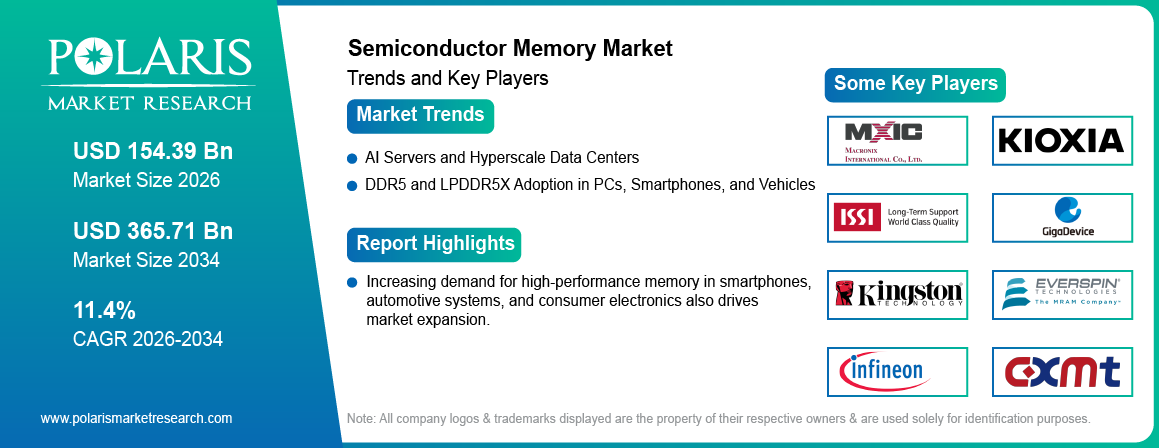
The expansion of AI servers and hyperscale data centers is driving the semiconductor memory market growth. In October 2026, Kioxia announced its LD4 Series E1.L SSDs based on BiCS FLASH generation 8 QLC NAND, with capacities up to 30.72 TB now and a validated architecture for up to 122.88 TB. It will provide the hyperscale data center and AI storage market with a new level of capacity. High memory bandwidth and large data capacity needed for AI training and inference spur the adoption of high-bandwidth memory (HBM) and server DRAM. AI server vendors are spending on AI hardware to handle greater amounts of compute workloads and need memory for such servers. HBM3E and HBM4 allow faster data transmission in AI accelerators and enterprise SSDs store massive amounts of data and model checkpoints. These factors are driving demand for AI memory in data centers (Source: KIOXIA).
Driver: DDR5 and LPDDR5X Adoption in PCs, Smartphones, and Vehicles
The rollout of DDR5 and LPDDR5X memory technology is fueling the semiconductor memory market expansion. DDR5 offers better memory bandwidth and density capabilities for PCs, servers, and high-performance computing. The LPDDR5X is a low-power, high-speed memory option aimed at use in 5G smartphones and some automotive applications. In June 2025, Micron introduced 1γ LPDDR5X memory for AI-powered smartphones at speeds of up to 10.7 Gbps with a 20% reduction in power consumption. The growing demand for faster memory is being driven by the increasing demand for advanced computing, connected vehicles, and AI-enabled devices. Such applications are forcing memory chip makers to expand product portfolios and increase performance. The memory chip market and replacement demand are also seeing the impact of the transition to newer memory standards (Source: Design News).
Restraint: Price Volatility and Capital Intensity
One of the big barriers to the semiconductor memory market is price volatility. The prices of DRAM and NAND flash are influenced by supply, inventory, and demand. Rising prices will result in higher costs for PC, smartphone, and server manufacturers, while declining prices will hurt revenue and margin for memory vendors. Also, expansion of memory fabs will require substantial capex expenditure in advanced equipment and cleanroom facilities. Higher costs increase the financial risk when markets turn down. Uncertain returns can delay capacity decisions, and manufacturers find it difficult to balance capacity of DRAM, NAND output and investment in HBM.
Restraint: Export Controls and Supply Concentration
Risks for the semiconductor memory industry are export controls and concentrated production capacity. Controls on advanced semiconductor equipment and related technologies can limit access to manufacturing tools and delay technology development in targeted markets. A concentration of production in the hands of a few memory chip makers also leaves buyers open to supply chain disruptions, geopolitical issues, and capacity constraints. Chinese memory vendors like CXMT and YMTC are boosting their domestic production capacity. Competitiveness will come down to having access to technologies, yields, and product qualifications. These issues will affect supply security and investment decisions in addition to advanced memory supplies.
Opportunity: Emerging Memory (MRAM, ReRAM) and CXL Memory Pooling
Besides the conventional DRAM and NAND flash memory, there are other opportunities, such as CXL-based memory pools, in the semiconductor memory market. Marvell announced second-generation Structera X CXL 3.2 memory expanders in October 2026. It will increase memory capacity and efficiency for AI inference and data center workloads, with up to 6TB DDR5 memory per controller. MRAM and ReRAM are alternative data storage technologies and can be suited to applications with particular requirements for speed, endurance, and power efficiency. Commercialization hinges on cost, manufacturing readiness and application requirements. At the same time, Compute Express Link (CXL) lets compatible systems expand or pool memory resources, helping data centers deal with memory-intensive workloads. The increasing need for AI infrastructure could create demand for these technologies as operators look for more flexible memory architectures and improved utilization of resources (Source: Marvell Technology).
Semiconductor Memory Market Segmentation Analysis
The semiconductor memory market is segmented by type, including SRAM, MRAM, DRAM (including HBM), NAND flash, and NOR flash, and by application, including data center and cloud, IT & telecommunication, consumer electronics, and automotive. Growing AI memory demand, cloud infrastructure, and advanced computing are driving segment growth.
Type Insights
The DRAM segment had a 49.65% semiconductor memory market share in 2025. DRAM is a type of temporary data storage for servers, PCs, smartphones, and automotive systems. The demand for memory at AI servers and high-performance computing is increasing, driving up DRAM consumption. DDR5 is designed for higher memory bandwidth in servers. LPDDR5X is designed for power-hungry devices. And the growing investments in AI infrastructure are also driving up demand for high-bandwidth memory (HBM), such as HBM3E and HBM4, helping to fuel DRAM’s role in advanced computing applications. Memory bandwidth is an essential parameter for AI accelerators in handling large data sets. HBM3E and HBM4 cater to the high bandwidth requirement. The growth of HBM adoption is driven by hyperscale data centers expansion and AI workloads. However, the growth across the high bandwidth memory market will be impacted by the production costs, advanced packaging requirements, manufacturing yields and supplier capacity.
SRAM is expected to exhibit a significant CAGR of 10.8% during the projected period. The static random-access memory (SRAM) market growth is driven by increasing memory demand in AI and data centers for high bandwidth and speed. In the semiconductor memory market, SRAM is used in cache memory for processors, as speed and low latency are essential in this segment. SRAM does not require frequent refreshing. Thus, its adoption enables faster access times. Processor performance advancements are projected to boost the demand for SRAM. Central processing units (CPUs) and graphics processing units (GPUs) are becoming powerful. Thus, there is a rising requirement for larger and faster cache memory.
HBM vs DRAM vs NAND Flash
| Attribute | DRAM | NAND Flash | HBM |
| Memory class | Volatile | Non-volatile | Volatile (stacked DRAM) |
| Primary role | System main memory | Persistent storage | Accelerator-attached working memory |
| Architecture | Planar DRAM die on DIMM or package | 3D NAND, 200+ layers (e.g., 218-layer BiCS8) | 8–16 DRAM dies stacked with TSVs on a base/logic die, co-packaged with GPU/ASIC |
| Typical bandwidth | ≈51 GB/s per DDR5-6400 module | Up to ≈15 GB/s per PCIe Gen5 SSD | ≈1.2 TB/s per HBM3E stack; up to 3.3 TB/s per HBM4 stack |
| 2026 product generation | DDR5, LPDDR5X, GDDR7 | QLC/TLC enterprise SSD, UFS 4.x | HBM3E (volume), HBM4 (ramping) |
| Main end uses | PCs, servers, smartphones, vehicles | SSDs, smartphones, memory cards, enterprise storage | AI training/inference accelerators, HPC |
| Leading suppliers | Samsung, SK hynix, Micron, CXMT, Nanya | Samsung, SK hynix/Solidigm, Kioxia, Sandisk, Micron, YMTC | SK hynix, Samsung, Micron |
| Pricing model | Quarterly contract + spot; cyclical | Quarterly contract + spot; cyclical | Annual allocation agreements; less exposed to spot swings |
| 2026 dynamic | Record contract-price increases; supply diverted to HBM | Price surge as enterprise SSD demand overtakes smartphones | Capacity-constrained; HBM4 qualification race |
Source: Polaris Market Research Analysis
Application Insights
The consumer electronics segment accounted for 33.65% share in the semiconductor memory market in 2025. DRAM and NAND flash are used in smartphones, laptops, tablets, gaming devices, and connected products to process and store data. Due to the increasing device capabilities and demand for higher storage capacity, memory requirements are increasing. While DDR5 aims to boost the computing power of the supporting computers, LPDDR5X will provide better power efficiency to mobile phones. Innovations in products and AI-enabled features have driven the demand for memory in consumer electronics.
The data center and cloud segment is projected to be the fastest growing application with an estimated 14.6% CAGR during the projected period. Demand for server DRAM, HBM, and enterprise SSDs is growing, propelled by the expansion of AI infrastructure, cloud computing, and hyperscale facilities. To train and infer AI, data is required that can be accessed quickly and has high memory bandwidth and large storage capacity. These needs are encouraging investment in advanced memory technologies and increasing AI memory demand. Capacity availability, memory pricing, and infrastructure investment will influence the pace of segment growth.
Semiconductor Memory Market Regional Insights
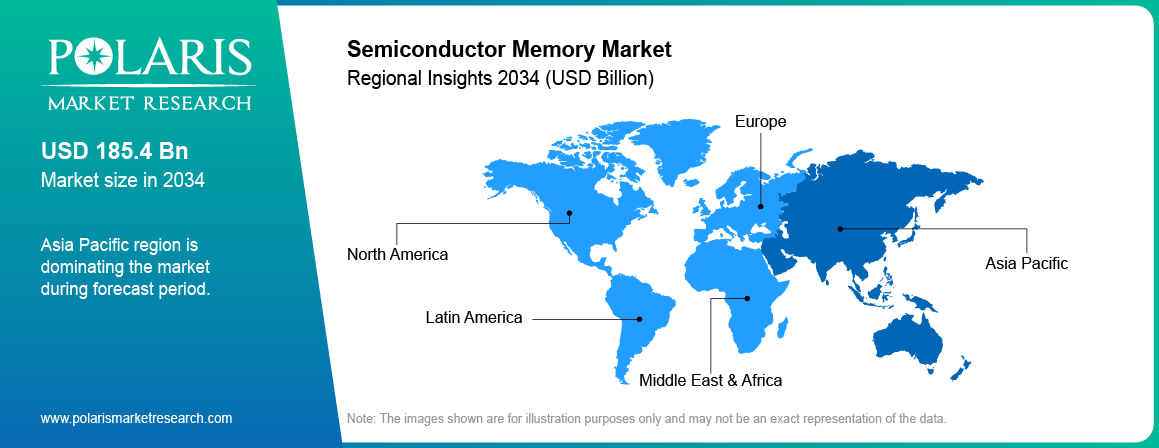
Asia Pacific held the largest share of the semiconductor memory market in 2025. The business opportunities in North America, Europe, Latin America, and the Middle East and Africa regions can be attributed to AI infrastructure development, data centers, auto electronics, and cloud computing.
Asia Pacific Semiconductor Memory Market Trends
The Asia Pacific led the semiconductor memory market with 43.07% share in 2025. Strong memory manufacturing capabilities in South Korea, Taiwan, Japan, and China, along with rising demand for AI memory and electronics, will fuel regional demand. In October 2026, CXMT made progress in its 4F² DRAM cell technology that aims to increase memory density and better position the company against rivals Samsung and SK hynix. South Korea is home to the world’s major DRAM and HBM suppliers, while Taiwan contributes in the areas of semiconductor manufacturing equipment and advanced packaging. Japan is supporting NAND technology and production equipment to produce memory, while China is increasing its domestic DRAM and NAND capacity through companies such as CXMT and YMTC. Regional demand is also underpinned by investments in memory fab expansion, consumer electronics manufacturing and AI infrastructure. "These factors reinforce the position of Asia Pacific as the leading production hub for the semiconductor memory industry (Source: SCMP).
North America Semiconductor Memory Market Trends
The North America semiconductor memory market is projected to register the highest CAGR of 12.2% during the forecast period. As hyperscale data center investments and growing AI memory needs are driving higher requirements for HBM, server DRAM and enterprise SSDs, NEO Semiconductor launched its NEO.AI memory platform in August 2026, combining X-SRAM to deliver up to 5× higher on-chip memory density and 3D X-DRAM to deliver up to 10× higher HBM capacity to tackle AI memory bottlenecks. The U.S. is promoting domestic semiconductor manufacturing through CHIPS-related incentives and investment in fabrication and advanced packaging. The company expect the regional memory production to grow over time with Micron’s planned investments in manufacturing and research. Memory chip makers across the region are benefiting from increased demand for memory for AI servers, high-performance computing and cloud infrastructure (Source: PR Newswire).
Europe Semiconductor Memory Market Trends
Europe was estimated to hold 22.6% share in the semiconductor memory market in 2025. Automotive electronics, industrial automation, telecommunications and enterprise computing are driving demand. In June 2025, European automotive industry installed 23,000 industrial robots in 2024 driving demand for semiconductor memory in robotic controllers, machine vision & automotive automation. Growth in electric vehicles and advanced driver-assistance systems is driving demand for reliable memory components. European semiconductor initiatives are driving investment in local manufacturing and supply chain resilience. But the region still depends on outside suppliers for much of its DRAM and NAND flash needs. Growing deployment of connected vehicles, industrial systems and data center infrastructure is creating opportunities for memory chip makers and providers of specialized memory technologies (Source: IFR).
Latin America Semiconductor Memory Market Trends
Latin America has a 6.8% semiconductor memory market share in 2025. The market is fueled by the adoption of smartphones, sales of PCs, upgrades in telecommunications and the growth of cloud services. Brazil and Mexico contribute through their consumption of electronics, production of automobiles, and industrial activity. The shift to digital is spurring demand for DRAM and NAND flash for connected devices and enterprises. However, due to the limited capacity of local manufacturing of memory chips, reliance on imported memory chips, which are affected by global market fluctuations, is seen. Additional capital investment in data centers energy and power management and digital infrastructure may raise regional demand through 2034.
Middle East & Africa Semiconductor Memory Market Trends
Middle East & Africa held a 3.5% share of the semiconductor memory market in 2025. Investments in digital infrastructure, cloud computing, smart-city projects and telecommunications are driving up memory needs. The Gulf nations are increasing their data centers and AI capabilities, hence generating a need for server DRAM, HBM, and enterprise SSDs. Demand for memory products is driven by the penetration of smartphones, mobile internet, and digital transformation of enterprises in Africa. But limited local semiconductor manufacturing and reliance on imports limit regional production. Continuing investment in cloud services and digital transformation could strengthen the region’s contribution to the semiconductor memory industry through 2034.
Semiconductor Memory Use Cases
| Domain | Use case | Memory used | Example platform |
| AI training | Large-model training clusters | HBM3E/HBM4 + DDR5 host memory + enterprise SSD | NVIDIA Blackwell / Rubin racks |
| AI inference at rack scale | Low-power host and context memory | LPDDR5X | NVIDIA rack systems carrying tens of TB of LPDDR5X |
| Hyperscale cloud | Multi-year AI infrastructure build-outs | DRAM wafers under LOI | OpenAI Stargate LOI with Samsung and SK hynix (Oct 2025) |
| Automotive ADAS | Sensor fusion for L2+ to L4 | LPDDR5X, GDDR, NOR flash | ASIL-D-certified automotive LPDDR5X |
| Smartphones / AI PCs | On-device generative AI | LPDDR5X, UFS NAND | Flagship phones and AI PCs |
| Enterprise storage | Checkpoint and dataset storage | High-capacity QLC SSD | 122.88 TB enterprise SSDs (e.g., Kioxia LC9) |
| Industrial / telecom | Firmware, base-station buffering | NOR flash, DRAM, MRAM | 5G base stations, PLCs |
Source: Polaris Market Research Analysis
Semiconductor Memory Market Competitive Landscape
The semiconductor memory market is competitive with the advancement of DRAM, NAND flash, high-bandwidth memory (HBM) and advanced packaging technologies. Memory chip makers are boosting output capacity to meet demand from AI servers, data centers, consumer electronics and automotive applications. Main players compete on product innovation, manufacturing efficiency, memory performance, price and production capacity. Investments in HBM3E, HBM4, DDR5, and 3D NAND, together with strategic alliances, memory fab capacity expansion, and geographic diversification, will shape competitive positioning during the forecast period.
List of Semiconductor Memory Key Players
- ChangXin Memory Technologies (CXMT)
- Everspin Technologies, Inc.
- GigaDevice Semiconductor Inc.
- Infineon Technologies AG
- Integrated Silicon Solution, Inc. (ISSI)
- Kingston Technology Company, Inc.
- Kioxia Holdings Corporation
- Macronix International Co., Ltd.
- Micron Technology, Inc.
- Nanya Technology Corporation
- Samsung Electronics Co., Ltd.
- SanDisk Corporation
- SK hynix Inc.
- Texas Instruments Incorporated
- Winbond Electronics Corporation
- Yangtze Memory Technologies Co., Ltd. (YMTC)
Vendor Positioning
| Company | Headquarters | Core memory portfolio | Market position | Positioning and strategic focus |
| ChangXin Memory Technologies (CXMT) | China | DDR4/DDR5, LPDDR4X/LPDDR5X and LPDDR6 DRAM | Emerging challenger (DRAM) | Fastest share gain in DRAM, at roughly 7–10% of DRAM revenue in Q2 2026 depending on the source. Listed on Shanghai’s STAR Market on 27 Jul 2026 (≈USD 8.6 B raised) to fund production-line upgrades and DRAM R&D. Plans a 4F² server DDR5 RDIMM by end-2026. Sells mainly to domestic customers. |
| Everspin Technologies, Inc. | U.S. | MRAM (Toggle and STT-MRAM) | Specialist (emerging memory) | Pure-play MRAM supplier for persistent, high-endurance memory in industrial, automotive and aerospace systems. Competes on speed and endurance rather than density. |
| GigaDevice Semiconductor Inc. | China | NOR flash, SLC NAND, specialty DRAM, microcontrollers | Specialist (code storage) | Among the larger NOR flash suppliers, serving automotive, industrial and consumer firmware storage. Extending into specialty DRAM. |
| Infineon Technologies AG | Germany | NOR flash, F-RAM, nvSRAM/SRAM (ex-Cypress) | Specialist (embedded / automotive) | Holds the former Cypress memory portfolio following its April 2020 acquisition. Focus is safety-critical automotive and industrial embedded memory rather than commodity DRAM or NAND. |
| Integrated Silicon Solution, Inc. (ISSI) | U.S. | SRAM, low- and mid-density DRAM, NOR flash | Specialist (automotive / industrial) | Fabless supplier known for automotive-grade DRAM and SRAM. Owned by Uphill Investment since 2015. |
| Kingston Technology Company, Inc. | U.S. | DRAM modules, SSDs, flash cards | Module and channel player | Not a memory chip manufacturer. Buys DRAM and NAND from chipmakers and sells modules and SSDs to consumer, enterprise and OEM customers, so margins and supply track the contract-price cycle. |
| Kioxia Holdings Corporation | Japan | 3D NAND (BiCS FLASH), SSDs | Leader (NAND) | NAND joint venture partner of Sandisk. Kitakami Fab2 has been operating since Sep 2025, backed by a >USD 31 B Japan investment plan (announced 27 Aug 2026). Announced the LD4 QLC E1.L enterprise SSD in Oct 2026 (sampling) for hyperscale data centers. |
| Macronix International Co., Ltd. | Taiwan | NOR flash, ROM, SLC NAND | Specialist (code storage) | Supplies firmware and code-storage memory for automotive, industrial and consumer devices. Not exposed to the HBM or enterprise-SSD cycle. |
| Micron Technology, Inc. | U.S. | DRAM, HBM, NAND | Leader (top-3 DRAM) | DRAM share of 24–25% and HBM share of 18% in Q2 2026 (Counterpoint). Exited the Crucial consumer brand (Dec 2025) to prioritize AI data-center customers. Expanding in Singapore (HBM packaging), Taiwan (Tongluo fab) and the U.S. (≈USD 150 B manufacturing plan). |
| Nanya Technology Corporation | Taiwan | Specialty and legacy DRAM (DDR4/DDR5, LPDDR) | Niche DRAM supplier | About 2% of DRAM revenue. Benefited from the 2026 price surge, with Counterpoint reporting 690% year-on-year revenue growth in Q2 2026 on higher DDR/LPDDR supply. |
| Samsung Electronics Co., Ltd. | South Korea | DRAM, HBM, NAND, LPDDR, GDDR | Leader (broadest portfolio) | No. 1 in DRAM with 38–39% share and No. 2 in HBM with 33% in Q2 2026. First to ship commercial HBM4 (February 2026, 11.7 Gbps). Pyeongtaek P4/P5 expansion supports DRAM and HBM. |
| Sandisk Corporation | U.S. | NAND flash, SSDs | Leader / challenger (NAND) | Independent since February 2025 after separating from Western Digital (Nasdaq: SNDK). Shares the NAND joint venture with Kioxia and sells flash and SSD products across consumer and enterprise markets. |
| SK hynix Inc. | South Korea | DRAM, HBM, NAND (including Solidigm) | Leader (HBM) | No. 1 in HBM with 50% share in Q2 2026, down from 64% a year earlier, and 25–26% of DRAM. Completed HBM4 development in Sep 2025. Filed an F-1 with the U.S. SEC in Jun 2026 for a U.S. listing. Building out Yongin and Cheongju M15X. |
| Texas Instruments Incorporated | U.S. | Embedded memory in microcontrollers (e.g., FRAM) | Peripheral (embedded only) | Memory is embedded in an analog and embedded-processing portfolio rather than sold as a standalone product line. |
| Winbond Electronics Corporation | Taiwan | NOR flash, SLC NAND, specialty DRAM | Specialist (code storage / specialty DRAM) | Low- and mid-density DRAM and flash for automotive, industrial and IoT customers. Positioned on reliability and long product lifecycles rather than leading-edge capacity. |
| Yangtze Memory Technologies Co., Ltd. (YMTC) | China | 3D NAND (Xtacking) | Emerging challenger (NAND) | Expanding Wuhan NAND capacity from about 200k toward 400–500k wafers per month. Growth is directed mainly at domestic customers, with an IPO process under way. |
Source: Polaris Market Research Analysis
Recent Developments
- July 2026: CXMT listed on Shanghai’s STAR Market on 27 July, raising around USD 8.6 billion to fund upgrades in memory production, DRAM technology development, and R&D. (Source: Shanghai Stock Exchange)
- June 2026: SK hynix filed an F-1 registration statement with the US SEC for a proposed US listing and outlined plans to double wafer production capacity within five years, depending on market conditions. (Source: US SEC)
- February 2026: Samsung Electronics began commercial shipments of HBM4, featuring an 11.7 Gbps transfer speed, 3.3 TB/s bandwidth per stack and a 2,048-I/O interface for AI computing applications. (Source: Samsung Semiconductor)
- October 2025: Samsung Electronics and SK hynix collaborated with OpenAI’s Stargate program to produce cutting-edge memory manufacturing capacity with monthly wafer starts of up to 900,000 units. (Source: OpenAI)
- September 2025: SK hynix announced the completion of HBM4 development and readiness for mass production, targeting growing demand for high-bandwidth memory in AI accelerators. (Source: SK hynix)
Semiconductor Memory Market Future Outlook
As per our semiconductor memory market forecast 2026, the global market is projected to grow in the coming years. Growth is driven by rising AI memory demand, expanding data centers, and increasing demand for DRAM, NAND flash, and high-bandwidth memory (HBM). Further, silicon photonics is expected to complement rather than replace DRAM, NAND, and HBM. It will enable optical links for pooled, disaggregated memory in AI clusters. It could shift some demand toward shared DDR and CXL-attached capacity and ease the memory bandwidth bottleneck.
Memory performance and capacity are expected to improve with HBM4, DDR5, LPDDR5X, 3D NAND, and advanced packaging. Growth opportunities are increasing demand from AI servers, cloud computing, automotive electronics, and enterprise storage. However, price volatility, costly investments, export restrictions and supply constraints represent major challenges. Companies that manage to expand their production capacity, improve their manufacturing efficiency. They are also developing next-generation memory technologies such as MRAM and ReRAM will consolidate their market positions until 2034.
Research Methodology
The semiconductor memory market study combines secondary research, primary interviews, market sizing, and cross-validation to develop estimates for the 2025 base year and the 2026–2034 forecast period.
Secondary research: The study reviews memory chip manufacturers' annual reports, investor presentations, product specifications, earnings releases, technology announcements, capacity expansion plans, and industry reports. It also involves DRAM, NAND flash, SRAM, NOR flash, HBM3E, HBM4, DDR5, LPDDR5X, enterprise SSDs, CXL memory and other emerging memory technologies. Sources include semiconductor industry associations, financial disclosures, manufacturing announcements, and technology research organizations.
Primary research: The research includes interviews with semiconductor memory makers, equipment suppliers, packaging companies, cloud service providers, data center operators, electronics manufacturers, and industry experts. Discussions are focused on memory pricing, production capacity, wafer allocation, HBM adoption, manufacturing yields, capital expenditure, supply constraints, and demand across AI infrastructure, consumer electronics, automotive, IT & telecommunication and enterprise storage.
Market sizing and validation: The study has a bottom-up approach and look at memory shipments, average selling prices, product revenue, and demand by application and region. Cross-checking is done by comparing estimates with company revenue disclosures, shipment data, production capacity, investment announcements, and a top-down assessment of the semiconductor memory industry. Regional and segment estimates are reconciled and assumptions are being documented. The assessment includes the impact of 2026 DRAM prices, NAND flash prices, memory fab expansion, AI memory demand, and supply-demand changes on semiconductor memory market size and the forecast.
Semiconductor Memory Market Segmentation
By Type Outlook (Revenue, USD Billion, 2021–2034)
- DRAM
- SRAM
- NAND Flash
- NOR Flash
- MRAM
- Others
By Application Outlook (Revenue, USD Billion, 2021–2034)
- Consumer Electronics
- IT & Telecommunication
- Data Center & Cloud
- Automotive
- Industrial
- Aerospace & Defense
- Medical
- Others
By Regional Outlook (Revenue, USD Billion, 2021-2034)
- North America
- U.S.
- Canada
- Europe
- Germany
- France
- UK
- Italy
- Spain
- Netherlands
- Russia
- Rest of Europe
- Asia Pacific
- China
- Japan
- India
- Malaysia
- South Korea
- Indonesia
- Australia
- Vietnam
- Rest of Asia Pacific
- Middle East & Africa
- Saudi Arabia
- UAE
- Israel
- South Africa
- Rest of Middle East & Africa
- Latin America
- Mexico
- Brazil
- Argentina
- Rest of Latin America
Semiconductor Memory Market Report Scope
| Report Attributes | Details |
| Market Size in 2025 | USD 138.92 Billion |
| Market Size in 2026 | USD 154.39 Billion |
| Revenue Forecast by 2034 | USD 365.71 Billion |
| CAGR | 11.4% from 2026 to 2034 |
| Base Year | 2025 |
| Historical Data | 2021–2024 |
| Forecast Period | 2026–2034 |
| Quantitative Units | Revenue in USD Billion and CAGR from 2026 to 2034 |
| Report Coverage | Revenue Forecast, Competitive Landscape, Growth Factors, and Industry Trends |
| Segments Covered |
|
| Regional Scope |
|
| Competitive Landscape |
|
| Report Format |
|
| Customization | Report customization as per your requirements with respect to countries, regions, and segmentation. |
Source: Polaris Market Research Analysis
Semiconductor Memory Market FAQ's
The semiconductor memory market was valued at USD 138.92 billion in 2025 and is predicted to reach USD 365.71 billion by 2034.
The market is anticipated to record a CAGR of 11.4% during the 2026–2034 forecast period, due to the growth of AI infrastructure and data centers.
Semiconductor memory is an electronic storage technology that stores data and instructions in integrated circuits. It is either volatile, such as DRAM and SRAM, or non-volatile, such as NAND flash, NOR flash, and MRAM.
DRAM is a short-term storage for data that is active. NAND flash is a non-volatile storage for data that is stored. HBM is a high-bandwidth memory for AI accelerators.
The strong demand for AI, the limited production capacity, and the diversion of manufacturing resources to HBM are tightening supply of conventional DRAM and NAND.
HBM provides high bandwidth and is created by stacking DRAM dies on top of each other. This makes it suitable for AI accelerators to process large datasets and model parameters efficiently.
The main players are SK hynix, Samsung Electronics, Micron Technology, Kioxia and Sandisk. CXMT and YMTC are growing in China.
Asia Pacific was the leading region in 2025 with a 43.07% share owing to memory manufacturing in South Korea, Taiwan, Japan and China.
Depending on ramp-up schedules and AI demand, supply could ease from late 2027 through 2028 as new fabrication capacity comes online.
HBM is expected to be the fastest-growing type of semiconductor memory, as demand from AI accelerators and data centers grows.
Main semiconductor memory types are SRAM (static RAM), DRAM (dynamic RAM), NAND flash, NOR flash, MRAM (magnetic RAM), and ReRAM (resistive RAM).

Download Sample Report of Semiconductor Memory Market
Please fill out the form to request a customized copy of the research report.


