
Ai In Material Discovery Market Size, Share, and Forecast 2026 to 2034
REPORT DETAILS
Ai In Material Discovery Market Summary
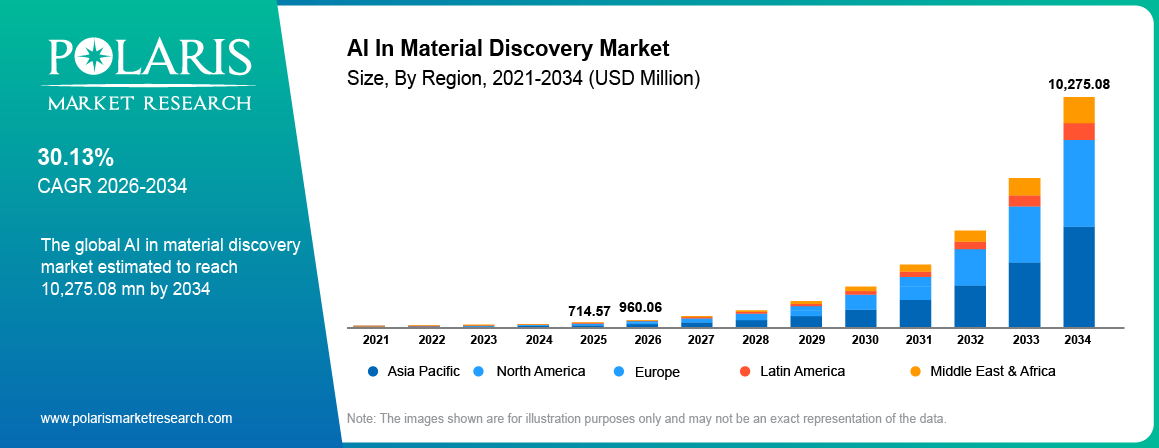
AI in material discovery market size was valued at USD 714.57 Million in 2025. The AI in material discovery market forecast points to a CAGR of 30.13% from 2026 to 2034. Growth is driven by generative AI, foundation models, diffusion models, graph neural network discovery engines, and autonomous synthesis lab platforms.
Market Statistics
Key Takeaways
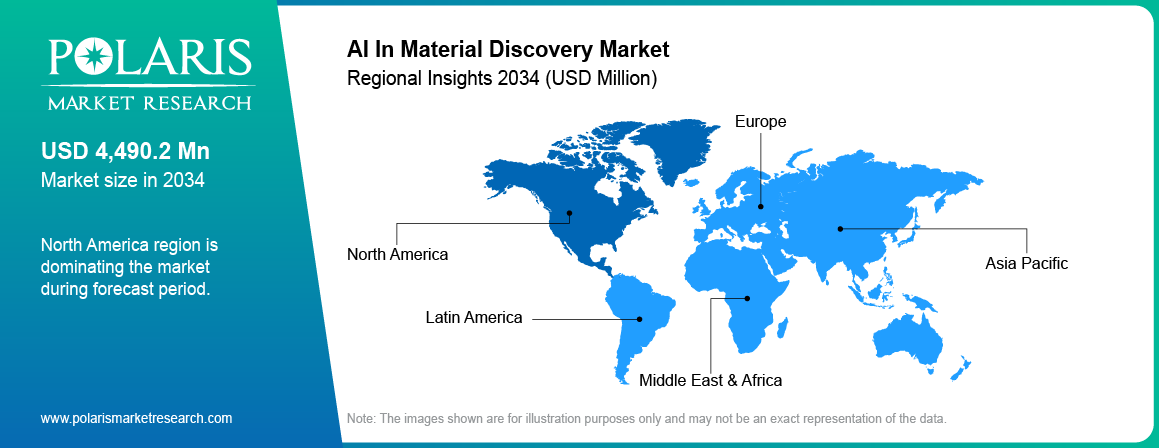
- North America dominated the AI in material discovery market with an 41.38% share in 2025, driven by major technology research labs, materials science research infrastructure, and startup funding activity.
- Asia Pacific is expected to register the fastest growth at 38.74% CAGR during 2026–2034 in the AI in material discovery market forecast, driven by research activity in generative materials design and experimental validation of AI-generated materials.
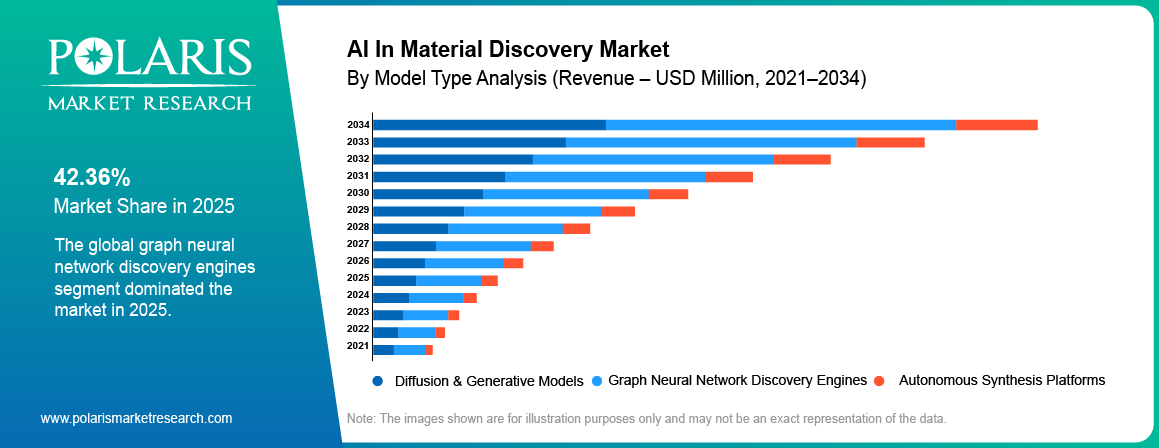
- Graph Neural Network Discovery Engines accounted for 42.36% share in 2025, driven by the use of graph-based models for large-scale material screening and validation.
- Diffusion & Generative Models are expected to register the fastest growth at 36.92% CAGR during 2026–2034, driven by the shift from screening known candidates toward de novo material design.
- Inorganic Crystals accounted for 28.64% share in 2025, driven by the focus of GNoME and MatterGen on stable inorganic and crystalline materials.
- Catalysis is expected to register the significant growth at 32.84% CAGR during 2026–2034, driven by applications in solar cell materials and CO? recycling catalyst design.
Note: Figures and projections outlined in this report are the result of Polaris Market Research’s proprietary analytical processes, grounded in the latest available datasets and market observations.
AI In Material Discovery Market Definition
The AI in material discovery market is an artificial intelligence tool used to design, generate, screen, and validate new materials. The market includes graph neural network discovery engines, diffusion models, generative models, foundation models, and autonomous synthesis platforms. These technologies help researchers identify new material structures and evaluate their properties. Predictive property screening and broader data management tools covered in the material informatics market remain outside the core scope.
The market includes AI systems for inorganic crystals, molecules, catalysts, polymers, and other material classes. Major applications include energy storage and batteries, catalysis, semiconductors, and other industrial material development areas. Graph neural networks evaluate large candidate pools, whereas generative models create new structures from defined material requirements. Generative materials design and diffusion model materials workflows go a step further by producing crystal structures that screening alone would not surface. Autonomous synthesis platforms connect computational discovery with laboratory validation.
Google DeepMind's GNoME represents a graph neural network discovery engine used to identify stable inorganic materials. Microsoft Research’s MatterGen uses a diffusion model to generate new crystal structures. In September 2026, researchers from Tohoku University came up with PhysMat AI, a combination of physical principles, AI models, databases, screening, and experimental validation, for advancing reliable materials discovery. These platforms show how AI is moving material research from candidate screening toward direct material design. The development of these tools is also creating demand for experimental validation and automated synthesis systems. (Source: eurekalert.org)
Growth in the AI in material discovery market is linked to advances in foundation models, generative AI, materials datasets, automated laboratories, and computational materials science. The Materials Project provides a major data foundation for AI-based material discovery. Research programs are also expanding into battery materials, catalysts, semiconductors, and other functional materials. Greater integration between AI models and laboratory systems is creating a broader material discovery workflow.
Market Scope Comparison
| Parameter | AI in Material Discovery | Material Informatics | Quantum-Enhanced Materials Informatics |
| Core Focus | Generating and validating new materials | Data-driven prediction, screening, and analysis | Quantum and classical methods for material simulation |
| Key Technologies | Graph neural networks, diffusion models, foundation models, autonomous labs | Machine learning, statistical analysis, digital annealer | Quantum computing, machine learning, deep learning |
| Typical Output | New candidate structures, such as GNoME and MatterGen results | Property predictions and materials data management | High-accuracy simulation of atomic interactions |
| Covered in This Report | Yes, core scope | No, adjacent market | No, adjacent market |
Source: Polaris Market Research Analysis
Market Dynamics
Driver Impact Analysis
| Driver | Impact on Market Growth | Time Horizon | Segments Most Affected | Regions Most Affected |
| Foundation models shifting discovery from screening to de novo design | High | Medium to Long Term | Diffusion & Generative Models; Inorganic Crystals | North America, Europe |
| Venture funding expanding generative materials platforms | High | Short to Medium Term | Autonomous Synthesis Platforms; Molecules & Catalysts | North America, Europe, Asia Pacific |
| Accelerated computing enabling large-scale screening | Medium to High | Short to Medium Term | Graph Neural Network Discovery Engines; Catalysis | Asia Pacific, North America |
Source: Polaris Market Research Analysis
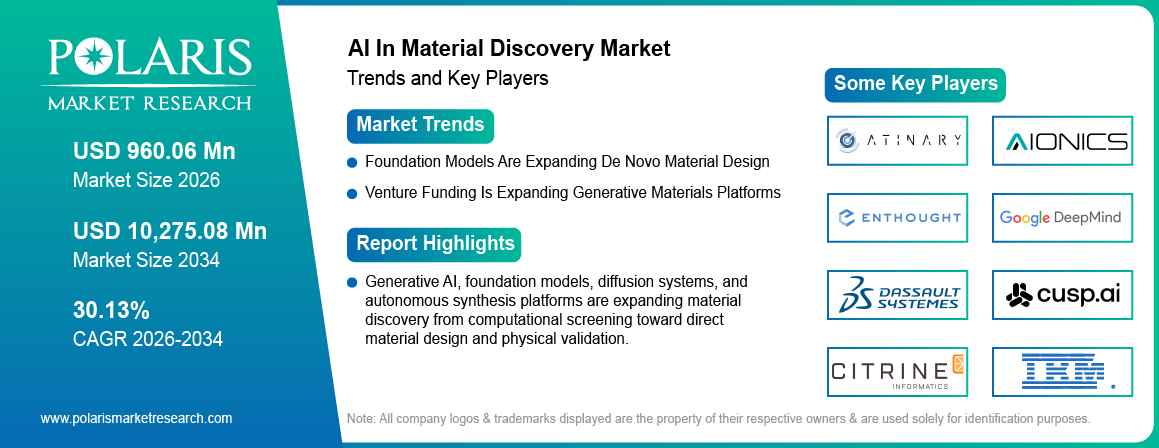
Driver: Foundation Models Are Shifting Material Discovery From Screening to De Novo Design
The evolution of foundation models is steering the AI in material discovery market from conventional material screening to de novo material design. For example, Google DeepMind’s GNoME combined graph neural networks with density functional theory validation to predict 2.2 million new crystal structures, including approximately 380,000 stable materials. This approach increases the number of material structures that can be evaluated by researchers in a discovery program. MatterGen from Microsoft Research also supplements this capability with diffusion-based generation, which creates novel crystal structures rather than just evaluating pre-existing candidates. The shift to direct material generation is driving demand for AI-based discovery platforms and creating opportunities in energy storage, catalysis, semiconductors and advanced materials. (Source: deepmind.google)
Driver: Venture Funding Is Expanding Commercial Development of Generative Materials Platforms
The commercialization of generative AI platforms is being fast-tracked by growing venture investment, and the AI in material discovery market report landscape is being broadened. CuspAI, which is building an AI-powered materials discovery platform, closed a $450 million Series B round at a $2.6 billion valuation in July 2026. These investments fund model development, materials datasets, computational infrastructure, research teams, and industrial partnerships. Thus, more funding enables specialized firms to develop their technology and commercial skills. More investment also means that more platforms are entering the market, providing more opportunities for industrial users to leverage AI-driven material discovery solutions. (Source: sifted.eu )
Driver: Accelerated Computing Is Enabling Screening of Far Larger Candidate Spaces
Advances in GPU-accelerated simulation are reducing the time and cost of screening candidate materials at scale. In September 2026, Matlantis announced that ENEOS Holdings used its Matlantis PFP machine learning potential with NVIDIA ALCHEMI to evaluate approximately 100 million candidate structures for oxygen evolution reaction catalysts, cutting a discovery process that traditionally took years to a few months. Faster atomistic simulation allows researchers to rank candidates before synthesis, which lowers the number of physical experiments required per discovery. As accelerated computing becomes part of standard research infrastructure, more industrial users are expected to adopt AI-based material discovery for catalysts, batteries, and semiconductor materials. (Source: globenewswire.com)
Restraint: Physical Validation Requirements Extend AI Material Discovery Workflows
The requirement of independent physical validation holds back the advancement of AI-generated materials from computational discovery to commercial development. AI models may find candidates with predicted stability or properties of interest, but researchers still need computational verification, laboratory synthesis and experimental testing to confirm material performance. A September 2026 preprint that proposes a pre-registered physics judge for AI-proposed superconductors also highlights the importance of independent evaluation of generated candidates. (Source: arxiv.org) Density functional theory calculations provide a computational validation step and physical synthesis involves laboratory resources and further testing. Within the framework of the larger materials genome initiative ecosystem, such requirements extend the development time and increase the cost of research, limiting the immediate translation of AI-generated candidates into commercially deployable materials.
Opportunity: Autonomous Synthesis Labs Are Connecting AI Design With Physical Material Production
The combination of AI models and autonomous synthesis lab technologies is closing the gap between digital material design and physical validation. In May 2026, researchers at North Carolina State University, using artificial intelligence, created an autonomous lab that discovered brighter, lead-free nanomaterials for optical applications. Artificial intelligence systems are used to identify or rank candidate materials and to automate selected synthesis and evaluation tasks on laboratory equipment. This link establishes a closed loop workflow where experimental results serve as new inputs for further material selection. The broader use of autonomous synthesis labs could reduce manual laboratory work, accelerate candidate testing and increase the demand for integrated AI platforms for material discovery that combine computational design with automated experimentation. (Source: ncsu.edu)
Opportunity: Sustainability Criteria Are Expanding the Scope of Generative Material Design
Embedding sustainability criteria into generative materials design creates new opportunities for AI-driven materials discovery. Traditional material selection is based on structure, performance, stability and cost, but sustainability-focused workflows also consider resource use, lifecycle impact, recyclability and environmental performance. When appropriate datasets are available, generative models can include extra design requirements in the candidate generation step. Research on sustainable materials discovery also identifies gaps in lifecycle information for AI-generated candidates. Greater availability of environmental and lifecycle data could therefore expand the criteria used during material generation. This development could broaden AI material discovery applications across energy, chemicals, industrial materials, and advanced manufacturing. Orbital Industries, formerly Orbital Materials, for example, has used its AI-driven materials platform to develop a PFAS-free dielectric cooling fluid for high-density GPUs. (Source: thenextweb.com)
AI In Material Discovery Market Segmentation Analysis
The report provides a comprehensive analysis of the AI in material discovery market by model type, material class, application, and region to identify leading market segments and high-growth opportunities.
Model Type Insights
The graph neural network discovery engines segment held the 42.36% share in 2025, making it the leading model type in the AI in material discovery market. A prime example of this technology is GNoME, which uses graph-based modeling to screen large numbers of candidate materials. Graph neural networks model relationships between atoms and crystal structures, helping researchers evaluate large material datasets. Another major category is diffusion and generative models, with MatterGen demonstrating how diffusion architecture can be used for direct material generation. Autonomous synthesis platforms connect AI-enabled discovery and lab systems and offer a path from digital candidate generation to experimental validation.
The diffusion and generative models segment is projected to register the significant CAGR of 36.92% during 2026-2034 owing to the emergence of systems that generate new materials instead of screening existing candidates alone. Materials platforms built on diffusion model materials approaches, such as MatterGen, employ an iterative generation process to generate novel crystal structures that meet specified criteria. These models are also expanding into molecules, catalysts, and functional materials. Greater integration with computational validation and autonomous laboratory systems is creating integrated discovery workflows. This development is expanding the application of generative AI across material research and development.
Material Class Insights
The inorganic crystals segment held an 28.64% share in 2025 and emerged as the leading material class in the AI in material discovery market. GNoME and MatterGen are heavily focused on inorganic and crystalline structures, which provide suitable datasets for computational modeling and material generation. Energy storage, semiconductors, and functional materials represent major areas of interest. The use of diffusion model materials approaches is also expanding the ability to generate new crystalline structures based on targeted requirements. Molecules, catalysts, polymers, and other material classes provide additional opportunities as AI models expand their training datasets and material design capabilities.
The molecules and catalysts segment is projected to witness the significant growth rate at 33.76% CAGR from 2026 to 2034, owing to the incorporation of generative techniques into chemical structures and catalytic materials. Generative materials design enables researchers to explore large chemical design spaces and discover candidates with targeted properties for solar energy, CO₂ recycling, and other applications. The increasing availability of molecular datasets and automated laboratory systems is increasing the capacity to assess generated candidates. Integration between AI models, chemistry, materials science, and experimental validation is therefore creating additional opportunities for AI-driven discovery across molecules and catalysts.
Application Insights
Energy storage and batteries was the major application category in the AI in material discovery market in 2025, with an 32.84% share. The development of batteries relies on materials with specific combinations of conductivity, stability, energy density and other performance characteristics. AI models can analyze large material spaces and find potential candidates for battery applications. Microsoft has also used Azure Quantum Elements to screen 32 million candidate materials and, with Pacific Northwest National Laboratory, identify a new solid-state electrolyte candidate. The materials genome initiative approach to data driven materials research provides an important basis for organizing and evaluating material candidates. Another application of AI-based material generation is catalysis and semiconductor materials.
The catalysis segment is expected to grow at the significant rate at 32.84% CAGR during 2026-2034 due to the use of generative models in solar cell materials and CO₂ recycling catalysts. These applications have been selected by Microsoft for MatterGen, which shows the application of AI-based material design for targeted functional requirements. The materials genome initiative framework also provides a framework for integrating materials datasets, computational modeling, and experimental research. Greater integration of generative models with computational validation and automated laboratory systems could shorten selected discovery workflows and expand AI applications across industrial catalysis.
Regional Analysis
North America AI in Material Discovery Market Trends
North America AI in material discovery market accounted for 41.38% of the global market in 2025, driven by advanced research capabilities, computational infrastructure, materials science expertise, and commercial investment. The AI in material discovery market analysis displays high activity from Google DeepMind and Microsoft Research, which are developing artificial intelligence systems for material generation and discovery. In the US, Radical AI operates a self-driving materials lab that can create and characterize more than 25 alloys in a single day. Research in energy storage, catalysts, semiconductors and advanced materials is driving demand for AI-based discovery platforms. These advances are increasing the regional capacity for material generation, computational screening, and experimental validation. (Source: rdworldonline.com)
Asia Pacific AI in Material Discovery Market Trends
Asia Pacific AI in material discovery market is projected to grow at the fastest CAGR of 38.74% during 2026–2034, driven by expanding artificial intelligence research, materials science capabilities, advanced manufacturing, and experimental validation. The AI in material discovery industry forecast reflects growing activity across China, Japan, South Korea, Singapore, and other regional markets. In July 2026, CuspAI and A*STAR forged a five-year partnership to accelerate AI-driven discovery and experimental validation of new materials across semiconductors, carbon capture, and advanced electronics. This development connects generative AI with physical material synthesis and shows regional participation in the discovery of advanced materials. AI-driven material discovery has important application areas in energy storage, catalysts, semiconductors, chemicals and advanced manufacturing. (Source: semiconductor-digest.com)
Europe AI in Material Discovery Market Trends
Europe AI in material discovery market accounted for 22.44% of the global market in 2025, driven by artificial intelligence research, computational materials science, advanced manufacturing and sustainable material development. In a May 2026 release, Kemira and CuspAI said they are working together to create AI-designed materials for PFAS removal from drinking water and industrial use. In December 2025, Google DeepMind said it would set up a robotic AI lab in the UK to search for new materials for uses ranging from batteries to semiconductors. The region has an active generative materials design sector involving research organizations, universities, technology companies and industrial groups working on AI-based material modeling and discovery. Demand for advanced materials across energy, chemicals, automotive, electronics and industrial manufacturing is creating application opportunities. Technology development is also being driven by research funding, scientific collaboration, materials datasets and computational infrastructure. Autonomous laboratory systems and AI-based material screening are creating additional opportunities for European organizations across advanced material research and industrial applications. (Source: computing.co.uk, Kemira)
Latin America AI in Material Discovery Market Trends
Latin America AI in material discovery market accounted for 4.48% of the global market in 2025, driven by demand for advanced materials across energy, mining, chemicals, manufacturing, and industrial applications. The AI in material discovery market share across the region is linked to the development of research capabilities, computational infrastructure, university programs, and industrial technology adoption. Universities and research institutions are contributing to computational materials research and artificial intelligence applications. Energy storage materials, catalysts, sustainable materials, and advanced manufacturing provide application opportunities. Development of scientific computing infrastructure can further expand access to AI-based material design, computational screening, and material property evaluation across major Latin American markets.
Middle East & Africa AI in Material Discovery Market Trends
Middle East & Africa AI in material discovery market held an 4.08% share of the global market in 2025. The region is attracting investments in artificial intelligence, advanced materials research, energy technologies, and scientific computing infrastructure. In Saudi Arabia, KAUST is partnering with SABIC and ACWA Power to apply AI to materials discovery, supported by a robotic chemistry lab and an AI Chemist foundation model for catalysts, battery materials, and membranes. The AI in material discovery market analysis includes the growing efforts of universities, research institutions, technology companies, and industrial organizations to develop AI and materials science capabilities. Its key application areas are energy storage, catalysts, sustainable materials, chemicals, and advanced manufacturing. Digital infrastructure and scientific computing investment are creating opportunities for computational material discovery. Development of AI research programs and industrial partnerships can further expand the use of generative materials design across regional markets. (Source: arabnews.com)
AI In Material Discovery Market Competitive Landscape
The generative materials design landscape is developing around major technology research labs, specialized materials AI startups, and autonomous synthesis research infrastructure. Google DeepMind and Microsoft Research represent major contributors to AI model development, including GNoME and MatterGen. CuspAI and Orbital Industries (formerly Orbital Materials) focus on AI-driven materials discovery and generative design platforms. NVIDIA Corporation supports the ecosystem through its ALCHEMI accelerated simulation tools, while Lila Sciences, Periodic Labs, and Radical AI are building AI-directed autonomous laboratories. Established platform vendors such as Schrödinger, Citrine Informatics, and Dassault Systèmes continue to serve industrial R&D teams. A-Lab, a facility at Lawrence Berkeley National Laboratory, represents an autonomous laboratory approach that connects machine learning with physical material synthesis. Competitive differentiation is linked to model architecture, materials datasets, validated discoveries, experimental capabilities, funding, and integration with laboratory systems.
Vendor Landscape Snapshot
| Vendor | Headquarters | Core Offering | Market Position |
| Google DeepMind (Alphabet Inc.) | UK / US | GNoME graph network discovery engine | Leader |
| Microsoft Corporation | US | MatterGen and Microsoft Discovery | Leader |
| NVIDIA Corporation | US | ALCHEMI accelerated simulation | Leader |
| CuspAI | UK | AI Materials Foundry and materials search engine | Challenger |
| Lila Sciences | US | AI Science Factories and autonomous labs | Challenger |
| Schrödinger, Inc. | US | Physics-based and ML materials modeling | Challenger |
| Dassault Systèmes SE (BIOVIA) | France | Materials modeling and simulation software | Challenger |
| Orbital Industries | UK / US | Orb atomistic AI and GPU cooling fluids | Niche Player |
| Citrine Informatics, Inc. | US | Materials informatics platform | Niche Player |
| A-Lab (Lawrence Berkeley National Laboratory) | US | Autonomous inorganic synthesis lab | Niche Player |
| Periodic Labs | US | AI scientist with autonomous labs | Emerging Player |
| Radical AI | US | Self-driving lab for alloys | Emerging Player |
Source: Polaris Market Research Analysis. Positioning reflects technology depth, funding, and commercial traction.
Funding and Investment Snapshot
| Company | Round | Amount | Date |
| Matter Machine | Pre-Series A | £4 million | October 2026 |
| Discovered Materials | Seed | $9 million | August 2026 |
| CuspAI | Series B | $450 million ($2.6 billion valuation) | July 2026 |
| Orbital Industries | Series B | $50 million | May 2026 |
| Lila Sciences | Series A | $350 million | October 2025 |
| Radical AI | Seed | $55 million | July 2025 |
| Periodic Labs | Seed | $300 million | 2025 |
Source: Company announcements and press releases
AI In Material Discovery Market Technology and Innovation Landscape
Technology and Innovation Landscape Snapshot
| Technology | Representative Platform | Role in Discovery Workflow | Maturity |
| Graph neural network discovery engines | GNoME (Google DeepMind) | Screens and ranks stable candidates | Established |
| Diffusion and generative models | MatterGen (Microsoft Research) | Generates new crystal structures from target properties | Scaling |
| Accelerated atomistic simulation | NVIDIA ALCHEMI, Matlantis PFP | Screens very large candidate pools before synthesis | Scaling |
| Agentic AI platforms | Microsoft Discovery | Coordinates AI agents, simulation, and knowledge engines | Early Stage |
| Autonomous synthesis labs | A-Lab, NC State autonomous lab | Links candidate design to physical synthesis | Early Stage |
| Stability-aware generation | CrysVCD (MIT) | Improves chemical stability of generated materials | Early Stage |
| Validation benchmarks | Material Discovery Bench | Tests AI agents on semiconductor materials problems | Early Stage |
Source: Polaris Market Research Analysis
The key technology shift in the AI in material discovery market is the move from predictive screening toward generative material design. Graph neural networks such as GNoME evaluate large material spaces, whereas diffusion models such as MatterGen generate new structures from defined conditions. These approaches expand AI from property prediction to direct material generation. Further innovation is taking place in autonomous synthesis. Automated laboratories connect AI models with physical experiments and create a closed-loop material discovery process. Comparable generative workflows are already established in molecule design within the AI in drug discovery market.
The diffusion model materials approach is broadening the role of generative AI across material research. MatterGen shows the potential of diffusion-based models to create new crystal structures from desired material properties. This technology enables researchers to explore material configurations that may not be observed in traditional screening workflows. Further development of the model may enable its use for batteries, catalysts, semiconductors and other advanced materials.
Autonomous synthesis is a significant innovation level for the market. A-Lab combines machine learning and active learning with automated laboratory procedures for inorganic materials synthesis. This reduces manual intervention in some experimental workflows and bridges computational material design and physical testing. The autonomous synthesis lab paradigm could provide a more integrated discovery process in which artificial intelligence systems could, for example, prioritize candidates, guide experiments, and leverage experimental results for subsequent material selection.
Agentic AI platforms are another area of innovation. Microsoft Discovery, an enterprise agentic platform for R&D, integrates the NVIDIA ALCHEMI microservice to support property prediction and candidate recommendation in materials research. Such platforms combine AI agents, simulation, and knowledge engines, which shortens the path from hypothesis formulation to experimental design. (Source: azure.microsoft.com)
AI In Material Discovery Use Case Analysis
Energy Storage and Batteries
One of the most important application areas of AI-driven materials discovery is energy storage and batteries. Microsoft used Azure Quantum Elements to screen about 32 million candidate materials and, with Pacific Northwest National Laboratory, identify a new solid-state electrolyte candidate, highlighting how AI-driven screening of materials can play a role in battery research. Artificial intelligence systems can explore enormous material spaces to find potential candidates with desired properties. GNoME also shows how standard artificial intelligence can be applied to screen huge datasets of inorganic materials to find stable candidates for further evaluation. In battery development, it is necessary to validate stability, conductivity, safety and performance. Generative models provide a pathway to design new material structures instead of only screening known materials. Further integration of AI models with laboratory testing could expand the use of AI in battery materials development. (Source: chemistryworld.com)
Catalysis
Catalysis represents an important application for generative materials design and the broader materials genome initiative approach to accelerating material discovery. Microsoft has identified efficient solar cell materials and CO₂ recycling catalysts as target applications for MatterGen. AI systems can generate candidate materials with defined structural or functional requirements. Computational methods can then assess stability and other properties before laboratory synthesis. Autonomous synthesis systems may reduce the time required to test selected candidates. Continued development of generative models could expand the use of AI in catalyst discovery across energy, chemical processing, and environmental applications.
Semiconductors
Semiconductor materials represent an emerging application area for generative materials design, as AI models provide new methods for exploring complex material spaces. Semiconductor development requires materials with precise electronic, structural, thermal, and manufacturing characteristics. AI systems can evaluate large numbers of candidate structures and identify materials that meet defined performance requirements. GNoME and MatterGen provides examples of AI-based material generation and discovery that could inform future semiconductor research. Commercial activity is also building around chip materials. CuspAI's AI Materials Foundry brings together semiconductor equipment and device makers such as Applied Materials, Tokyo Electron, Lam Research, and Samsung to develop new materials for chipmaking, while Discovered Materials raised a $9 million seed round in August 2026 to build AI agents for semiconductor materials discovery. (Source: mlq.ai, hpcwire.com)
AI In Material Discovery Market Premium Insights and Forward Outlook
Validated Discovery Rate May Become an Important Competitive Metric
AI material discovery platforms are moving toward direct generation of new materials, creating greater focus on validated discovery rates in the AI in material discovery market report. Raw model output does not establish that a generated material will perform as predicted in a physical environment. Computational validation and laboratory synthesis therefore remain important stages of the discovery process. Independent evaluation frameworks may receive greater attention as AI-generated material candidates increase. Companies that integrate generative models with validation and synthesis capabilities may develop broader discovery workflows.
Generative Models May Become a Larger Part of Material Informatics Platforms
The scope of the AI in material discovery market analysis overlaps with broader material informatics applications. Generative and foundation models represent a narrower technology layer focused on creating new material candidates. Material informatics platforms cover a wider range of data management, prediction, screening, and analysis functions. As commercial platforms add generative capabilities, the distinction between standalone AI discovery tools and broader material informatics systems may become less clear. This trend could influence future market segmentation and the treatment of generative material discovery within technology-focused market categories.
Key Players in the AI in Material Discovery Market
- Aionics, Inc.
- Atinary Technologies
- Citrine Informatics, Inc.
- CuspAI
- Dassault Systèmes SE (BIOVIA)
- Enthought, Inc.
- Google DeepMind (Alphabet Inc.)
- International Business Machines Corporation (IBM Research)
- Kebotix, Inc.
- Lila Sciences
- Mat3ra (formerly Exabyte.io)
- Materials Zone Ltd.
- Matlantis Corporation
- Microsoft Corporation (Microsoft Research)
- NVIDIA Corporation
- Orbital Industries (formerly Orbital Materials)
- Periodic Labs
- Radical AI
- Schrödinger, Inc.
- XtalPi Inc.
Industry Developments
- October 2026: Matter Machine, an AI materials discovery spin-out from the University of Liverpool, raised a £4 million pre-Series A round led by IP Group to advance its AI-led platform for inorganic crystalline materials. (Source: Sharecast)
- September 2026: Lila Sciences reported that its AI-directed laboratory proposed, synthesized, and screened 2,942 catalysts for green hydrogen in three months and identified six palladium-based material families. (Source: Unite.AI)
- August 2026: Discovered Materials raised a $9 million seed round led by Lightspeed India Partners to build AI agents for semiconductor materials discovery and released Material Discovery Bench, a benchmark for agentic materials discovery. (Source: Inc42)
- August 2026: MIT researchers developed CrysVCD, an AI framework designed to improve the chemical stability of generated materials and reduce the computational burden of screening unstable material designs. The approach combines language models with diffusion-based material generation. (Source: MIT News)
- August 2026: Argonne National Laboratory researchers demonstrated a multi-agent AI system that automates atomistic simulations from start to finish to accelerate materials discovery. (Source: Argonne National Laboratory)
- July 2026: CuspAI launched the AI Materials Foundry — a global network of AI, data, computation resources, labs and science expertise to speed new materials discovery. (Source: synbiobeta.com)
- June 2026: At ISC 2026, NVIDIA introduced new ALCHEMI NIM microservices and CUDA-X software to speed up AI for science, including chemistry and materials discovery. (Source: NVIDIA Blog)
- May 2026: Orbital Industries, formerly Orbital Materials, raised a $50 million Series B round led by Plural to scale its AI-designed data-center cooling fluid and expand its materials discovery platform. (Source: Fortune)
AI In Material Discovery Market Report Segmentation
By Model Type Outlook (Revenue, USD Million, 2021–2034)
- Graph Neural Network Discovery Engines
- Diffusion & Generative Models
- Autonomous Synthesis Platforms
By Material Class Outlook (Revenue, USD Million, 2021–2034)
- Inorganic Crystals
- Molecules & Catalysts
- Polymers
- Others
By Application Outlook (Revenue, USD Million, 2021–2034)
- Energy Storage & Batteries
- Catalysis
- Semiconductors
- Others
By Regional Outlook (Revenue, USD Million, 2021–2034)
- North America
- US
- Canada
- Europe
- Germany
- France
- UK
- Italy
- Spain
- Netherlands
- Rest of Europe
- Asia Pacific
- China
- Japan
- India
- South Korea
- Taiwan
- Australia
- Rest of Asia Pacific
- Latin America
- Brazil
- Mexico
- Argentina
- Rest of Latin America
- Middle East & Africa
- Saudi Arabia
- UAE
- South Africa
- Rest of Middle East & Africa
AI In Material Discovery Market Report Scope
| Report Attributes | Details |
| Market Size in 2025 | USD 714.57 Million |
| Market Size in 2026 | USD 960.06 Million |
| Revenue Forecast by 2034 | USD 10,275.08 Million |
| CAGR | 30.13% from 2026–2034 |
| Base Year | 2025 |
| Historical Data | 2021–2024 |
| Forecast Period | 2026–2034 |
| Quantitative Units | Revenue in USD Million and CAGR |
| Report Coverage | Revenue Forecast, Growth Factors, Competitive Landscape, Industry Trends, and Strategic Analysis |
| Segments Covered |
|
| Regional Scope | North America, Europe, Asia Pacific, Latin America, Middle East & Africa |
| Competitive Landscape | Company Profiling, Product Benchmarking, Financial Analysis, Market Developments, and Strategic Initiatives |
| Report Format | PDF + Excel |
| Customization | Available by Country, Region, and Segment |
Source: Polaris Market Research Analysis
Why Choose Polaris Market Research
Polaris Market Research & Consulting, Inc. develops its AI in material discovery market report using peer-reviewed research, company technical disclosures, research publications, funding announcements, and materials science datasets. This approach provides visibility into model development, generative material design, research investment, technology development, and experimental validation. The analysis separates generative and foundation model technologies from broader predictive material informatics tools. It also evaluates developments across energy storage, catalysis, semiconductors, autonomous synthesis, and advanced materials research.
The analysis can be customized by model type, material class, application, region, country, and company coverage. Buyers can also request detailed AI in material discovery market analysis covering generative models, diffusion systems, graph neural networks, autonomous synthesis platforms, materials datasets, and experimental validation. Coverage of companies can also be tailored to the client’s research needs. This structure allows the report to focus on specific technologies, applications, geographic markets or competitive groups within the AI in material discovery industry.
AI In Material Discovery Market Research Methodology
The research process follows a five-phase methodology covering peer-reviewed publications, company research disclosures, technical publications, funding announcements, materials datasets, and scientific research sources. Secondary research establishes the technology and competitive landscape, and primary validation checks key developments against company and research sources. Competitive benchmarking separates the AI in material discovery market from broader material informatics and quantum-enhanced materials informatics categories. Proprietary data reconciliation is then applied to the internal Polaris market model. A final quality and sourcing review checks the consistency of the analysis before publication.
The scientific nature of AI-generated materials means the methodology is more focused on technical validation. Research papers and technical disclosures support model architecture, material generation and experimental validation. The announcements of funding provide an insight into commercial development and investment activity. Datasets of materials also provide important inputs to AI-based discovery systems. The analysis evaluates the transition from computational generation to physical material synthesis through an autonomous synthesis lab approach. The final analysis is compiled through a materials science and artificial intelligence research review focused on source quality and consistency.
Research Methodology Phases
| Phase | Focus |
| 1. Secondary Mapping | Peer reviewed publications, company research blogs, funding disclosures |
| 2. Primary Validation | Nature publications, company technical blogs, funding announcements |
| 3. Competitive Benchmarking | Scope separation check against Material Informatics and Quantum-Enhanced Materials Informatics reports |
| 4. Proprietary Reconciliation | Internal Polaris market model validation |
| 5. Quality and Sourcing Review | Final editorial and citation check |
Source: Polaris Market Research Analysis.
Ai In Material Discovery Market FAQ's
The AI in material discovery market size is USD 714.57 million in 2025 and is projected to reach USD 10,275.08 million by 2034, at a CAGR of 30.13% during 2026–2034.
North America dominated the market with 41.38% share in 2025, supported by major technology research labs, materials science infrastructure, and startup funding. Asia Pacific is expected to register the fastest growth during 2026–2034.
Diffusion and generative models are expected to register the fastest growth at 36.92% CAGR during 2026–2034, as the market shifts from screening known candidates toward de novo material design. By application, catalysis is expected to grow at the fastest rate.
AI in material discovery uses artificial intelligence models to generate, screen, evaluate, and validate new materials. The market focuses on generative models, diffusion models, graph neural networks, and autonomous synthesis platforms.
AI screens large candidate pools, generates new crystal structures from target properties, predicts stability, and guides laboratory experiments. Graph neural networks, diffusion models, and autonomous synthesis labs handle these steps in a connected workflow.
Material informatics covers a broader category of data-driven tools for material property prediction, screening, and analysis. AI in material discovery focuses on generative and foundation models that create new candidate materials.
GNoME, or Graph Networks for Materials Exploration, is a Google DeepMind discovery engine that predicted 2.2 million new crystal structures, including approximately 380,000 stable materials, using graph neural network modeling and computational validation.
MatterGen is a diffusion-based generative AI model from Microsoft Research. It generates novel stable inorganic materials by refining atom types, coordinates, and crystal structures.
Physical validation remains an important stage in AI-driven material discovery. Generated candidates require computational assessment and, for selected candidates, laboratory synthesis and experimental testing.
An autonomous synthesis lab uses machine learning, active learning, robotics, and laboratory automation to move from material candidate selection to physical synthesis with limited manual laboratory intervention.
Major players include Google DeepMind, Microsoft Corporation, NVIDIA Corporation, CuspAI, Lila Sciences, Schrödinger, Inc., Citrine Informatics, Inc., Dassault Systèmes SE, Orbital Industries, Periodic Labs, and Radical AI. Their approaches differ across generative models, discovery engines, and autonomous synthesis.
Energy storage and batteries, catalysis, and semiconductor materials represent key application areas. Published work also covers solar cell materials and CO? recycling catalysts.
No. Quantum-enhanced materials informatics focuses on quantum computing or quantum chemistry methods. This report focuses on generative AI, foundation models, diffusion models, graph neural networks, and autonomous synthesis.
Foundation models shifting discovery from screening to de novo design, venture funding for generative materials platforms, and accelerated computing for large-scale screening are the main drivers.
Download Sample Report of Ai In Material Discovery Market
Please fill out the form to request a customized copy of the research report.


