
Carbon Capture, Utilization and Storage Market Size, Share, Trends & Forecast, 2026–2034
REPORT DETAILS
Carbon Capture, Utilization and Storage Market Summary
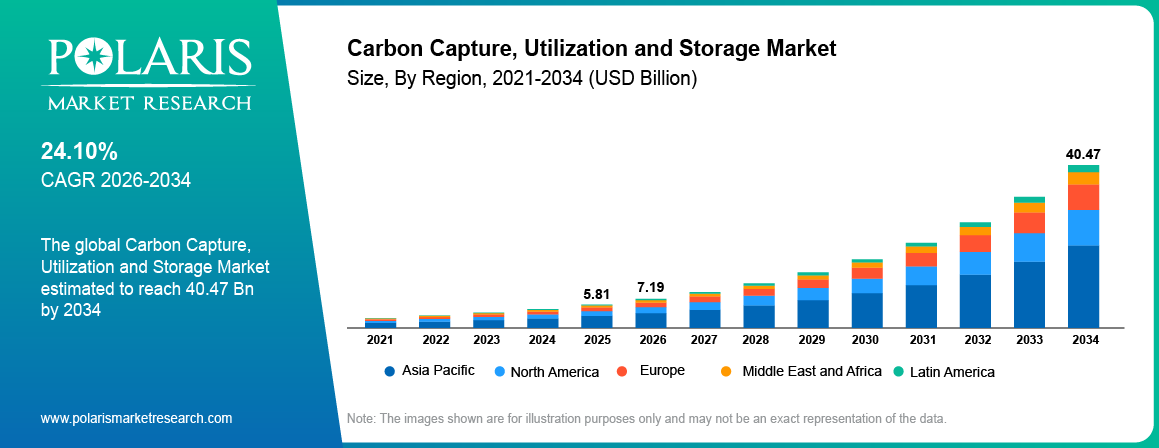
The global carbon capture, utilization and storage (CCUS) market size was valued at USD 5.81 billion in 2025. The market is projected to account for an 24.10% CAGR from 2026 to 2034. Stringent government regulations and rising corporate net-zero targets are a few of the key factors driving the carbon capture, utilization and storage market growth. Financial incentives for decarbonizing heavy industries are also influencing the market landscape.
Market Statistics
Key Takeaways
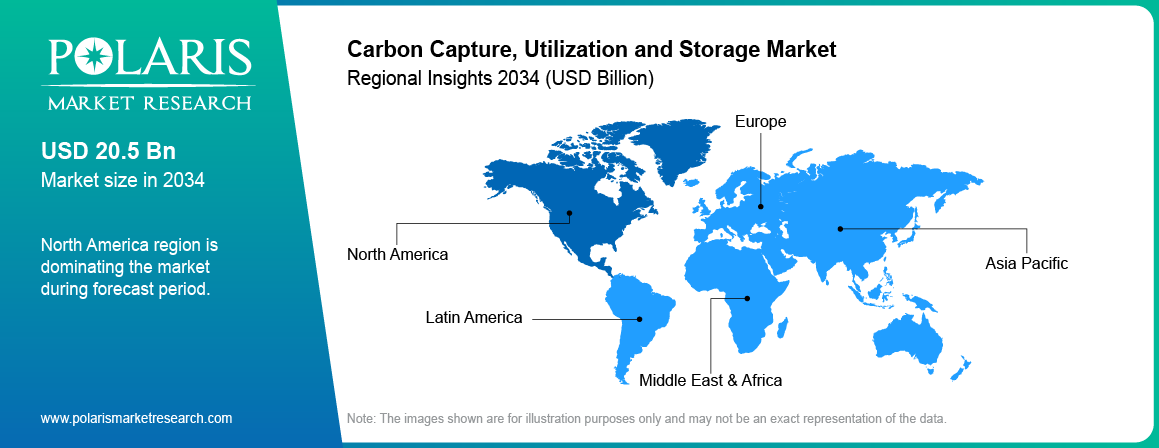
- North America accounted for an 38.20% CCUS market share in 2025. Robust government incentives and established energy infrastructure contribute to the regional market dominance.
- Asia Pacific is projected to account for an 26.00% CAGR. Rapid industrialization and stricter government climate policies drive market growth in the region.
- The chemical looping segment held an 8.50% carbon capture, utilization and storage share in 2025. This is because it eliminates the costly and energy-intensive separation step required by traditional carbon capture methods.
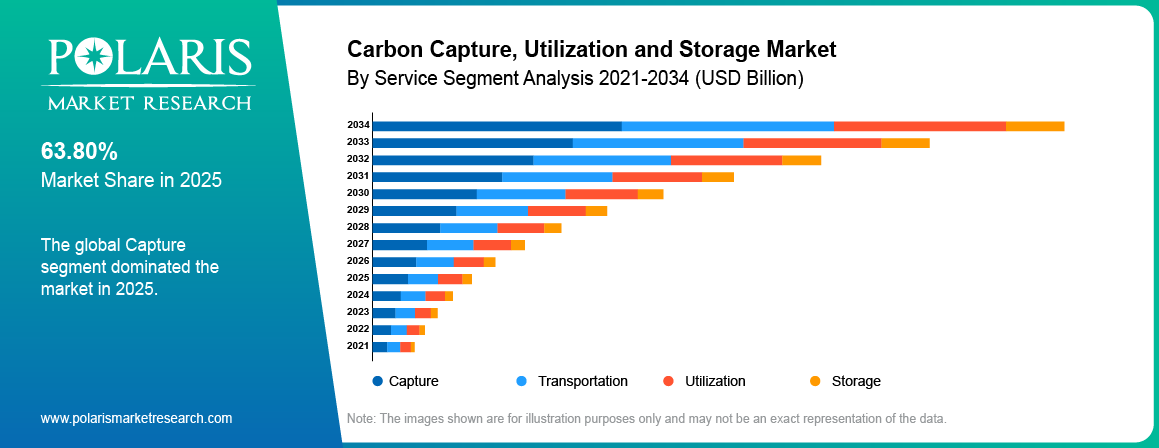
- The capture segment led with an 63.80% share in 2025. This is because it is the mandatory first step in the entire carbon chain.
- The transportation segment is expected to grow at a 25.20% CAGR. Rising industrial capture projects have created the need for extensive new pipeline networks.
- The oil & gas segment held an 34.50% market share in 2025. This is owing to the industry's infrastructure and technological expertise.
Note: Figures and projections outlined in this report are the result of Polaris Market Research’s proprietary analytical processes, grounded in the latest available datasets and market observations.
What Is CCUS?
CCUS refers to carbon capture, utilization, and storage, whereby carbon dioxide is captured from industrial processes or the air. The carbon dioxide that has been captured can then be utilized by industries for different uses or stored geologically. The carbon capture and storage market covers the technologies and services used across these activities. The technology assists industries in reducing emissions from non-decarbonizable processes.
How Carbon Capture, Utilization and Storage Works?
The CCUS system includes a number of stages whereby carbon dioxide is moved from an emission source up to the point where it is used or stored. This system can be used for both industrial plants and other sources of concentrated carbon dioxide emissions. Each stage requires proper equipment and monitoring facilities.
CO₂ Capture: The carbon dioxide (CO₂) is separated from exhaust gases in industries prior to their emission into the atmosphere. Various ways of capturing CO₂ depend on the emissions' source and nature of exhaust gases. Post-combustion, pre-combustion, and oxy-fuel combustion are among the main approaches used for capturing CO₂ from industrial processes.
Conditioning and preparation of the captured CO₂: The gas undergoes conditioning before transportation. This is done in accordance with the requirements of the selected mode of transportation.
CO₂ transportation: Transportation of the gas involves moving it either for utilization or storage. CO2 pipeline is always the most preferred mode in case of large amounts of gas. Otherwise, other modes of transportation apply.
CO₂ utilization: Some amount of the captured CO₂ is used as raw material for some industrial activities. Uses include chemicals, fuels, building materials, and carbon-based products.
CO₂ storage: Unutilized CO₂ may be stored in appropriate geological formations. These involve saline formations and depleted oil and gas reservoirs.
Monitoring and verification of storage: This involves monitoring the stored carbon in order to follow its movements underground. Measurement and verification are necessary to ensure storage of carbon for the required period.
Role in Net-Zero & Decarbonization Strategies
CCUS plays a vital role in meeting the net-zero target by curbing CO2 emissions in industries where switching directly to electricity and other alternative forms of fuel is difficult. In addition, it may reduce emissions in certain industries like cement, steel, chemicals, and refining. It may also facilitate the creation of low-carbon hydrogen and carbon dioxide removal. With more ambitious targets in place for carbon reduction, CCUS becomes another route for managing industrial emissions. Besides, CCUS ensures the continuity of industrial activity in industries with a high emission intensity, moving towards greener production processes.
Market Dynamics
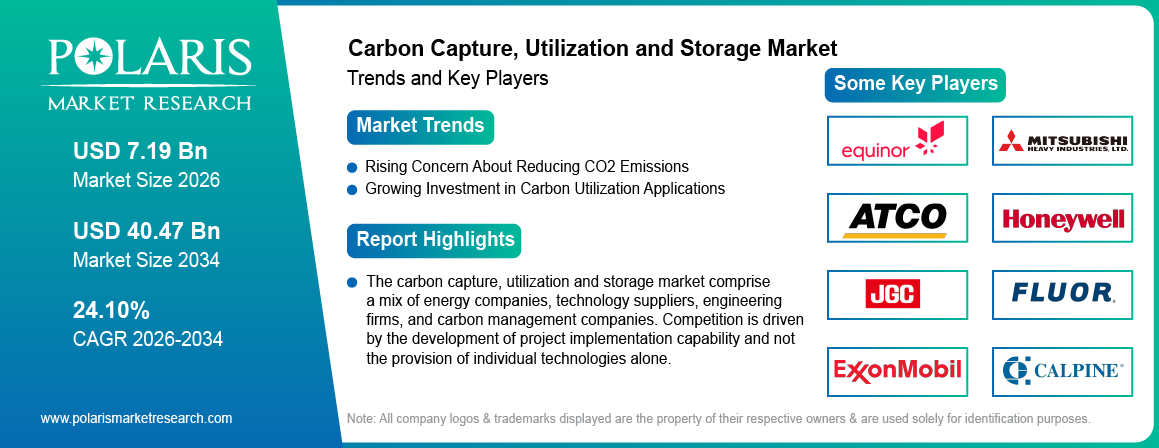
Drivers: Rising Concern About Reducing CO₂ Emissions
The growing concerns about CO₂ emissions have resulted in an increased demand for technologies that can help minimize the emissions from existing industrial operations. In sectors like cement, steel, chemicals, and power, process emissions are difficult to avoid through electrification and optimization of efficiency alone. Hence, there is increasing emphasis on technologies related to carbon capture, utilization, and storage as a way of decarbonizing. The Government of India launched the first integrated CCUS field laboratory in India in May 2026 at the Indian Institute of Technology Bombay. This lab incorporates carbon capture, CO2 use, and geological storage and is equipped to aid in the development of technology for controlling carbon emissions (source: pib.gov.in). Such developments have increased the technological base of CCUS and also interest in reducing carbon emissions by industries.
Drivers: Growing Investment in Carbon Utilization Applications
The growth of investments in carbon utilization has opened up new commercial pathways for the captured CO₂, along with making CCUS technology more economical. Instead of looking upon the captured carbon as a waste to be stored in a geological formation, companies are discovering ways in which they could make productive use of it. This not only creates potential revenue but also reduces the amount of CO₂ that needs to be stored. A recent example was seen in June 2026, when Australia launched its first carbon refinery in New South Wales. This carbon refinery is owned by MCI Carbon and uses the CO₂ generated from the manufacture of ammonia at Orica. The pilot carbon refinery has a capacity to capture 2,500 tons of CO₂ per year and manufacture concrete, paper, and glass (source: mcicarbon.com). This project demonstrates an application of carbon capture technology and may attract more investments in the carbon capture, utilization and storage market.
Restraints & Challenges: High Cost of CCUS Plant Installation and Maintenance
High investment cost in the construction and operation of CCUS plants is one of the primary barriers. There are significant differences in economics depending on the plant, CO₂ concentration, the amount of energy needed, and existing infrastructure. In 2026, the costs of capturing CO₂ in power plants were reported to be USD 100 per ton of CO₂, whereas less costly uses of this technology, such as ethanol production, would cost below USD 35 per ton (source: usa.carbon-capture-conference.com). The mentioned costs relate to the capture step and can rise even higher if other aspects like compression, transportation, storage, monitoring, and maintenance are added. High costs can make it hard to justify the project economically, especially if substantial retrofitting is needed.
Opportunities: Direct Air Capture (DAC) Expansion
A major opportunity in the carbon capture, utilization and storage market is the expansion of DAC. With the emergence of DAC, the CCUS market could grow beyond point-source capture at highly concentrated industrial emission sources. This technology involves CO₂ capture from ambient air, which means that CO₂ removal can be considered in industries where emissions reduction would not be enough on its own. The rising need for verifiable carbon removal has prompted technology developers to scale projects and make them more efficient. Funding and policy support have become more significant as governments have adopted financing systems for technologies that could pull out CO₂ from the atmosphere. The U.S. Department of Energy continues to finance DAC as part of the Carbon Negative Shot initiative and many DAC centers throughout the country. With developments in technology and reduced energy needs, DAC systems could enable CO₂ capture, transport, and storage.
Opportunities: Blue Hydrogen and Carbon Utilization
The rise in blue hydrogen production provides yet another opportunity for CCUS because carbon capture is a part of the hydrogen production process. Blue hydrogen is produced from natural gas, and CO2 is captured during the hydrogen production process and either sequestered or used. Higher demand for low-carbon hydrogen production can drive investments into the respective capturing and storing infrastructure. At the same time, carbon utilization can provide more outlets for captured CO2 in terms of synthetic fuels, chemical products, and building materials. Development of hydrogen hubs and industrial parks provides additional opportunities for the hydrogen economy through combining production, capture, transportation, and sequestration facilities.
Trends: Expansion of CO₂ Transport Infrastructure
The emergence of specialized CO₂ transportation infrastructure has become another significant trend since CCUS technologies go beyond capture facilities. Transport pipelines, ships, and shared carbon transportation hubs may link several emission sources to storage sites. That way, it is possible to avoid developing individual transport infrastructure in every CCUS project. Also, it contributes to the creation of larger carbon management networks. In 2026, there is growing interest in integrated transport infrastructure linking industrial complexes to offshore and international carbon storage hubs. One such example is the expansion of the Northern Lights network in Norway. By 2028, the transport capacity of this project is expected to increase from 1.5 million to 5 million tons per year (source: norlights.com). Development of such infrastructure is helping shape CCUS towards becoming more networked.
Trends: Greater Focus on CO₂ Measurement, Reporting, and Verification
Greater emphasis on measurement, reporting, and verification is becoming an integral part of the CCUS market development as participants are seeking evidence of the amount of CO₂ captured and sequestered. Measurement of CO₂ levels is vital for all the stages of CCUS, including capture, transportation, utilization, or geologic storage. Strong MRV mechanisms can help companies monitor the storage efficiency and detect possible changes in the amount of stored CO₂. Measurement mechanisms are useful when proving the reduction in GHG emissions and meeting the regulatory requirements. As the complexity of CCUS projects grows, the standardization of measurement methods and digital monitoring solutions is expected to become increasingly important in the carbon capture, utilization and storage market.
Report Segmentation
The carbon capture, utilization and storage market is segmented on the basis of technology, services, end use, and region. The technology segmentation segment covers the major approaches used in carbon capture and storage. The services segmentation segment reflects activities across the CCUS value chain. End use segmentation identifies various industries utilizing the services provided by the CCUS market.
| Segment Category | Sub-Segments |
| Technology | Chemical Looping · Solvents & Sorbent · Membranes · Direct Air Capture (DAC) |
| Service | Capture · Transportation · Utilization · Storage
|
| End Use | Iron & Steel · Cement · Oil & Gas · Chemical & Petrochemical · Power Generation · Others |
| Region | North America (U.S., Canada) · Europe (UK, Germany, France, Italy, Spain, Netherlands, Russia, Rest of Europe) · Asia Pacific (China, India, Japan, Malaysia, Indonesia, South Korea, Rest of Asia Pacific) · Latin America (Brazil, Mexico, Argentina, Rest of Latin America) · Middle East & Africa (Saudi Arabia, UAE, Israel, South Africa, Rest of Middle East & Africa) |
Source: Polaris Market Research Analysis
By Technology Insights
The chemical looping segment held an 8.50% share in the carbon capture, utilization and storage market in 2025, driven by the growing adoption of technologies that improve CO₂ separation in industrial processes. In chemical looping, solid oxygen carriers are used for the delivery of oxygen between reactors, which produces a stream of concentrated CO₂ that is easier to capture and process. This technology also enables the reduction in the use of air separation in some industrial processes. Its applicability in helping industries generate lower-emission electricity and production is attracting increasing attention. Efforts towards improvements in terms of reactor design, oxygen carriers, and efficiencies of the process are facilitating the use of chemical looping technology.
The solvent & sorbent segment accounted for an 70.03% carbon capture, utilization and storage market share in 2025. This is due to growing demand for effective means of separating CO₂ from gas streams. The systems involving the use of solvents can be easily integrated within the existing capture systems and have been widely considered for use where there are high amounts of emissions. In addition, the sorbent-based systems have gained considerable traction because of their capability to effectively separate CO₂ from gas streams. The continuous efforts made to improve the capacity for capturing carbon dioxide, reduce the energy consumption during the regeneration process, and increase the life of materials are driving the demand for these solutions.
| Technology | How It Works | Best Fit | Cost Profile |
| Chemical Looping | Metal-oxide oxygen carrier separates CO2 from fuel combustion without direct air contact. | New-build and retrofit power/industrial plants seeking lower energy penalty | Lower operating cost than solvent regeneration; largest revenue share |
| Solvents & Sorbents | Amine-based chemical absorption reacts preferentially with CO2 in flue gas | Retrofits of existing power and industrial facilities | Mature, proven technology; moderate-to-high regeneration energy cost |
| Membranes | Selective permeable membranes separate CO2 from other flue-gas components. | Natural gas processing and modular capture installations | Compact footprint; costs falling as membrane materials improve |
| Direct Air Capture (DAC) | Captures dilute CO₂ directly from ambient air via chemical or electrochemical processes | Carbon removal / negative-emissions projects, corporate offtake agreements | Highest cost per tonne today; steepest projected cost decline |
Source: Polaris Market Research Analysis
By Service Insights
The capture segment led with an 63.80% revenue share in 2025. CO₂ capture systems are fitted in plants for the separation of carbon dioxide from emission gases before they are released into the air. Demand is backed by decarbonization initiatives in electricity production, cement, steel, chemical, and oil & gas sectors. The segment is also gaining from growth in investments in new CO₂ capture plants and in existing industrial plants. Advances in efficiency, design, and energy consumption of the systems are assisting operators in handling their operational demands. As operators look for methods to cut emissions from hard-to-abate processes, demand for CO₂ capture technology will remain robust.
The transportation segment is projected to register a CAGR of 25.20% during the forecast period owing to the rising requirement for transportation of the captured carbon dioxide from its source to usage and storage locations. Due to the geographical distribution of CCUS projects, there is a need for transportation systems that can link the different stages of the process chain. Pipelines can be used to transport large and continuous amounts of carbon dioxide, whereas ships can be used for long-distance and offshore transportation. The mode of transportation can be decided depending on the distance, volume of carbon dioxide, storage site, and presence of existing infrastructure. The increased development of networked CO₂ transportation systems has led to new opportunities for third-party transportation and infrastructure services.
| Service Segment | Role in Value Chain | Share Position (2025) | Growth Outlook |
| Capture | First and most critical step (removes CO2 at the emission source) | Largest share of the four service segments | Steady growth; foundation for the rest of the chain |
| Transportation | Moves compressed CO2 by pipeline, ship, rail, or truck to storage or use | Smaller current share | Fastest-growing service segment as multi-user pipeline networks expand |
| Utilization | Converts captured CO2 into EOR injectant, fuels, chemicals, or building materials | Moderate share | Expanding as carbon-utilization revenue models mature |
Source: Polaris Market Research Analysis
By End-Use Insights
The oil & gas segment held an 34.50% carbon capture, utilization and storage market share in 2025, owing to the industry's infrastructure and technological expertise, along with its experience handling massive amounts of CO₂. Oil and gas companies operate in a number of stages in the CCUS value chain, such as capturing, transporting through pipelines, injecting, and geological storage of CO₂. Subsurface formation knowledge can also support the development of carbon storage projects. Moreover, the captured CO₂ can be used in enhanced oil recovery (EOR) activities in appropriate fields, thus providing an established CO₂ utilization route. The presence of large-scale industrial plants and energy infrastructures in the oil & gas industry provides a base for incorporating CCUS technology in existing processes.
The chemical & petrochemical segment is projected to grow at an 25.50% CAGR. Chemical and petrochemical plants produce emissions from energy consumption as well as from production processes, providing an opportunity for specific carbon capture techniques. Also, the presence of centralized plants can simplify the process of incorporating the capture technology in certain plants. There are ongoing developments related to using the captured carbon dioxide as a raw material for the production of various chemicals, fuels, and other products. This not only increases the value of the captured carbon but also helps reduce the emissions factor during the chemical production process.
Commercial Use Cases Across Industries
CCUS is emerging as a commercial service that could be used for managing emissions, product development, and carbon reduction strategies. Business applications of CCUS are not limited to the technological process itself but go further to cover services related to the management of carbon liabilities and carbon monetization.
| Use Case | Commercial Application |
| Low-Carbon Products | Captured CO₂ may be used as part of certain products, assisting producers in developing goods that emit fewer emissions. |
| Carbon Removal | Companies can buy carbon removal services to address emissions that cannot be reduced by operational changes. |
| CCUS as a Service | Industries can outsource some elements of their carbon capturing and storage requirements to external firms. |
| Carbon-Based Feedstock | CO₂ may be used as a raw material in certain manufacturing processes and chemical reactions. |
| Emissions Management | CCUS assists major emissions sources in managing their emissions while pursuing their decarbonization efforts. |
| Carbon Removal Credits | Permanent carbon storage may contribute to the development of carbon removal credits by companies dealing with residual emissions. |
Source: Polaris Market Research Analysis
CCUS vs Carbon Credits & Renewable Energy
CCUS, carbon credits, and renewable energy manage emissions in different ways. CCUS focuses on capturing CO2 and utilizing or storing the same. Renewable energy reduces emissions by replacing fossil fuel-based energy generation with solar or wind energy. Carbon credits provide market-based solutions to emissions in the form of carbon reduction and removal projects. The three strategies can thus be used differently when formulating decarbonization policies at both corporate and national levels.
| Factor | CCUS | Carbon Credits | Renewable Energy |
| Primary Role | Captures and manages CO₂ emissions | Compensates for verified emissions reductions or removals | Replaces fossil-based energy generation |
| How It Reduces Emissions | Removes CO₂ from industrial streams or the atmosphere | Funds or represents emissions reductions or removals elsewhere | Reduces fossil fuel use in electricity generation |
| Main Applications | Cement, steel, chemicals, hydrogen, power, and other industrial activities | Corporate climate programs and emissions management | Electricity generation, industrial power, and other energy needs |
| Revenue Model | Capture, transport, storage, utilization, and related services | Sale and purchase of carbon credits | Sale of electricity and renewable energy attributes |
| Key Infrastructure | Capture equipment, CO₂ transport, and storage facilities | Verification systems, registries, and trading platforms | Solar panels, wind turbines, grids, and storage systems |
| Best Fit | Hard-to-abate industries and carbon removal | Addressing emissions that remain after reduction efforts | Reducing emissions from energy consumption |
| Key Limitation | High project costs and infrastructure requirements | Credit quality and additionality concerns | Variable generation and grid integration requirements |
Source: Polaris Market Research Analysis
Policy & Incentive Landscape: 2026 Section 45Q Update
Section 45Q remains an important policy tool in the U.S. supporting investment in carbon capture and storage systems. In 2026, the Internal Revenue Service set the adjustment factor for the carbon oxide sequestration credit at 1.4639. This results in a credit of USD 29.28 per metric ton of carbon oxide captured in geological secure storage and USD 14.64 per metric ton of carbon oxide used in some other applications (source: irs.gov).
The policy framework was also affected by the One Big Beautiful Bill Act (OBBBA), enacted in July 2025. The legislation modified Section 45Q, including provisions establishing parity between credit amounts for geological storage and certain utilization pathways for qualifying facilities or equipment placed in service after July 4, 2025. It also introduced restrictions related to specified foreign and foreign-influenced entities (source: globalccsinstitute.com).
Additionally, in 2026, the IRS provided further guidance on reporting and verification. In particular, Notice 2026-50 broadened the scope of an existing safe harbor that pertains to the carbon oxide reported under EPA's Subpart RR system. It relates to secure geological storage of CO₂ and to its use as a tertiary injectant in enhanced oil and natural gas recovery projects. Such changes help bring more clarity to project developers and taxpayers in evaluating their eligibility under Section 45Q incentives (source: irs.gov).
In general, the 2026 policy environment offers financial incentives for eligible CCUS projects while putting more weight on issues of eligibility, reporting, and verification. These aspects are crucial for the economic performance of carbon capture projects, as tax credits may significantly affect the financial attractiveness of the investment.
Carbon Capture Market By Region
North America
North America dominated with an 38.20% carbon capture, utilization and storage market share in 2025. The regional market dominance is driven by the presence of infrastructure that is designed to manage carbon emissions, supportive policies, and a growing number of CCUS projects in the pipeline. In particular, the U.S. accounts for most of regional activity due to favorable 45Q tax credit carbon capture conditions for eligible projects. Geographical conditions in the region allow for the use of suitable geological formations for permanent CO₂ storage in areas that already have well-established oil and gas operations. In Canada, the CCUS ecosystem is being developed through various incentives at the federal and provincial level and large-scale project developments. The presence of industry activity in power generation, cement production, chemicals, refining, and hydrogen production provides for a wide range of applications of the technology. Partnerships among industries help further develop CCUS projects by linking emitters and transport/storage organizations.
Europe
Europe accounted for an 27.50% share of the carbon capture, utilization and storage market in 2025. Europe is becoming a major market for CCUS because of stringent emissions standards, the need to decarbonize industry, and increased funding of carbon management infrastructure. There is a robust project pipeline in Europe for sectors including cement, chemicals, refining, steel, and waste-to-energy. The European Union carbon reduction goals and the EU Emissions Trading Scheme are prompting industries to assess options for managing difficult-to-tackle emissions. Northern European nations are also establishing offshore CO2 storage facilities, creating opportunities to build inter-state carbon transport and storage facilities. Countries developing inter-state CCUS markets include Norway, Denmark, and the Netherlands. The availability of hydrocarbon reservoirs, among other options, supports this storage option. Europe’s push for common infrastructure and a cross-border CO2 network is also helping develop the CCUS market.
Asia Pacific
Asia Pacific is projected to account for an 26.00% CAGR. Asia Pacific has emerged as one of the key markets for CCUS as far as its significant industrial sector and increasing concern towards emissions management is concerned. Countries like China, Japan, South Korea, Australia, and India have shown interest in CCUS technologies to mitigate emissions from power plants, cement, steel, chemical, and refining sectors. In addition, geologic storage potential exists in Asia Pacific, although it varies by country. Governments in the region are taking action and formulating policies to facilitate the establishment of carbon capture facilities together with the supporting infrastructure. The transportation of CO₂ across borders is also becoming a point of interest as some countries in the region have limited ability to store CO₂. The industrial clusters might contribute to the creation of shared infrastructure for CO₂ capture, transportation, and storage.
Middle East & Africa
The Middle East & Africa accounted for an 6.80% carbon capture, utilization and storage market share in 2025. Regional expansion is driven by the existence of an established oil and gas industry and the increasing need to reduce carbon emissions from energy-intensive industries. Projects involving carbon management have attracted interest from Middle Eastern countries due to the region’s well-developed energy infrastructure, high level of technological expertise, and geological suitability for storing CO₂. CCUS has also been considered in conjunction with the generation of hydrogen and reduction of carbon intensity in the oil and gas sector. In Africa, carbon capture technologies are developing, and opportunities are emerging through industries, natural gas processing facilities, and carbon management initiatives.
Latin America
Latin America is projected to grow at an 22.50% CAGR. Growth will also be stimulated by increasing interest in carbon management among industries with high emissions. Oil and gas, cement production, power generation, and chemicals could be sectors where CCUS technologies are applied. Several countries in the region have geological formations suitable for CO₂ storage. As companies increasingly seek opportunities to cut emissions from existing installations, demand for CCS services will rise. Nevertheless, the pace of development will depend on many factors, including economic efficiency, infrastructure development, and policies in particular countries.
Competitive Landscape
The carbon capture, utilization and storage market comprise a mix of energy companies, technology suppliers, engineering firms, and carbon management companies. Competition is driven by the development of project implementation capability and not the provision of individual technologies alone. Investments are being made in CCUS capture, transportation of the captured CO₂, storage, and utilization processes. Partnerships among players are also common, especially in large-scale projects where various technologies and storage opportunities are needed. Traditional oil and gas companies have strengths in subsurface and infrastructure experience. Technology companies are focusing on improving capture efficiency and reducing operating costs. Start-ups are developing innovations in direct air capture, carbon utilization, and modular capture technologies.
Vendor Positioning
| Company | Primary Role in CCUS | Strategic Focus |
| Shell plc | Capture, transport & storage operator | Northern Lights (Europe), Polaris CCS and Atlas Hub (Canada) |
| Equinor ASA | Storage & full-chain operator | Sleipner and Northern Lights offshore storage; frequently cited as market leader on scale |
| ExxonMobil Corporation | Capture & storage service provider | Baytown Energy Center transport-and-storage agreement with Calpine |
| TotalEnergies SE | Full-chain partner | Co-investor in Northern Lights expansion |
| Linde plc | Industrial gas processing & capture technology | CO2 capture, purification, and liquefaction across industrial accounts |
| Fluor Corporation | Engineering & project delivery | CO2 mineral storage exploration (Carbix MOU) and EPC delivery |
| Mitsubishi Heavy Industries | Capture technology & pilot projects | Power-sector CCS pilots in Japan with JERA and regional utilities |
| Honeywell International Inc. | Capture equipment, subsurface services, process technology | Supporting infrastructure and equipment across capture and storage projects |
Source: Polaris Market Research Analysis
CCUS Companies
- Aker Solutions ASA
- ATCO EnPower
- Calpine Corporation (Operating as a subsidiary of Constellation Energy)
- Equinor ASA
- Exxon Mobil Corporation
- Fluor Corporation
- Honeywell International Inc.
- JGC Holdings Corporation
- Linde plc
- Mitsubishi Heavy Industries, Ltd.
- Shell plc
- SLB N.V.
- TotalEnergies SE
Recent Developments
-
June 2026: Burckhardt Compression won an order to supply compression systems for the first industrial-scale liquefied CO2 carrier serving the Northern Lights CCS project. (source: burckhardtcompression.com)
-
May 2026: California Resources Corporation injected its first CO2 at Carbon TerraVault I in Kern County, the first project to permanently store carbon underground in California. (source: crc.com)
-
May 2026: The UK Government published the official final project summaries and outcomes for its CCUS Innovation 2.0 Competition. These publications detailed advancements in both monolithic metal-organic frameworks (MOFs) and concrete-based carbon mineralization. (source: gov.uk)
- February 2026: The Indian Government announced a major financial outlay of INR 20,000 crore (approx. USD 2.2 billion) across five years in the Union Budget 2026–27 to advance CCUS readiness and test beds in hard-to-abate sectors like steel, cement, and refineries. (source: indiabudget.gov.in)
Report Coverage & Scope
| Report Attributes | Details |
| Market Size Value in 2025 | USD 5.81 billion |
| Market Size Value in 2026 | USD 7.19 billion |
| Market Forecast 2034 | USD 40.47 billion |
| CAGR | 24.10% from 2026 to 2034 |
| Base Year | 2025 |
| Historical Data | 2021–2024 |
| Forecast Period | 2026–2034 |
| Quantitative Units | Revenue in USD billion and CAGR from 2026 to 2034 |
| Report Coverage | Revenue Forecast, Market Competitive Landscape, Growth Factors, and Industry Trends |
| Segments Covered |
|
| Regional Scope |
|
| Competitive Landscape |
|
| Report Format |
|
| Customization | Report customization as per your requirements with respect to countries, regions, and segmentation. |
Source: Polaris Market Research Analysis
Research Methodology
Polaris Market Research estimates the global CCUS market using a two-stage process. The process combines exhaustive secondary research with structured primary validation. Secondary research draws on company financial statements, trade and industry association data, government and regulatory filings (including U.S. Treasury and IRS guidance on Section 45Q), and peer-reviewed and IEA project-tracking data to build an initial view of market size, segmentation, and competitive structure. We then validate and refine this initial estimate through primary interviews with CXOs, business-development leaders, technology and product teams, and supply-side system integrators. We also interview CIOs, CTOs, and procurement teams representing end-use industries on the demand side to validate estimates.
We apply and reconcile both top-down (starting from total addressable emissions and policy-driven capacity targets) and bottom-up (aggregating individual project and company-level capacity) approaches through data triangulation, so segment- and region-level figures sum consistently to the total market estimate. Forecasts incorporate announced project pipelines, government incentive structures (including Section 45Q credit values and eligibility rules), and technology cost-curve assumptions. We revisit forecasts at each report refresh to reflect newly disclosed capacity, policy changes, and completed transactions.
Carbon Capture, Utilization and Storage Market FAQ's
The CCUS market size was valued at USD 5.81 billion in 2025. The market is projected to grow to USD 40.47 billion by 2034.
The market is projected to grow at an 24.10% CAGR from 2026 to 2034.
North America accounted for an 38.20% market share in 2025. Robust government incentives contribute to the market’s leading position.
A few of the key market players include Aker Solutions ASA; ATCO EnPower; Calpine Corporation (Operating as a subsidiary of Constellation Energy); Equinor ASA; Exxon Mobil Corporation; Fluor Corporation; Honeywell International Inc.; JGC Holdings Corporation; Linde plc; Mitsubishi Heavy Industries, Ltd.; Shell plc; SLB N.V.; and TotalEnergies SE.
The transportation segment is projected to grow at an 25.20% CAGR. This is because rising industrial capture projects have created the need for extensive new pipeline networks.
The cost varies depending on the facility, the carbon capture process, and the emission sources. For some power facilities, carbon capture cost per ton is estimated at around USD 100 per ton of CO?. Some applications such as ethanol production have lower cost estimates.
Direct air capture market solutions remove CO? from the atmosphere instead of capturing it from an industrial emission source. The captured CO? can then be stored permanently or used in selected applications. DAC is being developed as an option for removing carbon from the atmosphere.
Incentives from governments may impact the financial feasibility of CCUS initiatives. In the U.S., for instance, Section 45Q offers tax credits for carbon capture, utilization, and storage activities that meet certain conditions.
Download Sample Report of Carbon Capture, Utilization and Storage Market
Please fill out the form to request a customized copy of the research report.


