
AI Protein Design Market Size, Share, and Forecast 2026 to 2034
REPORT DETAILS
AI Protein Design Market Summary
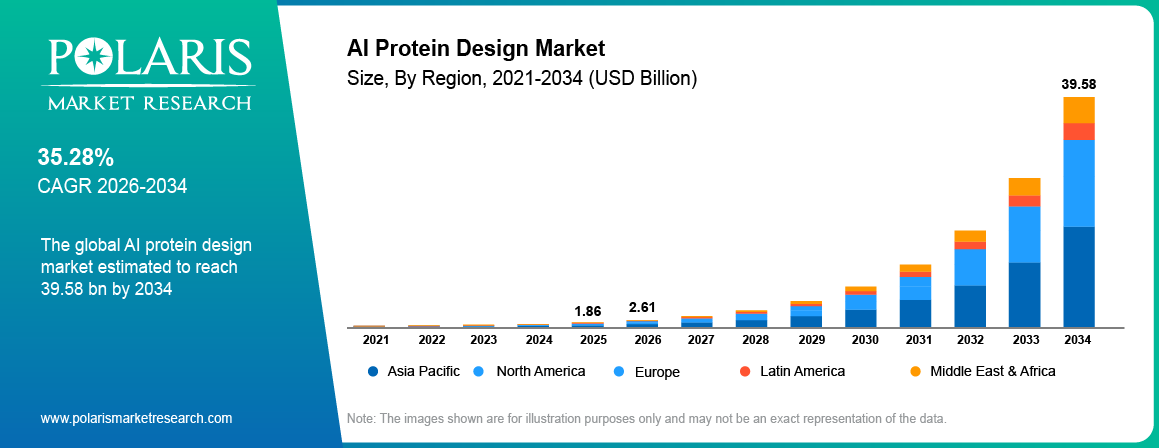
AI protein design market size was valued at USD 1.86 billion in 2025. The market is expected to grow at a CAGR of 35.28% from 2026 to 2034. Growth is driven by generative protein design, protein foundation models, diffusion-based design, structure prediction platforms, and AI-guided sequence optimization. Key AI protein design market trends include clinical-stage antibody programs, rising pharma partnerships, and open-source foundation models. North America held the largest AI protein design market share in 2025, while Asia Pacific is expected to record the fastest growth.
Market Statistics
Key Takeaways
- North America dominated the AI protein design market with 44.62%share in 2025, driven by concentrated clinical-stage programs, major generative biology companies, and strong investment in protein design platforms. This leadership is expected to shape the AI protein design market forecast through 2034.
- Asia Pacific is expected to register the fastest growth at 39.46% CAGR during 2026–2034, driven by expanding biotechnology research and adoption of AI-based protein design technologies.
- Structure Prediction accounted for 36.14% share in 2025, driven by broad use of platforms such as AlphaFold and Boltz across structural biology and protein analysis.
- Generative De Novo Design is expected to register the fastest growth at 40.42% CAGR during 2026–2034, driven by the development of new protein structures, binders, miniproteins, and therapeutic candidates.
- Antibodies accounted for an 31.46% share in 2025, driven by the concentration of clinical-stage AI designed protein programs, including GB-0895 and Absci's antibody candidates.
- De Novo Binders & Miniproteins are expected to register the fastest growth at 40.18% CAGR during 2026–2034, driven by generative models that create new protein scaffolds without natural analogues.
Note: Figures and projections outlined in this report are the result of Polaris Market Research’s proprietary analytical processes, grounded in the latest available datasets and market observations.
AI Protein Design Market Definition
The AI protein design market is artificial intelligence software, foundation models, computational platforms, and design services used to predict protein structures, optimize sequences, and design new proteins. These technologies allow researchers to test the properties of proteins before testing them in the lab. Applications span therapeutic development, industrial biotechnology, enzyme research, structural biology and academic research creating a broad technology market across several stages of protein discovery and engineering.
The market involves structure prediction, generative de novo design and AI-guided sequence optimization. Structure prediction models investigate 3D protein structures and molecular interactions. Generative systems construct new protein sequences or structures with specific biological objectives. These capabilities extend the application of generative protein design to antibodies, peptides, miniproteins, binders, enzymes and other protein modalities. Sequence optimization then improves selected candidates for specific biological characteristics.
De novo protein design is a key technology layer in the market. Researchers have a tool in generative models to explore novel protein structures not just those found in nature. Protein foundation models learn from large-scale biological data to discover patterns in sequences, structures, and functions. These capabilities offer researchers computational methods to predict, generate, structurally analyze and optimize across early-stage protein development workflows.
The market also features protein engineering AI used to improve binding, stability, expression, affinity, activity and manufacturability. AI-driven workflows can help researchers prioritize protein candidates prior to laboratory validation and reduce the size of experimental candidate pools. This excludes the AI-driven small molecule discovery under AI in Drug Discovery. AI-Generated Enzymes also exclude finished industrial enzyme products, so the AI protein design market report will focus on protein design technology.
Drug Pipeline Analysis
AI-Designed Protein Therapeutics Pipeline: Clinical and Preclinical Candidates
| Candidate | Company | Mechanism | Phase | Trial Identifier | Status |
| GB-0895 | Generate Biomedicines | Anti-TSLP antibody, generatively engineered for affinity, half-life | Phase 3 | SOLAIRIA-1 / SOLAIRIA-2 | Clinical development in severe asthma |
| ABS-201 | Absci | Anti-PRLR antibody, generative AI design | Phase 1/2a | HEADLINE (NCT07317544) | Ongoing; interim safety data reported |
| ABS-101 | Absci | Anti-TL1A antibody for IBD | Phase 1 | — | Phase 1 interim data reported; partnering sought |
| Undisclosed multi-target program | Novartis / Generate Biomedicines | De novo protein therapeutics | Preclinical | N/A | Multi-target collaboration |
| Up to 3 targets | Merck (MSD) / Absci | Generative biologics design | Preclinical | N/A | Collaboration since January 2022 |
Source: Polaris Market Research Analysis.
The AI protein design market pipeline is advancing to later-stage clinical development with antibody programs developed or optimized with generative approaches. These programs show how computational protein design is moving beyond structure prediction and sequence optimization and toward human trials. Development at the clinical stage also represents a pragmatic metric of the maturity of the technology, since candidates must pass biological validation before they enter clinical studies. Eventually this advance is driving commercial interest in AI-designed protein platforms for therapeutic discovery.
The increasing importance of AI-powered antibody technologies in therapeutic research is also reflected in Clinical Programs. Generative protein design allows developers to explore new antibody structures and optimize features such as target binding, stability and pharmacokinetic performance. With AI-generated candidates now in clinical studies, this opens up more opportunities for platform providers, pharma partnerships, and biotech companies looking for computational approaches to improve protein discovery and development workflows.
Market Dynamics
Driver: Clinical Progress Is Expanding Confidence in Generative Protein Design
Clinical advancement of generatively designed proteins is creating a stronger validation pathway for the overall AI protein design market. In July 2026, Broad Institute researchers combined AI-designed proteins with lab evolution to improve protein activity, specificity and stability. This shift from computational design to human testing indicates that artificial intelligence systems are progressing beyond structural prediction to the generation of therapeutic proteins with desired biological properties. GB-0895’s generatively designed antibody for severe asthma is an important late-stage benchmark. This advancement has sparked industry interest in AI-designed proteins as successful progression through clinical development can enhance confidence in computational design methods, increase pharmaceutical interest and generate a greater demand for platforms that produce clinically relevant protein candidates (Source: Broad Institute).
Driver: Rising Capital Investment Is Expanding the Generative Protein Design Ecosystem
Growing capital investment is expanding the overall AI protein design market by increasing funding available for model development, computational infrastructure, protein engineering, laboratory validation, and therapeutic programs. Large financings for generative biology companies provide resources to build broader technology platforms rather than limiting AI applications to individual research projects. Investment is also reaching the protein foundation model layer, where specialized companies are developing models for protein sequence, structure, and function. More capital availability leads to larger computational power, proprietary data sets, integrated workflows and larger protein development pipelines. This diversifies the commercial ecosystem. In November 2025, Profluent closed a USD 106 million Series B round co-led by Altimeter Capital and Bezos Expeditions to expand its protein design platform into therapeutics, agriculture, and biomanufacturing (Source: Bioxconomy).
Restraint: Limited Clinical Validation Restricts Wider Commercial Adoption
Limited clinical validation is a major obstacle to the overall AI protein design market. Many generative protein programs remain in the pre-clinical stage, creating a gap between the computational and demonstrated therapeutic performance. AI in protein engineering can generate or optimize promising candidates, but extensive experimental validation is needed to demonstrate biological activity, safety, pharmacokinetics, immunogenicity and manufacturability. This long validation pathway increases development time, capital requirements and commercial uncertainty. Pharma buyers also have difficulty comparing platforms due to the lack of clinical evidence. This may result in increased value placed on biological validation, development experience, private datasets, and clinical progress in the evaluation of AI protein design technologies by organizations.
Opportunity: Pharmaceutical Partnerships Are Expanding Access to Generative Design Capabilities
As pharma collaborations grow, existing drug developers are able to leverage niche generative capabilities, opening a window for the AI protein design market. Nuclera partnered with leadXpro in Feb 2026 to combine AI/ML-driven construct design with rapid multiplex screening to accelerate structure-based drug discovery for complex membrane proteins. Pharmaceutical companies are able to use external platforms for protein production, sequence optimization, target exploration, and candidate development. This enables them to not have to develop all of their computational capabilities in-house. This model creates commercial opportunities through licensing, up-front payments, milestones, research agreements and collaborative development programs. More partnership activity means more protein programs going into development, creating more demand for generative protein design platforms. This model allows the technology providers to generate commercial revenue during long development cycles before individual protein candidates gain regulatory approval (Source: leadXpro).
Opportunity: Integration of Wet-Lab Capabilities Is Improving Protein Design Workflows
Integration of computational systems with laboratory infrastructure is generating a substantial opportunity for the AI protein design market. AI models can generate a vast array of protein candidates, but their structures, functions and biological characteristics must be validated through physical testing. Computational design is combined with protein synthesis, screening, structural analysis and experimental validation, leading to an integrated development pipeline. It allows you to generate candidates, test performance, collect biological data, and then refine your next design through multiple cycles. Greater integration can improve the efficiency of de novo protein design by connecting computational generation directly with physical validation, creating additional value for integrated protein development platforms.
Driver Impact Analysis
The table below summarizes the estimated influence of key growth drivers on the AI protein design market during 2026–2034.
| Market Driver | Impact | Geographic Relevance | Impact Timeline |
| Clinical progress of generatively designed proteins | High | North America, Europe | Medium to long term (3–5 years) |
| Rising capital investment in generative biology | High | North America, Europe, Asia Pacific | Short to medium term (1–3 years) |
| Pharma partnerships and platform licensing | High | North America, Europe | Short to medium term (1–3 years) |
| Wet-lab and AI workflow integration | Medium | North America, Asia Pacific | Medium term (2–4 years) |
Source: Polaris Market Research Analysis
AI Protein Design Market Segmentation Analysis
The report provides a comprehensive analysis of the AI protein design market by design approach, protein modality, application, end user, and region to identify leading market segments and high-growth opportunities.
Design Approach Insights
The market is segmented into Structure Prediction, Generative De Novo Design, and AI Guided Sequence Optimization. Structure Prediction held the market share of 36.14% in 2025, due to the wide usage of computer models in protein structure analysis, biological research, target assessment and protein engineering. These models allow researchers to get a sense of what a protein’s 3D structure might look like before testing it out in the lab. This offers a fundamental computational layer for protein discovery and development. Wider use across structural biology, therapeutic research, and protein engineering continues to strengthen demand for structure prediction capabilities within the AI protein design market report.
Generative De Novo Design is projected to register the fastest growth at 40.42% CAGR during 2026–2034. The approach creates new protein structures from defined biological objectives rather than relying only on naturally occurring sequences. The broader use of diffusion models, generative systems, and computational design workflows creates opportunities for therapeutic binders, miniproteins, peptides, enzymes and novel protein scaffolds. This broader design capacity lets researchers explore structures beyond typical biological sequences. Greater adoption therefore creates demand for de novo protein design platforms across therapeutic development, industrial biotechnology, and research applications.
Protein Modality Insights
The market is segmented into Antibodies, De Novo Binders & Miniproteins, Enzymes, Peptides, and Others. Antibodies held an 31.46% share in 2025, due to the established role of monoclonal antibodies in therapeutic development and the progress of AI-designed antibody candidates into clinical research. They have well-established development pathways and offer a clear area of application for computational design, sequence optimization, target binding analysis and candidate refinement. Growing use of AI for antibody engineering also creates demand for platforms that improve candidate selection across therapeutic protein development programs.
De Novo Binders & Miniproteins are projected to record the fastest growth at 40.18% CAGR during 2026–2034. Generative models allow researchers to explore new scaffolds that are different from those found in natural proteins, thereby increasing the structural diversity that can be used to engage targets. These small protein formats can address biological targets with novel binding architectures and defined molecular features. The need for de novo protein design platforms to generate and optimize novel binders and miniproteins is increasing in therapeutic discovery, protein engineering and molecular research.
The enzymes segment held 18.62% share in 2025, owing to the application of AI methods for the assessment of sequence changes, structural features, functional properties and candidate performance. Computational protein engineering widens the field of enzyme research in therapeutic, industrial and biotechnological applications. These capabilities drive demand for AI platforms that optimize proteins for defined functional requirements.
Peptides are likely to record an 34.72% CAGR during 2026-2034 on the back of computational methods that enable researchers to explore peptide sequences and structural features. Generative approaches can expand the pool of candidates that are available for therapeutic and research use. This offers further opportunities for AI based peptide design and optimization.
Application Insights
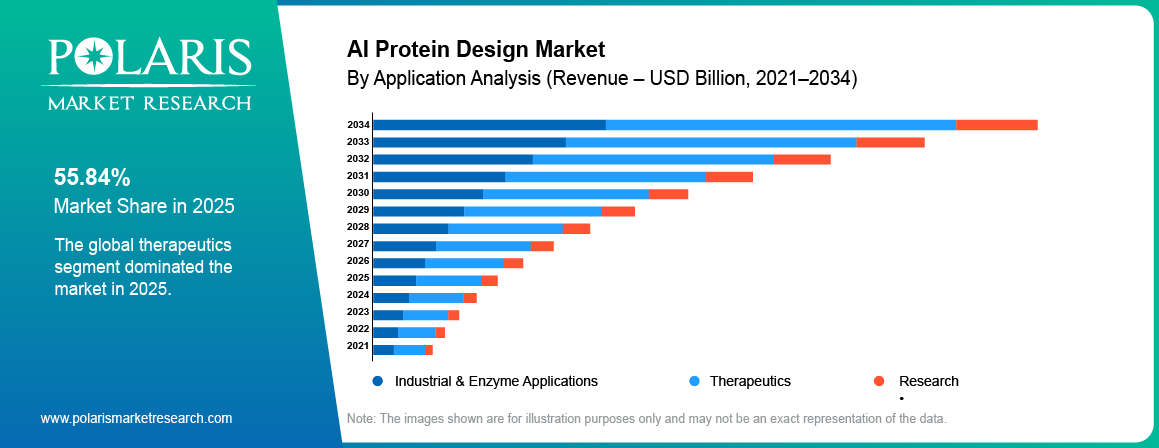
The market is divided into Therapeutics, Industrial & Enzyme Applications, and Research. Therapeutics was the leading segment with 55.84% share in 2025, owing to the application of AI protein design in biologic discovery, antibody engineering, protein optimization, and candidate development. Precise molecular features are necessary for therapeutic programs, and thus computational systems are needed to evaluate properties of proteins before laboratory and clinical testing. AI-designed proteins are being used in an increasing number of therapeutic development workflows.
Industrial & enzyme applications are expected to witness the significant CAGR of 34.26% over the forecast period 2026-2034. In industrial biotechnology and enzyme engineering, artificial intelligence systems allow researchers to scan through proteins with known functional properties. Computational design is a powerful tool to identify sequences with desired activity, stability, and performance requirements prior to experimental testing. This expands the use of protein foundation model technologies across enzyme engineering, industrial biotechnology, biomaterials, and other protein-based research applications.
End User Insights
The market is segmented into Pharmaceutical & Biotechnology Companies, Academic & Research Institutes, and Contract Research Organizations. Pharmaceutical & Biotechnology Companies accounted for 56.48% share in 2025, due to demand for AI-based protein design in therapeutic discovery, biologic engineering, candidate optimization, and development programs. These organizations need computational tools that can bridge the break between protein design and biological validation. This drives a need for integrated platforms for enhancing candidate generation and refinement across therapeutic workflows.
Academic & research institutes are anticipated to grow at the significant CAGR of 33.72% from 2026 to 2034. Open-source models, research platforms and collaborative interfaces lower technical barriers to computational protein design. The more access we have, the more we can evaluate structures, design new proteins, optimize sequences, and investigate protein interactions. This broadens the target of AI protein design methods in academia and generates more attention on available protein foundation model platforms.
Regional Analysis
North America AI Protein Design Market Trends
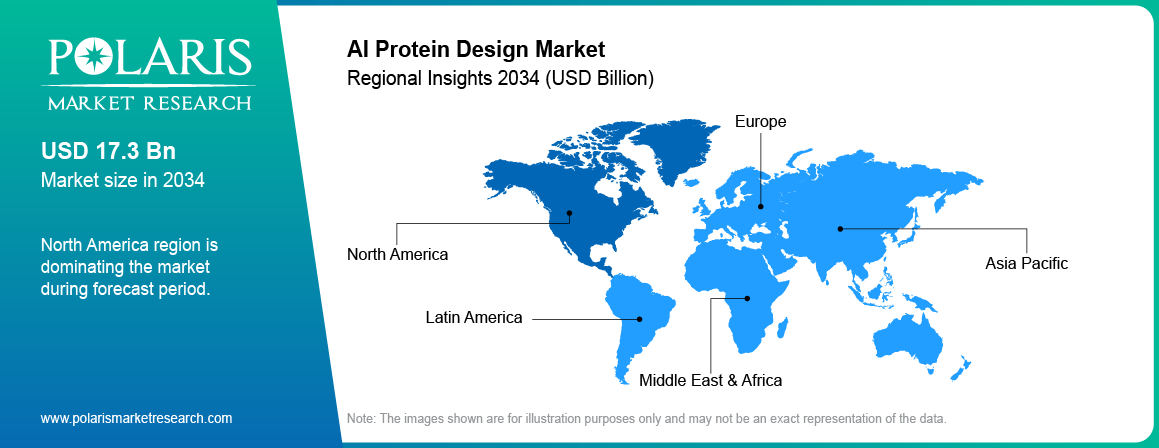
North America accounted for the largest share of the AI protein design market in 2025, with a share of 44.62%. The growth is attributed to the presence of advanced biotechnology research, strong AI infrastructure, venture capital funding, expertise in computational biology, and state-of-the-art laboratory facilities in the region. In September 2026, BioMarin partnered with Profluent to apply AI-based protein language models to design and optimize new enzyme therapies, with the most promising designs to be advanced into preclinical testing. The region provides a well-established ecosystem for AI protein design market analysis, encompassing computational modeling, protein engineering, biological validation, therapeutic development, and commercialization. Strong links between computational research and experimental biology enable the transition from generation to synthesis, screening, structural analysis and validation of proteins. This integrated environment creates demand for generative platforms that link design with physical testing. The clinical stage protein programs increase adoption regionally in therapeutic research, biologic development and advanced protein engineering applications (Source: Pharmaceutical Technology).
Europe AI Protein Design Market Trends
Europe held 24.18% share of the AI protein design market in 2025. This is due to its well-established pharmaceutical research and biotechnology capabilities, structural biology expertise, and the need for advanced computational methods. In October 2026, Hansa Biopharma entered into a collaboration agreement with Cradle to utilize its AI-driven protein engineering platform throughout the discovery pipeline for new therapies for severe autoimmune diseases. The regional ecosystem includes pharmaceutical companies, academic institutions, biotechnology firms and research centers, thereby creating opportunities for dedicated AI platforms through collaborations, licensing, research programs and joint development. The AI protein design industry forecast also points out the role of computational biology across therapeutic research. Broader adoption of protein foundation models will enable access to structure prediction, sequence optimization, generative design, and protein engineering capabilities for academic research, pharmaceutical discovery, biotechnology programs, and focused labs (Source: Contract Pharma).
Asia Pacific AI Protein Design Market Trends
The Asia Pacific region held 21.06% of the AI protein design market in 2025, owing to the growth of biotechnology research, pharmaceutical development, AI infrastructure, computational biology capabilities, and access to cutting-edge protein modeling technologies. In September 2026, Tsingke announced an integrated high-throughput validation workflow to fast-track the experimental validation of AI-designed proteins and antibodies. The regional ecosystem provides opportunities for structure prediction, sequence optimization, generative design and computational protein engineering for applications in therapeutics and industry. Wider use of protein foundation models can provide state-of-the-art computational power in a more accessible way to research institutions, biotechnology firms, pharmaceutical companies, and academic research labs. Furthermore, the increase in the use of AI protein design market technologies can increase the scope of the search for new protein structures, bringing new opportunities for de novo protein design in new therapeutic and industrial research initiatives (Source: PR Newswire).
Latin America AI Protein Design Market Trends
Latin America accounted for 4.38% share of the AI protein design market in 2025, reflecting the development of biotechnology research, digital infrastructure, computational biology capabilities, and access to AI-based research technologies. Open source protein models make structure prediction, sequence analysis, and generative design capabilities available at lower cost to academic labs and biotech organizations. The AI protein design industry forecast is also linked to outsourced research activity, including large molecule drug discovery outsourcing, since Contract Research Organizations can provide computational design, protein engineering, screening, and structural analysis services. These services create access to specialized capabilities for organizations with limited internal infrastructure, expanding applications across therapeutic, research, industrial, and biotechnology programs.
Middle East & Africa AI Protein Design Market Trends
Middle East & Africa held 5.76% share of the AI protein design market in 2025 and is anticipated to witness high growth rate during the forecast period due to developing biotechnology research and digital infrastructure, computational capabilities and investment in advanced life science technologies in Middle East & Africa. AI protein design offers research organizations methods for protein structure prediction, sequence optimization, novel protein generation and molecular analysis. Cloud based platforms + open source models lower infrastructure requirements for early stage research programs. Wider technology access creates opportunities across universities, research centers, biotechnology organizations, and life science programs. Greater adoption of generative protein design can expand computational protein engineering activity across therapeutic research, structural biology, industrial biotechnology, and academic applications.
AI Protein Design Market Competitive Landscape
The AI protein design market includes integrated generative biology companies, protein foundation model developers, specialized design platforms, plus pharmaceutical collaborators. Competition is shaped by clinical evidence, computational capabilities, proprietary biological data, experimental infrastructure, development expertise, plus partnership depth. The competitive environment is moving toward complete design-to-validation workflows. Companies with capabilities across protein generation, sequence optimization, laboratory testing, structural analysis, plus therapeutic development participate across multiple stages of the value chain.
Vendor Landscape Snapshot
The table below positions leading vendors by market role, based on clinical progress, platform scale, and partnership depth.
| Company | Headquarters | Market Position | Core Focus |
| Generate Biomedicines, Inc. | United States | Leader | Clinical-stage generative biologics; GB-0895 in Phase 3 |
| Google DeepMind | United Kingdom | Leader | AlphaFold and AlphaProteo structure and binder design |
| Isomorphic Labs Limited | United Kingdom | Challenger | AlphaFold-based drug design engine across modalities |
| Absci Corporation | United States | Challenger | Generative antibody design; ABS-201 and ABS-101 in the clinic |
| Xaira Therapeutics, Inc. | United States | Challenger | Generative protein design backed by USD 1 billion+ at launch |
| Chai Discovery, Inc. | United States | Challenger | Chai-1 structure model; multi-pharma biologics design deals |
| EvolutionaryScale, PBC | United States | Challenger | ESM3 protein foundation model |
| Profluent Bio, Inc. | United States | Emerging Player | ProGen3 protein language models; gene editors and enzymes |
| Latent Labs Limited | United Kingdom | Emerging Player | Latent-X generative binder and antibody design |
| Cradle Bio B.V. | Netherlands | Niche Specialist | Protein engineering software for lab-in-the-loop optimization |
Source: Company filings, named press releases, and Polaris Market Research Analysis.
AI Protein Design Market Technology and Innovation Landscape
Diffusion-based models represent an important technology development in de novo protein design. These systems generate new protein structures according to defined biological or structural requirements, expanding the range of candidates available for computational evaluation. The approach creates opportunities across therapeutic binders, peptides, miniproteins, enzymes, antibodies, plus other engineered proteins. Wider use of generative models also shifts protein engineering toward computational exploration of novel structures before laboratory synthesis, screening, structural analysis, plus biological validation.
Multi-objective optimization is another important technology area within protein engineering AI. During candidate generation or refinement, AI models can evaluate a number of features including binding affinity, structural stability, expression, specificity, activity and manufacturability. This enables investigators to take into account multiple requirements for development in computational design rather than a single molecular feature. Greater integration of these parameters improves candidate prioritization and creates demand for AI platforms that connect protein generation, sequence optimization, structural analysis, plus downstream experimental testing.
Protein foundation models are creating a broader computational layer for the AI protein design market. These models process large biological datasets to identify relationships across protein sequences, structures, functions, plus molecular characteristics. Their capabilities extend across structure prediction, sequence analysis, protein generation, candidate optimization, plus protein engineering. Wider availability of foundation models creates opportunities for integrated platforms that address several stages of protein development through one computational environment, expanding applications across therapeutic research, industrial biotechnology, plus academic protein science.
Technology and Innovation Landscape Snapshot
The table below outlines the core technology layers shaping AI protein design and their current commercial readiness.
| Technology Layer | Function | Representative Tools | Maturity |
| Structure prediction | Predicts 3D structures of proteins and complexes from sequence | AlphaFold 3, Boltz, Chai-1 | Commercial |
| Diffusion-based generative design | Generates novel backbones and binders against defined targets | RFdiffusion, AlphaProteo, Chroma | Early commercial |
| Protein foundation models | Learn sequence, structure, and function patterns for prediction and generation | ESM3, ProGen3 | Early commercial |
| Inverse folding and sequence optimization | Assigns sequences to target structures and refines stability and affinity | ProteinMPNN | Commercial |
| Multi-objective optimization | Balances affinity, expression, and stability within one design loop | Cradle platform | Commercial |
| Lab-in-the-loop design-test-learn | Links candidate generation with high-throughput experimental validation | Generate Platform, Absci platform | Early commercial |
| Provenance and watermarking | Marks AI-designed sequences and structures for traceability | SynthID Bio | Emerging |
| Open collaborative platforms | Shared design and engineering tools for academia and industry | GYDE | Emerging |
Source: Polaris Market Research Analysis
AI Protein Design Use Case Analysis
Therapeutic Protein Design
Therapeutic protein design represents a major use case for the AI designed antibody segment within the AI protein design market. AI systems help researchers generate, screen, optimize, plus prioritize antibodies, binders, peptides, miniproteins, plus other protein candidates. Computational evaluation can reduce the number of candidates requiring extensive early laboratory screening. This creates value across target assessment, protein generation, sequence refinement, structural analysis, candidate prioritization, plus preclinical development, expanding the commercial application of AI protein design across therapeutic research programs.
Respiratory & Immunology Applications
Respiratory and immunology applications represent important areas for generative protein design. Computational systems allow researchers to create or optimize protein candidates against defined biological targets. Generative workflows also provide opportunities to assess molecular characteristics such as binding, stability, specificity, plus pharmacokinetic properties during early development. This expands the use of AI protein design platforms across therapeutic programs focused on respiratory and immune-related diseases, creating demand for computational systems that connect protein generation with sequence optimization, experimental validation, plus candidate development.
GI & Dermatology Applications
Gastrointestinal and dermatology research represent additional applications for the AI protein design market. Computational systems help researchers create or optimize biologic candidates for targets requiring specific binding characteristics. AI-guided sequence optimization can improve selected protein properties before laboratory evaluation, creating a structured computational workflow for early therapeutic research. Wider application across these therapeutic areas expands demand for protein design platforms, particularly systems that combine structure prediction, generative design, sequence optimization, candidate screening, plus biological assessment within a connected development environment.
Academic Structural Biology
Academic structural biology represents an important research use case for protein foundation model technologies. Artificial intelligence can help researchers predict the structure of proteins, study how molecules interact, analyze biological functions, and study new protein architectures. Open research tools also provide laboratories with increased access to sophisticated computational capabilities, enabling them to do structure prediction and protein design without having to build out full internal modeling infrastructure. This expands the horizon of AI in structural biology, molecular studies, protein function studies, computational biology and even early protein engineering efforts in academia.
Industrial Protein Design
Industrial protein design creates opportunities for protein engineering AI across enzyme research, biotechnology, synthetic biology, biomaterials, industrial processes, plus related applications. AI models allow researchers to explore proteins with defined functional characteristics before laboratory testing. Computational screening can reduce candidate pools and rank sequences based on activity, stability, specificity or other demands. It speeds up early-stage research workflows and broadens AI protein design outside of therapeutics, growing demand across industrial biotechnology programs needing engineered proteins for specific functions.
AI Protein Design Market Value Chain Analysis
Value in the AI protein design market is spread across data, model, platform, validation, and development stages. Companies that connect several stages hold a stronger competitive position.
| Value Chain Stage | Key Activities | Representative Participants |
| Data and compute | Protein databases, proprietary datasets, cloud and GPU capacity | Public structure databases, cloud providers, platform companies |
| Model development | Structure prediction, generative, and foundation models | Google DeepMind, EvolutionaryScale, Profluent, Chai Discovery |
| Design platforms and services | Binder, antibody, and enzyme design; sequence optimization | Generate Biomedicines, Cradle, Latent Labs, Absci |
| Wet-lab validation | Synthesis, screening, structural analysis, iterative testing | In-house labs, CROs, Tsingke |
| Therapeutic and industrial development | Preclinical and clinical development, licensing, commercialization | Generate Biomedicines, Absci, Novartis, Merck & Co., Inc., Zealand Pharma |
Source: Polaris Market Research Analysis
Buyer Analysis and Barriers to Market Entry
AI protein design market analysis by big pharma companies is based on multiple factors like clinical data, biological validation, computational power, development know-how, proprietary data, lab integration, and partnership flexibility. These factors influence the platform selection as pharmaceutical buyers need more than model performance. Platforms that link protein generation to experimental validation offer a broader development pathway. This drives the demand for integrated capabilities in computational design, sequence optimization, protein synthesis, screening, structural analysis, and therapeutic development.
Mid-size biotech companies want to accelerate candidate generation, but don’t necessarily want to develop all the computational capabilities in-house. Academic labs favor readily available tools for structure prediction, protein generation, sequence analysis, and early design. Contract research organizations need flexible systems that merge experimental services with computational workflows. These needs translate into specific adoption models in the AI protein design market report, including platform licensing, research access, fee-for-service projects, strategic alliances, and integrated development programs tailored to different organizational requirements.
Barriers to Market Entry
-
Clinical proof: The limited clinical data adds an element of uncertainty for prospective buyers of AI protein design platforms, particularly for therapeutic applications that need to be validated in humans.
-
Wet lab integration: AI protein design platforms require protein synthesis, screening, structural analysis, and other laboratory capabilities, creating additional infrastructure requirements for new entrants.
-
Open-source competition: Open platforms and freely available models of proteins lower the cost of access to the software, putting pricing pressure on commercial design-only offerings.
-
Capital intensity: Building computational infrastructure, foundation models, protein libraries, laboratory capabilities, plus validation workflows requires substantial upfront investment, creating a high entry barrier for new companies.
Regulatory and Biosecurity Landscape
Regulation of AI-designed proteins focuses on the product and its biosecurity risks rather than the design method. The table below summarizes the main areas buyers and platform developers track.
| Area | Current Position | Market Implication |
| Product approval | AI-designed candidates are reviewed as conventional biologics; no separate AI approval route exists | Clinical validation remains the main gate to commercial adoption |
| DNA synthesis screening | Providers screen orders against known threats; AI designs may differ from known sequences | Raises demand for provenance and screening tools |
| Provenance and watermarking | SynthID Bio embeds detectable signatures in protein sequences and structures; standardization is still needed | Emerging layer for biosecurity compliance |
| Open-model governance | Open-source design tools widen access and raise dual-use questions | Developers add safeguards; differentiation shifts to data and validation |
| Intellectual property | Protection of AI-generated sequences depends on inventorship and novelty rules that vary by country | Favors firms with proprietary data and validated designs |
Source: Polaris Market Research Analysis
AI Protein Design Market Premium Insights and Forward Outlook
The AI protein design market report indicates a shift toward development models that combine computational protein generation with experimental validation. Clinical progress will provide additional evidence regarding the ability of generative systems to produce viable therapeutic candidates. This evidence may influence platform adoption, pharmaceutical collaboration structures, investment priorities, plus technology development. Greater clinical validation could also strengthen commercial interest in platforms that connect protein design with downstream synthesis, screening, optimization, biological testing, plus therapeutic development.
Open-source access is shifting commercial differentiation toward proprietary biological data, laboratory capabilities, integrated workflows, development expertise, plus validated outcomes. Wider model availability reduces the value of basic computational access alone. Protein foundation model developers therefore face demand for broader capabilities that connect prediction, generation, sequence optimization, experimental validation, plus biological data. This creates a market structure where commercial value extends beyond model availability toward integrated technology, proprietary datasets, workflow efficiency, plus development support.
The next phase of market development will involve closer integration between foundation models, generative protein design, automated laboratory systems, protein synthesis, structural analysis, plus biological datasets. These connections create a design-test-learn cycle across computational and physical workflows. Greater integration can improve candidate selection, reduce unnecessary experimental screening, accelerate sequence refinement, plus generate richer biological datasets. This integrated approach expands commercial opportunities across therapeutic proteins, industrial biotechnology, enzyme engineering, structural biology, plus research applications.
Key Players in the AI Protein Design Market
- Absci Corporation
- Arzeda Corp.
- AstraZeneca PLC
- Chai Discovery, Inc.
- Cradle Bio B.V.
- Earendil Labs
- Eli Lilly and Company
- EvolutionaryScale, PBC
- Generate Biomedicines, Inc.
- Google DeepMind
- Isomorphic Labs Limited
- Latent Labs Limited
- Merck & Co., Inc.
- Nabla Bio, Inc.
- Novartis AG
- Profluent Bio, Inc.
- Xaira Therapeutics, Inc.
Industry Developments
- October 2026: Zealand Pharma and Generate Biomedicines entered a multi-target collaboration and license agreement to develop AI-engineered multispecific protein therapeutics for obesity and metabolic diseases, with USD 30 million upfront and nearly USD 1.2 billion in potential milestones. (Source: globenewswire.com)
- October 2026: Chai Discovery signed GSK as its sixth pharma partner in nine months for AI-enabled biologics design, joining Eli Lilly, Pfizer, Novartis, Argenx and Bristol Myers Squibb; the company is reported at a USD 3.8 billion valuation. (Source: endpoints.news)
- September 2026: Google DeepMind developed SynthID Bio, a tool that embeds hidden identifiers into AI-generated protein sequences and structures to enable provenance tracking and improve biosecurity. (Source: chemistryworld.com)
- May 2026: Isomorphic Labs raised USD 2.1 billion in a Series B round led by Thrive Capital to scale its AI drug design engine, IsoDDE. (Source: isomorphiclabs.com)
- March 2026: GYDE, an open source collaborative platform for AI protein design and engineering, was published for academic and industry use. (Source: biorxiv.org)
- January 2026: Generate Biomedicines dosed the first patient in SOLAIRIA-1, a Phase 3 trial of GB-0895 for severe asthma. (Source: sec.gov)
AI Protein Design Market Report Segmentation
By Design Approach Outlook (Revenue, USD Billion, 2021–2034)
- Structure Prediction
- Generative De Novo Design
- AI Guided Sequence Optimization
By Protein Modality Outlook (Revenue, USD Billion, 2021–2034)
- Antibodies
- De Novo Binders & Miniproteins
- Enzymes
- Peptides
- Others
By Application Outlook (Revenue, USD Billion, 2021–2034)
- Therapeutics
- Industrial & Enzyme Applications
- Research
By End User Outlook (Revenue, USD Billion, 2021–2034)
- Pharmaceutical & Biotechnology Companies
- Academic & Research Institutes
- Contract Research Organizations
By Regional Outlook (Revenue, USD Billion, 2021–2034)
- North America
- US
- Canada
- Europe
- Germany
- France
- UK
- Italy
- Spain
- Netherlands
- Rest of Europe
- Asia Pacific
- China
- Japan
- India
- South Korea
- Taiwan
- Australia
- Rest of Asia Pacific
- Latin America
- Brazil
- Mexico
- Argentina
- Rest of Latin America
- Middle East & Africa
- Saudi Arabia
- UAE
- South Africa
- Rest of Middle East & Africa
AI Protein Design Market Report Scope
| Report Attributes | Details |
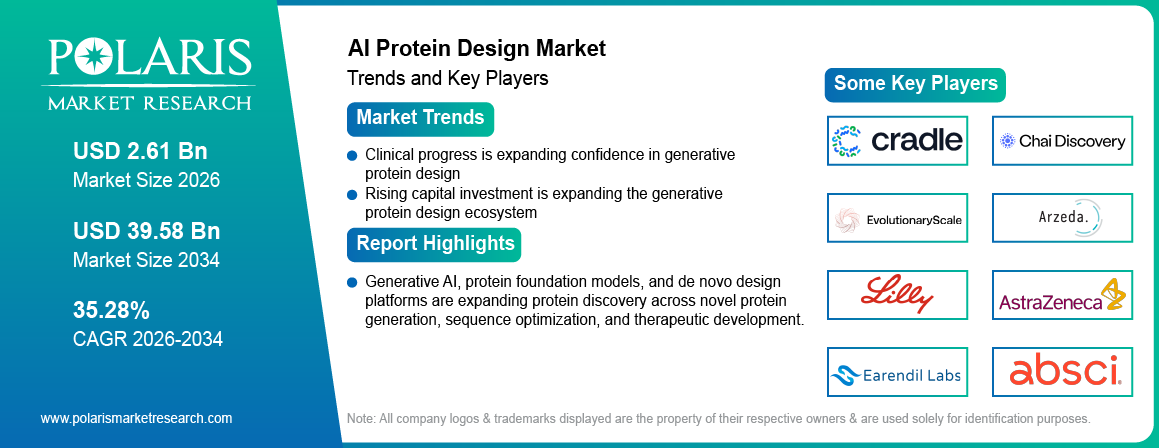
| Market Size in 2025 | USD 1.86 Billion |
| Market Size in 2026 | USD 2.61 Billion |
| Revenue Forecast by 2034 | USD 39.58 Billion |
| CAGR | 35.28% from 2026–2034 |
| Base Year | 2025 |
| Historical Data | 2021–2024 |
| Forecast Period | 2026–2034 |
| Quantitative Units | Revenue in USD Billion and CAGR |
| Report Coverage | Revenue Forecast, Growth Factors, Competitive Landscape, Industry Trends, and Strategic Analysis |
| Segments Covered |
|
| Regional Scope | North America, Europe, Asia Pacific, Latin America, Middle East & Africa |
| Competitive Landscape | Company Profiling, Product Benchmarking, Financial Analysis, Market Developments, and Strategic Initiatives |
| Report Format | PDF + Excel |
| Customization | Available by Country, Region, and Segment |
Source: Polaris Market Research Analysis
Why Choose Polaris Market Research
Polaris Market Research & Consulting, Inc. develops its AI protein design market report using clinical disclosures, scientific publications, company announcements, partnership information, and relevant technology research. The analysis separates protein design platforms from adjacent small molecule discovery and finished industrial enzyme markets. This approach creates a focused assessment of the technology layer, commercial applications, clinical programs, competitive activity, and market development across therapeutic, industrial, academic, and research applications.
The analysis covers design approach, protein modality, application, end user, region, company activity, clinical development, technology trends, and commercial partnerships. The AI protein design market analysis can also be customized around selected protein modalities, therapeutic applications, regional markets, platform companies, competitive requirements, or partnering priorities. This flexible scope helps organizations examine specific market segments, technology categories, commercial opportunities, competitive developments, and emerging areas relevant to their research objectives.
AI Protein Design Market Research Methodology
The research process follows five phases covering evidence collection, validation, competitive assessment, market reconciliation, and quality review. Secondary mapping examines clinical disclosures, scientific publications, preprints, company announcements, and partnership information. Primary validation checks important company details plus development programs against direct disclosures. Competitive benchmarking separates the AI protein design market analysis from adjacent AI in Drug Discovery plus AI-Generated Enzymes markets. Proprietary reconciliation connects validated evidence with the internal market model before final editorial review.
The source mix gives greater weight to clinical program disclosures plus partnership information than model benchmark claims. Clinical progress provides evidence of translation from computational design into biological development. The disclosures by the companies provide insight into their platform strategy, funding, partnerships, infrastructure and development activity. This methodology also takes into account the role of protein engineering AI throughout candidate generation, sequence optimization, experimental testing, and therapeutic development. The approach creates a structured basis for evaluating market development, technology adoption, commercial opportunities, and competitive activity.
Research Methodology Phases
| Phase | Focus |
| 1. Secondary Mapping | Clinical disclosures, preprints, company announcements |
| 2. Primary Validation | Company press materials and trial program details |
| 3. Competitive Benchmarking | Scope separation against AI in Drug Discovery and AI-Generated Enzymes |
| 4. Proprietary Reconciliation | Internal Polaris market model validation |
| 5. Quality and Sourcing Review | Final editorial and citation check |
Source: Polaris Market Research Analysis.
AI Protein Design Market FAQ's
The market size is USD 1.86 Billion in 2025 and is projected to reach USD 39.58 Billion by 2034, at a CAGR of 35.28% during 2026–2034.
Antibodies lead the market by protein modality, reflecting clinical development of AI-designed proteins such as GB-0895, ABS-101, and ABS-201.
North America leads the market, supported by major AI protein design companies plus advanced clinical-stage programs.
Asia Pacific is expected to register the fastest growth at 39.46% CAGR during 2026–2034, supported by expanding biotechnology research and wider adoption of AI-based protein design technologies.
The base year is 2025 and the forecast period is 2026–2034, as detailed in the Report Scope table.
AI protein design applies machine learning to predict the structures of proteins, improve their amino acid sequences and design new proteins for therapeutic, industrial and research purposes.
AI protein design uses models trained on large protein sequence and structure datasets to predict how a sequence will fold and function. Generative models then propose new sequences or structures against a target, and laboratory testing validates the best candidates.
Yes. Diffusion-based and language-model approaches can generate backbones and sequences with no natural counterpart, such as binders and miniproteins. These designs still need experimental validation of binding, stability, and safety.
As of 2026, no protein drug designed by AI has been approved. GB-0895 is among the most advanced AI-designed protein programs and is currently in Phase 3 development.
AlphaFold is about structure prediction, RFdiffusion is about designing new protein structures for e.g., binders and miniproteins.
Key companies include Generate Biomedicines, Inc., Absci Corporation, Xaira Therapeutics, Inc., EvolutionaryScale, PBC, Profluent Bio, Inc., Cradle Bio B.V., Latent Labs Limited, Chai Discovery, Inc., Google DeepMind, and Isomorphic Labs Limited.
Pharmaceutical companies access generative design capabilities through partnerships, licensing arrangements, research collaborations, and multi-target development agreements.
Several structure prediction and protein design tools are open source, whereas commercial platforms generally use licensing or other paid access models.
The main challenges are limited clinical validation, the cost of wet-lab integration, and pricing pressure from open-source tools. Many generative programs remain preclinical, which makes it difficult for pharma buyers to compare platforms.
Tools such as Google DeepMind's SynthID Bio embed detectable watermarks in AI-designed protein sequences and structures without disrupting function. They help DNA synthesis providers and researchers trace provenance, although broader standardization is still needed.
Download Sample Report of AI Protein Design Market
Please fill out the form to request a customized copy of the research report.


