
Third Party AI Assurance Services Market Size, Share, and Forecast 2026 to 2034
REPORT DETAILS
Third-Party AI Assurance Services Market Summary
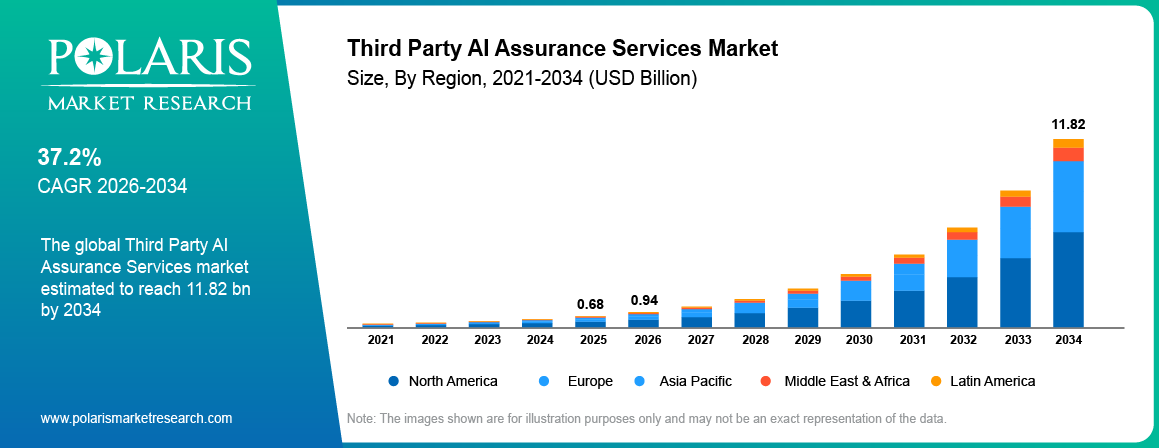
According to Polaris Market Research analysis, the third party AI assurance services market was valued at USD 0.68 Billion in 2025. It is projected to reach USD 11.82 Billion by 2034, growing at a CAGR of 37.2% from 2026 to 2034. Demand is driven by new AI regulation, certification standards with a clear target, and boards that want outside proof before AI enters core operations. Governance and risk reviews bring in the most service revenue, while security testing and agent audits expand quickest as buyers deploy generative and agentic systems. Supply spans audit and consulting groups, testing and certification bodies, and specialist firms that evaluate AI systems for parties other than the builder. North America is the leading market. Asia Pacific is the fastest growing region.
Market Statistics
Key Takeaways
- North America captured 39.3% of 2026 revenue, led by the United States, as large enterprises and regulated firms commissioned independent reviews of AI systems.
- Asia Pacific is the fastest growing region, advancing at a CAGR of 39.3% from 2026 to 2034, owing to national testing schemes in Singapore and rising AI adoption in India and China.
- Boards that ask for evidence on controls before approving AI programs keep Governance and Risk Assurance at 28.5% of 2026 service revenue.
- The quickest service line to scale is Security and Red Teaming, with a CAGR of 39.4% through 2034, as buyers test models for jailbreaks, data leaks, and misuse.
- Pre Deployment Assessment earned USD 478 Million in 2026, the largest engagement total, as most buyers want an outside view before launch.
- Installed credit, fraud, and scoring models that regulators already scrutinize keep Predictive and Traditional AI on top, with 51.7% in 2026.
- Agentic AI is projected to grow at a CAGR of 57.2% from 2026 to 2034, because autonomous agents create new failure modes that require recurring audits.
- Existing audit relationships and trust in signed attestations keep Big Four and Consulting Firms ahead of other providers, with 42.8% in 2026.
- Among end users, Government and Public Sector expands fastest, since national frameworks and accredited testers are being created in Singapore, the United Arab Emirates, and Saudi Arabia.
Note: Figures and projections outlined in this report are the result of Polaris Market Research’s proprietary analytical processes, grounded in the latest available datasets and market observations.
Third Party AI Assurance Services Market Definition
The third party AI assurance services market covers independent evaluation, testing, audit, and certification of artificial intelligence (AI) systems by a party that did not build or operate them. It spans governance reviews, model testing, compliance audits, security assessments, and recurring monitoring sold under a contract, and it excludes internal reviews and software tools sold without an outside opinion.
Counted revenue includes fees for assurance reports, attestations, certificates, red team exercises, bias and resilience testing, and monitoring retainers paid to outside firms. Governance software licenses, model hosting, and in house testing teams sit outside the boundary; as a result, this market is a small fraction of the broader AI trust, risk, and security management market. Standards bodies earn little directly, although their documents set the criteria that auditors apply.
An engagement follows a repeatable path. The assurer agrees the scope and criteria, collects evidence on data, models, and controls, runs tests against a standard or a regulation, and issues an opinion, a certificate, or a findings report. Numerous buyers then return for surveillance audits, because an AI system changes as models are retrained and prompts are rewritten.
Independence is what buyers pay for. A report written by the team that built the system carries limited weight with regulators, insurers, and customers, whereas a signed statement from an accredited body can be shown to all three. Accreditation under ISO/IEC 42001, the management system standard for AI, has therefore become the clearest early signal of quality in the field.
Third Party AI Assurance vs Internal AI Review: Key Differences
| Attribute | Third Party AI Assurance | Internal AI Review |
| Independence | Performed by an outside party with no stake in the system | Performed by the team that builds or runs the system |
| Credibility with regulators | High when the assurer is accredited | Lower, as the review is self reported |
| Output | Signed opinion, certificate, or attestation | Internal report or checklist |
| Cost profile | Recurring fees per engagement | Staff and tooling cost |
| Depth of system knowledge | Built up during the engagement | High from daily work |
| Common trigger | Regulation, procurement, insurance, or board request | Release gates and routine quality control |
Source: Polaris Market Research Analysis
Internal reviews remain essential, since only the builder can test every release. The outside opinion adds a layer of proof that stakeholders can rely on, and mature buyers combine both, using internal testing for speed and independent assurance for the systems that carry legal or financial consequences.
Porter's Five Forces Analysis
| Force | Intensity | Rationale |
| Bargaining power of suppliers | Moderate | Skilled evaluators, testing datasets, and accredited auditors are scarce, although tooling is available from many software vendors. |
| Bargaining power of buyers | Moderate to High | Large enterprises and public bodies run competitive tenders and can switch among audit firms, certification bodies, and specialists. |
| Threat of new entrants | Moderate | Software founders can start quickly, yet credibility, accreditation, and insurance cover take years to build. |
| Threat of substitutes | Moderate | Internal testing teams and automated evaluation tools can replace part of the outside work for low risk systems. |
| Competitive rivalry | High | Audit groups, certification bodies, and specialist firms compete for the same first engagements and the same standards. |
Source: Polaris Market Research Analysis
Credibility is the scarcest input in this field. Firms with an established audit brand win the first engagement with a regulated buyer, whereas specialists win on technical depth in areas such as red teaming, and both groups invest in accreditation to narrow the gap.
Market Dynamics
Driver Impact Analysis
| Driver | Impact on Market Growth | Time Horizon |
| New AI regulation and standards that call for independent proof | High | Short to Medium Term |
| Enterprise and insurer demand for outside assurance of AI systems | High | Medium Term |
Source: Polaris Market Research Analysis
Driver: New AI Regulation and Standards Are Calling for Independent Proof, Creating Market Demand
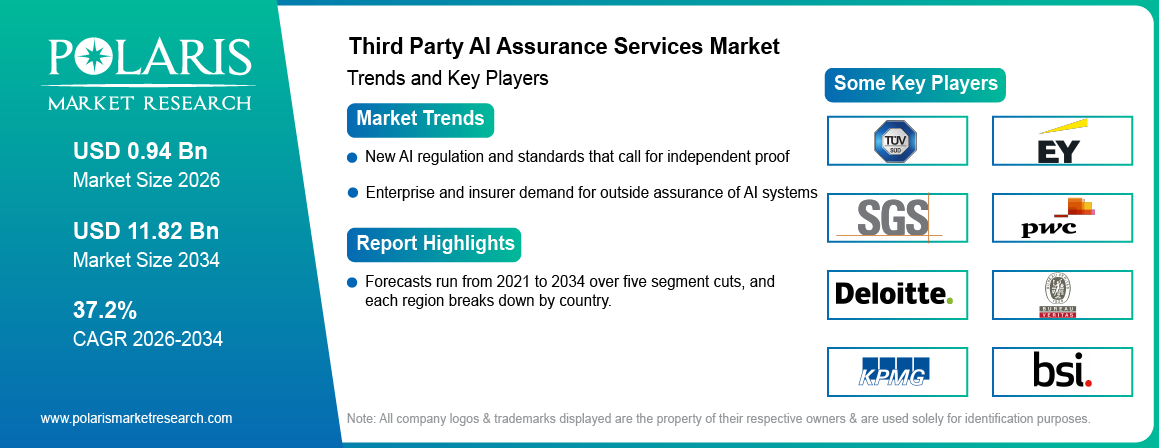
Lawmakers and regulators in Europe, Asia, and the Gulf are writing rules that treat AI as a regulated product, and numerous of those rules lean on conformity assessment, audit, or certification. A buyer facing a legal duty to demonstrate that a high risk system is controlled will usually seek an outside opinion, since a self declared review is hard to defend. The AI trust, risk, and security management market release covers the software side of the same compliance push.
For example, in June 2026, the European Parliament voted 423 to 57 on the Digital Omnibus on AI, and the Council of the European Union gave its final approval on 29 June. The agreed text moves the start date for standalone high risk systems from 2 August 2026 to 2 December 2027. Buyers gain extra time, although the duty to prepare remains.
Europe is projected to grow at a CAGR of 34.0% from 2026 to 2034, since the AI Act creates a lasting require for conformity evidence even with later dates. Testing and certification bodies with notified body experience gain most, as the Act ties some AI duties to existing product assessments.
Driver: Enterprise Buyers and Insurers Are Asking for Outside Assurance of AI Systems, Creating Market Demand
Boards, procurement teams, and insurers now ask the same question about every material AI system: who has checked it, and under what standard. A signed report answers that question in a form that can be filed with a contract or a policy, and the demand comes from customers as much as from regulators.
In September 2025, KPMG added AI assurance and attestation services to its AI Trust suite, including model risk assessments, model testing, and independent assurance against frameworks such as SOC and FedRAMP. The offer demonstrates that audit groups treat AI evidence as a billable line next to financial controls.
The projected CAGR for Big Four and Consulting Firms is 30.8% from 2026 to 2034, slower than Specialist AI Assurance Firms at 40.9%, since specialists start from a small base and add new service lines faster. Audit groups hold the buyer relationship, whereas specialists hold the technical edge.
Restraint: Immature Standards and Few Accredited Assessors Are Slowing Adoption and Limiting Scale
Assurance is only as credible as the standard behind it. Several testing standards are still in draft, accredited assessors are few, and buyers cannot yet compare one firm certificate with another. Smaller buyers also hesitate to pay for outside reviews of low risk systems, and some wait until a regulator or a customer makes the demand explicit.
For example, in September 2025, the UK government published its roadmap for trusted third party AI assurance. The roadmap noted that none of the existing AI assurance certifications it reviewed were issued by organizations accredited by UKAS, the national accreditation body (Source: UK Government). The same document puts the UK sector at about GBP 1.01 billion of gross value added in 2024.
The projected CAGR for Compliance Audit and Certification is 34.4% from 2026 to 2034, close to the market average, since certification depends on accredited bodies that remain scarce. Buyers that want a certificate rather than a report feel this limit most.
Opportunity: Accreditation Schemes Are Creating Openings for Certified Assurance Providers
Accreditation turns a service into a recognized credential. When a national body accredits a certifier, buyers can cite the certificate in tenders, and the certifier can sell the same audit in several countries. Certification bodies that already hold accreditation for other management systems have a head start.
For example, in March 2026, BSI received accreditation from ANAB in the United States to certify against ISO/IEC 42001, becoming the first certification body with accreditation from three bodies, namely UKAS, RvA, and ANAB. The step lets BSI deliver the same certificate to clients in North America and Europe.
In 2026, Compliance Audit and Certification earned USD 244 Million, behind Model Testing and Evaluation at USD 263 Million. Providers with accreditation can convert one engagement into recurring surveillance audits, lifting lifetime value per client.
Opportunity: Autonomous Agents and Frontier Models Are Creating Demand for Recurring Audits
Autonomous agents act on behalf of users, call tools, and handle data; as a result, a single failure can cause financial or legal harm. Buyers want testing at the scale of thousands of attack combinations and repeat checks when models change. That creates recurring work for firms that can automate evaluation.
For example, in September 2026, AIUC raised USD 40 million in Series A funding led by Ribbit Capital to extend its audit and insurance work from AI agents to frontier models. The company tests each agent against about 5,000 combinations of risk and attack and recertifies it every quarter (Source: SiliconANGLE).
Agentic AI is projected to grow at a CAGR of 57.2% from 2026 to 2034, the highest of the three system types, and Generative AI is projected to grow at 37.2%. Starting revenue for agents is small; as a result, the segment adds little to the 2026 total but a great deal to later growth.
Trend: Governments Are Moving Toward National Testing Schemes and Certification Marks
National governments are building their own testing capacity and accreditation lists, and several have chosen to certify private testers instead of testing every system themselves. The approach spreads the workload, creates a recognized pool of assessors, and gives buyers a mark they can trust.
For example, in May 2026, Singapore announced the AI Tester Accreditation Programme, run by a not for profit arm of the Infocomm Media Development Authority, to accredit companies that test AI systems, with no application or accreditation fees. Seven firms had expressed early interest, including PwC and Ernst & Young (Source: Economic Development Board of Singapore).
The CAGR of Government and Public Sector is projected at 40.0% from 2026 to 2034, the fastest of the five end users, as ministries commission tests and adopt national frameworks. Private firms that win accreditation early will serve both the public sector and its suppliers.
Value Chain Analysis
| Stage | Activities | Representative Participants |
| Standards and criteria | Writing management system, testing, and risk standards that auditors apply | ISO and IEC committees, national standards bodies, and regulators |
| Accreditation | Recognizing certifiers and testers as competent and independent | UKAS, ANAB, RvA, and the Singapore tester programme |
| Assurance delivery | Audits, testing, red teaming, certification, and monitoring | KPMG, PwC, BSI, SGS, Bureau Veritas, and specialist firms |
| Tooling and data | Evaluation platforms, test datasets, and automated scanners | Specialist software vendors and in house tools of assurers |
| Buyers and insurers | Enterprises, public bodies, and insurers that rely on the opinion | Banks, health systems, ministries, and AI developers |
Source: Polaris Market Research Analysis
Value concentrates where credibility is created. Accreditation and standards set the rules, and the firms that hold both capture the highest fees, while tooling suppliers earn smaller recurring sums that depend on the assurer buying their platform.
Margins differ by stage. Audit groups and certification bodies earn fees for signed opinions and recurring surveillance, specialists earn premiums for scarce technical work, and software vendors earn license income. Insurers are an emerging link, since an assurance report can reduce premiums for AI related liability.
Third Party AI Assurance Services Market Segmentation Analysis
The segmentation uses five cuts in sequence, since buyers choose a service line, a point in the system life cycle, a type of AI, an assurer, and an internal sponsor for different reasons.
Service Type Insights
Governance and Risk Assurance accounted for 28.5% of service type revenue in 2026, owing to boards and audit committees that want an outside review of policies, roles, and controls before they approve AI programs. The work is closest to traditional audit, and buyers already trust the firms that perform it.
For example, in June 2025, PwC introduced independent assurance on AI systems, covering the governance framework, control environment, data sourcing, and monitoring procedures of the client. The firm described the offer as aimed at boards, regulators, customers, and the public that want assurance that AI is built and run responsibly.
Security and Red Teaming is projected to grow at a CAGR of 39.4% from 2026 to 2034, as buyers pay specialists to attack models for jailbreaks, data leaks, and unsafe outputs. Revenue was USD 172 Million in 2026, the smallest of the four lines, although its pace is the highest. Teams that already run security posture management tools often extend the same budget to adversarial tests of AI.
Model Testing and Evaluation was worth USD 263 Million in 2026, driven by demand for accuracy, bias, and resilience evidence on models that sit inside credit, hiring, and clinical decisions. Compliance Audit and Certification grows at 34.4% from the same starting point.
Buyers often purchase two lines together. A governance review sets the criteria, testing provides the evidence, and a certificate packages the result for customers; as a result, providers that cover the full chain win larger and longer contracts.
Pricing follows effort and risk. Governance reviews are priced as audit work, testing is priced by system and test volume, and red team exercises command a premium for scarce talent. Recurring monitoring is increasingly bundled into annual fees, smoothing revenue for providers.
Engagement Stage Insights
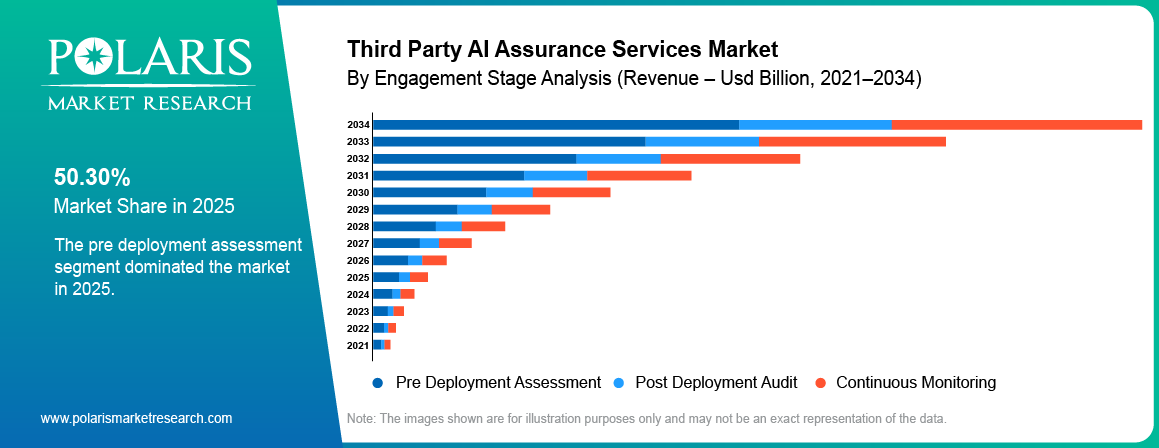
Pre Deployment Assessment accounted for 50.3% of engagement stage revenue in 2026, driven by launch gates in banks, hospitals, and public agencies that require an independent opinion before a system goes live. The assessment fixes scope, evidence, and criteria, and it is the natural entry point for a new client.
For example, in April 2026, Bureau Veritas announced an independent AI systems audit for European enterprises, built with Amazon Web Services and measured against eight pillars that cover areas such as security, governance, and fairness. The result is a maturity report against EU AI Act requirements, with rollout starting in the second quarter of 2026.
Continuous Monitoring is projected to grow at a CAGR of 43.8% from 2026 to 2034, the highest of the three stages, since models drift and prompts change after launch. Revenue was USD 183 Million in 2026, and Post Deployment Audit earned USD 289 Million.
Stage mix is shifting toward recurring work. A one time assessment ends with a report, whereas monitoring creates a subscription that renews each quarter, and providers with automated evaluation tools can serve numerous systems with a small team.
Buyers should expect scope disputes at each stage. A pre deployment opinion covers the system as built; as a result, any later change to a model, a data source, or a prompt can void the finding, and contracts increasingly define which changes trigger a new review.
AI System Type Insights
Predictive and Traditional AI accounted for 51.7% of AI system type revenue in 2026, due to installed scoring, fraud, and forecasting models that regulators and auditors already examine. These systems are stable and well documented, making them easier to test against a fixed standard.
For example, in January 2026, SGS described the ISO/IEC 42119 series on testing AI systems, with only the overview part published. A part on quality assessment of prompt based text generation was still in development, leaving buyers of generative AI assurance without a settled test method.
Generative AI is projected to grow at a CAGR of 37.2% from 2026 to 2034, and Agentic AI at 57.2%, as companies deploy chat assistants and autonomous workflows in customer and back office tasks. Revenue from Generative AI was USD 378 Million in 2026.
Agentic AI was worth USD 81 Million in 2026, a small base that explains its speed. Agents call tools, hold credentials, and act without a person in the loop; as a result, testers must probe chains of actions and not single answers.
Test methods differ by system type. Traditional models are checked for bias and drift with statistical tests, generative models with prompt libraries and human review, and agents with simulated attacks on tool use and permissions, and each method requires different skills.
Provider Type Insights
Big Four and Consulting Firms accounted for 42.8% of provider type revenue in 2026, owing to existing audit relationships, signed attestations, and the ability to staff large programs across regions. Their weakness is deep technical testing, often sourced from partners.
For example, in October 2026, BSI, a certification body, awarded its 50th ISO/IEC 42001 certificate, after issuing 11 in 2025 and more than tripling that count in 2026 (Source: BSI). The pace demonstrates how quickly Testing Inspection and Certification Bodies are building a certificate business.
Revenue of Testing Inspection and Certification Bodies was USD 317 Million in 2026, and the group is projected to grow at a CAGR of 33.4%. Specialist AI Assurance Firms are projected to grow fastest, at 40.9%, from a base of USD 226 Million.
Market share by provider type also differs by service line, with audit groups strongest in governance work and specialists strongest in red teaming.
Provider types are converging. Audit groups buy or partner with specialists for technical testing, certification bodies add advisory offers, and specialists seek accreditation to gain credibility with regulated buyers. Partnerships between types are therefore common.
Buyers choose by risk. A bank facing a regulator often wants a large audit brand, a technology company shipping an agent often wants a specialist that can attack it, and an exporter that requires a certificate recognized across borders favors an accredited certification body.
End User Insights
BFSI took 29.5% of 2026 revenue among end users, driven by model risk rules, supervisory scrutiny, and a long record of buying independent assurance. Banks and insurers use AI in credit, fraud, and claims, and each use case creates a documented control to be tested.
Technology and Telecom was worth USD 244 Million in 2026, due to vendors that require proof of safety to win enterprise contracts. Healthcare and Life Sciences should grow at 35.3%, attributed to clinical and diagnostic tools that regulators treat as high risk.
For example, in April 2026, Saudi Arabia published its National Artificial Intelligence Risk Management Framework. It applies to government and private organizations and sets a five phase process of scoping, risk identification, assessment, treatment, and monitoring. The framework creates an expectation that AI risk is checked in a structured way.
Government and Public Sector is projected to grow at a CAGR of 40.0% from 2026 to 2034, the highest of the five end users. Others earned USD 130 Million in 2026. Public bodies both buy assurance for their own systems and write the rules that private buyers follow.
Procurement habits differ. Regulated firms buy through risk and compliance teams, technology firms buy through security and product teams, and public bodies buy through tenders that favor accredited providers; as a result, sales cycles range from weeks to a year.
Third Party AI Assurance Services Market Regional Analysis
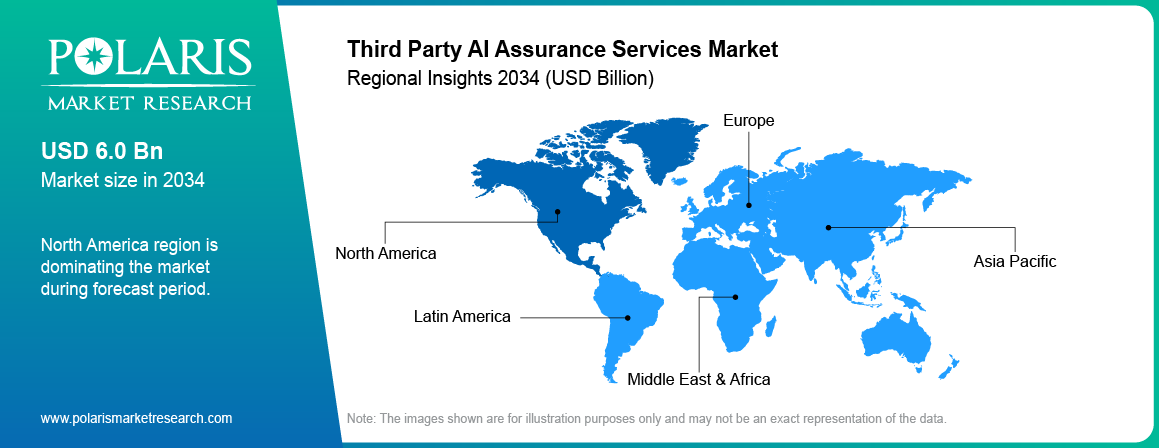
Regional demand follows regulation, the maturity of audit markets, and the pace of AI deployment. North America is the largest region, while Asia Pacific climbs quickest from a lower starting point as governments create testing schemes and accreditation lists.
North America Market
North America secured 39.3% of 2026 revenue, the largest of the five regions, driven by large enterprises, banks, and technology companies that buy outside reviews without a single national law. The region is projected to grow at a CAGR of 32.1% from 2026 to 2034, the weakest pace among the five regions.
Mexico should outgrow the larger United States market, at 35.8% from 2026 to 2034, as cross border supply chains pull Mexican suppliers into customer audits. Canada is projected to grow at 33.4%, and the United States advances at 31.5% from a 2026 base of USD 305 Million.
For example, in October 2026, UKG, based in Lowell, Massachusetts, received the 50th ISO/IEC 42001 certificate issued by BSI. The release describes a growing group of US firms seeking such certificates.
Demand is led by procurement and risk, since there is no single federal AI statute. Large buyers set their own requirements, insurers increasingly ask about AI controls, and state laws add duties that favor documented independent testing.
Europe Market
Europe held 27.9% of revenue in 2026, owing to the AI Act, a dense audit profession, and strong certification bodies. The United Kingdom leads Europe on revenue, at USD 79 Million in 2026, and Spain has the quickest growth, at a CAGR of 36.3% from 2026 to 2034.
For example, in March 2026, BSI added ANAB accreditation to existing accreditation from UKAS in the United Kingdom and RvA in the Netherlands. One certificate therefore carries recognition in the United Kingdom, the Netherlands, and the United States.
Europe is projected to grow at a CAGR of 34.0% from 2026 to 2034, ranking third among regions for growth, since the legal framework is already in place. Germany is projected at 34.0% and France at 35.0%, with notified bodies expected to gain the most conformity work.
The United Kingdom follows a different path, with a government roadmap that favors a professional assurance sector over a single regulator. Buyers in both markets are therefore comparing audit firms, certification bodies, and specialists on accreditation as much as on price.
Asia Pacific Market
Asia Pacific delivered 21.9% of 2026 revenue and is projected to grow at a CAGR of 39.3% from 2026 to 2034, the quickest of the five regions, driven by rapid AI adoption, government testing schemes, and exporters that require certificates. China is the biggest national market, at USD 42 Million in 2026, and India expands fastest, at 44.3%.
BSI also named Asia Pacific as the leading region for ISO/IEC 42001 adoption in its October 2026 release. Singapore is projected to grow at 43.8%, South Korea at 39.3%, and Japan at 36.1%, as ministries and regulators publish test guidance and exporters seek accredited certificates. Australia reached USD 28 Million in 2026.
For example, in January 2026, the Infocomm Media Development Authority of Singapore published a starter kit for testing applications built on large language models for safety and reliability. The tester scheme uses it as one benchmark of technical competence.
Government programs shape buying. Singapore is building a list of accredited testers, and other markets are watching how it works; as a result, firms that win early accreditation gain a regional reference to cite in tenders across the area.
Latin America Market
Latin America supplied 4.0% of 2026 revenue and is projected to grow at a CAGR of 34.5% from 2026 to 2034, the second fastest of the five regions. Growth is attributed to banks, telecom operators, and multinational subsidiaries that apply headquarters rules to local AI systems. Brazil leads on revenue, at USD 18 Million in 2026, and Colombia has the quickest growth, at 36.8% against 33.5% for Brazil.
Argentina and Chile are projected to grow at similar rates, as regional banks adopt the controls of their global parents. Most work comes from subsidiaries of international groups; as a result, global audit firms and certification bodies hold the main relationships.
Local AI legislation is still being drafted in several countries, and buyers wait for clear rules before they commit large budgets. Providers with regional teams and Spanish and Portuguese language testing capability have an advantage.
With a small base, a single national scheme or a large bank program can shift the numbers noticeably; as a result, forecasts carry a wider range than in larger regions.
Middle East & Africa Market
Middle East & Africa recorded 6.9% of 2026 revenue and is projected to grow at a CAGR of 32.2% from 2026 to 2034, placing fourth for growth owing to national AI strategies in the Gulf and public sector adoption. The United Arab Emirates has the highest revenue in the region, at USD 18 Million in 2026, and Saudi Arabia expands quickest, at 35.5% from 2026 to 2034.
For example, in May 2026, the UAE Cyber Security Council announced a national AI testing lab that is reported to certify models, applications, and autonomous agents before deployment, with a national certification mark for systems that pass. Cisco and Open Innovation AI were named as developers of the lab.
South Africa is projected to grow at 30.1% and Israel at 29.9%, supported by banks and a technology export base. Gulf governments buy assurance to build trust in public AI services, and they favor providers that train local staff.
Capacity is the limit in the region. Few accredited assessors operate locally; as a result, international firms staff most engagements and local bodies are building their own teams.
Third Party AI Assurance Services Market Competitive Landscape
Three layers make up the field. Audit and consulting groups sell attestations to boards, testing and certification bodies sell accredited certificates, and specialist firms sell technical evaluation and red teaming. A buyer usually signs a first engagement with one group and then widens the scope.
Market share is hard to measure because assurance fees are rarely disclosed. Observers rely on certificate counts, announced offers, and accreditation scope, and these signals favor certification bodies with a record over younger entrants.
Competition centers on credibility and speed. Audit groups lean on established brands, certification bodies on accreditation, and specialists on technical depth. Share moves slowly, since contracts renew annually and few buyers switch assurers after a first engagement.
Partnerships are common. Bureau Veritas built its offer with Amazon Web Services, KPMG builds on platforms from Microsoft, ServiceNow, and Cranium, and AIUC works with a consortium of security and risk leaders from large companies. Such links help providers cover tooling gaps without building every part.
Entry by new players continues. Seven firms signaled early interest in the Singapore tester scheme, and AIUC added USD 40 million of funding in September 2026 to widen its work. Established brands respond with acquisitions, partnerships, and accreditation.
Vendor Landscape Snapshot
| Company | Vendor Positioning | Role |
| PricewaterhouseCoopers (PwC) | Leader | Audit and advisory group that introduced independent assurance on AI systems in June 2025 |
| KPMG International | Leader | Audit group with AI assurance and attestation inside its AI Trust suite |
| Ernst & Young (EY) | Challenger | Audit group among firms interested in the Singapore tester accreditation scheme |
| Deloitte | Challenger | Audit and consulting group with AI governance and risk services |
| BSI Group | Leader | Certification body accredited by UKAS, RvA, and ANAB for ISO/IEC 42001 |
| Bureau Veritas | Challenger | Testing and certification group with an independent AI systems audit for Europe |
| SGS SA | Challenger | Testing and certification group offering AI system testing and ISO/IEC 42001 certification |
| TÜV SÜD | Challenger | Technical service and certification body with AI testing services |
| Artificial Intelligence Underwriting Company (AIUC) | Niche Player | Agent certification and insurance specialist that raised USD 40 million in September 2026 |
| Resaro | Niche Player | Testing company among firms interested in the Singapore tester scheme |
| Advai | Niche Player | Testing company among firms interested in the Singapore tester scheme |
| Credo AI | Niche Player | AI governance platform and assurance specialist |
| Holistic AI | Niche Player | AI governance and auditing specialist |
Source: Polaris Market Research Analysis
Third Party AI Assurance Services Market Technology and Innovation Landscape
Innovation centers on automated testing, standard test methods, and evidence that regulators accept. Providers are replacing manual review with software that runs thousands of checks, while humans confirm the final opinion on the most sensitive systems.
Standards are the second theme. ISO/IEC 42001 gives a management system target, and the ISO/IEC 42119 series is adding test methods, with an overview part published and parts on red teaming and generative systems still in development.
Agent testing is a further layer. AIUC reportedly puts each agent through thousands of simulated attacks, run mostly by AI agents, with humans confirming the final audit. Recertification each quarter keeps pace with new attack methods.
Evidence tooling is spreading across providers. Platforms collect model documentation, test logs, and approvals into a single record that auditors can inspect, shortening fieldwork and giving buyers a record to reuse for later regulators, customers, and insurers.
Technology and Innovation Landscape Snapshot
| Area | Role | Status and Representative Developers |
| AI management system certification | Certify governance and controls against ISO/IEC 42001 | Production, with BSI and SGS |
| Standard test methods | Define how AI systems are tested | Early, with the ISO/IEC 42119 series |
| Automated red teaming | Attack models and agents at scale | Scaling, with AIUC and specialist firms |
| Independent AI systems audit | Rate maturity against the EU AI Act | Rollout, with Bureau Veritas and AWS |
| Tester accreditation | Recognize competent third party testers | Launching, with the tester programme in Singapore |
| Continuous monitoring platforms | Track drift and policy breaches after launch | Early commercial use |
Source: Polaris Market Research Analysis
Use Case Analysis
Regulatory Conformity for High Risk Systems
Companies placing AI in hiring, credit, health, or critical infrastructure collect independent evidence that controls match the legal text. A conformity engagement maps each requirement to a test or a document and ends with a signed report.
The main constraint is timing. Dates for several obligations have moved; as a result, buyers plan staged programs that start with inventory and risk classification and defer certification until standards are final.
Sponsors usually sit in legal or risk teams and report to the board. They want a clear map from each legal clause to a test result, and they prefer assessors that can reuse the same evidence for several regimes at once.
Enterprise Procurement and Vendor Risk
Large buyers ask AI vendors for independent proof of safety before signing contracts, much as they ask for security reports today. A certificate or attestation shortens the review and makes vendors easier to compare.
Vendors respond by buying one respected assessment and reusing it across customers. Reuse works only if the assessor is recognized; as a result, accredited and large brand providers have an edge.
Buyers also ask what happens after a model update. Contracts now spell out when a change voids an earlier report, and vendors that offer a fast retest at a fixed fee gain an advantage during procurement reviews.
Agent and Frontier Model Audits
Companies deploying autonomous agents want proof that the agent resists attacks, protects data, and stays within its permissions. Testers run thousands of simulated attacks and repeat them each quarter.
The constraint is method maturity. There is no accepted test suite; as a result, each provider uses its own, and buyers read results with care.
Scope definition is the hardest step. An agent may call dozens of tools and inherit permissions from several systems; as a result, assessors map every action path first and then rank the paths by potential harm before testing begins.
Insurance and Financing Support
Insurers and lenders use assurance reports to price AI related risk. A strong report can lower premiums or ease financing terms, and some specialists pair certification with insurance cover.
The link is still young. Insurers require loss data before they trust a certificate; as a result, early products come from specialists that collect their own claims record.
Lenders and investors apply a similar logic in diligence. A buyer of an AI company may ask for an independent report on model risk, and a clean report can shorten negotiations and reduce price adjustments at closing.
Public Sector and National Schemes
Governments build testing labs, accreditation lists, and risk frameworks, and then require public suppliers to use them. These programs create steady demand for accredited testers.
Funding cycles and procurement rules drive timing. Providers that join pilots early build track records that carry into later tenders.
Public bodies also publish guidance that private firms adopt voluntarily. A test kit written for ministries becomes a common reference in supplier contracts, and that spread turns a government pilot into a wider commercial standard within a few years.
Buyer Needs and Decision Criteria
| Buyer Need | Decision Criteria | Why It Matters |
| Credibility | Brand, accreditation, and independence | A weak assurer gives the buyer little protection with regulators |
| Technical depth | Testing methods and tooling | Shallow tests miss failures in models and agents |
| Standard coverage | ISO/IEC 42001, AI Act, and national frameworks | One engagement should satisfy several audiences |
| Speed and cost | Time to report and fee structure | Launch dates are fixed and budgets are limited |
| Ongoing support | Monitoring and recertification | Models change after launch and findings go stale |
Source: Polaris Market Research Analysis
Entry barriers are high, since a new provider must build credibility, secure accreditation, and obtain professional cover. Comparing offers is hard because scopes differ, and buyers therefore stay with providers they already use.
Premium Insights and Forward Outlook
Accreditation Will Separate Leaders From Followers
As regulators and buyers begin to ask who accredited the assessor, certificates from unaccredited bodies will lose value. Providers with several accreditations can sell one audit in numerous countries.
The accreditation scope matters more than the logo on the certificate; as a result, it deserves a direct question to the provider. Providers should apply early, since accreditation bodies add pilots slowly.
Agent Assurance Will Become a Recurring Revenue Line
Autonomous agents change with every model update; as a result, one audit expires quickly. Quarterly recertification turns a project into a subscription and raises lifetime value per client.
Providers that automate testing can serve numerous agents at low marginal cost. Buyers should negotiate for change triggers that define when a new test is required.
Standards Gaps Will Create Pricing Pressure
Without agreed test methods, buyers cannot compare providers, and fees vary widely. Once the ISO/IEC 42119 series matures, tests will standardize and basic work will fall in price.
Premium pricing will then move to areas where standards lag, such as agents and generative systems, and providers should plan their portfolios accordingly.
Government Schemes Will Pull Private Demand
National labs and tester lists create reference points that private buyers copy. A supplier certified for public work gains an edge when bidding for private contracts in the same country.
Firms should track Singapore, the United Arab Emirates, the United Kingdom, and the European Union, as early alignment with each scheme lowers later entry costs.
Key Players in the Third Party AI Assurance Services Market
- PricewaterhouseCoopers (PwC)
- KPMG International
- Ernst & Young (EY)
- Deloitte
- BSI Group
- Bureau Veritas
- SGS SA
- TÜV SÜD
- Artificial Intelligence Underwriting Company (AIUC)
- Resaro
- Advai
- Credo AI
- Holistic AI
Industry Developments
- October 2026: BSI reached 50 ISO/IEC 42001 certificates, up from 11 issued in all of 2025.
- September 2026: AIUC closed a USD 40 million Series A round led by Ribbit Capital and plans to audit frontier models.
- June 2026: Parliament backed the AI omnibus by 423 votes to 57, and the Council gave final approval on 29 June.
- May 2026: Singapore unveiled a tester accreditation scheme, and the UAE announced a national testing lab.
- April 2026: Bureau Veritas rolled out an AI systems audit in Europe, and Saudi Arabia issued a national risk framework.
- March 2026: BSI became the first certification body accredited by ANAB, UKAS, and RvA for ISO/IEC 42001.
- January 2026: SGS outlined the ISO/IEC 42119 testing series, of which one part is published.
- September 2025: KPMG widened its AI Trust suite, and the UK issued a roadmap for third party assurance.
Third Party AI Assurance Services Market Report Segmentation
By Service Type Outlook (Revenue, USD Billion, 2021 to 2034)
-
Governance and Risk Assurance
-
Model Testing and Evaluation
-
Compliance Audit and Certification
-
Security and Red Teaming
By Engagement Stage Outlook (Revenue, USD Billion, 2021 to 2034)
-
Pre Deployment Assessment
-
Post Deployment Audit
-
Continuous Monitoring
By AI System Type Outlook (Revenue, USD Billion, 2021 to 2034)
-
Predictive and Traditional AI
-
Generative AI
-
Agentic AI
By Provider Type Outlook (Revenue, USD Billion, 2021 to 2034)
-
Big Four and Consulting Firms
-
Testing Inspection and Certification Bodies
-
Specialist AI Assurance Firms
By End User Outlook (Revenue, USD Billion, 2021 to 2034)
-
BFSI
-
Healthcare and Life Sciences
-
Government and Public Sector
-
Technology and Telecom
-
Others
By Regional Outlook (Revenue, USD Billion, 2021 to 2034)
- North America
- United States
- Canada
- Mexico
- Europe
- United Kingdom
- Germany
- France
- Italy
- Netherlands
- Spain
- Rest of Europe
- Asia Pacific
- China
- Japan
- India
- South Korea
- Singapore
- Australia
- Rest of Asia Pacific
- Latin America
- Brazil
- Argentina
- Chile
- Colombia
- Rest of Latin America
- Middle East & Africa
- United Arab Emirates
- Saudi Arabia
- South Africa
- Israel
- Rest of Middle East & Africa
Third Party AI Assurance Services Market Report Scope
| Report Attribute | Details |
| Market Size in 2025 | USD 0.68 Billion |
| Market Size in 2026 | USD 0.94 Billion |
| Revenue Forecast by 2034 | USD 11.82 Billion |
| CAGR | 37.2% (2026 to 2034) |
| Base Year | 2025 |
| Historical Data | 2021 to 2024 |
| Forecast Period | 2026 to 2034 |
| Quantitative Units | Revenue in USD Million and USD Billion, and CAGR in percent |
| Report Coverage | Revenue Forecast, Growth Factors, Competitive Landscape, Industry Trends, and Strategic Analysis of the third party AI assurance services market |
| Segments Covered | By Service Type, Engagement Stage, AI System Type, Provider Type, End User, and Region |
| Regional Scope | North America, Europe, Asia Pacific, Latin America, Middle East & Africa |
| Competitive Landscape | Company Profiling, Service Benchmarking, Financial Analysis, Market Developments, and Strategic Initiatives |
| Report Format | PDF and Excel |
| Customization | Available by Country, Region, and Segment |
| Research Team | Polaris Market Research & Consulting, Inc. research team |
| Last Updated | 9 November 2026 |
Source: Polaris Market Research Analysis
Why Choose Polaris Market Research
The numbers here come from one country by country model. Twenty seven country lines add up to five regions, and any regional figure can be traced to the service, stage, and buyer cuts that built it.
Two cuts set this study apart: revenue by engagement stage and revenue by provider type. Budgets are tracked as they move among early reviews, later audits, and continuous monitoring, and so are audit groups, certification bodies, and specialists as they trade position.
Every external fact is tagged with its publisher and, if known, its date. Anyone can then separate company claims from agency statements and press reports without leaving the report.
Polaris can tailor the work to a single country, a chosen segment, or a short list of assurance providers. To buy this report or request customization, contact Polaris Market Research & Consulting, Inc.
Research Methodology
Research Approach
The boundary covers fees that independent parties earn for evaluating, auditing, testing, and certifying AI systems. Software licenses, in house review teams, and standards bodies sit outside it. Figures run from 2021 to 2034 on a 2025 base, appear in USD Million and USD Billion, and cover five segment cuts across 27 country lines in five regions. The research methodology page describes the wider Polaris framework.
Secondary Research
Desk work yielded 12 dated facts, split into 2 agency sources, 4 company statements, and 6 trade or legal articles. The register records each publisher and date, and nearly every item falls inside the last eighteen months.
Primary Research
Polaris follows its standard process of primary interviews. These interviews cover audit and consulting firms, testing and certification bodies, AI developers and enterprise buyers, and industry experts. They are used to validate secondary estimates, segment shares, regional trends, and growth drivers.
Data Structuring
All inputs were put on a USD basis for each year before segmenting, and segment boundaries were set beforehand. An engagement spanning several service lines goes to its main line to avoid a double count, while governance software revenue was excluded to hold totals within scope.
Market Size Estimation
Country level estimates come first. Engagement counts, average fees, and recurring monitoring contracts form segment values that are added up into regions and then the global total.
Forecasting
Regulatory dates, accreditation progress, and enterprise rollout of generative and agentic systems drive the forecast. One easing growth curve produces the stated CAGR, and the mix tilts toward continuous monitoring, specialist providers, and Asia Pacific as the period advances.
Data Triangulation and Validation
Four checks were run on the finished model: each segment set reaches 100% annually, countries add to regions, regions roll up to the global total, and a single easing growth path joins history to forecast. The 2025 figure was then compared with the published estimates described earlier.
Limitations
Assurance fees overlap at the edges with cybersecurity consulting, financial audit, and compliance software spending, one reason published sizes differ. Engagement fees are usually private; as a result, segment splits by region are modeled estimates, not reported data. Market figures in this report are Polaris estimates.
Research Methodology Phases
| Phase | Focus | Evidence / Output |
| Scope and Setup | Market boundary, segments, and regions | Fixed scope and segment list |
| Secondary Data Collection | Releases, agency records, and press articles | 12 sourced facts with dates |
| Primary Research | Talks with providers, buyers, and domain experts | Checked shares, trends, and drivers |
| Data Structuring | USD basis for every year, fixed edges | Inputs without double counting |
| Bottom Up Estimate | Country and segment estimates | Regional and global totals |
| Top Down Estimate | Global base for 2025 and its segment mix | Base compared with public estimates |
| Forecasting | Annual growth path to 2034 | Stated CAGR |
| Triangulation and Validation | Share, total, and range checks | Four passed checks |
| Output | Report tables and text | A single data set behind all tables |
Source: Polaris Market Research Analysis
Data Sources by Type
| Type of Source | Named Examples | Role in the Estimates |
| Public agencies (2) | UK Department for Science, Innovation and Technology; Economic Development Board of Singapore | Sector size and national scheme design |
| Company releases (4) | BSI, Bureau Veritas, SGS | Certification activity and service launches |
| Trade and legal publications (6) | Accounting Today, CPA Practice Advisor, SiliconANGLE, Gowling WLG | Provider offers, funding, and regulatory timetables |
Source: Polaris Market Research Analysis
Third-Party AI Assurance Services Market FAQ's
The market covers independent testing, auditing, and certification of AI systems carried out by outside parties. Buyers use the results to demonstrate regulators, customers, and insurers that a system is controlled.
The third party AI assurance services market size was valued at USD 0.68 Billion in 2025, according to Polaris Market Research analysis. The 2026 figure reached USD 0.94 Billion on regulation and enterprise AI deployment.
According to Polaris Market Research analysis, the third party AI assurance services market should reach USD 11.82 Billion by 2034, with a CAGR of 37.2% from 2026 to 2034.
North America is the leading market, with 39.3% of revenue in 2026. Revenue is concentrated in large enterprises, banks, and technology firms in the United States.
Asia Pacific is the fastest growing region, at 39.3% a year from 2026 to 2034. India is the quickest riser there.
The largest share belongs to Governance and Risk Assurance, with a 28.5% slice of 2026 revenue, though Model Testing and Evaluation follows at 27.7%. Security and Red Teaming moves quicker, at 39.4% a year.
The key players include PricewaterhouseCoopers, KPMG International, Ernst & Young, Deloitte, BSI Group, Bureau Veritas, SGS SA, and the Artificial Intelligence Underwriting Company. Audit groups, certification bodies, and specialists each hold a different layer.
Certification bodies are winning accreditation for ISO/IEC 42001, audit groups are adding attestation, and governments are building testing schemes. Specialists are also moving into agent audits.
Test standards are incomplete, accredited assessors are scarce, and several legal dates have moved. Smaller buyers delay spending on low risk systems.
Third party assurance is performed by an outside party and ends in a signed opinion or certificate. An internal review is performed by the builder, which makes it faster but less persuasive to regulators.
Pre Deployment Assessment earns the most, at USD 478 Million in 2026, as most buyers want an opinion before launch. Continuous Monitoring is the quickest growing, at a CAGR of 43.8% from 2026 to 2034.
Agentic AI grows fastest, at a CAGR of 57.2% from 2026 to 2034. The largest type remains Predictive and Traditional AI.
The provider decides credibility and technical depth. In 2026, Big Four and Consulting Firms lead with 42.8% of 2026 revenue, while Specialist AI Assurance Firms are gaining ground at 40.9% a year.
The United States ranks first by country, with USD 305 Million in 2026, followed by the United Kingdom and China.
Regulation, emerging certification standards, and board demand for outside proof lift demand. BSI issued 11 ISO/IEC 42001 certificates in 2025 and its 50th in October 2026.

Download Sample Report of Third-Party AI Assurance Services Market
Please fill out the form to request a customized copy of the research report.


