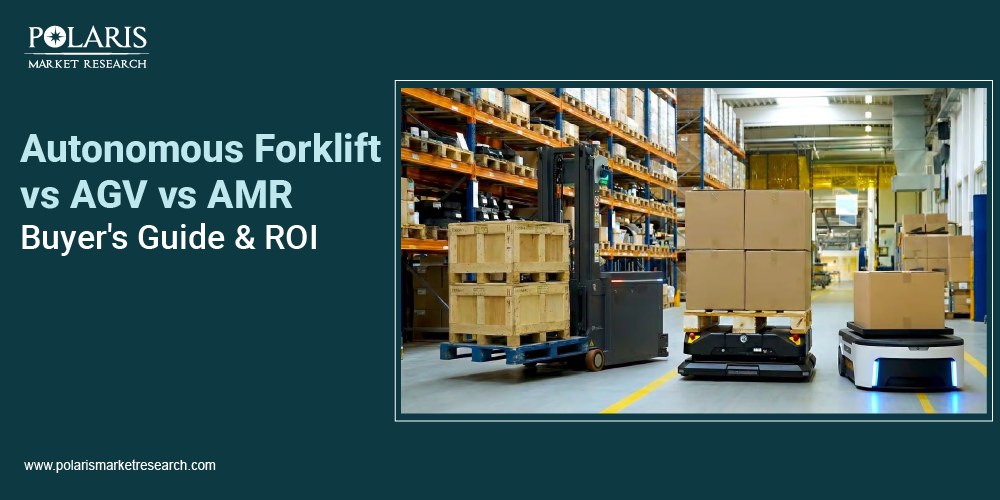
Choosing between an autonomous forklift, AGV and AMR depends on your warehouse requirements. AGVs suit fixed routes, AMRs support flexible transportation, and autonomous forklifts handle pallet lifting and movement.
Each technology offers different capabilities in navigation, payload capacity, flexibility and operating costs. Understanding these differences helps warehouse managers select suitable automation solutions. This guide compares all three technologies, explains ROI and provides a practical buying checklist.
What Are Autonomous Forklifts, AGVs and AMRs?
Autonomous forklifts, AGVs and AMRs automate material movement inside warehouses. However, they differ in navigation methods, flexibility and material-handling capabilities.
Automated Guided Vehicles (AGVs)
Automated Guided Vehicles (AGVs) follow predefined routes inside warehouses and manufacturing facilities. They use magnetic tape, wires, QR codes or reflectors for navigation.
AGVs work well in predictable environments with repetitive transportation requirements. They move materials between fixed locations with limited route changes.
However, changing their routes can require infrastructure modifications. This makes them less suitable for facilities with frequently changing layouts.
Autonomous Mobile Robots (AMRs)
Autonomous Mobile Robots (AMRs) navigate independently using LiDAR, cameras, sensors and onboard maps. They identify obstacles and adjust their routes when necessary.
Unlike traditional AGVs, AMRs do not depend entirely on fixed pathways. They support flexible warehouse operations, including picking assistance, inventory movement and internal transportation. These applications are contributing to the growth of the Autonomous Mobile Robots Market.
Autonomous Forklifts
Autonomous forklifts are driverless industrial vehicles designed to lift, transport and position materials. They use sensors, cameras, navigation software and automated control systems.
These vehicles handle pallet transportation, loading, unloading and storage operations. Depending on their technology, they can follow predefined routes or navigate dynamically.
They are particularly useful for warehouses handling repetitive pallet movements and heavy loads. Their applications also contribute to the expanding Logistics Robotics Market, where automated systems support material handling and transportation.
Autonomous Forklift vs AGV vs AMR: Side-by-Side
The main difference between autonomous forklifts, AGVs and AMRs is their navigation flexibility and material-handling capability.
| Factor | Autonomous Forklift | AGV | AMR |
| Navigation | Fixed or dynamic | Predefined routes | Dynamic navigation |
| Payload and lift height | Designed for pallet lifting and stacking | Depends on vehicle type | Depends on robot type |
| Facility changes | Low to moderate | Often requires route modifications | Usually requires remapping |
| Route flexibility | Moderate to high | Low | High |
| Typical tasks | Pallet handling and stacking | Repetitive transportation | Picking and material movement |
| Relative upfront cost | Generally high | Low to moderate | Moderate |
| Best fit | Pallet-intensive warehouses | Stable workflows | Flexible operations |
AGVs suit predictable transportation routes. AMRs offer greater flexibility in changing environments. Autonomous forklifts are suitable for pallet-intensive operations requiring lifting and stacking.
These technologies form important parts of modern warehouse automation. Their applications include storage, picking, sorting and material transportation. These activities are also supporting demand across the Warehouse Robotics Market.
How to Calculate Autonomous Forklift ROI
Autonomous forklift ROI depends on equipment costs, labor savings and warehouse productivity. Businesses should compare their total investment with annual operational savings.
Cost Inputs
The initial investment includes several expenses:
- Vehicle costs: Equipment, sensors, batteries and lifting systems.
- Software costs: Navigation software and fleet management systems.
- System integration: Integration with Warehouse Management Systems (WMS).
- Infrastructure: Safety upgrades, charging stations and facility modifications.
- Training and maintenance: Employee training, servicing and software updates.
Savings Inputs
Automation can reduce several recurring warehouse expenses:
- Operator labor: Reduced dependence on manual forklift operators.
- Product damage: Fewer handling errors and inventory damage.
- Operational uptime: Consistent material movement across multiple shifts.
- Workplace safety: Reduced exposure to certain manual handling risks.
- Productivity: Faster and more consistent material transportation.
Simple Payback Formula
Warehouse managers can estimate the payback period using this formula:
Payback Period (Years) = Total Investment ÷ Annual Net Savings
For example, consider a warehouse investing USD 300,000. Assume its annual net savings reach USD 180,000.
The estimated payback period would be approximately 1.67 years. This represents around 20 months.
Many multi-shift warehouses recover their autonomous forklift investment within 1.5 to 2 years. Actual returns depend on utilization, labor costs and implementation requirements.
Leasing and Robotics-as-a-Service (RaaS)
Businesses can also consider leasing and Robotics-as-a-Service (RaaS). These models reduce initial capital requirements.
Under RaaS, businesses pay recurring fees for robotic equipment and related services. Pricing may depend on subscriptions, usage or operational requirements.
This approach helps warehouses adopt automation without purchasing an entire fleet. Businesses should compare subscription expenses with long-term ownership costs.
Which One Fits Your Warehouse? A Decision Checklist
Selecting the right technology requires evaluating warehouse requirements. Consider these six questions before making an investment.
- What loads do you handle? Choose autonomous forklifts for pallet lifting. AGVs and AMRs suit other transportation requirements.
- What lifting height do you need? Autonomous forklifts support pallet stacking and vertical storage operations.
- Are your routes stable? AGVs suit fixed routes, while AMRs support changing layouts.
- How many shifts do you operate? Autonomous forklifts can support repetitive operations across multiple shifts.
- Do people and robots share working areas? Evaluate pedestrian detection, speed limits and safety systems.
- Is your WMS ready for integration? Check software compatibility and integration requirements before deployment.
Warehouses with stable routes may benefit from AGVs. Facilities requiring flexible transportation can consider AMRs. Pallet-intensive operations should evaluate autonomous forklifts.
Safety Standards to Know
Safety compliance is essential when introducing driverless vehicles. ISO 3691-4 covers safety requirements for driverless industrial trucks and their systems. ANSI/ITSDF B56.5 addresses driverless industrial vehicles in the United States.
Warehouses should establish designated safety zones and suitable speed limits. Emergency stops and obstacle detection are also important. Employee training supports safer operations.
Buyers should confirm equipment compliance with applicable local regulations before installation.
Market Outlook and Recent Launches
The autonomous forklift market is expanding as warehouses invest in automation. The global market was valued at USD 5.32 billion in 2025.
It is projected to reach USD 17.14 billion by 2034. This represents a CAGR of 13.9% from 2026 to 2034.
Warehousing accounted for 52.8% of the market share in 2025. Growing automation across distribution centers and e-commerce facilities supports this demand.
Recent industry developments also highlight growing investment in warehouse automation:
- April 2026: Toyota Industries launched Toyota Automated Logistics. The business combines Bastian Solutions, Vanderlande's warehousing business and viastore under one brand.
- August 2026: Pudu Robotics launched the PUDU MP2000. The autonomous pallet-handling robot supports payloads of up to 2,000 kg.
- July 2026: ABB introduced the Flexley Stack F712. It combines autonomous forklifts, tugs and movers on a common navigation platform.
These developments highlight increasing interest in flexible and scalable warehouse automation solutions.
Frequently Asked Questions
What is the difference between an AGV and an AMR?
An AGV follows fixed paths using wires, magnetic tape or reflectors. An AMR uses sensors and onboard maps to navigate independently. It can also reroute around obstacles.
Is an autonomous forklift an AGV or an AMR?
An autonomous forklift can use either navigation approach. Some models follow predefined routes like AGVs. Others use dynamic navigation similar to AMRs.
What is the ROI of an autonomous forklift?
ROI depends on labor costs, operating shifts and equipment utilization. Many multi-shift warehouses recover autonomous forklift costs within 1.5 to 2 years.
Can autonomous forklifts work alongside people?
Yes, autonomous forklifts can operate alongside human workers. However, appropriate safety systems, speed limits and designated operating zones are essential. Employee training also supports safer operations.
What safety standards apply to autonomous forklifts?
ISO 3691-4 covers driverless industrial trucks and their systems. ANSI/ITSDF B56.5 addresses driverless industrial vehicles in the United States. Buyers should also check applicable local regulations.
Explore the latest trends, growth opportunities and competitive insights in the Autonomous Forklift Market. Request a sample report from Polaris Market Research today.