
AI Laptop Market Size, Share, Trends and Forecast, 2026–2034
REPORT DETAILS
AI Laptop Market Summary
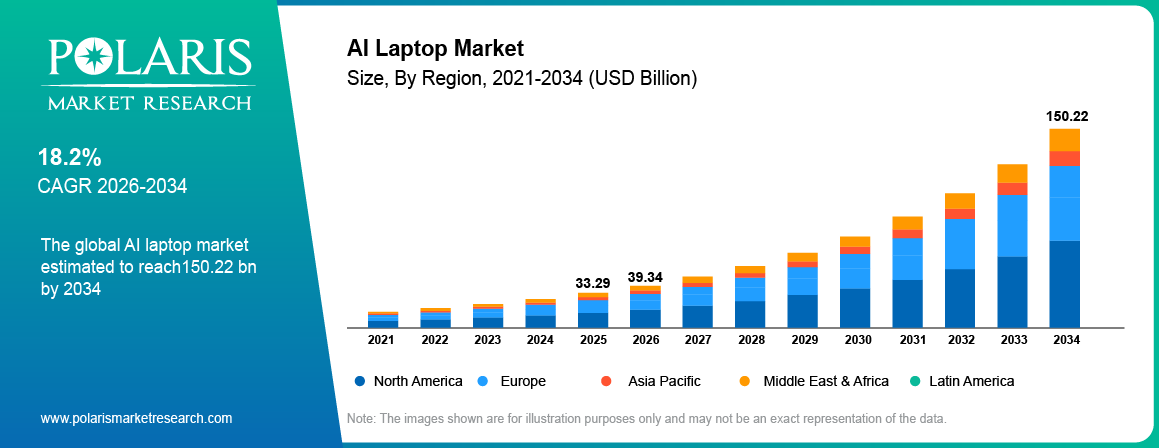
The AI laptop market size was valued at USD 33.29 billion in 2025. The market is expected to register a CAGR of 18.2% from 2026 to 2034. The demand for AI laptop is expected to grow owing to increasing demand for computing capabilities enhanced by AI, on-device computing capabilities, and increased productivity at workspaces.
Market Statistics
Key Takeaways
- North America has accounted for 32.18% of the global AI laptop market share in 2025, owing to the increasing adoption of AI laptops and enterprise demand.
- Asia Pacific is estimated to register the fastest CAGR of 21.46%, fueled by rising PC manufacturing and AI laptop demand.
- 40 to 60 TOPS NPU segment captures 39.18% market share in 2025, driven by the availability of Intel and AMD processor platforms.
- Above 60 TOPS NPU laptops are expected to register an 28.42% CAGR, powered by the development of advanced NPU platform by Qualcomm and demand for higher performance of on-device AI processing increases.
- Commercial users comprised a share of 55.84% in 2025 due to business laptop replacement requirements and productivity requirements through AI.
Note: Figures and projections outlined in this report are the result of Polaris Market Research’s proprietary analytical processes, grounded in the latest available datasets and market observations.
AI Laptop Market Definition
The AI laptop market comprises laptops equipped with dedicated AI processing capabilities for running artificial intelligence workloads in consumer and commercial applications. These devices also incorporate a neural processing unit (NPU) in addition to the CPU and GPU for AI tasks like image processing, content generation, voice recognition, and productivity features. The market includes laptops with AI-enabled processor platforms, such as x86 Windows, Arm Windows, and Apple Silicon systems. It does not include conventional laptops without dedicated AI processing capabilities and standalone AI software revenue.
AI laptops use NPUs to do some AI processing on the device, so they don’t need to rely as much on cloud computing. This allows on-device inference for applications such as real-time translation, image enhancement, and the execution of local AI applications. TOPS are used to measure NPU performance and give an indication of how well a laptop can handle AI workloads. Processor developments from Intel, AMD, Qualcomm and Apple are extending AI computing capabilities across different price bands and device categories. The market analysis covers processor platforms, NPU rating bands, pricing, and end-user demand.
The AI laptop industry is being driven by the increasing demand for AI-enabled productivity, local data processing, and commercial PC upgrades. Consumer applications include content creation, image editing, voice assistance, and AI-powered search. Uses in business include processing documents, assistance in meetings, analyzing data, and productivity at work. The market also includes Copilot+ PC laptops and other AI-enabled notebooks built for local AI workloads. The assessment covers revenue from AI-capable laptops in commercial and consumer segments, excluding standalone AI software and general-purpose computing devices without dedicated AI processing capabilities.
Market Dynamics
Market Driver and Opportunity Snapshot
| Factor | Snapshot | Market Impact |
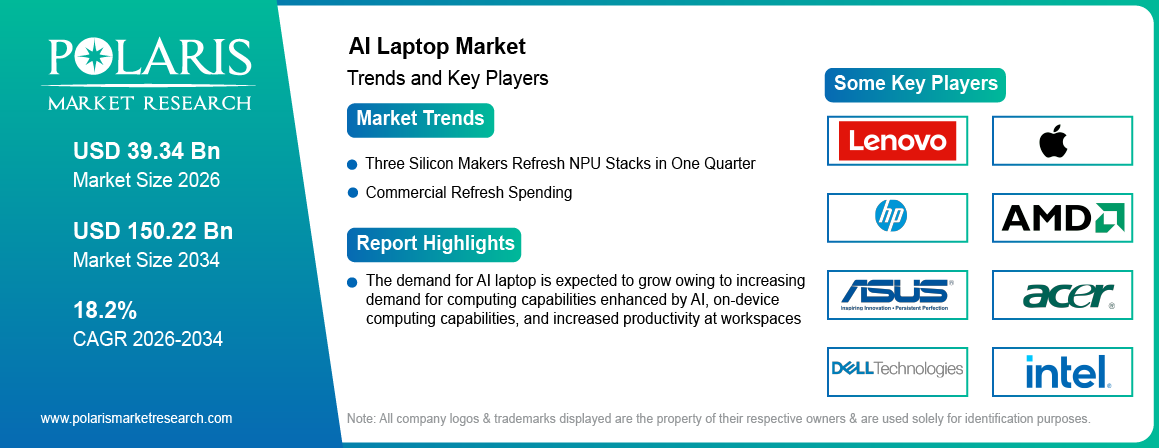
| Driver | Three Silicon Makers Refresh NPU Stacks in One Quarter | Expands AI laptop availability and accelerates adoption across price segments. |
| Driver | Commercial Refresh Spending | Increases enterprise demand and strengthens replacement cycles. |
| Opportunity | Local Large Language Models on Premium Notebooks | Creates demand for high-performance, privacy-focused AI laptops. |
| Opportunity | Windows on Arm Reaches Mid-Price Notebooks | Broadens customer reach and supports mainstream AI laptop adoption. |
Source: Polaris Market Research Analysis
Driver: Three Silicon Makers Refresh NPU Stacks in One Quarter
Rising upgrades to processors that provide greater NPU performance across the major laptop platforms are driving the AI laptop market growth. Intel, AMD, and Qualcomm are expanding their AI processor portfolios to support more workloads natively on devices. These upgrades enhance local processing capability for content creation, image editing, voice assistance, and other AI applications. Higher NPU performance also widens the range of devices that satisfy the Copilot+ PC requirements. Laptops makers get more options to roll out AI-enabled models across various price points with frequent processor updates. This product development cycle strengthens the market for AI-enabled laptops. Qualcomm and HUMAIN unveiled the Horizon Ultra AI PC laptops in August 2026, featuring the Snapdragon X2 Elite with 18-core CPU, GPU, and NPU architecture for on-device AI computing. Enterprise availability was expected to start from September 20, 2026 (Source: Qualcomm).
Driver: Commercial Refresh Spending
Commercial refresh spending is fueling increased demand for AI-enabled laptops in enterprises and professional workplaces. Businesses are upgrading older computers to improve employee productivity, device performance, and compatibility with newer software applications. AI laptops offer dedicated processing power for applications such as meeting summaries, document creation, data analysis, and workplace assistance. These features allow employees to complete routine activities through local AI applications. When enterprise buyers make purchasing decisions, they also consider device security, battery life, performance, and the operating costs over the long term. The move to AI-ready workplace computing is growing replacement demand in large enterprises and small and medium-sized businesses.
Restraint: Memory, Substrate and Price Pressure
AI laptop makers are dealing with cost pressures from memory, substrate, and component prices. With increasing AI processing demands, the need for advanced memory configurations and more powerful computing components also grows. Such requirements increase production cost and put pressure on device prices. Manufacturers also need to consider the availability of components and the cost of sourcing them across multiple products. Hardware design and cost considerations become even more complicated with unified memory designs, especially for high-end notebooks. Retailers may hike prices, and that could impact cost-conscious consumers and businesses’ buying decisions. Such cost pressures create challenges for manufacturers looking to drive AI laptop adoption in mass-market price categories.
Opportunity: Local Large Language Models on Premium Notebooks
High-end notebooks with local large language model support for advanced AI applications on laptops. Compatible devices can handle select AI workloads locally with increased processing power and larger memory configurations. That means that some operations will rely less on cloud services and that users will have more control over how data is processed. Applications include content generation, document analysis, coding help, and information retrieval. Premium notebooks also provide hardware configurations that can handle demanding computing tasks. As software developers optimize models for local execution, laptop manufacturers have opportunities to launch devices designed for private and responsive AI experiences in professional and consumer applications.
Opportunity: Windows on Arm Reaches Mid-Price Notebooks
Windows on Arm is growing into the mid-price notebook market so there are opportunities to get to a wider customer base. The combination of power efficiency and AI processing capabilities in arm-based processors allows manufacturers to build thinner laptops with longer battery life. More affordable devices can bring AI computing to consumers and businesses beyond the premium arena. Wider software compatibility and application optimization also affect adoption among different user groups. Manufacturers are broadening their product portfolios to meet a variety of performance and price requirements.
AI Laptop Market Segmentation Analysis
The AI laptop market is segmented by processor platform, NPU rating band, price band, and end user to examine market distribution and growth opportunities.
Processor Platform Insights
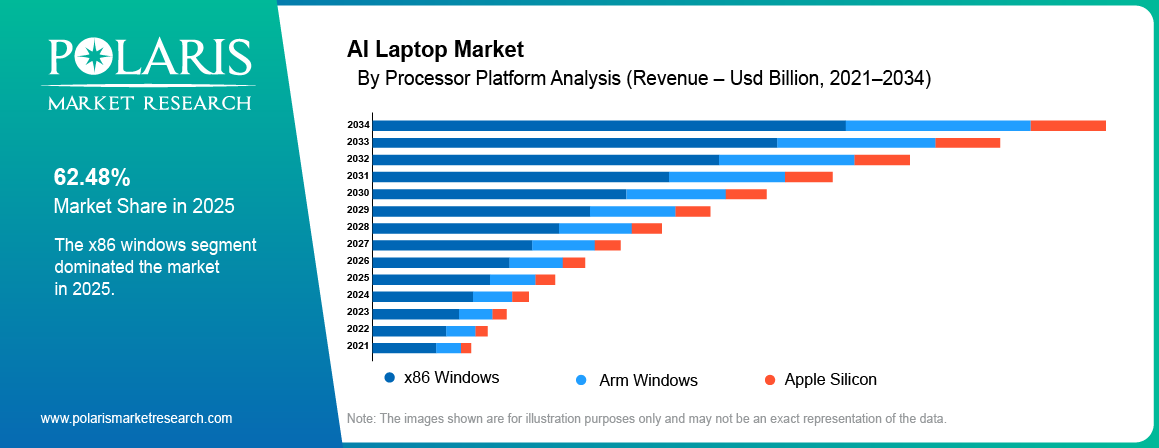
x86 Windows segment dominated the AI laptop market share with 62.48% in 2025. Laptops with processors from Intel and AMD are in this category. These systems combine an AI-optimized CPU, integrated GPU, and NPU to handle different computing workloads. The broad range of device configurations and existing software compatibility contribute to the demand in both consumer and commercial applications. The platform is also a huge choice for enterprise procurement and personal computing with manufacturers offering x86 Windows laptops in multiple price categories.
The Arm Windows segment is anticipated to register a 26.84% CAGR during 2026–2034. This section is about AI laptops using Arm-based processors such as Qualcomm Snapdragon platforms. They pair dedicated AI processing with power-efficient computing architectures. They use less power, which improves battery life and enables thinner notebook designs. Availability in premium and mid-range price categories is likely to boost adoption. Improvements in software compatibility and application optimization also play a role in the buying decisions of consumers and commercial buyers.
In 2025, Apple Silicon captured 23.15% of the AI laptop market share. This group includes MacBook models based on Apple’s M-series and A-series chips. These chips combine CPU, GPU, and neural processing power to handle some AI tasks locally. Apple designs the hardware and software for all its notebooks, so it can weave AI capabilities more tightly into its operating systems and applications. Demand is driven by consumers and professionals looking for performance for content creation, productivity, and other computing activities. Product pricing and device upgrades are influencing the segment growth.
NPU Rating Band Insights
The 40 to 60 TOPS segment held the significant market share of 39.18% in 2025. The category includes laptops with enough NPU capacity for a wider range of local AI applications. This performance range is where processor platforms like the AMD Ryzen AI 400 laptops and the Intel Core Ultra Series 3 Panther Lake laptops are found. These handle AI-driven productivity, image processing and some content generation. Broad availability across notebook categories and compatibility with Copilot+ PC requirements fortify demand among commercial and consumer buyers.
The above 60 TOPS segment is projected to grow at the fastest pace, at a CAGR of 28.42% during 2026–2034. AI laptops in this category have NPUs with over 60 TOPS. Qualcomm’s Snapdragon X2 platform supports up to 80 TOPS of NPU performance, boosting the capacity for local AI workloads. Users who run demanding AI applications and local models are drawn to the higher processing capabilities. The growth of the segment is also dependent on software optimization, device pricing, and broader availability of compatible applications in consumer and commercial computing environments.
The below 40 TOPS segment accounted for 47.26% of the AI laptop market share in 2025. This category includes laptops with NPUs that are less than 40 trillion operations per second (TOPS). These things handle certain AI workloads, like background effects, voice processing, and simple image enhancement. Their lower processing capacity keeps them out of the higher NPU performance categories. The demand depends on the price of the devices, the applications’ needs, and the amount of AI functionality the users need. This also covers buyers who are looking more at general computing performance instead of advanced local AI processing.
Price Band Insights
The USD 1,000 to USD 1,999 segment led the AI laptop market share in 2025, accounting for 45.16%. This category contains mid-range and upper-mid-range notebooks, which offer a good balance of processing power, memory capacity, battery life, and AI capabilities. Buyers in this category are looking for devices for professional tasks, productivity apps and computing on a daily basis. There is a variety of processor platforms and edge AI hardware configurations that manufacturers offer in this price range. Enterprise buying and consumer appetite for smart AI-enabled notebooks help revenues in the segment.
The below USD 1,000 segment is anticipated to record a CAGR of 22.68% during 2026–2034. This category is for entry-level and mid-range AI laptops for consumers and cost-conscious businesses. Manufacturers are expanding their product portfolios to deliver AI processing capabilities at lower price points. They satisfy daily needs like preparing documents, collaborating online, searching information, and creating basic content. The market access should be improved by the introduction of more affordable models. Segment growth is a function of component costs, hardware configurations, and consumer purchasing power.
In 2025, the USD 2,000 and above segment held a share of 20.12% in the AI laptop market. This category includes premium laptops for demanding professional workloads, advanced content creation, and high performance computing. These devices generally have higher memory configurations, better displays, and powerful processor platforms. Premium ultrabook designs also appeal to users who want portability and advanced computing features. The demand is driven by professionals, enterprise buyers, and consumers, who prioritize performance over price. The segment’s growth is driven by product innovation, hardware specifications, and replacement cycles for premium devices.
End User Insights
The commercial segment accounted for the largest share of 55.84% in 2025. Businesses are increasingly embracing AI-enabled notebooks to boost employee productivity, improve workplace collaboration, and access local AI applications. The commercial refresh programs also create demand for devices with newer processors with dedicated NPUs. Companies are thinking about the performance of the hardware, security, battery life, and how it is managed in procurement. AI laptops are also great for work related needs like preparing documents, help in meetings, data analysis, and software development.
In 2025, the consumer segment made up 44.16% of the AI laptop market share. This section covers end users purchasing AI-powered notebooks for their personal use, education, entertainment, and content creation. Consumers select devices based on their processing power, battery life, memory capacity, and access to AI-enabled features. Local image processing, voice assistance, and content generation are also among the broader range of applications available on personal computers. Demand will be driven by disposable income, price of devices, availability of products, and awareness of what artificial intelligence can do. New product launches and replacement purchases also influence segment revenue.
AI Laptop Market Regional Insights
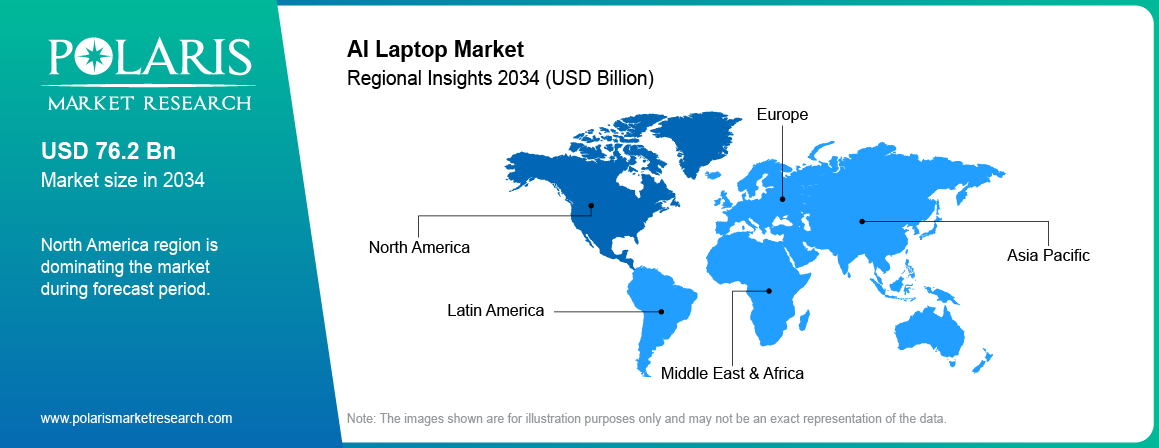
The AI laptop market spans North America, Europe, Asia Pacific, the Middle East & Africa, and Latin America. Demand is a function of enterprise PC replacement, consumer purchasing power, digital infrastructure, and access to AI-enabled devices across regions. Vendors are expanding their product portfolios across price segments, from entry-level notebooks to premium ultrabook models. Availability of processor, NPU performance, software compatibility, and local demand for AI computing also affect the development of the regional market.
North America AI Laptop Market Trends
North America held the largest market share with a share of 32.18% in 2025. Enterprise PC replacement, adoption of AI-enabled computing, and strong demand for advanced notebook configurations drive regional demand. Companies are testing AI laptops for workplace productivity, data processing, and software development. Consumers also consider battery life, processing power, and access to AI-enabled features when choosing a device. The region’s position in the global market is strengthened by established technology adoption and commercial procurement activity. Microsoft launched the Surface Laptop Ultra in October 2026, running on NVIDIA RTX Spark, with a starting price of USD 2,599, aimed at developers and creators who want powerful on-device AI computing (Source: Axios).
Asia Pacific AI Laptop Market Trends
The market in Asia Pacific is expected to register the fastest growth at a 21.46% CAGR during 2026–2034. Rising demand for personal computers, growing enterprise technology adoption, and wider availability of AI-enabled devices are driving regional expansion. Manufacturers are expanding their product portfolios across different performance and price segments. The demand for on-device AI laptops is also opening up opportunities for devices with advanced NPUs. Regional market growth is anticipated from enterprise procurement and consumer upgrades. On September 2026, Dell Technologies Inc. introduced the Dell Pro 3, Pro 5, and Pro 7 commercial PCs and Pro Precision workstations in India powered by Intel Core Ultra Series 3 and AMD Ryzen AI 400 processors to support on-device AI workloads (Source: ETCIO).
Europe AI Laptop Market Trends
In 2025, Europe had an 25.16% share of the global AI laptop market. Enterprises are modernizing, businesses want tools to boost worker productivity, and there is interest in computing devices that save energy. All of these are driving the regional adoption. Businesses are looking at AI laptops for processing documents, collaboration, data analysis, and other work tasks. Copilot+ PC laptops are broadening the selection of AI-enabled devices for commercial and consumer buyers. Pricing of device, software compatibility, battery performance, and data security also play a role in buying decisions across the region. In October 2026, ASUS released the Zenbook 14 (UX3480) featuring Snapdragon X and Intel Core Ultra processor choices, offering AI features and a Ceraluminum build.
Middle East & Africa AI Laptop Market Trends
In 2025, the Middle East & Africa accounted for a considerable share of the global AI laptop market. The demand in the region is fueled by digital transformation of enterprises, modernization of workplace infrastructure, and growing interest in AI-enabled computing. Businesses are looking at AI laptops to boost employee productivity, process information, and run business applications. The adoption also depends on device affordability, access to appropriate hardware, software compatibility, and enterprise procurement budgets. These factors are studied in the AI laptop market report to understand the demand for commercial and consumer applications in these regions.
Latin America AI Laptop Market Trends
In 2025, Latin America held a 6.02% share of the global AI laptop market. Regional demand is fueled by computer replacement cycles, enterprise technology upgrades, and increasing interest in AI-powered productivity applications. Both businesses and individual buyers are testing out AI laptops for document preparation, content creation, data processing and everyday computing. The price of the device and the purchasing power of customers are still important factors that influence adoption across different customer groups. The AI laptop market report also examines processor availability, hardware costs and access to AI-enabled notebooks as factors influencing regional growth.
Competitive Landscape
In the AI laptop category, semiconductor companies and laptop makers compete on processor performance, NPU capabilities, device pricing, and product innovation. Intel, AMD, and Qualcomm are all designing processor platforms for AI-enabled notebooks, while Apple is building its own silicon for MacBook devices. Lenovo, HP Inc., Dell Technologies Inc., ASUS, Acer, Samsung Electronics, and MSI compete with product portfolios that span commercial and consumer needs. It competes with Windows on Arm devices, premium notebooks, and laptops for on-device AI processing.
AI Laptop Competitive Capability Snapshot
| Company | Position | Latest dated evidence | Note |
| Lenovo Group Limited | Volume and AI PC share claim | Release, August 13, 2026 | Global PC share 24.2%; AI PC share 25.1%, company reported |
| HP Inc. | Commercial and premium | Results, quarter ended Jul y31, 2026 | Personal Systems $11.8 billion, up 18% |
| Dell Technologies Inc. | Commercial | Results, quarter ended July 31, 2026 | Client Solutions Group $15.0 billion, up 20% |
| Apple Inc. | Apple Silicon, entry to premium | Report, March 4, 2026 | MacBook Neo from $599; M5 MacBook Air and Pro |
| Microsoft Corporation | Surface, Arm Windows | Report, September 24, 2026 | Surface Laptop second edition from $1,199 |
| ASUS | Arm Windows and AMD systems | Report, 2026 | Zenbook A16 from $1,699.99 |
| Acer Inc. | AMD systems | Release, January 5, 2026 | Ryzen AI Max+ systems from Q1 2026 |
| Samsung Electronics | Premium x86 | Release, February 23, 2026 | Galaxy Book6 from $1,049.99 |
| Micro Star International | Business and gaming | Release, January 5, 2026 | Prestige series from Jan 27, 2026 |
| Intel Corporation | x86 silicon | Release, October 29, 2026 | Client revenue $8.1 billion, down 5% |
| Advanced Micro Devices, Inc. | x86 silicon | Release, January 5, 2026 | Ryzen AI 400, up to 60 TOPS |
| Qualcomm | Arm silicon | Report, 2026 | Snapdragon X2 Elite laptops, 80 TOPS |
Source: Polaris Market Research Analysis
Competition is shaped by NPU performance, processor efficiency, software compatibility, hardware configurations, and pricing. Intel and AMD are battling it out in the x86 Windows space, while Qualcomm is broadening its footprint with Arm-based processor platforms. Apple’s notebooks are differentiated by the integration of hardware and software development. Lenovo, HP, and Dell have large commercial and consumer portfolios, while ASUS, Acer, Samsung, and MSI compete in different notebook categories. The changes have implications for product positioning and AI laptop market share among the major manufacturers.
Technology and Innovation Landscape
| Design or element | Example | Company | Evidence | Stage |
| x86 NPU platform on 18A | Core Ultra Series 3 | Intel Corporation | Up to 50 TOPS, 14 SKUs | Laptops from January 27, 2026 |
| x86 NPU platform | Ryzen AI 400 | Advanced Micro Devices, Inc. | Up to 60 TOPS | Systems from Q1 2026 |
| Large memory x86 platform | Ryzen AI Max+ 392 and 388 | Advanced Micro Devices, Inc. | 50 TOPS, Radeon 8060S | Acer and ASUS, Q1 2026 |
| Arm Windows platform | Snapdragon X2 Elite | Qualcomm | 80 TOPS | Devices from 2026 |
| Mid range Arm platform | Snapdragon X2 Plus | Qualcomm | Six core, in Surface Laptop | Launch October 13, 2026 |
| Apple Silicon notebook | M5 Pro and M5 Max | Apple Inc. | Advanced LLMs on device | Launched March 2026 |
| Entry Apple Silicon notebook | A18 Pro in MacBook Neo | Apple Inc. | From $599 | Launched March 2026 |
| Premium x86 notebook | Galaxy Book6 Ultra | Samsung Electronics | First client SoCs on Intel 18A | On sale March 11, 2026 |
| Thin AI notebook | Prestige 13 AI+ | Micro Star International | 899 grams | Sales from January 27, 2026 |
Source: Polaris Market Research Analysis
On-Device AI Processing and NPU Performance
AI laptop development is focused on improving on-device inference through dedicated neural processing units (NPUs). These processors handle selected AI workloads locally, reducing reliance on cloud computing for compatible applications. The efficiency of an NPU is gauged using TOPS, meaning the number of operations performed per second by a processor. The higher the TOPS value, the more AI operations the laptop can perform locally. Copilot+ PC laptops also use minimum NPU performance requirements to define device eligibility. These developments are shaping product differentiation and the AI laptop market analysis.
Unified Memory and Hardware Optimization
Memory architecture is an important factor in AI laptop performance. Unified memory means the CPU, GPU, and other processing components share a memory pool in compatible systems. This architecture helps manage the data movement between the computing components in AI workloads. More memory capacity also improves the ability to run demanding applications and local models. Memory requirements, however, affect hardware costs and product prices. Manufacturers have to find a balance between memory capacity, processing power, and power efficiency across different notebook categories.
Windows on Arm and Processor Platform Development
Windows on Arm is broadening the choice of processors available on AI-enabled notebooks. Arm-based processors combine dedicated NPU with power-efficient computing architecture. This design allows for thinner devices and offers better power management for mobile computing. Qualcomm’s Snapdragon X2 portfolio is driving NPU performance scale in premium and mid-tier notebook segments. Broader software compatibility and application optimization remain important adoption considerations. Manufacturers are also evaluating Arm-based platforms to address demand for portable AI laptops across commercial and consumer segments.
Local AI Models and Premium Computing
The ability to run a local large language model is creating new opportunities in premium AI laptops. Higher memory capacity and processing performance allow compatible notebooks to handle selected generative AI workloads directly on the device. Applications include document analysis, content generation, coding assistance, and information retrieval. Running locally also cuts reliance on cloud services for some jobs. However, the range of workloads a laptop can handle depends on model size, memory capacity, processor performance, and software optimization. These factors are fueling innovation in premium notebook portfolios.
Use Case Analysis
Commercial: Fleet Refresh at Dell and HP
AI-powered laptops are in demand across enterprise computing fleets due to commercial refresh programs. Companies are upgrading older devices to increase employee productivity, hardware performance, and compatibility with new workplace applications. Commercial PC revenue grew for both Dell and HP in 2026, a sign of more action across enterprise computing. But those revenue numbers are for the whole commercial PC business, not just AI laptop sales. Buying decisions are affected by security of devices, total cost of ownership, memory size, and software compatibility with enterprise solutions, to name a few. Another consideration with commercial device replacement plans is the inclusion of AI-enabled features.
Consumer: Premium Notebooks with Local Models
The premium notebook is the choice of consumers and professionals who need more computing power for demanding applications. Devices with larger memory configurations and advanced processors can run a local large language model with more capacity. These include content creation, coding, document comprehension, recognition of images and processing, etc. Apple, ASUS, HP and others are broadening premium notebook portfolios across multiple processor platforms. Buyers also consider display quality, storage, processing performance, and portability. Demand will be driven by the usefulness of local AI features and the price premium that advanced hardware configurations command.
Consumer: Entry-Price Notebooks
Entry-price AI notebooks are opening new avenues for adoption growth in price-sensitive consumer segments. Low-cost devices are used for everyday tasks like writing documents, attending online classes, browsing the web, and using basic AI applications. Manufacturers are also trying to push AI processing capabilities into cheaper product categories. Buyers in this segment consider device pricing, memory capacity, storage, and battery life before making a purchase. Demand is also affected by the availability of suitable software and practical AI functionalities. More products at lower price points should help make AI-enabled personal computing more accessible.
Commercial: Mobile Professionals on Arm Windows
Mobile professionals need notebooks with a combination of processing performance, portability, and efficient power consumption. These needs are met by Windows on Arm devices with power-efficient processor architectures and dedicated NPU capabilities. These laptops are a good fit for professionals on the go who use productivity applications, video conferencing, and select AI tools. Their adoption also depends on software compatibility, application performance, enterprise security, and device management needs. More widely available business-ready models and optimized applications could spur further adoption of Arm-based notebooks across mobile commercial workforces.
Buyer Analysis and Market Entry Barriers
Buyer Decision Framework
| Buyer | Typical need | Decision criteria |
| Enterprise IT | Fleet refresh on commercial models | Platform support, price |
| Consumers | Premium and entry notebooks | Price, battery life, AI features |
| Power users and developers | Large memory and local models | Memory, NPU rating |
Source: Polaris Market Research Analysis
Market Entry Barriers
- High Hardware Investment: AI-enabled notebooks require investment in advanced processors, memory, and other computing components. These costs are a challenge for new manufacturers entering the market of AI laptops.
- Commercial Procurement Needs: In commercial refresh programs, enterprise buyers look at security, device management, software compatibility and total cost of ownership. Meeting these requirements increases product development and certification costs.
- Memory and Component Costs: Production costs and retail prices are affected by higher memory needs and price volatility of components. Unified memory configurations also affect hardware design and cost planning.
- Software Compatibility: AI laptop makers need access to optimized applications and operating systems that work with their devices. Limited App availability may impact buyer interest in newer processor platforms.
- Brand Competition and Distribution: Established manufacturers have broader product lines, supplier relationships, and distribution networks. These advantages create problems for new entrants that want to gain market share.
Premium Insights and Forward Outlook
Memory, Not AI, May Be Setting 2026 Laptop Prices
The prices of AI laptops are becoming a factor of memory and component costs. The need for more memory increases the cost of hardware for notebooks intended to process heavy AI workloads locally. Memory, substrate, and other computing component makers are also feeling procurement pressure. These costs affect product configurations, retail prices and profitability across notebook categories. The cost of the configuration will be higher in the case of premium ultrabook models because of the performance and memory needs. Price increases can also impact consumer buying decisions and corporate replacement budgets. Cost management is therefore an important factor in the AI laptop industry.
NPU Rating Race: 80 Against 60 Against 50
NPU performance is becoming a major point of competition across AI laptop processor platforms. Qualcomm’s Snapdragon X2 Elite portfolio promises up to 80 TOPS vs AMD Ryzen AI 400 with 60 TOPS and Intel Core Ultra Series 3 with 50 TOPS. These performance levels imply differences in dedicated AI processing capacity between processor platforms. The higher the NPU rating, the wider the range of workloads that can be run locally. But real application performance also depends on memory, software optimization, CPU, and GPU capabilities, and power efficiency. NPU performance therefore remains one of several factors influencing buyer selection and product positioning.
Cost and Pricing Benchmarking Analysis
AI laptop pricing varies according to processor platform, NPU performance, memory capacity, storage, and device positioning. The market covers three price categories: below USD 1,000, USD 1,000 to USD 1,999, and USD 2,000 and above. Entry-level models are attractive to budget buyers, while mid-range notebooks balance performance and price. Premium devices have more advanced hardware and computing features. The requirements for unified memory and other components also impact manufacturing costs and final retail prices.
When manufacturers decide on the price of a notebook, factors such as the origin of the components, the hardware put into the machine, the cost of getting the notebooks to the buyer and the position of the notebook in the market will be taken into consideration. The higher cost of memory and substrates adds additional pricing pressure on AI-enabled devices. Buyers will look at NPU performance, battery life, storage, processing capacity, and software compatibility when picking a model. Commercial procurement also considers fleet size, device lifecycle, warranty coverage, and total ownership costs. These factors influence purchasing decisions across consumer and enterprise segments and shape competition across the AI laptop industry.
Cost and Pricing Benchmarks
| Item | Value | Basis | Date |
| MacBook Neo, A18 Pro | From $599 | Company list price | March 4, 2026 |
| Apple MacBook Air M5 | Starts at 512 GB, $100 above the prior model | Company reported change | March 4, 2026 |
| Samsung Galaxy Book6 | From $1,049.99 | Company list price | February 23, 2026 |
| Samsung Galaxy Book6 Pro, 16 inch | From $1,599.99 | Company list price | February 23, 2026 |
| Samsung Galaxy Book6 Ultra | From $2,449.99 | Company list price | February 23, 2026 |
| Surface Laptop 13 inch Second Edition | $1,199 base, against $899 | Reported by an outlet | September 24, 2026 |
| Surface Laptop base price change | Up $300, about 33% | Derived | September 24, 2026 |
| ASUS Zenbook A16, X2 Elite Extreme, 48 GB | From $1,699.99 | Retail listing | 2026 |
| HP OmniBook Ultra 14, X2 Elite, 32 GB, 1 TB | $2,049.99 | Retail listing | 2026 |
| Span of starting prices above | $599 to $2,449.99 | Derived | 2026 |
Source: Polaris Market Research Analysis
Key Players
Key Players by Value Chain Category
| Value chain category | Companies | Basis |
| Silicon platform makers | Intel Corporation; Advanced Micro Devices, Inc.; Qualcomm | Launches and results |
| Notebook makers | Lenovo Group Limited; HP Inc.; Dell Technologies Inc.; ASUS; Acer Inc.; Samsung Electronics; Micro Star International | Results and launches |
| Platform and device owners | Apple Inc.; Microsoft Corporation | Launches |
Source: Polaris Market Research Analysis
List of AI Laptop Key Players
- Acer Inc.
- Advanced Micro Devices, Inc.
- Apple Inc.
- ASUS
- Dell Technologies Inc.
- HP Inc.
- Intel Corporation
- Lenovo Group Limited
- Micro Star International
- Microsoft Corporation
- Qualcomm
- Samsung Electronics
Industry Developments
- September 2026: Microsoft introduced the Surface Laptop 13-inch Second Edition, powered by Snapdragon X2 Plus. The laptop became available from October 2026, at a starting price of USD 1,199.99. (Source: Microsoft)
- August 2026: Lenovo reported Intelligent Devices Group revenue of USD 17.1 billion, up 27% year over year, alongside a global PC market share of 24.2% and a company-reported AI PC share of 25.1%. (Source: Lenovo)
- March 2026: Samsung launched the Galaxy Book6 series in the US, featuring Intel Core Ultra Series 3 processors. The standard Galaxy Book6 started at USD 1,049.99, with U.S. availability beginning March 11.
- March 2026: Apple announced the MacBook Air with M5 and MacBook Pro models with M5 Pro and M5 Max on March 3. The company introduced MacBook Neo A18 Pro price of USD 599.
- January 2026: MSI introduced its Prestige laptop series powered by Intel Core Ultra Series 3 processors, with sales beginning January 27. Intel also confirmed global availability of Series 3-powered systems from January 27.
- January 2026: Intel developed processors called the Core Ultra Series 3, with NPU capability of up to 50 TOPS. The AMD company presented Ryzen AI 400 and PRO 400 processor series, with the NPU capability being up to 60 TOPS.
- January 2026: ASUS released the Zenbook A16 laptop with the Snapdragon X2 Elite Extreme NPU up to 80 TOPS. HP also introduced the OmniBook Ultra 14 with Snapdragon X2 Elite, with specified configurations offering up to 85 NPU TOPS. (Sources: ASUS)
AI Laptop Market Report Segmentation
By Processor Platform (Revenue, USD Billion, 2021–2034)
- x86 Windows
- Arm Windows
- Apple Silicon
By NPU Rating Band (Revenue, USD Billion, 2021–2034)
- Below 40 TOPS
- 40 to 60 TOPS
- Above 60 TOPS
By Price Band (Revenue, USD Billion, 2021–2034)
- Below USD 1,000
- USD 1,000 to USD 1,999
- USD 2,000 and Above
By End User (Revenue, USD Billion, 2021–2034)
- Commercial
- Consumer
By Regional Outlook (Revenue, USD Billion, 2021-2034)
- North America
- U.S.
- Canada
- Europe
- Germany
- France
- UK
- Italy
- Spain
- Netherlands
- Russia
- Rest of Europe
- Asia Pacific
- China
- Japan
- India
- Malaysia
- South Korea
- Indonesia
- Australia
- Vietnam
- Rest of Asia Pacific
- Middle East & Africa
- Saudi Arabia
- UAE
- Israel
- South Africa
- Rest of Middle East & Africa
- Latin America
- Mexico
- Brazil
- Argentina
- Rest of Latin America
AI Laptop Market Report Scope
| Report Attributes | Details |
| Market Size in 2025 | USD 33.29 Billion |
| Market Size in 2026 | USD 39.34 Billion |
| Revenue Forecast by 2034 | USD 150.22 Billion |
| CAGR | 18.2% from 2026 to 2034 |
| Base Year | 2025 |
| Historical Data | 2021–2024 |
| Forecast Period | 2026–2034 |
| Quantitative Units | Revenue in USD Billion and CAGR from 2026 to 2034 |
| Report Coverage | Revenue Forecast, Competitive Landscape, Growth Factors, and Industry Trends |
| Segments Covered |
|
| Regional Scope |
|
| Competitive Landscape |
|
| Report Format |
|
| Customization | Report customization as per your requirements with respect to countries, regions, and segmentation. |
Source: Polaris Market Research Analysis
Why Choose Polaris Market Research
Polaris Market Research & Consulting, Inc. provides detailed research on the AI laptop industry, covering processor platforms, NPU rating bands, price categories, end users, regional trends, and competitive developments. The study considers AI-enabled laptops on x86 Windows, Arm Windows, and Apple Silicon platforms. It also discusses neural processing capabilities, on-device AI processing, hardware configurations, and commercial adoption. The analysis helps clients to understand the structure of the AI PC industry and identify growth opportunities across consumer and commercial applications.
Clients can request custom research based on processor platform, NPU rating, price band, end user, or region. The study covers specific requirements related to technology assessment, competitive analysis, market sizing, pricing benchmarks, and application-level demand. This approach helps clients compare processor capabilities, evaluate AI laptop pricing, and understand commercial refresh patterns. The analysis also provides inputs for business planning, investment decisions, and evaluation of the AI laptop market report across different market segments.
Research Methodology
Polaris Market Research & Consulting, Inc. follows a structured research process to examine the AI laptop market. The study begins with market definition and scope control. It covers laptops equipped with dedicated AI processing capabilities through a neural processing unit (NPU), CPU or GPU. The assessment includes x86 Windows, Arm Windows and Apple Silicon platforms across consumer and commercial applications. Conventional laptops without dedicated AI processing capabilities and standalone AI software revenue remain outside the study scope.
The next stages include secondary research, market segmentation, estimation, data triangulation and analyst review. Secondary research includes analysis of company filings, product releases, processor specifications, pricing, technical publications and industry developments. The market assessment looks at the processor platform, NPU rating band, price band, end user and regional coverage. The estimation process is based on identifiable revenue from AI laptops and related product-level information. The technical evaluation considers NPU performance, TOPS, on-device inference, processor architecture and hardware configurations. The final review examines source reliability, segment classification, scope consistency and factual accuracy to develop a reliable AI laptop market forecast.
Research Methodology Phases
| Phase | Activity |
| 1 Scoping | NPU notebook basis, overlap check with three Polaris reports |
| 2 Secondary research | Company results, releases, trade press |
| 3 Estimation | Revenue sizing on a stated basis |
| 4 Review against evidence | Launch, price, results and rating evidence |
| 5 Quality review | Senior analyst review |
Source: Polaris Market Research Analysis
AI Laptop Market FAQ's
Higher costs for memory and components mean that laptop production costs and retail prices are going up.
Key companies include Intel, Apple, Qualcomm, Lenovo, HP Inc., Dell Technologies, AMD, and Microsoft.
An AI laptop is a computer with dedicated AI processing capabilities, including an NPU, for AI tasks on-device.
AI laptop has AI processing hardware to support local AI workloads. A typical laptop may rely largely on its CPU and GPU.
An NPU is a neural processing unit that efficiently handles AI workloads, including inference on the device.
The 2026 market size is estimated at USD 39.34 Billion, and is expected to reach USD 150.22 billion by 2034.
The AI laptop market is projected to grow at a CAGR of 18.2% during 2026–2034.
North America held the largest regional position in the AI laptop market, by holding 32.18% revenue share in 2025.
x86 Windows segment led the AI laptop industry share with 62.48% in 2025.
AI laptop prices vary by processor, NPU rating, memory, storage, and product category. The study covers prices below USD 1,000, USD 1,000 to USD 1,999, and USD 2,000 and above.
Qualcomm's Snapdragon X2 Elite and X2 Elite Extreme offer up to 80 TOPS in the supplied product data.
An AI laptop can run compatible AI tasks locally, including selected language-model functions, without continuous cloud access.
At least 40 NPU TOPS for Microsoft Copilot+ PC qualification.
Yes. They offer faster on-device AI processing and improved productivity.

Download Sample Report of AI Laptop Market
Please fill out the form to request a customized copy of the research report.


