
Aircraft Health Monitoring Systems Market Demand, Industry Analysis Report, 2026 – 2034
REPORT DETAILS
Aircraft Health Monitoring Systems Market Summary
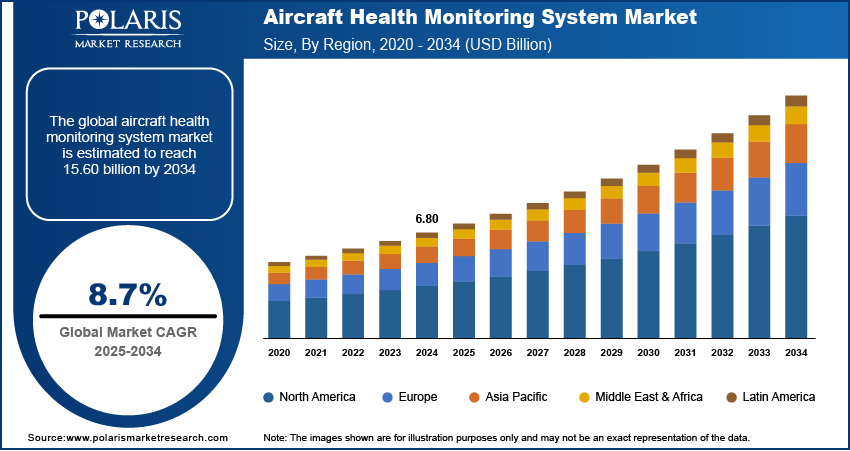
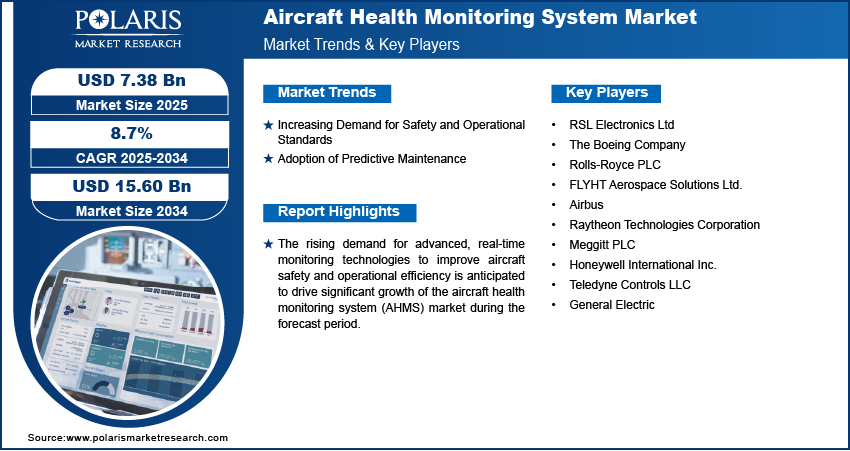
The global aircraft health monitoring system market size was valued at USD 7.01 billion in 2025, growing at a CAGR of 6.7% from 2026 to 2034. The factors driving the market include rising flight safety concerns, increased aerospace IT spending, advancements in real-time analytics, and growing demand for predictive maintenance.
Market Statistics
Key Takeaways
- The software segment led the aircraft health monitoring systems market with approximately 37.40% revenue share in 2025, driven by the growing use of data analytics, machine learning, and AI-based predictive maintenance in aviation.
- The fixed-wing aircraft segment dominated the market with approximately 58.60% revenue share in 2025, owing to its extensive deployment across commercial, military, cargo, and business aviation fleets.
- The airlines segment led the market with approximately 36.80% revenue share in 2025, supported by the increasing need to reduce unplanned maintenance, aircraft downtime, and operating costs.
- North America dominated the aircraft health monitoring systems market with approximately 38.70% revenue share in 2025, driven by its established aerospace industry, large aircraft fleet, and early adoption of predictive maintenance technologies.
- Europe held the second-largest market share of approximately 29.40% in 2025, supported by the presence of major aerospace manufacturers and aviation technology providers across France, Germany, and the UK.
Traditional Aircraft Maintenance vs Predictive Maintenance
| Factor | Traditional Aircraft Maintenance | Predictive Maintenance |
| Downtime | Downtime is higher due to planned inspections and unforeseen malfunctions | Downtime is reduced due to early fault detection and preventive maintenance |
| Operation Cost | Higher operation cost resulting from reactive repair and unplanned maintenance operation operations | Reduced operation cost because it prevents catastrophic failures and optimizes maintenance operations |
| Maintenance Operations | Planned maintenance operations based on set schedule and inspection intervals | Maintenance operations are planned using real-time performance and condition of aircraft |
| Safety Operation | Based on regular inspections for safety of aircraft flight | Safety is increased because it detects faults before catastrophic failure |
| Fault Detection Capability | Faults are detected either by planned inspections or their symptoms | Anomalies and faults are detected early enough to prevent catastrophic failure |
Industry Dynamics
- With the aviation industry increasingly prioritizing safety and efficiency, AHMS is important for proactive issue detection, streamlined maintenance, and regulatory compliance, fueling market growth.
- The growing adoption of predictive maintenance in the aircraft health monitoring industry enhances safety, reduces costs and downtime, and improves operational efficiency, driving increased demand for AHMS.
- The demand for real-time issue management, performance monitoring, and tailored alerts drives the market demand.
- High costs and the complexity of integrating aircraft health monitoring systems often hinder adoption, particularly for smaller airlines and operators with limited budgets.
AI Impact on Aircraft Health Monitoring System Market
- AI helps detect faults quickly by analyzing real-time data from aircraft systems, leading to faster and more accurate issue identification.
- It predicts potential failures in advance by recognizing patterns in data, allowing maintenance teams to act before problems occur.
- This reduces unexpected downtime, improves flight safety, and keeps aircraft in service longer.
- AI also supports smarter maintenance planning, making fleet operations more efficient and cost-effective.
Source: Polaris Market Research Analysis
To Understand More About this Research: Download Sample Report
An aircraft health monitoring system (AHMS) monitors and evaluates the condition of aircraft components in real time. It collects information from multiple sensors that observe essential systems such as engines, structures, and avionics, enabling early identification of possible problems. By facilitating predictive maintenance and timely action before failures occur, AHMS helps improve safety, streamline maintenance planning, lower expenses, and boost operational efficiency.
The increasing focus on flight safety by aircraft manufacturing companies is driving the adoption of aircraft health monitoring systems. The rise in aerospace IT spending in emerging economies, along with advancements in workflow optimization and analytical systems, drives the aircraft health monitoring system market growth. Furthermore, the demand for real-time problem management, performance monitoring solutions, and customized alerts drives the market development.
The increasing adoption of predictive maintenance, driven by advanced product analytics and real-time sensor information, enables airlines to predict and avert failures, which helps decrease downtime, enhance efficiency, and reduce maintenance expenses. This is one of the major market trends anticipated to boost the aircraft health monitoring system market demand during the forecast period. The regulatory approval of new AHM solutions is expected to create AHMS market opportunities in the coming years.
Market Dynamics
Increasing Demand for Safety and Operational Standards
The aviation industry is increasingly focusing on safety and maintenance. Aircraft health monitoring system promotes the safety of passengers, crew, and cargo by taking proactive steps that detect and resolve potential problems before they escalate. As technology advances, AHMS improves operational efficiency by offering airlines crucial insights into aircraft conditions, such as fuel usage and engine performance. This enables optimized maintenance planning, minimized downtime, and better fleet management, making AHMS essential for airlines aiming to stay competitive while maintaining high safety and operational standards. Therefore, the rising demand for safety and regulatory compliance propels the aircraft health monitoring systems (AHMS) market growth.
Adoption of Predictive Maintenance
The aircraft health monitoring industry is adopting predictive maintenance solutions to reduce maintenance costs, decrease downtime, and improve aircraft safety and dependability. This proactive approach utilizes data from AHMS to anticipate maintenance requirements before failures occur. By identifying possible problems early through data analytics, airlines can schedule maintenance more efficiently, minimizing unexpected incidents and prolonging component life. Predictive maintenance allows airlines to streamline operations, minimize interruptions, and enhance cost-effectiveness, ensuring sustained operational continuity and improved performance in the long term. Thus, the rising adoption of predictive maintenance by the aircraft health monitoring industry fuels the aircraft health monitoring systems (AHMS) market demand.
Use of IoT and Connected Aircraft Technologies
IoT and connected aircraft systems have completely changed the aviation industry by enabling real-time tracking of aircraft performance. Today, modern aircraft feature many sensors that provide real-time information on engine and fuel system performance, aircraft construction, and other factors during operation. This information is gathered from ground systems and used to efficiently track aircraft performance, perform early diagnostics of potential issues, and support maintenance services. The connected aircraft system plays a critical role in enhancing aircraft performance, avoiding aircraft failure, and providing predictive maintenance. As safety and performance are increasingly becoming areas of interest, along with cost reduction, more attention will be drawn to monitoring systems.
Source: Polaris Market Research Analysis
Segment Insights
Outlook Based on Solution
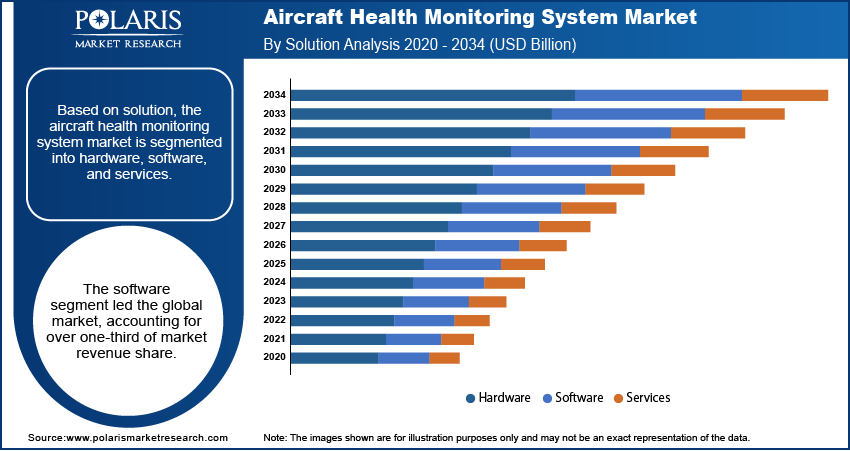
The aircraft health monitoring system market, by solution, is segmented into hardware, software, and services. The software segment led the aircraft health monitoring systems market with approximately 37.40% revenue share in 2025, accounting for over one-third of market revenue. The dominance of the segment is attributed to the growing dependence on data analysis, machine learning, and artificial intelligence (AI) in the aviation industry.
Assessment Based on Aircraft Type
The aircraft health monitoring system market, by aircraft type, is segmented into fixed-wing aircraft and helicopters. The fixed-wing aircraft segment dominated the market with approximately 58.60% revenue share in 2025. The market growth for the segment is driven by the greater prevalence and variety of fixed-wing aircraft in commercial and military fleets.
Evaluation Based on End User
The aircraft health monitoring system market, by end user, is segmented into OEMs, MROs, and airlines. The airlines segment led the market with approximately 36.80% revenue share in 2025. Airlines manage and maintain extensive fleets of airplanes, emphasizing safety, reliability, and efficiency, which propels the demand for various safety and maintenance solutions such as aircraft health monitoring systems.
Source: Polaris Market Research Analysis
Regional Analysis
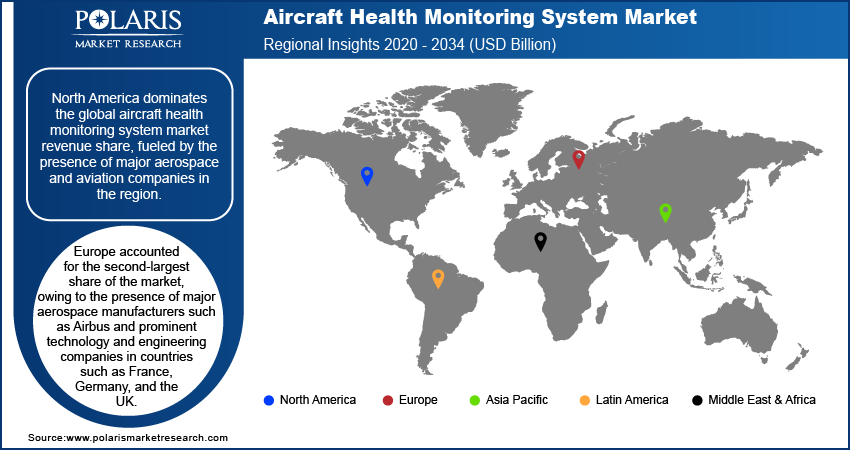
The market report offers aircraft health monitoring system market insights into North America, Europe, Asia Pacific, Latin America, and the Middle East & Africa. North America dominated the aircraft health monitoring systems market with approximately 38.70% revenue share in 2025, fueled by the presence of major aerospace and aviation companies in the region. Major aircraft manufacturers, technology pioneers, and service providers are operating across the region, and prominent companies such as Boeing and Lockheed Martin are headquartered in the US. These major players are essential in promoting and implementing innovative aviation technologies, such as AHMS.
Europe held the second-largest market share of approximately 29.40% in 2025. The regional market growth is propelled by the presence of major aerospace manufacturers such as Airbus and prominent technology and engineering companies in countries, including France, Germany, and the UK. The collaborative efforts within the European aviation industry, along with a significant focus on research and development, have led to ongoing progress in aviation technologies such as AHMS. Germany holds the largest share of the European AHMS market, whereas the UK has the fastest-growing market in the region.
Source: Polaris Market Research Analysis
Key Players and Competitive Insights
Leading market players are focusing on ongoing innovation to develop advanced and differentiated AHMS solutions. Furthermore, they are actively implementing various strategic initiatives to broaden their global reach, such as establishing strategic alliances, introducing new offerings, obtaining contractual agreements, participating in mergers and acquisitions, and pursuing significant investments. To thrive and stay competitive in a fast-growing market, market players need to provide innovative solutions that distinguish them.
The aircraft health monitoring system market report offers a market assessment of all key players such as RSL Electronics Ltd, The Boeing Company, Rolls-Royce PLC, FLYHT Aerospace Solutions Ltd., Airbus, Raytheon Technologies Corporation, Meggitt PLC, Honeywell International Inc., Teledyne Controls LLC, and General Electric.
List of Key Companies
- RSL Electronics Ltd
- The Boeing Company
- Rolls-Royce PLC
- FLYHT Aerospace Solutions Ltd.
- Airbus
- Raytheon Technologies Corporation
- Meggitt PLC
- Honeywell International Inc.
- Teledyne Controls LLC
- General Electric
Future Outlook
The aircraft health monitoring systems market is poised for robust growth over the coming years due to the increasing acceptance of predictive maintenance and operations within the airline industry. The rise of advancements in technology such as AI, machine learning, IoT connectivity, and cloud analytics have made fault detection easier than before, enabling operators to monitor aircraft performance and better plan maintenance activities. The increasing concern for flight safety, reliable fleets, and improved efficiency in operations would continue to fuel the adoption of these monitoring systems in commercial, military, and business aviation sectors. In addition, the development of emerging technologies like digital twin models and autonomous diagnostic tools would go a long way in optimizing maintenance operations and enhancing the performance of the aircraft.
Industry Developments
June 2026: Bombardier and Rolls-Royce have launched an enhanced health monitoring solution for the Global 5500 and 6500 aircraft. The solution integrates Bombardier Smart Link Plus with the Rolls-Royce engine vibration and health monitoring unit (EVHMU). The upgrade is now available at Bombardier's service center network, improving access for in-service fleets and enhancing OEM-led recurring digital services, in addition to traditional support. (Source:rolls-royce.com)
April 2026: Airbus has announced a new agreement with JetBlue for the Skywise Fleet Performance+ (S.FP+) solution to be implemented across its A320 and A220 fleets. This increases the airline industry's adoption of OEM analytics for predictive maintenance and fleet health monitoring, adding to platform-level benefits from connected-aircraft data backbones. (Source:airbus.com)
February 2026: Boeing signed a renewal agreement with All Nippon Airways (ANA) for Boeing Airplane Health Management (AHM). The companies also announced plans for strengthening strategic collaboration around predictive maintenance to further enhance reliability and operational efficiency across ANA’s fleet. (source: boeing.com)
May 2025: ACE Aeronautics chose Ultra PCS and Curtiss-Wright to supply the ED-112A Fortress HUMS CVR/FDR systems for 13 UH-60L Black Hawk helicopters, including one prototype. Deliveries will start this year and continue through 2028, providing advanced monitoring capabilities for foreign military rotorcraft fleets. (Source: asiapacificdefencereporter.com)
March 2025: RTX subsidiaries Pratt & Whitney and Collins Aerospace partnered with JetZero’s blended-wing-body demonstrator program to reduce fuel consumption by 50% and incorporate next-generation monitoring technologies. (Source: rtx.com)
Aircraft Health Monitoring System Market Segmentation
By Type Outlook
- Commercial Aviation
- Military Aviation
By Solution Outlook
- Hardware
- Software
- Services
By End User Outlook
- OEMs
- MRO
- Airlines
By Aircraft Type Outlook
- Fixed Wing Aircraft
- Helicopter
By Regional Outlook
- North America
- US
- Canada
- Europe
- Germany
- France
- UK
- Italy
- Spain
- Netherlands
- Russia
- Rest of Europe
- Asia Pacific
- China
- Japan
- India
- Malaysia
- South Korea
- Indonesia
- Australia
- Rest of Asia Pacific
- Middle East & Africa
- Saudi Arabia
- UAE
- Israel
- South Africa
- Rest of Middle East & Africa
- Latin America
- Mexico
- Brazil
- Argentina
- Rest of Latin America
Aircraft Health Monitoring System Market Report Scope
| Report Attributes | Details |
| Market Size Value in 2025 | USD 7.01 billion |
| Market Size Value in 2026 | USD 7.48 billion |
| Revenue Forecast by 2034 | USD 12.54 billion |
| CAGR | 6.7% from 2026 to 2034 |
| Base Year | 2025 |
| Historical Data | 2021–2024 |
| Forecast Period | 2026–2034 |
| Quantitative Units | Revenue in USD billion and CAGR from 2026 to 2034 |
| Report Coverage | Revenue Forecast, Market Competitive Landscape, Growth Factors, and Trends |
| Segments Covered |
|
| Regional Scope | North America Europe Asia Pacific Latin America Middle East & Africa |
| Competitive Landscape |
|
| Report Format | PDF + Excel |
| Customization | Report customization as per your requirements with respect to countries, regions, and segmentation. |
Source: Polaris Market Research Analysis
aircraft health monitoring systems market FAQ's
The AHMS market size was valued at USD 7.01 billion in 2025 and is projected to grow to USD 12.54 billion by 2034.
The market is projected to register a CAGR of 6.7% from 2026 to 2034.
North America dominated the aircraft health monitoring systems market with approximately 38.70% revenue share in 2025.
RSL Electronics Ltd, The Boeing Company, Rolls-Royce PLC, FLYHT Aerospace Solutions Ltd., Airbus, Raytheon Technologies Corporation, Meggitt PLC, Honeywell International Inc., Teledyne Controls LLC, and General Electric are a few key players in the market.
The software segment led the aircraft health monitoring systems market with approximately 37.40% revenue share in 2025.
The fixed-wing aircraft segment dominated the market with approximately 58.60% revenue share in 2025.
Aircraft health monitoring systems continuously collect and analyze data from engines, avionics, structures, and other components. They help to early detect faults, allow predictive maintenance, reduce unplanned downtime, increase aircraft availability and enhance operational safety.
Artificial intelligence, machine learning, IoT-enabled sensors, cloud computing, digital twins and real-time data analytics are driving the market. These technologies enhance fault detection, component-life prediction, remote diagnostics and maintenance planning.
Download Sample Report of aircraft health monitoring systems market
Please fill out the form to request a customized copy of the research report.


