
Predictive Maintenance Market Share, Size, Trends, Industry Analysis Report, 2026 - 2034
REPORT DETAILS
Predictive Maintenance Market Overview and Key Insights
The global predictive maintenance market size was valued at USD 15.88 billion in 2025 exhibiting the CAGR of 29.1% during the forecast period. The growth of this market is primarily driven by the need for reduced cost and downtime associated with predictive maintenance.
Market Statistics
Predictive Maintenance Market Key Takeaways
- By region, North America held the largest share accounting for 30.0% in 2025 in the predictive maintenance industry, as it was one of the first to adopt the IoT and AI technologies and has invested heavily in both.
- By region, Asia Pacific is the fastest growing during 2024–2026, with CAGR around 28.5%. Growth is due to rising industrial automation and higher adoption of predictive solutions in countries like China and India.
- By component, the solutions segment held the largest share accounting for 70.0% in 2025. This is due to the growing demand for the solutions offered, such as predictive analytic and other sophisticated data solutions.
- By deployment model, the on-premises deployment model held 40.0% share in 2025 as it gives organizations in the manufacturing and energy industries better control of their data, along with enhanced security.
- By organization size, the large enterprises segment held the largest share in 2025, as these companies have more assets to work with in addition to higher IT budgets.
- By industry vertical, the manufacturing segment held 30.0% share in 2025, as it has the most emphasis on increasing operational efficiency, minimizing unplanned downtimes, and reducing operational expenditures.
*Note: Figures and projections outlined in this report are the result of Polaris Market Research’s proprietary analytical processes, grounded in the latest available datasets and market observations.
Predictive Maintenance Market Dynamics
- The use and emergence of smart technologies such as Artificial Intelligence and Internet of Things is a key driving factor for adoption of predictive maintenance.
- The growing emphasis on minimizing expenditures and enhancing equipment availability drives corporations to utilize the technology is also driving the growth.
- Improved asset management and enhancing the equipment life-cycle also drive this growth.
AI and Machine Learning in Predictive Maintenance
- AI increases the accuracy of the predictions by performing more complex analysis of large data sets originating from a multitude of diverse sensors and sources.
- Incorporating AI greatly reduces unplanned downtime. Predicting potential issues accurately and resolving them helps companies to plan maintenance during a non-peak period and avoid disruption.
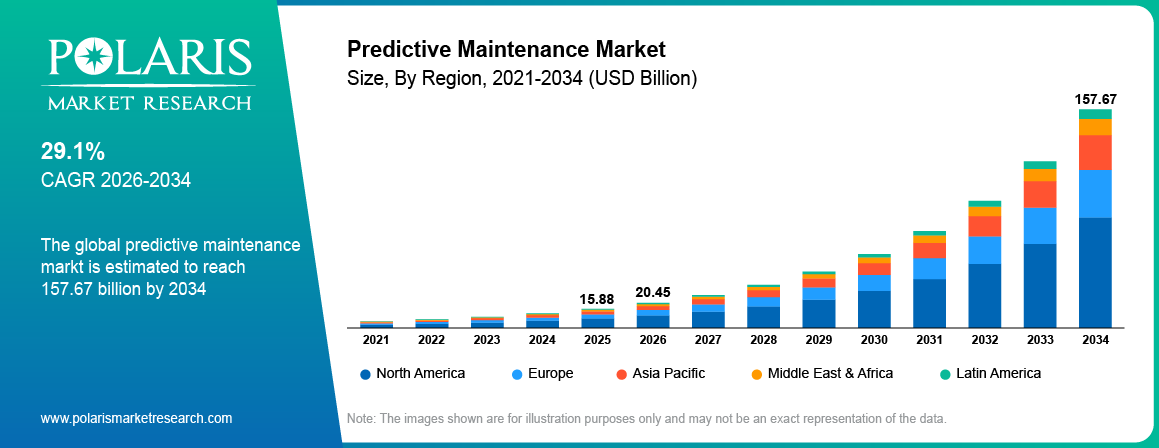
Source: Polaris Market Research Analysis
To Understand More About this Research: Download Sample Report
What Is Predictive Maintenance and How Does It Work?
Predictive maintenance is used to monitor equipment and predict failures before they happen. It uses data from machines to check condition and performance. AI and sensors track data like temperature, vibration, and pressure. This data helps find patterns and early fault signs to predict failures. Key benefits include less downtime, lower costs, better efficiency, and longer equipment life.
For instance, the data from the U.S. Department of Energy indicates that predictive maintenance is very cost-effective and that it helps an enterprise to gain remarkable results such as a tenfold increase in ROI, 70-75% decrease in breakdowns, 25-30% reduction in costs, and 35-45% reduction in downtime.
In addition, the industry enables the technicians to plan and prepare for a repair by taking steps, including shifting the capacity to other equipment or scheduling activity for times with the minimum impact on production. This results in the elimination of unplanned downtime during the production process.
The Covid-19 pandemic disrupted industrial networks and manufacturing, including demand-side shocks along with the supply disruptions that had a negative impact on the industry. The enterprises were forced to take harsh actions for their staff and employees, as SMEs were shut down, and production & manufacturing facilities were put on hold for a longer period of time.
However, this situation has led to significant growth in focus on digital transformation among enterprises. For instance, the pandemic has boosted the need for enhanced manufacturing processes with the integration of technologies such as Machine Learning (ML) and Artificial Intelligence (AI) for the industry. This has made manufacturing systems more agile and helped manufacturing companies increase their production capacity.
Predictive Maintenance Market Drivers and Opportunities
Upsurge in investment in predictive maintenance solutions to reduce cost and downtime fuels the growth of the global market. Investment in predictive maintenance initiatives generates a tangible return on investment (ROI). For instance, predictive maintenance users reported metrics such as 2-6% increased availability, 5-10% inventory cost reduction, and 10-40% reduction in reactive maintenance.
In addition, as per the recent study by Deutsche Messe AG and Roland Berger, VDMA 81% of companies are currently devoting time and resources to predictive maintenance subject, while 40% already have confidence that is practicing predictive maintenance PdM will be most significant for future business. This increase in awareness and trust in predictive maintenance solutions is projected to fuel the growth of the industry in upcoming years.
On the other hand, the integration of artificial intelligence and machine learning has created lucrative growth opportunities for the predictive maintenance industry. An increasing number of customers are using such solutions powered by AI to help shift from a reactive to a proactive approach. In addition, the market players are actively introducing new AI-enabled solutions. For instance, in September 2020, TeamViewer, a provider of remote connectivity solutions, launched TeamViewer IoT software, an AI-supported solution.
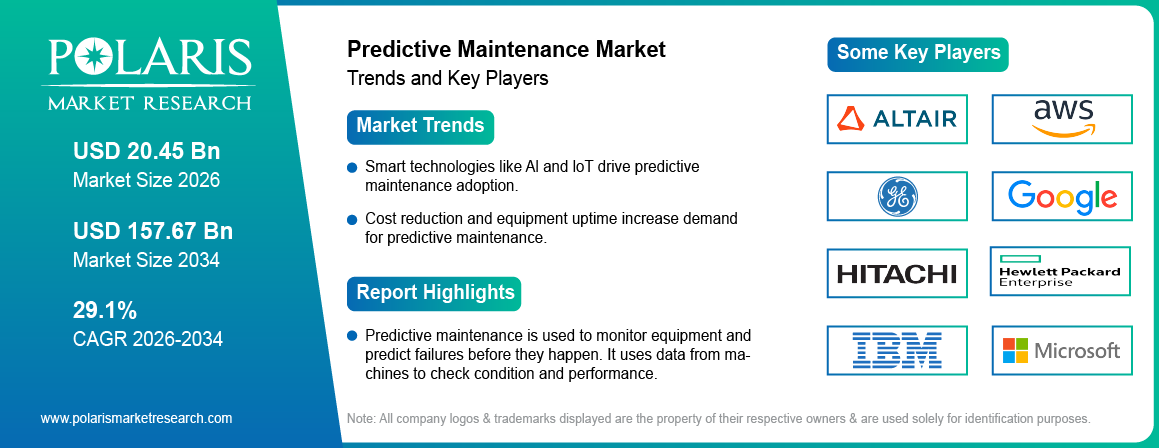
Source: Polaris Market Research Analysis
Predictive Maintenance Market Segment Analysis
The market is primarily segmented on the basis of component, deployment model, organization size, industry vertical, and region.
| By Component | By Deployment Model | By Organization Size | By Industry Vertical | By Region |
|
|
|
|
|
Source: Polaris Market Research Analysis
Know more about this report: Download Sample Report
Predictive Maintenance Market, by Component
The solution segment dominated the global market with 70.0% revenue share in 2025. The solution leverages the data accumulated by different IoT sensors and performs an in-depth data analysis for the prediction of an anomaly in the operation of the critical equipment. The growth of this segment is mainly driven by the increasing demand for predictive maintenance market solutions, which minimize unplanned downtime and allows the prolonged life of machinery.
In addition, the market players are introducing innovative solutions to meet the demand for the predictive maintenance market. For instance, in May 2021, aiSensing launched a new AI-based predictive maintenance solution which is based on SensiML Analytics Toolkit and QuickLogic EOS S3 Platform. On the other hand, the services segment is anticipated to witness the highest growth rate during the forecast period. These services are expected to gain traction in the market due to the need for implementation and consulting of solutions.
In certain cases, companies directly prefer adopting managed services for their businesses as per their requirements. Moreover, the rising need to train the staff, effective utilization of these solutions, and assistance in integration & deployment are expected to boost the growth of the services segment.
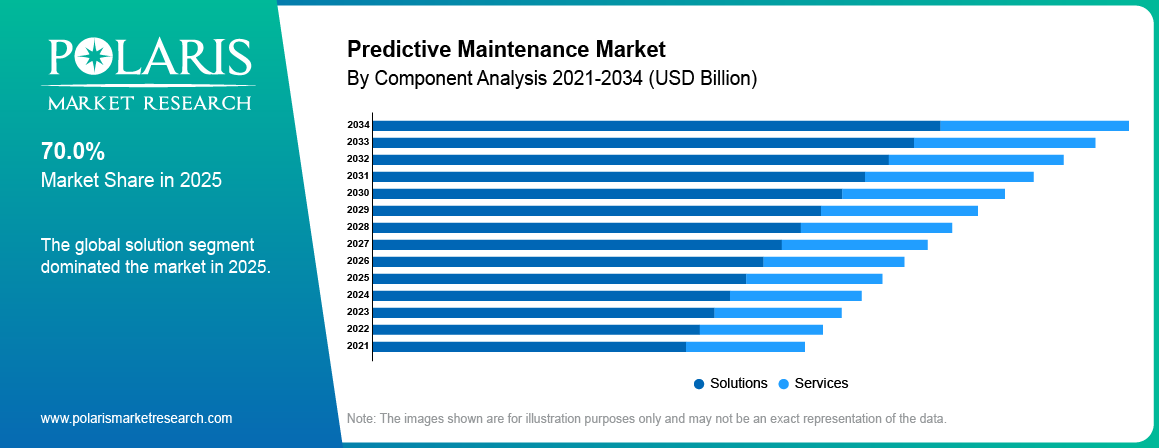
Source: Polaris Market Research Analysis
Predictive Maintenance Market, by Deployment Model
The cloud segment is anticipated to witness 32.0% CAGR in the global market during the forecast period due to the fact that the cloud-based services offer businesses the competitive advantages such as remote accessibility, internal data delivery & handling, direct IT control, robust deployment, faster data processing, efficient resource utilization, and cost-effectiveness.
In addition, the integration of the Industrial Internet of Things, artificial intelligence, and machine learning with cloud-based services have become an essential part of Industry 4.0. Hence, the proliferation of Industry 4.0 has further boosted the growth of the segment. Moreover, the on-premise segment is expected to contribute the largest revenue in 2021. On-premise predictive maintenance software is installed and operated from a customer's in-house server and computing infrastructure.
Organizations are deploying this technology through on-premises software, as this type of deployment has complete control over data and processes. In addition, it is considered a more secure and reliable solution by large enterprises. The aforementioned factors boost the growth of this segment.
Predictive Maintenance Market, by Industry Vertical
The healthcare segment is expected to witness 31.0% CAGR during the forecast period. The predictive maintenance of biomedical devices such as X-ray, MR, tomography, ventilators, and mammography is one of the major concerns to increase decision-making capabilities and optimize operational efficiencies in hospitals.
For instance, Accruent, a Texas-based services provider, offers predictive maintenance market solutions for critical hospitals and healthcare machinery such as ventilators and MRI machines with their asset management (EAM) solution. Also, Accruent is responsible for providing healthcare asset management solutions to more than 55% of hospitals in the U.S.
Predictive, Preventive and Reactive Maintenance Comparison
| Type | Approach | When maintenance done | Cost level | Downtime | Data use |
| Predictive | Condition-based | Before failure | Medium | Low | High |
| Preventive | Schedule-based | Fixed intervals | Medium-High | Medium | Low |
| Reactive | Breakdown-based | After failure | High | High | None |
Source: Polaris Market Research Analysis
Predictive Maintenance Market Regional Analysis
North America is the largest revenue contributor in the global market due to the presence of a large number of solution and service vendors in this region. In addition to this, increasing awareness regarding predictive measures, their importance, and early adoption of technology has further boosted the growth of the market.
Moreover, the huge manufacturing sector in this region is projected to create demand for the predictive maintenance market. For instance, the manufacturing sector in the U.S. accounts for over 11.3% of the total output in the economy, and it employs nearly 8.5% of the workforce. Moreover, APAC is anticipated to witness the highest growth in the global market. Increasing focus towards an innovative solution for achieving optimized output drives the region’s growth.
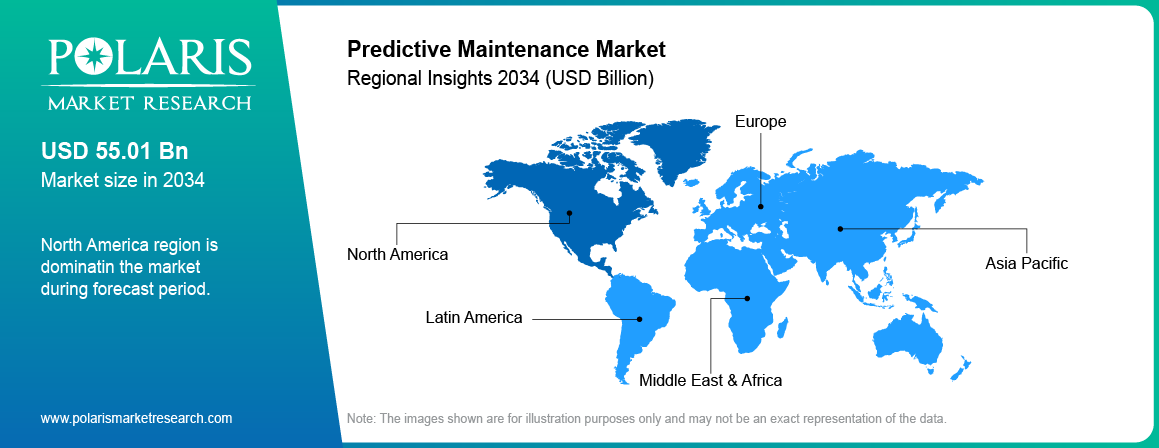
Source: Polaris Market Research Analysis
Leading Predictive Maintenance Companies and Platform Providers
- Altair,
- AWS,
- General Electric,
- Google,
- Hitachi,
- HPE,
- IBM,
- Microsoft,
- Oracle,
- SAP,
- SAS Institute,
- Schneider Electric,
- Software AG,
- Splunk,
- Tibco Software.
Predictive Maintenance Market Recent Developments
- April 2026: Odysight.ai collaborated with GACI Technologies to increase predictive maintenance solutions in France aerospace and defense sector. (Source: odysight.a)
- January 2026: SymphonyAI launched eight generative applications at Hannover Messe for energy asset reliability and industrial operations. (Source: symphonyai.com)
- September 2025: Schneider Electric launched EcoCare Advanced+ for Electrical Distribution, providing 24/7 remote monitoring, AI insights, and condition-based maintenance to improve safety and efficiency. (Source: schneider.com)
- August 2025: Accenture partnered with Qatar Airways to launch AI Skyways, using AI to improve operations, predictive maintenance, and personalized customer experiences. (Source: accenture.com)
- June 2025: Siemens partnered with Sachsenmilch Leppersdorf in Germany to use AI-based Senseye Predictive Maintenance for early fault detection and more efficient plant operations. (Source:siemens.com)
- January 2024: Siemens and AWS expanded their collaboration to streamline the development and scaling of generative artificial intelligence (AI) solutions for businesses of all sizes and industries. (Source: siemens.com)
Predictive Maintenance Market Future Outlook
The market will grow with rising use of automation and smart factories across industries. More companies are shifting towards connected systems to monitor equipment in real time. This supports improve efficiency and reduces unexpected breakdowns. Demand will increase as industries focus on better asset performance and continuous operations.
AI-based systems will improve prediction accuracy and support faster decisions. Companies are focusing on cost optimization and lowering downtime. Integration with IoT and data analytics will expand further. This will support in better planning and longer equipment life across sectors.
Predictive Maintenance Market Report Scope and Methodology
| Report Attributes | Details |
| Market size value in 2025 | USD 15.88 billion |
| Market size value in 2026 | USD 20.45 billion |
| Revenue forecast in 2034 | USD 157.67 billion |
| CAGR | 29.1% from 2026 - 2034 |
| Base year | 2025 |
| Historical data | 2021 - 2024 |
| Forecast period | 2026 - 2034 |
| Quantitative units | Revenue in USD billion and CAGR from 2026 - 2034 |
| Segments covered | By Component, By Deployment Model, By Organization Size, By Industry Verticals, By Region |
| Regional scope | North America, Europe, Asia Pacific, Latin America, Middle East & Africa |
| Key companies | Altair, AWS, General Electric, Google, Hitachi, HPE, IBM, Microsoft, Oracle, SAP, SAS Institute, Schneider Electric, Software AG, Splunk, and Tibco Software |
Source: Polaris Market Research Analysis
Predictive Maintenance Market Frequently Asked Questions
? The global market size was valued at USD 15.88 billion in 2025 and is projected to grow to USD 157.67 billion by 2034.
? The global market is projected to register a CAGR of 29.1% during the forecast period.
? North America dominated the market with 30.0% share in 2025.
The solutions segment accounted for the largest share of the market in 2025 valued at 70.0%.
Download Sample Report of Predictive Maintenance Market
Please fill out the form to request a customized copy of the research report.


