
Asphalt Pavers Market Size, Global Analysis Report, 2026-2034
REPORT DETAILS
Asphalt Pavers Market Summary
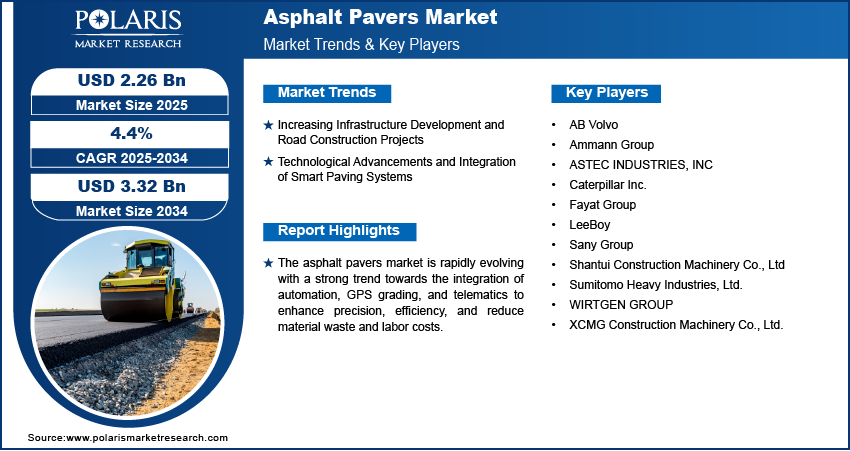
The global asphalt pavers market size was valued at USD 2.26 billion in 2025, growing at a CAGR of 4.4% from 2026 to 2034. Key factors driving demand for asphalt pavers include increasing infrastructure development, technological advancements, sustainability focus, and rising urbanization.
Market Statistics
Key Takeaways
- Asia Pacific had the largest share of 32.35% in 2025. This is due to the higher demand for gear that handles large paving jobs across various types of terrain.
- The North America asphalt pavers market is expected to grow rapidly, with a 4.4% CAGR. This is driven by the ongoing building work on city roads, business growth projects, and highways in the region.
- The variable segment held 97.65% revenue share in 2025. Variable screen asphalt pavers reduce the need for many machines and save money for different projects.
- The wheeled segment is projected to grow fastest, with a 4.8% CAGR in the forecast period. This is due to their fast on-site problem-solving, higher output, and lower downtime.
- The electric heating segment accounted for a 65.03% market share in 2025. Electric heating is increasingly favored due to its cleaner operation and higher fuel efficiency.
*Note: Figures and projections outlined in this report are the result of Polaris Market Research’s proprietary analytical processes, grounded in the latest available datasets and market observations.
Industry Dynamics
- Increasing infrastructure development and road construction projects are driving market growth due to ongoing construction of highways, bridges, airports, and rural roads, as well as investments in private projects.
- Technological advancements and the integration of smart paving systems boost the market expansion due to rising demand for intelligent control systems, automation, and telematics.
- Expansion in emerging economies and infrastructure modernization creates growth opportunities.
- Intense market competition and price pressure creates opportunity to expand
AI Impact on Asphalt Pavers Market
- AI facilitates more accurate paving through the guidance of machinery to pave with even thickness and smoothness.
- AI enables quality control through the detection of any problems on the surface of the pavement.
- AI helps improve efficiency through the optimization of the speed of the machinery, its fuel consumption, and the movement of materials.
- AI allows for predictive maintenance through the detection of any potential problems with the machinery.
What is the Asphalt Pavers Market Landscape?
Asphalt pavers are machines used in construction. These machines are used to precisely and uniformly spread asphalt on roads, bridges, parking lots, and other surfaces. The machine used in the application of asphalt provides the ability to carry a specified and necessary amount of asphalt to ensure distribution and compaction. This is essential for smooth surfaces that resist heavy traffic loads and changing weather conditions. Moreover, the asphalt pavers are an essential segment of the road construction and infrastructure industry. The global market is driven by the rising need for durable, efficient, and high-quality road surfaces. The demand for modern asphalt pavers continues to expand across both developed and emerging economies, as infrastructure development simultaneously boosts.
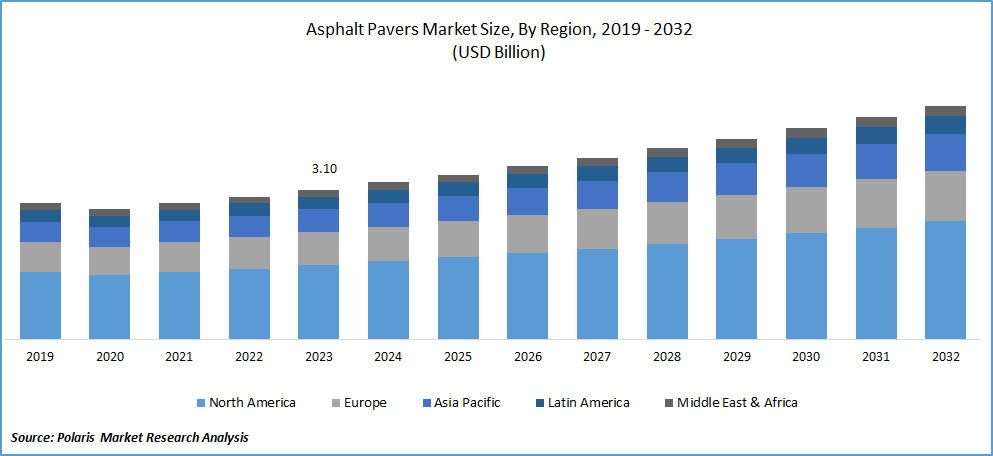
Source: Polaris Market Research Analysis
These machines provide uniform roadway thickness while improving the longevity and durability of all roadways. This is another synonym for global sustainability in the construction industry. Modern pavers are engineered to emit lower emissions, improve fuel efficiency, and lower noise levels. Global investment in road reconstruction and highway construction drives industrial growth, urbanization, and increased transportation needs. According to the Ministry of Industry and Commerce of the government in FY 2024, approximately 12,349 km of National Highway development occurred. This highlights the demand for asphalt pavers. Moreover, the growth in intelligent paving technologies using automotive telematics and GPS-based automation is transforming the asphalt paver marketplace by increasing operational precision and reducing downtime, thereby increasing demand for pavers.
How Asphalt Pavers Work?
Step 1: Introduction of Hot Asphalt to the Hopper
- The first stage is the loading of hot asphalt material into the hopper of the paver. Hot asphalt is placed in the hopper, where it is kept temporarily before being fed steadily during paving.
Step 2: Transportation Using Conveyors
- An internal conveying system transports the material from the hopper to the back side of the machine to ensure an unbroken supply of asphalt.
Step 3: Even Spreading Through Augers
- The rotating augers located at the back part of the machine are used to spread asphalt evenly on the desired width during paving.
Step 4: Distributing and Leveling using the Screed
- The screed is the major component that does the final work of the paver machine. The task of the screed is to spread, compact, and level the asphalt to the desired thickness and width. This step largely determines the end product quality.
Step 5: Final Compaction using Road Rollers
- Finally, after laying the asphalt layer on the paved area, road rollers are used for the purpose of achieving maximum density and compaction in order to fill any spaces left behind.
Final Result
-
Using this procedure, smooth, strong and long-lasting roads, highways, and airport runways can be created.
Drivers & Opportunities
Which factors are Driving the Market Demand?
Increasing Infrastructure Development and Road Construction Projects
The rise in global infrastructure development, primarily road networks and urban development projects, boosts the market growth. The ongoing construction of highways, bridges, airports, smart cities, and rural roads continues to grow. This creates consistent demand for high-performance paving machinery. Investments in infrastructure have also boosted private projects. According to a World Bank Report, private participation in infrastructure (PPI) investment in 2024 totaled USD 100.7 billion, an increase of 16%.
Furthermore, a lot of countries are investing into fixing up old roads. They're focusing on this to handle today's traffic and stand up to tough weather. There's a growing need for high-tech pavers as cities grow faster and more places push for smart city plans. These machines can do precise work and get the job done.
Technological Advancements and Integration of Smart Paving Systems
Continuous innovation in paving technologies such as temperature control and GPS systems allow for increased precision and reduced human error. Advances in technology has changed the way asphalt pavers are designed and work. Equipment manufacturers are placing more focus on intelligent control systems, automation, and the use of telematics. This is to improve accuracy, material efficiency, and operator safety in all aspects of asphalt paving. In April 2025, Leica Geosystems, and Dynapac, introduced auto-steering and screed edge control on Dynapac asphalt pavers with the new Leica iCON pave solution. The system improves sustainability by optimizing material usage thereby reducing waste and improving material estimation throughout the paving process. The shift to digital construction ecosystems is consistent with the more comprehensive industrial revolution known as Industry 4.0 which is driven by a focus on productivity achieved through automation and the use of smart systems, with the ultimate purpose of improving efficiency and profitability on projects.
Sustainable Road Construction & Efficiency
The concept of sustainability has become very important in the asphalt pavers industry. The reason behind this development lies in the growing interest in environmental sustainability and sustainable construction practices. The current generation of asphalt pavers incorporates efficient engine design and low-emissions technology. They also have minimal noise production and enhanced hydraulic performance.
Furthermore, advanced material flow technology assists in reducing wastage of asphalt, while better temperature control contributes towards increased usability of the material, and ultimately the quality of the pavement. This ensures reduced cost and compliance with any environmental legislation set out by the contractors. With green construction becoming a growing trend among construction initiatives, demand for asphalt paving machinery will likely increase.
Challenges in Asphalt Pavers Market
Despite strong growth potential, the asphalt pavers market faces some challenges. One of the biggest constraints facing this market is the high cost of investing in new asphalt paver machines, particularly highly automated models.
High maintenance expenses, the cost of replacements, and downtime of machines are some other factors that can lower the profit margins of contractors. Skilled professionals to operate modern paving machines are not available in many countries. The strong competition among manufacturers often creates pricing pressure.
Source: Polaris Market Research Analysis
Segmental Insights
Which Segments Contributed to the Growth of the Overall Market?
Variable Analysis
Based on variable, the segmentation includes variable and fixed. The variable segment accounted for 97.65% of revenue share in 2025 due to its great adaptability and flexibility across rigid paving conditions. Its operation reduces the need for multiple machines, which makes it cost efficient for small and large-scale projects. This segment also supports different project requirements to help contractors improve consistency in surface, adjustment of paving widths, and complex layouts. Furthermore, their ability of high precision and control for the flow of material improves productivity on construction sites. These advantages make variable segment a preferred option for contractors aiming for adaptability, reliability, and efficiency in road construction.
Application Analysis
In terms of application, the segmentation includes tracked and wheeled. The wheeled segment is expected to witness the fastest growth with a CAGR of 4.8% during the forecast period. This is due to their sustainability and mobility for different construction environments. These pavers move quickly on sites, improve operational efficiency, and reduce downtime. They are designed to support maneuverability on paved surfaces, which makes them preferred for resurfacing, maintenance, and for infrastructure development in cities. Moreover, operating costs are lower in these models due to reduced wear as compared to the tracked alternatives. Their smooth handling, fast setup, and ease of transportation makes them an attractive option for contractors to focus on time saving tasks. Thus, these factors contribute to the expansion of this segment.
Tracked vs Wheeled Asphalt Pavers
| Feature | Tracked Pavers | Wheeled Pavers |
| Best For | Large highway jobs | Urban roads |
| Stability | High | Moderate |
| Mobility | Lower | Higher |
| Terrain Handling | Excellent | Good |
| Speed | Slower | Faster |
Source: Polaris Market Research Analysis
Source: Polaris Market Research Analysis
Regional Analysis
How North America and Asia Pacific Support the Global Market?
North American Market Assessment
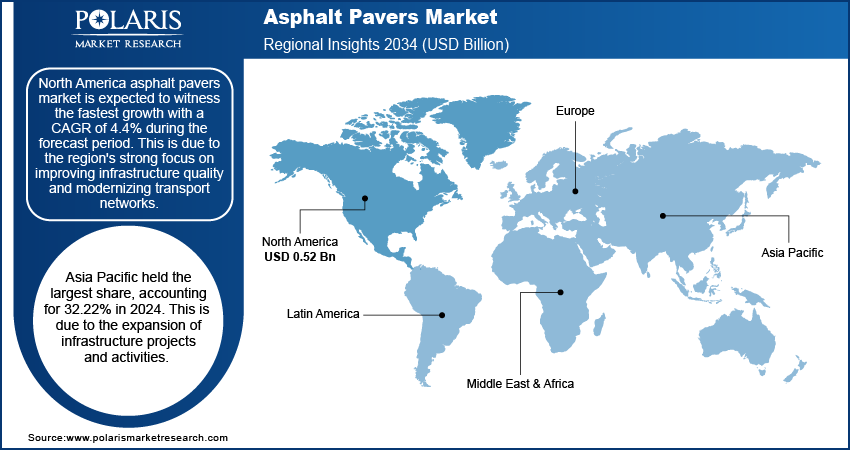
The North American asphalt pavers market is expected to witness the fastest growth with a CAGR of 4.4% during the forecast period. This is due to the region's strong focus on improving infrastructure quality and modernizing transport networks. Contractors adopt technologically advanced machinery to improve precision and productivity. The construction activities in this region are consistent for urban roads, commercial development projects, and highways, which drive the demand for advanced paving equipment. For instance, in August 2025, Holbrook Asphalt Company, an asphalt pavement preservation and infrastructure solutions provider, acquired Advanced Paving & Construction to increase its footprint and offerings while continuing to provide best-in-class service, performance, and innovation. Furthermore, the well-established construction standards boost the use of high-performance pavers that are capable to meet strict requirements for quality purposes. Therefore, these conditions support the growth of this region, where demand for efficient, modern, and reliable paving equipment is high.
Asia Pacific Asphalt Pavers Market
Asia Pacific held the largest share, accounting for 32.35% in 2025. This is due to the expansion of infrastructure projects and activities. The APAC region witnesses rising demand for equipment to handle large scale tasks for paving with high efficiency across different terrains. Rapid industrial growth and urbanization create a continuous flow of investments to upgrade existing roads and to construct new road networks. According to an India Brand Equity Foundation report, in August 2025, National Highways Infra Trust (NHIT) raised USD 1.92 billion to construct 889 kilometers of national highways. Moreover, the changing construction requirements in APAC require pavers that deliver high output and reliability for strong utilization of equipment's. Therefore, this widespread demand and consistent utilization of the pavers positions the leading position of this region.
Source: Polaris Market Research Analysis
Key Players & Competitive Analysis Report
In the asphalt pavers sector, competition is intense, requiring competitive intelligence and strategy to gain market share. Major players are launching aggressive market development strategies, such as joint ventures and acquisitions, to solidify their position in mature markets. At the same time, they are aggressively pursuing emerging markets with significant growth potential. Vendor strategies increasingly emphasize technology provision to enhance sustainable value chains and gain differentiation against competitors. A thorough understanding of supply chain disruptions and economic and geopolitical changes is essential for analyzing and substantiating revenue growth projections. Moreover, the future development strategies of market leaders are based on experts' knowledge of industry trends, such as automation, which indicate substantial growth prospects and inform high-value strategic opportunities to capitalize on unmet demand and sector growth.
Major companies operating in the asphalt pavers industry include AB Volvo; Ammann Group; ASTEC INDUSTRIES, INC; Caterpillar Inc.; Fayat Group; LeeBoy; Sany Group; Shantui Construction Machinery Co., Ltd; Sumitomo Heavy Industries, Ltd.; WIRTGEN GROUP; XCMG Construction Machinery Co., Ltd.
Key Players
- AB Volvo
- Ammann Group
- ASTEC INDUSTRIES, INC
- Caterpillar Inc.
- Fayat Group
- LeeBoy
- Sany Group
- Shantui Construction Machinery Co., Ltd
- Sumitomo Heavy Industries, Ltd.
- WIRTGEN GROUP
- XCMG Construction Machinery Co., Ltd.
Strategic Positioning & Market Dynamics Analysis
| Company | Core Strengths | Recent Strategic Moves | Competitive Edge | Market Outlook |
| Astec Industries | Full road construction equipment line | 2024 Best Line partnership | Dealer network expansion | Growing North American footprint |
| WIRTGEN Group | High-end road pavers, screeds | Launch of concrete paving train (2022) | Deere & Co. backing | Innovation-driven steady growth |
| AB Volvo | Global leader in trucks & equipment | New Indian paver (2022) | Diversified industrial group | Moderate but steady asphalt share |
| Ammann Group | Broad asphalt range | 2024 ABG acquisition | Strengthened in paving tech | Expanding European dominance |
| Sumitomo Heavy Industries | Broad machinery portfolio | 2024 European HQ expansion | Technological innovation | European market entry accelerates growth |
| Fayat Group | Dynapac legacy, multi-sector | Product upgrades | Independent, global reach | Sustained through diverse operations |
| LeeBoy | Compact asphalt pavers | Electric paver launch (2023) | Strong U.S. presence | Growth via sustainability & innovation |
| Shantui | Road & earthmoving machinery | Expanding overseas operations | Competitive pricing | Strong in Asia, growing globally |
| XCMG | Full construction machinery line | Expanding finance & leasing | Scale, cost efficiency | Global export growth driver |
| SANY Group | Diversified product lines | Asphalt business in India (2023) | Innovation & localization | Rapid APAC and African expansion |
| Caterpillar | High-performance paving range | Compact pavers launch (2023) | Brand, scale, R&D | Continues global leadership |
Source: Polaris Market Research Analysis
Industry Developments
- March 2026: Vögele revealed the "Dash 5" generation of pavers at CONEXPO 2026 for the North American market. The company stated that new pavers feature the VR 600/VF 600 screeds. They also offer improved ergonomics and faster setup times. (source: wirtgen-group.com)
- March 2026: Dynapac debuted the CC7000 VI roller, marking its re-entry into the 16-ton asphalt roller class as the world's heaviest. The company stated that it features patented Seismic Asphalt technology to optimize compaction through automatic vibration frequency adjustment. (source: dynapac.com)
- September 2025: Astec Industries, Inc., a manufacturer of equipment for asphalt road building, aggregate processing, and concrete production, launched the EZR3 Screed to deliver superior paving performance, enhanced stability, and unmatched mat quality. (Source: astecindustries.com)
- August 2025: Red Deer Polytechnic’s (RDP) Centre for Innovation in Manufacturing-Technology Access Centre (CIM-TAC) collaborated with Sustainable Paving Stones (SPS) with a USD 450,000 grant from Emissions Reduction. This collaboration aims for a new applied research initiative to transform construction waste into high-value paving stones. (Source: rdpolytech.ca)
- December 2024, Huron Capital’s platform company Sunland Asphalt acquired Metro Pavers, Inc., strengthening its foothold in Colorado’s expanding market. The acquisition enhances Sunland Asphalt’s regional presence and supports its continued growth strategy. (Source: metropaversinc.com)
Asphalt Pavers Market Segmentation
By Screed Outlook (Revenue, USD Billion, 2021–2034)
- Variable
- Fixed
By Screed Type Outlook (Revenue, USD Billion, 2021–2034)
- Tracked
- Wheeled
By Technology Outlook (Revenue, USD Billion, 2021–2034)
- Electric Heating
- Gas Heating
By Horsepower Outlook (Revenue, USD Billion, 2021–2034)
- 125–250 hp
- 60–125 hp
- 250 hp
- < 60 hp
By Maximum Paving Width Outlook (Revenue, USD Billion, 2021–2034)
- 5.5–12 m Segment
- 2.4–5.5 m Segment
- <2.4 m Segment
- >12 m Segment
By Tractor Width Outlook (Revenue, USD Billion, 2021–2034)
- 2.4–3.0 m
- 1.4–2.4 m
- < 1.4 m
- 3.0 m
By Type Outlook (Revenue, USD Billion, 2021–2034)
- Roads & Highways
- Commercial Infrastructure
- Residential Infrastructure
By End Use Outlook (Revenue, USD Billion, 2021–2034)
- Government
- Municipalities
By Control Systems Outlook (Revenue, USD Billion, 2021–2034)
- With Grade & Slope Control
- Without Control
By Regional Outlook (Revenue, USD Billion, 2021–2034)
- North America
- US
- Canada
- Europe
- Germany
- France
- UK
- Italy
- Spain
- Netherlands
- Russia
- Rest of Europe
- Asia Pacific
- China
- Japan
- India
- Malaysia
- South Korea
- Indonesia
- Australia
- Vietnam
- Rest of Asia Pacific
- Middle East & Africa
- Saudi Arabia
- UAE
- Israel
- South Africa
- Rest of Middle East & Africa
- Latin America
- Mexico
- Brazil
- Argentina
- Rest of Latin America
Report Scope
| Report Attributes | Details |
| Market Size in 2025 | USD 2.26 Billion |
| Market Size in 2026 | USD 2.35 Billion |
| Revenue Forecast by 2034 | USD 3.32 Billion |
| CAGR | 4.4% from 2026 to 2034 |
| Base Year | 2025 |
| Historical Data | 2021–2024 |
| Forecast Period | 2026–2034 |
| Quantitative Units | Revenue in USD Billion and CAGR from 2026 to 2034 |
| Report Coverage | Revenue Forecast, Competitive Landscape, Growth Factors, and Industry Trends |
| Segments Covered |
|
| Regional Scope |
|
| Competitive Landscape |
|
| Report Format |
|
| Customization | Report customization as per your requirements with respect to countries, regions, and segmentation. |
Source: Polaris Market Research Analysis
Asphalt Pavers Market FAQ's
The global market size was valued at USD 2.26 billion in 2025 and is projected to grow to USD 3.32 billion by 2034.
The global market is projected to register a CAGR of 4.4% during the forecast period.
Asia Pacific dominated the market in 2025.
A few of the key players in the market are AB Volvo; Ammann Group; ASTEC INDUSTRIES, INC; Caterpillar Inc.; Fayat Group; LeeBoy; Sany Group; Shantui Construction Machinery Co., Ltd; Sumitomo Heavy Industries, Ltd.; WIRTGEN GROUP; XCMG Construction Machinery Co., Ltd.
The variable segment accounted for 97.65% of revenue share in 2025.
The wheeled segment is expected to witness the fastest growth with a CAGR of 4.8% during the forecast period.
Download Sample Report of Asphalt Pavers Market
Please fill out the form to request a customized copy of the research report.


