
Bioinformatics Services Market Share-Trends Report 2026-2034
REPORT DETAILS
Bioinformatics Services Market Summary
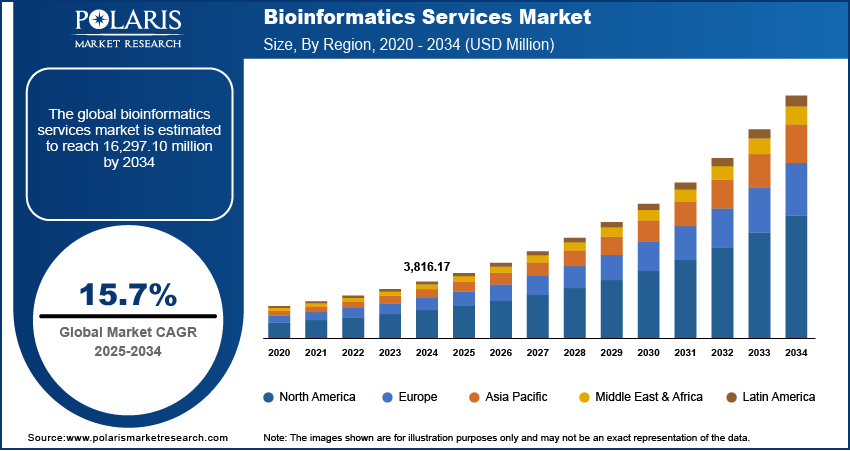
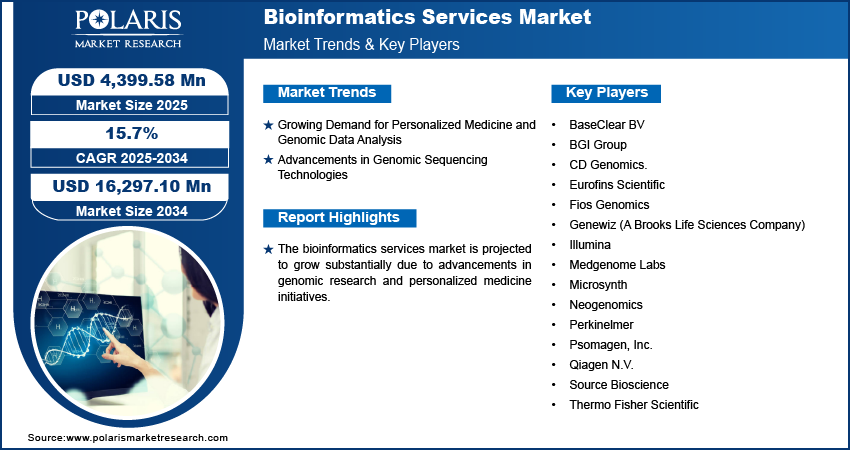
The global bioinformatics services market size was valued at USD 3.58 billion in 2025, growing at a CAGR of 15.35% from 2026 to 2034. The expanding applications of bioinformatics services across industries and growing public and private sector investments are a few of the key factors driving market growth.
Market Statistics
Key Takeaways
- North America accounted for the largest share of the global market at 45.71% in 2025, supported by the presence of robust biotechnology and pharmaceutical sectors and significant investments in life sciences research.
- The Asia Pacific bioinformatics services market is expected to witness the fastest growth at a 16.72% CAGR during the forecast period, propelled by increasing biotechnology investments, expanding genomic research, and rising demand for personalized medicine.
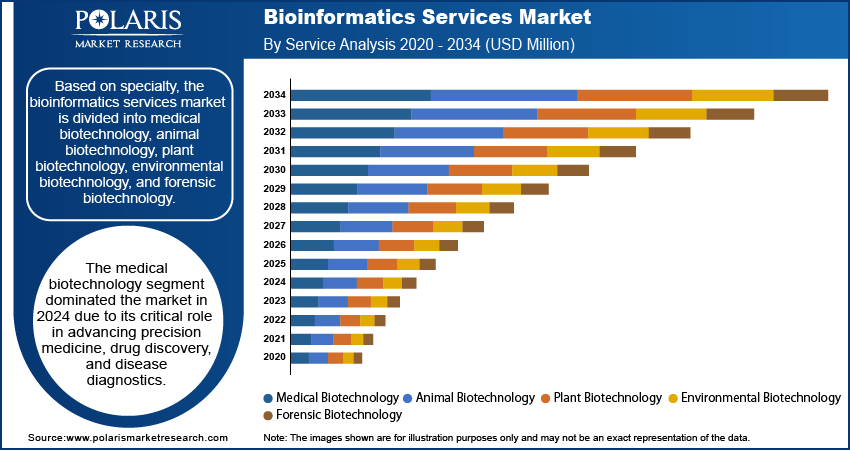
- In terms of specialty, the medical biotechnology segment led the bioinformatics services market with a 33.27% share in 2025, fueled by its pivotal role in advancing precision medicine, drug discovery, and disease diagnostics.
- Based on end user, the academic institutes & research centers segment is anticipated to experience the fastest growth at a 16.34% CAGR, due to the rising focus on genomics, molecular biology, and computational biology research.
Industry Dynamics
- The growing demand for personalized medicine and genomic data analysis are fueling the need for bioinformatics services.
- Advancements in genomic sequencing technologies is fueling the need for advanced bioinformatics tools for the efficient processing and interpretation of data.
- Rising integration of advanced technologies is expected to create several market opportunities in the coming years.
- In-house development of bioinformatics solutions is hindering market growth.
AI Impact on Bioinformatics Services Market
- AI enables drug discovery and personalized medicine by accelerating genomic and proteomic data analysis.
- Machine learning models allow for more accurate biomarker discovery and disease prediction by identifying patterns in large biological datasets.
- AI-powered platforms automate complex workflows. This automation reduces analysis time and operational costs for research organizations.
- Advanced analytics integrate multi-omics data, supporting precision healthcare strategies.
Source: Polaris Market Research Analysis
To Understand More About this Research: Download Sample Report
Bioinformatics services encompass computational and analytical solutions that facilitate the interpretation of biological data, driving advancements in research, drug discovery services, and personalized medicine.
The growing usage of bioinformatics services in the pharmaceutical, agriculture, and environmental science industries is the major factor responsible for the growth of the bioinformatics services market. The use of bioinformatics in drug discovery provides rapid target identification and validation, making research more productive. Bioinformatics enhances crop breeding via genomic analysis to increase yield and tolerance to diseases in agriculture. For example, the US Department of Agriculture’s Agricultural Research Service will be continuing its Breeding Insight project in 2026, which brings together artificial intelligence (AI), genomics, and bioinformatics tools for 31 of its crop and animal breeding programs and is seeking to expand to as many as 90 species. (Source: ars.usda.gov) This would demonstrate the increasing importance of computational biology in the public breeding programs and is beyond a twofold increase in the pace at which new varieties are developed and delivered. Furthermore, the scope of bioinformatics has expanded as it has become fundamental to environmental studies including biodiversity conservation and microbial investigation. With industries placing more emphasis on insights driven by data, the need for bioinformatics services is expected to continue to rise.
Another key factor fueling the bioinformatics services market expansion is the increasing public and private sector investment in bioinformatics services, supporting innovation and infrastructure development. Governments and research institutions are allocating substantial funding to improve bioinformatics capabilities, boosting advancements in genomics, proteomics, and personalized medicine. Simultaneously, private-sector investments are fostering collaborations between bioinformatics service providers and biotechnology firms, accelerating research outcomes. For instance, in November 2022, Arima Genomics partnered with Basepair to improve 3D genomic data analysis. The collaboration focuses on providing a user-friendly interface, faster processing, better data management, and simplified reporting to make advanced bioinformatics tools more accessible to researchers. It supports the development of high-throughput computing, artificial intelligence-based analytics, and cloud-based bioinformatics solutions, enhancing accessibility and efficiency. As financial support continues to expand, the bioinformatics services market is poised for sustained growth, reinforcing its critical role in advancing life sciences research and innovation.
Comparison Between Bioinformatics vs Traditional Biological Research
| Aspect | Bioinformatics | Traditional Biological Research |
| Approach | Uses computational analysis, algorithms, and AI-driven data processing | Relies primarily on laboratory experiments, observations, and manual analysis |
| Data Handling | Efficiently manages and analyzes large-scale biological datasets | Limited by manual processing and smaller data volumes |
| Genomic Analysis | Enables rapid genome sequencing, annotation, and interpretation | Genomic studies are more time-consuming and labor-intensive |
| Speed | Provides faster analysis through automation and high-performance computing | Requires longer experimental and validation timelines |
| Scalability | Highly scalable for multi-omics, population genetics, and big data research | Scaling studies often requires additional laboratory resources and manpower |
| Cost Efficiency | Reduces long-term costs for large-scale data analysis and research | Can involve significant laboratory, equipment, and personnel expenses |
| Accuracy & Insights | Identifies complex biological patterns using advanced analytics and machine learning | Depends heavily on experimental design and manual interpretation |
| Applications | Genomics, proteomics, drug discovery, precision medicine, and systems biology | Cell biology, microbiology, physiology, molecular biology, and experimental research |
| Decision Support | Supports predictive modeling and data-driven biological discoveries | Focuses on hypothesis testing through experimental validation |
| Limitations | Requires computational infrastructure, specialized software, and bioinformatics expertise | Slower for analyzing complex biological datasets and large-scale genomic information |
Market Dynamics
Growing Demand for Personalized Medicine and Genomic Data Analysis
Personalized medicine uses genomic sequencing and bioinformatics tools to analyze genetic variations, which allows for targeted therapies and precision treatments. Bioinformatics services enable the processing of large-scale genomic data, which helps in the discovery of biomarkers, pharmacogenomics, and disease risk assessment as genomics starts to revolutionize healthcare delivery and disease management. Governments around the world are now aware of the importance of genomic research and are investing heavily in bioinformatics infrastructure. For example, the UK government announced over USD 868.70 million in funding for Genomics England in July 2026, with the goal of creating a genomic research database of more than 500,000 genomes by 2030 and sequencing 150,000 adults through a new Adult Population Genomics Programme. (Source: gov.uk) This funding will enhance genomic data generation and analysis capabilities, contributing to preventive healthcare, precision medicine, and advanced diagnostics. The growing use of next-generation sequencing technologies is also increasing the demand for advanced bioinformatics solutions for efficient data interpretation. As a result, the demand for bioinformatics services is projected to increase as healthcare moves towards personalized treatment approaches.
Advancements in Genomic Sequencing Technologies
Next-generation sequencing (NGS) and third-generation sequencing technologies produce massive amounts of complex biological data that require sophisticated bioinformatics tools for efficient processing and interpretation. These technologies enable comprehensive genomic studies, contributing to advances in personalized medicine, disease diagnosis, and evolutionary biology. For example, QIAGEN's QIAGEN Discovery Platform, a bioinformatics solution with AI grounding that integrates biological knowledge, omics data, and advanced analytics to accelerate drug discovery and oncology research, was launched in April 2026. (Source: corporate.qiagen.com) Moreover, the use of artificial intelligence (AI) and machine learning (ML) in genomic sequencing has improved the analysis of data. For example, in January 2026, Illumina released Connected Multiomics, a cloud-based platform that combines and analyzes genomics, transcriptomics, proteomics, epigenomics, and other biological datasets with AI-powered analytics and scalable workflows. (Source: illumina.com)Thus, as sequencing technologies advance, the demand for more sophisticated bioinformatics solutions to handle, analyze and extract insights from genomic data will increase, confirming their key role in life sciences research and healthcare.
Technological Advancements in Bioinformatics
| Technology | Description | Key Benefits |
| AI-Powered Genomic Analysis | Utilizes artificial intelligence and machine learning algorithms to analyze genomic sequences and identify genetic variations. | Accelerates genome interpretation, improves diagnostic accuracy, and supports precision medicine. |
| Cloud Bioinformatics Platforms | Cloud-based infrastructures that provide scalable storage, computing power, and collaborative analysis tools. | Enhances accessibility, reduces infrastructure costs, and enables global research collaboration. |
| Automated Data Interpretation Pipelines | Automated workflows for processing, annotating, and interpreting biological datasets with minimal human intervention. | Increases efficiency, reduces errors, and shortens research timelines. |
| Real-Time Genomic Analytics | Advanced platforms capable of processing and analyzing genomic data as it is generated. | Supports rapid disease surveillance, outbreak monitoring, and time-sensitive clinical decisions. |
| Computational Drug Discovery Tools | Bioinformatics-driven software that models biological interactions and screens potential drug candidates virtually. | Reduces drug development costs, accelerates candidate identification, and improves success rates. |
| Protein Structure Prediction Models | AI-based systems that predict three-dimensional protein structures from amino acid sequences. | Enhances understanding of protein function, supports drug design, and advances biomedical research. |
| Multi-Omics Data Integration | Combines genomics, proteomics, transcriptomics, and metabolomics data into unified analytical frameworks. | Provides comprehensive biological insights and improves biomarker discovery. |
| High-Performance Computing (HPC) | Advanced computing systems designed to process massive biological datasets efficiently. | Enables large-scale genomic studies and complex biological simulations. |
| Single-Cell Bioinformatics Tools | Specialized platforms for analyzing gene expression and molecular characteristics at the single-cell level. | Improves understanding of cellular heterogeneity and disease mechanisms. |
| Digital Twin and Predictive Biology Models | Computational models that simulate biological systems and predict responses to treatments or environmental changes. | Supports personalized medicine, predictive healthcare, and advanced biological research. |
Source: Polaris Market Research Analysis
Segment Insights
Market Assessment by Specialty Outlook
The global bioinformatics services market assessment, based on specialty, includes medical biotechnology, animal biotechnology, plant biotechnology, environmental biotechnology, and forensic biotechnology. The medical biotechnology segment led the bioinformatics services market with a 33.27% share in 2025 due to its critical role in advancing precision medicine, drug discovery, and disease diagnostics. The increasing adoption of bioinformatics in genomics, proteomics, and transcriptomics has greatly improved biomarker identification, allowing targeted therapies for complex diseases such as cancer and genetic disorders. Additionally, the rising integration of AI and ML in bioinformatics has improved data analysis efficiency, accelerating drug development timelines. As healthcare systems continue to prioritize personalized treatment strategies, the demand for bioinformatics services in medical biotechnology remains strong, driving market growth.
Market Evaluation by End User Outlook
The global bioinformatics services market evaluation, based on end user, includes academic institutes & research centers, hospitals & clinics, pharmaceutical & biotechnology companies, CROs, and other end users. The academic institutes & research centers segment is anticipated to experience the fastest growth at a 16.34% CAGR from 2026 to 2034, driven by the increasing focus on genomics research, molecular biology studies, and computational biology advancements. These institutions serve as hubs for innovation, leveraging bioinformatics services to analyze vast biological datasets and develop novel therapeutic solutions. Government and private sector funding for research initiatives further supports the adoption of bioinformatics tools, boosting advancements in precision medicine and agricultural biotechnology. As research institutions continue to expand their collaborations with biotechnology firms and pharmaceutical companies, the demand for bioinformatics services is projected to accelerate, reinforcing their critical role in scientific discovery.
Source: Polaris Market Research Analysis
Market Regional Analysis
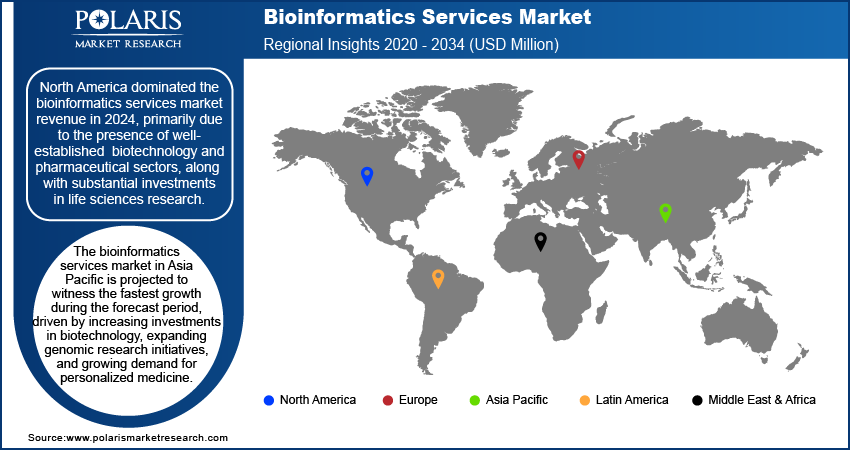
By region, the report provides the bioinformatics services market insights into North America, Europe, Asia Pacific, Latin America, and the Middle East & Africa. North America accounted for the largest share of the global market at 45.71% in 2025, primarily due to its well-established biotechnology and pharmaceutical industries, along with substantial investments in life sciences research. The region benefits from a strong infrastructure for genomics, bioinformatics, and clinical research, which facilitates the rapid adoption of advanced computational tools. Additionally, the widespread implementation of NGS technologies and AI in healthcare has driven the need for robust bioinformatics services. Supportive regulatory frameworks and government funding initiatives further strengthen North America's leadership in the bioinformatics sector, ensuring continued market expansion.
The Asia Pacific bioinformatics services market is expected to witness the fastest growth at a 16.72% CAGR during the forecast period, driven by increasing investments in biotechnology, expanding genomic research initiatives, and a growing demand for personalized medicine. The region’s rapidly developing healthcare and life sciences sectors, particularly in countries such as China, India, and Japan, are fueling the adoption of bioinformatics solutions. Government-backed genomic projects, coupled with a rising number of research collaborations, are further accelerating market growth. Additionally, advancements in bioinformatics infrastructure and the increasing availability of skilled professionals are improving the region’s ability to support large-scale biological data analysis, positioning Asia Pacific as a major growth hub for the bioinformatics services market.
Source: Polaris Market Research Analysis
Key Players and Competitive Insights
The competitive landscape features a mix of global leaders and regional players competing for bioinformatics services market share through innovation, strategic collaborations, and geographic expansion. Global players such as Illumina, Inc.; Thermo Fisher Scientific; QIAGEN; and PerkinElmer leverage strong R&D capabilities and expansive distribution networks to deliver advanced bioinformatics solutions, such as genomic data analysis, proteomics, and drug discovery platforms. Bioinformatics services market trends highlight increasing demand for cloud-based bioinformatics tools, AI-driven data analytics, and personalized medicine solutions, reflecting advancements in computational biology and biotechnology. According to bioinformatics services market analysis, the market is projected to experience substantial growth, driven by the rising volume of biological data, increasing adoption of precision medicine, and growing applications in genomics and clinical research.
Regional companies are focusing on addressing localized needs by offering cost-effective and customized bioinformatics services, particularly in emerging markets. Market competitive strategies, including mergers and acquisitions, partnerships with academic and research institutions, and the development of innovative bioinformatics platforms, cater to the growing demand for data-driven insights in healthcare and life sciences. The importance of technological innovation, bioinformatics services market adaptability, and investments in driving the expansion of the bioinformatics services industry. A few key major players are BaseClear BV; BGI Group; CD Genomics; Eurofins Scientific; Fios Genomics; Genewiz; Illumina; Medgenome Labs; Microsynth; Neogenomics; Perkinelmer; Psomagen, Inc.; Qiagen N.V.; Source Bioscience; and Thermo Fisher Scientific.
Illumina, Inc., founded in 1998 and headquartered in San Diego, California, is a biotechnology company specializing in genomic sequencing and array-based technologies. The company develops integrated systems that facilitate the analysis of genetic variation and biological function, serving a diverse clientele, such as academic institutions, pharmaceutical companies, and genomic research centers across over 160 countries. Illumina's product portfolio encompasses a wide range of solutions, such as sequencing kits, reagents, and microarray services, which are pivotal in molecular diagnostics, translational genomics, and cancer research. Illumina is recognized for its innovative technologies that have advanced personalized medicine by allowing researchers to conduct large-scale genomic analyses. The company's sequencing platforms, such as the NovaSeq series, are capable of generating vast amounts of data efficiently, thereby supporting various applications from whole-genome sequencing to gene expression analysis. Additionally, Illumina offers bioinformatics services that help interpret complex genomic data, making it easier for researchers and clinicians to derive actionable insights for disease detection and treatment. Illumina continues to drive advancements that enhance the understanding of genetics and improve healthcare outcomes globally.
QIAGEN N.V., founded in 1996 and headquartered in Venlo, Netherlands, is a global provider of "Sample to Insight" solutions that facilitate the extraction and analysis of biological materials. The company specializes in technologies that isolate DNA, RNA, and proteins from various samples, such as blood and tissue. Its innovative assay technologies improve the visibility of these biomolecules for further analysis, while its bioinformatics services play a crucial role in interpreting complex data to deliver actionable insights. QIAGEN's bioinformatics software and knowledge bases support a diverse clientele across multiple sectors, such as molecular diagnostics, applied testing (forensics), pharmaceuticals, and academic research. The company is committed to advancing science and improving healthcare outcomes through its comprehensive range of products and services. QIAGEN has also expanded its capabilities through strategic acquisitions, improving its offerings in molecular diagnostics and bioinformatics solutions.
List of Key Companies
- BaseClear BV
- BGI Group
- CD Genomics.
- Eurofins Scientific
- Fios Genomics
- Genewiz
- Illumina
- Medgenome Labs
- Microsynth
- Neogenomics
- Perkinelmer
- Psomagen, Inc.
- Qiagen N.V.
- Source Bioscience
- Thermo Fisher Scientific
Bioinformatics Services Industry Developments
January 2025: Illumina partnered with NVIDIA to integrate AI and multiomic data, enhancing genomic analysis, drug discovery, and clinical research through advanced tools like NVIDIA BioNeMo and Illumina Connected Analytics. (Source: nvidianews.nvidia.com)
January 2025: Almaden Genomics launched g.nome 2.0, improving its bioinformatics platform with g.nome analytics and a user-friendly interface. These upgrades facilitate deeper data exploration and streamlined workflows for researchers, boosting efficiency in the life sciences industry. (Source: almaden.io)
Bioinformatics Services Market Segmentation
By Type Outlook (Revenue, USD Billion, 2021–2034)
- Sequencing Services
- Data Analysis
- Drug Discovery Services
- Differential Gene Expression Analysis
- Database and Management Services
- Other Bioinformatics Services
By Application Outlook (Revenue, USD Billion, 2021–2034)
- Genomics
- Chemo Informatics & Drug Design
- Proteomics
- Transcriptomic
- Metabolomics
- Other Applications
By Specialty Outlook (Revenue, USD Billion, 2021–2034)
- Medical Biotechnology
- Animal Biotechnology
- Plant Biotechnology
- Environmental Biotechnology
- Forensic Biotechnology
By End User Outlook (Revenue, USD Billion, 2021–2034)
- Academic Institutes & Research Centers
- Hospitals & Clinics
- Pharmaceutical & Biotechnology Companies
- CROs
- Other End Users
By Regional Outlook (Revenue, USD Billion, 2021–2034)
- North America
- US
- Canada
- Europe
- Germany
- France
- UK
- Italy
- Spain
- Netherlands
- Russia
- Rest of Europe
- Asia Pacific
- China
- Japan
- India
- Malaysia
- South Korea
- Indonesia
- Australia
- Vietnam
- Rest of Asia Pacific
- Middle East & Africa
- Saudi Arabia
- UAE
- Israel
- South Africa
- Rest of Middle East & Africa
- Latin America
- Mexico
- Brazil
- Argentina
- Rest of Latin America
Bioinformatics Services Market Report Scope
| Report Attributes | Details |
| Market Size Value in 2025 | USD 3.58 million |
| Market Size Value in 2026 | USD 4.11 million |
| Revenue Forecast by 2034 | USD 12.93 million |
| CAGR | 15.35% from 2026 to 2034 |
| Base Year | 2025 |
| Historical Data | 2021–2024 |
| Forecast Period | 2026–2034 |
| Quantitative Units | Revenue in USD billion and CAGR from 2026 to 2034 |
| Report Coverage | Revenue Forecast, Market Competitive Landscape, Growth Factors, and Industry Trends |
| Segments Covered |
|
| Regional Scope |
|
| Competitive Landscape |
|
| Report Format |
|
| Customization | Report customization as per your requirements with respect to countries, regions, and segmentation. |
Source: Polaris Market Research Analysis
bioinformatics services market FAQ's
The global bioinformatics services market size was valued at USD 3.58 billion in 2025 and is projected to grow to USD 12.93 billion by 2034.
The global market is projected to register a CAGR of 15.35% during the forecast period.
North America accounted for the largest share of the global market at 45.71% in 2025.
Some of the key players in the market are BaseClear BV; BGI Group; CD Genomics; Eurofins Scientific; Fios Genomics; Genewiz; Illumina; Medgenome Labs; Microsynth; Neogenomics; Perkinelmer; Psomagen, Inc.; Qiagen N.V.; Source Bioscience; and Thermo Fisher Scientific.
In terms of specialty, the medical biotechnology segment led the bioinformatics services market with a 33.27% share in 2025
Download Sample Report of bioinformatics services market
Please fill out the form to request a customized copy of the research report.


