
Border Security Market Size, Share, Trends & Forecast, 2026–2034
REPORT DETAILS
Border Security Market Summary
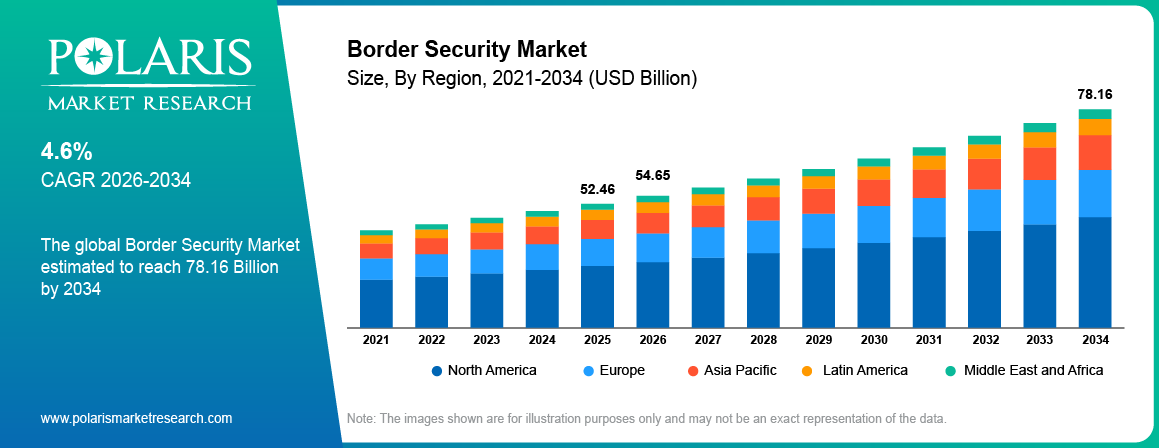
The global border security market size was valued at USD 52.46 billion in 2025. The market is projected to grow at an 4.6% CAGR from 2026 to 2034. Rising geopolitical tensions and increasing cross-border illegal migration and trafficking have led to the rapid growth of the border security market.
Market Statistics
Border Security Market Key Takeaways
- North America led with an 33.20% border security market share in 2025. North America’s extensive land and maritime borders contribute to its leading market position.
- Asia Pacific is projected to grow at a 5.60% CAGR. Increasing defense modernization efforts drive the regional market growth.
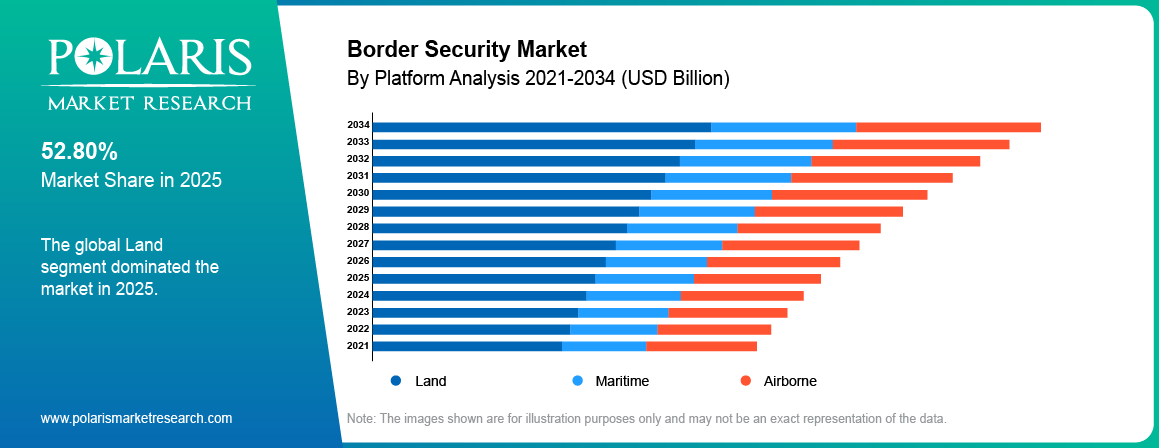
- The land segment led with a 52.80% share in 2025. Rising migration rates and increased investment in advanced security technologies drive the segment’s leading position.
- The surveillance systems segment is projected to grow at a 4.30% CAGR. This is owing to the rising need for advanced monitoring solutions.
- The new installations segment accounted for an 58.10% share in 2025. This is due to increased government spending on entirely new smart surveillance frameworks.
Note: Figures and projections outlined in this report are the result of Polaris Market Research’s proprietary analytical processes, grounded in the latest available datasets and market observations.
What Is Border Security?
Border security refers to the processes and actions taken to protect the borders of a nation against any form of unauthorized activity. It entails technologies and services that aid in monitoring the borders and validating the identities of individuals. Border security solutions facilitate the detection and prevention of threats for government institutions, thus enhancing the safety of the nation’s borders.
How Does Border Security Work?
Border Surveillance: Continuous monitoring through cameras, sensors, drones, and radars is done for detection of any suspicious activities at the land, sea, and air borders.
Threat Detection: Analyzing the information gathered helps in detecting unauthorized access and other possible threats to security.
Risk Assessment: Risks posed by the security threats detected are assessed in order to respond to them.
Identity Authentication: Systems for biometric authentication help to authenticate the identity of an individual at the border through facial recognition border control solutions, fingerprints, or iris scanning.
Event Response: Border patrols get alerted and react to the events occurring in the specific location.
Source: Polaris Market Research Analysis
Key Market Trends & Insights
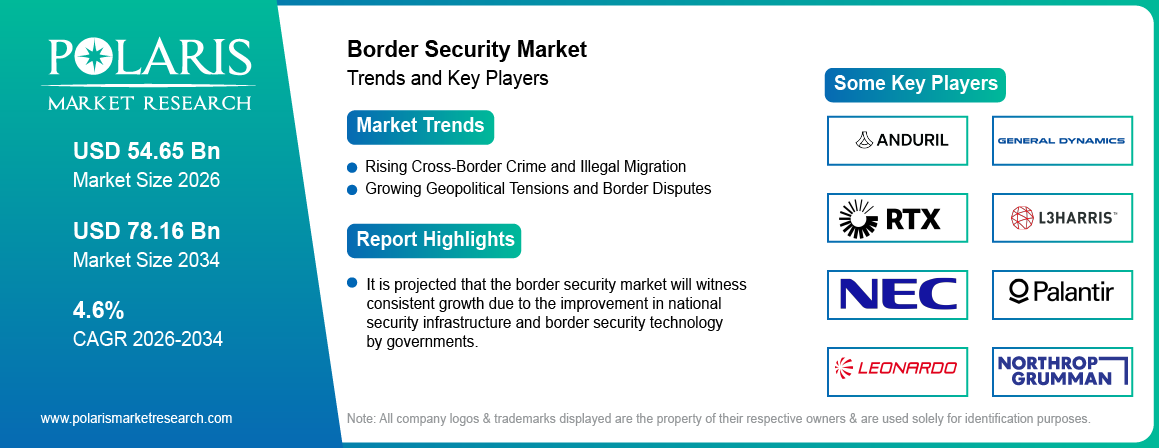
Governments are increasingly investing in advanced technologies such as surveillance drones, biometric identification systems, and AI-powered analytics to enhance border monitoring and enforcement capabilities. These technologies help in detecting and preventing illicit activities and also enable quicker response times to security threats, ensuring safer and more secure borders and driving demand for border security solutions.
Rising Adoption of AI Border Security Technology
The adoption of artificial intelligence in border security is rising as a result of increased needs by governments to enhance surveillance in wide border regions. Artificial intelligence enables the analysis of surveillance data and the spotting of abnormal behavior. Artificial intelligence & analytics can also be used for quicker threat detection and response in such scenarios. Agencies are increasingly integrating artificial intelligence technology with camera equipment and other surveillance tools. These innovations help speed up information review. AI can also help in recognizing patterns in surveillance applications. With the anticipated increase in investments for intelligent border management systems, the use of AI-powered border security solutions will become easier to adopt. The technology can assist organizations in understanding the situation and handling large volumes of security data.
Growing Use of UAVs and Drones
Border control is increasingly adopting UAVs and drones because they are effective in monitoring distant locations that are usually hard to reach by ground personnel. Drones provide aerial images and facilitate routine patrol activities. They provide real-time information to personnel on the ground. The use of drones is increasing as governments look for more efficient possibilities of surveillance. UAVs are capable of long-duration flights and cover wide areas. Besides, they can be used in places where it is difficult to build fixed surveillance infrastructure. Improvements in cameras and sensors, and flight capacities make drones increasingly effective for security operations. Growing concerns about illegal border crossings and cross-border crime will result in further adoption of UAVs and counter-drones.
Biometric Border Control Systems
One of the key border security market trends 2026 is the use of biometric systems. They enable faster identification, as they can instantly verify travelers’ identities using fingerprints or facial features. Travel processing is simplified with the use of these systems. Biometric technology is used to detect inconsistencies in travelers’ identities during the inspection process. In recent years, many border points, such as airports, have implemented automated identity verification systems in different countries. Automated identity verification makes it possible to have a more consistent verification process and avoid using manual verification. The growing popularity of international trips is a reason for such systems to become widely adopted. More investments in border digital identity verification and border management will enhance the use of biometric technologies. Continuous efforts to make processes safer and faster are expected to further contribute to the trend.
Cybersecurity in Border Management
As border agencies have started to depend on interconnected digital systems, the need for cybersecurity is also increasing. These systems process important information and facilitate daily border activities. Cybersecurity solutions can prove beneficial in protecting border systems from unauthorized access and cyberattacks. Governments have also stepped up digital protection efforts as connected devices become more common in border management systems. The companies operating the surveillance networks also rely on secure communication systems for data transfer. Cyberattacks can disrupt surveillance processes and reduce the availability of critical security information. Thus, the need for stronger protection of border database security is growing. This has led to an increase in the demand for identity management systems and network security infrastructure.
Market Dynamics
The border security market is influenced by heightened security considerations as well as increased efforts of governments to improve their national borders. Shifting migration trends, along with geopolitical factors, are increasing the need for enhanced border management. The government's efforts to modernize have also played an important role in shaping the demand.
Drivers: Rising Cross-Border Crime and Illegal Migration
Growing incidents of illegal immigration and criminal activity at borders have created greater demands for border security measures. Governments are stepping up efforts toward border surveillance in order to curb unauthorized crossing and trafficking. In addition, drug trafficking continues to be a serious issue for border security agencies. Such issues are prompting governments to enhance efforts toward surveillance and border security infrastructure. Increased migration is putting additional pressure on governments to handle border crossings. According to March 2026 data from the World Health Organization, about 1 in 8 people (or more than a billion) are on the move globally (source: who.int). The increased movement of people has created demands for more efficient identity verification and border monitoring measures.
Drivers: Growing Geopolitical Tensions and Border Disputes
The increase in geopolitical tensions is driving nations to enhance their border surveillance capabilities. The occurrence of territorial conflicts and the transformation of regional security environments is making national border surveillance more critical. Nations are spending on surveillance technology in order to enhance their ability to monitor activity around national borders. Border security has also become increasingly tied to national defense policies. The rise in tension in areas like the South China Sea and at the India-China border has increased demand for surveillance technology. In addition, the need for better detection technologies for unlawful entry into challenging terrains has made investments in border surveillance technology inevitable. These factors are expected to sustain investments in border surveillance technology infrastructure.
Restraints & Challenges: High Cost of Border Security Infrastructure
Due to the high cost of border security systems, the adoption of these systems is often limited in countries with limited security budgets. Large projects require significant investment in equipment, installation, repairs, and personnel. The costs could also increase in the case of upgrading existing systems. The older systems may require replacement before the new technologies can be used. This can postpone the modernization and delay the implementation. The complexity of the procurement process may increase the delay.
Opportunities: Expansion of Smart Border Infrastructure
As smart borders continue to evolve, there will be increasing opportunities for providers of border security technology. Government investment in digitization will improve monitoring and control of border areas. Automated scanning and smart border management are becoming increasingly popular in key border crossing points. Remote border regions will also offer opportunities for advanced monitoring systems. There is potential for developing border security solutions that interface with existing infrastructure. Scalability can enable agencies to increase their capabilities as their security needs grow. Further opportunities can arise from the continued investment in border modernization.
Source: Polaris Market Research Analysis
Smart Border vs Traditional Border Security
The traditional border security system relies on manual surveillance and infrastructure. The smart border security system employs technological networks for enhanced surveillance and decision-making. The following comparison highlights the differences.
| Feature | Traditional Border Security | Smart Border Security |
| Monitoring | Dependent on manual patrolling and surveillance. | Employs AI, sensor systems, military drones, and automated monitoring systems. |
| Detection Time | Lag in detecting threats due to manual surveillance. | Detection is done in real time via automated monitoring. |
| Data Analysis | Limited data available for decision-making purposes. | Advanced data analytics for faster and more precise decisions. |
| Automation | All operations require human intervention. | Automates many tasks of monitoring and alerts. |
| Threat Detection | Completely dependent on security staff. | Human expert knowledge combined with smart detection technology. |
| Operational Effectiveness | Necessitates high levels of human resources. | Greater effectiveness in operations. |
Source: Polaris Market Research Analysis
By Platform
The land segment led with a 52.80% market share in 2025. This is due to rising migration rates, increased investment in advanced security technologies, and heightened geopolitical tensions. According to the World Migration Report 2026, there were around 304 million international migrants worldwide in 2024. This equates to 3.7 percent of the global population (source: iom.int). The impact of climate change is also expected to displace millions, creating a new wave of climate refugees and necessitating improved border management. Stricter immigration laws and growing public advocacy for enhanced border security further drive segment growth. Countries are increasingly collaborating on initiatives to share intelligence and best practices, ensuring that the land border segment remains a critical focus for national security efforts in an evolving global landscape.
The maritime segment accounted for an 28.30% share in 2025. The increasing maritime trade has led to the demand for more effective border surveillance systems. Governments are increasing surveillance in the coastal areas and important waterways. The maritime borders are subject to risks such as illegal immigration, smuggling, and unregulated sea traffic. These factors are driving investment in advanced monitoring systems. The demand for solutions that can enhance visibility over the large sea areas is also rising. The continued increase in expenditure on coastal security is expected to drive growth in this segment.
By Systems
The surveillance systems segment led with an 25.90% market share in 2025. This is due to the rising need for advanced monitoring solutions that can effectively address rising security threats. Governments and border control agencies are increasingly investing in technologies such as AI, machine learning threat detection systems, and high-resolution imaging. These advancements enable real-time monitoring and improved accuracy, allowing for rapid threat detection and response to illegal activities, such as drug trafficking and terrorism. Integrating surveillance systems with other security technologies, including biometric identification and access control, enhances overall security effectiveness. Increased public safety concerns, driven by recent global events, are boosting investments in comprehensive border monitoring solutions.
The unmanned systems segment is projected to grow at an 6.50% CAGR. The need for remote monitoring of borders is driving the adoption of unmanned solutions. Such solutions enable government organizations to monitor areas that are hard to reach by humans. They can help with surveillance of extensive border areas. Unmanned aerial systems are deployed for patrolling and reconnaissance operations. Unmanned ground vehicles play a significant role in border monitoring in extreme terrains. Growing concerns about border safety and efficiency are expected to further boost the demand for autonomous surveillance.
| System Type | Primary Use Case | Typical Deployment |
| Surveillance Systems | Monitor border areas and detect suspicious activity | Land borders, coastal areas, airports, and border checkpoints |
| Detection Systems | Identify unauthorized movement and potential threats | Border crossings, remote areas, and sensitive border zones |
| Communication Systems | Support secure communication between border personnel | Border posts, patrol units, command centers, and control rooms |
| Border Security Systems | Manage border monitoring and security operations | Border checkpoints, entry points, and command centers |
| Laser Systems | Detect movement and support perimeter monitoring | Restricted areas, border fences, and sensitive locations |
| Unmanned Systems | Conduct remote surveillance and support patrol activities | Remote border areas, difficult terrain, and maritime zones |
| Perimeter Intrusion Detection Systems | Detect unauthorized entry across protected boundaries | Border fences, restricted zones, and secured facilities |
| Cybersecurity Systems | Protect digital border infrastructure and data | Command centers, communication networks, and connected security systems |
| Others | Support additional border protection requirements | Specialized border security environments |
Source: Polaris Market Research Analysis
By Installation
The new installations segment led with an 58.10% market share in 2025. Growing government expenditure on the construction of border security infrastructure is aiding the demand for security infrastructure. Countries are setting up surveillance and monitoring infrastructure in strategic border areas. The demand for security infrastructure is also being driven by the need for better security in remote and high-risk areas. Such projects may comprise setting up new surveillance infrastructure and communication systems. Rising demand for border security is expected to aid the installation of new systems during the forecast period.
The upgradation segment is projected to account for an 5.50% CAGR. Existing infrastructure is being upgraded by the agencies to improve the security capabilities. Modernization of many existing systems is necessary to be able to incorporate advanced technology in the systems. Modernization could also increase the efficiency of the surveillance and detection systems. Agencies could upgrade their existing installation without having to replace them entirely. Increased usage of digital border management is creating further need for system upgrades. Growing cybersecurity demands are also prompting agencies to modernize their existing security infrastructure.
By Vertical
The military segment accounted for an 59.20% share in 2025. Military departments demand advanced security systems for surveillance of sensitive border regions. Geopolitical instabilities have increased the demand for better surveillance of borders. Higher military expenditure on defense systems is also being witnessed due to changing security situations. Military departments are adopting border security solutions to facilitate better surveillance. Demand is projected to remain robust as nations expand their defense systems.
The homeland security segment is projected to account for an 5.20% CAGR. Rising concerns about immigration and cross-border criminal activity have increased demand for homeland security technology. There has been an increase in investment in border controls and monitoring systems due to increasing emphasis by government organizations on improving national security. Investments have also risen in technologies that will help to identify security threats quickly. The focus on protecting critical infrastructure is another factor driving demand.
Use Cases & Real-World Applications
| Use | Description |
| Monitoring of Land Borders | Performs surveillance on remote land borders for unauthorized border crossing or suspicious activities. |
| Identification of Illegal Immigrants | Helps identify the unauthorized movement of individuals across national borders. |
| Detection of Drug Smuggling | Aids in law enforcement's detection and interception of drug-smuggling operations. |
| Surveillance of Maritime Borders | Performs surveillance on coastal and territorial waters in order to improve maritime security. |
| Immigration Management at Airports | Assists in the identification of passengers at international airports. |
| Counter-Terrorism Operations | Helps detect potential threats that may be coming into the nation’s border regions. |
| Critical Infrastructure Protection | Helps secure border infrastructure and other vital assets in the nation. |
| Human Trafficking Detection | Helps authorities identify suspicious movement and support efforts to prevent human trafficking across borders. |
Source: Polaris Market Research Analysis
Source: Polaris Market Research Analysis
Border Security Market by Region
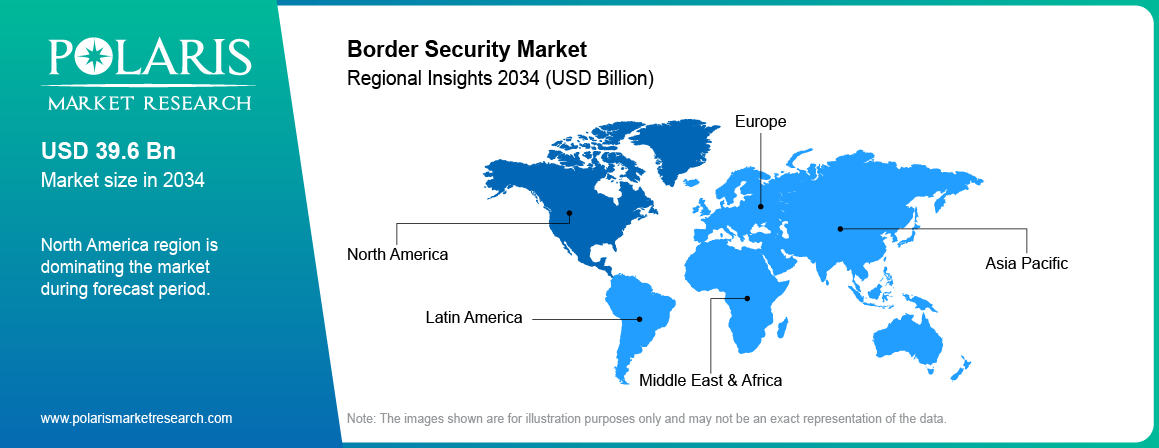
North America held the largest market share in 2025. High government expenditure is fueling market growth in the region. Europe is also making efforts towards border security and surveillance. Asia Pacific is likely to witness the highest growth rate during the forecast period. Increasing security concerns and rising defense expenditure have been driving demand in the region. Latin America and the Middle East and Africa regions are also enhancing border security infrastructure.
North America
The North America border security market accounted for an 33.20% share in 2025. This is due to its extensive land and maritime borders, necessitating robust security measures to combat challenges such as drug trafficking, illegal immigration, and terrorism. According to U.S. Customs and Border Protection, the total nationwide encounters were 691,906 in 2025 (source: cbp.gov). Significant investments in advanced technologies, including unmanned aerial vehicles (UAVs) and biometric systems, are also being made to improve surveillance and identity verification. The presence of major defense contractors such as Lockheed Martin and Northrop Grumman fosters rapid innovation in border security technologies. Collaborative efforts between North American countries and international partners to share intelligence further enhance security capabilities. Legislative frameworks, such as the U.S. Customs and Border Protection modernization initiatives, emphasize investing in advanced security measures, solidifying North America’s position as a leader in the border security market as it addresses current and emerging threats.
Europe
Europe held an 23.30% market share in 2025. The market for border security in Europe is fueled by rising efforts to secure the borders of the nation and control the issue of irregular migration. Investments are being made in technology for surveillance and border control. In addition to this, the region is giving increasing emphasis to the issue of cooperation among border authorities. There has been an increase in the demand for monitoring technologies due to issues related to crime across borders. Investments in digital border management system technologies are being made in order to improve the efficiency of identification and border control processes.
Asia Pacific
The Asia Pacific border security market is anticipated to witness a 5.60% CAGR during the forecast period. Higher defense budgets are driving the adoption of monitoring and protection systems in the border region. China allocated 1.94 trillion yuan for defense spending in 2026. Similarly, India allocated INR 7.85 lakh crore to the Ministry of Defence in the Union Budget 2026-27 (source: pib.gov.in). These developments are fueling the adoption of security infrastructure in the border security space. Nations are focusing more on surveillance and border protection measures. Geopolitical issues are also driving nations to secure their borders better. Issues of illegal immigration and cross-border criminal activities are fueling the demand for such services. The rise in cross-border trade is also driving the need for monitoring and protection measures.
Middle East & Africa
The Middle East & Africa is projected to account for an 5.20% CAGR. The market of border security in the Middle East and Africa is growing due to rising concerns about cross-border crime, illegal migration, and regional security. Countries are increasingly investing in surveillance and monitoring technology. Governments are also enhancing controls at both land and maritime borders. There is increasing demand for technologies that aid monitoring in remote locations. Countries like Saudi Arabia, the UAE, and Israel are investing heavily in advanced security systems. Likewise, efforts directed at protecting critical infrastructure are also boosting the demand for the market. Ongoing concerns regarding regional security are expected to spur additional investments in border security solutions.
Latin America
Latin America is anticipated to register a 4.80% CAGR. Concerns related to drug trafficking, illegal immigration, and organized crime are fueling growth in the Latin American border security sector. Governments are enhancing their border control systems to boost their control capabilities. Countries such as Mexico and Brazil are also investing in new technologies for surveillance and detection. Border agencies are also investing in the latest systems that can be used to monitor remote areas and reduce response times. Increased cross-border trade is also pushing the demand for effective border management. Continuous efforts to address organized crime and enhance national security are likely to boost market growth in the region.
Source: Polaris Market Research Analysis
Maritime Border Security Applications
Maritime border security solutions assist governments in keeping track of their coastal areas. These solutions play a big role in detecting illegal vessels that enter their territorial waters. The technologies enable solutions against illegal immigration, smuggling, or any other form of cross-border crime. Surveillance systems allow constant vessel monitoring across vast sea areas. Radars and other detection systems enable the authorities to track vessels. Many other modern technologies are used today, such as unmanned vessels, for port security. Governments are investing more in coastal surveillance with the increase in maritime traffic.
Key Market Players & Competitive Insights
Leading market players are investing heavily in research and development to expand their offerings, which will help the border security market grow. Market participants are also undertaking a variety of strategic activities to expand their global footprint, including new solution launches, contractual agreements, mergers and acquisitions, increased investment, and collaboration with other organizations. To expand and survive in a more competitive, growing market, the border security industry must offer cost-effective solutions.
Lockheed Martin Corporation is a security and aerospace company formed by combining the businesses of Martin Marietta Corporation and Lockheed Corporation. The company is engaged in diverse industry sectors, including research, development, design, integration, and manufacture of advanced technology products, systems, and services.
Teledyne FLIR LLC is a provider of thermal imaging and sensing technologies specializing in products for government, defense, industrial, and commercial markets. Founded as FLIR Systems and acquired by Teledyne Technologies, the company offers a diverse range of products, including thermal cameras, sensor systems, and threat-detection solutions.
Northrop Grumman Corporation is a global aerospace and defense company that provides highly advanced systems to its government and defense clients. The company's product line consists of surveillance and sensing systems, autonomous systems, and command and control systems. The company offers border security solutions that could potentially improve situational awareness capabilities.
Palantir Technologies Inc. offers platform software products aimed at providing its users with means to organize and analyze complex data. Palantir's platform assists government and defense customers in connecting information gathered from multiple sources. This could be utilized by border security organizations to enhance situational awareness.
Competitive Benchmarking
| Category | Representative players | Competitive edge | Watch-outs |
| Defense primes | Lockheed Martin Corporation, Northrop Grumman Corporation, BAE Systems plc, General Dynamics Corporation, RTX Corporation | Large defense programs and established public-sector business | Lengthy procurement processes and high contract values |
| Sensors and surveillance | Teledyne FLIR LLC, Leonardo S.p.A., Elbit Systems Ltd. | Thermal imaging, electro-optics, radar, and border surveillance | Product costs and competition from larger defense suppliers |
| Unmanned platforms | Israel Aerospace Industries (IAI), Anduril Industries, Inc. | UAVs and autonomous platforms for remote monitoring | Certification requirements and changing regulations |
| Biometric systems | NEC Corporation, Thales Group | Facial recognition, biometric matching, and automated identity checks | Privacy rules and protection of personal data |
| Data platforms | Palantir Technologies Inc. | Data integration and software for security operations | Integration with older government systems |
| Communications | L3Harris Technologies, Inc. | Secure communications for border and defense operations | Upgrading existing communication infrastructure |
Source: Polaris Market Research Analysis
Top Border Security Companies Listed
- Anduril Industries, Inc.
- BAE Systems plc
- Elbit Systems Ltd.
- General Dynamics Corporation
- Israel Aerospace Industries (IAI)
- L3Harris Technologies, Inc.
- Leonardo S.p.A.
- Lockheed Martin Corporation
- NEC Corporation
- Northrop Grumman Corporation
- Palantir Technologies Inc.
- RTX Corporation
- Teledyne FLIR LLC
- Thales Group
Border Security Industry Developments
- August 2026: UK Defence Innovation relaunched its Security Open Call with a focus on technologies for border security and protective security. Selected projects can receive funding of up to £350,000. (source: gov.uk)
- July 2026: CACI International Inc announced that it was awarded a contract by the Department of War (DoW). The company stated that the contract is for the deployment of SkyValor, its advanced drone defense system, at the Southern Border. It is intended to support a broader national security effort to counter the growing threat of hostile drones. (source: caci.com)
- June 2026: General Dynamics Information Technology (GDIT) announced that it was awarded a $71 million task order by the U.S. Customs and Border Protection (CBP) for next-gen autonomous surveillance towers. According to GDIT, the task order carries a potential total value of $115 million and is intended to strengthen the nation’s border security. (source: gdit.com)
- May 2026: The U.S. Department of War announced that the Great Lakes District will deploy autonomous drones to support Coast Guard missions on the Great Lakes from May to October. The drones are wind- and solar-powered vessels that will be used for tracking illicit activity and keeping maritime borders safe. (source: war.gov)
Border Security Market Segmentation
By Platform Outlook
- Land
- Maritime
- Airborne
By Systems Outlook
- Surveillance Systems
- Detection Systems
- Communication Systems
- Border security systems
- Laser Systems
- Unmanned Systems
- Perimeter Intrusion Detection Systems
- Cybersecurity Systems
- Others
By Installation Outlook
- New Installations
- Upgradation
By Vertical Outlook
- Military
- Homeland Security
By Regional Outlook
- North America
- US
- Canada
- Europe
- Germany
- France
- UK
- Italy
- Spain
- Netherlands
- Russia
- Rest of Europe
- Asia Pacific
- China
- Japan
- India
- Malaysia
- South Korea
- Indonesia
- Australia
- Vietnam
- Rest of Asia Pacific
- Middle East & Africa
- Saudi Arabia
- UAE
- Israel
- South Africa
- Rest of Middle East & Africa
- Latin America
- Mexico
- Brazil
- Argentina
- Rest of Latin America
Future Outlook
It is projected that the border security market will witness consistent growth due to the improvement in national security infrastructure and border security technology by governments. The adoption of more advanced border control technology is expected to rise due to increased efforts to improve threat detection and operational efficiency. Technologies expected to be adopted more often include artificial intelligence, drone technology, biometric authentication, and satellite technology. There have been efforts to develop an integrated border management system, which can help coordinate activities at the border security agencies. Modernization of defense equipment and increased threats from across the border are expected to drive the border security market growth.
Report Scope
| Report Attributes | Details |
| Market Size Value in 2025 | USD 52.46 billion |
| Market Size Value in 2026 | USD 54.65 billion |
| Market Forecast 2034 | USD 78.16 billion |
| CAGR | 4.6% from 2026 to 2034 |
| Base Year | 2025 |
| Historical Data | 2021–2024 |
| Forecast Period | 2026–2034 |
| Quantitative Units | Revenue in USD billion and CAGR from 2026 to 2034 |
| Report Coverage | Revenue Forecast, Market Competitive Landscape, Growth Factors, and Industry Trends |
| Segments Covered |
|
| Regional Scope |
|
| Competitive Landscape |
|
| Report Format |
|
| Customization | Report customization as per your requirements with respect to countries, regions, and segmentation. |
Source: Polaris Market Research Analysis
Border Security Market FAQ's
The global border security market size was valued at USD 52.46 billion in 2025. The market is anticipated to grow to USD 78.16 billion by 2034.
The market is projected to account for an 4.6% CAGR from 2026 to 2034.
North America led with an 33.20% share in 2025. Its extensive land and maritime borders contribute to its leading market position.
A few of the key market players include Anduril Industries, Inc.; BAE Systems plc; Elbit Systems Ltd.; General Dynamics Corporation; Israel Aerospace Industries (IAI); L3Harris Technologies, Inc.; Leonardo S.p.A.; Lockheed Martin Corporation; NEC Corporation; Northrop Grumman Corporation; Palantir Technologies Inc.; RTX Corporation; Teledyne FLIR LLC; and Thales Group.
The land segment led with an 52.80% market share in 2025. Increased investment in advanced security technologies drives the segment’s leading position.
Biometric systems are technological tools that help identify an individual through physical attributes such as fingerprints, face recognition, and iris scan. The significance of biometric systems in border security is that they help reduce identity fraud and verify identity in time.
Drones help with the real-time surveillance of difficult and inaccessible areas of the borders. Drones help security officers detect any form of suspicious activity and take necessary measures against any threat.
There are various types of technology used in border security. They include surveillance cameras, radars, drones, biometric recognition, thermal imaging, artificial intelligence, and communication and satellite surveillance.
Download Sample Report of Border Security Market
Please fill out the form to request a customized copy of the research report.


