
Central Venous Catheters Market Size, Share, and Forecast 2027 to 2035
REPORT DETAILS
Central Venous Catheters Market Summary
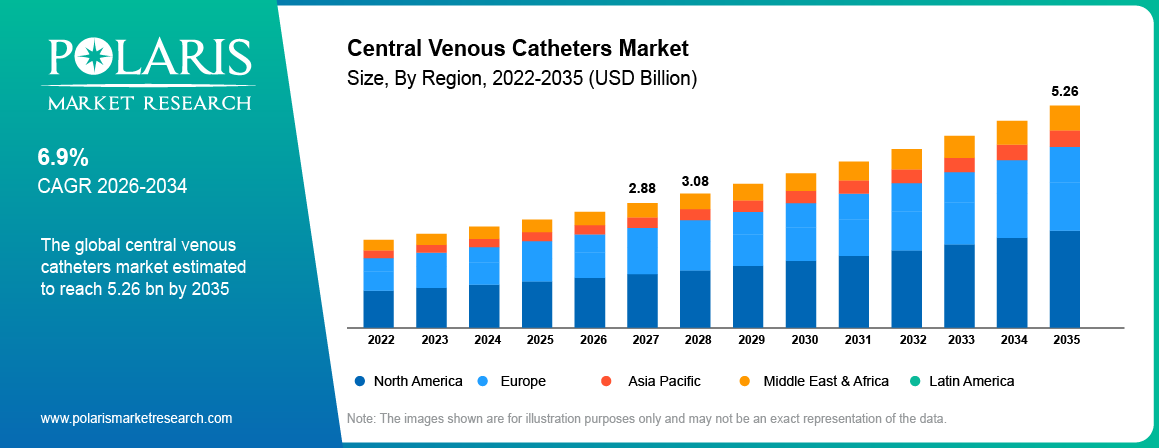
According to Polaris Market Research analysis, the central venous catheters market was valued at USD 2.88 Billion in 2026. It is projected to reach USD 5.26 Billion by 2035, growing at a CAGR of 6.9% from 2027 to 2035. Demand is supported by rising cancer and critical care caseloads, longer courses of intravenous therapy, and hospital programs that aim to cut bloodstream infections. Arm placed catheters bring in the most product revenue, while implantable ports grow quickest. The market covers catheters whose tip rests in a large central vein and the ports that feed them, and it excludes dialysis, midline, and peripheral devices. North America is the leading market. Asia Pacific is the fastest growing region.
Market Statistics
Key Takeaways
- 35.1% of 2027 revenue sits in North America, where big hospital systems, deep oncology care, and strict infection reporting keep central access devices in daily use.
- Asia Pacific is projected to expand at 8.9% a year from 2027 to 2035, the quickest region, owing to new intensive care capacity in China and a rapid rise in hospital beds in India.
- Arm placed catheters hold a 31.8% share of 2027 revenue, as clinicians prefer arm placement for long courses of treatment outside the intensive care unit.
- Implantable ports are the quickest growing product, with a CAGR of 8.0% through 2035, as oncology teams favor a device that sits under the skin between treatment cycles.
- Double Lumen catheters led lumen types with USD 1,145.2 Million of 2027 revenue, since two channels allow fluids and drugs to run without mixing.
- The Quadruple Lumen and Above group is on track for 9.0% yearly growth through 2035, as intensive care units manage more infusions at the same time.
- Hospitals account for 82.0% of 2027 revenue, supported by operating room, emergency, and intensive care use, together with group purchasing contracts.
- The home channel is the quickest end use, with a CAGR of 10.6% through 2035, as nutrition and antibiotic courses move out of the ward.
- Ambulatory Surgical Centers and Clinics generated USD 313.8 Million in 2027, driven by outpatient oncology and infusion programs.
Note: Figures and projections outlined in this report are the result of Polaris Market Research’s proprietary analytical processes, grounded in the latest available datasets and market observations.
Central Venous Catheters Market Definition
The central venous catheters market covers sterile catheters ending in a large central vein, placed to give access for drugs, fluids, nutrition, blood products, and pressure monitoring. It includes nontunneled catheters, peripherally inserted central catheters, tunneled catheters, and implantable ports, and it excludes hemodialysis catheters, midline catheters, and peripheral cannulas.
The count includes manufacturer sales of finished catheters, ports, and the insertion components packed with them, sold into hospitals, clinics, and home infusion. Hemodialysis catheters sit in the separate hemodialysis catheters market, and general urinary, cardiac, and neurovascular devices fall under the wider catheters market. Pulmonary artery catheters and guidewires sold alone are not counted.
Central venous catheters are one group inside the broader vascular access device market, alongside short peripheral cannulas, midline catheters, and needles for ports. A central catheter is chosen when a drug is too irritating for a small vein, when therapy will last weeks, or when a patient needs several infusions at once. A physician, an advanced nurse, or a radiologist places it.
Four product types share the market. A nontunneled catheter enters the neck, chest, or groin and is used for days. A peripherally inserted catheter enters through an arm vein and advances toward the heart for weeks or months. A tunneled catheter passes under the skin before it enters a vein, and a port sits fully beneath the skin with a membrane that clinicians puncture with a needle.
Lumen count adds a second cut. A single channel suits simple therapy, two channels allow incompatible drugs to run side by side, and three or more channels serve intensive care patients who need nutrition, drugs, and monitoring at once. More channels give a thicker catheter body, so clinicians balance function against vein size and infection risk.
Central Venous Catheters vs Hemodialysis Catheters: Key Differences
| Attribute | Central Venous Catheters | Hemodialysis Catheters |
| Main purpose | Infusion of drugs, fluids, and nutrition and blood sampling | Blood withdrawal and return during dialysis |
| Common formats | Nontunneled, peripherally inserted, tunneled, and implantable port | Tunneled cuffed, tunneled uncuffed, and nontunneled |
| Market scale | USD 2.88 Billion in 2026 (Polaris estimate) | USD 1.66 Billion in 2025 (Polaris estimate) |
| Growth outlook | 6.9% CAGR from 2027 to 2035 | 7.7% CAGR from 2025 to 2034 (Polaris estimate) |
| Typical purchasing argument | Infection control, patient comfort, and kit convenience | Flow rate, durability, and kidney service contracts |
Source: Polaris Market Research Analysis
The comparison above shows how two neighbors differ in purpose and speed. Dialysis devices serve a defined group of kidney patients, whereas central access devices serve oncology, critical care, surgery, and nutrition support at the same time. Buyers rarely trade one for the other, but they often buy both from the same supplier.
Porter's Five Forces Analysis
| Force | Intensity | Rationale |
| Bargaining power of suppliers | Moderate | Medical grade polyurethane and silicone come from a few qualified resin makers, although catheter makers can qualify a second source over time. |
| Bargaining power of purchasers | High | Hospital groups and group purchasing organizations negotiate volume contracts and compare price per procedure kit across several suppliers. |
| Threat of new entrants | Moderate | Clearance, sterile production, and clinical trust slow entry, yet contract makers and private label kits lower the barrier. |
| Threat of substitutes | Moderate | Midline catheters and peripheral lines serve short courses, and oral or subcutaneous therapy replaces some infusions. |
| Competitive rivalry | High | Global suppliers and regional makers compete on price, kit design, infection claims, and contract access. |
Source: Polaris Market Research Analysis
Purchaser power is the strongest force in the table. A hospital group that standardizes on one catheter family can change suppliers at contract renewal, and manufacturers respond with kit bundles, clinician training, and complication data.
Market Dynamics
Driver Impact Analysis
| Driver | Impact on Market Growth | Time Horizon |
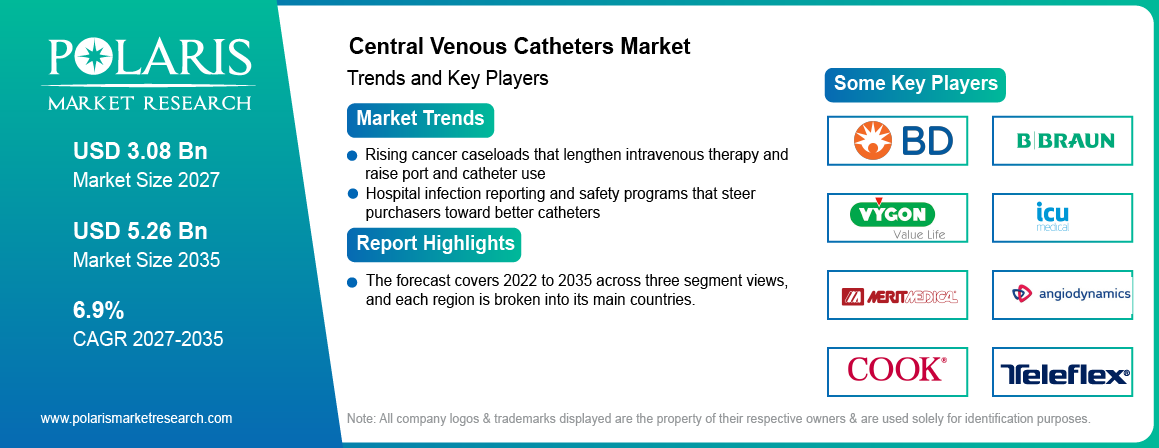
| Rising cancer caseloads that lengthen intravenous therapy and raise port and catheter use | High | Medium to Long Term |
| Hospital infection reporting and safety programs that steer purchasers toward better catheters | High | Short to Medium Term |
Source: Polaris Market Research Analysis
Driver: Rising Cancer Caseloads Are Lengthening Intravenous Therapy, Creating Market Demand
Cancer care is the largest single source of long courses of infusion. Chemotherapy, supportive drugs, blood products, and contrast media are often given over months, and many of the drugs irritate small veins. A central device spares patients repeated needle sticks and lets nurses give treatment in short, predictable visits.
For example, in January 2026, the American Cancer Society estimated 2,114,850 new cancer diagnoses and 626,140 cancer deaths in the United States for the year. It also reported a five year relative survival rate of 70% for people diagnosed between 2015 and 2021. Longer survival lengthens the period of possible infusion access, and a larger caseload widens the group that needs it.
Implantable ports respond most directly to this pattern, with a projected CAGR of 8.0% from 2027 to 2035, the quickest among products. A port can stay in place between cycles, and patients can swim or shower without a line outside the skin, a feature clinicians often cite in device discussions.
Driver: Hospital Infection Reporting Is Steering Purchasers Toward Safer Catheters, Creating Market Demand
Central line associated bloodstream infections are among the best tracked hospital complications. National reporting gives each hospital a score against a baseline, and boards and payers watch that score closely. A catheter that supports a lower infection rate, or a kit that makes correct insertion easier, wins attention in that setting.
For example, in July 2026, an updated national progress report from the US Centers for Disease Control and Prevention was released. It recorded a 9% decrease in central line associated bloodstream infections across acute care hospitals in 2024 compared with 2023, and 46 states did better than the baseline (Source: CDC). Purchasers can read that result as proof that bundles and device choice matter.
Reporting rules are widening as well. A new measure for oncology locations began its performance period on January 1, 2026. Cancer units therefore face a separate score for line infections, and that gives them a direct reason to review catheter and port choices.
Europe trails every other region at 5.6% a year from 2027 to 2035, since its installed base is mature and tenders press prices down. Polaris expects growth there to come from replacement with higher value coated and tunneled devices.
Restraint: Catheter Complications and Product Recalls Are Slowing Purchasing Decisions
Every central catheter carries a risk of infection, thrombosis, occlusion, or breakage, and a visible recall can change purchasing patterns within weeks. Hospitals want proof of low complication rates, and they respond to safety notices by moving volume to other suppliers or by adding checks to receiving and storage.
For example, in January 2026, an update from US regulators classed the 4 Fr single lumen PowerPICC catheter issue at BD as a Class I recall. BD had told providers in March 2025 that it saw more material fatigue leaks, mostly cracks across the catheter body, and it reported 10 serious injuries linked to the issue (Source: FDA). The agency noted that the investigation pointed to the resin used for the tubing.
A recall of this kind does not shrink the whole category, since patients still need access, but it moves volume between suppliers and raises the bar for material testing. Makers that can show lot level traceability and fatigue data gain an advantage in tenders that follow a safety event.
Non Tunneled Central Venous Catheters show the weakest product CAGR, at 5.8% from 2027 to 2035, as clinicians move patients toward tunneled catheters, ports, and peripherally inserted devices for stays beyond a few days.
Cost pressure compounds the safety concern. Hospital finance teams compare the price of an advanced catheter with the cost of an infection, and they ask suppliers for data that show the difference in their own units rather than in published averages.
Opportunity: Antithrombogenic and Antimicrobial Materials Are Widening the Premium Product Tier
Material science is opening a premium tier. Antithrombogenic hydrogels, antimicrobial coatings, and impregnated catheters target the two complications behind most removals, clots and infection. The antimicrobial catheters market lists central venous catheters as one of its three product types, and that shows how closely the two categories overlap.
For example, in October 2025, the FDA granted Access Vascular a new indication for its HydroMid and HydroPICC catheters. The indication recognizes the hydrogel material as having antithrombogenic properties designed to reduce the risk of clot formation on catheter surfaces (Source: Access Vascular). It covers single lumen and dual lumen versions, and it gives sales teams a labeled claim that rivals cannot copy without their own clearance.
In 2027, Peripherally Inserted Central Catheters earned USD 980.3 Billion against USD 699.8 Billion for Tunneled Central Venous Catheters. Premium materials are first launched in the peripherally inserted segment, since that segment already carries the largest base and the most frequent clot complaints.
Opportunity: Procedure Kit Partnerships and Home Infusion Are Opening New Sales Channels
Procedure kits and home care are the two channels where suppliers can grow without large new field teams. A kit bundles the catheter, drapes, dressing, and cap in one sterile tray, and hospitals value the time saved and the lower risk of a missing item. Home infusion moves long courses of nutrition and antibiotics out of the ward.
For example, in June 2026, Access Vascular and Medline announced a multi year agreement to launch co branded catheters. Medline expects to offer them from late 2026 as assembled, customizable procedure kits for health systems, including more than 1,600 Prime Vendor customers (Source: Business Wire). The deal pairs a technology developer with a distributor that already holds hospital contracts.
Home providers grow faster than hospitals, with a CAGR of 10.6% for Home Healthcare and Others against 6.2% for Hospitals from 2027 to 2035. Hospitals keep the larger base, while home providers add volume as payers accept lower cost settings for long therapy.
Overall, the growth levers differ by buyer. Hospitals respond to infection and complication data, oncology clinics respond to port comfort and reliability, and home providers respond to simple care routines, so suppliers sell one device family with three different messages.
Trend: Portfolio Restructuring Is Sharpening Vascular Access Strategies Among Large Suppliers
Large medical technology groups are restructuring portfolios to focus on units with clear growth. Vascular access has become a core business for several of them, since catheters, ports, and kits repeat in every hospital and carry steady demand. Disposals of nearby units free cash for investment in the access franchise.
For example, in August 2026, Teleflex completed the sale of its OEM business to Montagu and Kohlberg for USD 1.5 billion in cash. The company had announced in December 2025 that it would sell three business lines in deals worth about USD 2.03 billion, and it said its continuing businesses include vascular access. It plans to use proceeds to repay debt and repurchase shares (Source: Business Wire).
Portfolio moves also shift the supplier map in each region. Asia Pacific posts the fastest regional pace, at 8.9% a year through 2035. Regional makers are widening product ranges to meet that demand, while global groups concentrate on catheter families, kits, and safety data.
Value Chain Analysis
| Stage | Activities | Representative Participants |
| Raw materials | Producing polyurethane, silicone, hydrogel, and coating materials and metal components | Specialty resin and chemical manufacturers |
| Device manufacturing | Extruding catheter tubing, molding hubs and ports, coating, assembling, and sterilizing | BD, Teleflex Incorporated, B. Braun SE, and Medical Components, Inc. |
| Regulatory and quality | Clearance, labeling, plant audits, and post market surveillance | FDA, European notified bodies, and national agencies |
| Distribution and kitting | Kit assembly, hospital supply contracts, and home infusion supply | Cardinal Health, Medline, and regional distributors |
| Clinical use | Placement, dressing care, flushing, and removal in wards, clinics, and homes | Hospitals, infusion centers, and home nursing teams |
Source: Polaris Market Research Analysis
Value concentrates in manufacturing and in kitting. Whoever controls extrusion, coating, and sterilization decides quality and cost, and a distributor assembling kits earns margin from contracts that span dozens of products. Upstream, resin choice decides flexibility, kink resistance, and compatibility with drugs.
Regulation touches every stage. Selling a catheter or port in the United States needs clearance, Europe needs a conformity mark under its medical device rules, and other countries run separate registration schemes. Every new product therefore raises the cost of entering another country.
Central Venous Catheters Market Segmentation Analysis
The segmentation follows three buying decisions: the placement route and device type that fit the therapy, the number of channels the catheter needs, and the care setting where the patient is treated.
Product Insights
Peripherally Inserted Central Catheters took the largest product share in 2027, at 31.8%, owing to the preference for arm placement in patients who need weeks or months of therapy outside the intensive care unit. Nurse led teams can place these catheters at the bedside with ultrasound and tip guidance, and that shortens the wait for access.
For example, in September 2025, the FDA cleared two power injectable port families from Bard Access Systems, the Vaccess CT and the PowerPort duo with magnetic resonance conditions. The labeling covers chemotherapy, fluids, parenteral nutrition, blood products, and blood sampling, and it allows contrast media to be injected at up to 5 ml per second with a compatible safety infusion set. Hospitals can therefore use one port for both treatment and imaging.
Non Tunneled Central Venous Catheters earned USD 868.5 Billion in 2027, driven by demand in emergency departments, operating rooms, and intensive care units, where access is needed within minutes and the device may stay for only several days. Kits that bundle the catheter, guidewire, and dressing speed up placement in those settings.
Tunneled Central Venous Catheters are projected to grow at a CAGR of 6.6% from 2027 to 2035. Patients with long term nutrition, antibiotic, or chemotherapy needs move to a device that resists infection better than a short term catheter. The cuff and the skin tunnel form a physical barrier, and they let a patient manage a line at home.
Implantable Ports earned USD 535.3 Billion in 2027. Product teams position ports for patients who need access in cycles, since the device is completely covered by skin between uses and needs no dressing change at the entry site.
Hospitals often stock several product types at once. Nontunneled catheters serve emergency and short stay care, peripherally inserted catheters serve medium courses, and tunneled devices and ports serve long therapy, so broad ranges win larger contracts and simpler training.
Device choice also follows the length of therapy and the vein. A short stay in intensive care points to a neck or chest catheter, a six week antibiotic course points to an arm catheter, and a year of chemotherapy points to a port. Clinicians who understand this ladder tend to ask suppliers for a simple guide that links each product to a therapy length.
Contracts reward breadth and reliability. A hospital that buys catheters, ports, and kits from one maker receives a single price list, one training set, and one contact for safety notices, and that convenience can weigh as much as unit price in tender scoring.
Lumen Insights
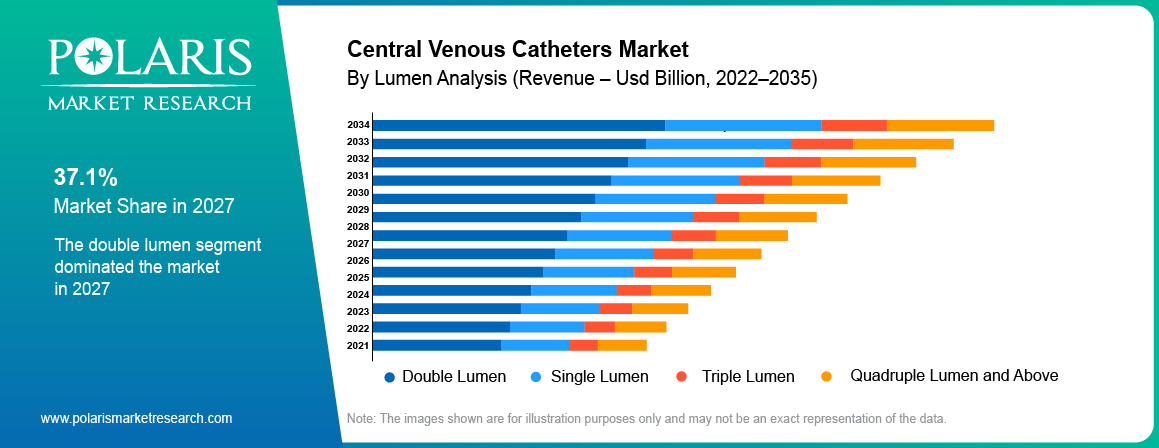
Double Lumen catheters accounted for 37.1% of lumen revenue in 2027, the largest group, owing to two channels that let a team run drugs that cannot share a line while keeping one channel free for blood sampling or pressure readings. The format balances function against catheter diameter, and most general wards and oncology units accept it as the default.
For example, in February 2026, a guideline for adult intensive care patients with central lines, published in the Journal of Intensive Medicine, set out about 52 recommendations drawn from a systematic review and expert voting. It noted that subclavian vein insertions are generally linked to lower infection risk than femoral or internal jugular insertions, and that kind of advice shapes the number of channels and the site a team picks.
Single Lumen catheters earned USD 837.0 Billion in 2027, supported by simple therapy, pediatric use, and cost sensitive settings, where one channel is enough. A smaller body can also fit a small vein or a premature infant with less trauma.
Triple Lumen catheters add 7.9% a year through 2035, as intensive care and surgical teams manage patients who need vasoactive drugs, nutrition, and antibiotics at once. Every extra channel adds a hub that must be cleaned and capped, so teams weigh convenience against infection risk.
The highest CAGR among lumen types belongs to the Quadruple Lumen and Above group, at 9.0% over the same period, as burn, trauma, and transplant units care for patients with long lists of infusions. Its revenue base is modest, so it lifts growth more than it lifts current totals.
Lumen count is one of the few features that clinicians change by patient need rather than by supplier. That habit gives suppliers an opening, since a hospital that stocks a full range from one maker can meet each request without extra approvals. Pressure injectable lumens add a further selling point for imaging.
Infection control stays the counterweight. Each additional channel creates one more connection that staff must disinfect, and many hospitals ask for the smallest number of lumens that meets the therapy plan. Suppliers answer with needleless connectors, antimicrobial caps, and flush protocols.
End Use Insights
Hospitals produced 82.0% of 2027 end use revenue, driven by placement, intensive care, surgery, and most oncology therapy, since these activities still take place inside hospital walls. A hospital buyer weighs price against the cost of a complication and the nursing time spent on each catheter.
For example, in April 2026, AngioDynamics reported fiscal third quarter MedTech revenue of USD 37.3 Billion, a 19% rise on the prior year, and described its vascular access activity as covering implanted ports and peripherally inserted central catheters. Growth at the unit may point to rising demand for access devices across care settings, though the company does not report central catheter sales alone.
Home Healthcare and Others leads end use growth, with a CAGR of 10.6% from 2027 to 2035, as nutrition support, long antibiotic courses, and some cancer drugs move to the home. Payers favor lower cost settings, and patients usually prefer to recover in familiar surroundings.
Ambulatory Surgical Centers and Clinics earned USD 313.8 Billion in 2027, supported by outpatient oncology, infusion suites, and interventional radiology, where ports and peripherally inserted catheters are placed and used on the same day. These sites value kits that cut preparation time.
Hospital contracts remain the base of the business, yet suppliers now build training, remote support, and supply programs for home infusion nurses. A patient who goes home with a line needs clear instructions and fast replacement of supplies.
Central Venous Catheters Market Regional Analysis
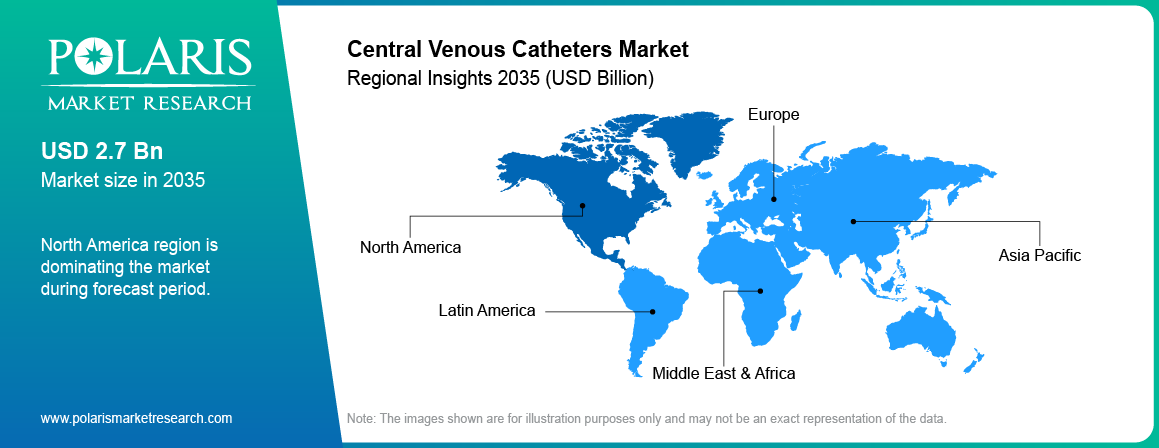
Regional demand rests on the size of the oncology and critical care population, the strength of infection reporting, and the pace of hospital bed and trained staff additions. North America has the biggest revenue base, while Asia Pacific gains fastest from a smaller starting revenue.
North America Market
North America took 35.1% of global revenue in 2027, the biggest slice of any region, driven by large hospital systems, a deep oncology base, and mature infection reporting. Its CAGR of 5.9% from 2027 to 2035 sits below the global rate, since the base is already large.
Canada expands more quickly than the United States, at 6.9% against 5.8% from 2027 to 2035, as provincial plans extend day oncology and home infusion services. The United States starts from a 2027 base of USD 951.1 Billion.
For example, in August 2026, US hospitals faced the first data submission deadline for a new central line infection measure that covers oncology locations, under the inpatient quality reporting program of the Centers for Medicare and Medicaid Services. The measure uses the 2022 baseline models of the National Healthcare Safety Network and supports payment determination for fiscal year 2028.
US demand is led by hospital systems and large infusion networks. Buyers favor products with clear safety data, strong kit offers, and dependable supply, and group purchasing organizations hold much of the negotiating power on price.
Europe Market
Europe held 26.9% of 2027 revenue and advances at 5.6% a year to 2035, owing to a saturated installed base and price focused tenders. Germany leads national revenue with USD 223.0 Billion in 2027, and the United Kingdom follows at USD 164.9 Billion.
For example, in November 2026, Poly Medicure, an Indian maker of infusion and vascular access products, reported that its consolidated sales in Europe rose 29% in the first half of its fiscal year, ended September 2026. The result shows how regional suppliers are gaining space in a market that tenders and national purchasing bodies once split among a few large groups.
European buyers compare catheters through national tenders and hospital group contracts. Public purchasers weigh price against complication data, and a product without published infection results struggles to hold a premium.
Several tenders score a catheter on cost per catheter day or per procedure kit instead of cost per piece. Tender scorers reward products with documented dwell times and clear instructions, so manufacturers invest in clinical training across the region.
Asia Pacific Market
Asia Pacific is the quickest region, rising 8.9% a year to 2035, as hospital beds, intensive care capacity, and cancer services expand, owing to government attention to health infrastructure. Among major countries, India posts the highest CAGR, at 14.2%, and China earns the most, at USD 274.9 Billion in 2027.
For example, in November 2026, Poly Medicure reported that revenue from its infusion therapy line rose 12% to INR 284 crores in the second quarter of its fiscal year, and that international revenue rose 15%. Indian makers use this base to supply domestic hospitals and to export to regulated markets.
In 2027, Japan generated USD 164.8 Billion and South Korea USD 64.5 Billion, mostly through hospitals and cancer centers, and Australia added USD 55.5 Billion, helped by established community nursing and home infusion services.
Domestic production is rising in China and India. Local makers target price sensitive hospitals first and then seek clearances in the United States and Europe, a path that widens supply and presses prices for plain nontunneled catheters.
Cancer screening and treatment capacity are growing across the region, and that adds ports and peripherally inserted catheters to hospital budgets. Training for nurses who place and maintain these devices remains the limit in many provinces.
Latin America Market
Latin America ranks second on growth, with a CAGR of 7.7% from 2027 to 2035, from a 5.6% share of 2027 revenue, owing to private hospital expansion in large cities. Brazil is the largest Latin American country, with USD 86.8 Billion in 2027, and Mexico is the fastest, at 8.3%.
Buyers divide between public systems and private hospital networks, driven by uneven coverage. Private networks in large cities buy coated catheters and kits, whereas public hospitals tend to buy plain devices through tenders where price per unit decides the award.
Local registration is the main gate for imported catheters, owing to the need for approval in each country. Weak currencies lift import costs, and distributors that hold local stock and price flexibly beat importers that ship on request.
Middle East & Africa Market
Middle East & Africa took 6.2% of 2027 revenue, with a CAGR of 7.6% from 2027 to 2035. Saudi Arabia is both the largest and the fastest growing country here, at 8.9%, driven by hospital building and wider cancer and critical care services.
In 2027, the United Arab Emirates generated USD 42.6 Billion and South Africa USD 41.7 Billion. Most supplies arrive by import, so distributors with registrations and dependable logistics hold the edge.
African hospitals import most catheters and ports, and donor funded or national tenders are common purchasing routes. Price per catheter, shelf life, and simple storage count for more there than premium features.
Central Venous Catheters Market Competitive Landscape
The field splits into three groups. Global vascular access leaders sell broad catheter, port, and kit ranges through hospital contracts. Regional and Asian volume makers sell plain catheters at lower prices. Technology developers introduce coated or hydrogel products and partner with distributors for reach.
BD, through Bard Access Systems, sells peripherally inserted catheters and implantable ports. The FDA updated its notice on the 4 Fr single lumen PowerPICC recall in January 2026, and the company reported fourth quarter fiscal 2026 revenue of USD 5,274 Billion, up 5.4%, on November 5, 2026.
Teleflex Incorporated sells Arrow catheters and kits, and it kept its vascular access business when it sold its OEM unit for USD 1.5 billion in August 2026. ICU Medical posted third quarter revenue of USD 560.4 Billion on November 5, 2026, and its Consumables unit rose 5% to USD 298.4 Billion.
Merit Medical reported second quarter 2026 revenue of USD 418.8 Billion, up 10%, with its Access category at USD 161.8 Billion, up 6%. AngioDynamics grows a MedTech unit that includes ports and peripherally inserted catheters, and Poly Medicure grows its infusion therapy line in India and export markets.
Smaller and newer names add technology. Access Vascular sells hydrogel catheters with a labeled antithrombogenic indication and has a distribution agreement with Medline for kits from late 2026. B. Braun SE, Cook Medical, Vygon SAS, and Medical Components, Inc. also supply central venous catheters and serve hospitals through regional channels.
Company market share is hard to measure, as few firms report central venous catheter sales alone. Clearances, tender wins, recalls, and product listings work as proxies, and they favor suppliers with several product families, wide registrations, and reliable supply.
Distribution is the other lever: big distributors assemble procedure kits and sell them through hospital contracts, and a device placed inside a kit reaches customers without a large field team. Kit partnerships are therefore a main route for smaller developers.
Vendor Landscape Snapshot
| Company | Vendor Positioning | Role |
| BD | Leader | Maker of peripherally inserted catheters and ports through Bard Access Systems, with a Class I update on PowerPICC catheters in January 2026 |
| Teleflex Incorporated | Leader | Maker of Arrow catheters and kits, with vascular access kept after the OEM sale of August 2026 |
| ICU Medical, Inc. | Leader | Infusion and consumables group with central venous catheter products |
| B. Braun SE | Challenger | European medical technology group with central venous catheter products |
| Cook Medical | Challenger | Private medical device maker with central venous catheter products |
| Vygon SAS | Challenger | French maker of vascular access devices |
| Merit Medical Systems, Inc. | Challenger | Device maker with an Access category of USD 161.8 Billion in the second quarter of 2026 |
| AngioDynamics, Inc. | Niche Player | Maker of ports and peripherally inserted catheters inside a MedTech unit that grew 19% in its fiscal third quarter |
| Medical Components, Inc. | Niche Player | Maker of tunneled catheters and ports sold under the Medcomp name |
| Poly Medicure Limited | Niche Player | Indian maker whose infusion therapy revenue rose 12% in the second quarter of fiscal 2027 |
| Access Vascular, Inc. | Emerging Player | Developer of HydroMid and HydroPICC catheters with an antithrombogenic indication from the FDA in October 2025 |
Source: Polaris Market Research Analysis
Central Venous Catheters Market Technology and Innovation Landscape
Innovation centers on three goals: fewer infections, fewer clots, and easier placement. Manufacturers pursue them through coatings, new base materials, better tip guidance, and kits that standardize insertion, and each route changes the cost, the comfort, and the dwell time of the device.
Polyurethane remains a common catheter material, and coated or treated devices usually sell at a premium to plain ones. That price gap is the premium opportunity, and it also explains why suppliers work to publish data on coated products.
Antithrombogenic hydrogels are the newest material story. Access Vascular describes its hydrogel technology as designed to combat thrombosis and infection, and the FDA indication granted in October 2025 allows a clot risk claim for HydroMid and HydroPICC catheters. Preclinical evidence does not always predict clinical results, so hospitals ask for registry data before they change formularies.
Placement technology matters as much as materials. Ultrasound guidance, intracavitary electrocardiogram tip confirmation, and magnetic tip tracking can reduce the need for a chest film, and trials in cancer patients continue to test combined methods. Faster confirmation lets nurses place catheters at the bedside and start therapy sooner.
Power injectable devices add imaging value. A catheter or port that withstands high pressure lets a hospital run contrast injections through the same line used for treatment. An October 2024 FDA letter for Bard Access Systems ClearVUE ports and a September 2025 letter for Vaccess ports both describe injection at up to 5 ml per second.
Manufacturing control counts as much as chemistry. Consistent extrusion, tipping, and bonding decide whether each catheter meets its strength rating, and the PowerPICC recall shows how a resin issue can surface as leaks long after launch. Suppliers now publish more fatigue and lot data for hospital buyers.
Sterilization adds a further constraint. Coatings can change under ethylene oxide or radiation, so a maker must show that the coating survives the cycle and the shelf life. Kit assembly adds its own testing steps, and new products often spend a year or more moving from the bench to the ward.
Technology and Innovation Landscape Snapshot
| Area | Role | Status and Representative Developers |
| Polyurethane and silicone tubing | Base material for most catheters | Production, with BD, Teleflex Incorporated, and B. Braun SE |
| Antithrombogenic hydrogel | Surface material that lowers clot formation risk | Cleared indication in 2025, with Access Vascular |
| Antimicrobial coatings | Impregnated or coated surfaces that limit bacterial growth | Production, with several global suppliers |
| Power injectable ports | Ports and catheters rated for contrast injection | Cleared in 2024 and 2025, with Bard Access Systems |
| Tip location and guidance | Ultrasound and electrocardiogram tools for placement | Production and clinical trials across several suppliers |
| Procedure kits | Bundled sterile trays that standardize insertion | Expanding, with Medline and Access Vascular |
Source: Polaris Market Research Analysis
Use Case Analysis
Critical Care and Hemodynamic Support
Intensive care units use central catheters to give vasoactive drugs, sedatives, and fluids that must reach the heart quickly and in a stable dose. Multi lumen devices allow several infusions at once, and neck or chest placement lets teams maintain access during long stays. Hospitals also track daily line necessity to cut avoidable days.
Oncology and Chemotherapy
Cancer teams use ports, tunneled catheters, and peripherally inserted catheters for cycles of chemotherapy, supportive drugs, and blood draws. Ports suit patients who need access at intervals, whereas peripherally inserted catheters suit shorter courses. Comfort, infection risk, and the patient lifestyle drive the choice with the oncology nurse.
Parenteral Nutrition and Long Term Antibiotics
Patients who cannot absorb food through the gut depend on concentrated nutrition that damages small veins, so a central device is the standard route. Tunneled catheters suit months or years of use, whereas peripherally inserted catheters suit shorter periods. Home infusion nurses train patients and carers to flush lines and change dressings.
Surgery and Emergency Care
Major surgery and trauma teams place central lines to monitor pressure, give blood products, and deliver drugs during rapid change. Speed and certainty matter most in these cases, so nontunneled kits with ultrasound guidance are common. After the procedure, teams remove the line as soon as it is no longer needed.
Neonatal and Pediatric Care
Premature infants and young children need very small catheters that give access for nutrition and drugs over weeks. Single lumen devices and small bore peripherally inserted catheters dominate, and placement requires specialist skill. Pediatric units rank low trauma and low infection risk above all other features.
Buyer Needs and Decision Criteria
| Buyer Need | Decision Criteria | Why It Matters |
| Safety and complication data | Infection, clot, and breakage rates and recall history | Committees want proof beyond marketing claims before they switch suppliers |
| Regulatory standing | US 510(k) clearance, European CE marking, or national registration | Tenders exclude products that lack registration |
| Ease of placement | Kit contents, tip guidance, and training | Faster, correct placement saves time and lowers complication risk |
| Price per procedure | Contract price and full cost per catheter day | Buyers compare suppliers on kit price and the cost of complications |
| Supply reliability | Plant locations, safety stock, and lead times | A shortage during care forces hospitals to change supplier |
Source: Polaris Market Research Analysis
Clearance, sterile production, clinical trust, and tender experience form the entry barriers. Supplier comparisons are difficult, since complication rates depend on hospital practice, and purchasers ask about the patient mix and conditions behind each result.
Hospital buyers screen a new catheter on four points: its safety record, its local registration, its fit with current kits and training, and its cost per catheter day. A supplier that answers each of these on a single sheet can shorten the sales cycle.
Supply reliability matters to hospital buyers. A ward that runs short of catheters or kits must delay procedures, so purchasing teams ask suppliers about stock levels, backup manufacturing sites, and delivery times. Suppliers with several plants and clear recall procedures are easier to approve, and they gain trust during periods of tight supply.
Premium Insights and Forward Outlook
Complication Data Will Separate Leaders From Followers
Tenders will favor suppliers that publish clean infection, clot, and breakage data. Today's record mixes company claims, single center studies, and guideline statements, and a maker that adds a registry or controlled trial gains an edge. Recall history will also weigh on buying decisions for several years.
Coated and Hydrogel Catheters Will Lift the Premium Tier
Coatings justify a higher price than plain polyurethane only when evidence backs the claim and payers fund the premium. Suppliers must also scale output without losing quality. Whoever arrives first with proof will hold the clinician's trust before rivals cut prices.
Kits and Distribution Partnerships Will Shape Access
Distributors that assemble procedure kits hold the contract and the customer. Developers with a clever device but little reach will turn to partnerships, as the Medline and Access Vascular agreement shows, and large suppliers will respond by bundling more components into their own kits.
Outpatient and Home Care Will Redirect Demand
Long courses of therapy are moving to infusion suites and homes. That shift favors tunneled catheters, ports, and peripherally inserted devices with simple care steps, and it rewards suppliers that provide patient education and supply support alongside the device.
Consolidation is possible. Large groups that rework their portfolios may buy specialist makers with cleared coatings or tip guidance, since a cleared product arrives sooner than one built in house, and distributors could launch private label kits to protect margin.
Key Players in the Central Venous Catheters Market
- BD
- Teleflex Incorporated
- ICU Medical, Inc.
- B. Braun SE
- Cook Medical
- Vygon SAS
- Merit Medical Systems, Inc.
- AngioDynamics, Inc.
- Medical Components, Inc.
- Poly Medicure Limited
- Access Vascular, Inc.
Industry Developments
- November 2026: ICU Medical posted USD 560.4 Billion of quarterly sales for its third quarter, and its Consumables unit grew 5% to USD 298.4 Billion (ICU Medical results release).
- August 2026: Teleflex closed its OEM business sale to Montagu and Kohlberg at USD 1.5 billion in cash, and vascular access remains in its continuing portfolio.
- June 2026: Medline and Access Vascular agreed a multi year deal on co branded HydroMid and HydroPICC catheters, with procedure kits due from late 2026.
- January 2026: The FDA updated its notice on BD 4 Fr single lumen PowerPICC catheters, classifying the matter as a Class I recall.
- December 2025: Teleflex disclosed plans to sell its OEM, acute care, and interventional urology units for about USD 2.03 billion, keeping vascular access.
- October 2025: The FDA cleared an antithrombogenic indication for Access Vascular HydroMid and HydroPICC catheters.
- September 2025: The FDA cleared Bard Access Systems Vaccess CT and PowerPort duo implantable ports for power injection of contrast media.
Central Venous Catheters Market Report Segmentation
By Product Outlook (Revenue, USD Billion, 2022 to 2035)
- Non Tunneled Central Venous Catheters
- Peripherally Inserted Central Catheters
- Tunneled Central Venous Catheters
- Implantable Ports
By Lumen Outlook (Revenue, USD Billion, 2022 to 2035)
- Single Lumen
- Double Lumen
- Triple Lumen
- Quadruple Lumen and Above
By End Use Outlook (Revenue, USD Billion, 2022 to 2035)
- Hospitals
- Ambulatory Surgical Centers and Clinics
- Home Healthcare and Others
By Regional Outlook (Revenue, USD Billion, 2022 to 2035)
- North America
- United States
- Canada
- Europe
- United Kingdom
- Germany
- France
- Italy
- Spain
- Rest of Europe
- Asia Pacific
- China
- Japan
- India
- South Korea
- Australia
- Rest of Asia Pacific
- Latin America
- Brazil
- Mexico
- Argentina
- Rest of Latin America
- Middle East & Africa
- Saudi Arabia
- United Arab Emirates
- South Africa
- Rest of Middle East & Africa
Central Venous Catheters Market Report Scope
| Report Attribute | Details |
| Market Size in 2026 | USD 2.88 Billion |
| Market Size in 2027 | USD 3.08 Billion |
| Revenue Forecast by 2035 | USD 5.26 Billion |
| CAGR | 6.9% (2027 to 2035) |
| Base Year | 2026 |
| Historical Data | 2022 to 2025 |
| Forecast Period | 2027 to 2035 |
| Quantitative Units | Revenue in USD Billion and USD Billion, and CAGR in percent |
| Report Coverage | Revenue Forecast, Growth Factors, Competitive Landscape, Industry Trends, and Strategic Analysis of the central venous catheters market |
| Segments Covered | By Product, By Lumen, By End Use, and By Region |
| Regional Scope | North America, Europe, Asia Pacific, Latin America, Middle East & Africa |
| Competitive Landscape | Company Profiling, Product Benchmarking, Financial Analysis, Market Developments, and Strategic Initiatives |
| Report Format | PDF and Excel |
| Customization | Available by Country, Region, and Segment |
| Research Team | Polaris Market Research & Consulting, Inc. research team |
| Last Updated | 20 November 2026 |
Source: Polaris Market Research Analysis
Why Choose Polaris Market Research
Each figure comes from one bottom up model of twenty two country lines. Twenty two country lines roll up into five regions, so a reader can trace any regional number to its product, lumen, and care setting inputs.
The study separates revenue by device type and by channel count. That split traces spending across nontunneled catheters, peripherally inserted catheters, tunneled devices, and ports, and across hospitals, clinics, and homes.
Facts from outside sources name their publisher and, where known, their date. That habit lets a reader tell a company statement from a regulator notice or a trade press report, and it makes later audits of the evidence simple.
Polaris can tailor the analysis to a single market, one device family, or a chosen set of suppliers. To buy this report or request customization, contact Polaris Market Research & Consulting, Inc.
Research Methodology
Research Approach
The study counts revenue from finished central venous catheters, implantable ports, and the insertion kits sold with them. Hemodialysis catheters, midline catheters, peripheral cannulas, and standalone guidewires are left out. The base year is 2026, history covers 2022 to 2025, the forecast covers 2027 to 2035, and figures appear in USD Billion with headline sizes in USD Billion. The model rests on three segment cuts and on 22 country lines that group into five regions.
Secondary Research
Desk work gathered 16 dated facts. Agencies, regulators, and associations supplied 6, company releases supplied 6, and trade or press pages supplied 4. Source names and dates appear where the page gives them, and older items are labeled.
Primary Research
Polaris follows its standard process of primary interviews. These interviews cover manufacturers, distributors and channel partners, and industry experts and consultants. They are used to validate secondary estimates, segment shares, regional trends, and growth drivers.
Data Structuring
Values were converted to USD for each calendar year, and the definition of every segment was set before sizing started. A product that fits two types sits under its main use only, and hemodialysis catheters, midline catheters, and peripheral cannulas stay outside the totals.
Market Size Estimation
Bottom up: each country was sized for every dimension, then country values were summed into regional totals and the global figure.
The top down view starts from the 2026 base of USD 2.88 Billion, fixed from the market boundary and set beside outside estimates that anyone can read. The Polaris base falls inside their range, though each estimate draws its category lines differently, so the comparison carries uncertainty.
Forecasting
The forecast follows a growth path that eases a little each year and delivers the stated CAGR. Its direction reflects cancer and critical care caseloads, infection reporting rules, recall risk, new materials, kit partnerships, home infusion, and regional capacity. Regional and segment mixes drift gradually between 2026 and 2035.
Data Triangulation and Validation
The finished model passed three tests: each segment set sums to 100% annually, countries roll into regions and then into the global figure, and the years around 2026 follow one smooth growth path. The 2026 starting value and the 2035 endpoint were checked against outside estimates, as described under Market Size Estimation.
Limitations
Market figures in this report are Polaris estimates. Few companies report central venous catheter sales alone, and the segment and regional splits therefore come from modeled shares rather than reported data. Publishers draw category lines differently, and that explains part of the spread across published sizes.
Research Methodology Phases
| Phase | Focus | Evidence / Output |
| Scope and Setup | Market boundary, segments, and regions | Fixed scope and segment list |
| Secondary Data Collection | Agency records, company releases, and trade and press articles | 16 sourced facts with dates |
| Primary Research | Interviews with manufacturers, channel partners, and industry experts | Validated segment shares, regional trends, and growth drivers |
| Data Structuring | Yearly USD conversion with segment definitions fixed up front | Inputs counted once |
| Bottom Up Estimate | Country and segment estimates | Regional and global totals |
| Top Down Estimate | Global base for 2026 and its segment mix | Base compared with outside estimates |
| Forecasting | Annual growth path to 2035 | Stated CAGR |
| Triangulation and Validation | Checks on shares, totals, and the growth curve | Checks that passed |
| Output | Report tables and text | A single dataset behind every table |
Source: Polaris Market Research Analysis
Data Sources by Type
| Type of Source | Named Examples | Used For |
| Agencies and associations (6) | CDC; FDA; American Cancer Society | Infection data, product clearances and recalls, and cancer caseloads |
| Company releases (6) | BD; Teleflex; ICU Medical; Merit Medical; Access Vascular | Quarterly results, product ranges, and portfolio moves |
| Trade and press pages (4) | MedTech Dive; EurekAlert; Investywise | Clinical guidance and regional results |
Source: Polaris Market Research Analysis
Central Venous Catheters Market FAQ's
The market covers sterile catheters that end in a large central vein, plus implantable ports. Hospitals, clinics, and home infusion providers use them for drugs, nutrition, and fluids.
The central venous catheters market size was valued at USD 2.88 Billion in 2026, according to Polaris Market Research analysis. Revenue is projected to climb to USD 5.26 Billion by 2035.
According to Polaris Market Research analysis, the central venous catheters market should reach USD 5.26 Billion by 2035, with a CAGR of 6.9% from 2027 to 2035.
North America is the leading market, with 35.1% of revenue in 2027. Large hospital systems, oncology volumes, and infection reporting support the lead.
Asia Pacific is the fastest growing region, at 8.9% annually through 2035, with India setting the pace among the larger countries in the region.
Arm placed catheters lead, as Peripherally Inserted Central Catheters hold 31.8% of 2027 revenue, and Non Tunneled Central Venous Catheters follow at 28.2%. Implantable Ports grow quickest, at 8.0% a year.
The key players include BD, Teleflex Incorporated, ICU Medical, Inc., B. Braun SE, Cook Medical, and Vygon SAS. Merit Medical, AngioDynamics, Medcomp, Poly Medicure, and Access Vascular complete the list.
Suppliers are launching antithrombogenic and antimicrobial materials, bundling catheters into procedure kits, and restructuring portfolios around vascular access. Cancer units and home infusion providers are also asking for simpler devices.
Infection, clots, and breakage remain risks, and a Class I recall of PowerPICC catheters was updated in January 2026. Purchasers also press suppliers hard on price through group contracts.
A PICC enters through an arm vein and leaves a line outside the skin, whereas a port sits fully beneath the skin and is accessed with a needle. Ports suit cyclic therapy.
Double Lumen catheters earn the most, at USD 1,145.2 Million in 2027, since two channels let drugs run without mixing. The Quadruple Lumen and Above group grows quickest, at 9.0% a year.
The home channel grows quickest, at 10.6% a year to 2035, as long infusion courses leave the ward. Hospitals stay the biggest end use, at 82.0% of 2027 revenue.
A recall changes purchasing quickly, since hospitals move volume to other suppliers and ask for fatigue and lot data. Makers with clean safety records and clear traceability gain an advantage in tenders.
The United States generates the highest revenue, with USD 951.1 Million in 2027, ahead of China and Germany, owing to its large hospital systems and deep oncology base.
Rising cancer caseloads, intensive care use, and infection reporting rules lift demand. The American Cancer Society projects 2,114,850 new US cancer diagnoses for 2026, and infection measures now cover oncology units.

Download Sample Report of Central Venous Catheters Market
Please fill out the form to request a customized copy of the research report.


