
Cybersecurity Insurance Market Size, Share, and Forecast 2026 to 2034
REPORT DETAILS
Cybersecurity Insurance Market Summary
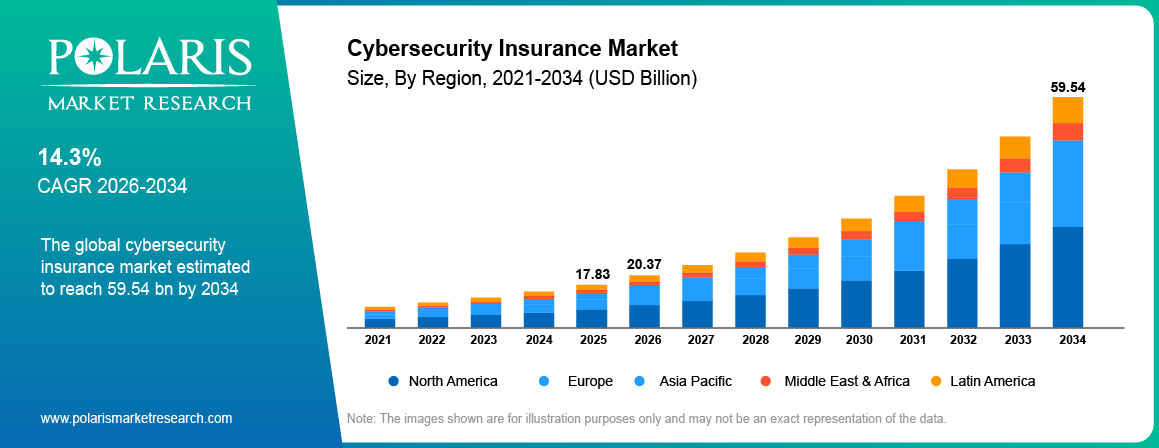
According to Polaris Market Research analysis, the cybersecurity insurance market size was valued at USD 17.83 Billion in 2025. It is projected to reach USD 59.54 Billion by 2034, growing at a CAGR of 14.3% from 2026 to 2034. Demand is driven by rising ransomware losses, new reporting laws, and wider cover for small firms. Policy premiums are the largest component, and risk assessment solutions are the fastest growing one. The market includes premiums and the assessment, response, and advisory work sold alongside them. North America is the leading market. Asia Pacific is the fastest growing region.
Market Statistics
Key Takeaways
- North America accounted for 42.2% of market revenue in 2026, and the United States writes most of the world's cyber policies.
- Asia Pacific is the fastest growing region, at a CAGR of 18.6% from 2026 to 2034, as India and Southeast Asia add buyers fastest.
- Risk Assessment Solutions is the fastest growing component, at a CAGR of 19.5% from 2026 to 2034. Insurers now use scan data to price cover.
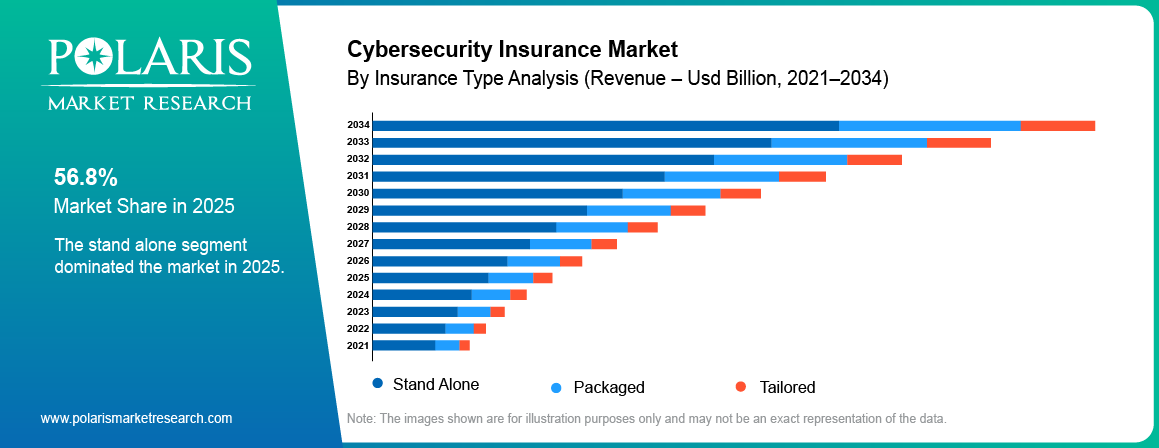
- Stand Alone policies held 56.8% of insurance type revenue in 2026. Packaged cover, which is added to property and liability policies, ranks second.
- Cyber Extortion and Ransomware is the fastest growing coverage type, at a CAGR of 17.7% from 2026 to 2034. Buyers want cover for ransom payments and downtime.
- Large Enterprises accounted for 59.8% of organization size revenue in 2026. Small Enterprises are the fastest growing group, at a CAGR of 19.9% from 2026 to 2034.
- Banking, Financial Services, and Insurance (BFSI) is the largest end user. Banks and insurers face strict rules on breach reporting.
- Digital and Embedded Platforms is projected to grow at a CAGR of 26.5% from 2026 to 2034. Buyers can now add cover inside software and payment tools.
Note: Figures and projections outlined in this report are the result of Polaris Market Research’s proprietary analytical processes, grounded in the latest available datasets and market observations.
Cybersecurity Insurance Market Definition
The cybersecurity insurance market covers insurance policies that pay for losses from cyber attacks and data breaches. It also includes the risk assessment, incident response, and advisory services sold with those policies. Buyers range from banks and hospitals to small shops that depend on online payments.
The scope counts premiums written by insurers, along with the services they bundle or sell next to the policy. It leaves out general security software, hardware, and managed security services bought without insurance. Each dollar is counted once. For the wider security software view, read the cybersecurity market report.
Cyber policies split into first party and third party cover. First party cover pays the buyer's own costs, such as forensic work, lost income, and data recovery. Third party cover pays claims from customers, partners, and regulators. Munich Re reported on 25 March 2026 that 62% of the claims it actively manages are first party claims. Many buyers call the product cyber insurance, so the cyber insurance market and this market are the same thing.
Premium figures from insurance regulators measure only the policy line. The scope here is wider. Swiss Re, the reinsurer, projects global cyber premiums of USD 16.4 billion in 2026 and USD 17.1 billion in 2027. It also says premium growth has held near 5% a year since 2022. Polaris adds the services sold with policies, and that explains the gap.
Cyber cover is sold on an annual contract. The buyer fills in a form or allows a scan of its systems. The insurer then sets a price from the risk score, the limit, the retention, and the claims record of similar firms. At renewal the insurer repeats the process, so price and terms can change every year.
Cybersecurity Insurance vs Standalone Security Software: Key Differences
| Attribute | Cybersecurity Insurance | Security Software |
| What the buyer gets | Money for losses, legal costs, and recovery help | Tools that block and detect attacks |
| Who sells it | Insurers, reinsurers, brokers, and cyber specialists | Software and managed service vendors |
| How it is priced | Premiums based on risk, limits, and claims history | Licences or subscriptions based on users or devices |
| What it removes | Financial loss after an incident | The chance of an incident |
| Regulation | Insurance regulators set rules on filings and capital | Data and product rules apply, with no capital rules |
| Link to the other | Insurers ask for security controls before they quote | Strong tools can lower the premium |
Source: Polaris Market Research Analysis
Porter's Five Forces Analysis
| Force | Intensity | Rationale |
| Bargaining power of suppliers | Moderate | Reinsurers and security data providers set capacity and risk scores |
| Bargaining power of buyers | Moderate to High | Large firms use brokers to compare terms, and falling rates favor them |
| Threat of new entrants | Moderate | Capital is easy to raise for specialists, but claims data and broker access take years to build |
| Threat of substitutes | Low to Moderate | Self insurance and captives replace cover for the largest firms only |
| Competitive rivalry | High | Many insurers write cyber and price cuts have followed |
Source: Polaris Market Research Analysis
Market Dynamics
Driver Impact Analysis
| Driver | Impact on Market Growth | Time Horizon |
| Cyber incidents ranked as the top business risk | High | Short to Long Term |
| Breach reporting and resilience laws | High | Short to Medium Term |
| Falling rates and risk of one event hitting many insureds | Negative, Medium | Short to Medium Term |
| Cover for small and medium firms | High | Medium to Long Term |
| Embedded and partner distribution | Medium to High | Medium to Long Term |
| Risk transfer to capital markets | Medium | Medium to Long Term |
Source: Polaris Market Research Analysis
Cyber Incidents Are Now the Top Business Risk, Boosting Demand for Cover
Allianz said in its Risk Barometer of 3 February 2026 that cyber incidents are the top global business risk for the fifth year in a row. They scored 42% of responses, the highest ever, from 3,338 experts in almost 100 countries. AI rose to second place, from tenth.
IBM said in its 2026 Cost of a Data Breach report, released on 29 July 2026, that the average breach cost USD 4.99 million. One in four malicious breaches now involves AI. Boards read these figures and ask for cover.
Demand is driven by large firms first. Large Enterprises made up 59.8% of cybersecurity insurance market revenue in 2026. Each loss headline adds to renewals in BFSI, healthcare, and IT and Telecom. Boards now ask how much cover they hold and how fast the insurer will respond. Brokers use the Allianz ranking to open that talk with finance chiefs.
New Breach Reporting Laws Are Raising the Need for Insurance Support
The European Commission says manufacturers of digital products must report actively exploited vulnerabilities and severe incidents under the Cyber Resilience Act from 11 September 2026. An early warning is due within 24 hours and a full notification within 72 hours (Source: European Commission).
The United Kingdom introduced its Cyber Security and Resilience Bill on 12 November 2025. It has passed second reading and committee stage in the House of Commons. Australia already requires ransomware payment reports, covered in the Asia Pacific section.
Fast reporting means firms need a response team on call. Insurers sell that help with the policy, so response and advisory services grow alongside premiums. Europe and Asia Pacific show the most legal change, so demand for response services is likely to rise in both.
Falling Rates and Systemic Event Risk Are Limiting Premium Growth
Marsh said on 21 October 2026 that global cyber rates fell 4% in the third quarter. Rates were flat in the United States after a long period of declines. Lower rates reduce premium income even when more firms buy cover.
Beazley plc reported in August 2026 that its cyber rates fell 4.3% in the first half. Cyber premiums at Beazley were USD 524.9 million in the half, compared with USD 620.3 million a year earlier. The National Association of Insurance Commissioners (NAIC) reported that the US loss ratio rose to 53 from 48.7 while prices fell.
The larger worry is one event that hits many insureds at once. Insurers cap policy limits and add exclusions to manage that risk. The restraint affects the timing of growth, not the demand for cover. Beazley chose to hold prices, so buyers should read exclusions closely.
Small and Medium Firms Offer the Largest Gap Between Risk and Cover
Munich Re said on 25 March 2026 that most cyber incidents hit micro firms and small and medium firms. It also said the great majority of cyber risk is not insured. Nearly nine in ten senior executives surveyed do not feel adequately protected.
The NAIC says only about 1% of global economic cyber losses are insured. Swiss Re puts insurance penetration at 5% to 10% for micro firms and 10% to 20% for small and medium firms.
The CAGR for Small Enterprises is 19.9% from 2026 to 2034, the highest of any size group. Packaged cover and low-cost digital sales are the main routes to this group. Background risk scans mean a small firm does not need a security team to qualify.
Partner and Embedded Distribution Is Reaching Buyers That Brokers Miss
Allianz Commercial said on 6 May 2026 that it will move its commercial cyber business to Coalition, Inc. under a partnership of at least 10 years. The rollout starts in the United States, United Kingdom, Australia, Germany, Denmark, and Sweden, and it needs regulatory approvals.
Hiscox Ltd said in its half-year report of 5 August 2026 that it had rolled out its cyber product across all European markets. It also said conditions are hard for technology and cyber business sold through United States brokers.
Digital and Embedded Platforms has the highest CAGR of any channel, at 26.5% from 2026 to 2034. Software firms, payment providers, and cloud vendors can offer cover at the point of sale. These partners add a revenue line, and insurers gain data on how the customer runs its systems.
Insurers Are Moving Systemic Cyber Risk to Capital Markets
Beazley plc said in its half-year 2026 results that its cyber portfolio benefits from catastrophe bond cover against systemic cyber events. It is also building a cyber insurance linked securities business in Bermuda.
Capital markets investors take part of the risk of a large outage or attack. In return they earn a fee. This adds capacity without more reinsurance and helps insurers keep writing large limits.
The shift links this market with the broader insurance technology sector. See the insurtech market report for the wider view of digital insurers and data-driven underwriting.
Value Chain Analysis
| Stage | Activities | Representative Participants |
| Risk data and scoring | Security ratings, scans, and threat data used to price risk | BitSight Technologies and SecurityScorecard |
| Capacity and reinsurance | Capital that backs the policies, including reinsurance and catastrophe bonds | Munich Re, Zurich Insurance Group, and AXIS Capital Holdings |
| Underwriting and product | Policy design, pricing, and claims handling | Chubb Limited, AXA XL, Beazley plc, and Coalition, Inc. |
| Distribution | Brokers, agents, direct sales, and embedded offers | Aon plc and partner platforms |
| Response and recovery | Forensics, legal help, ransom negotiation, and restoration | Panel vendors and in house insurer teams |
Source: Polaris Market Research Analysis
Value sits with two groups. Underwriters hold the claims data that sets prices. Capacity providers decide how large a limit the market can offer. Data firms and brokers earn fees along the way, and both gain from the trend to measured risk.
Margins differ by stage. Insurers earn from the gap between premiums and claims, so loss ratios matter most to them. Brokers earn commissions and fees, which are less tied to claims. Rating firms sell subscriptions. Response vendors are paid per incident, and their work grows with every new attack.
Cybersecurity Insurance Market Segmentation Analysis
Polaris segments the cybersecurity insurance market by component, insurance type, coverage type, organization size, end user, and distribution channel. Each block below shows market share, revenue, or growth for the segments that matter most to buyers and sellers, with one measure per segment.
Component Insights
The Policy Premiums segment accounted for 66.1% of component revenue in 2026. Buyers pay for the policy first and add services later. Insurers write more cover each year, so premiums remain the base of the market.
The Risk Assessment Solutions segment was worth USD 3,276 Million in 2026. Insurers use scans, ratings, and questionnaires to decide who gets cover and at what price. Buyers also use the same reports to fix weak controls.
The Incident Response Services segment is projected to grow at a CAGR of 19.1% from 2026 to 2034. Policies now include forensic teams, lawyers, and negotiators on call, so the service and the policy are sold together. The Advisory and Training Services segment held 8.8% of component revenue in 2026, as insurers offer staff training and security reviews to lower claims.
Services and assessment tools together accounted for 33.9% of component revenue in 2026. They are growing faster than premiums, so the mix shifts toward services over the forecast period.
Insurance Type Insights
The Stand Alone segment held the largest market share in 2026. Large buyers prefer a separate cyber policy with its own limits, and brokers can compare terms between insurers more easily.
The Packaged segment accounted for 30.8% of insurance type revenue in 2026. It adds cyber protection to a property, liability, or business owner policy. Smaller firms prefer it because one purchase covers many risks.
The Tailored segment is the fastest growing insurance type, with a CAGR of 19.9% from 2026 to 2034. Buyers with unusual risks, such as industrial control systems or critical suppliers, ask for custom wording and limits.
Stand Alone and Packaged policies together accounted for 87.6% of insurance type revenue in 2026. Tailored policies are smaller today, but they give hard-to-place risks the wording they need.
Coverage Type Insights
The Data Breach Response segment held the largest share of coverage type revenue, at 29.5% in 2026. This cover pays for customer notices, credit monitoring, legal advice, and forensic work. Data protection laws make these costs hard to avoid.
The Network Security and Privacy Liability segment is projected to grow at a CAGR of 14.5% from 2026 to 2034. It pays when a third party sues over stolen or leaked data. The Technology Errors and Omissions segment serves software and service firms and pays when a product failure harms a client.
Data Breach Response and Business Interruption together accounted for 52.2% of coverage type revenue in 2026. Ransomware cover is closing the gap, so buyers now compare extortion limits as closely as breach limits.
Organization Size Insights
The Large Enterprises segment held largest market share in 2026. These firms buy high limits, often in layers from several insurers. Their share is expected to fall over the forecast period as smaller firms start to buy cover.
The Medium Enterprises segment is projected to grow at a CAGR of 17.1% from 2026 to 2034. Mid-sized firms hold valuable data but often lack a full security team. Insurers and brokers now offer simpler policy forms to reach them.
The Small Enterprises segment accounted for 16.3% of organization size revenue in 2026. Few small firms hold a policy today, which leaves wide room for growth.
Medium and Small Enterprises together accounted for 40.2% of organization size revenue in 2026. Both groups are growing faster than Large Enterprises, which is changing how insurers design and sell their products.
End User Insights
The BFSI segment accounted for 25.3% of end user revenue in 2026. Banks, insurers, and payment firms hold sensitive data and face strict supervisors. They are also the most frequent buyers of large limits.
The Healthcare segment is projected to grow at a CAGR of 15.7% from 2026 to 2034. Hospitals hold patient records and cannot afford long outages. The Government and Public Sector segment is the fastest growing end user, with a CAGR of 16.6% from 2026 to 2034, as cities and agencies buy cover after attacks on local services.
The IT and Telecom segment held 17.4% of end user revenue in 2026. Providers of software, cloud, and network services buy cover for their own risk and for claims from clients. The Others segment covers education, energy, transport, and professional services.
BFSI, IT and Telecom, and Healthcare together accounted for 59.9% of end user revenue in 2026. These three groups hold the most sensitive data, and insurers study them most closely.
Distribution Channel Insights
The Brokers and Agents segment accounted for 60.2% of distribution channel revenue in 2026. Brokers help buyers compare terms, set limits, and handle claims. Most mid-sized and large policies are placed this way.
The Direct Insurers segment is projected to grow at a CAGR of 15.1% from 2026 to 2034. Insurers sell straight to buyers through their own sales teams and websites. Specialists such as Coalition, Inc. use scan data to quote fast.
The Digital and Embedded Platforms segment held 10.4% of distribution channel revenue in 2026. The channel sells cover inside software, payment tools, and cloud services.
Direct Insurers and Digital and Embedded Platforms together accounted for 39.8% of distribution channel revenue in 2026. Brokers remain the main route to market, but their lead narrows over the forecast period.
Cybersecurity Insurance Market Regional Analysis
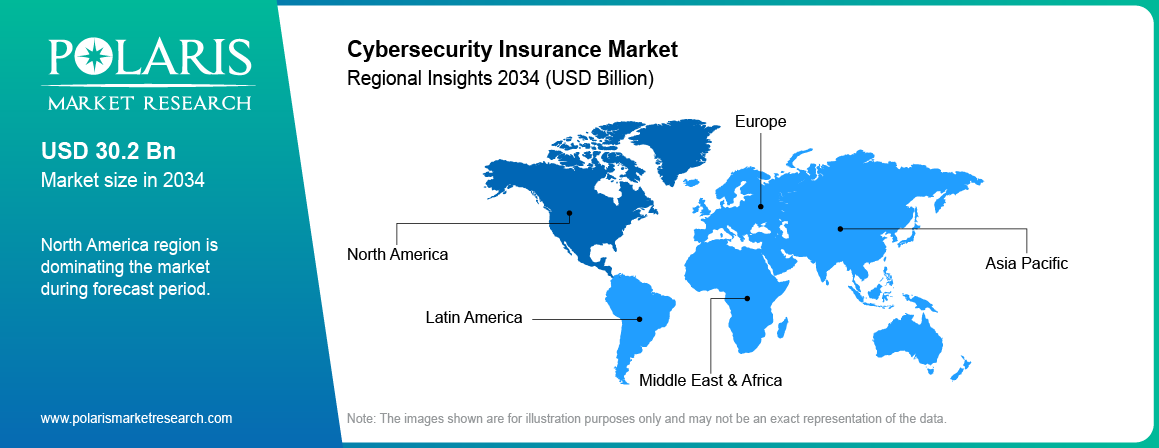
The five regions differ in maturity. North America is the oldest and largest market. Europe is shaped by data protection and reporting rules. Asia Pacific has the widest range of country stages. Latin America and Middle East & Africa are smaller, with fewer insurers and fewer policies per firm.
North America Market
North America held the largest regional share, at 42.2% of revenue in 2026. The National Association of Insurance Commissioners (NAIC) published its 2026 report on this market. US cyber direct written premium was about USD 9.46 billion in 2025, including surplus lines from non US insurers. That was 3.5% higher than a year earlier (Source: NAIC).
The same report counted 5.84 million domestic policies in force, up 33%, and 56,323 claims, up 20%. More buyers and more claims are driving the market, even as prices fall.
The United States is the largest country market in North America. Canada is projected to grow faster, at a CAGR of 15.5% from 2026 to 2034. Canadian banks and public bodies are buying more cover.
Large insurers, Lloyd's specialists, and cyber-focused firms compete for United States business. Brokers place most mid-sized and large policies. Buyers in healthcare, finance, and retail face state breach laws, so notice and legal cost cover is a standard request.
North America is projected to grow at a CAGR of 11.19% from 2026 to 2034, the slowest of the five regions. The market is mature, so growth comes from new buyers and higher limits rather than from first-time demand. More policies and more claims push insurers to use data, and risk scans are now part of the quote for many mid-sized buyers.
Europe Market
Europe accounted for 26.7% of cybersecurity insurance market revenue in 2026. The United Kingdom is the largest country market in Europe, ahead of Germany and France.
Companies selling digital products in the European Union now face reporting duties under the Cyber Resilience Act. Insurers expect firms to ask for help with incident response and legal advice. Many European buyers also want packaged cover from their property insurer.
Coalition, Inc. will take over the commercial cyber business of Allianz Commercial in Germany, Denmark, and Sweden, subject to approvals. The change shows how fast specialist insurers are growing in the region.
Germany has a large industrial base, so manufacturers buy business interruption cover to protect production lines. France and Italy are earlier in adoption, and many buyers there start with packaged policies. Buyers across Europe also compare insurers on how they handle data protection claims, given fines under the General Data Protection Regulation.
Europe is projected to grow at a CAGR of 14.3% from 2026 to 2034. The United Kingdom and Germany are the two largest country markets, and both have strong broker networks. Spain and the Netherlands are smaller but are growing faster than the region as a whole.
Asia Pacific Market
Asia Pacific is the fastest growing region, with a CAGR of 18.6% from 2026 to 2034. China is the largest country market. India is the fastest growing country, at a CAGR of 23.2% from 2026 to 2034.
The Australian Department of Home Affairs says ransomware payment reporting has applied since 30 May 2025 under the Cyber Security Act 2024. Businesses with annual turnover above 3 million Australian dollars must report a payment within 72 hours. The department used an education first approach until 31 December 2025 and moved to a compliance approach from 1 January 2026 (Source: Australian Department of Home Affairs).
Japan and South Korea have mature insurance sectors and many large firms. Southeast Asia has a growing base of small firms that sell and pay online.
China is projected to grow at a CAGR of 18.6% from 2026 to 2034. Its data security rules push large firms to review their risk. Australia is a smaller market, but its reporting rules make it a guide for other countries in the region.
Asia Pacific accounted for 21.2% of revenue in 2026, and its weight in the market rises over the forecast period. Southeast Asia is projected to grow at a CAGR of 21.0% from 2026 to 2034. Small firms there sell and pay online, and they are early buyers of packaged and digital cover.
Latin America Market
Latin America was worth USD 937 Million in 2026. Brazil is the largest country market, ahead of Mexico and Argentina.
Banks and retailers in the region run large digital payment networks. Fraud and data theft push them to buy cover. Most buyers choose packaged policies from local insurers and brokers.
Brazil has a general data protection law with fines for leaks, and that gives banks and retailers a reason to review cover. Mexico and Argentina are smaller markets, where cover is mainly held by banks, large retailers, and subsidiaries of global firms.
Latin America is projected to grow at a CAGR of 16.0% from 2026 to 2034. Growth starts from a small base, so each new corporate buyer has a visible effect. Local brokers and bank insurance arms are the main sales routes. Global insurers enter through partners and regional offices.
Middle East & Africa Market
Middle East & Africa is projected to grow at a CAGR of 16.4% from 2026 to 2034. Saudi Arabia is the largest and fastest growing country market in the region.
Government programs in the Gulf states are moving public services online. That raises the number of targets and the need for cover. The United Arab Emirates, Israel, and South Africa are the other leading country markets.
Saudi Arabia is projected to grow at a CAGR of 17.8% from 2026 to 2034, the fastest of any country in the region. Banks and government bodies are the main buyers in the Gulf. South Africa has a developed insurance sector and an established broker network.
Middle East & Africa accounted for 5.3% of revenue in 2026. Israel has a deep cyber security industry, and its firms are active buyers of cover. Demand in the United Arab Emirates comes from banks, free zone companies, and government entities. Smaller African markets rely on regional offices of global insurers.
Cybersecurity Insurance Market Competitive Landscape
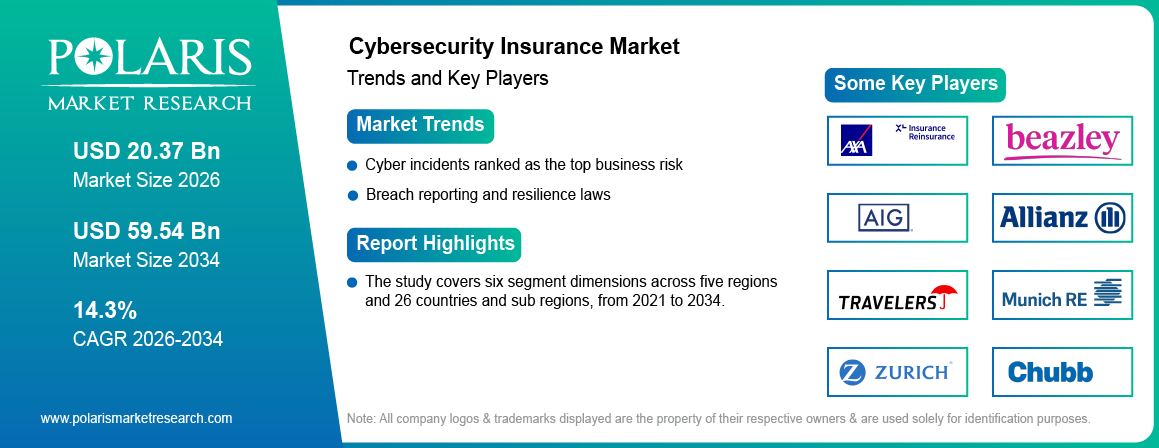
The cybersecurity insurance market has a mix of global insurers, Lloyd's market specialists, reinsurers, and cyber-focused firms. Market share is spread across many names, and no one insurer writes most of the premium. Cyber is a fast growing line inside the wider property and casualty insurance market.
AXA XL is the commercial insurance unit of AXA, and Allianz Global Corporate & Specialty now trades as Allianz Commercial. Lloyd's of London is a market, not a single company, so it is not listed as a key player. Several of the companies above, such as Beazley plc and Hiscox Ltd, write cyber business through Lloyd's syndicates.
Chubb Limited, American International Group, Inc. (AIG), and AXA XL are large commercial insurers with global cyber teams. Chubb reported on 20 October 2026 that third quarter net premiums written were USD 15,143 million, up 1.9%. Its chief executive said the commercial market keeps getting more competitive. Price pressure shapes every large insurer.
Beazley plc and Hiscox Ltd are specialist insurers that put cyber at the center of their plans. Beazley said it will not follow the market down on price. It is building a cyber business that sells risk to capital markets investors. Hiscox rolled out its cyber product across Europe.
Coalition, Inc. combines insurance with security tools and scans for its customers. Allianz Commercial chose it as exclusive global cyber partner. Munich Re and Zurich Insurance Group supply reinsurance capacity, and Aon plc places large programs as a broker. BitSight Technologies and SecurityScorecard sell the security ratings that insurers use to price risk.
Market share is moving. Specialist firms win accounts as large insurers cut back or move books to partners. Allianz Commercial is the clearest case. The Travelers Companies and CNA Financial Corporation focus on small and mid-sized US business, where packaged cover and agent sales matter most. AXIS Capital Holdings writes specialty lines and reinsurance. Tokio Marine Holdings brings Japanese clients and Asian reach.
Strategies fall into four groups. Large insurers focus on price discipline and large limits. Specialists focus on data, speed, and service. Reinsurers focus on capacity and models of widespread loss. Brokers focus on advice and on placing programs across several insurers. Partnerships link these groups, as the Allianz Commercial and Coalition deal shows.
Vendor Landscape Snapshot
| Company | Vendor Positioning | Role |
| Chubb Limited | Leader | Global commercial insurer with a large cyber book |
| American International Group, Inc. | Leader | Global commercial insurer for large and mid sized firms |
| AXA XL | Leader | Commercial unit of AXA writing large cyber programs |
| Beazley plc | Leader | Specialist cyber insurer with a capital markets program |
| Zurich Insurance Group | Challenger | Global insurer and reinsurer with a cyber line |
| The Travelers Companies | Challenger | US insurer focused on small and mid sized business |
| Munich Re | Leader | Reinsurer and cyber risk analyst |
| Allianz Commercial | Challenger | Commercial insurance unit moving cyber to a partner |
| CNA Financial Corporation | Challenger | US commercial insurer with cyber and liability cover |
| AXIS Capital Holdings | Challenger | Specialty insurer and reinsurer |
| Hiscox Ltd | Challenger | Specialist insurer growing cyber across Europe |
| Tokio Marine Holdings | Challenger | Japanese group with cyber cover in Asia and the United States |
| Coalition, Inc. | Emerging Player | Insurer that bundles security tools with cover |
| Aon plc | Niche Player | Broker that places and advises on cyber programs |
| BitSight Technologies | Niche Player | Security ratings used in underwriting |
| SecurityScorecard | Niche Player | Security ratings used in underwriting |
Source: Polaris Market Research Analysis
Cybersecurity Insurance Market Technology and Innovation Landscape
Technology now decides who wins cyber business. Insurers collect data on a customer's network before they quote and again during the policy. Models then group customers by risk and show where one event could hit many at once.
Shared data is the next step. Insurers already ask for scan results before they quote. The next step is continuous monitoring, where the insurer sees open weaknesses and alerts the customer. Customers that fix problems quickly may earn lower rates.
Artificial intelligence is now part of claims and underwriting at several insurers. It reads loss notices, flags unusual patterns, and drafts routine replies. Buyers see faster settlements on simple claims. Complex claims still need forensic and legal experts, so human teams remain central.
Attackers use AI to write convincing messages and to scan for weak systems faster. Insurers respond with stricter security checks before they quote. Buyers that keep multi-factor login, tested backups, and patch records in good order qualify more easily.
Allianz noted that AI rose to second place among business risks in its 2026 Risk Barometer.
Technology and Innovation Landscape Snapshot
| Area | Role | Status and Representative Developers |
| Security ratings and scans | Measure a buyer's exposure before and during cover | In wide use, led by BitSight Technologies and SecurityScorecard |
| Insurance with built in security tools | Alert customers to open weaknesses while they hold a policy | Growing, led by Coalition, Inc. |
| Accumulation modeling | Show losses if one provider fails and many insureds are hit | Developing, used by Munich Re and large insurers |
| Capital markets risk transfer | Move part of a systemic loss to bond investors | Early stage, with programs at Beazley plc |
| Claims automation | Sort and settle claims faster with data and AI | Developing across large insurers |
Source: Polaris Market Research Analysis
Use Case Analysis
Cyber risk looks different in each industry. The five cases below show how buyers think about cover and what insurers ask for in return.
Banking, Financial Services, and Insurance
Banks and insurers run payment systems, trading platforms, and customer databases. A short outage can stop millions of transactions. These firms buy large limits and ask for cover for third party providers. Supervisors in many countries expect banks to show how they would recover from a major incident, and insurance forms part of that plan.
BFSI was the largest end user in 2026. Regulators require fast reporting of major incidents, and insurers sell response services for that purpose.
Healthcare Providers
Hospitals depend on electronic records and connected devices. Ransomware can delay surgery and divert patients. Insurers ask for backups, staff training, and tested recovery plans before they offer cover. Healthcare buyers value fast access to forensic teams, since every hour offline affects patient care.
Hospitals also buy privacy liability cover for patient data claims. Underwriters ask which systems must stay online, and they price each answer.
Manufacturing and Industrial Operations
News reports said in September 2025 that the UK government announced a loan guarantee of up to GBP 1.5 billion for Jaguar Land Rover after a cyber attack. The company employs 34,000 people directly, and its supply chain supports about 120,000 jobs. The case shows how one attack can reach a whole supply chain. Manufacturers now ask insurers about contingent business interruption, which pays when a supplier or customer goes offline.
Technology and Telecom Providers
Cloud, software, and network firms serve thousands of clients. A fault at one provider can hit all of them. These firms buy technology errors cover and liability cover, and clients ask them for proof of insurance. Contracts with large clients often set a minimum limit, so a policy can decide whether a vendor wins a tender.
Retail and Online Commerce
Retailers store card data and depend on websites for sales. Downtime during a peak sales season is costly. They buy business interruption and breach response cover together. Ecommerce firms also ask for cover for payment fraud and for claims from card networks.
Buyer Needs and Decision Criteria
| Buyer Need | Decision Criteria | Why It Matters |
| Adequate limits | Policy limit, sublimits, and retention | Breach costs can exceed low limits quickly |
| Clear wording | Exclusions for war, infrastructure failure, and prior acts | Disputes often start with unclear terms |
| Fast response | Panel of forensic and legal firms | Early action lowers the final loss |
| Fair price | Rate trend, deductible, and risk score | Rates are falling in 2026, so buyers can negotiate |
| Insurer strength | Financial rating and claims record | Large claims depend on a firm that can pay |
Source: Polaris Market Research Analysis
Entry is hard for new insurers. Claims data takes years to build, and reinsurers want proof of risk control. Broker relationships decide access to large buyers. Regulators also require capital and filings in each market. Buyers should compare insurers on claims service, wording, and panel quality, not on price alone.
Premium Insights and Forward Outlook
Pricing Will Settle Before Volumes Slow
Rates fell in 2026, but policy counts rose. Swiss Re expects the rate decline to ease from about 13% in 2025 to about 5% in 2026. If rates stop falling, premium growth should follow policy growth more closely.
Polaris expects the 2026 price decline to ease in the next two years. If it does, insurers will earn more premium per policy again. If it does not, the market relies on volume, services, and new buyers for growth.
Insurers that hold prices lose some accounts in the short run, but they keep margin. Insurers that cut prices gain accounts but see loss ratios rise. The US loss ratio of 53, reported by the NAIC, shows the cost of cheap cover.
Services Will Gain Share Against Premiums
Policy Premiums fall from 66.1% of component revenue in 2026 as response and assessment services grow faster. Buyers prefer one provider for cover and recovery help.
Buyers gain from the model too. One call opens a claim, brings in a response team, and starts the legal process. The insurer gains data and loyalty. That is why Incident Response Services is projected to grow at nearly the pace of Risk Assessment Solutions.
Insurers that sell scans, response, and training next to the policy tie buyers to one provider. The services also give the insurer data on the customer, which supports better pricing.
Small Firms Will Decide the Pace of Growth
Large firms already buy cover. The next wave comes from firms with fewer than 250 staff. Simple forms, bundled policies, and partner sales will decide how many of them sign up.
Polaris expects Small Enterprises to add the most new policies in the forecast, while Large Enterprises add the most premium per policy. Both groups matter, but they need different products and sales methods.
Brokers will link buyers and insurers. They know the buyer and can explain a simple form. Platform partners will reach firms that never talk to a broker.
Digital and Embedded Platforms is the smallest channel today and the fastest growing. If platforms meet insurer standards on data and claims, the channel could change how small firms buy cover.
Shared Data Will Shape Terms
Insurers will rely more on shared scan data and incident reports. Firms that show strong controls will earn better terms. Firms that do not will face higher retentions or limits.
Shared data also raises privacy questions. Insurers will need clear rules on what they collect and how they use it. Buyers should ask these questions before they agree to continuous monitoring.
Key Players in the Cybersecurity Insurance Market
- Chubb Limited
- American International Group, Inc.
- AXA XL
- Beazley plc
- Zurich Insurance Group
- The Travelers Companies
- Munich Re
- Allianz Commercial
- CNA Financial Corporation
- AXIS Capital Holdings
- Hiscox Ltd
- Tokio Marine Holdings
- Coalition, Inc.
- Aon plc
- BitSight Technologies
- SecurityScorecard
Industry Developments
- October 2026: Marsh said global commercial insurance rates fell 5% in the third quarter of 2026. Cyber rates fell 4% globally and were flat in the United States. Lower prices help buyers and cut premium per policy.
- September 2026: The European Commission said reporting duties for manufacturers under the Cyber Resilience Act began on 11 September 2026. A single reporting platform opened on the same date. Firms must prepare for fast incident notices.
- August 2026: Beazley plc reported first half cyber insurance written premiums of USD 524.9 million, down from USD 620.3 million. The cyber rate change was a fall of 4.3%. Premium and price trends are still moving in opposite directions (Source: Beazley plc).
- August 2026: Hiscox Ltd extended its cyber product to all European markets. The insurer also reported tough conditions for cyber business through United States brokers. Competition is rising in both regions.
- July 2026: IBM released its yearly breach cost study on 29 July 2026. The average breach cost USD 4.99 million. Higher costs support the case for cover.
- May 2026: Allianz Commercial named Coalition, Inc. as its exclusive global cyber partner under a deal of at least 10 years. Specialist firms are taking over large insurer books.
- March 2026: Munich Re published its cyber insurance risks and trends report on 25 March 2026. The reinsurer reported that most claims it handles are the buyer's own losses. Own losses, not lawsuits, drive claims.
- February 2026: Allianz published its 2026 Risk Barometer on 3 February 2026. Cyber incidents ranked first among business risks for the fifth year. Boards keep cyber on the agenda.
Cybersecurity Insurance Market Report Segmentation
By Component Outlook (Revenue, USD Billion, 2021 to 2034)
- Policy Premiums
- Risk Assessment Solutions
- Incident Response Services
- Advisory and Training Services
By Insurance Type Outlook (Revenue, USD Billion, 2021 to 2034)
- Stand Alone
- Packaged
- Tailored
By Coverage Type Outlook (Revenue, USD Billion, 2021 to 2034)
- Data Breach Response
- Business Interruption
- Cyber Extortion and Ransomware
- Network Security and Privacy Liability
- Technology Errors and Omissions
By Organization Size Outlook (Revenue, USD Billion, 2021 to 2034)
- Large Enterprises
- Medium Enterprises
- Small Enterprises
By End User Outlook (Revenue, USD Billion, 2021 to 2034)
- BFSI
- Healthcare
- IT and Telecom
- Retail and Ecommerce
- Manufacturing
- Government and Public Sector
- Others
By Distribution Channel Outlook (Revenue, USD Billion, 2021 to 2034)
- Brokers and Agents
- Direct Insurers
- Digital and Embedded Platforms
By Regional Outlook (Revenue, USD Billion, 2021 to 2034)
- North America
- United States
- Canada
- Europe
- Germany
- United Kingdom
- France
- Italy
- Spain
- Netherlands
- Russia
- Rest of Europe
- Asia Pacific
- China
- Japan
- India
- South Korea
- Australia
- Southeast Asia
- Rest of Asia Pacific
- Latin America
- Brazil
- Mexico
- Argentina
- Rest of Latin America
- Middle East & Africa
- Saudi Arabia
- United Arab Emirates
- Israel
- South Africa
- Rest of Middle East & Africa
Cybersecurity Insurance Market Report Scope
| Report Attribute | Details |
| Market Size in 2025 | USD 17.83 Billion |
| Market Size in 2026 | USD 20.37 Billion |
| Revenue Forecast by 2034 | USD 59.54 Billion |
| CAGR | 14.3% (2026 to 2034) |
| Base Year | 2025 |
| Historical Data | 2021 to 2024 |
| Forecast Period | 2026 to 2034 |
| Quantitative Units | Revenue in USD Million and USD Billion, and CAGR in percent |
| Report Coverage | Revenue Forecast, Growth Factors, Competitive Landscape, Industry Trends, and Strategic Analysis of the cybersecurity insurance market |
| Segments Covered | By Component, Insurance Type, Coverage Type, Organization Size, End User, Distribution Channel, and Region |
| Regional Scope | North America, Europe, Asia Pacific, Latin America, Middle East & Africa |
| Competitive Landscape | Company Profiling, Product Benchmarking, Financial Analysis, Market Developments, and Strategic Initiatives |
| Report Format | PDF and Excel |
| Customization | Available by Country, Region, and Segment |
| Research Team | Polaris Market Research & Consulting, Inc. research team |
| Last Updated | 4 November 2026 |
Source: Polaris Market Research Analysis
Why Choose Polaris Market Research
Polaris Market Research & Consulting, Inc. builds each cybersecurity insurance market study from country level estimates. Every figure in this report comes from one model, so the size, growth rate, and segment shares agree from the summary to the scope table.
The report goes beyond totals. It shows how buyers choose cover, how insurers price risk, and where new demand is likely to come from. Readers can see which components, coverage types, and regions are gaining share and why.
Each external fact in the report names its source and date. Readers can check the claims that matter most. Where the evidence is thin, the text says less.
Buyers also get a clear view of how the forecast was built. The methodology section lists the checks that ran and the limits of the data. That makes it easier for a planning team to rely on the figures.
Polaris can adjust the study to a country, a segment, or a company set. To buy this report or request customization, contact Polaris Market Research & Consulting, Inc.
Research Methodology
Research Approach
The study covers the global cybersecurity insurance market. It counts cyber premiums plus the scanning, recovery, and training services bundled with policies. It leaves out security tools, devices, and managed services sold without insurance. The base year is 2025 and the forecast runs from 2026 to 2034. Values are in USD Million and USD Billion across five regions, six segment dimensions, and 26 countries and sub regions. Polaris explains its general research framework on its research methodology page.
Secondary Research
Polaris reviewed 14 published sources for dated facts. They include 5 company filings and results releases, 3 government documents, 1 insurance regulator publication, 4 industry and reinsurer research reports, and 1 news report. Most were published in the last 24 months. Older facts are labeled in the text. External facts are attributed by source name, with the date where available.
Primary Research
Polaris follows its standard process of primary interviews. These interviews cover manufacturers, distributors and channel partners, and industry experts and consultants. They are used to validate secondary estimates, segment shares, regional trends, and growth drivers. Secondary and primary evidence were combined in the Polaris market model.
Data Structuring
All inputs were converted to one currency, USD, and one calendar year basis. Segment definitions were fixed before any sizing began. Items that sit in more than one product line were counted once. Security tools, devices, and managed services bought without insurance are excluded.
Market Size Estimation
The bottom up estimate starts at country level. Polaris built an estimate for every country and every segment dimension. Country values were summed to regional totals, and regional totals were summed to the global total.
The top down view set the 2025 global base from the scope. Polaris compared the base with publicly available estimates and with disclosed company and premium data. It then split the base by region and segment. The USD 17.83 Billion base for 2025 sits inside the range of public estimates.
Forecasting
The forecast starts from premium trends, policy counts, and regulatory timelines. The forecast uses an annual growth path that eases year over year and produces the stated CAGR. Regional and segment mixes shift gradually from 2026 to 2034.
The direction of growth reflects the drivers, restraints, and opportunities in this report. The first driver is "Cyber Incidents Are Now the Top Business Risk, Boosting Demand for Cover". The second is "New Breach Reporting Laws Are Raising the Need for Insurance Support". The restraint is "Falling Rates and Systemic Event Risk Are Limiting Premium Growth". The opportunities are "Small and Medium Firms Offer the Largest Gap Between Risk and Cover" and "Partner and Embedded Distribution Is Reaching Buyers That Brokers Miss". The trend is "Insurers Are Moving Systemic Cyber Risk to Capital Markets".
Data Triangulation and Validation
Polaris ran four checks on the model. Every share set adds to 100% in every year. Country values add to regional totals, and regional totals add to the global total. History and forecast sit on one growth path. The 2025 base sits inside the range of publicly available estimates.
Limitations
Premium reports from regulators measure only the policy line, so the wider scope here sits above those figures. Regional text for Latin America and parts of Middle East & Africa is qualitative where no primary document was found. Market figures in this report are Polaris estimates.
Research Methodology Phases
| Phase | Focus | Evidence / Output |
| Scope and Setup | Market boundary, segments, and regions | Defined scope and segment list |
| Secondary Data Collection | Filings, releases, and agency documents | 14 dated facts, each with a named source |
| Primary Research | Interviews with manufacturers, channel partners, and industry experts | Validated segment shares, regional trends, and growth drivers |
| Data Structuring | One currency and one calendar year basis | Clean inputs with no double counting |
| Bottom Up Estimate | Country and segment estimates | Regional and global totals |
| Top Down Estimate | 2025 global base and split by region and segment | Base checked against public estimates |
| Forecasting | Annual growth path to 2034 | Stated CAGR |
| Triangulation and Validation | Share, total, and range checks | Four passed checks |
| Output | Report tables and text | Figures that match across the report |
Source: Polaris Market Research Analysis
Data Sources by Type
| Source Type | Examples | Used For |
| Company filings and results releases (5) | Beazley plc, Hiscox Ltd, Chubb Limited, Allianz Commercial, IBM | Premiums, rates, partnerships, and breach costs |
| Government documents (3) | European Commission, Australian Department of Home Affairs, UK government | Reporting laws and bills |
| Insurance regulator publications (1) | National Association of Insurance Commissioners | US premium, policy, and claims data |
| Industry and reinsurer research (4) | Munich Re, Swiss Re, Marsh, Allianz | Risk ranking, pricing, and protection gap |
| News reports (1) | Technology news | One supply chain case |
Source: Polaris Market Research Analysis
Cybersecurity Insurance Market FAQ's
The cybersecurity insurance market covers insurance against cyber attacks and data theft. The market also counts the services insurers sell with each policy.
The cybersecurity insurance market size was valued at USD 17.83 Billion in 2025, according to Polaris Market Research analysis. The market was worth USD 20.37 Billion in 2026.
The cybersecurity insurance market is projected to reach USD 59.54 Billion by 2034, growing at a CAGR of 14.3% from 2026 to 2034, according to Polaris Market Research analysis.
Falling rates cut premium income, and one event can hit many insureds at once. Buyers face complex wording and strict security checks before they qualify for cover.
North America is the leading region in the cybersecurity insurance market, with 42.2% of revenue in 2026. Insurers in the United States write most of the cyber policies in the world.
Asia Pacific is the fastest growing region in the cybersecurity insurance market, at a CAGR of 18.6% from 2026 to 2034. Within the region, India grows fastest by country.
Policy Premiums is the largest component of the cybersecurity insurance market, with a 66.1% share in 2026. Risk Assessment Solutions grows fastest among components, at a CAGR of 19.5% from 2026 to 2034.
The key players in the cybersecurity insurance market include Chubb Limited, American International Group, Inc., AXA XL, Beazley plc, Zurich Insurance Group, Munich Re, Hiscox Ltd, Coalition, Inc., and Aon plc.
The main trends in 2026 are falling cyber rates, new reporting laws, and growth in embedded sales. Insurers are also moving systemic risk to capital markets through catastrophe bonds.
Cyber insurance covers breach response costs, business interruption, ransomware and extortion events, privacy liability claims, and technology errors. Each policy sets its own limits, retentions, and exclusions.
Most small firms hold no cover, so the gap to fill is large. Small Enterprises are projected to grow at a CAGR of 19.9% from 2026 to 2034, the fastest of any organization size.
Cyber Extortion and Ransomware grows fastest among coverage types, at a CAGR of 17.7% from 2026 to 2034. Cover pays for ransom talks, legal payments, and recovery costs.
BFSI is the largest end user, with a 25.3% share in 2026. Banks and insurers hold sensitive data and face strict breach reporting rules.
The United States has the largest cyber insurance revenue, at USD 9,334 Million in 2026. The United Kingdom and Germany are the largest country markets in Europe.
Demand is driven by rising breach costs, new reporting laws, and board-level concern about cyber risk. Allianz ranked cyber incidents as the top business risk in its 2026 Risk Barometer.

Download Sample Report of Cybersecurity Insurance Market
Please fill out the form to request a customized copy of the research report.


