
Deepfake AI Market Growth, Trends, Forecasts, Top Key Players, Analysis, 2026-2034
REPORT DETAILS
Deepfake AI Market Summary and Key Insights
The deepfake AI market size was valued at USD 1,122.54 million in 2025, and it is expected to reach USD 25,495.16 million by 2034, exhibiting a CAGR of 41.5% from 2026–2034. This industry is expanding as the technology becomes more sophisticated and accessible. It’s finding applications in entertainment, marketing, and digital communication. At the same time, the demand for deepfake detection tools is growing, as both private and public sectors work to balance innovation with security concerns.
Market Statistics
Deepfake AI Market Key Insights
- Asia Pacific held the largest share of 38.5% in 2025. The leading position is attributed to rapid adoption across industries such as gaming, entertainment, and advertisement.
- In Asia Pacific, China accounted for the largest market share of 41.2% in 2025. Supportive government initiatives boost the dominance.
- The North America deepfake AI industry is expected to experience the highest CAGR of 41.9% during the forecast period. The increasing integration of deepfake technologies into the autonomous vehicle sector would propel the growth.
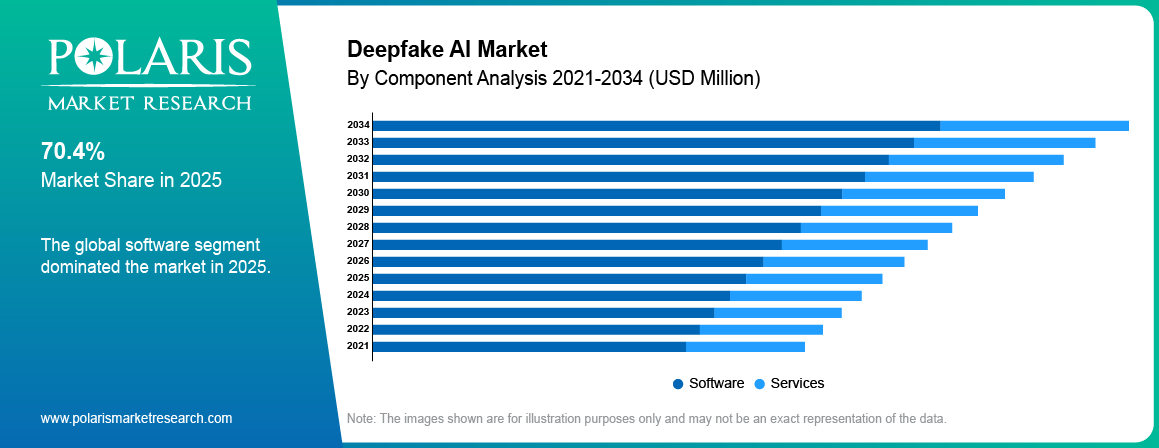
- The software segment dominated the market with 70.4% share in 2025. This is due to its essential role in creating and detecting fake content.
- The government organizations segment led the market with 28.9% revenue share in 2025. The dominance is fueled by the increasing number of frauds in the market.
Note: Figures and projections outlined in this report are the result of Polaris Market Research’s proprietary analytical processes, grounded in the latest available datasets and market observations.
Deepfake AI Market Dynamics
- Increasing adoption of AI-generated media in entertainment, gaming, and advertising propels demand for deepfake technologies.
- Rising use of synthetic content for personalized marketing and virtual influencers supports market expansion.
- Growing concerns regarding fraud, misinformation, and identity manipulation hinder widespread adoption.
- Expanding applications in education, film production, and multilingual content localization are expected to create opportunities in the future.
- Surging investments in deepfake detection and authentication solutions would emerge as a key trend in the coming years.
Deepfake AI refers to the use of artificial intelligence, particularly deep learning techniques, to create highly realistic but artificially generated images, videos, and audio typically used for entertainment purposes. Deepfake technology leverages neural networks, especially generative adversarial networks (GANs), to synthesize these realistic outputs.
The industry is experiencing significant growth due to advancements in generative AI algorithms, especially generative adversarial networks (GANs). Improvements in GANs have led to the development of highly convincing and realistic deepfake AIs. In May 2024, McAfee announced significant enhancements to its AI-powered deepfake AI technology.
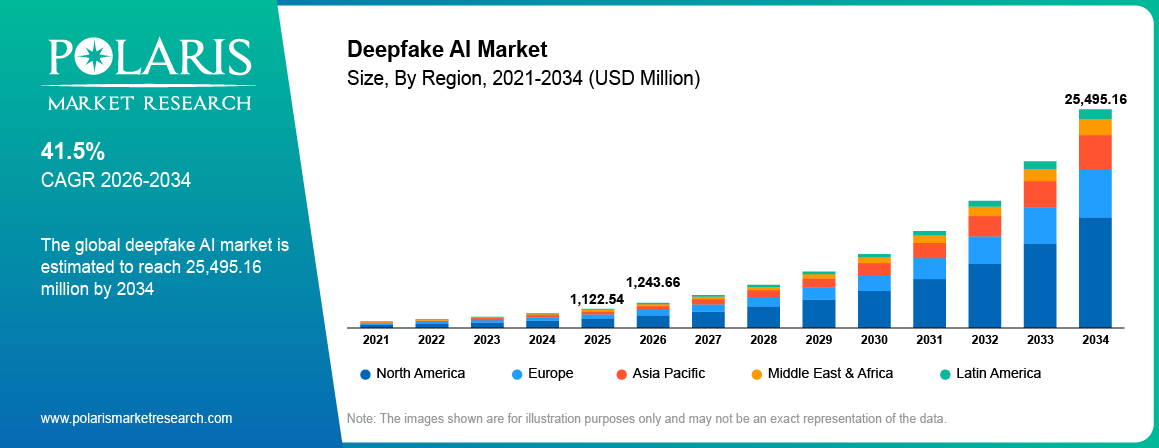
Source: Polaris Market Research Analysis
To Understand More About this Research: Download Sample Report
The deepfake AI market has seen significant growth due to its increasing use in advertising networks and the entertainment industry. The technology has enabled the creation of innovative and captivating content, driving its popularity in the educational and commercial sectors. In November 2023, Google and Universal Music formed a partnership to license artists' melodies and voices for AI-generated songs. This collaboration aims to address challenges faced by the music industry in adapting to emerging AI technology.
Deepfake Creation vs. Deepfake Detection: Technologies and Use Cases
| Parameters | Deepfake Creation | Deepfake Detection |
| Core Technology | Uses generative AI (GenAI) models such as GANs and diffusion models to create synthetic media | Uses forensic AI and detection algorithms to identify manipulated or synthetic content |
| Primary Objective | Generates realistic fake videos, images, or audio | Verifies authenticity and detects tampered digital media |
| AI Approach | Offensive AI system focused on content synthesis | Defensive AI system focused on fraud and misinformation prevention |
| Key Function | Face swapping, voice cloning, and synthetic avatar creation | Artifact analysis, metadata inspection, and behavioral pattern recognition |
| Accuracy Focus | Emphasizes realism and visual/audio quality | Emphasizes detection precision and authenticity verification |
| Major Applications | Entertainment, gaming, advertising, and virtual influencers | Cybersecurity, media verification, banking, and law enforcement |
| Main Challenge | Ethical misuse and misinformation risks | Keeping pace with rapidly evolving deepfake generation technologies |
Source: Polaris Market Research Analysis
Deepfake AI Market Trends
Partnerships for Deepfake Detection and Content Authentication
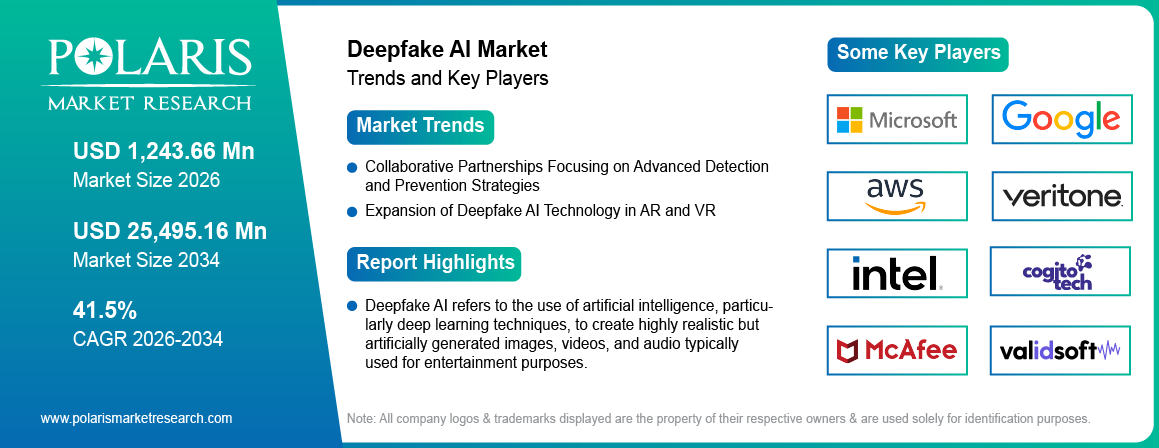
Collaborative partnerships focusing on advanced detection and prevention strategies are boosting demand for deepfake AI by promoting innovation and expanding its practical applications. These partnerships, involving tech companies, research institutions, and governments, aim to develop tools to identify and mitigate the misuse of deepfake technology. Additionally, these collaborations highlight the dual-use potential of deepfake AI, encouraging industries such as media, entertainment, and education to adopt the technology for legitimate and creative purposes. This collaboration between ethical oversight and innovation amplifies the demand for solutions, balancing societal concerns with technological progress.
Deepfake AI in AR, VR and Digital Humans
The use of this technology has significantly expanded within augmented reality (AR) and virtual reality (VR). Deepfake AI is being widely used in AR to enable real-time facial overlays and voice synthesis, allowing users to adopt lifelike personas or interact with hyper-realistic virtual characters in collaborative or entertainment settings. Similarly, in VR, the integration enhances the realism of avatars, making social interactions, storytelling, and simulations more engaging and believable. Industries such as gaming, training, virtual events, and filmmaking are leveraging this technology to create dynamic, customizable content, catering to audiences' increasing expectations for interactivity and authenticity. Therefore, as AR and VR continue to evolve, the expansion of deepfake AI applications in AR and VR is expected to rise. For instance, in June 2023, Apple introduced the Vision Pro headset, priced at USD 3,499, which combines AR with VR capabilities. The device features advanced eye-tracking, gesture controls, and a 3D avatar system powered by this technology to create realistic avatars.
Deepfake AI Risks, Ethical Concerns and Regulatory Challenges
- Ethical Concerns: Deepfake technology leads to serious ethical issues related to consent, privacy violations, and digital identity manipulation.
- Misuse Risks: Use of deepfakes for fraud, political misinformation, cybercrime, and social manipulation creates major security concerns.
- Detection Difficulty: There are rapid advancements in AI-generated media. This makes it increasingly difficult for existing detection systems to identify highly realistic deepfakes.
- Regulatory Gaps: Lack of standardized global regulations and legal frameworks limits effective monitoring and control of deepfake content
Source: Polaris Market Research Analysis
Deepfake AI Market Segment Analysis
Deepfake AI Market, by Component
The software segment dominated the market with 70.4% share in 2025 due to its essential role in creating and detecting fake content. Advanced AI algorithms used in deepfake AI generation tools have made it easier for users to create highly convincing fake videos and images. The accessibility of these tools has led to widespread adoption among various users for legitimate purposes and malicious intent. In September 2020, Microsoft unveiled Video Authenticator and a digital hash tool to combat disinformation and deepfake AIs. They collaborated with the AI Foundation and media companies to advance these technologies.
Deepfake AI Market, by Application
The government organizations segment led the market with 28.9% revenue share in 2025 and is expected to maintain its dominance by 2034. This is due to the increasing number of frauds in the market. Governments around the world are developing innovative solutions to address this challenge.
Source: Polaris Market Research Analysis
Deepfake AI Market Regional Analysis
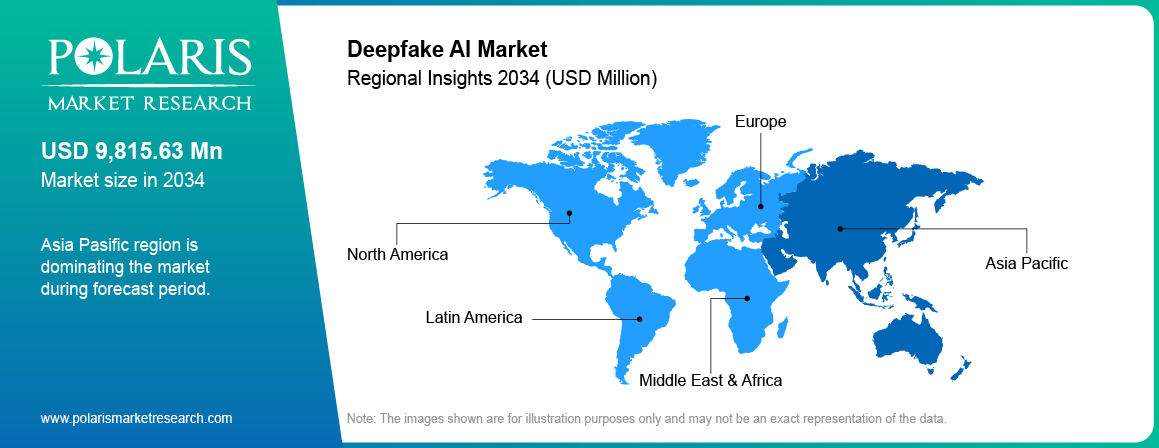
Asia Pacific held the largest share of 38.5% in 2025, due to rapid adoption across industries such as gaming, entertainment, and advertisement. This technology is extensively utilized in visual effects and content creation throughout the region. India and China, along with other South Asian countries, significantly contribute to the regional market growth. Furthermore, supportive government initiatives play a crucial role in propelling the expansion of the market in the Asia Pacific.
The global Indian Summit 2024 underscored India's commitment to democratizing AI and demonstrating its readiness to lead global innovation while ensuring AI accessibility for all. The summit attracted 12,000 global AI experts and practitioners, with delegates from 50 countries.
Source: Polaris Market Research Analysis
The North America deepfake AI industry is expected to experience the highest CAGR of 41.9% during the forecast period, driven largely by the integration of deepfake technologies into the autonomous vehicle sector. The region's leadership in AI research and the robust development of self-driving cars are expected to create significant market opportunities in the coming years. Deepfake AI is being leveraged to enhance the training of autonomous driving systems by generating realistic, synthetic images that simulate various driving scenarios. These images help train AI models more efficiently by altering elements such as road markings, weather conditions, and obstacles.
Oxa, an autonomous vehicle software company, utilizes deepfake AI to develop alternative images for use in its systems. By simulating different road environments, including weather conditions and complex urban settings, Oxa’s technology enhances the AI’s ability to adapt to real-world driving situations, improving safety and performance. As more companies embrace this innovative approach, the market in North America is expected to see significant expansion in the coming years, particularly in sectors such as transportation, logistics, and urban planning.
Deepfake AI Market Competitive Landscape
Major market players are investing heavily in research and development to expand their product lines, which will drive the industry in the coming years. Industry participants are also undertaking a variety of strategic activities to expand their global footprint, with important developments such as new product launches, contractual agreements, mergers and acquisitions, higher investments, and collaboration with other organizations. To expand and survive in a more competitiveenvironment, market players must offer cost-effective products.
Major players operating in the industry include Microsoft, Google, AWS, Veritone, Intel, Cogito Tech, Veritone, Cogito Tech, Apple, Primeau Forensics, Kairos, Valid Soft, My Heritage, HyperVerge, BioID, DuckDuckGo’s AI, Pindrop, Truepic, Sentinel, and Synthesia.
Microsoft Corporation is a global technology company known for its Windows operating system, Office suite, Azure cloud services, and Xbox gaming. The company aims to empower individuals and organizations worldwide. In April 2024, Microsoft's research team gave a glimpse into their latest AI model called “VASA-1.” The model can generate lifelike talking faces with appealing visual affective skills (VAS) given a single static image and a speech audio clip.
Google offers a range of products and services designed to empower individuals and organizations globally, with a strong emphasis on ethical practices and responsible innovation. The company claims that it is committed to improving lives through innovative technology, focusing on accessibility, sustainability, and user protection. In May 2024, Google introduced a method to label AI-generated text without modification, integrating it into Google DeepMind's SynthID tool. This enhancement adds metadata to the large language model (LLM)-based tool during text generation.
Leading Deepfake AI Companies and Platform Providers
- Microsoft
- AWS
- Veritone
- Intel
- Cogito Tech
- Veritone
- McAfee
- Cogito Tech
- Primeau Forensics
- Kairos
- ValidSoft
- MyHeritage
- HyperVerge
- BioID
- DuckDuckGoose AI
- Pindrop
- Truepic
- Sentinel
Deepfake AI Market Recent Developments
- May 2026: GetReal Security announced the availability of continuous identity verification within its flagship product, GetReal Protect. GetReal Protect will offer a holistic, real-time solution. This solution combines impersonation and deepfake detection. It also includes continuous identity verification across voice and video. (Source: PRNewswire)
- July 2025: Paravision launched its upgraded Deepfake Detection 2.0 platform, incorporating advanced multimodal analysis to improve the identification of synthetic media across various formats. The enhanced system integrates facial biometrics, audio pattern analysis, and contextual metadata scoring, empowering organizations to detect real-time content manipulation. This breakthrough technology is crucial for applications such as KYC processes, compliance checks, and public safety communications. (Source: paravision.ai)
- January 2024: McAfee introduced Project Mockingbird, an AI-powered technology for improved deepfake AI audio detection. This innovation empowers users to identify synthetic audio, safeguarding against phishing and other malicious attacks. (Source:mcafee.com )
Deepfake AI Market Segmentation
By Component Outlook (Revenue, USD Million, 2021–2034)
- Software
- Services
By Type Outlook (Revenue, USD Million, 2021–2034)
- Image Deepfake
- Video Deepfake
- Others
By Technology Outlook (Revenue, USD Million, 2021–2034)
- Generative Adversarial Networks (GANs)
- Autoencoders
- Recurrent Neural Networks (RNNs)
- Diffusion Models
- Transformer Models
- Natural Language Processing (NLP)
- Other Technologies
By Application Outlook (Revenue, USD Million, 2021–2034)
- Government Organizations
- Media and Entertainment
- Retail and E-commerce
- Legal
- Healthcare
- Others
By Regional Outlook (Revenue, USD Million, 2021–2034)
- North America
- US
- Canada
- Europe
- Germany
- France
- UK
- Italy
- Spain
- Netherlands
- Russia
- Rest of Europe
- Asia Pacific
- China
- Japan
- India
- Malaysia
- South Korea
- Indonesia
- Australia
- Vietnam
- Rest of Asia Pacific
- Middle East & Africa
- Saudi Arabia
- UAE
- Israel
- South Africa
- Rest of Middle East & Africa
- Latin America
- Mexico
- Brazil
- Argentina
- Rest of Latin America
Deepfake AI Market Report Scope and Methodology
| Report Attributes | Details |
| Market Size Value in 2025 | USD 1,122.54 Million |
| Market Size Value in 2026 | USD 1,243.66 Million |
| Revenue Forecast by 2034 | USD 25,495.16 Million |
| CAGR | 41.5% from 2026–2034 |
| Base Year | 2025 |
| Historical Data | 2021–2024 |
| Forecast Period | 2026–2034 |
| Quantitative Units | Revenue in USD Million and CAGR from 2026–2034 |
| Report Coverage | Revenue Forecast, Market Competitive Landscape, Growth Factors, and Trends |
| Segments Covered |
|
| Regional Scope |
|
| Competitive Landscape |
|
| Report Format |
|
| Customization | Report customization as per your requirements with respect to countries, regions, and segmentation. |
Source: Polaris Market Research Analysis
Deepfake AI Market Frequently Asked Questions
The deepfake AI market size was valued at USD 1,122.54 million in 2025.
The global market is projected to register a CAGR of 41.5% during 2026–2034.
Asia Pacific held the largest share of 38.5% in 2025.
A few key players in the market are Microsoft, Google, AWS, Veritone, Intel, Cogito Tech, Veritone, Cogito Tech, Apple, Primeau Forensics, Kairos, Valid Soft, My Heritage, HyperVerge, BioID, DuckDuckGo’s AI, Pindrop, Truepic, Sentinel, and Synthesia.
The software segment dominated the market with 70.4% share in 2025.
The government organizations segment led the market with 28.9% revenue share in 2025.
Download Sample Report of Deepfake AI Market
Please fill out the form to request a customized copy of the research report.


