
Digital MRO Market Size, Share & Trends Analysis Report, 2026-2034
REPORT DETAILS
Digital MRO Market Summary
The global Digital MRO Market was valued at USD 1.33 billion in 2025 and is expected to grow at a CAGR of 12.52% from 2026 to 2034. Increasing integration of predictive analytics, IoT, and AI in aircraft maintenance processes is revolutionizing digital MRO solutions.
Market Statistics
Digital MRO Market Ket Takeaways
- North America dominated the global market with 36.0% revenue share in 2025. Technological advancements and growing adoption of blockchain for transparent supply chain management boost the market growth.
- The market in Asia Pacific is expected to record a significant CAGR of 15.28% during the forecast period. It is owing to increasing air traffic and technological advancements.
- The predictive maintenance segment held a significant revenue share of 27.0% in 2025. Predictive maintenance employs advanced technologies. It helps anticipate and address potential aircraft component failures before they occur. These factors boost the segment growth.
- The artificial intelligence and big data analytics segment held the largest share of 22.0% in 2025. The increasing integration of artificial intelligence and big data analytics has revolutionized digital MRO. It optimizes aircraft maintenance across various dimensions. These factors propel the segment growth.
- The MROs segment held 38.0% share in 2025. MROs are revolutionizing operations with digital aircraft maintenance tools, driving the segment expansion.
Note: Figures and projections outlined in this report are the result of Polaris Market Research’s proprietary analytical processes, grounded in the latest available datasets and market observations.
What are Digital MRO?
Digital MRO (Maintenance, Repair, and Overhaul) revolutionizes aviation maintenance through advanced technologies. It employs predictive maintenance using AI and IoT technology for real-time monitoring, enhancing condition monitoring. Digital MRO market optimizes processes, reduces costs, and extends aircraft lifespan, marking a data-driven transformation in aviation maintenance practices.
Its AI-driven insights optimize schedules, enhance safety, and extend aircraft life. Real-time data access through mobile apps improves decision-making, while cloud-based platforms streamline collaboration. The system ensures efficient workforce management, transparent supply chains with blockchain, and compliance with regulations. Immersive training using AR and VR technologies elevates technician skills. Beyond cost-effectiveness, digital MRO positions organizations to adapt to industry changes, reducing environmental impact and ensuring competitiveness in the dynamic aviation landscape.
Difference Between Traditional MRO vs Digital MRO
| Parameter | Traditional MRO | Digital MRO |
| Maintenance Scheduling | Primarily based on fixed schedules or reactive maintenance practices. | Utilizes real-time data, condition monitoring, and predictive scheduling. |
| Downtime Reduction | Equipment failures are often addressed after occurrence, leading to longer downtime. | Predictive maintenance capabilities help identify issues early and minimize unplanned downtime. |
| Operational Visibility | Limited visibility due to manual record-keeping and disconnected systems. | Provides centralized dashboards and real-time insights into asset performance and maintenance activities. |
| Predictive Analytics | Relies heavily on historical experience and manual assessments. | Uses AI, IoT, and advanced analytics to forecast failures and optimize maintenance strategies. |
| Documentation Management | Paper-based records and spreadsheets can be difficult to access and update. | Digital documentation enables instant access, automated updates, and improved traceability. |
| Automation Efficiency | Maintenance workflows require significant manual intervention and coordination. | Automated work orders, inventory tracking, and maintenance processes improve efficiency and reduce human error. |
Source: Polaris Market Research Analysis
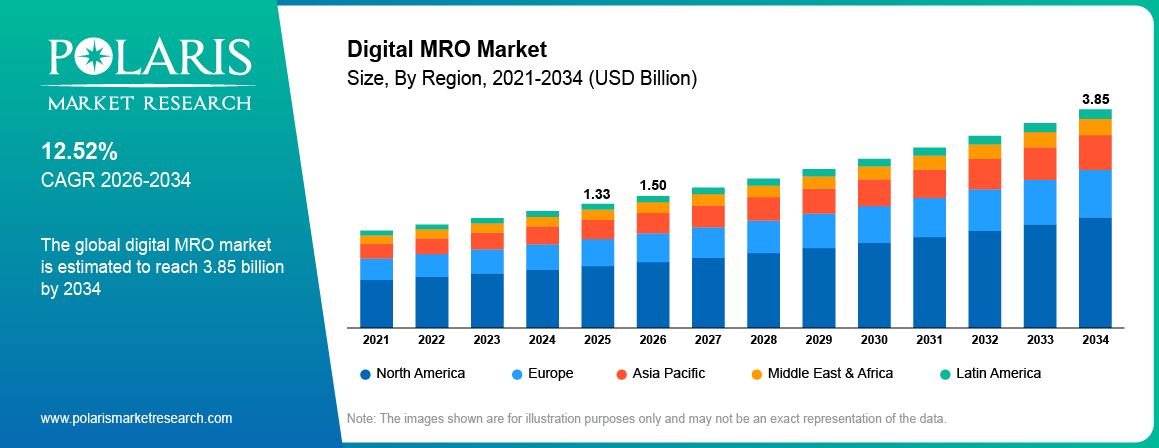
Source: Polaris Market Research Analysis
To Understand More About this Research: Download Sample Report
Companies are investing in R&D and market expansion to gain an edge. In addition, companies operating in the market are introducing new solutions to cater to the growing market demand.
For instance, in June 2023, Pratt & Whitney introduced Percept, an innovative AI-driven Aircraft Engine Analysis Tool. Percept uses computer vision technology, enabling users to acquire images and videos of aircraft engines through mobile devices. It offers real-time feedback on parts availability.
Technological Advancements in Digital MRO
| Technology | Description | Key Benefits |
| AI-Powered Analytics | Uses AI and ML to analyze equipment data, detect anomalies, and predict maintenance needs. | Reduces unplanned downtime, improves asset reliability, and optimizes maintenance scheduling. |
| Blockchain Maintenance Records | Provides secure, immutable, and transparent maintenance histories across assets and stakeholders. | Enhances traceability, regulatory compliance, data integrity, and audit efficiency. |
| Digital Twins | Creates virtual replicas of physical assets to simulate performance, monitor conditions, and predict failures. | Enables proactive maintenance, improves operational efficiency, and supports informed decision-making. |
| AR-Assisted Repair Systems | Employs augmented reality tools to provide technicians with real-time guidance, digital overlays, and remote expert support. | Accelerates repairs, reduces human errors, and improves workforce productivity and training. |
| Cloud-Based Maintenance Platforms | Centralizes maintenance data, asset information, and workflows on cloud infrastructure for remote access and collaboration. | Enhances scalability, real-time visibility, data accessibility, and multi-site maintenance management. |
| IoT-Enabled Asset Monitoring | Integrates connected sensors to continuously collect operational and performance data from equipment. | Supports real-time monitoring, early fault detection, and predictive maintenance strategies. |
| Automated Workflow Management | Digitizes work orders, approvals, scheduling, and inventory management through intelligent software systems. | Increases process efficiency, reduces administrative workload, and improves maintenance coordination. |
| Mobile MRO Applications | Enables maintenance teams to access asset data, update work orders, and communicate through mobile devices. | Improves field service efficiency, response times, and workforce connectivity. |
Source: Polaris Market Research Analysis
Market Dynamics
Drivers: Aging Aircraft Fleet and Technological Advancements
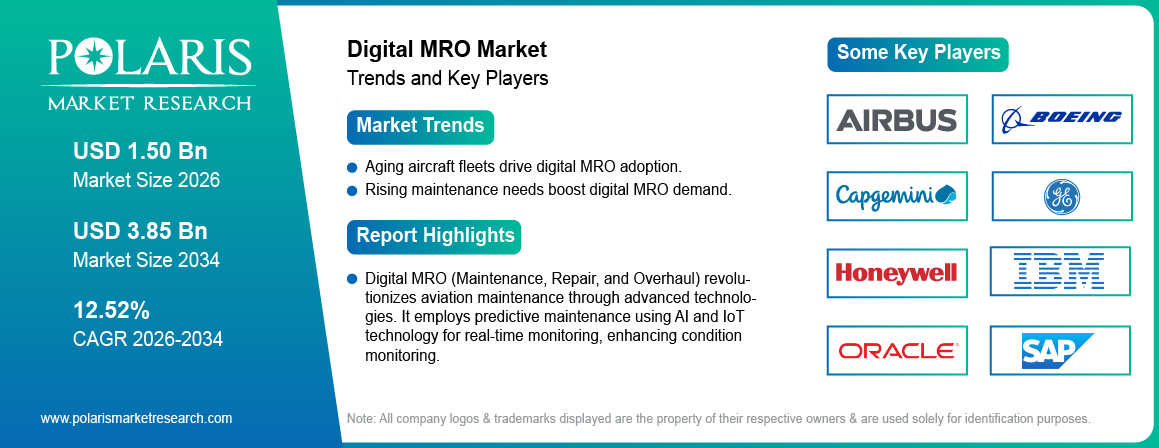
The increasing age of aircraft fleets has become a crucial driver, spurring the integration of digital Maintenance, Repair, and Overhaul solutions. As a growing number of aircraft exceed their initial design life, the aviation sector encounters distinct challenges in maintenance, reliability, and efficiency. In response, targeted digital MRO technologies have emerged to meet the specific requirements of aging aircraft. Adopting digital MRO within this context not only prolongs the operational lifespan of these aircraft but also addresses safety issues and ensures compliance with regulations. Faced with the unique challenges posed by aging fleets, the digital MRO market assumes an essential role, providing customized solutions to augment the reliability, safety, and cost-effectiveness of older aircraft.
Technological advancements are propelling the digital MRO market. Artificial intelligence utilizes predictive analytics to optimize maintenance schedules, while IoT devices enable real-time monitoring for continuous condition assessment. Big Data Analytics deciphers intricate patterns, aiding informed decision support in maintenance planning. Cloud computing fosters collaboration, augmented and virtual reality redefines technician training, and blockchain ensures transparent supply chain management. Digital twins facilitate in-depth understanding and proactive maintenance. Mobile applications empower technicians on the go, and robotics automate tasks with precision. The integration of 5G connectivity further enhances data transfer speeds, collectively reshaping the landscape of aircraft maintenance with sophistication and efficacy.
Source: Polaris Market Research Analysis
Report Segmentation
The market is primarily segmented based on application, technology, end user, and region.
| By Application | By Technology | By End User | By Region |
|
|
|
|
Source: Polaris Market Research Analysis
To Understand the Scope of this Report: Request Customization
By Application Analysis
The Predictive Maintenance Segment Accounted for a Significant Share in 2025
The predictive maintenance segment accounted for a significant market revenue share of 27.0% in 2025. Predictive maintenance employs advanced technologies to anticipate and address potential aircraft component issues before they lead to failures. Leveraging data analytics and machine learning, historical and real-time data are analyzed to predict maintenance requirements and identify patterns to foresee component failures. AI-driven early warning systems provide alerts for proactive maintenance measures. This approach optimizes maintenance schedules, minimizing downtime by tailoring activities to actual component conditions. The strategy focuses on reducing unscheduled downtime, enhancing fleet reliability, and realizing cost savings. Integration with digital twins allows for simulated analysis and predictive insights into component behavior. A continuous improvement loop refines predictive maintenance models, ensuring accuracy and effectiveness, marking a significant shift towards proactive and data-driven aircraft maintenance strategies.
By Technology Analysis
The Artificial Intelligence and Big Data Analytics Segment Accounted for the Largest Market Share in 2025
The artificial intelligence and big data analytics segment accounted for the largest market share of 22.0% in 2025. The integration of artificial intelligence and big data analytics has revolutionized digital MRO, optimizing aircraft maintenance across various dimensions. AI predicts equipment failures and optimizes schedules, while big data analytics identifies operational efficiencies. IoT sensors provide real-time data for continuous condition monitoring, and AI aids fault detection. Predictive analytics streamline inventory management, forecasting spare parts needs, and enhancing workforce efficiency. This synergy fosters a data-driven, proactive approach to maintenance, improving safety, cost-effectiveness, and operational excellence in the Digital MRO market landscape.
By End User Analysis
The Mros Segment Accounted for the Largest Market Share in 2025
The MRO segment accounted for the largest market share of 38.0% in 2025. MROs are revolutionizing operations with digital aircraft maintenance tools. Predictive maintenance systems, driven by data analytics and machine learning, forecast potential equipment failures, reducing downtime. IoT and sensors provide real-time monitoring for timely interventions and heightened maintenance precision. AR and VR enhance training and troubleshooting. Digital twins enable proactive maintenance planning, while mobile applications and cloud-based platforms streamline communication and data sharing. Electronic Flight Bags (EFBs) replace paperwork, improving efficiency and supply chain tools with blockchain to ensure inventory control and transparency. This collective integration of digital tools reflects a transformative shift toward data-driven, efficient, and proactive maintenance in the aviation industry.
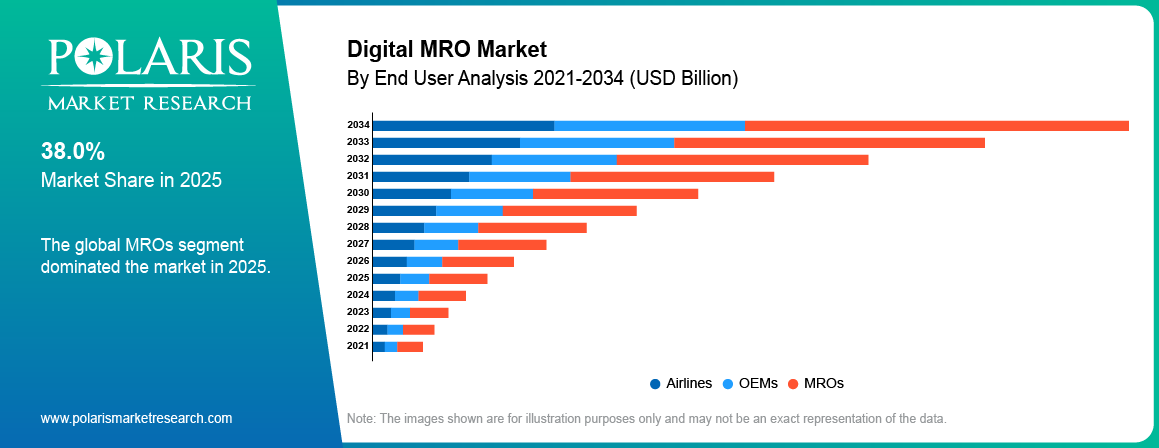
Source: Polaris Market Research Analysis
Regional Analysis
Asia-Pacific is Expected to Experience Significant Growth During the Forecast Period
Asia Pacific is expected to experience significant growth at a CAGR of 15.28% during the market forecast period owing to rising air traffic and technological advancements. Strategic collaborations among companies, coupled with government initiatives to promote digitalization in aviation, have further shaped the market. The Asia-Pacific region has also witnessed an increased adoption of digital technologies like IoT and AI in MRO processes for improved efficiency. The proliferation of low-cost carriers also influenced MRO strategies, emphasizing cost-effective maintenance solutions.
North America's digital MRO market held 36.0% share in 2025. There is a growing exploration of blockchain for transparent supply chain management, ensuring the authenticity of spare parts. Technologies such as augmented and virtual reality technologies are increasingly being adopted for immersive training and complex procedure visualization. The adoption of IoT and sensors for real-time monitoring, increased integration of AI and ML algorithms for predictive maintenance, and advanced data analytics to optimize MRO processes have also gained traction. Cloud-based solutions have gained traction for enhanced accessibility and collaboration.
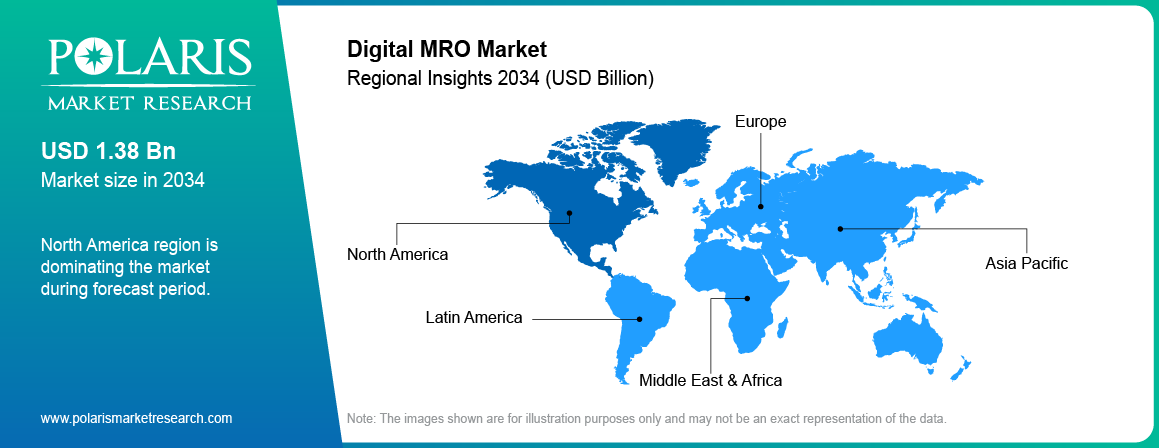
Source: Polaris Market Research Analysis
Competitive Insight
The market faces fierce rivalry, with companies leveraging cutting-edge technology, top-notch product offerings, and a robust brand reputation to propel revenue expansion. Key players employ diverse tactics, including dedicated research and development, strategic mergers and acquisitions, and continuous technological advancements. These strategic maneuvers are aimed at broadening their product ranges and sustaining a competitive advantage. The market dynamic is shaped by constant innovation and a commitment to delivering high-quality solutions, underscoring the importance of strategic initiatives in ensuring sustained competitiveness.
Some of the major players operating in the global market include:
- Airbus
- Boeing
- Capgemini
- General Electric
- Hexaware Technologies
- Honeywell International Inc.
- IBM
- IFS AB
- Lufthansa Technik
- Oracle Corporation
- Ramco Systems
- Rusada
- SAP SE
- SITA
- Swiss AviationSoftware
Recent Developments
- January 2026: AAR CORP. announced that Thai Airways selected Trax and Aerostrat to drive the airline’s digital MRO transformation. (Source: aarcorp.com)
Report Scope
| Report Attributes | Details |
| Market size value in 2025 | USD 1.33 billion |
| Market size value in 2026 | USD 1.50 billion |
| Revenue forecast in 2034 | USD 3.85 billion |
| CAGR | 12.52% from 2026 - 2034 |
| Base year | 2025 |
| Historical data | 2021 - 2024 |
| Forecast period | 2026 - 2034 |
| Quantitative units | Revenue in USD billion and CAGR from 2026 to 2034 |
| Segments covered | By Application, By Technology, By End User, By Region |
| Regional scope | North America, Europe, Asia Pacific, Latin America, Middle East & Africa |
| Customization | Report customization as per your requirements with respect to countries, region, and segmentation. |
Source: Polaris Market Research Analysis
Digital MRO Market FAQ's
The global digital MRO market size is expected to reach USD 3.85 billion by 2034
Airbus, Boeing, Capgemini, General Electric, IBM, Ramco Systems, and SAP SE are the top market players in the market.
The market in Asia Pacific is expected to record a significant CAGR of 15.28% during the forecast period.
The global digital MRO market accounted for 38.0%.
The Digital MRO Market report covering key segments are application, technology, end user, and region.
Download Sample Report of Digital MRO Market
Please fill out the form to request a customized copy of the research report.


