
Drip Irrigation Market Share, Size, Trends, Industry Analysis Report, 2026 - 2034
REPORT DETAILS
Drip Irrigation Market Summary
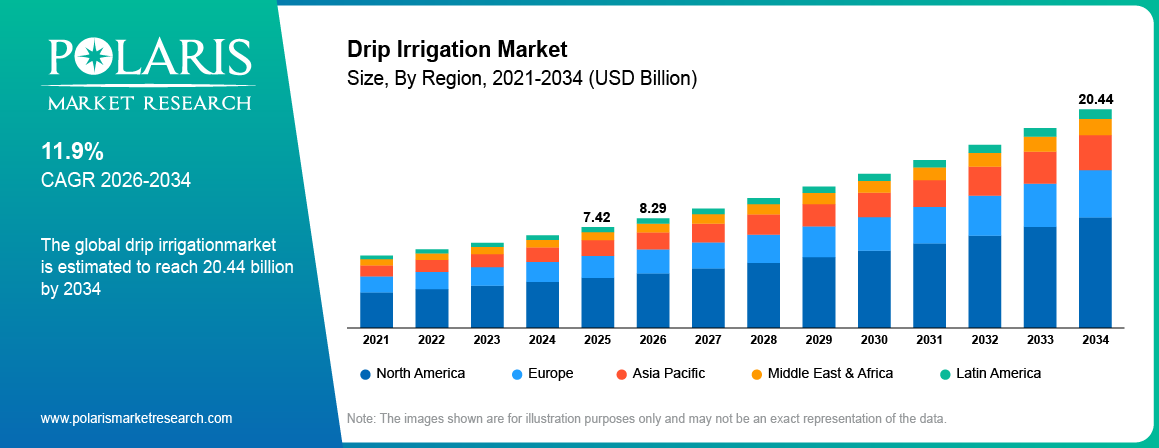
The global drip irrigation market was valued at USD 7.42 billion in 2025 and is expected to grow at a CAGR of 11.9% during the forecast period. Key factors driving the demand includes rising government initiatives and the increasing popularity of drip irrigation among crop growers.
Market Statistics
Drip Irrigation Market Key Takeaways
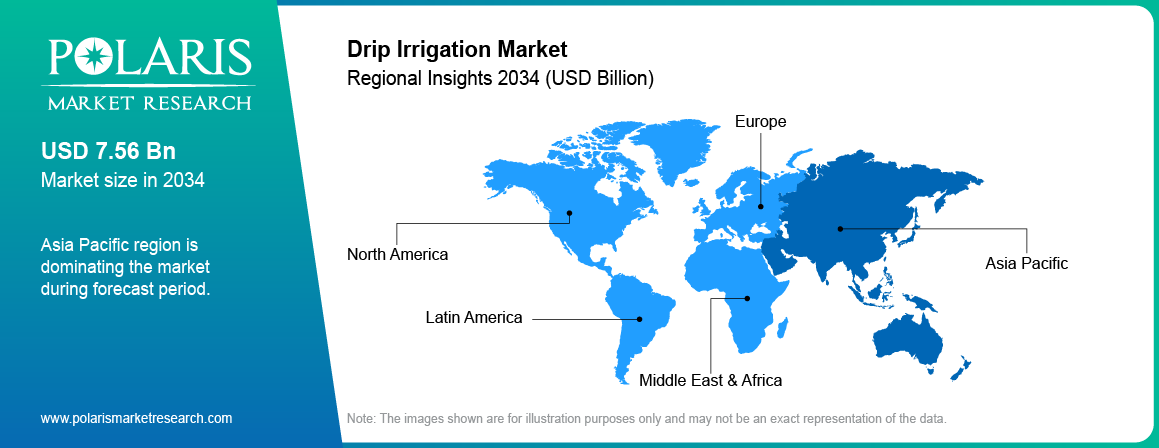
- The Asia Pacific held the largest revenue share of 37.0% in 2025. This is due to the regulatory initiatives for the enhancement of efficiency of water usage and to promote sustainable agriculture for food security.
- North America is expected to witness significant growth at a CAGR of 10.5% during the forecast period. This is due to the region's large-scale farming operations and the incorporation of precision farming techniques.
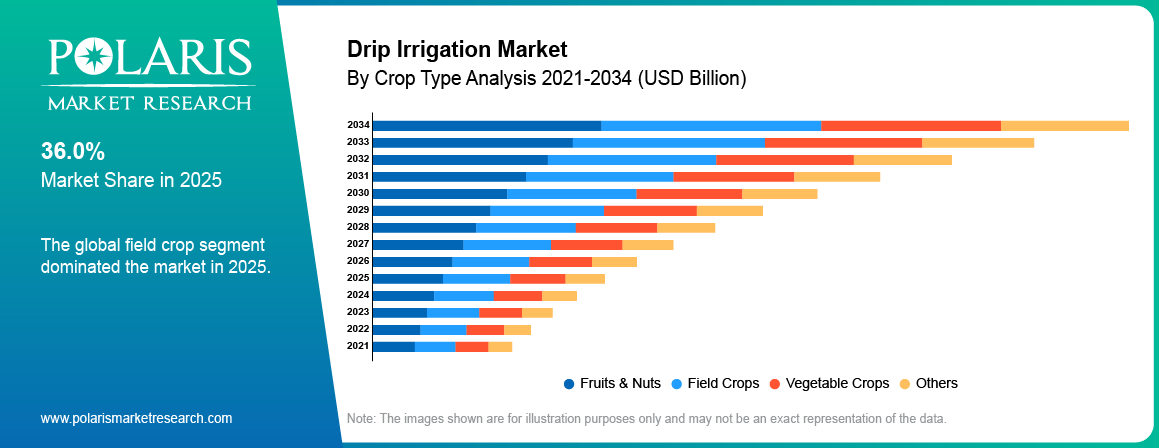
- In 2025, the field crop segment dominated the global market with 36.0% share. This is due to its numerous advantages, such as helping to increase profit percentages and requiring fewer fertilizers and water.
- The drip tubes/drip lines segment is expected to witness substantial growth at a CAGR of 11.40% during the forecast period. This is due to easy installation and high efficiency.
Note: Figures and projections outlined in this report are the result of Polaris Market Research’s proprietary analytical processes, grounded in the latest available datasets and market observations.
What is Drip Irrigation?
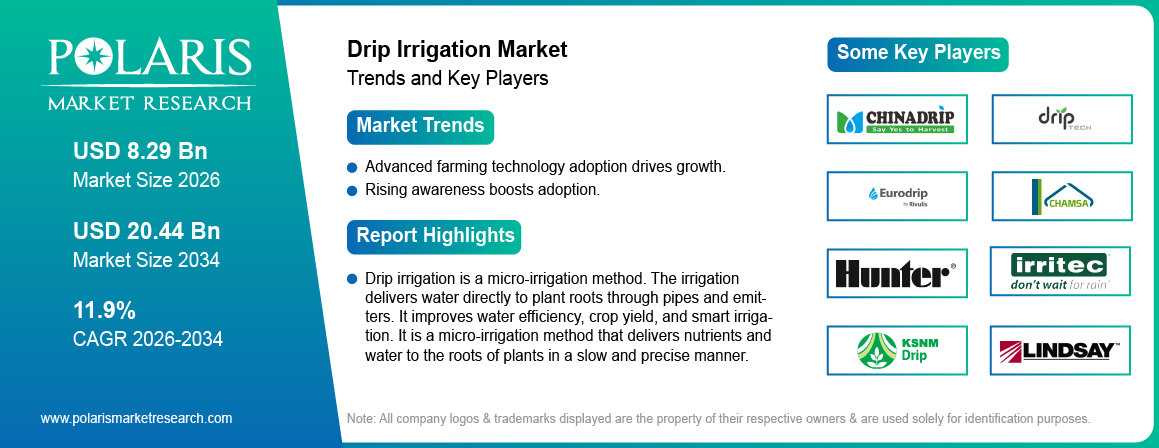
Drip irrigation is a micro-irrigation method. The irrigation delivers water directly to plant roots through pipes and emitters. It improves water efficiency, crop yield, and smart irrigation. It is a micro-irrigation method that delivers nutrients and water to the roots of plants in a slow and precise manner. Increasing awareness of the benefits of the technique, such as reduced water usage and improved crop quality, along with government initiatives aimed at increasing adoption, is expected to drive demand in the industry during the forecast period. It entails laying tubes with emitters next to the crops in the soil. The injectors gently trickle moisture into the surrounding soil. It is 90% effective in enabling crops to utilize the water delivered, contrasting with other methods, including sprinklers, which are approximately 65-75% effective. It also reduces waste and evaporation. It progressively delivers water to the bottom of the plant, where it is vitally required.
AI Impact on Drip Irrigation Market
- Data analysis enables precision farming by delivering water whenever needed.
- Forecasting weather and soil data automates watering for perfect growth.
- Monitors leakage and clogs to instantly identify and locate issues.
- Water optimization and nutrient use for healthy and productive plants enhance crop yields and overall health.
Source: Polaris Market Research Analysis
To Understand More About this Research: Download Sample Report
Source: Polaris Market Research Analysis
Difference Between Drip Irrigation vs Sprinkler Irrigation
| Parameter | Drip Irrigation | Sprinkler Irrigation |
| Water Efficiency | Highly water-efficient as water is delivered directly to plant roots with minimal wastage | Lower water efficiency due to runoff, overspray, and uneven distribution |
| Installation Cost | Higher initial installation cost because of tubing, emitters, and filtration systems | Comparatively lower installation cost with simpler infrastructure requirements |
| Evaporation Loss | Very low evaporation loss since water is applied near the soil surface | Higher evaporation loss as water is sprayed into the air |
| Crop Suitability | Ideal for row crops, orchards, vineyards, vegetables, and greenhouse farming | Suitable for cereals, lawns, fodder crops, and large open-field cultivation |
| Energy Usage | Requires lower water pressure, resulting in lower energy consumption | Requires higher pressure pumping systems, leading to greater energy usage |
| Irrigation Precision | Offers precise and controlled water application directly to roots | Provides broader coverage but lower precision compared to drip systems |
| Weed Growth | Reduces weed growth by irrigating only targeted areas | Can promote weed growth due to watering of surrounding soil areas |
| Maintenance Requirements | Requires regular maintenance to prevent clogging of emitters | Easier maintenance but susceptible to nozzle wear and wind interference |
| Soil Erosion Risk | Minimal soil erosion due to slow water delivery | Higher possibility of soil erosion under excessive spray intensity |
| Climate Suitability | Highly effective in arid and water-scarce regions | More suitable for moderate climates with adequate water availability |
Source: Polaris Market Research Analysis
Market Dynamics
Growth Drivers
How Increasing Popularity of Drip Irrigation Among Crop Growers is Driving the Market Expansion?
The popularity of these technologies in farmland and fields worldwide has remained at an all-time high due to the numerous benefits. Consequently, the industry worldwide has been growing at a similar rate, and this trend is likely to persist during the projection period. These systems are used in landscapes and surroundings with unusual shapes, as well as areas with irregular terrain or soil characteristics. Such methods are more adaptable, allowing farmers and gardeners to design a network as required. This often results in improved system performance.
Furthermore, a rise in awareness of these benefits, with the adoption of modern techniques, is expected to boost the expansion opportunities.
Report Segmentation
The market is primarily segmented based on component, crop type, application, and region.
| By Component | By Crop Type | By Application | By Region |
|
|
|
|
Source: Polaris Market Research Analysis
Know more about this report: Download Sample Report
Segmental Insights
Crop Type Analysis
Why Crop Segment Dominated the Market in 2025?
In 2025, the field crop segment held the largest share of the global market valued at 36.0%, as it has many advantages, including increasing profit percentages as it requires less fertilizer and water. Additionally, with a growing population due to urbanization, farmers are now growing sugarcane and corn, which will further grow the segment during the forecast period. Drip systems can scale, allowing for the possibility of large monoculture farming of these staple crops, which again addresses the need for maximizing yield per hectare while saving an essential resource, water. The adoption of the irrigation method for field crops evolves from efficiency measures to a need for sustainable or profitable agriculture as the global demand for food becomes stronger. This trend is supported further by progressive agricultural policies fostering water-saving technology.
Source: Polaris Market Research Analysis
Component Analysis
What is the Reason Behind the Drip Tubes/Drip Lines Segment's Substantial Growth?
Drip Tubes/Drip Lines segment is expected to witness substantial growth at a CAGR of 11.40% during the forecast period, owing to easy installation and high efficiency. These tubes are made to work in extreme conditions and are UV stabilized, which encourages the growth of the segment. In addition, the flexibility of the drip tube designs allows for various field layouts and cropping designs, including orchards and row crops. The maintenance requirements of drip tubing are relatively low with long operational life, providing a clear cost management advantage to farming. Recent advances in manufacturing are also materializing more durable emitters that resist clogging, enabling greater reliability of the whole irrigation system. Here is the backdrop of practicality, durability, and value settings that quickly enhances their growth in the market.
Technological Advancements in Drip Irrigation
| Technology | Innovation & Industry Impact |
| Solar-Powered Irrigation Systems | Solar-driven pumps reduce dependence on grid electricity and diesel, lowering operational costs and supporting sustainable agricultural irrigation practices. |
| AI-Based Irrigation Scheduling | Artificial intelligence analyzes weather conditions, soil moisture, and crop requirements to optimize irrigation timing and water usage efficiency. |
| Self-Cleaning Emitters | Advanced emitter technologies minimize clogging issues, improve water flow consistency, and reduce maintenance requirements in drip irrigation networks. |
| Wireless Monitoring Systems | IoT-enabled sensors and wireless platforms provide real-time monitoring of soil moisture, pressure levels, and irrigation performance for precision farming. |
| Automated Fertigation Technologies | Integrated fertigation systems automatically deliver nutrients along with irrigation water, enhancing crop productivity and nutrient management efficiency. |
| Smart Control Valves | Digitally controlled valves enable automated water distribution, remote operation, and precise irrigation management across large agricultural fields. |
| Remote Mobile Applications | Smartphone-based irrigation management platforms allow farmers to monitor and control irrigation systems remotely, improving operational flexibility. |
| Climate-Smart Irrigation Analytics | Data analytics platforms utilize satellite and climate data to improve water conservation strategies and support climate-resilient agriculture. |
| Pressure Compensation Technology | Pressure-compensating drippers ensure uniform water distribution across uneven terrains and long-distance irrigation systems. |
| Integrated Filtration Systems | Advanced filtration technologies improve water quality, prevent clogging, and enhance overall irrigation system durabi |
Source: Polaris Market Research Analysis
Geographic Overview
Why Asia Pacific Held the Largest Revenue Share in 2025?
In 2025, the Asia Pacific held the largest revenue share of 37.0%. The increasing upgradation of technology, coupled with the rising adoption of micro-irrigation in emerging economies such as China and India, is expected to boost market demand throughout the forecast period. This growth is further boosted by the regulatory initiatives for the enhancement of efficiency of water usage and to promote sustainable agriculture for food security. The presence of large agricultural lands, combined with the rising need to address water scarcity, creates opportunities for expansion.
Furthermore, the regulatory effort to encourage such systems through subsidies, foreign investments, and low-interest rates boost the opportunities to expand. For instance, in August 2024, Jain Irrigation collaborated with the Central Potato Research Institute (CPRI) to launch the innovative Kufri FryoM potato variety. The aim is to revolutionize potato farming in India.
What are the factors for North America's Significant Growth?
North America is expected to witness significant growth at a CAGR of 10.5% during the forecast period. This is due to the progress of agriculture and increased environmental reasons. The region's operation of large-scale farming have benefited from the incorporation of precision farming techniques to optimize the use of resources and improve crop resilience. Regulatory support and subsidized transitions have helped adapt efficient water systems, providing technology to smart agriculture infrastructure. Furthermore, a more sophisticated production agriculture sector with a high degree of awareness and acceptance of high-end technology in irrigation methods has led to the adoption of advanced drip solutions. Therefore, the widespread incorporation of technology has led to an increased adoption of drip irrigation in prominent row crops and high-value agriculture.
Source: Polaris Market Research Analysis
Competitive Insight
Major market players operating in the global drip irrigation market include Chinadrip Irrigation Equipment Co., Ltd., Driptech Incorporated, EPC Industries Limited, Eurodrip S.A, Grupo Chamartin Chamsa, Hunter Industries, Irritec S. p. A, Jain Irrigation Systems, KSNM Drip, Lidsay Corporation, Metzer Group, Microjet Irrigation, Netafim, Rain Bird Corporation, Rivulus Irrigation, and The Toro Company. These players are adopting organic and inorganic tactics such as new product releases, collaborations & acquisitions, partnerships & mergers in order to increase their market presence and compete in the global market.
Industry Developments
- March 2026: Irrigreen, in partnership with Netafim, launched the Smart Drip System. The company announced that it is expanding its platform from turf irrigation into garden beds and landscaped areas. (Source: lawnandlandscape.com)
- February 2026: Orbia Netafim announced two major water stewardship initiatives with Amazon India. The company claims that these initiatives will save approximately 325 million liters of water per year through advanced drip irrigation across India. (Source: netafim.com)
Drip Irrigation Market Report Scope
| Report Attributes | Details |
| Market size value in 2025 | USD 7.42 Billion |
| Market size value in 2026 | USD 8.29 Billion |
| Revenue forecast in 2034 | USD 20.44 Billion |
| CAGR | 11.9% from 2026 - 2034 |
| Base year | 2025 |
| Historical data | 2021 - 2024 |
| Forecast period | 2026 - 2034 |
| Quantitative units | Revenue in USD billion and CAGR from 2026 to 2034 |
| Segments covered | By Component, By Crop Type, By Application, By Region |
| Regional scope | North America, Europe, Asia Pacific, Latin America; Middle East & Africa |
| Key companies | Chinadrip Irrigation Equipment Co., Ltd., Driptech Incorporated, EPC Industries Limited, Eurodrip S.A, Grupo Chamartin Chamsa, Hunter Industries, Irritec S. p. A, Jain Irrigation Systems, KSNM Drip, Lidsay Corporation, Metzer Group, Microjet Irrigation, Netafim, Rain Bird Corporation, Rivulus Irrigation, and The Toro Company. |
Source: Polaris Market Research Analysis
Drip Irrigation Market FAQ's
• The global market size was valued at USD 7.42 billion in 2025 and is projected to grow to USD 20.44 billion by 2034.
• The global market is projected to register a CAGR of 11.9% during the forecast period.
• The Asia Pacific held the largest revenue share of 37.0% in 2025.
• A few of the key players in the market are Chinadrip Irrigation Equipment Co., Ltd., Driptech Incorporated, EPC Industries Limited, Eurodrip S.A, Grupo Chamartin Chamsa, Hunter Industries, Irritec S. p. A, Jain Irrigation Systems, KSNM Drip, Lidsay Corporation, Metzer Group, Microjet Irrigation, Netafim, Rain Bird Corporation, Rivulus Irrigation, and The Toro Company.
• In 2025, the field crop segment dominated the global market with 36.0% share.
• The drip tubes/drip lines segment is expected to witness substantial growth at a CAGR of 11.40% during the forecast period.
Download Sample Report of Drip Irrigation Market
Please fill out the form to request a customized copy of the research report.


