
Drug Testing Market Share, Size, Trends, Industry Analysis Report, 2026 - 2034
REPORT DETAILS
Drug Testing Market Summary
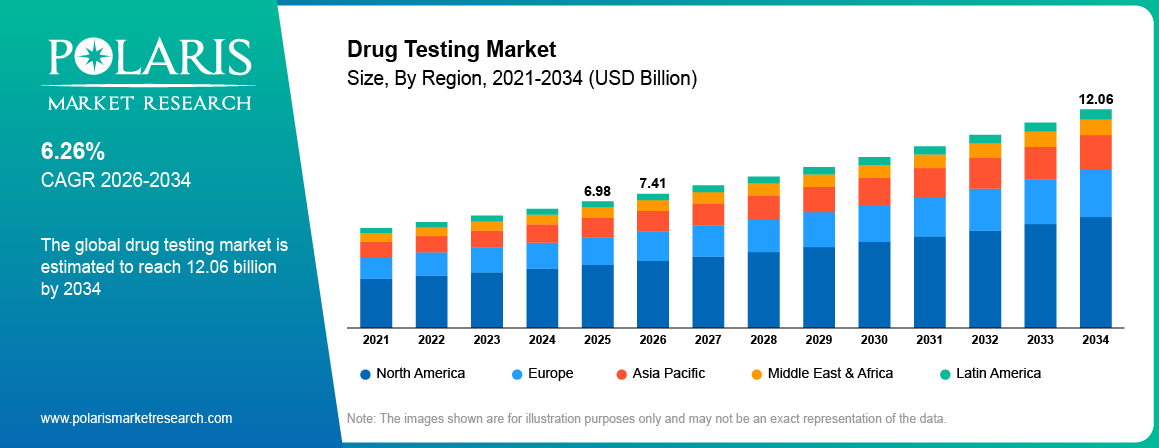
The global drug testing market is estimated around USD 6.98 Billion in 2025,?with consistent growth anticipated during 2026–2034. Growth is driven by rising substance abuse cases and strict workplace safety regulations across global markets. The market is projected to grow at a CAGR of 6.26%during the forecast period.
Market Statistics
Key Takeaways
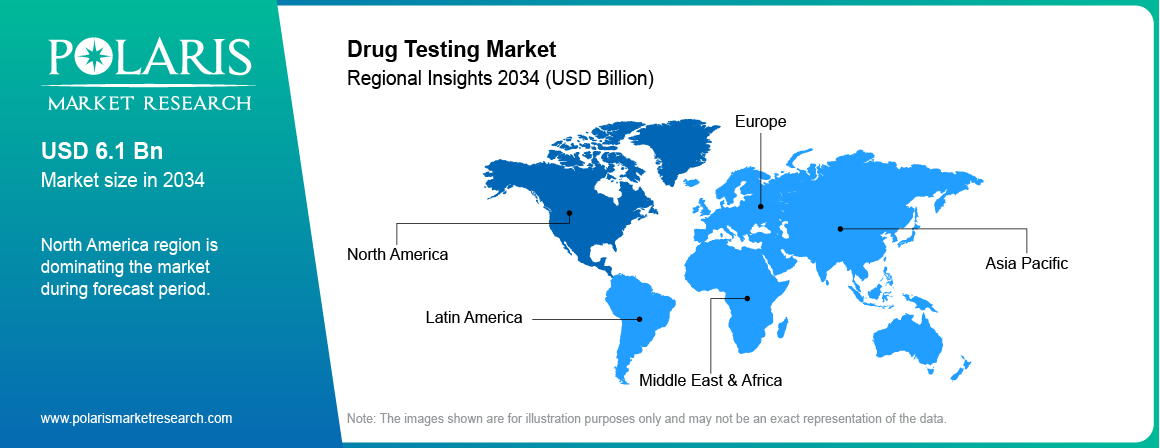
- North America dominated revenue, accounting for approximately 39.25% market share due to strong regulatory enforcement and high testing volume.
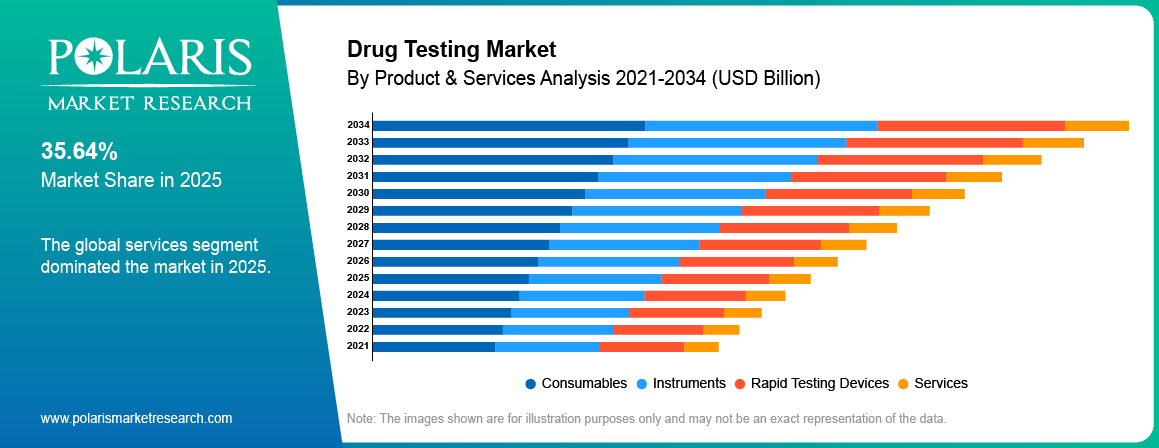
- Rapid testing devices show high adoption, holding approximately 34.80% market share due to faster results and ease of use.
- Companies are increasing investment in portable drug testing devices, expected to register a CAGR of approximately 11.65% to improve efficiency.
- Service providers are focusing on expanding laboratory networks and on-site testing solutions, contributing approximately 29.40% market share.
- Demand for workplace safety is increasing adoption of routine drug screening programs, projected to grow at a CAGR of approximately 10.90%.
- Rising healthcare monitoring is strengthening diagnostic testing demand, expected to witness a CAGR of approximately 9.75%.
Industry Dynamics
- Increasing workplace drug testing programs are driving service demand.
- Expansion of healthcare and forensic testing is supporting market growth.
- High cost of advanced instruments is creating adoption challenges.
- Advancements in rapid and non-invasive testing methods are creating long-term growth opportunities in the drug testing market.
What is the Drug Testing Market?
Drug testing refers to the examination of biological specimens like blood, urine, and saliva to identify any substance traces present. The process finds application in various sectors like healthcare, occupational safety, law enforcement, and sport surveillance. This is different from routine medical diagnostics, which focus on disease identification and treatment. According to the global drug testing market analysis, the use of drug testing is increasing due to rising substance abuse cases and regulatory enforcement.
The sector functions in a healthcare and forensic setting characterized by stringent accuracy and regulatory compliance. The increasing demand for drug testing results from strict workplace policies and stringent government guidelines. Drug testing market insights show that service providers are focusing on faster result delivery and improved testing technologies. The drug testing industry is aligning with regulatory standards and evolving client requirements.
Source: Polaris Market Research Analysis
To Understand More About this Research:Download Sample Report
There is growing demand for drug testing services due to increasing workplace screening programs and expansion of forensic applications. Rising adoption in sports organizations and rehabilitation centers is supporting service utilization. Increasing investment in point-of-care diagnostics and expansion of lab facilities is driving demand growth. This trend drives growth in the global drug testing market analysis.
Drivers & Opportunities
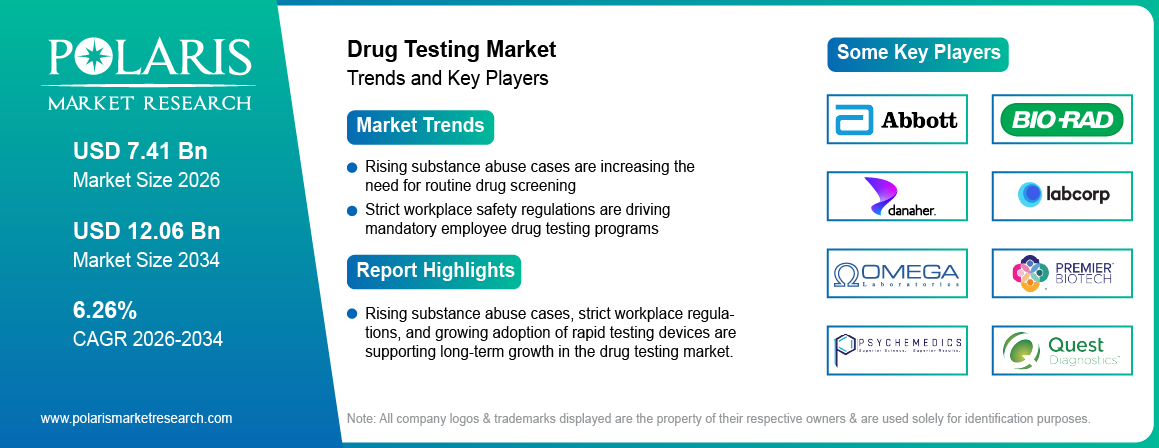
Rising substance abuse cases are increasing the need for routine drug screening: The rise in the number of substance abuse cases has led to an increase in the requirement of drug tests in many places like the workplace, healthcare institutions, and even law enforcement agencies. According to World Health Organization, about 2.6 million people die due to the use of alcohol each year (4.7% of total deaths), and the usage of psychoactive drugs kills about 0.6 million people each year, mostly men.Early detection and monitoring programs are implemented by governments and organizations alike. More testing leads to the increased need for laboratories and rapid test kits. This has been positively impacting the global market for drug testing.
Strict workplace safety regulations are driving mandatory employee drug testing programs: Workplace safety policies have been enforced in the implementation of mandatory drug testing in various industries including transportation, manufacturing, and construction. Businesses have become interested in lowering workplace accidents. The government agencies have been enforcing regulations that involve regular and random drug tests, thus increasing drug testing demand.
Restraints & Challenges
High cost of advanced testing equipment is limiting adoption among small laboratories: Modern techniques for drug testing involve high initial capital and operational expenses. Small labs lack the financial resources required for implementing these advanced techniques. Such an expense-related factor has hampered further growth in the testing capacity of laboratories in cost-sensitive areas.
Opportunity
Growing adoption of point-of-care diagnostics services is creating new revenue streams: The use of portable testing devices is making drug testing easier to carry out on-site. Businesses are increasingly concentrating on getting quick results, reducing dependence on laboratory services. The creation of user-friendly testing kits is leading to more uses of drug testing in both office environments and remote sites. In May 2025, scientists from the University of Bath have come up with a device for detecting street drugs immediately.This trend is giving new growth prospects to the drug testing market.
Source: Polaris Market Research Analysis
Segmental Insights
This report offers detailed coverage of the drug testing market by product & services, sample type, drug type, and end-use industry to help readers identify the fastest expanding and most attractive demand segments.
By Product & Services
-
Services
Services segment dominated the market in 2025, driven by rising outsourcing of drug testing activities by organizations and healthcare providers. There is an increase in the amount of sample collection, which has increased the dependence on customized testing services. The development of workplace and forensic testing programs has been fueling the need for service-based approaches.
-
Rapid Testing Devices
The rapid testing devices market is estimated to experience the highest CAGR during the forecast period owing to rising demand for rapid testing devices that can perform tests at the point of care and give instant results. Organizations are concentrating on lowering the turnaround time for testing procedures.
By Sample Type
-
Urine Samples
The urine samples category held the largest market share in 2025 owing to its extensive usage in workplace and clinical drug testing applications. Ease of collection and affordability are factors driving its widespread use. The high sensitivity of this test type to various drugs is another driver.
-
Oral Fluid Samples
Oral fluid samples segment is projected to grow at the fastest CAGR during the forecast period, due to increasing adoption of non-invasive testing methods. Increased ease of sampling, along with low chances of tampering with samples, is expected to boost demand. The growth of roadside and workplace drug testing activities will fuel the market.
By Drug Type
-
Cannabis/Marijuana
The Cannabis/Marijuana segment had the largest share of the market in 2025 due to high usage levels, coupled with monitoring in several regions. As per the statistics provided by the National Center for Drug Abuse Statistics, there were 61.5 million adults who have consumed marijuana in 2024 within the US alone, which constitutes 23.4% of the population.High prevalence is supporting continuous testing demand.
-
Opioids
Opioids segment is projected to grow at the fastest CAGR during the forecast period, due to rising cases of opioid misuse and overdose. Governments and healthcare providers are increasing screening efforts to control abuse. Expansion of rehabilitation and monitoring programs is supporting segment growth.
By End-Use Industry
-
Workplace Testing
The workplace testing segment was dominating the market in 2025 owing to the stringent safety laws coupled with mandatory testing of employees. Industries having significant safety hazards are now adopting the process of random and regular testing for drugs.
-
Healthcare & Diagnostics
Healthcare & diagnostics segment is projected to grow at the fastest CAGR during the forecast period, due to increasing use of drug testing in clinical diagnostics and treatment monitoring. Expansion of diagnostic laboratories and rehabilitation centers is supporting demand. Rising focus on patient monitoring is accelerating segment growth.
Source: Polaris Market Research Analysis
Regional Analysis
North America Market Assessment
North America drug testing market dominated the global market in 2025, driven by strict workplace safety regulations and high substance abuse monitoring. According to the data by National Center for Drug Abuse Statistics, there were about 47.7 million Americans aged 12+ using illegal drugs within the previous 30 days of 2023, constituting about 16.8% of the population and having increased by 1.9% annually compared to last year.The US market is the most advanced in the region owing to strict regulations as well as widespread use of drug tests in workplaces. The presence of advanced laboratory facilities and development of rapid tests will drive market growth in coming years.
Asia Pacific Drug Testing Market Insights
Asia Pacific drug testing market is projected to grow at the fastest CAGR during the forecast period, driven by rising substance abuse cases and expanding workplace regulations. Some of the major countries including India and China have been showing an upsurge due to an increase in their industrial labor force as well as healthcare infrastructure. The expansion of diagnostic centers as well as government policies towards controlling drug abuse will boost market growth. For example, in April 2026, Hong Kong introduced phased independent assessment process for new drugs.
Europe Drug Testing Market Overview
The Europe drug testing market occupied the second highest market share, backed up by compliance regulations and workplace screening applications. For example, European Union Drugs Agency has developed an EU drug alert system in November 2025 in order to prepare for and manage any potential drug risks in the region.Moreover, demand remains stable in countries like Germany, France, and UK as they have well-structured health safety regulations and monitoring programs. The development of forensic testing and anti-doping efforts boosts the regional market.
LATAM & MEA Emerging Markets
The Latin America and Middle East & Africa drug testing market is registering steady growth as a result of growing awareness and improvement in the healthcare infrastructure. Countries like Brazil and South Africa are implementing drug testing systems in workplaces and policing activities. Expansion of private laboratories and rising focus on public safety are supporting demand. Gradual regulatory development is creating new growth opportunities in these regions.
Source: Polaris Market Research Analysis
Competitive Landscape, Pricing & Consumer Insights
Drug testing services have a moderate level of fragmentation, with international diagnostic companies and local laboratories competing in the space. The key competitive factor is accurate results, fast processing, and low costs. Leading organizations continue to enhance their rapid testing products and expand collaborations for better positioning in the market.
The major industry participants include Abbott Laboratories, Bio-Rad Laboratories, Danaher Corporation, Labcorp Holdings Inc., Omega Laboratories, Premier Biotech, Psychemedics Corporation, Quest Diagnostics, Roche Diagnostics, Siemens Healthineers, Thermo Fisher Scientific Inc., OraSure Technologies Inc., and others.
Trends, Innovations & Future Outlook
Emerging Technologies (AI, Remote Testing)
In terms of developments, the use of artificial intelligence is facilitating the improvement of accuracy rates and processing times with the help of automated data processing technology. The use of remote drug testing is also emerging with digital tracking of samples and telemedicine capabilities. Portable drug testing equipment is becoming increasingly popular in the space.
Future Market Outlook (2026–2034)
The future of drug testing is shaped by increasing adoption of rapid and non-invasive testing methods. Growth in decentralized testing and expansion of point-of-care solutions are strengthening market demand. Integration of digital platforms for reporting and compliance is improving operational efficiency.
Key Players
- Abbott Laboratories
- Bio-Rad Laboratories
- Danaher Corporation
- Labcorp Holdings Inc.
- Omega Laboratories
- Premier Biotech
- Psychemedics Corporation
- Quest Diagnostics
- Roche Diagnostics
- Siemens Healthineers
- Thermo Fisher Scientific Inc.
- OraSure Technologies Inc.
Industry Developments
- April 2026: Oklahoma DPS has launched a pilot program using roadside drug swab tests to detect opioids and other substances quickly and improve impaired driving enforcement. [source: Komonews.com]
- April 2026: InOut Labs has launched nationwide oral fluid drug testing services to enable fast, non-invasive substance detection across the US. [source: inoutlabs.com]
Drug Testing Market Segmentation
By Product & Services Outlook (Revenue, USD Billion, 2021-2034)
- Consumables
- Instruments
- Rapid Testing Devices
- Services
By Sample Type Outlook (Revenue, USD Billion, 2021-2034)
- Urine Samples
- Oral Fluid Samples
- Hair Samples
- Others
By Drug Type Outlook (Revenue, USD Billion, 2021-2034)
- Alcohol
- Cannabis/Marijuana
- Cocaine
- Opioids
- Amphetamine & Methamphetamine
- LSD
- Others
By End-Use Industry Outlook (Revenue, USD Billion, 2021-2034)
- Workplace Testing
- Healthcare & Diagnostics
- Law Enforcement & Forensics
By Regional Outlook (Revenue, USD Billion, 2021-2034)
- North America
- US
- Canada
- Europe
- Germany
- France
- UK
- Italy
- Spain
- Netherlands
- Russia
- Rest of Europe
- Asia Pacific
- China
- Japan
- India
- Malaysia
- South Korea
- Indonesia
- Australia
- Vietnam
- Rest of Asia Pacific
- Middle East & Africa
- Saudi Arabia
- UAE
- Israel
- South Africa
- Rest of Middle East & Africa
- Latin America
- Mexico
- Brazil
- Argentina
- Rest of Latin America
Drug Testing Market Report Scope
| Report Attributes | Details |
| Market Size in 2025 | USD 6.98 Billion |
| Market Size in 2026 | USD 7.41 Billion |
| Revenue Forecast by 2034 | USD 12.06 Billion |
| CAGR | 6.26% from 2026 to 2034 |
| Base Year | 2025 |
| Historical Data | 2021–2024 |
| Forecast Period | 2026–2034 |
| Quantitative Units | Revenue in USD Billion and CAGR from 2026 to 2034 |
| Report Coverage | Revenue Forecast, Competitive Landscape, Growth Factors, and Industry Trends |
| Segments Covered |
|
| Regional Scope |
|
| Competitive Landscape |
|
| Report Format |
|
| Customization | Report customization as per your requirements with respect to countries, regions, and segmentation. |
Source: Polaris Market Research Analysis
Drug Testing Market FAQ's
The global market size was valued at USD 6.98 Billion in 2025 and is projected to grow to USD 12.06 Billion by 2034
North America dominates the market due to strict workplace regulations and high adoption of drug screening programs.
Major applications include workplace testing, healthcare diagnostics, law enforcement, and sports screening.
A few of the key players in the market are Abbott Laboratories, Bio-Rad Laboratories, Danaher Corporation, Labcorp Holdings Inc., Omega Laboratories, Premier Biotech, Psychemedics Corporation, Quest Diagnostics, Roche Diagnostics, Siemens Healthineers, Thermo Fisher Scientific Inc., OraSure Technologies Inc., and others.
Key drivers include rising substance abuse cases, strict regulatory policies, and growing adoption of rapid testing devices.
Major demand comes from transportation, manufacturing, healthcare, and law enforcement sectors.
The market outlook remains strong due to increasing adoption of point-of-care testing and expansion of diagnostic services.
Download Sample Report of Drug Testing Market
Please fill out the form to request a customized copy of the research report.


