
Feed Mycotoxin Detoxifiers Market Demand, Industry Trends, 2026-2034
REPORT DETAILS
Feed Mycotoxin Detoxifiers Market Summary
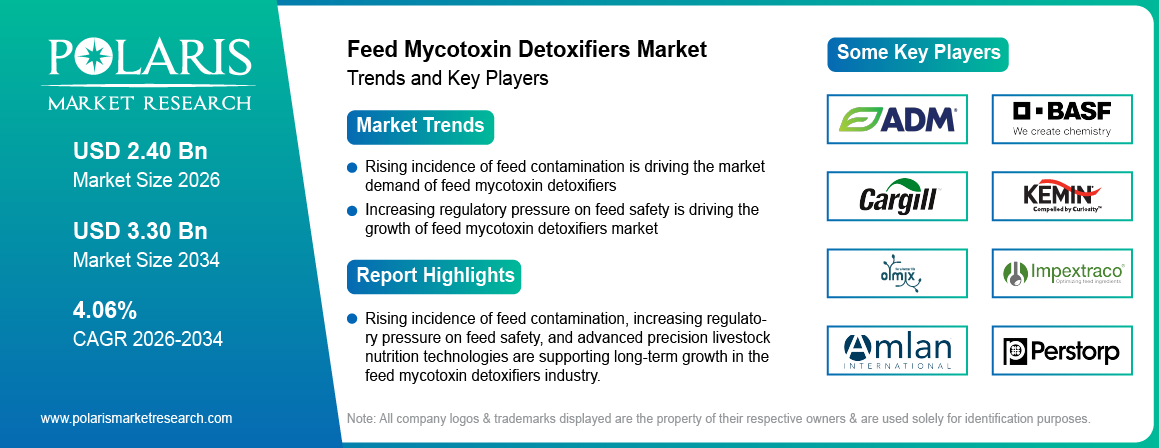
The global feed mycotoxin detoxifiers market is estimated around USD 2.30 Billion in 2025,with consistent growth anticipated during 2026–2034. Growth is driven by rising incidence of feed contamination, and increasing regulatory pressure on feed safety. The market is projected to grow at a CAGR of 4.06% during the forecast period.
Market Statistics
Key Takeaways
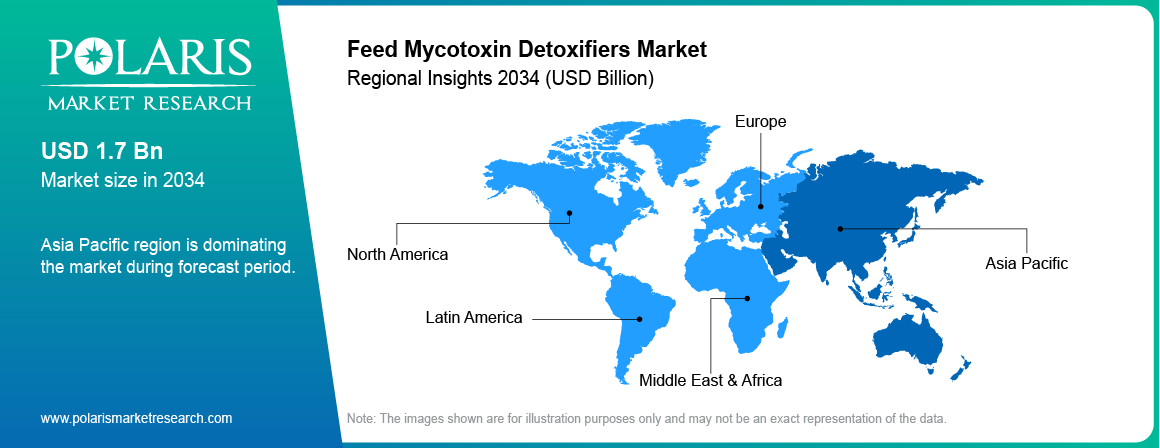
- Asia Pacific dominated the market in 2025 with 33.0% share, driven by driven by growing poultry and aquaculture industries across China, India, Vietnam, and Indonesia.
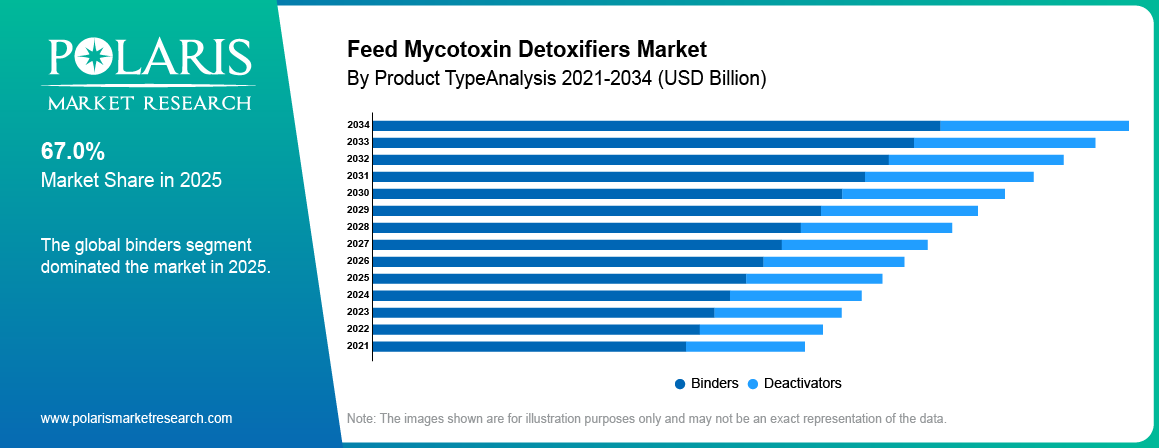
- Binders segment dominated the market in 2025 with 67.0% share, driven by cost-effectiveness and broad commercial adoption across poultry and dairy industries.
- Poultry segment dominated the market in 2025 accounting for 38.0% share, due to intensive commercial poultry farming, and high feed consumption volumes globally.
- Organic segment is projected to show rapid growth at a CAGR of 4.9%, due to increasing demand for sustainable feed additives and multi-toxin detoxification efficiency.
- Major companies operating in the market include ADM, BASF SE, Cargill, Inc., Kemin Industries, Inc., Olmix Group, Impextraco N.V., Special Nutrients, Inc., Amlan International, and others.
Industry Dynamics
- Rising incidence of feed contamination is driving market growth.
- Increasing regulatory pressure on feed safety is accelerating detoxifier adoption.
- High costs of biological detoxifiers are restraining market growth.
- Advanced precision livestock nutrition technologies are creating growth opportunities in the market.
What is the Feed Mycotoxin Detoxifiers Market?
Feed mycotoxin detoxifiers are specialized feed additives used to neutralize or reduce harmful mycotoxins present in livestock feed ingredients. These toxins are mainly produced by fungal species such as Aspergillus, Fusarium, and Penicillium, which negatively affect livestock productivity, reproductive performance, immunity, and feed conversion efficiency.
Value chain of the feed mycotoxin detoxifier involves raw material suppliers, feed additive producers, feed mills, and animal nutrition firms. The mycotoxin detoxifier is included in feed formulas for reducing the risk of contamination.
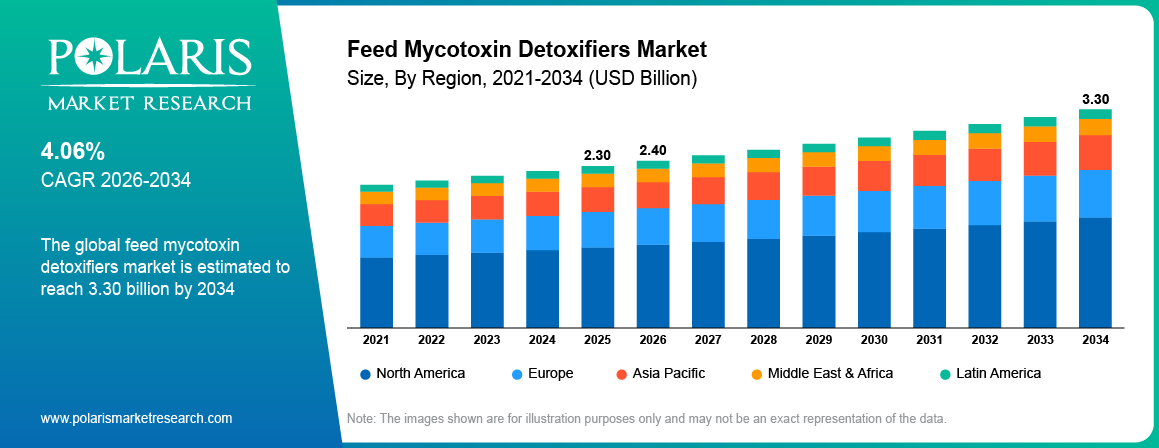
Market is expanding due to the higher contamination of fungi in grains including corn, wheat, soybean meal, and barley. Growth factors include increasing industrialization of livestock, rising feed safety concerns, and awareness regarding the financial implications of toxins.
Drivers & Opportunities
Rising incidence of feed contamination is creating demand for feed mycotoxin detoxifiers: Increasing aflatoxins and fumonisins content in feed crops are boosting the need for mycotoxin deactivators. Issues including climatic changes, variation in humidity levels, and international grains trade are rising the risk of contamination in different regions. For instance, as per the study conducted by Trouw Nutrition, in Q2 2025, maize samples across India showed significant mycotoxin contamination, with nearly 80% testing positive for both Aflatoxins and Fumonisins.Feed manufacturers are increasingly adopting modern deactivation technologies to prevent livestock losses.
Increasing regulatory pressure on feed safety is driving market growth: Government agencies and regulatory organizations are establishing stringent regulatory requirements on feed quality to help minimize the content of toxins in meat, milk, and poultry products. For example, in 2024, the US Government set a maximum limit of 5% for botanical impurities in animal feed raw materials, including straw, seed residues, and debris from cultivated and wild plant species.Feed producers and livestock farmers are adopting advanced detoxifiers in their feeds to improve feed quality, and animal health.
Restraints & Challenges
High cost of biological detoxifiers is limiting market adoption: The biological detoxification process is associated with advanced formulation and high production costs, thereby limiting the adoption among cost-conscious feed manufacturers. Biological detoxification includes two steps due to the advanced level of formulation and quality control, thereby increasing the production costs.
Fluctuations in raw material availability are limiting the demand for feed mycotoxin detoxifiers: Fluctuations in availability and prices of raw materials include bentonite clay, activated carbon, and special enzymes affect the cost of production and the supply chain dynamics. Supply disruptions and rising transportation costs affect the pricing and profitability of detoxifier products.
Opportunity
Advanced precision livestock nutrition technologies to open opportunities for feed mycotoxin detoxifiers market: Precision livestock nutrition technology is creating growth opportunity for feed mycotoxin detoxifiers market. Livestock farmers are adopting modern methods such as data-driven feed management solutions to enhance feed conversion rate and animal health. The precision nutrition tools assist in customizing the detoxifier products according to the degree of toxin exposure and animal type.
Rising global demand for high-quality animal protein to create market opportunities: Rising consumption of poultry meat, dairy foods, aquaculture products, and animal protein is driving the market growth for feed mycotoxin detoxifiers. For instance, in 2025, the United Nations estimated that global agriculture and fish production is projected to increase by 14% by 2034, showing future demand of mycotoxin detoxifiers for aquaculture animals.The livestock industry is focusing on improving feed quality and preventing diseases, which increases the demand for mycotoxin detoxifiers.
Segmental Insights
This report offers detailed coverage of the feed mycotoxin detoxifiers market by product type, by livestock, by source, by form, and by distribution channel to help readers identify the fastest expanding and most attractive demand segments.
By Product Type
-
Binders
Binders segment dominated the market in 2025 with 67.0% share, driven by cost-effectiveness and broad commercial adoption across poultry and dairy industries. Clay minerals such as bentonite, activated charcoal, and aluminosilicates are widely used due to their strong toxin adsorption capabilities.
-
Deactivators
Deactivators segment is projected to grow at the fastest CAGR of 4.6% during the forecast period owing to rising adoption of enzymatic and microbial detoxification technologies. These solutions help to degrade toxins biologically, improving detoxification efficiency across multi-toxin contamination environments.
By Livestock
-
Poultry
Poultry segment dominated the market in 2025 accounting for 38.0% share, driven by intensive commercial poultry farming, and high feed consumption volumes globally. Poultry birds are highly sensitive to contamination by aflatoxin, which negatively affects the immune system, growth performance, and ratio of feed conversion.
-
Swine
Swine segment is projected to grow at the fastest CAGR of 3.6% during the forecast period, due to increasing concerns regarding zearalenone and fumonisin contamination. Swine producers are increasingly utilizing advanced decontamination additives in order to enhance fertility, feed quality and health management.
By Source
-
Inorganic
Inorganic segment dominated the market in 2025 with 59.0% share, due to affordability, wide commercial availability, and strong adsorption performance. Bentonite, aluminosilicate and activated carbon are commonly used in the formulation of animal feeds owing to their low cost of production and ease of incorporation into feed manufacturing.
-
Organic
Organic segment is projected to grow at the fastest CAGR of 4.9% during the forecast period owing to increasing demand for sustainable feed additives and multi-toxin detoxification efficiency. Feed manufacturers are increasingly using microbial and enzymatic methods of decontamination for better livestock productivity and sustainability.
By Form
-
Dry
Dry segment dominated the market in 2025 with 84.0% share, driven by easier storage, transportation, and integration into feed premixes. Feed mills widely prefer dry detoxifiers due to operational convenience, longer shelf life, and compatibility with large-scale feed manufacturing systems.
-
Liquid
Liquid segment is projected to grow at the fastest CAGR of 5.0% during the forecast period, due to increasing adoption in precision nutrition systems and liquid feed applications. Liquid detoxifiers provide rapid diffusion and better feed uniformity in livestock feeding processes.
By Distribution Channel
-
Direct Sales
Direct sales segment dominated the market in 2025 with 54.0% share, due to strong procurement relationships between feed additive manufacturers and large livestock integrators. Major feed producers prefer direct sourcing agreements for customized formulations, bulk procurement, and technical support services.
-
Online Distribution
Online distribution segment is projected to grow at the fastest CAGR of 5.6% during the forecast period owing to rising e-commerce penetration in agricultural procurement systems. For example, as per the International Trade Administration, the Global B2C ecommerce revenue is expected to grow to USD 5.5 trillion by 2027 with a CAGR of 14.4%.Increasing availability of feed additives through e-commerce platforms and B2B agricultural marketplaces is supporting segment expansion.
Regional Analysis
Europe Market Assessment
Europe feed mycotoxin detoxifiers market held 29.0% share of the global market in 2025, due to strict feed safety regulations and strong awareness regarding toxin contamination risks. Countries such as Germany, France, the Netherlands, and Spain are major contributors owing to established dairy, poultry, and swine farming industries. For example, the European Commission reported that in 2024, the poultry meat production in Europe reached 14.1 million tons, an increase of 6% compared to 2023.The European Food Safety Authority (EFSA) maintains stringent permissible toxin limits, accelerating detoxifier adoption across feed manufacturing operations.
Asia Pacific feed mycotoxin detoxifiers Market Insights
Asia Pacific feed mycotoxin detoxifiers market held the largest share valued at 33.0% in 2025, driven by growing poultry and aquaculture industries across China, India, Vietnam, and Indonesia. For instance, in 2025, the Government of India reported that India is the 4th largest meat producing country globally with total meat production of 10.5 million tons during 2024-2025, registering a growth of 2.46% compared to 2023-2024.High humidity conditions and expanding feed production activities are further supporting market growth.
North America feed mycotoxin detoxifiers Market Overview
In 2025, North America feed mycotoxin detoxifiers market held 27.0% market share, driven by advanced livestock production systems and growing aquaculture production. The market in the US is growing, due to rising number of aquaculture farms. For example, the US Department of Agriculture reported that the total number of aquaculture farms in the US in 2023 was 3,453, an increase of 18% compared to the number of aquaculture farms in 2018.Moreover, rising investments in animal nutrition technologies and feed contamination monitoring systems are supporting regional market growth.
LATAM & MEA Emerging Markets
The feed mycotoxin detoxifiers market in Latin America and Middle East & Africa regions is experiencing steady growth, due to rising livestock production, increasing agricultural exports, and growing focus on feed safety management. Nations such as Brazil, Mexico, Saudi Arabia, UAE, and South Africa are implementing advanced detoxification technologies for improving feed quality, increase animal productivity, and meet international feed safety standards.
Competitive Landscape
The feed mycotoxin detoxifiers market is moderately fragmented with the presence of global feed additive manufacturers and regional livestock nutrition companies. Competition is based on detoxification efficiency, pricing, multi-toxin effectiveness, and sustainability performance. Companies are focusing on biological detoxification technologies, strategic partnerships, and expansion of feed safety portfolios to strengthen their market presence.
Premium Insights
Emerging Industry Trends
- Fungal diseases due to climate change are transforming feed procurement methods and increasing the need for advanced mycotoxin risk management systems within livestock feed chain operations.
- The integrated livestock operators are increasingly adopting preventive detoxification measures to ensure high feed conversion rates, low chances of disease breakouts, and increased livestock productivity.
- AI-powered contamination analysis systems and smart feed monitoring devices are becoming commercially attractive for detecting toxins and optimizing feed quality.
- Biological detoxifiers are disrupting the dominance of traditional binders due to their ability of detoxifying multiple mycotoxins with more efficacy.
Key Players
- ADM
- BASF SE
- Cargill, Inc.
- Kemin Industries, Inc.
- Olmix Group
- Impextraco N.V.
- Special Nutrients, Inc.
- Amlan International
- Perstorp Holding AB
- Cenzone Tech Inc.
- Alltech
- dsm-firmenich
Industry Developments
- August 2025: dsm-firmenich inaugurated a new 11,200 square meters feed additive manufacturing plant in Hyderabad to expand its market presence in India. [source: dsm-firmenich.com]
- March 2025: Cargill introduced Notox AMA that offers advanced protection with proven mycotoxin-binding technology to support animal health and performance. [source: cargill.com]
Feed Mycotoxin Detoxifiers Market Segmentation
By Product Type Outlook (Revenue, USD Billion, 2021-2034)
- Binders
- Deactivators
By Livestock Outlook (Revenue, USD Billion, 2021-2034)
- Poultry
- Swine
- Ruminants
- Aquaculture
- Pets
By Source Outlook (Revenue, USD Billion, 2021-2034)
- Inorganic
- Organic
By Form Outlook (Revenue, USD Billion, 2021-2034)
- Dry
- Liquid
By Distribution Channel Outlook (Revenue, USD Billion, 2021-2034)
- Direct Sales
- Distributors
- Online Distribution
By Regional Outlook (Revenue, USD Billion, 2021-2034)
- North America
- US
- Canada
- Europe
- Germany
- France
- UK
- Italy
- Spain
- Netherlands
- Russia
- Rest of Europe
- Asia Pacific
- China
- Japan
- India
- Malaysia
- South Korea
- Indonesia
- Australia
- Vietnam
- Rest of Asia Pacific
- Middle East & Africa
- Saudi Arabia
- UAE
- Israel
- South Africa
- Rest of Middle East & Africa
- Latin America
- Mexico
- Brazil
- Argentina
- Rest of Latin America
Feed Mycotoxin Detoxifiers Market Report Scope
| Report Attributes | Details |
| Market Size in 2025 | USD 2.30 Billion |
| Market Size in 2026 | USD 2.40 Billion |
| Revenue Forecast by 2034 | USD 3.30 Billion |
| CAGR | 4.06% from 2026 to 2034 |
| Base Year | 2025 |
| Historical Data | 2021–2024 |
| Forecast Period | 2026–2034 |
| Quantitative Units | Revenue in USD Billion and CAGR from 2026 to 2034 |
| Report Coverage | Revenue Forecast, Competitive Landscape, Growth Factors, and Industry Trends |
| Segments Covered |
|
| Regional Scope |
|
| Competitive Landscape |
|
| Report Format |
|
| Customization | Report customization as per your requirements with respect to countries, regions, and segmentation. |
Source: Polaris Market Research Analysis
Feed Mycotoxin Detoxifiers Market FAQ's
The global market size was valued at USD 2.30 Billion in 2025 and is projected to grow to USD 3.30 Billion by 2034.
Asia Pacific feed mycotoxin detoxifiers market held the largest share valued at 33.0% in 2025, driven by growing poultry and aquaculture industries across China, India, Vietnam, and Indonesia.
Major distribution channels are direct sales, distributors, and online distribution.
A few of the key players in the market are ADM, BASF SE, Cargill, Inc., Kemin Industries, Inc., Olmix Group, Impextraco N.V., Special Nutrients, Inc., Amlan International, Perstorp Holding AB, Cenzone Tech Inc., Alltech, dsm-firmenich, and others.
Key drivers include rising incidence of feed contamination and increasing regulatory pressure on feed safety.
Major demand comes from the poultry and aquaculture industry.
The market outlook remains strong due to advanced precision livestock nutrition technologies and rising global demand for high-quality animal protein.
Download Sample Report of Feed Mycotoxin Detoxifiers Market
Please fill out the form to request a customized copy of the research report.


