
Animal Feed Market Demand, Industry Share, Forecast, 2026-2034
REPORT DETAILS
Animal Feed Market Summary
The animal feed market size was valued at USD 542.36 billion in 2025, exhibiting a CAGR of 3.3% from 2026 to 2034. Rising demand for animal-based food, focus on livestock health, growing feed mill capacity, and shifting dietary trends are fueling the market growth.
Market Statistics
Key Takeaways
- Asia Pacific dominated the market with a revenue share of 38.8% in 2025, due to growing demand for meat and dairy commodities.
- North America is expected to witness a notable growth with a CAGR of 2.6%, during the forecast period due to a rise in meat intake across North America and the application of strict directives are expected to push the market growth in the region.
- The amino acids segment accounted for the largest market share of 20.0% in 2025. The amino acids animal feed market growth is driven by the growing industry focus on precision nutrition and feed efficiency optimization. Similarly, the segment dominance reflects the sector’s shorter production cycles and lower feed conversion ratios. Rising global preference for poultry meat as a cost-effective protein source also boosts the segment growth.
- The poultry segment held the largest revenue share of 36.0% in 2025. Poultry feed market share is attributed to poultry concentration on ducks, turkeys, and chickens for meat. It is an important source of proteins for animals.
Industry Dynamics
- With the surging worldwide population, there is a growing demand for protein-rich food and livestock production growth. It has accelerated growth in livestock production, thus igniting the demand for animal feed.
- The growing concentration on animal health and nutrition is fueling the market growth.
- Technological advancements in feed production and the growing aggregate of feed mills will provide lucrative opportunities for the market in the coming years.
- Fluctuating prices of soybean meals, corn, and other important feed components present a notable challenge for livestock producers and feed manufacturers.
- Rising livestock populations and higher per-capita protein intake strengthen long-term animal feed demand. On the supply side, advances in feed formulation technologies, enzyme supplementation, and digital feed management systems enable manufacturers to deliver nutritionally dense feed while managing input cost volatility.
What is Animal Feed?
Animal feed is a type of food given to animals to provide them with the nutrients they need for growth, health, and productivity. Grains, protein meals, fats, minerals, and other ingredients are used to make animal feed products. There are many different types of animal feed. Each feed is designed for a specific kind of animal and purpose. Poultry feed is formulated specifically for chickens and other poultry. It has nutrients needed for egg production and growth. Cattle feed is designed for cows and other ruminants. The feed has high levels of fiber that aids in digestion.
Source: Polaris Market Research Analysis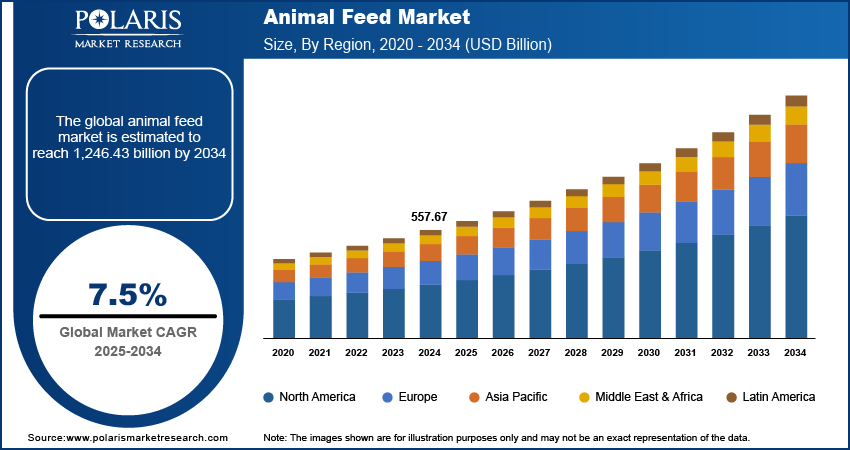
To Understand More About this Research:Download Sample Report
The animal feed industry forms a critical backbone of the global livestock and protein supply chain. It supports commercial meat, dairy, egg, and aquaculture production. There is an increasing industrialization in livestock farming. Thus, the global animal feed industry is transitioning toward large-scale, nutritionally optimized commercial animal feed production. Owing to the shift from traditional on-farm feed preparation. there is a rising preference for scientifically formulated feed solutions. These solutions enhance feed efficiency and animal health. It improves production yields across poultry, ruminant, swine, and aquaculture sectors..
The high demand for animal-derived food products such as meat, dairy, and eggs and the increasing focus on animal health and nutrition drive the animal feed market growth. Technological advancements in feed production, the rising number of feed mills, and consolidation of the industry are other factors supporting the market development.
Growing disposable income, changing lifestyles, and increasing awareness regarding health and nutrition have resulted in increased demand for high-quality meat and meat-based products. This, in turn, has boosted the demand for animal feed. The rising inclination toward using naturally produced feed and the adoption of effective livestock husbandry further fuels animal feed demand. New product launches and strategic developments, such as mergers and acquisitions, by major players are expected to offer numerous animal feed industry opportunities during the forecast period.
According to the animal feed market analysis, rising concerns about the environmental effects of animal agriculture and the changing costs of feeds limit the market growth. The impact of livestock farming, including greenhouse gas emissions and water use, creates concerns among many consumers and policymakers. This could lead to greater pressure for sustainable practices, hindering the demand for animal feed and its ingredients. Additionally, the cost of feed ingredients, like corn and soybean meal, often varies due to unfavorable weather conditions and supply and demand. This makes it hard for feed manufacturers to keep prices and profit margins steady.
Animal Feed Value Chain Analysis
Raw Materials: The first part of the animal feed value chain is raw material sourcing. Some of these materials include cereals like corn and wheat, oilseeds such as soybean meal, and additives like vitamins and amino acids. Also, by-products from food and biofuel industries are used as raw materials. Price volatility, climate impact, and trade policies strongly influence supply chain stability.
Formulation: The next stage is feed formulation and manufacturing. In this, raw inputs are processed, blended, and pelletized. The formulation is based on livestock species, nutritional requirements, and regulatory standards. Feed producers focus on advanced formulation software, precision nutrition, and quality testing. It helps enhance feed efficiency and cost control.
Distribution: Distribution and marketing channels include wholesalers, integrated agribusinesses, cooperatives, and direct farm sales. Efficient logistics, cold storage for additives, and digital ordering platforms are vital for timely delivery, traceability, and keeping customers in regional and international markets.
Animal Feed Market Drivers
Increased Demand for Animal-Derived Food Products
Rising global population increased demand for protein-rich foods. Protein consumption growth led to a significant increase in livestock production. In addition, rising disposable incomes in developing countries have led to a shift in dietary habits. Consumers are increasingly opting for meat and dairy products. The United Nations Food and Agriculture Organization (FAO) estimates that food demand will rise by 60% by 2050. From 2010 to 2050, meat production is expected to increase by 70%, dairy by 55%, and aquaculture by 90%. Growing preference for protein-rich diets and a growing middle class are boosting demand for animal feed in developed and emerging markets. As livestock production increases, feed manufacturers face pressure to provide effective feed formulations that promote growth while keeping costs low. Therefore, the growing demand for animal-based food products is a major factor driving the expansion of the animal feed industry.
Rising Focus on Animal Health and Nutrition
Consumers prefer meat and dairy products that are nutrient-rich and free from antibiotics and other harmful chemicals. Thus, market players focus on maintaining animal health to prevent illness and promote their overall wellness. Livestock producers are increasingly using natural and organic animal feed. The feed is perceived as healthier and safer for animals and humans. Also, they are enriching animal feeds with supplements such as B12 and salt-based additives. Due to these supplements, animals get all the essential vitamins and minerals they need. The increased focus on animal health and nutrition is a major market revenue contributor.
Source: Polaris Market Research Analysis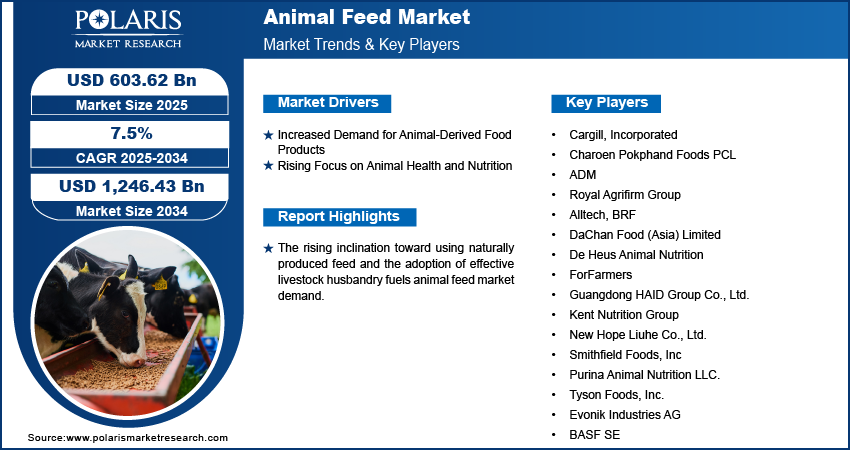
Segment Insights
By Type
Based on type, the animal feed industry is segmented into antibiotics, antioxidants, amino acids, feed enzymes, feed acidifiers, vitamins, and others. The amino acids segment dominated the market with a revenue share of 33.6% in 2025. Amino acids play a crucial role in preventing nail and skin issues in animals. Also, they regulate metabolic pathways that improve health, growth, development, and reproduction. These benefits boost the amino acids animal feed market growth. The growing demand for meat and dairy products, the need to improve feed efficiency and reduce feed cost, and the rising focus on sustainability and environmental responsibility in animal agriculture contribute to the dominance of the segment in animal feed additives market. The industry’s shift toward reducing crude protein levels while maintaining optimal animal performance propels the adoption of amino acids in animal feed formulations. It supports both cost control and sustainability objectives.
Animal Feed Types and Their Key Applications
| Feed Type | Main Uses |
| Antibiotics |
|
| Antioxidants |
|
| Amino Acids |
|
| Feed Enzymes |
|
| Feed Acidifiers |
|
| Vitamin |
|
| Others (Minerals, probiotics, prebiotics, pigments, and binders) |
|
Source: Polaris Market Research Analysis
By Livestock
Based on livestock, the market is segmented into cattle, poultry, swine, aquaculture, and others. The poultry segment held the largest revenue share of 39.8% in 2025. Poultry is focused on the production of ducks, turkeys, and chicken for meat. The segment is a vital source of animal protein worldwide. Several ingredients, including vitamins, minerals, oilseeds, and grains, are used to prepare balanced diets for various poultry growth stages. As per our poultry feed market analysis, the rising global population leads to an increase in the number of poultry farms and the volume of poultry feed produced. Further, the shift toward more intensive farming methods requires high-quality feed specifically formulated to meet the birds' nutritional needs. This is another factor driving growth in the poultry feed market. The poultry feed market benefits from standardized feeding programs and large-scale commercial operations. These factors make it one of the most technologically advanced and volume-driven segments within the market.
By Form
By form, the market is segmented into mash, pellets, crumbles, and others. The pellets segment is anticipated to register a CAGR of 3.5% from 2026 to 2034. The increased demand for efficient and convenient feed options is a key driver of the segment. Pelleted feed is easier to store, transfer, and use than loose feed. It is less likely to spoil or attract pests. Thus, farmers and feed manufacturers prefer pelleted feed to improve their operational efficiency. This feed form offers several benefits for animal health and performance. The pelleting process can improve the digestibility and bioavailability of nutrients in the feed. It is leading to better feed conversion rates and improved animal growth and development. Producers prioritize feed forms that enhance feed conversion ratios, minimize wastage, and support consistent animal growth outcomes. Thus, the pelleted animal feed market is gaining traction. Crumbled feed is easier to consume. Thus, it is used for young or small animals. Powdered feed is used for feeding young animals that cannot yet consume solid food.
Source: Polaris Market Research Analysis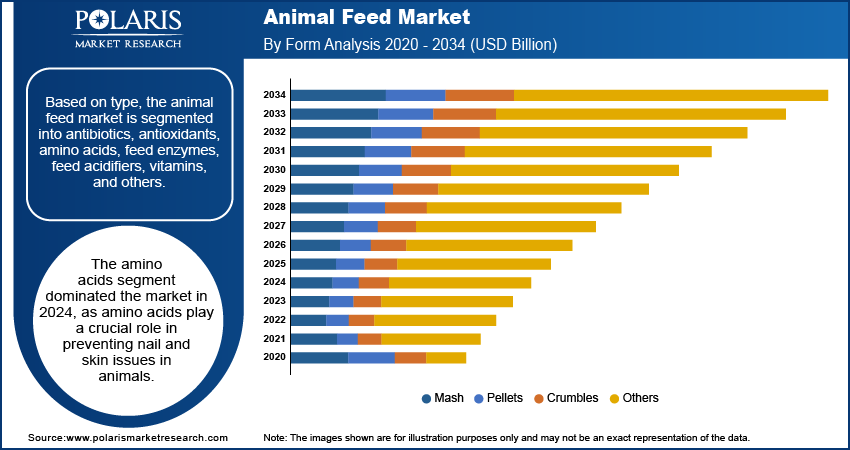
Regional Analysis
The market report offers insights into North America, Europe, Asia Pacific, Latin America, and the Middle East & Africa. Asia Pacific accounted for the largest revenue share of 39.9% in 2025. The increasing demand for meat and dairy products is one of the major market growth drivers in the region. Asia Pacific animal feed market analysis shows that rising income and changing dietary preferences boost the consumption of more animal protein in Asia Pacific. This factor is driving up demand for animal feed. In addition, the region is home to some of the largest meat producers in the world, such as China, India, and Indonesia, which are also the major consumers of animal feed. Asia Pacific serves as both a major production and consumption hub for animal feed. It is supported by rapid urbanization, increasing protein consumption, and large-scale poultry and aquaculture farming across China, India, and Southeast Asia.
The North America animal feed market is anticipated to witness growth with a CAGR of 2.6%, during the forecast period. A significant surge in meat consumption across North America and the implementation of stringent regulations are anticipated to propel the market growth in the region. The rising health awareness among consumers and the presence of well-established players are also projected to boost the demand for animal feed in North America.
Source: Polaris Market Research Analysis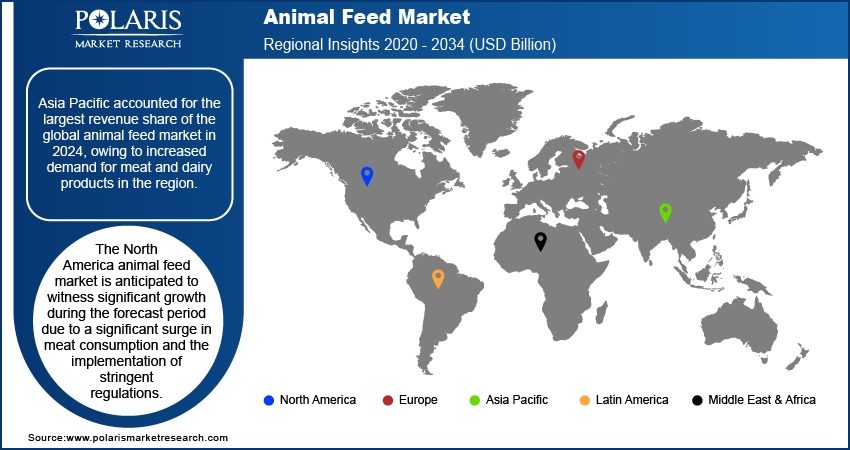
Regional Feed Regulation Frameworks and Their Impact on Animal Feed Industry
Regulatory frameworks affect market growth and structure. Market players must follow strict safety rules, traceability, and ingredient approval requirements. As a result, they invest in compliant formulations, thorough testing, and transparent supply chains. Regions with clearly defined regulations, such as Europe and North America, attract multinational feed producers. Such streamlined regulations allow for predictable and simple approval processes, along with strong enforcement.
| Region | Regulatory Authority | Key Feed Regulations | Approval Process | Compliance Focus |
| North America | FDA (U.S.), CFIA (Canada) | FDA FSMA, AAFCO Feed Ingredient Standards | Pre-market approval for additives | Feed safety, traceability, and contamination control |
| Europe | European Commission, EFSA | Regulation (EC) No 767/2009, Feed Hygiene Regulation | Centralized EFSA risk assessment and authorization | GMO labeling, sustainability, and animal health |
| Asia Pacific | FSSAI (India), MARA (China), MAFF (Japan) | National feed acts and import standards | Country-specific registration and testing | Quality certification, residue limits |
| Latin America | MAPA (Brazil), SENASICA (Mexico) | National feed safety laws, import permits | Local authority approval | Disease control, feed quality |
| Middle East & Africa | SFDA (Saudi), DAFF (South Africa) | Regional feed safety frameworks | Import licensing and product registration | Halal compliance, import safety checks |
Source: Polaris Market Research Analysis
Key Players and Competitive Insights
The key players in the animal feed industry are focusing on research and development to enhance their products and services offerings and drive market demand. Also, they are adopting various strategic initiatives, including collaborations, new product launches, and increased investments, to improve their global footprint. To expand and survive in a more competitive environment, the animal feed industry players must offer high-quality animal feeds. Competition in the market is defined by formulation expertise and supply chain integration. It is also influenced by the ability of a player to offer customized nutrition solutions tailored to livestock and regional requirements.
In recent years, the animal feed industry has witnessed several innovations, with key players seeking to provide specially formulated animal feeds that help meet sustainability goals. The research report offers a market assessment of all the key players. A few global animal feed companies are Cargill, Incorporated; Charoen Pokphand Foods PCL; ADM; Royal Agrifirm Group; Alltech; BRF; DaChan Food (Asia) Limited; De Heus Animal Nutrition; ForFarmers; Guangdong HAID Group Co., Ltd.; Kent Nutrition Group; New Hope Liuhe Co., Ltd.; Smithfield Foods, Inc; Purina Animal Nutrition LLC.; Tyson Foods, Inc.; Evonik Industries AG; and BASF SE.
Formulation Advances
Market players focus on advances in animal feed formulation. The innovative formulations can improve nutritional efficiency and animal health. They enhance production performance across livestock sectors. Producers use precision nutrition, enzyme-based additives, probiotic blends, and amino acid optimization. It helps them reduce feed costs. Sustainable feed ingredients such as insect protein, algae, and plant-based alternatives are also gaining attention. They support productivity and environmental goals in the global animal feed market.
List of Major Animal Feed Market Players
- ADM
- Alltech
- BASF SE
- BRF
- Cargill, Incorporated
- Charoen Pokphand Foods PCL
- DaChan Food (Asia) Limited
- De Heus Animal Nutrition
- Evonik Industries AG
- ForFarmers
- Guangdong HAID Group Co., Ltd.
- Kent Nutrition Group
- New Hope Liuhe Co., Ltd.
- Purina Animal Nutrition LLC.
- Royal Agrifirm Group
- Smithfield Foods, Inc
- Tyson Foods, Inc.
Animal Feed Industry Developments
- March 2026: De Heus announced that it had acquired CJ Feed & Care. The acquisition is expected to boost De Heus’ expansion in countries such as Vietnam, Indonesia, Cambodia, Korea, and the Philippines. The transaction includes 17 feed mills and various livestock operations across Asia. (Source: deheus.com)
- February 2025: Novonesis acquired DSM-Firmenich’s stake in the Feed Enzyme Alliance. This strategy is expected to strengthen its position in the animal bio-solutions market. (Source: novonesis.com)
- September 2024: Growel Group launched Carniwel, a new pet food brand offering premium nutrition at affordable prices. The product line serves both small and large breed dogs across different life stages, available in various pack sizes to meet growing demand for quality pet food. (Source: carniwel.com)
Future of Animal Feed Market
Rising global demand for meat, dairy, and aquaculture products influence the future of the animal feed industry. Increasing focus on animal health and productivity will boost the market demand. Feed manufacturers are investing in precision nutrition and sustainable ingredients. They are emphasizing functional additives such as probiotics, enzymes, and amino acids to improve feed efficiency. Technological advancements in feed formulation and digital livestock management will support market expansion. Further, growing awareness of antibiotic-free and eco-friendly feed solutions would encourage innovation and regulatory support across the industry.
Animal Feed Market Segmentation
By Type Outlook
- Antibiotic
- Antioxidants
- Amino Acids
- Feed Enzymes
- Feed Acidifiers
- Vitamin
- Others
By Livestock Outlook
- Cattle
- Poultry
- Swine
- Aquaculture
- Others
By Form Outlook
- Mash
- Pellets
- Crumbles
- Others
By Composition Outlook
- Cereal-Based Feed
- Soy-Based Feed
- Fish-Based Feed
- Oilseed-Based Feed
- Other Animal-Based Feed
By Regional Outlook
- North America
- U.S.
- Canada
- Europe
- Germany
- France
- UK
- Italy
- Spain
- Netherlands
- Russia
- Rest of Europe
- Asia Pacific
- China
- Japan
- India
- Malaysia
- South Korea
- Indonesia
- Australia
- Rest of Asia Pacific
- Middle East & Africa
- Saudi Arabia
- UAE
- Israel
- South Africa
- Rest of Middle East & Africa
- Latin America
- Mexico
- Brazil
- Argentina
- Rest of Latin America
Animal Feed Market Report Scope
| Report Attributes | Details |
| Market Size in 2025 | USD 542.36 billion |
| Market Size in 2026 | USD 559.66 billion |
| Revenue Forecast in 2034 | USD 724.52 billion |
| CAGR | 3.3% from 2026 to 2034 |
| Base Year | 2025 |
| Historical Data | 2021–2024 |
| Forecast Period | 2026–2034 |
| Quantitative Units | Revenue in USD billion, 2021–2034 and CAGR from 2026 to 2034 |
| Report Coverage | Revenue Forecast, Market Competitive Landscape, Growth Factors, and Trends |
| Segments Covered |
|
| Regional Scope |
|
| Competitive Landscape |
|
| Report Format |
|
| Customization | Report customization as per your requirements with respect to countries, regions, and segmentation. |
Source: Polaris Market Research Analysis
Animal Feed Market FAQ's
The market size was valued at USD 557.67 billion in 2024 and is projected to grow to USD 1,246.43 billion by 2034.
The global animal feed market was valued at USD 542.36 billion in 2025. Increasing livestock production and upsurging protein demand worldwide drove the market growth.
Asia Pacific led revenue share in 2025. Large livestock populations and the growing disposable income of the middle-class population fueled the regional market growth. Also, increasing urbanization across developing nations accelerated the growth.
Animal feed is available in pellets, crumbles, mash, and other forms. The pellets segment dominates the market. Its superior nutrient distribution and reduced wastage propel the dominance. Its improved digestibility across livestock species also contributes to the segment’s largest share.
Poultry accounted for 39.8% of revenue share. Increasing broiler production and growing global consumption of chicken meat and eggs worldwide boost the demand.
A few common feed additives are amino acids, vitamins, antibiotics, enzymes, and probiotics. Amino acids lead the revenue share, enhancing growth and immunity in livestock.
Download Sample Report of Animal Feed Market
Please fill out the form to request a customized copy of the research report.


