
Fused Deposition Modeling 3D Printing Market Size & Trends, Forecast 2026-2034
REPORT DETAILS
Fused Deposition Modeling 3D Printing Market Summary
The global fused deposition modeling 3D printing market is estimated around USD 2,316 Million in 2025, with consistent growth anticipated during 2026–2034. This growth is driven by rising demand for rapid prototyping and increasing adoption of digital manufacturing technologies across global industries. The market is projected to grow at a CAGR of 22.9% during the forecast period.
Market Statistics
Key Takeaways
- The PLA segment dominated in 2025 by 39.9% share due to its low cost and wide usage in prototyping applications.
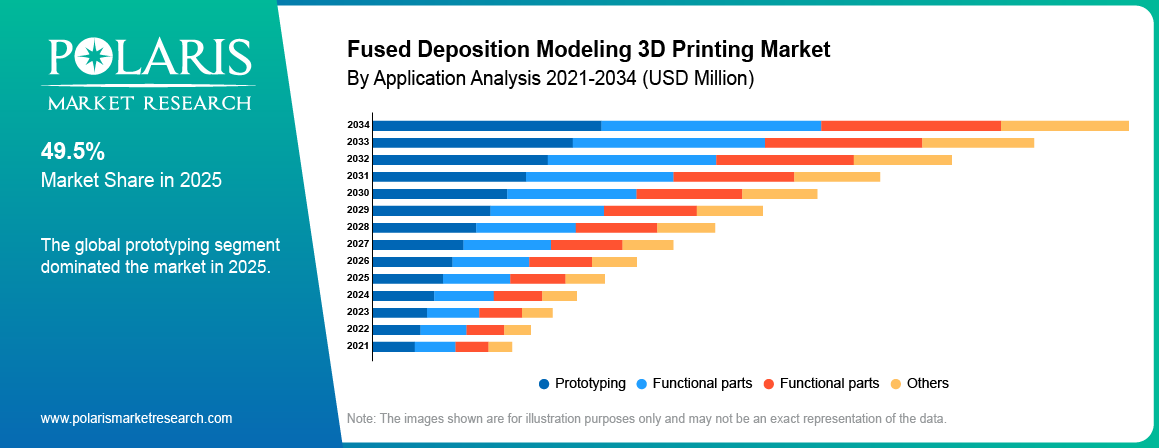
- The prototyping segment dominated the market by holding 49.5% revenue share in 2025 due to strong demand for faster product development.
- The healthcare segment is anticipated to witness rapid growth at CAGR of 23.6% due to rising demand for customized medical devices and dental applications.
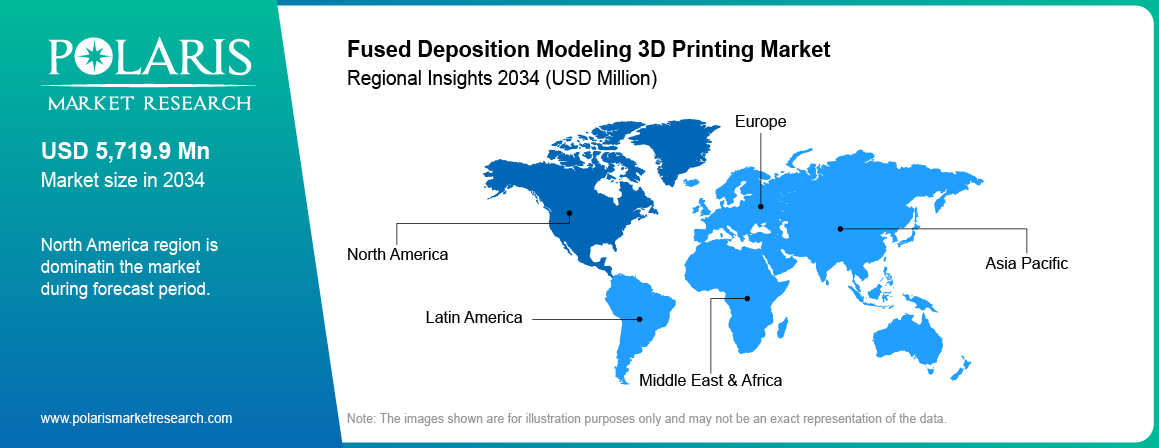
- North America dominated the fused deposition modeling 3D printing market with 39.94% revenue share due to strong industrial adoption and the presence of major manufacturers.
- Asia-Pacific is projected to grow at the fastest CAGR of 23.5% in the global fused deposition modeling 3D printing market owing to rapid industrialization, expanding manufacturing capabilities.
Industry Dynamics
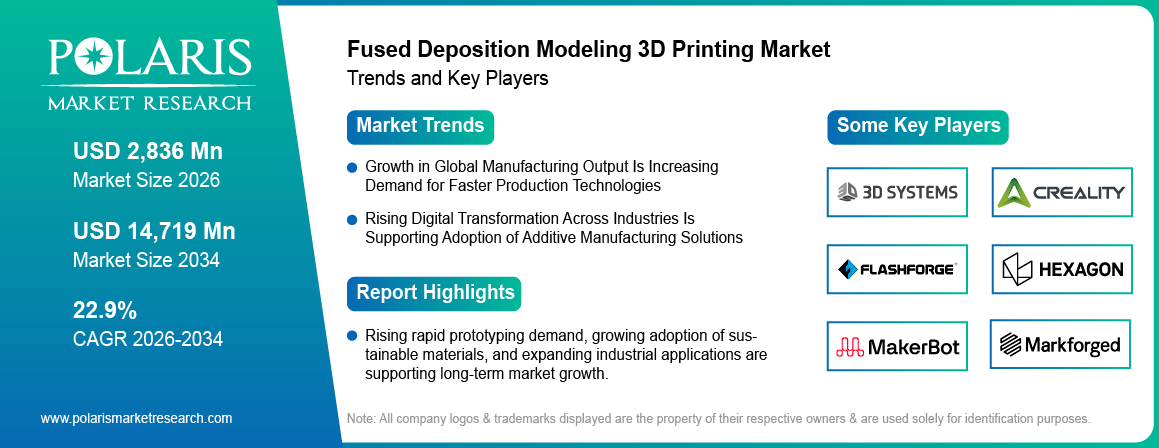
- Growth in global manufacturing output is increasing demand for faster production technologies.
- Rising digital transformation across industries is supporting FDM 3D printing adoption.
- High maintenance costs for industrial-grade systems create adoption challenges for small businesses.
- Expansion of sustainable filament materials is creating new growth opportunities.
What is Fused Deposition Modeling 3D Printing?
Fused deposition modeling (FDM) 3D printing is an additive manufacturing technology that creates objects by depositing thermoplastic filament layer by layer based on digital design files. The technology uses materials such as PLA, ABS, PETG, nylon, and composite filaments to produce prototypes, functional parts, tools, and customized components. FDM printers have gained popularity in different sectors such as automotive, aerospace, health care, consumer goods, education, and manufacturing owing to their cost-effective working method and simple usage.
The value chain for the FDM 3D printing process includes suppliers, printer manufacturers, software firms, services firms, distributors, and end users. The rising demand is attributed to firms' attempts to gain rapid product development and lower the cost of prototypes. Organizations are resorting to using the FDM method in order to save materials and time for making small quantities of products.
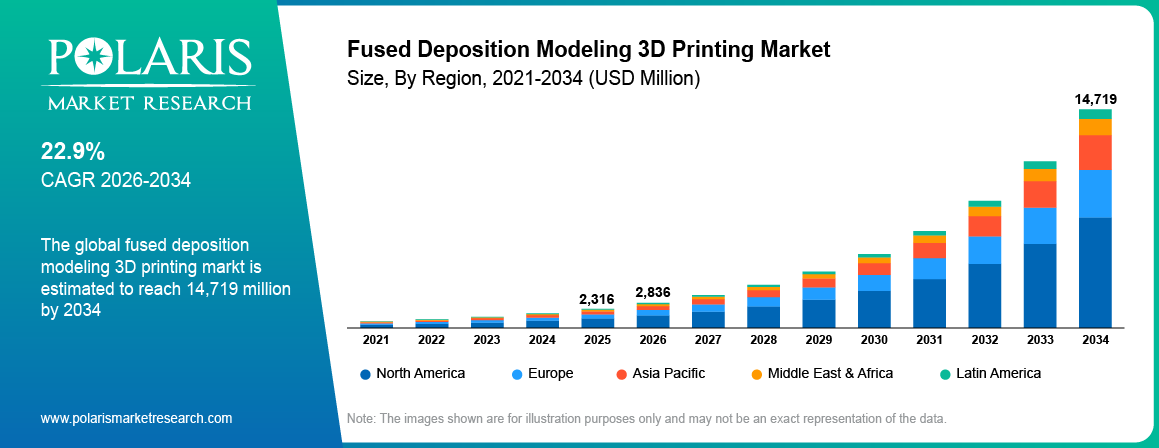
The demand for the FDM printer is increasing rapidly due to the growing popularity of rapid prototyping, customized manufacturing and healthcare and aerospace applications. Desktop FDM printers are increasingly adopted by small and medium enterprises due to their cost-effective feature. Multi-material printing, advancements in filaments and automation technology are expected to boost the growth of the industry in the coming years.
Drivers & Opportunities
Growth in Global Manufacturing Output Is Increasing Demand for Faster Production Technologies: Increasing number of manufacturing activities around the world have caused an increasing need for rapid prototyping and low volume manufacturing technologies. According to UNIDO's report on the quarter of Q4 2025, there has been an increase of 0.5% in global manufacturing production and 1.7% increase in manufacturing exports.[United Nations Industrial Development Organization, 'Quarterly Industrial Production Index (QIIP) - Statistical Publications', stat.unido.org] Companies have begun using the FDM technology in order to reduce development time and offer flexible manufacturing solutions.
Rising Digital Transformation Across Industries Is Supporting Adoption of Additive Manufacturing Solutions: The industries are utilizing digital manufacturing technology for improving their efficiency. The FDM 3D printer technology is used in facilitating digital manufacturing methods through CAD modeling, rapid prototyping, and on-demand manufacturing. The European Union's Digital Europe program is providing around USD 8.5 Million (2021-2027) for promoting AI, cybersecurity, digital skills, and advanced technologies in different sectors.[European Commission, 'Digital Europe Programme', digital-strategy.ec.europa.eu] Hence, this is expected to lead to increasing demand for FDM 3D printers.
Restraints & Challenges
High Maintenance Costs for Industrial-Grade FDM Systems Affect Purchasing Decisions Among Small Businesses: FDM printers in industries are subjected to maintenance, software updates, and parts replacement, which results in increasing operating expenses. The limited budget of small and medium-sized enterprises prevents them from adopting expensive equipment. This budget constraint is an obstacle to the use of FDM printers by enterprises.
Opportunity
Expansion of Biodegradable and Sustainable Filament Materials Is Opening New Revenue Opportunities: Manufacturers are developing filaments from biodegradable as well as recycled raw materials to cater to their growing demand for sustainability. There has been a growing demand for filaments developed using sustainable materials like PLA and recycled plastics. In May 2026, Xenia Materials introduced a new kind of carbon fiber reinforced polypropylene filament for use in 3D printing. Rising focus on reducing plastic waste is expected to create new growth opportunities for FDM printer and material manufacturers.
Segmental Insights
This report offers detailed coverage of the fused deposition modeling 3D printing market based on material, application, and end-use industry to identify major revenue-generating and high-growth segments.
By Material
-
PLA
The PLA segment dominated in 2025 by 39.9% share due to its low cost, ease of printing, and wide usage in prototyping applications. The material is widely preferred by educational institutions, hobby users, and small businesses due to its compatibility with desktop FDM printers.
-
High-performance Polymer
High-performance polymer segment is projected to grow at the fastest CAGR during the forecast period owing to rising demand for durable and heat-resistant parts in aerospace, automotive, and industrial applications. Increasing use of advanced manufacturing materials is supporting segment growth.
By Application
-
Prototyping
The prototyping segment dominated the fused deposition modeling 3D printing market by holding 49.5% revenue share due to rising demand for faster product development across manufacturing industries. FDM technology helps companies reduce design cycles and lower prototype production costs.
-
Functional Parts
Functional parts segment is projected to grow at the fastest CAGR at 23.2% during the forecast period owing to increasing adoption of on-demand manufacturing and low-volume production. Companies are using FDM printers to produce end-use parts with improved customization capabilities.
By End-Use Industry
-
Automotive
Automotive segment dominated the market by holding 32.8% revenue share in 2025 due to high demand for rapid prototyping, tooling, and lightweight component development. Automakers are increasingly using FDM systems to improve production efficiency and reduce development costs.
-
Healthcare
The healthcare segment is anticipated to witness rapid growth at CAGR of 23.6% during the forecast period owing to rising demand for customized medical devices, surgical models, and dental applications. Growing use of patient-specific manufacturing solutions is driving segment expansion.
Regional Analysis
North America Fused Deposition Modeling 3D Printing Market Overview
North America dominated the market with 39.94% revenue share owing to strong adoption of advanced manufacturing technologies across automotive, aerospace & defense, and healthcare industries. In January 2026, Hadrian launched Hadrian Additive to expand U.S. defense production through scalable additive manufacturing systems designed for high-volume, repeatable 3D printing production in 2026. The presence of major companies such as Stratasys Ltd., 3D Systems Corporation, and Desktop Metal, Inc. is supporting product innovation and commercial adoption across the US and Canada.
Asia Pacific Fused Deposition Modeling 3D Printing Market Insights
Asia-Pacific is projected to grow at the fastest CAGR of 23.5% during the forecast period due to rapid industrial expansion and rising adoption of digital manufacturing technologies. China and India have witnessed high demand for FDM printers from their automotive industry, electronic sector, and the educational field. For example, in March 2026, Xiamen Hanin Co., Ltd. launched an AI-enabled FDM 3D printer at TCT Asia 2026, which allows for printing at a maximum speed of 300 mm/s and automatic bed leveling.
Europe Market Insights
Europe represents a significant market share owing to the increasing adoption of sustainable production and constant product development. Countries like Germany, France, Italy, and UK companies have started using FDM technology in order to conserve materials and ensure production efficiency. In March 2026, GE Aerospace announced a USD 129 million investment to expand European manufacturing capacity, including additive manufacturing capabilities, while supporting over 1,000 new jobs across the region.
Rest of World FDM 3D Printing Market Insights
Rest of the world is witnessing gradual growth due to increasing awareness of additive manufacturing benefits across Latin America, Middle East and Africa. Expanding industrial development and growing adoption of affordable desktop printers are supporting market opportunities in these regions.
Competitive Landscape & Key Players
The FDM 3D printing market is moderately fragmented due to the presence of global printer manufacturers, material suppliers, software providers, and regional players. Competition is based on printer pricing, printing speed, material compatibility, product quality, and after-sales support. Companies are focusing on developing top-quality printers, expanding sustainable filament banks, improving automation capabilities, and forming partnerships to create an upper hand in the competitive market.
Some of the leading firms that are active in this sector include Stratasys Ltd., 3D Systems Corporation, Ultimaker, MakerBot, Prusa Research, Flashforge, Creality, EOS GmbH, Materialise NV, Markforged Holding Corporation, Raise3D Technologies, Inc., Hexagon AB, and others.
Premium Insights
Shift Toward Distributed Manufacturing: The use of FDM-based 3D printing is also becoming prevalent in the creation of distributed manufacturing capabilities to ensure that parts are manufactured near consumers.
Rise of On-Demand Production Models: The manufacturers are opting for the on-demand manufacturing model to cut down the cost of stock holding and manufacture customized parts as needed. FDM technology makes low-volume production possible with quick turnaround times in many industries.
Growing Use of AI-Facilitated Printing Optimizations: Many companies are resorting to AI-powered software solutions to ensure more accurate printing and reduce wastage. Such technological developments have helped optimize the printing process.
Key Players
- 3D Systems Corporation
- Creality
- EOS GmbH
- Flashforge
- Hexagon AB
- MakerBot
- Markforged Holding Corporation
- Materialise NV
- Prusa Research
- Raise3D Technologies, Inc.
- Stratasys Ltd.
- Ultimaker
Industry Developments
- April 2026: MIT's Computer Science and Artificial Intelligence Lab created Zip-up Print, an FDM technology which increases speed during production through flat component printing without support materials. [source: csail.mit.edu]
Fused Deposition Modeling 3D Printing Market Segmentation
By Material Outlook (Revenue, USD Million, 2021-2034)
- PLA
- ABS
- Nylon
- Polycarbonate
- High-performance polymer
- Others
By Application Outlook (Revenue, USD Million, 2021-2034)
- Prototyping
- Functional parts
- Tooling
- Others
By End-Use Industry Outlook (Revenue, USD Million, 2021-2034)
- Automotive
- Aerospace
- Healthcare
- Consumer goods
- Others
By Regional Outlook (Revenue, USD Million, 2021-2034)
- North America
- US
- Canada
- Europe
- Germany
- France
- UK
- Italy
- Spain
- Netherlands
- Russia
- Rest of Europe
- Asia Pacific
- China
- Japan
- India
- Malaysia
- South Korea
- Indonesia
- Australia
- Vietnam
- Rest of Asia Pacific
- Middle East & Africa
- Saudi Arabia
- UAE
- Israel
- South Africa
- Rest of Middle East & Africa
- Latin America
- Mexico
- Brazil
- Argentina
- Rest of Latin America
Fused Deposition Modeling 3D Printing Market Report Scope
| Report Attributes | Details |
| Market Size in 2025 | USD 2,316 Million |
| Market Size in 2026 | USD 2,836 Million |
| Revenue Forecast by 2034 | USD 14,719 Million |
| CAGR | 22.9% from 2026 to 2034 |
| Base Year | 2025 |
| Historical Data | 2021–2024 |
| Forecast Period | 2026–2034 |
| Quantitative Units | Revenue in USD Million and CAGR from 2026 to 2034 |
| Report Coverage | Revenue Forecast, Competitive Landscape, Growth Factors, and Industry Trends |
| Segments Covered |
|
| Regional Scope |
|
| Competitive Landscape |
|
| Report Format |
|
| Customization | Report customization as per your requirements with respect to countries, regions, and segmentation. |
Source: Polaris Market Research Analysis
Fused Deposition Modeling 3D Printing Market FAQ's
The global market size was valued at USD 2,316 Million in 2025 and is projected to grow to USD 14,719 Million by 2034.
North America dominated the market with 39.94% revenue share owing to the dominance of key players and higher adoption rates of additive manufacturing technology.
Key applications include prototyping, functional parts production, and tooling applications.
A few of the key players in the market are Stratasys Ltd., 3D Systems Corporation, Ultimaker, MakerBot, Prusa Research, Flashforge, Creality, EOS GmbH, Materialise NV, Markforged Holding Corporation, Raise3D Technologies, Inc., Hexagon AB, and others.
Growth is driven by rising manufacturing output, increasing digital transformation, and growing demand for cost-efficient production technologies.
Demand is mainly generated from automotive, aerospace, healthcare, consumer goods, and education industries.
The future outlook remains positive due to growing industrial automation, rising use of sustainable filaments, and expanding customized manufacturing applications.
Download Sample Report of Fused Deposition Modeling 3D Printing Market
Please fill out the form to request a customized copy of the research report.


