
Global Gardening Equipment Market Share Analysis Report, 2026-2034
REPORT DETAILS
Gardening Equipment Market Summary
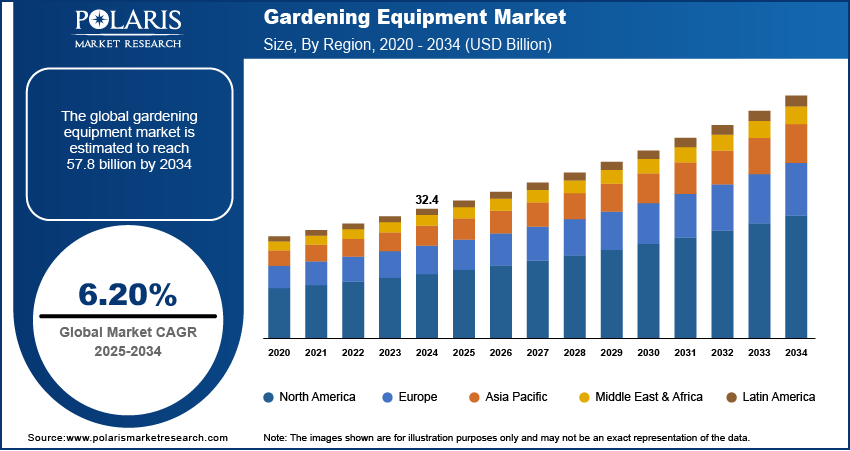
The global Gardening Equipment Market was valued at USD 34.25 billion in 2025 and is forecasted to grow at a CAGR of 6.2% from 2026 to 2034. Rising interest in outdoor living and landscaping is boosting equipment demand.
Market Statistics
Key Insights
- North America dominated the gardening equipment market in 2025 with a revenue share of 38.8%. Strong consumer spending on home gardening and landscaping supported market growth in the region.
- Asia Pacific is projected to register the fastest CAGR of 6.9% during 2026–2034. Rising urbanization and increasing demand for gardening tools are driving regional expansion.
- The residential segment held the largest market share of 72.1% in 2025. Growing interest in home improvement and outdoor living spaces boosted demand for gardening equipment.
- Home Centers held the largest market share of 24.6% owing to their extensive product assortments, competitive pricing, strong brand partnerships, and widespread consumer preference for one-stop home improvement shopping.
- The lawnmower segment is expected to grow at a CAGR of 6.5% during 2026–2034. Adoption of robotic, electric, and battery-powered models continues to accelerate segment growth.
Note: Figures and projections outlined in this report are the result of Polaris Market Research’s proprietary analytical processes, grounded in the latest available datasets and market observations.
Industry Dynamics
- Growing urban farming activities increase demand for compact gardening equipment designed for balconies, rooftops, and limited spaces.
- Rising interest in home gardening and landscaping encourages consumers to invest in advanced gardening tools regularly.
- Increasing adoption of robotic, electric, and battery-powered equipment supports market growth through convenience and efficiency.
- High costs of advanced gardening equipment and maintenance limit adoption among price-sensitive consumers in developing regions.
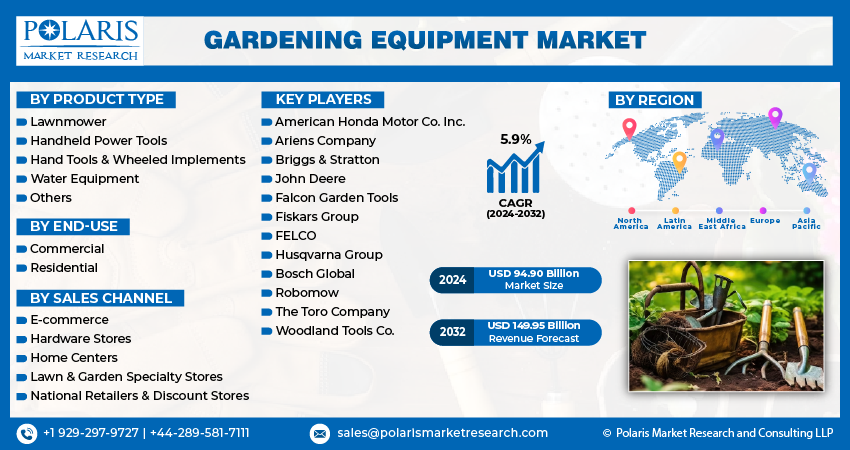
Gardening equipment refers to a wide range of tools and machinery designed to help individuals in the cultivation, maintenance, and beautification of gardens, lawns, and outdoor spaces. These tools serve various purposes, catering to the needs of both nonexpert gardeners and professional landscapers. Common gardening equipment includes lawnmowers, handheld power tools, hand tools and wheeled implements, and water equipment.
The market is driven by factors such as the increasing global interest in gardening and landscaping activities. The trend toward home improvement projects by vertical gardens, rooftop gardens, and balcony gardens, has further boosted the demand for gardening equipment as more individuals invested time and resources. Also, technological advancements in gardening equipment, such as smart irrigation systems and robotic lawnmowers, are contributing to market growth by offering convenience and efficiency.
How Gardening Equipment Is Used
Gardening equipment is used across different gardening activities, starting with soil preparation using shovels, spades, and tillers. Planting is carried out with hand tools and seeders, while watering systems help maintain moisture levels. Regular maintenance includes weeding, pruning, and trimming using pruners and trimmers. Lawnmowers and grass cutters are used for lawn care, while leaf blowers and other tools support seasonal garden upkeep.
Manual Tools vs Power Gardening Equipment
| Parameters | Manual Tools | Power gardening Equipment |
| Cost | Lower initial purchase cost | Higher purchase cost |
| Efficiency | Suitable for small gardening tasks | Faster and more efficient for large areas |
| Maintenance | Requires minimal maintenance | Requires regular servicing and parts replacement |
| Energy Use | No fuel or electricity required | Operates using electricity, batteries, or fuel |
| User Skill Requirements | Easy to use with basic gardening knowledge | May require training and operational knowledge |
| Labor Requirement | More physical effort required | Reduces manual labor and saves time |
| Common Examples | Shovels, pruners, hoes, rakes | Lawnmowers, trimmers, leaf blowers, tillers |
| Best Suited For | Small gardens and household use | Large gardens, commercial landscaping, and public spaces |
Source: Polaris Market Research Analysis
Source: Polaris Market Research Analysis
To Understand More About this Research: Download Sample Report
The market for gardening tools has experienced significant growth due to various factors, such as changing consumer lifestyles, the expansion of modern houses, and an increase in disposable income worldwide. The usage of lithium-ion batteries in gardening equipment has made it more convenient and flexible for gardeners to use these tools. Consequently, this has led to an increase in the demand for easy-to-use gardening equipment, further fueling the growth of the market.
The market faces certain restraining factors, including the environmental impact of manufacturing and disposing of gardening equipment. In addition, the overall cost of gardening equipment influences consumer purchasing decisions.
Growth Drivers
The Growing Trend of Urban Farming Drives the Demand for Gardening Equipment
The growing trend of urban farming acts as a significant driver behind the increasing demand for gardening equipment. Because of urbanization, green spaces like public gardens have become more limited; thus, individuals are increasingly turning to urban farming to cultivate their fresh produce in limited spaces. This trend has led to a surge in demand for compact and efficient gardening equipment made according to urban structures. Tools such as cutters, pruners, and trimmers have gained popularity as they enable individuals to maximize space and efficiently manage small-scale gardens or balcony farms. The rise of community gardens and rooftop farming in urban areas has further fueled the demand for specialized gardening equipment suitable for various urban structures.
Source: Polaris Market Research Analysis
Report Segmentation
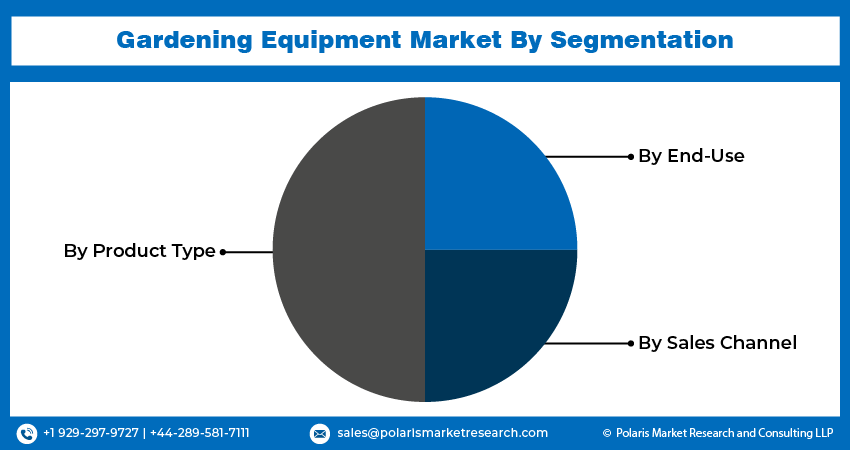
The market is primarily segmented based on product type, end-use, sales channel, and region.
| By Product Type | By End-Use | By Sales Channel | By Region |
|
|
|
|
Source: Polaris Market Research Analysis
To Understand the Scope of this Report: Request Customization
By Application Analysis
The Lawnmower Segment Is Expected to Grow with a Significant Cagr over the Forecast Period
The lawnmower segment is expected to grow at a CAGR of 6.5% during 2026–2034 because of the increasing emphasis on maintaining well-groomed lawns and outdoor spaces, not only in residential areas but also in commercial and public spaces. As homeowners and landscapers seek efficient and time-saving solutions for lawn maintenance, there is an increased demand for technologically advanced lawnmowers. Innovations such as robotic lawnmowers, which offer automatic grass-cutting capabilities, are gaining traction, contributing to the segment's growth. The transition towards eco-friendly gardening practices has spurred the adoption of electric and battery-powered lawnmowers. The ease of use, convenience, and advancements in features and smart connectivity also contribute to the increasing popularity of lawnmowers.
By End-Use Analysis
The Residential Segment Dominated the Revenue Share in 2025
The residential segment held the largest market share of 72.1% in 2025 because of the increasing interest and investment in home improvement and outdoor living spaces, driven by a growing awareness of the benefits of green environments. Homeowners are engaging in gardening and landscaping activities to create pleasing and functional outdoor spaces, boosting the demand for a wide range of gardening equipment tailored for residential use.
Lawn Maintenance Equipment Demand
Lawn maintenance equipment represents a major share of gardening equipment demand, with lawnmowers, trimmers, and leaf blowers widely used across residential properties. Growing interest in home landscaping and outdoor space improvement is increasing the adoption of these tools for regular lawn care and maintenance.
The demand for advanced electric, battery-powered, and robotic lawn maintenance equipment is also rising due to their convenience, efficiency, and ease of use. Increasing residential gardening activities continue to support demand for lawn care equipment globally.
Source: Polaris Market Research Analysis
Regional Insights
North America Accounted for the Largest Revenue Contributor in 2025
North America dominated the gardening equipment market in 2025 with a revenue share of 38.8% because of the increasing focus on home gardening. Homeowners across North America are purchasing tools and machinery to enhance the visual appearance of their outdoor spaces, which, in turn, contributes significantly to the overall revenue. North America benefits from a well-established and innovative gardening equipment market featuring a wide range of products designed to serve diverse consumer needs. Technological advancements in the sector, such as the integration of smart features in gardening equipment, have aligned well with the tech-savvy North American consumer base.
Asia Pacific is projected to register the fastest CAGR of 6.9% during 2026–2034, owing to the expansion of the industry, which is attributed to rising infrastructure development in Asian nations such as India, China, Australia, and Japan. For instance, China, with its large population, presents more growth opportunities for gardening equipment manufacturers. The growing interest in outdoor and gardening activities, linked with rising urbanization, is pushing up the demand for quality gardening equipment and tools.

Source: Polaris Market Research Analysis
Key Market Players & Competitive Insights.
Due to the presence of a few major players, the market is classified as fragmented. To earn more and achieve a strong market position, key players in the gardening equipment market are introducing advanced gardening tools and devices such as solar-powered lawnmowers and others.
Some of the major players operating in the global market include:
- American Honda Motor Co. Inc.
- Ariens Company
- Briggs & Stratton
- John Deere
- Falcon Garden Tools
- Fiskars Group
- FELCO
- Husqvarna Group
- Bosch Global
- Robomow
- The Toro Company
- Woodland Tools Co.
Recent Developments
- April 2026: Dreame launched the All-in Center and Roboticmower APEX, featuring automated maintenance, self-cleaning functions, and AI-powered lawn care capabilities. (Source: openpr.com)
- March 2026: Sunseeker launched the S4 Robotic Mower, equipped with LiDAR and AI Vision technology for autonomous lawn mowing and obstacle detection. (Source: ces.tech)
- January 2026: Worx launched Landroid Vision Cloud, an AI-powered robotic lawn mower with Vision AI and RTK Cloud positioning for wire-free, autonomous lawn maintenance. (Source: prnewswire.com)
- June 2025: GrowGeneration completed the acquisition of Viagrow, a USD 3 million gardening and hydroponics supplier, as part of its strategy to expand into big-box retail channels and the home gardening market. This acquisition strengthens GrowGeneration’s e-commerce and brick-and-mortar retail footprint, accelerates private-label product development, and reinforces its competitive position in the consumer-focused controlled environment agriculture (CEA) industry. (Source: growgeneration.com)
- April 2025: De Vroomen Garden Products introduced the Miffy Gardening Collection for kids across the U.S. and Canada. The new product line includes 20 Miffy-themed gardening items, such as flower bulbs, pot kits, and child-sized gardening tools. Designed to inspire early interest in gardening, the collection promotes hands-on learning, sustainability, and environmental awareness among children (Source: gardencentermag.com)
- February 2024: Gardena, part of Husqvarna Group, launched new 2024 battery-powered gardening tools—including a hose box, weed brush, and shears—supporting its goal to electrify two-thirds of products by 2026. (Source: husqvarnagroup.com)
-
Gardening Equipment Market Report Scope
| Report Attributes | Details |
| Market size value in 2025 | USD 102.86 billion |
| Market size value in 2026 | USD 109.44 billion |
| Revenue Forecast in 2034 | USD 182.83 billion |
| CAGR | 6.6% from 2026 – 2034 |
| Base year | 2025 |
| Historical data | 2021 – 2024 |
| Forecast period | 2026 – 2034 |
| Quantitative units | Revenue in USD billion and CAGR from 2026 to 2034 |
| Segments Covered | By Product Type, By End-Use, By Sales Channel, By Region |
| Regional scope | North America, Europe, Asia Pacific, Latin America, Middle East & Africa |
| Customization | Report customization as per your requirements concerning countries, regions, and segmentation. |
Source: Polaris Market Research Analysis
Gardening Equipment Market FAQ's
Gardening Equipment Market report covering key segments are product type, end-use, sales channel, and region.
Gardening Equipment Market Size Worth USD 182.83 Billion By 2034
Gardening Equipment Market expected to grow at a CAGR of 6.6% during the forecast period.
North America dominated the gardening equipment market in 2025 with a revenue share of 38.8%.
the key driving factors in Gardening Equipment Market growing trend of urban farming drives the demand for gardening equipment
The lawnmower segment is expected to grow at a CAGR of 6.5% during 2026–2034 due to rising demand for robotic models, electric variants, and smart-connected features for efficient lawn maintenance.
Major players include John Deere, Husqvarna Group, The Toro Company, Honda, Bosch, Briggs & Stratton, Fiskars Group, and FELCO.
Download Sample Report of Gardening Equipment Market
Please fill out the form to request a customized copy of the research report.


