
High-Resolution Melting Analysis Market Growth Driver, Global Report, 2026-2034
REPORT DETAILS
High-Resolution Melting Analysis Market Summary
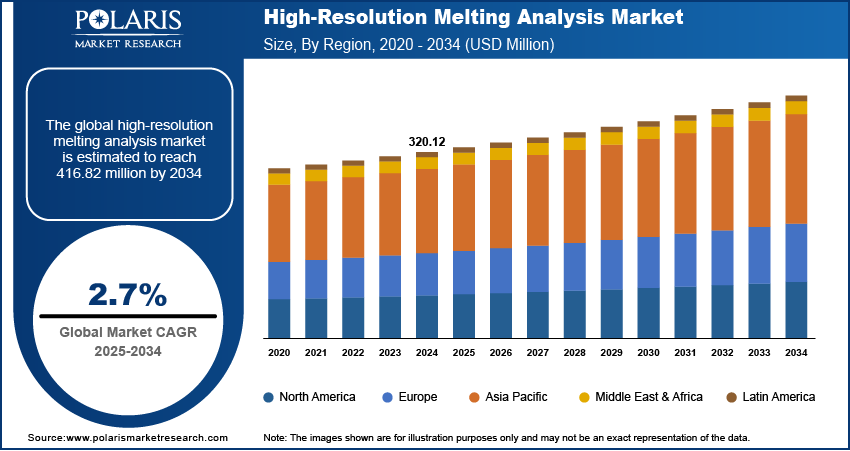
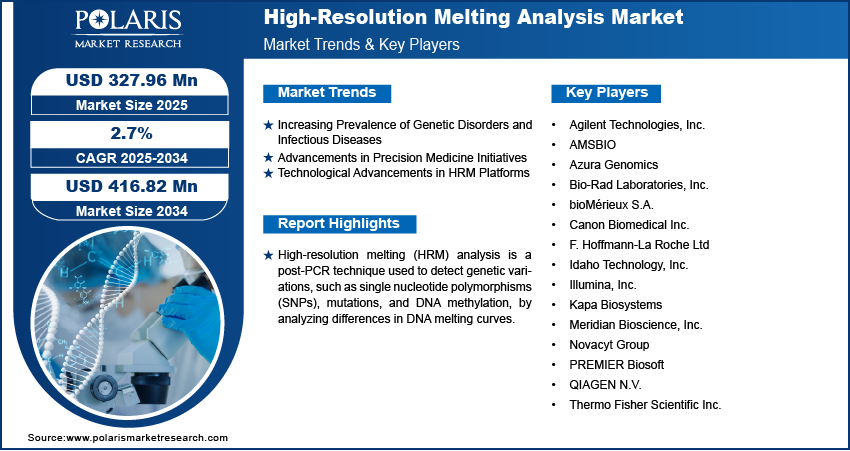
The high-resolution melting analysis market size was valued at USD 328.91 million in 2025. The market is projected to grow from USD 337.84 million in 2026 to USD 419.59 million by 2034, exhibiting a CAGR of 2.7% during 2026–2034.
Market Statistics
Key Takeaways
- North America held the largest market revenue share of 36.0% in 2025. The dominance is driven by the strong presence of leading biotechnology and pharmaceutical companies, and well-established healthcare infrastructure.
- Europe accounted for a significant market share of 28.0% in 2025. The strong presence of research institutions, academic laboratories, and biotechnology companies engaged in genetic and molecular research drives the market growth.
- The Asia Pacific high-resolution melting analysis industry is expected to register the highest CAGR of 4.3% during the forecast period. The growth is attributed to the expanding healthcare infrastructure and increasing investments in molecular diagnostics.
- The instruments segment is expected to record a significant CAGR of 1.8% during the forecast period. The growing application of HRM analysis for the identification of candidate predisposition genes, DNA mapping, mutation discovery, and HLA typing propels the growth.
- The SNP genotyping segment held the largest revenue share of 25.0% in 2025. This is attributed to its key role in identifying SNPs that influence disease susceptibility and drug response.
- The research laboratories & academic institutes segment dominated with 40.0% in 2025. This is fueled by their pivotal role in advancing genetic research and molecular diagnostics.
*Note: Figures and projections outlined in this report are the result of Polaris Market Research’s proprietary analytical processes, grounded in the latest available datasets and market observations.
Industry Dynamics
- Rising adoption of high-resolution melting analysis in genetic testing and molecular diagnostics drives the market growth.
- Increasing demand from academic and research laboratories is expanding the application base of technologies related to high-resolution melting analysis.
- High-resolution melting analysis is enhancing mutation detection and disease profiling capabilities. Thus, the growing use of this process in oncology and epigenetics boosts market growth.
- Surging role in personalized medicine supports precise and cost-effective genetic variation analysis.
- Increasing integration with next-generation sequencing (NGS) technologies improves workflow efficiency and validation processes.
- Limited sensitivity compared to advanced sequencing methods restrains adoption in highly complex analyses.
AI Impact on the High-Resolution Melting Market
- AI-based algorithms are enhancing interpretation of complex melting curves. It enables accurate detection of genetic variations and mutations.
- Integration of machine learning in high-resolution melting software automates genotype clustering. It also reduces human error in data analysis.
- AI-enabled analytics are improving sensitivity in identifying subtle DNA sequence differences. This is strengthening applications in oncology and epigenetics.
- Adoption of AI is accelerating workflow efficiency. The technology enables real-time data processing and faster turnaround in molecular diagnostics.
- AI integration supports large-scale genomic studies. The adoption enables high-throughput analysis and better data management capabilities.
What is High-Resolution Melting Analysis?
The high-resolution melting analysis market growth is attributed to its increasing adoption in genetic research, clinical diagnostics, and epigenetic studies. High-resolution melting (HRM) analysis is a post-PCR technique used for detecting mutations, polymorphisms, and methylation changes in DNA sequences. This method is widely utilized due to its cost-effectiveness, high sensitivity, and rapid processing capabilities compared to traditional sequencing techniques. The rising prevalence of genetic disorders, advancements in precision medicine, and the growing demand for molecular diagnostic techniques are key factors fueling the market's expansion. Additionally, the increasing focus on personalized medicine and companion diagnostics is further driving the adoption of HRM analysis in clinical settings.
Source: Polaris Market Research Analysis
Several factors, including technological advancements in HRM analysis platforms, increasing funding for genetic research, and the expanding application of HRM in oncology and infectious disease diagnostics contribute to the high-resolution melting analysis market demand. The market is also benefiting from the growing emphasis on early disease detection and the rising adoption of HRM analysis in forensic science and agricultural biotechnology. However, challenges such as the requirement for high-quality DNA samples and the availability of alternative genotyping techniques may hinder market growth to some extent. Despite these limitations, ongoing research and development efforts and the increasing integration of HRM technology in diagnostic and research laboratories worldwide are expected to offer lucrative the high-resolution melting analysis market opportunities during the forecast period.
High-Resolution Melting Vs DNA Sequencing
High-resolution melting analysis and DNA sequencing are widely used molecular techniques for detecting genetic variations. They differ significantly based on cost, speed, and depth of analysis. High-resolution melting analysis is primarily a rapid screening tool. However, DNA sequencing provides comprehensive and highly detailed genetic information.
| Parameter | High-Resolution Melting (HRM) | DNA Sequencing |
| Cost | Low cost, as it does not require probes or extensive reagents | Higher cost due to complex workflows, reagents, and instrumentation |
| Speed | Rapid analysis with results available immediately after PCR | Slower process involving library preparation, sequencing, and data analysis |
| Sensitivity | High sensitivity for detecting known and unknown variations, but limited in resolving very complex mutations | Very high sensitivity and accuracy, capable of identifying even rare and complex genetic variations |
| Application | Ideal for screening, genotyping, mutation scanning, and methylation analysis | Used for comprehensive genomic analysis, variant confirmation, and detailed DNA characterization |
Source: Polaris Market Research Analysis
Market Dynamics
Increasing Prevalence of Genetic Disorders and Infectious Diseases
The rising incidence of genetic disorders and infectious diseases has significantly propelled the demand for advanced diagnostic techniques, including high-resolution melting (HRM) analysis. HRM analysis offers a rapid and cost-effective method for detecting genetic mutations and variations, making it invaluable in clinical diagnostics. For instance, the World Health Organization (WHO) reported in 2023 that tuberculosis (TB) was responsible for approximately 1.25 million fatalities globally, highlighting the urgent need for efficient diagnostic tools. This escalating burden underscores the critical role of HRM analysis in early detection and management of such conditions, further driving the high-resolution melting analysis market development.
Advancements in Precision Medicine Initiatives
The global shift towards precision medicine has bolstered the HRM analysis market growth. Precision medicine aims to tailor medical treatment to individual genetic profiles, necessitating accurate and efficient genomic analysis methods such as high-resolution melting. Such initiatives have increased the adoption of high-resolution melting analysis in both research and clinical settings.
Technological Advancements in HRM Platforms
Continuous technological innovations have enhanced the accuracy, efficiency, and application range of HRM analysis platforms. Modern HRM instruments now offer higher sensitivity and specificity, enabling the detection of subtle genetic variations. These advancements have expanded the utility of HRM analysis across various applications, including mutation scanning, SNP typing, and epigenetic studies. The integration of HRM technology in diagnostic and research laboratories worldwide is expected to support the high-resolution melting analysis market trends.
Market Challenges
- Limited detection scope compared to DNA sequencing. Thus, its use is restricted to identifying highly complex or rare genetic variations.
- The technique requires skilled professionals to accurately interpret melting curves. It creates a dependency on technical expertise.
- High initial investments in specialized, compatible instruments in high-resolution melting analysis can hinder adoption in small and mid-sized laboratories.
- Variability in results due to sample quality, dye selection, and instrument differences can adversely impact reproducibility and reliability.
- Lack of standardization across protocols and platforms restricts widespread clinical adoption and consistent outcomes.
Source: Polaris Market Research Analysis
Segment Insights
Market Assessment – by Product & Services
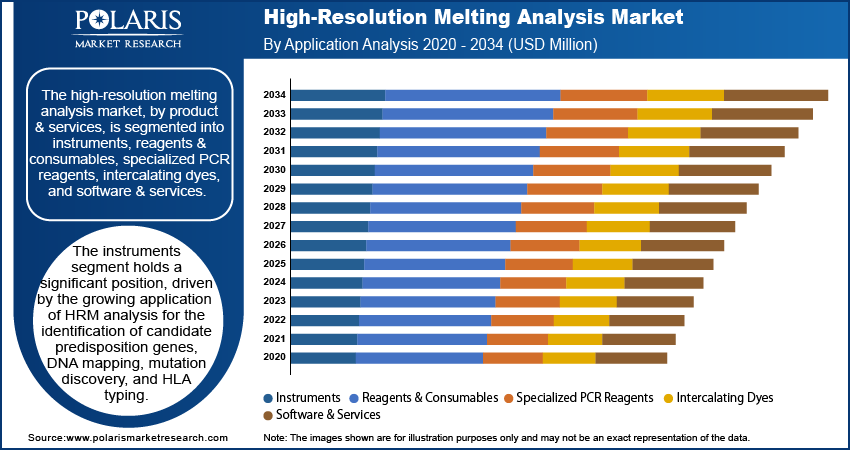
The high-resolution melting analysis market, by product & services, is segmented into instruments, reagents & consumables, specialized PCR reagents, intercalating dyes, and software & services. The instruments segment is expected to record significant growth at 1.8% CAGR during the forecast period, driven by the growing application of HRM analysis for the identification of candidate predisposition genes, DNA mapping, mutation discovery, and HLA typing. This segment's prominence is attributed to the essential role instruments play in facilitating precise and efficient HRM procedures. Advancements in instrument technology have enhanced the sensitivity and accuracy of HRM analysis, leading to increased adoption in both research and clinical settings. Manufacturers are continually innovating to develop user-friendly and automated systems, further propelling the growth of this segment.
The reagents and consumables segment accounted for the largest share valued at 46.0% of the high-resolution melting analysis market revenue in 2025, due to the recurring nature of their use in HRM procedures. This segment encompasses DNA intercalating dyes, primers, and other essential chemicals required for each HRM analysis. The consistent demand for these products ensures a steady revenue stream for manufacturers. Moreover, the increasing number of HRM tests conducted for applications such as mutation discovery and SNP genotyping further drives the demand for reagents and consumables, underscoring the segment's lucrative potential.
Market Evaluation – by Application
The high-resolution melting analysis market, by application, is segmented into SNP genotyping, mutation discovery, species identification, pathogen identification, epigenetics, and other applications. The SNP genotyping segment held 25.0% share in 2025, attributed to its essential function in identifying single nucleotide polymorphisms (SNPs) that influence disease susceptibility and drug response. Advancements in genomic research and the rising focus on individualized treatment strategies have heightened the importance of SNP genotyping. High-resolution melting analysis offers a cost-effective and efficient approach to SNP detection, leading to its increased adoption in both research and clinical settings. This growing utilization underscores the segment's rapid expansion within the market.
The mutation discovery segment is experiencing significant growth at 3.3% CAGR, driven by its critical role in detecting genetic variations associated with various diseases. Mutation scanning is crucial in genetic research, clinical diagnostics, and pharmaceutical development for identifying genetic changes associated with diseases, drug response, and treatment resistance. The increasing prevalence of genetic disorders and the growing emphasis on personalized medicine have further propelled the demand for mutation scanning applications, solidifying its substantial market share.
Market Outlook – by End User
The high-resolution melting analysis market, by end user, is segmented into research laboratories & academic institutes, hospitals & diagnostic centers, pharmaceutical & biotechnology companies, and other end users. The research laboratories & academic institutes segment held 40.0% share in 2025, driven by their pivotal role in advancing genetic research and molecular diagnostics. These institutions are at the forefront of exploring new technologies and methodologies, including high-resolution melting analysis (HRMA), for applications such as genotyping, mutation detection, and DNA methylation analysis. The demand for HRMA is propelled by the need for accurate and reliable methods to study genetic variations and molecular markers associated with diseases, drug responses, and environmental factors. Access to state-of-the-art equipment, specialized facilities, and expert personnel enables these institutions to conduct sophisticated HRMA experiments, optimize assay conditions, and interpret complex data generated from high-resolution melting curves.
The clinical diagnostics segment is experiencing substantial growth, attributed to the increasing adoption of HRMA technology for detecting genetic variations associated with human diseases. Clinical laboratories and healthcare institutions utilize HRMA for disease diagnosis, mutation analysis, and personalized medicine applications. The effectiveness of HRM technology in delivering precise and real-time genetic information greatly benefits clinical laboratories, enhancing patient care and treatment outcomes.
Source: Polaris Market Research Analysis
Regional Insights
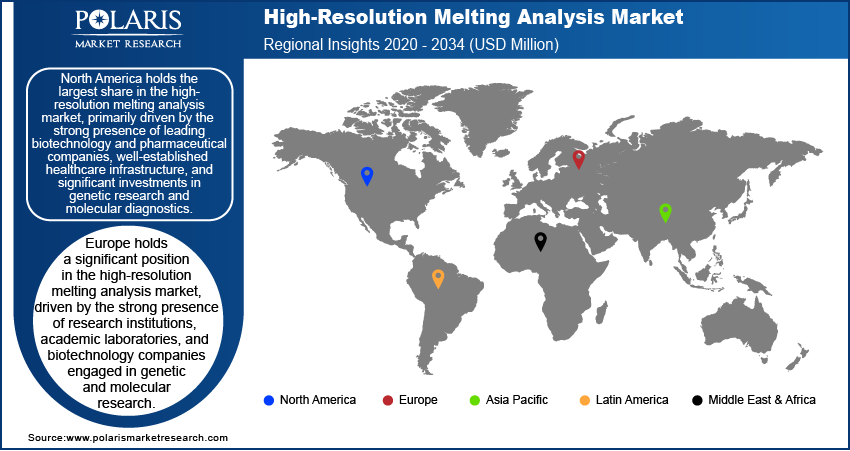
By region, the study provides high-resolution melting analysis market insights into North America, Europe, Asia Pacific, Latin America, and the Middle East & Africa. North America holds the largest share accounting for 36.0% in 2025, primarily driven by the strong presence of leading biotechnology and pharmaceutical companies, well-established healthcare infrastructure, and significant investments in genetic research and molecular diagnostics. The region benefits from a high adoption rate of advanced diagnostic technologies, supported by favorable government initiatives and funding for precision medicine and genomic research. The increasing prevalence of genetic disorders and cancer has further accelerated the demand for high-resolution melting analysis in clinical diagnostics and research applications. Additionally, the presence of key market players and ongoing technological advancements contribute to the region’s dominant position in the global market. Meanwhile, Asia Pacific market is witnessing rapid growth due to expanding healthcare infrastructure, rising research activities, and increasing awareness of molecular diagnostics in emerging economies such as China and India.
In 2025, Europe holds 28.0% share in the high-resolution melting analysis market, driven by the strong presence of research institutions, academic laboratories, and biotechnology companies engaged in genetic and molecular research. The region benefits from well-established healthcare systems, increasing government funding for genomic studies, and growing adoption of precision medicine. Countries such as Germany, the UK, and France are leading contributors, with high investments in diagnostic technologies and a strong focus on cancer research and genetic disease screening. Additionally, the region's stringent regulatory policies ensure the use of high-quality diagnostic tools, further supporting market growth.
The Asia Pacific high-resolution melting analysis market is witnessing rapid growth at a CAGR of 4.3%, fueled by expanding healthcare infrastructure, increasing investments in molecular diagnostics, and rising awareness of genetic testing. Countries such as China, India, and Japan are driving market expansion due to government initiatives supporting genomic research, a growing patient population with genetic disorders, and the increasing demand for cost-effective diagnostic techniques. The rise in pharmaceutical and biotechnology research, coupled with the region’s increasing focus on personalized medicine, further contributes to the growing adoption of high-resolution melting analysis in clinical and research applications.
Source: Polaris Market Research Analysis
Key Players and Competitive Insights
Several key players in the high-resolution melting analysis market ecosystem maintain active operations. A few companies are Agilent Technologies, Inc.; Azura Genomics; bioMérieux S.A.; Bio-Rad Laboratories, Inc.; F. Hoffmann-La Roche Ltd; Idaho Technology, Inc.; Illumina, Inc.; Meridian Bioscience, Inc.; PREMIER Biosoft; QIAGEN N.V.; and Thermo Fisher Scientific Inc.
These companies offer a diverse range of products and services that cater to various applications of high-resolution melting analysis. Their offerings include advanced instruments, reagents, software solutions, and comprehensive support services, enabling researchers and clinicians to conduct precise genetic analyses. The presence of these companies contributes to a competitive market landscape, fostering innovation and the development of more efficient and accurate diagnostic tools.
The competitive dynamics among these players drive continuous advancements in high-resolution melting analysis technologies. Collaborations, strategic partnerships, and investments in research and development are common strategies employed to enhance product portfolios and expand market reach. This competition benefits the companies involved and accelerates the availability of innovative diagnostic solutions to the scientific and medical communities, ultimately improving patient outcomes.
Thermo Fisher Scientific Inc. is a global leader in serving science, providing innovative technologies, analytical instruments, and services to various sectors, including healthcare, life sciences, and environmental research. The company operates in multiple countries, offering products and services that support advancements in research and diagnostics.
F. Hoffmann-La Roche Ltd, commonly known as Roche, is a Swiss multinational healthcare company specializing in pharmaceuticals and diagnostics. Roche focuses on developing innovative medicines and diagnostic tools to improve patient care. The company has a significant presence in both the pharmaceutical and diagnostics markets, contributing to advancements in personalized healthcare.
List of Key Companies
- Agilent Technologies, Inc.
- Azura Genomics
- bioMérieux S.A.
- Bio-Rad Laboratories, Inc.
- F. Hoffmann-La Roche Ltd
- Idaho Technology, Inc.
- Illumina, Inc.
- Meridian Bioscience, Inc.
- PREMIER Biosoft
- QIAGEN N.V.
- Thermo Fisher Scientific Inc.
Industry Developments
- February 2025: Illumina introduced new multiomic technologies capable of analyzing rare-disease variants and methylation simultaneously in a single run. The platform is scheduled for commercial release in 2026 and is expected to broaden access to advanced high-resolution analytical tools. (Source: illumina.com)
- January 2025: bioMérieux completed its EUR 111 million acquisition of SpinChip Diagnostics, expanding its point-of-care portfolio with rapid, blood-based immunoassays that deliver results in just 10 minutes. (Source: biomerieux.com)
Market Segmentation
By Product and Services Outlook (Revenue – USD Million, 2021–2034)
- Instruments
- Reagents & Consumables
- Specialized PCR Reagents
- Intercalating Dyes
- Software & Services
By Application Outlook (Revenue – USD Million, 2021–2034)
- SNP Genotyping
- Mutation Discovery
- Species Identification
- Pathogen Identification
- Epigenetics
- Other Applications
By End User Outlook (Revenue – USD Million, 2021–2034)
- Research Laboratories & Academic Institutes
- Hospitals & Diagnostic Centers
- Pharmaceutical & Biotechnology Companies
- Other End Users
By Regional Outlook (Revenue – USD Million, 2021–2034)
- North America
- US
- Canada
- Europe
- Germany
- France
- UK
- Italy
- Spain
- Netherlands
- Russia
- Rest f Europe
- Asia Pacific
- China
- Japan
- India
- Malaysia
- Suth Korea
- Indnesia
- Australia
- Vietnam
- Rest f Asia Pacific
- Middle East & Africa
- Saudi Arabia
- UAE
- Israel
- Suth Africa
- Rest f Middle East & Africa
- Latin America
- Mexic
- Brazil
- Argentina
- Rest f Latin America
Report Scope
| Report Attributes | Details |
| Market Size Value in 2025 | USD 328.91 million |
| Market Size Value in 2026 | USD 337.84 million |
| Revenue Forecast by 2034 | USD 419.59 million |
| CAGR | 2.7% from 2026 to 2034 |
| Base Year | 2025 |
| Historical Data | 2021–2024 |
| Forecast Period | 2026–2034 |
| Quantitative Units | Revenue in USD million and CAGR from 2026 to 2034 |
| Report Coverage | Revenue Forecast, Market Competitive Landscape, Growth Factors, and Industry Trends |
| Segments Covered |
|
| Regional Scope |
|
| Competitive Landscape |
|
| Report Format |
|
| Customization | Report customization as per your requirements with respect to countries, regions, and segmentation. |
Source: Polaris Market Research Analysis
How is the report valuable for an organization?
Workflow/Innovation Strategy: The high-resolution melting analysis market has been segmented into product and services, application, and end user. Moreover, the study provides the reader with a detailed understanding of the different segments at both the global and regional levels.
Growth/Marketing Strategy: Companies in the high-resolution melting analysis market focus on expanding their product portfolios, forming strategic collaborations, and investing in research and development to enhance technological capabilities. Market players emphasize the development of cost-effective and high-precision solutions to meet the growing demand for genetic analysis in clinical diagnostics and research. Geographic expansion into emerging markets, particularly in Asia Pacific and Latin America, is a key strategy to increase market penetration. Additionally, partnerships with research institutions and healthcare providers help drive innovation and accelerate adoption. Digital marketing, educational initiatives, and participation in industry conferences further support awareness and customer engagement.
High-Resolution Melting Analysis Market FAQ's
The high-resolution melting analysis market size was valued at USD 328.91 million in 2025 and is projected to grow to USD 419.59 million by 2034.
The market is projected to register a CAGR of 2.7% during the forecast period.
North America had the largest share of the market in 2025 with a valuation of 36.0%.
Several key players in the market maintain active operations. A few players include Agilent Technologies, Inc.; Azura Genomics; bioMérieux S.A.; Bio-Rad Laboratories, Inc.; F. Hoffmann-La Roche Ltd; Idaho Technology, Inc.; Illumina, Inc.; Meridian Bioscience, Inc.; PREMIER Biosoft; QIAGEN N.V.; and Thermo Fisher Scientific Inc.
The reagents & consumables segment accounted for the largest share of the market of 46.0% in 2025.
The SNP genotyping segment holds 25.0% share in 2025, attributed to its essential function in identifying single nucleotide polymorphisms (SNPs).
Download Sample Report of High-Resolution Melting Analysis Market
Please fill out the form to request a customized copy of the research report.


