
Hyperspectral Imaging Systems Market Insights, Size, Share & Industry Report, 2025-2034
REPORT DETAILS
Market Statistics
Market Overview
The hyperspectral imaging systems market size was valued at USD 15.54 billion in 2024 and is projected to register a CAGR of 10.6% from 2025 to 2034. The growing focus on the diagnosis of plant diseases in crops propels the demand for hyperspectral imaging systems. The rising need for the detection of rock minerals to locate natural resources is driving the global industry expansion.
Key Insights
- The cameras segment accounted for a major share in 2024. It is due to its critical role in capturing high-resolution spectral data across various applications.
- The military surveillance segment dominated in 2024. The dominance is attributed to the increasing need for advanced reconnaissance and intelligence-gathering capabilities.
- North America held the largest share in 2024. The dominance of this region is driven by heavy investments in research and development, particularly in defense, agriculture, and healthcare.
- The Asia Pacific hyperspectral imaging systems industry is expected to register a significant CAGR during the forecast period. Rapid industrialization and increasing agricultural needs in countries such as China and India fuel the growth.
Industry Dynamics
- Rising popularity of image-guided surgeries is driving the market growth
- Growing need for surveillance and reconnaissance in military operations propels the industry expansion.
- High cost and complexity are hindering the adoption of hyperspectral imaging systems.
- Increasing technological advancements in sensor design and manufacturing will offer lucrative opportunities in the coming years.
Market Statistics
2024 Market Size: USD 15.54 billion
2034 Projected Market Size: USD 42.35 billion
CAGR (2025–2034): 10.6%
North America: Largest market in 2024
AI Impact on Hyperspectral Imaging Systems Market
- Artificial intelligence (AI) technology enhances hyperspectral imaging (HSI) as it facilitates faster interpretation of complex spectral data.
- It offers automated material classification, predictive analytics, and anomaly detection, which were previously time-consuming with conventional methods.
- In agriculture, AI-integrated HSI is used for precision farming, soil analysis, and crop health monitoring to improve yields and reduce waste.
- In the healthcare sector, the technology helps in early disease detection and noninvasive diagnostics, which improves patient outcomes.
- The use of AI in environmental monitoring offers high-resolution spectral insights. It helps track ecosystem changes and support disaster response.
- In defense & security, the technology is integrated into space-borne systems. The systems are used for target detection, surveillance, and terrain analysis.
Source: Polaris Market Research Analysis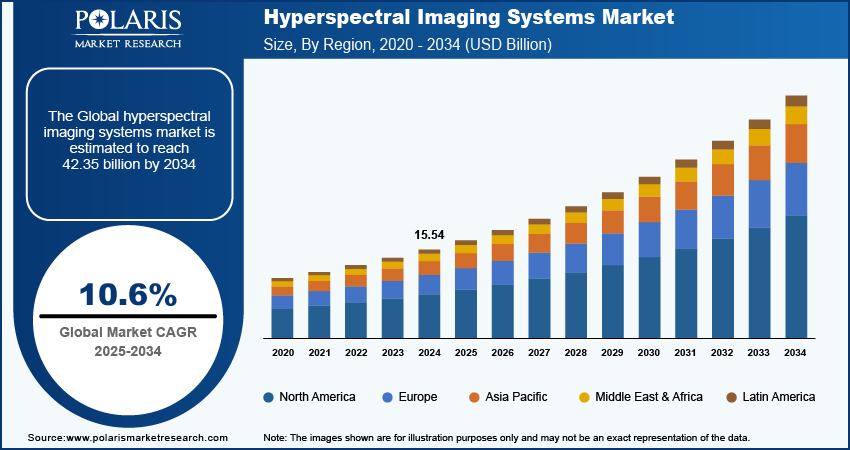
To Understand More About this Research: Download Sample Report
Hyperspectral imaging systems (HSI) are an advanced technology that captures and analyzes data across a wide range of the electromagnetic spectrum, providing detailed spectral information for each pixel in an image. The system divides the spectrum into hundreds or even thousands of narrow bands, allowing for a more detailed understanding of the materials and processes within the scene being imaged.
The growing need for the detection of rock minerals to find natural resources is driving the global hyperspectral imaging systems market growth. Hyperspectral imaging systems capture a wide range of wavelengths across the electromagnetic spectrum, allowing for detailed analysis and identification of rock minerals based on their unique spectral signatures.
The rising advancement in technology is projected to fuel the global hyperspectral imaging systems market growth during the forecast period. Advancements in sensor design and manufacturing have led to the development of more sensitive, compact, and cost-effective hyperspectral imaging systems, making them accessible for various applications and thereby increasing adoption. Additionally, the integration of artificial intelligence and machine learning technologies in hyperspectral imaging systems enhances their ability to analyze hyperspectral data, improving object detection, classification, and anomaly detection. This factor increases their adoption in several industries, such as defense, medicine, geology, and agriculture.
The hyperspectral imaging systems market is driven by a growing focus on the diagnosis of plant diseases in crops. Hyperspectral imaging enables the early detection of plant diseases in crops by analyzing minimal changes in leaf reflectance. This allows farmers to identify infections before visible symptoms appear, facilitating timely intervention. Furthermore, the ability to rapidly capture and analyze hyperspectral data across large areas makes hyperspectral imaging systems ideal for monitoring vast agricultural fields. This makes hyperspectral imaging beneficial during the diagnosis of plant diseases in crops.
Market Driver Analysis
Rising Popularity of Image-Guided Surgeries
Hyperspectral imaging provides detailed information about tissue composition and health that traditional imaging methods do not cover. This capability helps surgeons visualize critical structures, such as blood vessels and tumors, thereby improving surgical precision and increasing adoption in image-guided surgeries. Therefore, the rising popularity of image-guided surgeries is projected to propel the global hyperspectral imaging systems market.
Growing Need for Surveillance and Reconnaissance in Military Operations
The ability of hyperspectral imaging systems to detect objects based on their spectral signatures enables military forces to see through certain types of camouflage that may be effective against conventional imaging systems, giving them a tactical advantage in military operations. This boosts demand for hyperspectral imaging systems for surveillance and reconnaissance in military operations. Thus, the rising need for surveillance and reconnaissance in military operations fuels the global hyperspectral imaging systems market growth.
Source: Polaris Market Research Analysis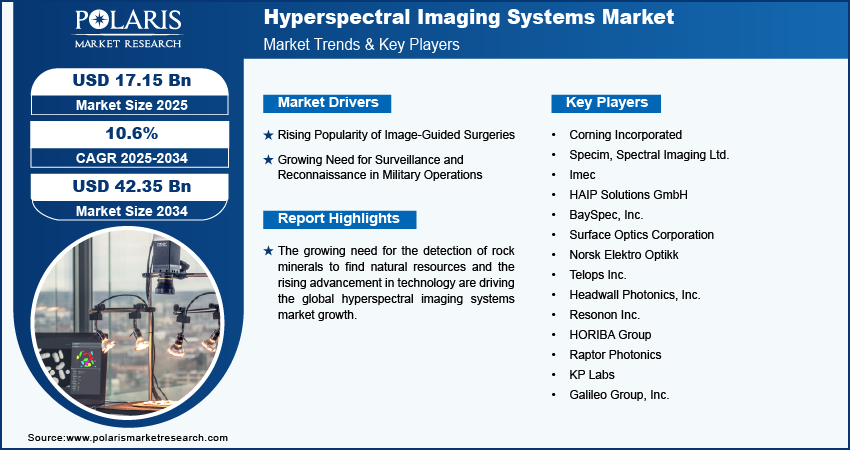
Segment Analysis
Market Breakdown by Product Insights
Based on product, the hyperspectral imaging systems market is bifurcated into cameras and accessories. The cameras segment accounted for a major market share in 2024 due to its critical role in capturing high-resolution spectral data across various applications. The increasing demand for accurate and detailed imaging in fields such as agriculture, environmental monitoring, and defense has propelled the growth of this segment. Cameras equipped with advanced sensors provide precise measurements of spectral reflectance, enabling users to identify materials and monitor changes in the environment effectively. Additionally, innovations in camera technology, including improved sensitivity and resolution, have fueled their adoption among industries seeking enhanced imaging capabilities. The demand for advanced imaging cameras continues to rise as sectors such as precision agriculture increasingly rely on real-time data for crop management and disease detection.
The accessories segment is projected to grow at a robust pace in the coming years, owing to the increasing need for complementary tools that enhance the functionality of hyperspectral imaging systems. Accessories such as lighting systems, filters, and software solutions play a crucial role in optimizing image quality and data analysis. Furthermore, the integration of artificial intelligence and machine learning in data processing requires advanced software solutions, propelling the need for innovative accessories. This trend toward enhancing imaging capabilities through complementary products positions the accessories segment for significant growth in the hyperspectral imaging system market.
Market Breakdown by Application Insights
In terms of application, the hyperspectral imaging systems market is divided into military surveillance, remote sensing, medical diagnostics, machine vision & optical sorting, and others. The military surveillance segment dominated the market in 2024 due to the increasing need for advanced reconnaissance and intelligence-gathering capabilities. The demand for precise and reliable imaging technologies has surged as armed forces across the world focus on enhancing their situational awareness and operational efficiency. Military applications benefit from the ability of hyperspectral imaging to detect materials and identify potential threats in real time, even in challenging environments. The capability of hyperspectral imaging to penetrate camouflage and discern features that traditional imaging systems cannot detect further solidifies its importance in defense strategies. Additionally, governments around the globe are investing in modernizing their military capabilities, contributing to the sustained growth of the segment.
The medical diagnostics segment is projected to experience significant growth during the forecast period, owing to the increasing emphasis on early disease detection and personalized medicine. The ability of hyperspectral imaging to provide detailed spectral information allows for the differentiation between healthy and diseased tissues, enhancing the efficacy of diagnostics and increasing adoption. Furthermore, ongoing research in the applications of hyperspectral imaging systems in various medical fields, including oncology and dermatology, is expanding its relevance and adoption in medical diagnostics.
Source: Polaris Market Research Analysis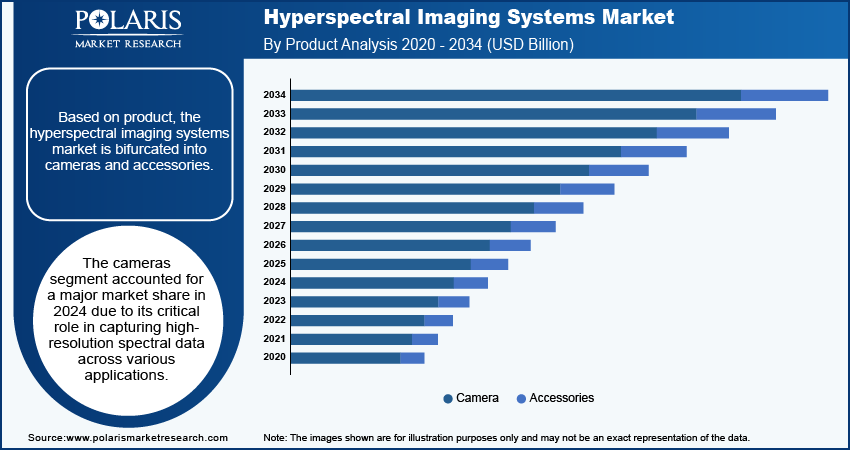
Regional Insights
By region, the study provides the hyperspectral imaging systems market insights into North America, Europe, Asia Pacific, Latin America, and the Middle East & Africa. North America held the largest market share in 2024, with the US leading the region. The dominance of this region is attributed to heavy investments in research and development, particularly in defense, agriculture, and healthcare. Military applications drive significant demand as advanced imaging technologies enhance surveillance capabilities and situational awareness. Additionally, the presence of key players and technological innovators in the US boosts rapid advancements and adoption across various sectors. Furthermore, growing awareness of environmental issues has prompted investments in monitoring and assessment technologies, further propelling the adoption of hyperspectral imaging systems in North America.
Source: Polaris Market Research Analysis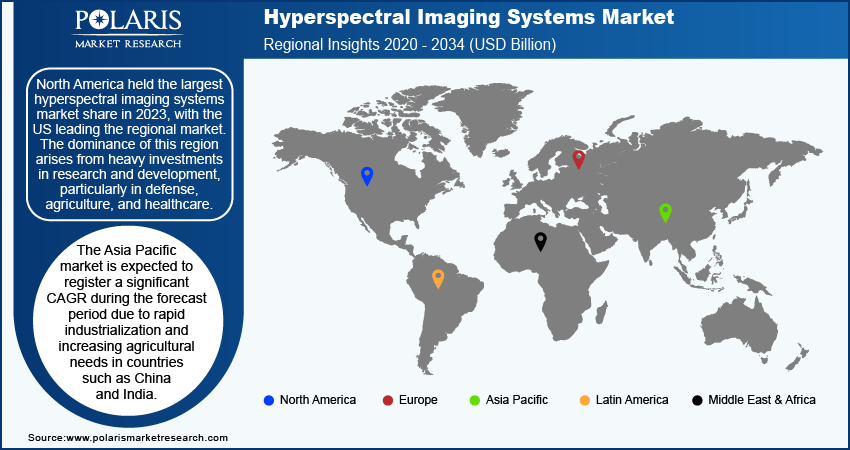
The Asia Pacific hyperspectral imaging systems market is expected to register a significant CAGR during the forecast period due to rapid industrialization and increasing agricultural needs in countries such as China and India. These nations are increasingly turning to advanced imaging technologies, such as hyperspectral imaging systems, for precision agriculture and environmental monitoring as they strive to enhance food security and manage resources more efficiently. The ongoing investments in healthcare infrastructure and research initiatives in the region are expanding the applications of hyperspectral imaging systems in medical diagnostics. Moreover, the rise in defense spending in countries such as India and Japan contributes to the growing demand for sophisticated surveillance tools such as hyperspectral imaging systems. For instance, India's defense budget has steadily increased from USD 64.63 billion (₹5.25 lakh crore) in 2022 to USD 72.40 billion (₹5.94 lakh crore) in 2023.
Key Players and Competitive Analysis
Major hyperspectral imaging systems market players are investing heavily in research and development to expand their offerings, which will help the market grow even more. Market participants are also undertaking a variety of strategic activities to expand their global footprint, with important market developments such as innovative launches, international collaborations, higher investments, and mergers and acquisitions between organizations.
The hyperspectral imaging systems market is fragmented, with the presence of numerous global and regional market players. A few major players in the market are Corning Incorporated, Specim, Spectral Imaging Ltd., Imec, HAIP Solutions GmbH, BaySpec, Inc., Surface Optics Corporation, Norsk Elektro Optikk, Telops Inc., Headwall Photonics, Inc., Resonon Inc., HORIBA Group, Raptor Photonics, KP Labs, and Galileo Group, Inc.
HAIP Solutions GmbH, founded in 2018, is an innovative technology company based in Hanover, Germany, specializing in the development of user-oriented hyperspectral imaging (HSI) camera solutions. The company has rapidly established itself as a key player in the field of spectral imaging, focusing on applications that span agriculture, food processing, forestry, recycling, and geology. HAIP Solutions aims to leverage the power of hyperspectral imaging to promote sustainability and enhance efficiency across various industries. Its products are designed to provide detailed spectral data that help users make informed decisions based on the unique spectral signatures of materials.
Resonon Inc. is a prominent technology company based in Bozeman, Montana, specializing in the design and manufacturing of hyperspectral imaging systems. Resonon has established itself as a player in the field with over 20 years of experience, providing innovative solutions that cater to a diverse range of applications, including agriculture, environmental monitoring, biotechnology, and industrial processes. The product lineup includes various hyperspectral cameras and integrated systems designed for laboratory and field use, enabling users to capture high-quality spectral data across the electromagnetic spectrum.
List Of Key Companies
- Corning Incorporated
- Specim, Spectral Imaging Ltd.
- Imec
- HAIP Solutions GmbH
- BaySpec, Inc.
- Surface Optics Corporation
- Norsk Elektro Optikk
- Telops Inc.
- Headwall Photonics, Inc.
- Resonon Inc.
- HORIBA Group
- Raptor Photonics
- KP Labs
- Galileo Group, Inc.
Hyperspectral Imaging Systems Industry Developments
January 2025: Pixxel launched the first three satellites of its Firefly constellation via a SpaceX rideshare mission. These high-resolution commercial hyperspectral imaging satellites capture data across hundreds of spectral bands with a five-meter native resolution. The launch marked the start of Pixxel’s commercial operations, providing vital earth observation data for industries such as agriculture, energy, and environmental monitoring. According to Pixxel’s CEO, the constellation is designed for daily global coverage, supporting data-driven decisions for climate action and sustainable resource management.
April 2024: KP Labs, a NewSpace company based in Poland, announced the successful capture of the first hyperspectral images by the Intuition-1 satellite, which provides detailed observations of the equatorial region. This development and on-board data processing supported by AI highlights a significant advancement in Earth observation capabilities, enhancing data analysis for various scientific and commercial applications.
May 2023: Specim, a Europe-based technology firm headquartered in Oulu, Finland, announced the launch of the next-generation near-infrared line-scan hyperspectral camera, Specim GX17, for advanced machine vision.
September 2022: Raptor Photonics, a global company that designs, manufactures, and sells high-performance digital and analog cameras and systems for industrial, research, and governmental organizations, announced the launch of a new Hyperspectral Imaging System Hardware Engine for OEMs at Vision 2022.
Hyperspectral Imaging Systems Market Segmentation
By Product Outlook (Revenue, USD Billion, 2020–2034)
- Camera
- Accessories
By Technology Outlook (Revenue, USD Billion, 2020–2034)
- Snapshot
- Push Broom
- Others
By Application Outlook (Revenue, USD Billion, 2020–2034)
- Military Surveillance
- Remote Sensing
- Medical Diagnostics
- Machine Vision & Optical Sorting
- Others
By Regional Outlook (Revenue, USD Billion, 2020–2034)
- North America
- US
- Canada
- Europe
- Germany
- France
- UK
- Italy
- Spain
- Netherlands
- Russia
- Rest of Europe
- Asia Pacific
- China
- Japan
- India
- Malaysia
- South Korea
- Indonesia
- Australia
- Rest of Asia Pacific
- Middle East & Africa
- Saudi Arabia
- UAE
- Israel
- South Africa
- Rest of Middle East & Africa
- Latin America
- Mexico
- Brazil
- Argentina
- Rest of Latin America
Hyperspectral Imaging Systems Market Report Scope
| Report Attributes | Details |
| Market Size Value in 2024 | USD 15.54 billion |
| Market Size Value in 2025 | USD 17.15 billion |
| Revenue Forecast by 2034 | USD 42.35 billion |
| CAGR | 10.6% from 2025 to 2034 |
| Base Year | 2024 |
| Historical Data | 2020–2023 |
| Forecast Period | 2025–2034 |
| Quantitative Units | Revenue in USD Billion and CAGR from 2025 to 2034 |
| Report Coverage | Revenue Forecast, Market Competitive Landscape, Growth Factors, and Trends |
| Segments Covered |
|
| Regional Scope |
|
| Competitive Landscape |
|
| Report Format |
|
| Customization | Report customization as per your requirements with respect to countries, regions, and segmentation. |
Source: Polaris Market Research Analysis
hyperspectral imaging systems market FAQ's
The global hyperspectral imaging systems market size was valued at USD 15.54 billion in 2024 and is projected to grow to USD 42.35 billion by 2034.
The global market is projected to register a CAGR of 10.6% during the forecast period.
North America accounted for the largest share of the global market in 2024
A few key players in the market are Corning Incorporated; Specim, Spectral Imaging Ltd.; Imec; HAIP Solutions GmbH; BaySpec, Inc.; Surface Optics Corporation; Norsk Elektro Optikk; Telops Inc.; Headwall Photonics, Inc.; Resonon Inc.; HORIBA Group; Raptor Photonics; KP Labs; and Galileo Group, Inc.
The medical diagnostic segment is projected for significant growth in the global market during the forecast period.
The camera segment dominated the market in 2024.
Download Sample Report of hyperspectral imaging systems market
Please fill out the form to request a customized copy of the research report.


