
Identity Verification Market Size, Share, Trends and Forecast, 2026–2034
REPORT DETAILS
Identity Verification Market Summary
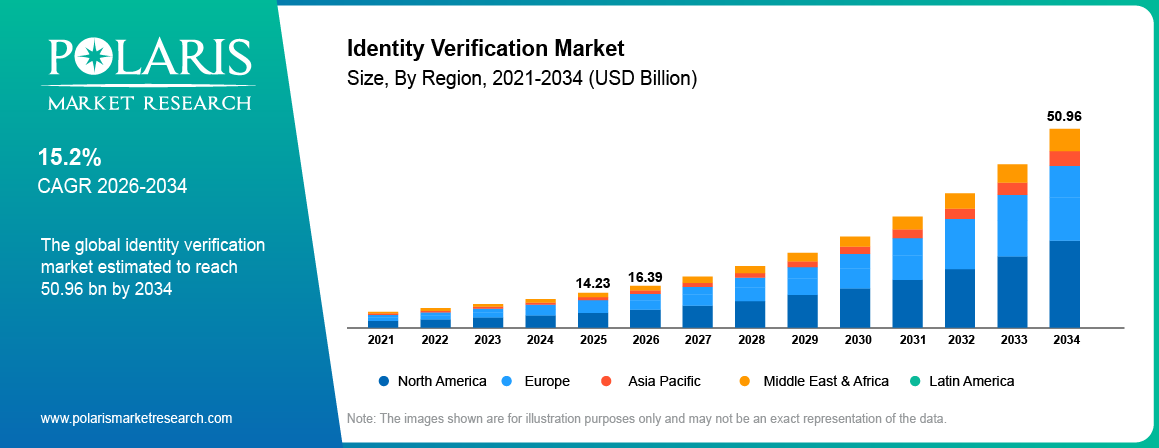
The identity verification market size was valued at USD 14.23 billion in 2025. The market is expected to register a CAGR of 15.2% from 2026 to 2034. Market growth is driven by rising digital identity checks, biometric verification, AI-based fraud detection, and regulatory compliance.
Market Statistics
Key Takeaways
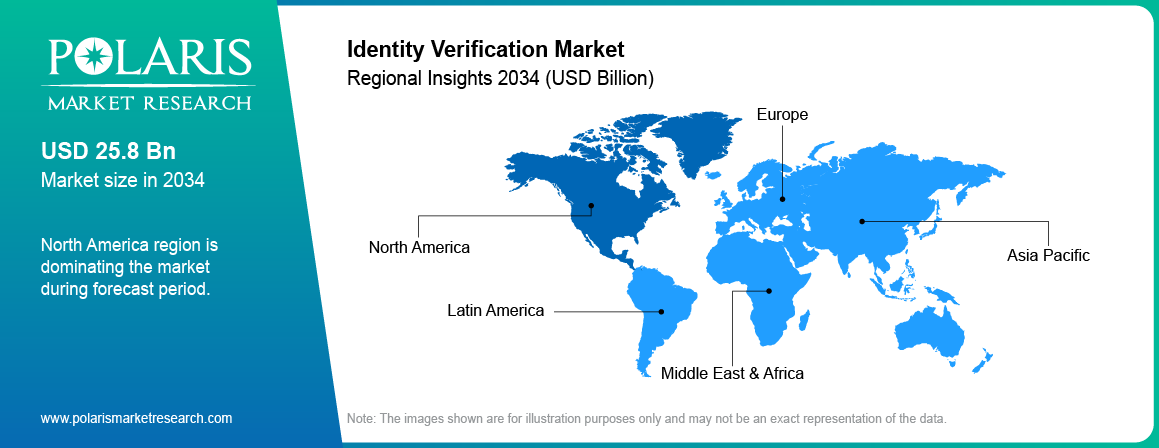
- North America dominated the global identity verification market share with 36.42% in 2025. The growth is driven by strong demand from financial institutions and government agencies.
- The market in Europe is projected to record the significant CAGR of 14.80% during the forecast period. This is fueled by EU AMLA regulations and eIDAS digital identity requirements.
- Document verification held an 29.64% market share in 2025. It is attributed to the rising demand for secure digital onboarding and document authentication.
- Digital credentials are projected to grow at an 21.26% CAGR during the forecast period. The growth is supported by mobile driver's licenses and reusable identity adoption.
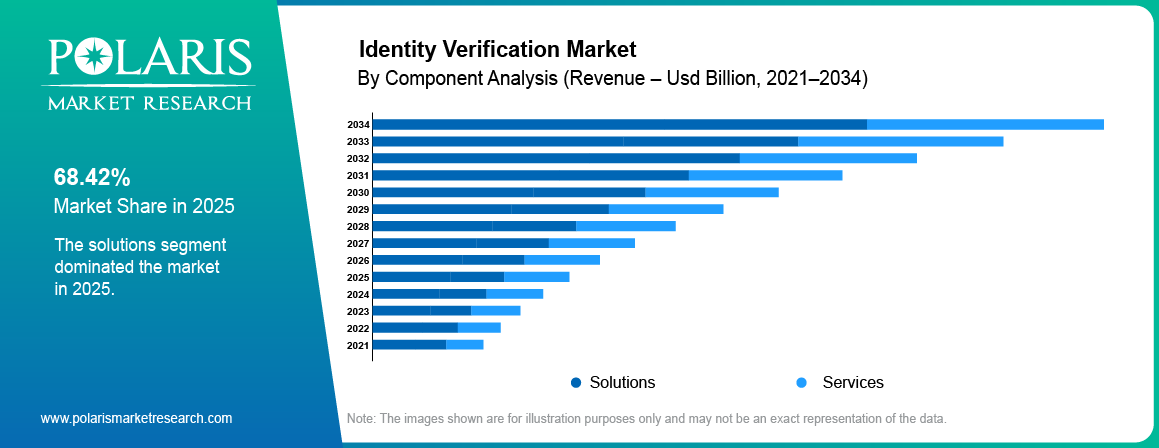
- Solutions accounted for 68.42% market share in 2025. This is attributed to demand for automated verification and biometric technologies.
- Services are projected to grow at an 17.06% CAGR during the forecast period. This is driven by demand for identity screening and continuous identity monitoring.
- BFSI accounted for 30.72% market share in 2025. The segment growth is supported by regulatory requirements for know your customer checks.
Note: Figures and projections outlined in this report are the result of Polaris Market Research’s proprietary analytical processes, grounded in the latest available datasets and market observations.
Identity Verification Market Definition
The identity verification market comprises software, APIs, and related services used to confirm an individual's identity through identity documents, biometric data, database checks, and digital credentials. The market includes document verification platforms, biometric verification solutions, database and data-check services, and digital identity verification technologies. These solutions help businesses confirm customer identities during onboarding, account registration, and financial transactions. The market caters to banks and other financial institutions, government bodies, cryptocurrency and digital asset platforms, gaming operators, and other firms. Market coverage includes revenues generated by identity verification solutions and services. Workforce access management, credit bureau data sales, issuance of identity cards, and biometric matching at borders are not part of the market.
Identity verification solutions use technologies such as optical character recognition, biometric matching, liveness detection, and database screening. These are used to detect fraudulent or altered identity credentials. Document authentication verifies the authenticity of identity documents, and biometric verification compares facial or other biometric characteristics with submitted records. These capabilities enable businesses to conduct know your customer checks and comply with regulatory requirements during digital onboarding. Business verification platforms also do know your business checks to review company records and ownership information. Digital credentials such as mobile driver’s licenses and electronic identity wallets are extending the range of remote identity proofing. Identity verification market analysis by verification method, solution component, end-use industry, and regional demand.
Demand for identity verification solutions is being driven by growing digital transactions, tougher identity compliance rules, and more AI-powered fraud. These platforms are used by financial institutions to screen customers and reduce identity fraud. Federal agencies use identity proofing systems to protect access to public services. Identity checks are used by gaming operators and crypto exchanges to comply with regulations. Businesses are also using liveness detection and deepfake detection technologies to find manipulated identities during remote onboarding. The market assessment covers revenue from dedicated identity verification solutions and directly related services across document verification, biometric verification, database and data checks, and digital credentials.
Market Dynamics
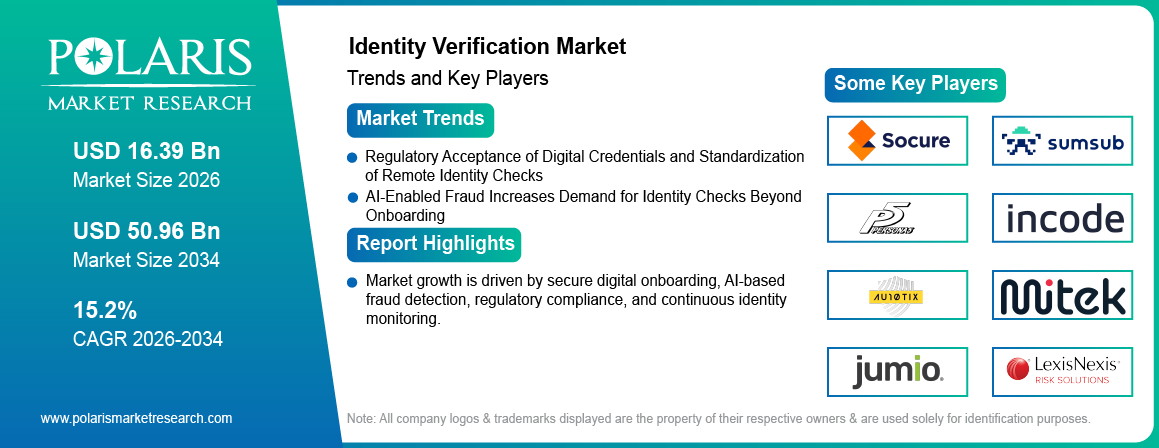
Driver: Regulatory Acceptance of Digital Credentials and Standardization of Remote Identity Checks
The identity verification market is growing, with digital credentials being more widely accepted by regulators and better-defined standards for remote identity verification. Financial institutions and digital service providers need trustworthy methods of verifying the identity of customers when they are registering for accounts and making online transactions. eIDAS for instance, sets out requirements on trusted electronic identification and digital credentials. Government-issued digital identity solutions can also serve as an alternative to physical identity documents. Mobile driver’s licenses allow users to share verified identity information through digital wallets. These developments extend the use of remote identity verification to regulated industries. THINK Digital Partners made observations about trends in the international digital identity landscape in November 2026, which included testing of biometric passenger authentication in India and consolidations within the identity technology vendors (Source: THINK Digital Partners).
Driver: AI-Enabled Fraud Increases Demand for Identity Checks Beyond Onboarding
With AI-enabled fraud on the rise, there is a growing demand for identity checks beyond the initial customer onboarding. Criminals bypass traditional verification systems with fake documents, synthetic identities, and AI-generated faces. Companies need advanced deepfake detection tools to identify manipulated images and fake identity submissions when handling online transactions. Identity verification providers are also broadening their offerings to do more than just account registration and monitor user behavior and identity risk changes. Continuous identity monitoring helps businesses detect suspicious activity post-account creation and as transactions take place. These capabilities improve fraud prevention and extend the role of identity verification across digital business processes. In February 2026 Pindrop reported a 1,210% growth in AI-enabled fraud in 2025, with voice-cloning and deepfake attacks rising against contact centers and virtual business meetings (Source: Infosecurity Magazine).
Restraint: Pricing Pressure and Revenue Complexity Across Identity Verification Services
Identity verification providers are under pressure to price and make revenue more complex. Businesses want to verify high volumes of customers at low cost, limiting the pricing flexibility of service providers. Enterprise contracts also include document checks, biometrics matching, database searches, and fraud detection in pricing structures. This makes it difficult to attribute revenue to individual verification services. The regulatory burden also adds to the cost of providing know your customer checks and know your business services. Technology companies that bundle platforms for identity and fraud prevention and providers also compete on price. These factors create challenges in measuring standalone market revenue and in maintaining service profitability.
Opportunity: Reusable and Wallet-Based Identity Reduces Repeated Verification
Digital credentials can be reused and this gives users the chance to make identity verification easier on multiple services. People can share previously issued identity credentials instead of having to submit the same documents for every new account or transaction. A reusable identity framework also allows businesses to get access to trusted identity information through authorized digital channels. Digital wallets take it a step further, allowing users to store credentials and display them when they are required and verified. A mobile driver’s license is another method for securely sharing identity across supported platforms. These developments open up opportunities for providers to provide wallet-based verification, reduce repeated checks, and improve the customer onboarding experience.
Opportunity: AI Agents Automate Fraud and Compliance Investigations
AI agents will unlock the potential to automate fraud and compliance investigations related to identity. These systems can search customer records, look at suspicious activity, and sift through information for investigation teams. Organizations can link to screening databases to screen for sanctions and determine whether there are any individuals or entities associated with restricted activities. Agent-based platforms can also assist with know your business checks by automatically analyzing company records, ownership information, and risk indicators. Sensitive decisions are still subject to defined permissions and human review. These capabilities enable identity verification providers to go beyond simple onboarding checks into automated fraud investigation and compliance workflows. In October 2026, Shufti launched Know Your Agent (KYA), a solution to verify AI agents, authenticate their human owners, and manage agent permissions for digital transactions.
Identity Verification Market Segmentation Analysis
Identity verification market can be divided on the basis of verification method, component, end-use industry, and region to determine key revenue generators and potential sources of future growth in the market. Regulatory pressures, digital onboarding, and fraud prevention needs drive demand in the market.
Verification Method Insights
In 2025, document verification led the identity verification market share with 29.64%. This part involves verification of identity documents such as passports, national identity cards, and driving licenses. Verification platforms look at document images, pull out personal details, and search for indications of changes or alterations. Digital document verification enables businesses to process customer applications through online channels. The adoption of the mobile driver’s license also broadens the range of credentials accepted through digital verification systems. Demand is driven by document coverage, speed, accuracy, and the ability to detect fraudulent submissions.
The digital credentials market is expected to record the highest CAGR of 21.26% between 2026 and 2034. Digital credentials comprise electronic IDs, government digital credentials, and digital wallets storing identity information. Users can show these credentials through supported platforms instead of submitting physical documents for every transaction. A mobile driver’s license provides a digital way to share government identity information. Adoption is a function of regulatory approval, wallet compatibility, issuer coverage, and user trust. Re-use credentials also allows for the possibility of reducing redundant identity checks.
Biometric verification accounted for 35.86% of the identity verification market share in 2025. This includes facial recognition, fingerprint checks, and other biometric methods to match an individual’s physical traits to identity records submitted. Biometric matching allows businesses to compare live user data with photographs or saved records. Liveness detection tries to determine if the biometric input is a real person or a photograph, recording, or manipulated image. These technologies help reduce impersonation risk during remote onboarding. The demand is based on the recognition accuracy, user experience, device compatibility, and the possibility to determine that the biometric input was generated or manipulated by AI.
In 2025, database and data checks held 24.37% market share. This section includes identity verifications using public records, commercial databases, address data, watchlists, and other reliable sources. Such checks allow companies to cross-reference the details provided by the customer against their existing data and highlight any discrepancies. Financial institutions use database screening during customer onboarding and compliance reviews. Business verification also verifies corporate identities by using company registration records and ownership information. The demand is based on the data coverage, accuracy of records, geographical availability, and access to credible sources of information in diverse markets.
Component Insights
Solutions was the leading segment with an 68.42% share in 2025. This segment covers software platforms, APIs, and automated tools for document verification, biometric checks, database screening, and digital credentials. These products enable businesses to perform remote identity proofing for customer onboarding and online transactions. Integrated platforms combine identity checks with fraud detection and risk assessment capabilities. Buyers take into account the verification accuracy, processing speed, database coverage, system compatibility, and regulatory requirements when procuring. The need for scalable identity checks across digital services and business operations continues to drive demand.
The services segment is estimated to record the highest CAGR of 17.06% during 2026–2034. This portion includes implementation, system integration, configuration, technical support, and managed verification services. Identity platforms are connected to internal systems and compliance workflows by service providers. They also assist businesses with specialized checks such as sanctions screening, customer record reviews, and business identity assessments. Demand is driven by the difficulty of deployment, compliance, technical know-how, and the ongoing management of the platform. Growing adoption across regulated industries is also driving demand for specialized implementation services.
End-Use Industry Insights
BFSI held the largest market share of 30.72% in 2025. Banks, insurance firms, payment services, and FinTech companies employ identity verification platforms to screen clients and prevent fraud related to their identities. They support the opening of accounts, registration of payments, applications for loans, and verification of transactions. Financial institutions also perform know your customer checks to meet regulatory requirements and to validate the identity of their customers. After opening a business account, there is a need to look at ownership and company records, and there may be extra checks. Digital banking adoption, fraud exposure, regulatory obligations, and the need for secure customer onboarding across the financial services sector are driving demand.
Crypto and digital assets sector is expected to record a CAGR of 19.86% during 2026–2034. Crypto exchanges and digital assets platforms carry out identity checks when signing up accounts, performing withdrawals, and analyzing transactions. It enables the platform to spot suspicious users and ensure compliance with regulations. Organizations perform Know Your Business checks for analysis of corporate clients and institutional accounts. The demand is driven by the adoption of digital assets, regulatory requirements, fraud risks, and customer verification processes on the trading platforms.
In 2025, government and public sector accounted for 22.48% of the identity verification market share. This segment entails identity proofing solutions for the enrollment of people in public services, government digital accounts, benefit applications, and access to government platforms. These agencies rely on document checks, biometric matching, and database searches to confirm the identity of the individual. Digital credentials also provide citizens with alternative ways to access eligible public services. Frameworks such as eIDAS have an impact on the acceptance of electronic identification and digital identity wallets in relevant markets. Demand is driven by digitalization in the public sector, identity security needs, service availability, and government procurement activity.
The gaming and gambling sector is expected to record the significant CAGR of 18.72% during the forecast period. The gaming sites and gambling establishments make use of identity verification services to validate customer identities when they register and conduct transactions. Document verification ensures identity and age validation of users, whereas biometrics helps in screening users remotely. The databases are used to detect suspicious users as well as fulfill any other compliance requirements. The demand is based on the level of participation in online games, compliance requirements, susceptibility to account frauds, and secure registration of customers.
In 2025, Others represented 20.70% of the market share of identity verification solutions. The other category consists of identity verification demands for industries apart from BFSI, government & public sector, crypto & digital assets, and gaming & gambling. Some of the examples of such categories may include online marketplaces, travel services, telecoms, healthcare services, and professional service providers. Such organizations require identity verification while registering users, activating services, and during certain types of digital transactions. Document verification, biometric authentication, and database validation help prevent fraud and improve user identification.
Identity Verification Market Regional Insights
Identity verification market by region is segmented into North America, Europe, Asia Pacific, Latin America, Middle East & Africa. Regional demand is driven by digital onboarding, regulatory requirements, online transactions, and rising identity fraud. Verification platforms are used by financial institutions, government agencies, and digital businesses to verify customer identities and minimize fraudulent activities. Regulatory systems, such as eIDAS, also affect the adoption of electronic identification and digital credentials. Regional markets develop differently due to variations in digital infrastructure, compliance requirements, and technology adoption. North America is the leading regional market, and Asia Pacific is expected to witness the fastest growth over the forecast period.
North America Identity Verification Market Trends
In 2025, North America dominated the identity verification market share with 36.42%. Digital onboarding solutions adoption across financial services, government platforms, and online businesses is driving demand in the region. Banks and fintech firms use identity verification tools to satisfy customer screening requirements and decrease account fraud. Government digital identity programs also generate demand for secure remote verification. That means people will also have the option to share government-issued identity credentials in digital form, as is the case with the adoption of a mobile driver's license. Crypto exchanges and gaming operators also require reliable identity checks to comply with regulations. These applications increase the demand for document verification, biometric checks, and database screening in the region. As of October 2026, Socure has over 6,000 customers globally, and of these, more than 3,000 customers have been acquired in just Q3 2026, owing to the growing need for identity verification and fraud solutions.
Europe Identity Verification Market Trends
Europe held 27.16% share of the global identity verification market in 2025. The regional growth is driven by regulatory requirements for digital identification, customer screening, and financial compliance. The eIDAS framework lays down the standards for electronic identification and trust services in the European Union. The use of digital identity wallets is also creating opportunities for providers of document verification and biometric solutions. Banks and other financial services companies and digital service providers need to securely verify the identity of customers when opening accounts and making transactions online. These requirements are driving demand for identity verification platforms in regulated industries. The European Anti-Money Laundering Authority (AMLA) completed draft regulatory technical standards on customer due diligence, including identity verification, electronic identification, and screening across financial and non-financial sectors (Source: AMLA Regulatory Update).
Asia Pacific Identity Verification Market Trends
Asia Pacific is expected to exhibit a CAGR of 18.10% during the projected period. Demand is being driven by digital payments, online banking, e-commerce, and the growth of digital financial services in the region. Financial institutions and fintech companies need to perform reliable identity checks to help with customer onboarding and limit fraudulent activity on accounts. Government digitalization programs also create opportunities for identity verification providers in public services. Remote identity proofing allows businesses to verify customer identities without having to meet in person. Document authentication, facial recognition and database checks across digital channels back this up. Regional market development depends on digital infrastructure, regulatory requirements and uptake of secure online services. In September 2026, Socure launched mobile driver’s license verification through Google Wallet and Samsung Wallet as part of its DocV product, enabling companies to verify digital credentials with the issuing state agencies in remote onboarding.
Latin America Identity Verification Market Trends
Latin America held 6.54% of the global identity verification market share in 2025. The regional opportunities are associated with the growth of digital banking, financial technology services, e-commerce, and online payment platforms. To check on their customers and stop people from creating fake accounts, banks and other financial institutions use identity verification solutions. Also, digital service providers need secure customer onboarding procedures for remote service access. Remote identity proofing enables businesses to verify the identity of their users through document checks, facial recognition, and screening databases. Such capabilities enhance access to digital services for geographically dispersed customer groups. Regulatory developments, internet access, and investment in digital financial infrastructure across the region matter for demand as well.
Middle East and Africa Identity Verification Market Trends
The Middle East & Africa contributed 5.30% of the global identity verification market share in 2025. The region is witnessing demand on the back of digital banking, government technology initiatives, and the rise of online financial services. Financial institutions carry out identity checks for two reasons: to meet their customer due diligence requirements and to mitigate the risk of financial crime. Providers of digital payments and online businesses also use platforms for identity verification during the customer onboarding process and for transactions. Sanctions screening allows organizations to identify restricted persons and entities and meet applicable compliance requirements. Adoption of document verification, biometric checks, and database screening also creates opportunities across the region. Market development depends on regulatory frameworks, digital infrastructure, and enterprise investment in secure identity systems.
Competitive Landscape
The identity verification market includes companies that develop digital identity verification platforms, document authentication solutions, biometric verification technologies, and identity data-check services. Key participants include Socure, Jumio, Mitek Systems, Persona, LexisNexis Risk Solutions, Incode Technologies, Sumsub, Veriff, Trulioo, and AU10TIX. They provide solutions for financial institutions, government agencies, crypto platforms, and online businesses to help with customer onboarding, fraud detection and regulatory compliance. document checks, facial recognition, liveness detection, database screening, and digital credentials. The competition in the ID verification space is driven by verification accuracy, platform integration, global document coverage, processing speed, and pricing.
Identity Verification Market Vendor Positioning
| Rank | Company (Legal Entity) | HQ / Founded | Core Identity Verification Offering | Key Differentiators & Technology Focus | Primary Target Segments | Geographic Footprint | Market Position |
| 1 | LexisNexis Risk Solutions (LexisNexis Risk Solutions Inc., a RELX PLC company) | Alpharetta, Georgia, USA | Identity verification, authentication and fraud-risk suite: LexID, Instant Verify, ThreatMetrix, Emailage; document verification expanded via IDVerse acquisition (2025) | Largest data asset in the peer set (public records, consortium and device intelligence); Digital Identity Network for cross-industry fraud signals; strong risk-based, layered decisioning | Large banks, insurers, government, healthcare, retail, telecom | Global, with deepest base in North America, UK and Europe | Market Leader – data-led, enterprise-scale |
| 2 | Socure (Socure Inc.) | United States / 2012 | Predictive identity verification and fraud platform: ID+ (KYC/fraud), Predictive DocV (document verification), RiskOS decisioning platform | ML models trained on large identity graph; high auto-approval rates; expanded via Effectiv (2024) and Qlarifi (2025) acquisitions into risk orchestration and credit risk | Banks, fintechs, neobanks, payments, online lending, gaming | Primarily North America; selective international expansion | Market Leader – US fintech and banking |
| 3 | Jumio (Jumio Corporation) | California, USA / 2010 | Jumio Identity Verification, eKYC/AML screening, biometric authentication (Jumio Go), KYX Platform | Early pioneer in selfie-plus-ID biometric verification; liveness detection; mature API and one-stop KYX orchestration; long enterprise track record | Banks, crypto exchanges, payments, travel, sharing economy, gaming | Global (strong in North America, EMEA and APAC) | Established Leader – regulated financial services |
| 4 | Incode Technologies (Incode Technologies, Inc.) | San Francisco, California, USA | Incode Omni platform: onboarding, identity verification, biometric authentication, fraud prevention and workforce/government identity | Proprietary face biometrics and deepfake/injection-attack defenses; strong Latin America origins and government-ID relationships; face-based password less authentication | Banks, fintechs, telecom, government, workforce identity, travel and hospitality | Americas-led (US, Latin America), expanding in EMEA and APAC | Strong Challenger – biometric specialist |
| 5 | Persona (Persona Identities, Inc.) | San Francisco, California, USA / 2018 | Configurable identity platform: KYC/KYB, Dynamic Flow, case management, verification and fraud tooling | Highly configurable, no-code workflow builder; fast-growing, venture-backed (US$200 million Series D in 2025); broad coverage of consumer and business verification | Fintechs, marketplaces, crypto, social platforms, SaaS and enterprises | Global; strongest in North America | Fast-Growing Challenger – platform flexibility |
| 6 | Veriff (Veriff OÜ) | Tallinn, Estonia / 2015 | Veriff Identity Verification, biometric authentication, fraud and AML solutions | Proprietary AI plus human-in-the-loop review; broad document coverage; fraud-focused positioning and deepfake detection; European regulatory fluency | Fintech, mobility, crypto, iGaming, marketplaces, banking | Global; strong in Europe | Strong Challenger – European leader |
| 7 | Sumsub (Sum and Substance Ltd.) | London, UK / 2015 | All-in-one verification platform: KYC, KYB, AML screening, transaction monitoring, liveness, reusable KYC | Single integrated compliance stack; broad document coverage and crypto/fintech traction; aggressive product expansion in fraud prevention and reusable identity | Crypto, fintech, iGaming, payments, marketplaces, SMEs | Global; strong in Europe, APAC, Middle East and LATAM | Challenger – compliance all-in-one |
| 8 | Trulioo (Trulioo Information Services Inc.) | Vancouver, Canada / 2011 | Global identity verification network: electronic identity verification (data-source based), document verification, business verification, workflow orchestration | Wide data-source and country coverage; strength in data-driven (non-document) verification; global identity network for KYC/KYB | Banks, fintechs, marketplaces, payments, crypto, global enterprises | Global (coverage across ~195 countries) | Established Challenger – global data coverage |
| 9 | Mitek Systems (Mitek Systems, Inc.) | San Diego, California, USA / 1986 | Mitek Verified Identity Platform (MiVIP), mobile ID verification, MiSnap capture, Mobile Deposit, check fraud tools | Computer-vision heritage and mobile capture; ID R&D biometrics and liveness; strong embedded position in US bank mobile deposit; Nasdaq-listed (MITK) | US banks and credit unions, financial institutions, digital banking | North America-led, with presence in Europe | Niche Specialist – banking and mobile capture |
| 10 | AU10TIX (AU10TIX Ltd.) | Israel / 2002 | Automated ID verification, Serial Fraud Monitor, biometric checks, KYC/AML and risk-based onboarding | Pattern-based serial-fraud detection across customer base; long-standing document-forensics expertise; focus on high-volume platforms | Payments, crypto, social media, gig economy, large digital platforms | Global; strong in Europe, Israel and North America | Niche Specialist – fraud and high-volume platforms |
Source: Polaris Market Research Analysis
Technology and Innovation Landscape
| Capability | Example | Company | Evidence | Stage |
| Document forensics and liveness | Identity Verification Suite | AU10TIX | More than 180 forgery and forensic checks, company claim | Available, Oct 2026 |
| Digital credential check | DocV with mDL | Socure | Google Wallet and Samsung Wallet | Added, Oct 2026 |
| Digital ID acceptance | Global Digital ID Acceptance | Jumio | More than 60 countries and territories | Launched, Jun 2026 |
| Continuous monitoring | Jumio Watch | Jumio | Monitors risk after the first check | Launched, Apr 2026 |
| Selfie reuse | selfie.DONE | Jumio | Expanded across Latin America | Rolling out, Q2 2026 |
| Reusable identity layer | Persona platform | Persona | Reusable identity across services | Operating |
| Investigation agents | RiskOS Agents | Socure | Watchlist screening and monitoring | Acquired, Aug 2026 |
| Single API for person and business | Trulioo platform | Trulioo | 195 countries; 14,000 document types | Operating |
| Identity resolution | Login.gov functional area 3 | LexisNexis Risk Solutions | Identity resolution and fraud detection | Awarded, Aug 2026 |
Source: Polaris Market Research Analysis
Biometric Matching and Advanced Identity Comparison
Identity verification providers are developing better biometric matching technologies to match facial features and other biometric data against submitted identity records. These systems help companies to spot inconsistencies between customer information and identity documents during digital onboarding. Automated facial comparison also reduces dependence on manual document reviews and speeds up identity checks. The use of biometrics in mobile apps and digital verification platforms extends their use in financial services, government programs, and online businesses. Enhanced image processing and biometric analysis are also improving identity verification for both remote and in-person transactions.
Liveness Detection and Real-Time Identity Verification
Liveness detection is a process that identity verification platforms use to determine if a biometric submission is a real person's image or a photograph, recorded video, or an artificial representation. The tech looks at facial movements, image depth, and other visual cues to detect presentation attacks in remote verification. Active and passive liveness techniques enable providers to assess user submissions without depending solely on manual reviews. Integration with document verification and facial recognition tools also enhances the ability to identify impersonation attempts. They improve remote onboarding and reduce the submission of fraudulent identities across digital services.
Deepfake Detection and AI-Based Fraud Identification
The growing use of AI-generated images, videos, and doctored identity documents has spurred the demand for advanced deepfake detection technologies. The tools scan for visual anomalies, patterns in synthetic media, and irregularities in biometric signals that could flag identity submissions that may have been tampered with. Identity verification providers are adding deepfake detection to their document authentication, facial comparison, and liveness checks for fraud detection. By combining these technologies, companies can help prevent the creation of synthetic identities and impersonation attempts during digital onboarding. The technology scope of identity verification platforms is being extended across regulated and digital business environments, with further development of AI-based detection capabilities.
Use Case Analysis
Government and Public Sector: Login.gov
Government agencies use identity verification systems to confirm user identities when accessing public services, applying for benefits, and carrying out digital government transactions. Identity proofing is used by platforms such as Login.gov to verify personal information and create access to government accounts. Also, these systems help agencies meet regulatory requirements and reduce identity fraud across their online services. International standards like eIDAS provide the framework to securely recognize digital identity across European public services. Adoption depends on the accuracy of verification, data protection, accessibility, and the ability to manage and understand your business requirements for the relevant organizational users.
BFSI: Banks and Mobile Driver's Licenses
Banks and other financial institutions use identity verification solutions to verify customer identities during account opening, loan applications, and digital transactions. Digital wallets can integrate a mobile driver’s license to let customers present government-issued identity credentials. This offers banks another avenue to obtain verified identity information and reduces the need for physical documents when onboarding remotely. Digital credentials also help financial institutions to make things easier for their customers and make identity checks more efficient. Adoption depends on regulatory acceptance, credential security, system compatibility, and identity data accuracy.
Crypto and Digital Assets: Exchanges
Cryptocurrency exchanges have identity verification systems that verify customer details before allowing them access to trading and financial services. These platforms use sanctions screening to identify individuals and entities that are on the list of relevant regulatory restrictions. Identity checks also help exchanges fulfill their known business requirements for business partners and institutional customers. Customer onboarding is enhanced, and fraudulent account creation is helped to be mitigated by document verification, biometric checks, and integration of database screening. Speed of verification, global coverage, regulatory requirements, and the ability to detect dubious transactions and high-risk users will all influence adoption.
Gaming and Gambling: Player Onboarding
Online gaming and gambling operators use ID verification to verify the identities of players when they sign up and log in. These checks help businesses verify age, prevent duplicate accounts, and reduce the use of false or stolen identities. Document authentication and biometric checks also help operators to detect suspicious registration attempts and secure player accounts. Automated verification systems improve onboarding speed and reduce the need for manual review across digital gaming platforms. Adoption is dependent on the accuracy of verification, time taken to process, regional age restrictions, data privacy and compliance requirements across markets.
Buyer Analysis and Market Entry Barriers
Buyer Decision Framework
| Buyer | Typical need | Decision criteria |
| Banks and fintechs | Onboarding checks and wallet acceptance | Pass rates, rules, cost per check |
| Federal agencies | Remote identity proofing at scale | Document and biometric accuracy, fraud tools |
| Crypto and gaming operators | Fast onboarding with screening | Verification rate, regional coverage |
Source: Polaris Market Research Analysis
Market Entry Barriers
- High levels of integration need to raise costs and complexity of implementation of remote identity proofing services within the banking system, governmental infrastructure, and digital channels of service delivery.
- Limited availability of databases of trusted identities raises barriers for providers who cover their services globally and do KYB checks worldwide.
- Regulatory requirements vary between different countries; thus, compliance costs go up, and new barriers emerge for identity verification service providers.
- Pricing becomes an issue since users compare prices on identity verification per check across providers, identity verification techniques, and transaction volume.
- Data privacy issues, security risks related to biometrics, and fraud detection requirements become important factors.
Premium Insights and Forward Outlook
Revenue Is Blended and Government Awards Overlap, So Market Size Has to Be Built Bottom Up
Revenue reporting across identity verification providers requires careful interpretation. Companies such as Mitek Systems and Socure report financial results across broader fraud prevention, risk management, and identity technology portfolios. These numbers are not only for identity verification revenue. Government contract awards also require separate examination since multiple awards involving the same program may overlap. For example, Login.gov awards with LexisNexis Risk Solutions and Incode Technologies require checks at the contract level before inclusion in market estimates. A bottom-up approach based on verification-specific products, services, customer usage and attributable revenue gives a more reliable basis for market sizing.
Verification Is Turning from a One-Time Gate into a Continuous Layer
Identity verification is moving past the first customer onboarding. Financial institutions, digital platforms, and government agencies use continuous identity monitoring to detect changes in risk associated with a user after an account is created. This change drives the need for systems that merge biometric checks, document checks, transaction signals, and database screening. Providers are also extending verification capabilities to institutional customers and business entities via know your business checks. Bringing these functions together on a single platform enhances the role of remote identity proofing in customer lifecycle management, fraud prevention, and regulatory compliance. This development creates new revenue opportunities for providers that offer recurring monitoring and risk assessment services.
Cost and Pricing Benchmarking Analysis
Identity verification pricing varies according to verification method, transaction volume, geographic coverage, and service requirements. Basic document or identity checks generally involve different cost structures from biometric verification, database screening, and ongoing monitoring. For example, third-party pricing estimates place Sumsub identity checks at approximately USD 1.35 per check and Onfido checks at USD 2–3. These figures are indicative benchmarks, not standard market prices. Enterprise buyers also consider integration costs, minimum use commitments, compliance obligations, and other fees for remote identity proofing services. Businesses need to factor in the extra cost of company data checks, ownership screening and risk assessment when they are looking at know your business solutions. Comparing total contract costs and verification coverage provides a stronger basis for vendor selection.
List of Key Players
- AU10TIX
- Incode Technologies
- Jumio
- LexisNexis Risk Solutions
- Mitek Systems
- Persona
- Socure
- Sumsub
- Trulioo
- Veriff
Identity Verification Industry Developments
- October 2026: AU10TIX received three industry award recognitions for its Identity Verification Suite and fraud prevention technologies.
- August 2026: Socure secured USD 156 million in growth funding at a USD 5.2 billion valuation and acquired Fravity, an agentic operations platform designed to automate fraud, risk, and compliance processes. (Source: Reuters)
- August 2026: LexisNexis Risk Solutions secured awards across all three functional areas of Login.gov's next-generation identity proofing initiative, with combined contract values of approximately USD 218 million covering document authentication, biometric verification, and identity resolution.
- July 2026: Jumio delivered a solid Q2 quarter and announced progress on Global Digital ID Acceptance, Jumio Watch for 24/7 identity monitoring and reusable identity expansion across Latin America. (Source: Jumio)
- June 2026: Veriff has been named a Leader in G2’s Summer 2026 Identity Verification Grid, based on positive customer reviews of its AI-powered document verification and liveness detection capabilities.
- December 2025: Incode Technologies and Diamond Capture Associates have won a $37.4 million contract with the General Services Administration to support the Next Generation Identity Proofing program for Login.gov.
- November 2025: Sumsub reported that multi-step attacks accounted for 28% of identity fraud in 2025, compared with 10% in 2024, based on an analysis of more than four million fraud attempts. (Source: Sumsub)
Identity Verification Market Report Segmentation
By Verification Method (Revenue, USD Billion, 2021–2034)
- Document Verification
- Biometric Verification
- Database and Data Checks
- Digital Credentials
By Component (Revenue, USD Billion, 2021–2034)
- Solutions
- Services
By End-Use Industry (Revenue, USD Billion, 2021–2034)
- BFSI
- Government and Public Sector
- Crypto and Digital Assets
- Gaming and Gambling
- Others
By Regional Outlook (Revenue, USD Billion, 2021–2034)
- North America
- U.S.
- Canada
- Europe
- Germany
- France
- UK
- Italy
- Spain
- Netherlands
- Russia
- Rest of Europe
- Asia Pacific
- China
- Japan
- India
- Malaysia
- South Korea
- Indonesia
- Australia
- Vietnam
- Rest of Asia Pacific
- Middle East & Africa
- Saudi Arabia
- UAE
- Israel
- South Africa
- Rest of Middle East & Africa
- Latin America
- Mexico
- Brazil
- Argentina
- Rest of Latin America
Identity Verification Market Report Scope
| Report Attributes | Details |
| Market Size in 2025 | USD 14.23 Billion |
| Market Size in 2026 | USD 16.39 Billion |
| Revenue Forecast by 2034 | USD 50.96 Billion |
| CAGR | 15.2% from 2026 to 2034 |
| Base Year | 2025 |
| Historical Data | 2021–2024 |
| Forecast Period | 2026–2034 |
| Quantitative Units | Revenue in USD Billion and CAGR from 2026 to 2034 |
| Report Coverage | Revenue Forecast, Competitive Landscape, Growth Factors, and Industry Trends |
| Segments Covered |
|
| Regional Scope |
|
| Competitive Landscape |
|
| Report Format |
|
| Customization | Report customization as per your requirements with respect to countries, regions, and segmentation. |
Source: Polaris Market Research Analysis
Why Choose Polaris Market Research
Polaris Market Research & Consulting, Inc. provides detailed research on the identity verification market, covering market definition, verification methods, components, end-use industries, regional trends, and competitive developments. The study considers document verification, biometric verification, database and data checks and digital credentials. It also looks at uses in financial services, government platforms, crypto exchanges, gaming, and other digital businesses. This analysis helps clients understand the structure of the ID verification industry and find growth opportunities across regulated and digital business environments.
Clients can request custom research by verification method, component, end-use industry or region. The study includes technology assessment, competitive landscape, market size, pricing benchmarks and application level demand. This approach helps clients to look at digital onboarding, fraud prevention, regulatory compliance, and identity screening requirements. The analysis also provides inputs for evaluating market opportunities, comparing verification providers, and understanding demand across different customer segments.
Research Methodology
Polaris Market Research & Consulting, Inc. follows a structured research process to examine the identity verification market. The study starts with market definition and scope control. It offers software, APIs, and related services that authenticate a person’s identity through document verification, biometric data, database screening, and digital credentials. The study covers applications for customer onboarding, identity proofing, and verification in digital transactions. Workforce identity and access management, sale of credit bureau data, identity card production, and border biometric matching are outside the defined market scope.
The next stages include data triangulation and analyst review. Market segmentation estimation involves secondary research, which looks at company disclosures, product information, pricing, technical publications, industry developments, and regulatory updates. Market assessment includes verification methods, components, end-use industries, and regional demand. The estimation process focuses on revenues that can be directly attributed to identity verification products and services. It also examines provider announcements, customer adoption, transaction volumes, and pricing benchmarks. Technical assessment involves document authentication, biometric checks, digital credentials, and know your business capabilities. The final review examines source reliability, segment classification, market scope, and consistency across the identity verification industry forecast.
Research Methodology Phases
| Phase | Activity | Primary evidence in this report |
| 1 Scoping | Verification basis, overlap check with Polaris reports | Scope boundary |
| 2 Secondary research | Releases, regulatory notices, trade press | Sources list |
| 3 Estimation | Revenue sizing on a stated basis | Polaris internal data |
| 4 Reconciliation | Award, release, regulation and customer evidence | Cost and Pricing table |
| 5 Quality review | Senior analyst review | Reviewer sign off |
Source: Polaris Market Research Analysis
Identity Verification Market FAQ's
The market size is estimated at USD 14.23 billion in 2025.
The market is projected to grow at a CAGR of 15.2% during 2026–2034.
North America dominated the market with 36.42% share in 2025.
Identity verification confirms who a person is, while authentication confirms their identity during account access.
Liveness detection checks whether a biometric submission comes from a real person.
A digital representation of a government-issued driver’s license stored on a mobile device or digital wallet.
The EU Anti-Money Laundering Authority coordinates anti-money laundering supervision in the European Union.
Cost depends on the provider and the service. Indicative estimates vary from USD 1.35 to USD 3 per identity check.
The big players are Socure, Jumio, Mitek Systems, Persona, LexisNexis Risk Solutions, Incode Technologies, Sumsub, Veriff, Trulioo, and AU10TIX.
It uses AI to generate or alter images and videos to impersonate a real person when verifying their identity.
AI agents automate identity screening, risk monitoring, case review, and suspicious activity investigations.
Identity verification confirms an individual's identity through document checks, biometric matching, database screening, and digital credentials.
Know Your Business (KYB) is a verification process used to confirm a company's legal identity, ownership, and business activities.
Reusable identity allows individuals to securely reuse previously verified digital identity credentials across multiple platforms and services, reducing repeated verification checks.

Download Sample Report of Identity Verification Market
Please fill out the form to request a customized copy of the research report.


