
Cryptocurrency Market Size & Share Global Analysis Report, 2026-2034
REPORT DETAILS
Cryptocurrency Market Summary
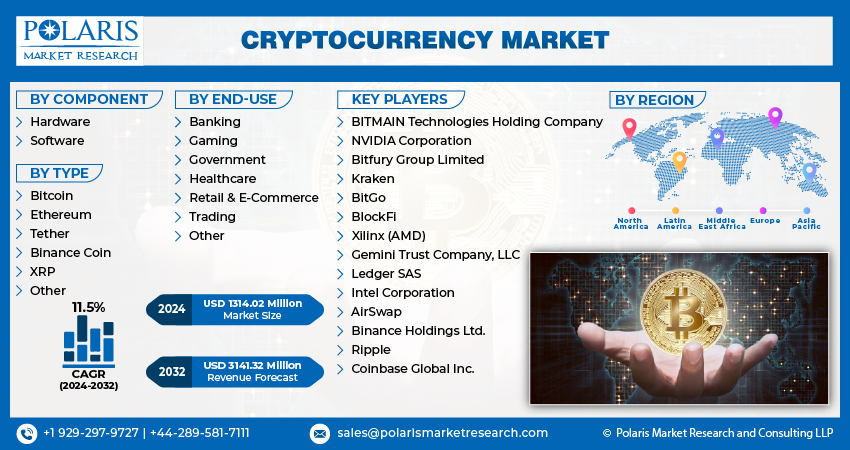
The global cryptocurrency market size was valued at USD 7.08 billion in 2025. It is projected to register a CAGR of 14.20% between 2026 and 2034. The market is driven by increasing adoption of decentralized finance (DeFi) and rising institutional investments. Also, growing interest in blockchain-based financial systems propels the industry growth.
Market Statistics
Key Takeaways
- The hardware segment accounted for the largest market share in 2025. It is driven by the growing number of companies manufacturing specialized cryptocurrency mining equipment.
- The Ethereum segment is projected to experience the fastest growth. This is due to its expanding decentralized finance (DeFi) applications and smart contract capabilities.
- The trading segment dominated the market in 2025. Growing interest from investors and the emergence of cryptocurrency exchanges are responsible for the leading market position of the trading segment.
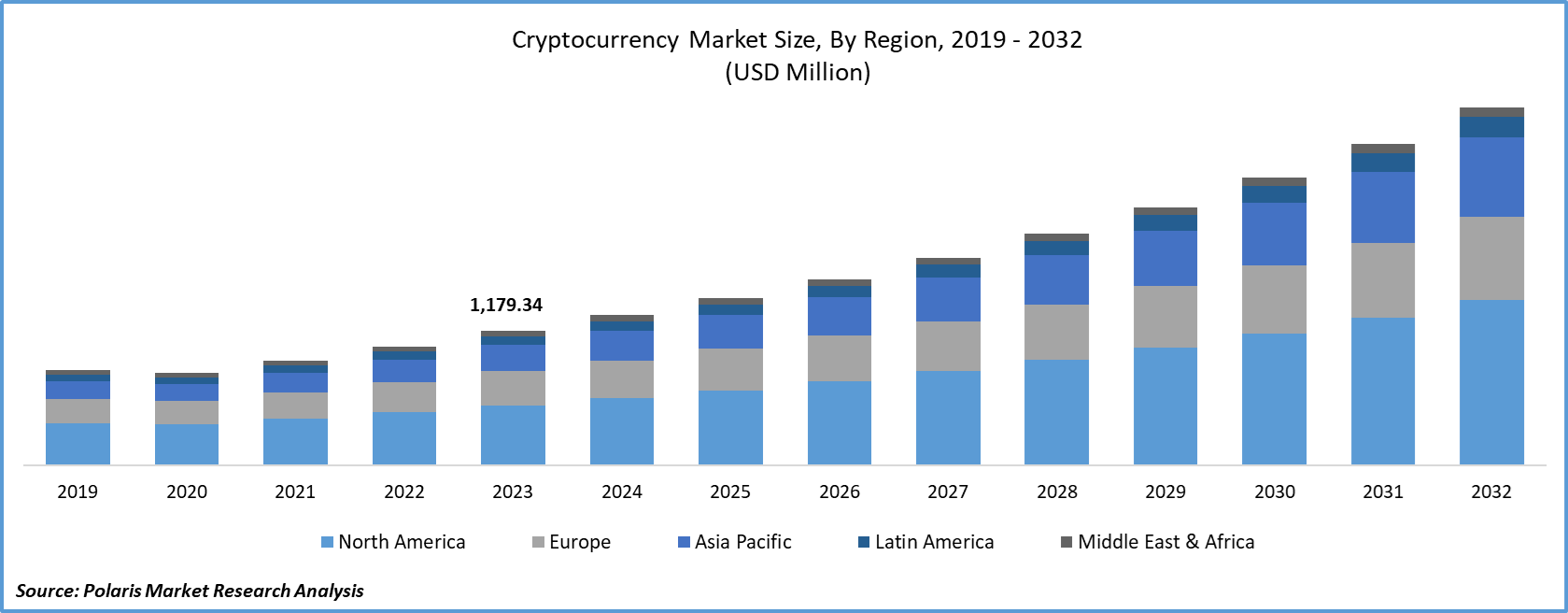
- The North America market holds a significant share of the global market. This is due to robust institutional investments and retail adoption.
- The U.S. leads in cryptocurrency development, investment, and trading. The country has a robust financial market and technology infrastructure.
- The Asia Pacific market is growing rapidly. This is due to its tech-savvy population and favorable government regulations.
The valuation reflects revenues from cryptocurrency exchanges, mining hardware, blockchain financial infrastructure services, custody platforms, and enterprise-grade digital asset solutions. The valuation does not include token market capitalization, which has surpassed trillions in peak market cycles.
The cryptocurrency market has undergone significant changes over the last decade, from retail-based speculation to more organized institutional participation, including ETF listings and enterprise blockchain solutions. The growing adoption of cryptocurrency in North America, the Asia Pacific, and some parts of Latin America is changing the digital finance industry and is expected to fuel the cryptocurrency market growth.
Industry Dynamics
- The adoption of blockchain technology and interest in decentralized finance are contributing to market expansion.
- Regulatory clarity on spot Bitcoin ETFs in major financial markets has encouraged more institutional investment in the crypto market and improved the overall legitimacy of the industry.
- The stablecoin market expansion and the development of real-world assets in tokens are improving liquidity on decentralized platforms.
- The concerns regarding energy consumption in crypto mining activities are prompting organizations to switch to renewable energy-based mining and proof of stake.
- The regulatory issues, cybersecurity concerns, and prevailing monetary policy of global markets are affecting the volatility of the cryptocurrency market.
Source: Polaris Market Research Analysis
To Understand More About this Research:Download Sample Report
AI Impact on Cryptocurrency Market
- Artificial intelligence (AI) systems process a huge variety of datasets and identify trends, patterns, and anomalies that are not visible to human traders. It allows for accurate price forecasts, volatility forecasts, and sentiment analysis, thus facilitating effective decisions for investors.
- AI-based bots enable swift trading operations using real-time information. These systems facilitate 24/7 market monitoring and high-frequency trading. AI optimizes gains and minimizes risks of human error.
- AI-based tools can recognize suspicious activities and forecast possible threats. AI can identify phishing attacks and fraudulent transactions. Thus, it increases user trust for AI-based cryptocurrency systems.
Cryptocurrency is a digital asset that uses blockchain or distributed ledger technology to support safe and secure transactions. There are different types of cryptocurrencies. Each cryptocurrency has its own set of rules and regulations. Cryptocurrencies are decentralized as they are not controlled or regulated by any government or financial institution. They are used to buy, sell, swap, and store cryptos. The price of cryptocurrency can vary significantly due to various factors. These include economic conditions, government regulations, media coverage, and more.
Technological innovation plays an essential role in the success of cryptocurrency. It improves the efficiency of the financial system or enhances competition. Recent innovations in artificial intelligence (AI) are likely to have a tremendous effect on the market. For example, in August 2025, Microsoft created a prototype of an artificial intelligence agent called Project Ire that can automatically detect and analyze malware. The AI agent can analyze software files to detect malicious code. In addition, it can integrate with security tools like Microsoft Defender. This can help reduce the workload of security professionals and speed up malware detection.
Banks are also investing in cryptocurrency platforms and developing their own blockchain technology. The implementation of expansionary monetary policies by key nations worldwide to mitigate the economic consequences of the pandemic boosted Bitcoin prices. Bitcoin, Litecoin, Ethereum, Cardano, Ripple, and Stellar have become key players in the market after the pandemic, and different factors drive their performance.
Industry Dynamics
Growth Drivers
The demand for cryptocurrency exchange platforms is likely to increase in the coming years, especially as digital assets continue to grow in popularity. Cryptocurrencies offer flexibility and convenience for transactions. This makes them suitable for use among people living in industrialized countries such as the U.S. and Canada. Additionally, the use of mobile trading platforms is likely to increase, driving growth in the cryptocurrency market.
Government institutions across the globe are working towards creating laws that can govern cryptocurrencies. The European Union has created a law called Markets in Crypto Assets (MiCA), which is intended to create a legal framework for the crypto asset market. Furthermore, in February 2022, the Indian government made a move towards making cryptocurrencies legal by imposing a 30.0% tax on income from the transfer of digital currencies. Cryptocurrencies, such as Bitcoin, are gaining traction in countries with higher inflation rates, such as Zimbabwe, Argentina, and Brazil.
What are Key Challenges, Risks, and Opportunities in the Cryptocurrency Market?
Market players are seeing growth opportunities and operational challenges. Asset tokenization and blockchain as a service are opening new avenues for market players to generate new revenue streams. However, there are major concerns regarding ambiguity and cybersecurity risks. Enterprises are looking for secure custody solutions and transparent ESG practices. This would enable them to establish trust and scalability. Strategic partnerships among cloud players, fintech players, and financial institutions would drive sustainable business growth. Stablecoin/CBDC frameworks are evolving. Thus, B2B players are expected to benefit from market legitimacy and global digital finance integration.
| Category | Description | B2B Implications | Key Stakeholders Affected |
| Regulatory Uncertainty | Inconsistency in crypto regulations across the world | Regulatory complexity for payment firms, institutional investors, and exchanges | Exchanges, custodians, institutional investors, fintech firms |
| Market Volatility | Ongoing price fluctuations in tokens and DeFi assets | Increases risks in portfolios and adoption of corporate treasuries | Trading platforms, financial institutions, hedge funds |
| Security & Custody Risks | Hacking, cybersecurity, and wallet risks | Requires investment in safe custody and compliance infrastructure | Custodians, crypto infrastructure, and wallet providers |
| Reputation & ESG Concerns | Environmental concerns associated with mining and the perception of illicit transactions | Drives the need for environmentally friendly blockchain solutions | Enterprises, mining firms, and ESG auditors |
| Stablecoin & CBDC Integration | Emergence of regulated stablecoins and Central Bank Digital Currencies (CBDCs) | Facilitates cross-border payments and liquidity management | Payment processors and cross-border remittance firms |
| Blockchain-as-a-Service (BaaS) | Enterprises are using blockchain infrastructure with the help of cloud providers. | Reduces the barriers to B2B crypto adoption |
Cloud providers, enterprises, blockchain firms |
| Tokenization of Assets | Digitalization of real assets on the blockchain | Increases the scope for investments and liquidity | Real estate, fintech, supply chain firms |
| Partnership Ecosystems | Partnerships between traditional finance and crypto firms | Increases compliance, trust, and market reach | Payment networks, traditional financial firms, crypto firms |
Source: Polaris Market Research Analysis
Source: Polaris Market Research Analysis
Market Segmentation
Component Insights
By component, the cryptocurrency market is segmented into hardware and software. The hardware segment accounted for the largest market share in 2025 and is likely to retain its position over the forecast period. There are several companies providing hardware for cryptocurrency mining. Some of the most well-known companies include Bitmain, Canaan Creative, Ebang, and MicroBT. These are all Chinese-based companies that manufacture ASICs for Bitcoin mining. They are responsible for a significant portion of the world's Bitcoin mining power. Other companies that provide mining hardware include NVIDIA and AMD. They manufacture GPUs that can be used for mining cryptocurrencies.
Type Insights
By type, the market segmentation is done into Bitcoin, Ethereum, Tether, Binance Coin, XRP, and Other. The Ethereum segment is projected to grow the fastest. Ethereum is a decentralized blockchain platform. It allows for the creation of decentralized applications (dApps) and smart contracts. Ethereum is one of the most popular blockchain platforms since its introduction. Ethereum is a programmable blockchain. This implies that smart contracts can be created using the Solidity programming language. In 2022, Ethereum underwent a major upgrade, Ethereum 2.0. This upgrade was aimed at improving the scalability and security of the Ethereum platform. This upgrade involved a shift from the proof-of-work consensus mechanism to the proof-of-stake consensus mechanism. It reduces the energy required to validate transactions on the Ethereum network. It also speeds up transaction processing.
End-Use Insights
Based on end-use, the market is segmented into banking, gaming, government, healthcare, retail & e-commerce, trading, and other. The trading segment accounted for the largest cryptocurrency market share in 2025. Cryptocurrency trading is taking a financial position on the direction of the prices of individual cryptocurrencies relative to the dollar in crypto/dollar pairs or to another cryptocurrency in crypto-to-crypto pairs. Cryptocurrency trading allows individuals to speculate on the prices of cryptocurrencies without actually owning the cryptocurrencies. The trading of cryptocurrencies is a process in which traders agree on a price and trade on exchanges that set the market valuation. Web browsers are collaborating with blockchain technology companies to facilitate cryptocurrency trading. CFDs are widely used for trading cryptocurrencies because of their flexibility. Risk management is crucial and involves limiting losses during trading. The trading strategies differ based on personal interests and trading capital.
Source: Polaris Market Research Analysis
Regional Analysis
The North America cryptocurrency market represents a substantial share of the overall global market due to the presence of robust institutional investment, retail adoption, and the overall fintech infrastructure, as well as the blockchain innovation stack. The region also boasts some of the largest crypto exchanges, miners, blockchain developers, and venture capital investors globally. The regulatory environment also has a major impact on the overall market.
The U.S. cryptocurrency market is at the forefront of cryptocurrency development, investment, and trading. Despite the ambiguity surrounding the classification and taxation of digital assets, the U.S. leads in terms of cryptocurrency transaction volume. Also, major financial institutions have entered the market. These include Fidelity, BlackRock, and JPMorgan. The financial institutions have contributed to the growth of the market through the introduction of financial instruments to the market, for instance, crypto ETFs and tokenization platforms. Moreover, in early 2024, the SEC approved spot ETFs in the U.S. This helped create legitimacy and trust for the market. The mining of cryptocurrency, for instance, was initially concentrated in China. However, it has now shifted in the U.S., specifically in Texas and Wyoming. This is because of the region’s renewable energy and a conducive business environment. Additionally, the region continues to be at the forefront of blockchain startups, Web3, and decentralized finance. The U.S. is also at the forefront of stablecoins, with Tether and Circle's USDC being used globally. However, the debate on consumer protection, anti-money laundering, and CBDCs might change the way the industry operates. Despite these challenges, it is highly likely that the U.S. will still remain a cornerstone of the global cryptocurrency market. This is because of the innovative approach and capital access.
The Singapore cryptocurrency market is an important cryptocurrency and blockchain technology market in Asia. It is recognized for its advanced regulatory environment and technology. Singapore's Monetary Authority has created a highly regulated environment for digital payment tokens under the Payment Services Act. Consequently, several exchanges, blockchain technology firms, and cryptocurrency hedge funds have set up their regional headquarters in Singapore. It is an important market for cryptocurrency and blockchain technology innovation, including Project Guardian for tokenized finance and Project Ubin for CBDCs. Citizens and institutions in Singapore are showing a growing level of acceptance for cryptocurrencies. In addition, the government’s position on anti-money laundering compliance and cybersecurity has ensured that the country is recognized as a legitimate place for crypto transactions. Although the government has tightened its stand on regulations in 2023 to protect retail investors from market volatility, the country has still been able to strike a balance between innovation and regulations. The strategic position and vision of the regulations and transparency in Singapore have ensured that the country is a key influencer in setting the course of the market in the Asia Pacific.
In the European region, the cryptocurrency market is being led by the Markets in Crypto-Assets Regulation, or MiCA. The Europe crypto regulation MiCA aims at establishing a common set of rules for operating in the European Union. In the Middle East, countries such as the United Arab Emirates and Saudi Arabia are vying to be the new hubs for cryptocurrencies. These countries are providing support for innovation, regulatory sandboxes, and national digital asset strategies. In the Latin American region, retail adoption is on the rise. It is primarily driven by the need for remittance and currency volatility in the region. In India, changes in India crypto taxation policy and regulatory environments are impacting trading volumes and exchange expansions.

Source: Polaris Market Research Analysis
Competitive Insights
The market is moderately fragmented. A few exchanges account for a significant percentage of total trading volume and crypto exchange market share. Strategic activity, such as Coinbase’s expansion into derivatives, is shaping the cryptocurrency market competitive landscape.
Manufacturers of mining equipment are consolidating their position by continuing to drive innovation and improvements in ASIC technology. Meanwhile, decentralized exchanges (DEXs) are becoming more popular as more people seek a non-custodial experience. There is an increasing number of crypto ETFs and other financial products, which is helping drive competition among institutional investors in the digital asset market.
A few of the major players in the market include BITMAIN Technologies Holding Company, NVIDIA Corporation, Bitfury Group Limited, Kraken, BitGo, BlockFi, Xilinx (AMD), Gemini Trust Company, LLC, Ledger SAS, Intel Corporation, AirSwap, Binance Holdings Ltd., Ripple, and Coinbase Global Inc.
List of Key Companies
- AirSwap
- Binance Holdings Ltd
- Bitfury Group Limited
- BitGo
- BITMAIN Technologies Holding Company
- BlockFi
- Coinbase Global Inc.
- Gemini Trust Company, LLC
- Intel Corporation
- Kraken
- Ledger SAS
- NVIDIA Corporation
- Ripple
- Xilinx (AMD)
Recent Developments
December 2025: Binance launched Binance Junior, which is a parent-supervised crypto savings platform for children aged 6 to 17. The platform allows parents to have full control over funding and activity. It allows older children to make limited transfers. Binance Junior aims to help families introduce financial literacy and crypto savings without trading exposure.
May 2025: Canary Marinade, 21Shares, and Bitwise amended their filings with the SEC for the launch of Solana-based ETFs. This is an indication of the innovation and progress that have characterized the expansion of tradable crypto assets.
May 2025: In an announcement, Coinbase stated that it was acquiring the crypto derivatives exchange Deribit for $2.9 billion. The strategic move aims to expand the exchange's offerings.
July 2024: Robinhood Markets Inc. announced its acquisition of Pluto Capital Inc., an artificial intelligence research platform that provides its clients highly customized investment strategies and analysis. The strategic move, according to Robinhood, is the beginning of a new chapter in intelligent, data-driven investing.
May 2024: Binance, a leading cryptocurrency exchange, completed its first registration with the Financial Intelligence Unit (FIU) in India.
Report Segmentation
By Component Outlook (Revenue, USD Billion, 2021–2034)
- Hardware
- Software
By Process Outlook (Revenue, USD Billion, 2021–2034)
- Mining
- Transaction
By Type Outlook (Revenue, USD Billion, 2021–2034)
- Bitcoin
- Ethereum
- Tether
- Binance Coin
- XRP
- Other
By End-Use Outlook (Revenue, USD Billion, 2021–2034)
- Banking
- Gaming
- Government
- Healthcare
- Retail & E-Commerce
- Trading
- Other
By Regional Outlook (Revenue, USD Billion, 2021–2034)
- North America
- US
- Canada
- Europe
- Germany
- France
- UK
- Italy
- Spain
- Netherlands
- Russia
- Rest of Europe
- Asia Pacific
- China
- Japan
- India
- Malaysia
- South Korea
- Indonesia
- Australia
- Vietnam
- Rest of Asia Pacific
- Middle East & Africa
- Saudi Arabia
- UAE
- Israel
- South Africa
- Rest of Middle East & Africa
- Latin America
- Mexico
- Brazil
- Argentina
- Rest of Latin America
Cryptocurrency Market Report Scope
| Report Attributes | Details |
| Market Size in 2025 | USD 7.08 billion |
| Market Size in 2026 | USD 8.07 billion |
| Revenue Forecast by 2034 | USD 23.38 billion |
| CAGR | 14.20% |
| Base Year | 2025 |
| Historical Data | 2021–2024 |
| Forecast Period | 2026–2034 |
| Quantitative Units | Revenue in USD billion, and CAGR from 2026 to 2034 |
| Report Coverage | Revenue Forecast, Market Competitive Landscape, Growth Factors, and Trends |
| Segments Covered |
|
| Regional Scope |
|
Source: Polaris Market Research Analysis
Cryptocurrency Market FAQ's
The cryptocurrency market was valued at USD 7.08 billion in 2025. The market is projected to account for a CAGR of 14.20% between 2026 and 2034.
Cryptocurrency is used for buying, selling, and trading digital assets. It is also used to store value and for decentralized finance applications.
The market for cryptocurrencies is primarily driven by the rising adoption by financial institutions and blockchain innovations. The market also benefits from the expansion of DeFi platforms.
Ethereum is expected to grow at the fastest rate. This is because it allows for the creation of decentralized applications (dApps) and smart contracts.
North America leads the market. This is due to the region’s high technology adoption rates and increasing utilization of NFTs.
The Ethereum segment is projected to grow at the fastest rate, driven by its expanding decentralized finance (DeFi) applications and smart contract capabilities.
Key growth drivers include rising adoption of blockchain technology, growing interest in decentralized finance (DeFi), increasing institutional investments, and higher demand for fast, borderless digital transactions.
Download Sample Report of Cryptocurrency Market
Please fill out the form to request a customized copy of the research report.


