
IP Camera Market Share, Size, Trends, Industry Analysis Report, 2026 - 2034
REPORT DETAILS
IP Camera Market Summary
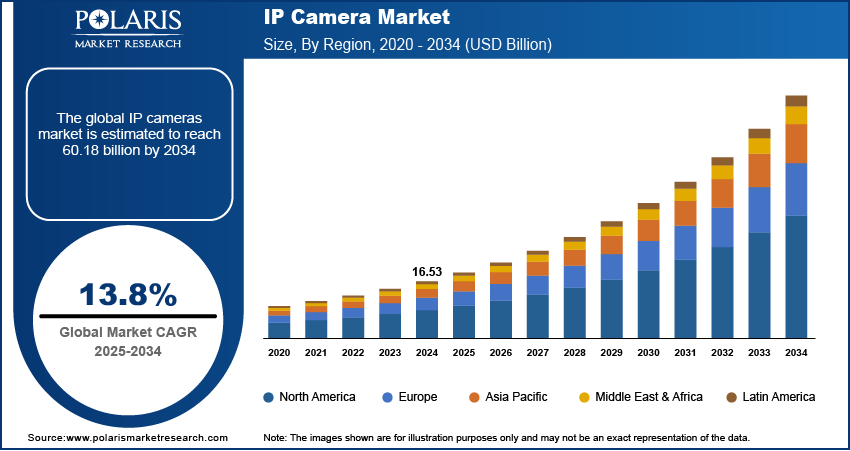
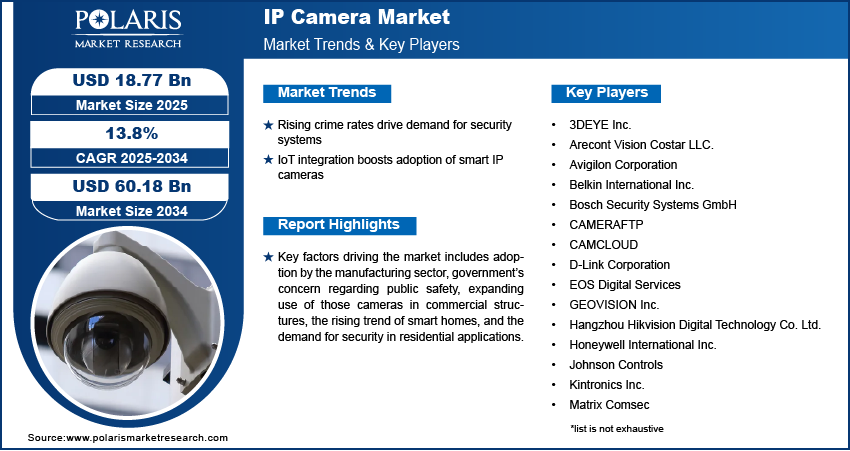
The global IP Camera market was valued at USD 17.87 billion in 2025 and is expected to grow at a CAGR of 13.43% during the forecast period. Key factors driving the market includes adoption by the manufacturing sector, government’s concern regarding public safety, expanding use of those cameras in commercial structures, the rising trend of smart homes, and the demand for security in residential applications.
Market Statistics
Key Takeaways
- North America dominated the market with 34.0% share in 2025 due to its developed infrastructure, which readily supports high-bandwidth network systems essential to IP camera functionality.
- Asia Pacific is expected to witness the fastest growth with 15.80% CAGR during 2026-2034. This is due to the increasing use of modern security technologies for a variety of purposes, including traffic monitoring, home security, and public surveillance.
- Hardware components accounted for the majority of market share of 72.0% in 2025. This is due to developments in chip-set design, which have also helped produce these advanced hardware systems at a lower cost.
- The service segment is expected to witness the highest 15.15% CAGR during the forecast period. This is due to the manufacturers and service providers meet the market demand for better solutions.
- The commercial segment of IP cameras dominated the market with 63.0% share in 2025. This is due to the increasing demand for advanced security technology in the banking and financial sector.
Note: Figures and projections outlined in this report are the result of Polaris Market Research’s proprietary analytical processes, grounded in the latest available datasets and market observations.
Industry Dynamics
- Rising crime rates, like squatting and burglaries, are directly increasing consumer demand for advanced residential security systems and surveillance technology.
- The expansion of smart home ecosystems and the integration of IoT are making sophisticated IP cameras a central and growing component of modern home security.
- The high cost and complexity of installing and maintaining advanced systems with adequate cybersecurity against sophisticated threats create challenges.
- The integration of AI analytics for proactive security, creating new value-added services and recurring revenue streams for providers, creates opportunities for growth.
AI Impact on the Market
- Enables real-time video analytics and automated threat detection.
- It reduces false alarms through intelligent object recognition.
- AI creates new revenue with cloud-based analytics services.
- It drives demand for higher-resolution cameras and processing power.
What is the Current Landscape for the IP Camera Market?
IP camera is a digital video camera that transmits data over a network or the internet. The emergence of thermal cameras and the subsequent use of IoT in video surveillance has significantly raised the demand for Internet Protocol (IP)-based camera systems. In the future years, it is expected that the IP Camera Market is driven by the expanding use of those cameras in commercial structures, the rising trend of smart homes, and the demand for security in residential applications.
Source: Polaris Market Research Analysis
Know more about this report: Download Sample Report
Modern security systems include cameras that must process a lot of data in order to provide us with information that will allow us to identify threats and stop them before they materialize. Additionally, these cameras have new voice, motor, and video processing skills. Modern cameras must be deployed in difficult outdoor conditions where energy efficiency is essential. They are IP-linked and can be connected via wired Ethernet, IEEE 802.11 WiFi, or HDBaseT. Interactive product releases, new product launches, ongoing research and development (R&D), and innovation activities in camera and networking technologies are a few examples of significant strategic actions done by market participants. Features like remote monitoring, easy installation, low cost, and limitless storage have made cameras widely used in a number of commercial industries.
Security issues and the high cost of installation and execution will be the two main challenges restricting the growth of this industry because this system is totally online and vulnerable to hacking. As these devices are used more frequently in countries like China, India, Australia, Singapore, Japan, and others, the regional IP camera market is expected to grow. Favorable infrastructural developments and governmental programs, such as the smart city initiatives in Thailand and India, have a positive impact on the market. The availability of affordable options, particularly in China and Taiwan, is projected to increase the region's demand for these products. The Chinese IP camera market is expected to grow because there are so many local business operators offering cost-effective solutions. Demand is also expected to be boosted by favorable government initiatives on city surveillance, the expansion of smart cities, and the use of IoT devices.
Source: Polaris Market Research Analysis
Know more about this report: Download Sample Report
Industry Dynamics
What are the Factors Driving the Market Growth?
The need for security cameras has recently gained popularity due to the rise in squatting and home burglaries. Homeowners' top priorities now include domestic security. Over the projected period, it is predicted that this aspect would propel the expansion of the internet protocol (IP) camera market. The popularity of home monitoring has increased in tandem with the urban population growth. A few of the crucial strategic actions for manufacturers include interactive product releases, new product launches, continued research and development, and innovation efforts in the technologies of cameras and networking. IoT technologies are being embraced by homeowners, which helps the market expand. In order to improve the security of their properties, users are increasingly choosing smart IP cameras instead of more conventional mountable Wi-Fi cameras. Players in this industry stand to benefit from this with respect to growth. The expanding usage of IoT in video monitoring and the introduction of infrared cameras have both greatly raised demand for IP cameras. The IP camera market is further driven by the rising popularity of smart homes, the expansion of their use in commercial buildings, and the need for security in residential applications. The increase in smartphone users and the availability of appealing installment policies for security are what is driving the residential market.
Report Segmentation
The market is primarily segmented based on component, application, and region.
| By Component | By Application | By Region |
|
|
|
Source: Polaris Market Research Analysis
Know more about this report: Download Sample Report
Segment Insights
Why Hardware Segment Dominated the Market in 2025?
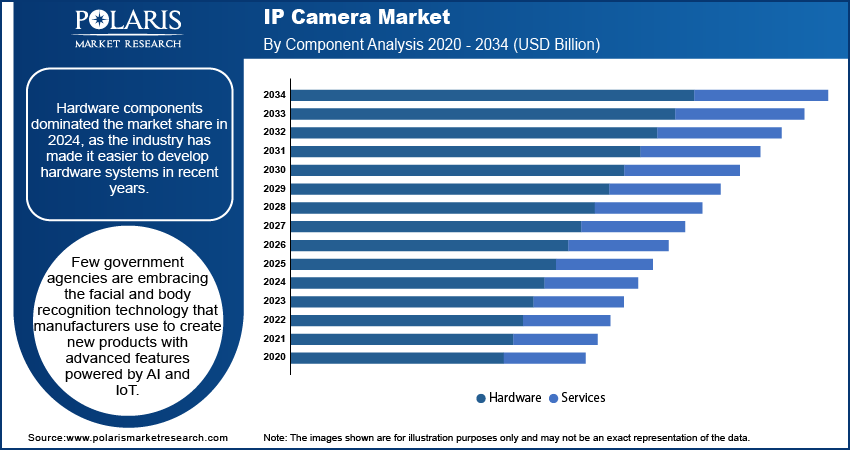
Hardware components dominated the market with 72.0% share in 2025, as the industry has made it easier to develop hardware systems in recent years. Few government agencies are embracing the facial and body recognition technology that manufacturers use to create new products with advanced features powered by AI and IoT. The hardware segment's dominance is further reinforced by the critical need for high-resolution sensors and robust processing units to support advanced analytics. Moreover, developments in chip set design has also help produce these advanced hardware systems at a lower cost. These core components are essential for capturing high-fidelity data that can be reliably connected to AI-based recognition. In this sense, scale in the hardware market is a crucial element for intelligent software due to its ability to be reliable through hardware adoption further solidifying its standing in the overall market percentage.
Source: Polaris Market Research Analysis
The service segment is expected to witness the highest 15.15% CAGR during the forecast period. This is due to the manufacturers and service providers meet the market demand for better solutions. Manufacturers are expanding their service portfolios to include managed access and advanced data analytics, creating recurring revenue streams and enhancing long-term customer value. This evolution from a product-centric to a service-oriented approach is the primary catalyst for its exceptional growth rate.
Which Segments Contributed to the Growth of Application?
Residential applications is expected to witness the fastest growth with 14.29% CAGR during the forecast period. The rise of the industry is also fueled by its growing use of IoT in smart homes. Customers are moving away from traditional CCTV cameras and using IP cameras with new and innovative features to enhance the security of their assets. The many advantages of these state-of-the-art smart home security cameras make them a preferred choice for many home installations.
The commercial segment of IP cameras dominated the market with 63.0% share in 2025, with increasing demand for advanced security technology in banking and financial sector accelerating the commercial industry and influencing the growth of IP cameras market. The implementation of state-of-the-art video solutions that can alert and notify security personnel of break-ins and break-ins are being driven by the rise in retail thefts. Many providers on the market try to offer security solutions that are particularly suitable for commercial use.
Regional Analysis
What are the Factors Boosting the Global Growth?
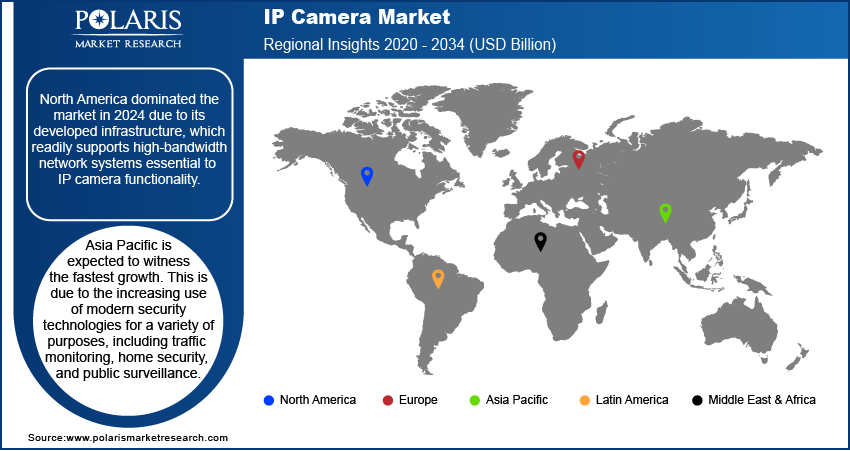
North America dominated the market growth with 34.0% share in 2025 due to the expansion of industrial sectors, advancements in features and technologies, as well as the impact of video surveillance cameras on regional market growth. The region has a mature infrastructure that readily supports high-bandwidth network systems, which is essential for IP camera functionality. High security concerns among both commercial and residential users, coupled with stringent regulatory requirements, create a consistent demand for sophisticated surveillance solutions. Furthermore, the strong presence of leading market players and continuous investment in AI and cloud-based analytics accelerates the development and integration of cutting-edge features, solidifying the region's leading market position. In the United States, only 20 cities are expected to house 50% of all construction projects by 2023, according to a report by BuiltWorlds Inc.
Asia Pacific is expected to witness the fastest growth with 15.80% CAGR during the forecast period. In addition, the market for internet protocol (IP) cameras is anticipated to grow significantly by 2034 as a result of the increasing use of modern security technologies for a variety of purposes, including traffic monitoring, home security, and public surveillance. The market in the region is expected to grow owing to increasing government, private and academic investment in government-related new technology innovations and research and development.
Source: Polaris Market Research Analysis
Competitive Insight
The IP camera market features a competitive landscape shaped by established incumbents, regional challengers, and disruptive innovators. Hikvision and Dahua dominate through vast scale, vertical integration, and aggressive pricing across global markets. Axis Communications and Hanwha Vision differentiate through premium imaging quality, cybersecurity focus, and strong channel partnerships in enterprise segments. Avigilon, backed by Motorola Solutions, and i-PRO, with Panasonic heritage, leverage deep integration with video management and analytics ecosystems. Bosch Video Systems and Johnson Controls anchor the building automation and smart city space, while Honeywell brings broad security portfolio synergies. Verkada and Ubiquiti disrupt with cloud-first architectures and simplified deployment models targeting mid-market and SMB customers. Reolink, Lorex, and TP-Link VIGI compete on affordability and ease of use in consumer and prosumer channels. MOBOTIX and Matrix Comsec occupy niche positions with decentralized processing and regional specialization respectively. VIVOTEK, GeoVision, and Uniview balance cost-performance across diverse verticals, while Arlo, D-Link, and Arecont Vision Costar address specific use cases. Competition increasingly centers on AI analytics, cybersecurity hardening, and cloud integration.
Some of the major players operating in the global market include, Arecont Vision Costar, LLC; Arlo Technologies, Inc.; Avigilon, a Motorola Solutions company; Axis Communications AB; Dahua Technology Co., Ltd.; D-Link Corporation; GeoVision Inc.; Hangzhou Hikvision Digital Technology Co., Ltd.; Hanwha Vision Co., Ltd.; Honeywell International Inc.; i-PRO Co., Ltd.; Johnson Controls; Keenfinity / Bosch Video Systems; Lorex Technology Inc.; Matrix Comsec; Milesight; MOBOTIX AG; Reolink; TP-Link VIGI; Ubiquiti Inc.; Verkada Inc.; VIVOTEK Inc.; Zhejiang Uniview Technologies Co., Ltd.
Key Companies
- Arecont Vision Costar, LLC
- Arlo Technologies, Inc.
- Avigilon, a Motorola Solutions company
- Axis Communications AB
- Dahua Technology Co., Ltd.
- D-Link Corporation
- GeoVision Inc.
- Hangzhou Hikvision Digital Technology Co., Ltd.
- Hanwha Vision Co., Ltd.
- Honeywell International Inc.
- i-PRO Co., Ltd.
- Johnson Controls
- Keenfinity / Bosch Video Systems
- Lorex Technology Inc.
- Matrix Comsec
- Milesight
- MOBOTIX AG
- Reolink
- TP-Link VIGI
- Ubiquiti Inc.
- Verkada Inc.
- VIVOTEK Inc.
- Zhejiang Uniview Technologies Co., Ltd.
Recent Developments
- August 2026: Exein announced a commercial partnership with LILIN to integrate Exein's cybersecurity technology into LILIN's IP camera firmware. The collaboration provides kernel-level defense for connected surveillance devices, serving government and enterprise deployments across critical infrastructure, transportation, retail, and smart city applications. (Source: exein.io)
- August 2026: Hikvision partnered with Natilon to integrate its cloud-based visual management platform with Hikvision IP cameras. The integration enables construction, infrastructure, and EPC customers to convert existing CCTV hardware into cloud-based monitoring and time-lapse systems with automated 8K video production. (Source: hikvision.com)
- March 2026: Sunell launched its 72 Series, the third generation of its NightHawk AI ISP IP camera lineup. The series includes 4MP and 8MP models with advanced imaging, built-in lighting, and AI analytics for professional surveillance scenarios. (Source: sunellsecurity.com)
IP Camera Market Report Scope
| Report Attributes | Details |
| Market size value in 2025 | USD 17.87 billion |
| Market size value in 2026 | USD 20.18 billion |
| Revenue forecast in 2034 | USD 55.53 billion |
| CAGR | 13.43% from 2026 - 2034 |
| Base year | 2025 |
| Historical data | 2021 – 2024 |
| Forecast period | 2026 - 2034 |
| Quantitative units | Revenue in USD billion and CAGR from 2026 to 2034 |
| Segments Covered | By Component, By Application, By Region |
| Regional scope | North America, Europe, Asia Pacific, Latin America; Middle East & Africa |
| Key Companies | Arecont Vision Costar, LLC; Arlo Technologies, Inc.; Avigilon, a Motorola Solutions company; Axis Communications AB; Dahua Technology Co., Ltd.; D-Link Corporation; GeoVision Inc.; Hangzhou Hikvision Digital Technology Co., Ltd.; Hanwha Vision Co., Ltd.; Honeywell International Inc.; i-PRO Co., Ltd.; Johnson Controls; Keenfinity / Bosch Video Systems; Lorex Technology Inc.; Matrix Comsec; Milesight; MOBOTIX AG; Reolink; TP-Link VIGI; Ubiquiti Inc.; Verkada Inc.; VIVOTEK Inc.; Zhejiang Uniview Technologies Co., Ltd. |
Source: Polaris Market Research Analysis
IP Camera Market FAQ's
IP Camera Market Size Worth USD 55.53 Billion By 2034
Some of the major players operating in the global market include, Arecont Vision Costar, LLC; Arlo Technologies, Inc.; Avigilon, a Motorola Solutions company; Axis Communications AB; Dahua Technology Co., Ltd.; D-Link Corporation; GeoVision Inc.; Hangzhou Hikvision Digital Technology Co., Ltd.; Hanwha Vision Co., Ltd.; Honeywell International Inc.; i-PRO Co., Ltd.; Johnson Controls; Keenfinity / Bosch Video Systems; Lorex Technology Inc.; Matrix Comsec; Milesight; MOBOTIX AG; Reolink; TP-Link VIGI; Ubiquiti Inc.; Verkada Inc.; VIVOTEK Inc.; Zhejiang Uniview Technologies Co., Ltd.
North America dominated the market with 34.0% share in 2025.
Expected CAGR growth is 13.43% till 2034
Key segments are By Component, By Application and region.
Key trends include AI-powered video analytics integration, rising smart home and IoT adoption, growing cloud-based services, expansion of smart city initiatives, and increasing demand for thermal and high-resolution surveillance cameras.
Key trends include AI-powered video analytics integration, rising smart home and IoT adoption, growing cloud-based services, expansion of smart city initiatives, and increasing demand for thermal and high-resolution surveillance cameras.
Download Sample Report of IP Camera Market
Please fill out the form to request a customized copy of the research report.


