- April 2025: Vidopix, a leader in video intelligence solutions, launched its new AI-powered video analytics platform in India. With tools like InstaVidIQ and SurveyCine, the platform helps businesses easily analyze video content and gain accurate insights to support better decisions.
- February 2025: Hudl acquired Balltime, an AI-based volleyball analysis platform, strengthening its sports analytics offerings and highlighting the rising use of video analytics in improving athlete performance and game analysis.

Video Analytics Market Size & Share Global Analysis Report, 2026-2034
Video Analytics Market Size & Share Global Analysis Report, 2026-2034
REPORT DETAILS
Report Code: PM1416
No. of Pages: 126
Format: PDF
Published Date:
Base Year: 2025
Author: Apurva Agarwal
Historical Data: 2021-2024
Reviewed By: Likhil Gajbhiye
Video Analytics Market Summary
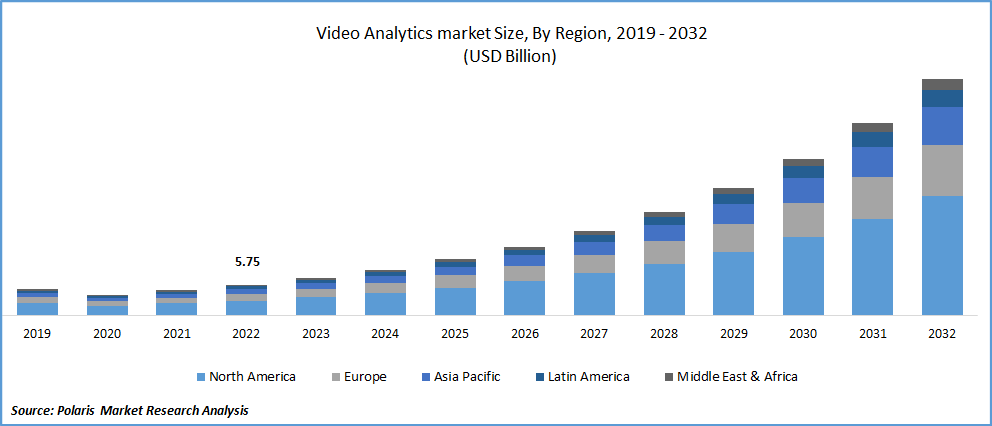
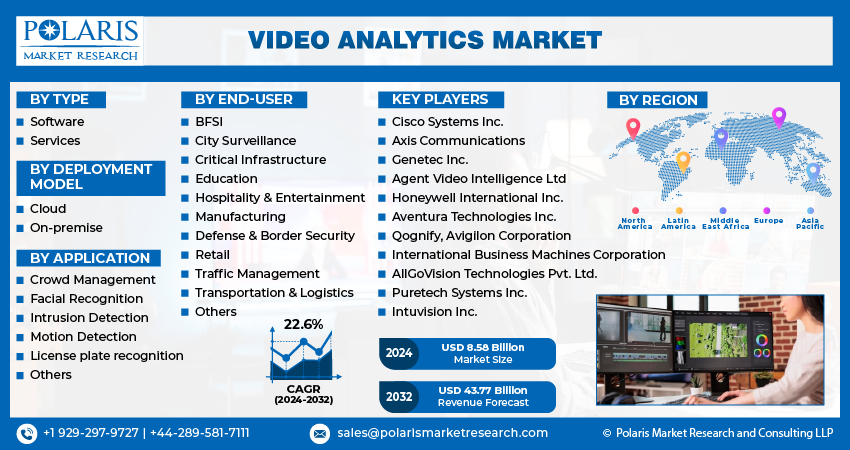
The global video analytics market was valued at USD 14.82 billion in 2025, registering a CAGR of 19.3% from 2026 to 2034. Rising smart city surveillance investments and increasing military and border security requirements drive demand for video analytics. Also, the industry growth is driven by the upsurging adoption of AI video analytics for proactive threat detection.
Market Statistics
2026 Market Size USD 17.62 Billion
2034 Projected Market Size USD 72.43 Billion
CAGR (2026 - 2034) 19.30%
Largest Market in 2025 North America
Key Takeaways
- The video analytics software market held a major revenue share in 2025. The dominance is attributed to the increasing adoption of advanced software solutions for real-time monitoring in organizations across industries.
- The intrusion detection segment dominated the video analytics market share in 2025. Rising focus on strengthening security contributed to the dominance.
- Mid-market buyers seek faster deployment and lower upfront costs. Regulated industries prefer on-premise or hybrid video analytics deployment. Thus, there is a rising traction for cloud video analytics and VaaS models.
- North America dominated the global market with 32.10% revenue share in 2025. Rapid digital transformation across industries and a strong investments in smart city infrastructure drive the regional market growth.
- The U.S. held a major revenue share in North America video analytics landscape in 2025. The U.S. market growth is driven by rising innovation in artificial intelligence.
- The industry in Europe is projected to register a significant CAGR from 2025 to 2034. Stringent regulatory frameworks encourage the use of video analytics in security surveillance. This factor fuels the regional market growth.
Industry Dynamics
- Organizations and governments seek effective ways to monitor and secure public and private spaces. The increasing requirement for enhanced surveillance systems boosts demand for video analytics.
- Video analytics enables real-time analysis of drone footage, satellite imagery, and ground-based camera feeds. The rising military spending fuels the need for video analytics.
- Growing urbanization across the world is expected to create lucrative market opportunities in the coming years.
- Adherence to data privacy regulations and cybersecurity for surveillance influence the purchasing decisions of enterprises.
- The high cost of video analytics software and complexity related to VMS integration restrain the video analytics market growth.
- Integration complexity with legacy camera networks and higher compute and storage requirements restrain the industry growth.
- Performance challenges such as false positives/false alarms in crowded environment hinder the adoption of video analytics.
AI Impact on Video Analytics Market
- Artificial intelligence (AI) enables real-time object detection, behavior analysis, and predictive insights.
- It enhances accuracy, reducing false alarms via deep learning models.
- AI video surveillance automates monitoring across thousands of feeds, which improves scalability.
- AI-based analytics deliver actionable intelligence, not just raw data. It facilitates faster, data-backed responses across industries.
Source: Polaris Market Research Analysis
What is Video Analytics?
Video analytics automatically analyzes video footage and extracts meaningful information. Various advanced software and AI are used in the video analytics setup. Different algorithms detect patterns, recognize objects, and track movements. They also identify unusual behavior in real time. Video analytics can detect suspicious activity, monitor crowds, and improve public safety. Thus, security and surveillance is one of the most common uses.
Comparison matrix: Video Analytics vs Traditional CCTV vs Computer Vision
Intelligent video analytics, unlike traditional CCTV monitoring, applies computer vision and real-time video analytics. It automatically detects objects, tracks behavior, and triggers alerts. It eliminates the requirement for manual monitoring, as well as improves response times.
| Criteria | Traditional CCTV | Video Analytics | Computer Vision |
| Primary Purpose | Video capture and review | Automated monitoring and alerts | Visual intelligence and autonomous decisions |
| Analytics Capability | None | Rule-based and AI analytics | Deep learning-based perception |
| Human Intervention | High | Medium | Low |
| Real-time Insights | Limited | Available | Available (advanced, contextual) |
| Intelligence Level | Reactive | Proactive | Predictive and prescriptive |
| Deployment Model | On-premise DVR/NVR | Cloud, edge, and hybrid | Edge and cloud AI pipelines |
| Scalability | Low | Medium to High | Very high |
| Learning Capability | None | Limited model tuning | Continuous model training |
| Accuracy Over Time | Static | Improves with updates | Continuous improvements |
| Bandwidth Usage | Low | Medium | High (for training purposes and optimization) |
| Cost Structure | Low capex and high opex | Moderate capex or opex | Higher capex and high long-term ROI |
| Major End-Use Industries | Residential buildings, small retail stores, banks, offices, education campuses, and warehouses, | Retail and e-commerce, smart cities, airports, stadiums, transportation & logistics, manufacturing, and BFSI | Automotive and autonomous driving, manufacturing, healthcare imaging, agriculture, robotics, defense & aerospace |
| Typical Business Impact | Evidence & compliance | Operational efficiency & risk reduction | Automation, optimization & strategic decision-making |
| Key Adoption Barriers | Limited intelligence and manual monitoring | High concerns related to integration, data privacy, and model tuning | High compute cost, data complexity, and AI talent gap |
| ROI Profile | Low to moderate, long payback | Medium to high ROI within 12–24 months via efficiency gains | High ROI over 24–48 months through automation and new capabilities |
Source: Polaris Market Research Analysis
Video Analytics Architecture
The architecture of video analytics transforms raw video into actionable insights. It includes cameras and sensors that capture video streams. Then, edge processing is used for encoding, compression, and optional real-time inference. It helps reduce latency and bandwidth. Video is securely transmitted over networks to cloud or on-premise platforms. AI/ML analytics engines are integrated for object detection and tracking. They also perform behavior analysis. Extracted metadata and videos are stored for search and compliance. A management and application layer provides alerts and dashboards. It also provides integrations with enterprise systems, scalability controls, cybersecurity, and model lifecycle management. This supports reliable, enterprise-grade deployments.
Consumer Analysis: Why do enterprises choose Cloud vs edge video analytics?
- Enterprises prefer cloud video analytics for centralized model training and lower upfront infrastructure. They use it for scalability and cross-site analytics. Cloud infrastructure is ideal for multi-location deployments, historical analysis, and advanced AI workloads.
- Edge video analytics is adopted for smart manufacturing, safety monitoring, and traffic management. It is mostly deployed for compliance-sensitive environments. Organizations deploy these solutions as they enable real-time decision-making. Edge infrastructure offers low latency and data privacy. It reduces bandwidth costs and enables offline operation.
- Enterprises deploy a hybrid edge-cloud model. Edge analytics enables real-time inference. Cloud is used for aggregation, insights, and AI model updates.
Governments of various countries are highly investing in smart city development. As of June 2025, India completed 94% of the total 8,067 projects under Smart Cities Mission. As per the government of India, the country invested USD 19.4 billion in these projects. These cities rely on vast networks of smart city surveillance cameras and IoT sensors. Authorities use city surveillance video analytics to process the massive influx of visual data. Traffic management analytics helps them manage traffic. Further, public safety analytics is used to enhance public safety. Thus, increasing investments in smart city development boost the video analytics market growth.
Market Dynamics
Rising Need for Enhanced Surveillance Systems: Governments and organizations seek smarter solutions to secure public spaces. Rising crime incidence, terrorism threats, and crowd management are among the modern security concerns. Authorities find it difficult to address these concerns by using traditional CCTV cameras only. They demand intelligent systems for real-time analysis of video feeds. Video analytics empowers surveillance systems to detect suspicious activities automatically. They help recognize faces and track objects. Adoption of smart systems reduces reliance on human operators. It boosts response speeds. Various businesses, law enforcement agencies, and critical infrastructure providers deploy advanced video analytics. It assists them in gaining deeper insights and improving threat detection. It enhances operational efficiency. The growing complexity of security risks boosts the requirement for video analytics. Further, the increasing demand for a proactive approach over reactive measures drives the adoption of AI-powered video analytics. Thus, the increasing requirements for enhanced surveillance systems boost demand for video analytics.
Increasing Military Spending: Military operations rely heavily on advanced technologies to track enemy movements and secure critical installations. Video analytics are adopted in military operations. They offer real-time analysis of drone footage, satellite imagery, and ground-based camera feeds. Thus, armed forces can effectively identify threats and classify objects. It helps them make rapid, data-driven decisions. Reports by Stockholm International Peace Research Institute stated that world military expenditure reached $2718 billion in 2024. It increased by 9.4% in real terms from 2023. Various countries are increasing their defense budgets. Thus, military organizations prioritize investments in surveillance and intelligence systems. Hence, rising defense spending boosts the adoption of sophisticated video analytics solutions.
Source: Polaris Market Research Analysis
Segmental Insights
Type Analysis
Based on type, the segmentation includes software and service. The software segment held a major revenue share in 2025. Advanced software solutions were increasingly adopted for real-time monitoring, pattern recognition, and incident detection. Enterprises invested heavily in software that supported facial recognition, license plate identification, and behavioral analysis to strengthen security operations and optimize business intelligence. The rising integration of video management systems with AI algorithms encouraged companies to adopt scalable and flexible software that reduce manual intervention and improve accuracy. Various sectors, including retail, transportation, and banking, prioritize advanced video software solutions. It helps them analyze customer behavior, manage crowd flow, and detect fraudulent activities.
The services segment is projected to grow at a rapid pace in the coming years. Demand for managed and professional services is rising to implement and maintain complex video solutions. Organizations seek expert consulting, system integration, and cloud-based service models. These services are required to ensure seamless deployment and scalability and minimize operational costs. The rising popularity of video-as-a-service (VaaS) models enables companies to access advanced tools. It does not need heavy upfront investments. Thus, small and medium enterprises increasingly adopt these services. Businesses focus on achieving long-term efficiency and compliance with evolving data security regulations. The need for ongoing training, predictive maintenance, and customization fuels service adoption.
Deployment Mode Analysis
Based on deployment mode, the segmentation includes cloud, on-premise, and hybrid. The on-premise segment held the largest revenue share in 2025. Its security, reliability, and control boost the dominance. Enterprises across sectors, such as government, defense, and banking, demand on-premises solutions. It helps them with regulatory compliance and the protection of sensitive information. They invest heavily in in-house analytics systems to ensure seamless integration with existing hardware and software. On-premise deployment can process data locally without relying on external servers. This feature encourages large enterprises to adopt this deployment type. Companies, especially in regions where data privacy concerns remain high, are increasingly deploying on-premises video analytics solutions.
Hybrid video analytics deployment is emerging as a high-utility model. It combines on-premise processing/edge inference with cloud video analyrics for centralized monitoring and sensitive feeds. It is used for model updates and cross-site analytics.
Application Analysis
By application, the segmentation includes crowd management, facial recognition, intrusion detection, motion detection, license plate recognition, and others. The intrusion detection segment led the revenue share in 2025. Growing emphasis on strengthening security and preventing unauthorized access across critical facilities fueled the dominance. Airports, government buildings, and industrial plants invested in advanced video analytics. It helps them reduce the risks of theft, vandalism, and terrorist threats. Businesses in retail and banking rely on these solutions to safeguard assets and ensure customer safety. The ability to integrate intrusion detection with existing surveillance infrastructure and provide real-time alerts encouraged wide adoption. Increasing urbanization and the rise in smart city projects supported the segment growth. The United Nations report reveals that the global urban population is projected to increase to around two-thirds of the total population by 2050.
Vido Analytics Applications
| Industry | Applications |
| Retail | Customer behavior analysis, optimize store layouts, and increase store safety to reduce theft |
| Transportation | Manage traffic flow, monitor congestion, and prevent accidents. |
| Industrial | Ensure worker safety and enhance operational efficiency |
| To automate parking systems, law enforcement, crowd management, and emergency response. |
Source: Polaris Market Research Analysis
End Use Analysis
In terms of end user, the segmentation includes BFSI, city surveillance, critical infrastructure, education, hospitality & entertainment, manufacturing, defense & border security, retail, traffic management, transportation & logistics, and others. The city surveillance segment led the revenue share in 2025. Many developed and developing economies are taking smart city initiatives. Advanced monitoring systems help manage traffic, strengthen public safety, and boost crime prevention. Thus, increasing urbanization and smart city projects boost the demand for city surveillance.
Source: Polaris Market Research Analysis
Regional Analysis
North America held 31.11% of the global market share in 2025. Rapid digital transformation across industries fueled the dominance. Also, strong investments in smart city infrastructure propelled the use of advanced solutions, such as video analytics. The high emphasis on public safety and security drives the North America video analytics market expansion. AI-powered video surveillance is being adopted to optimize operations, reduce costs, and enhance customer experiences. Government agencies and law enforcement integrated intelligent video systems. It helps them monitor critical infrastructure and respond to threats in real time.
U.S. Video Analytics Market Insight
The U.S. held a major revenue share of the North America video analytics landscape in 2025. Rising innovation in AI and ML technologies fueled the dominance. Retailers, transportation networks, and healthcare providers in the country deployed video analytics to improve efficiency, track consumer behavior, and ensure regulatory compliance. Federal and local security initiatives, coupled with increasing cybersecurity concerns, pushed organizations to invest in advanced video intelligence platforms that deliver actionable insights.
Asia Pacific Video Analytics Market Outlook
The Asia Pacific market is projected to hold a significant revenue share by 2034. It is driven by expanding urbanization and smart city projects. India, Japan, and South Korea prioritize intelligent traffic management, crowd control, and crime prevention. Thus, demand for video-based AI solutions is rising across these countries. The region witnesses rapid industrial automation and the expansion of e-commerce logistics. It compels manufacturers and warehouse operators to implement video analytics. In these processes, video analytics solutions are used for process optimization and safety monitoring.
China Video Analytics Market Overview
Scaling surveillance infrastructure under national security and social governance agendas propels market growth. The government and private sector in China collaborate to deploy facial recognition and behavior analysis tools. Also, predictive policing systems are deployed across cities and transportation hubs. Domestic tech giants emphasize innovation with homegrown AI capabilities. Manufacturing and retail industries leverage video analytics to boost productivity, manage supply chains, and personalize customer engagement.
Europe Video Analytics Market Analysis
The industry in Europe is projected to register the highest CAGR from 2025 to 2034. The imposition of stringent regulatory frameworks is encouraging ethical AI use in security surveillance. Economies in the region focus on enhancing public safety without compromising privacy. They invest in smart surveillance to manage traffic, protect crowd, and reduce emissions. In the retail, banking, and transportation industries, video analytics is used to streamline operations and detect fraud. Cross-border collaboration and EU-funded innovation programs stimulate market expansion.
Regulatory and Privacy Landscape Across Key Regions
| Region | Key Regulations & Frameworks | Impact on Video Analytics/CCTV/Computer Vision Markets |
| North America |
|
|
| Europe |
| Stringent regulations on lawful bases for processing, data minimization, and data protection impact assessments (DPIAs). Imposition of restrictions on real-time biometric surveillance and high penalties for non-compliance. |
| Asia Pacific |
| In the region, CCTV and analytics compliance is often tied to general data privacy and protection laws. They do not have CCTV-specific statutes. Asia Pacific has diverse and evolving regulatory landscape. Some countries have comprehensive privacy protections. A few economies are emerging. |
| Middle East & Africa |
| Regulatory frameworks vary widely across countries. In South Africa, POPIA and Gulf data protection laws provide privacy controls. AI-specific rules are emerging. |
| Latin America |
| Increasing alignment with GDPR-style privacy protections. Strong data subject rights and obligations for processing video data. AI governance that evolves with risk-based approaches. |
Source: Polaris Market Research Analysis

Source: Polaris Market Research Analysis
Key Players and Competitive Analysis Report
The video analytics vendors landscape remains highly competitive. It has a presence of global tech giants and specialized vendors vying for dominance. Open-platform VMS ecosystems focus on interoperability. AI security suite vendors bundling analytics with cloud management. Also, edge analytics cameras are being optimized for on-camera or near-camera processing. They reduce latency and bandwidth. Companies such as IBM, Cisco, and Honeywell leverage AI, cloud infrastructure, and enterprise integration. They offer scalable, intelligent surveillance. Niche players such as Milestone Systems, Genetec, and Axis Communications focus on open-platform analytics and edge-computing innovations. Dahua and Avigilon drive cost-efficient, high-performance solutions for mass deployment. Startups such as Irisity AB and Gorilla Technology Inc. disrupt with behavioral analytics and deep learning. AllGoVision contributes regional expertise and customization.
Major companies operating in the video analytics industry include AllGoVision Technologies Pvt. Ltd; Avigilon; Axis Communications AB; Cisco Systems, Inc.; Dahua Technology; Genetec Inc.; Gorilla Technology Inc.; Honeywell International Inc.; IBM Corporation; Irisity AB; and Milestone Systems.
Key Companies
- AllGoVision Technologies Pvt. Ltd
- Avigilon
- Axis Communications AB
- Cisco Systems, Inc.
- Dahua Technology
- Genetec Inc.
- Gorilla Technology Inc.
- Honeywell International Inc.
- IBM Corporation
- Irisity AB
- Milestone Systems
Industry Developments
- January 2025: Jaipur International Airport deployed a perimeter intrusion detection system. It uses fiber-optic sensors, lasers, radar, and AI video monitoring to strengthen security.
- October 2024: LA Metro tested concealed-weapon detection and upgraded video analytics. It enhances threat detection and passenger safety across its network.
Video Analytics Market Segmentation
By Type Outlook (Revenue, USD Billion, 2021–2034)
- Software
- Services
By Deployment Mode Outlook (Revenue, USD Billion, 2021–2034)
- Cloud
- On-premise
- Hybrid
By Application Outlook (Revenue, USD Billion, 2021–2034)
- Crowd Management
- Facial Recognition
- Intrusion Detection
- Motion Detection
- License Plate Recognition
- Others
By End Use Outlook (Revenue, USD Billion, 2021–2034)
- BFSI
- City Surveillance
- Critical Infrastructure
- Education
- Hospitality & Entertainment
- Manufacturing
- Defense & Border Security
- Retail
- Traffic Management
- Transportation & Logistics
- Others
By Regional Outlook (Revenue, USD Billion, 2021–2034)
- North America
- U.S.
- Canada
- Europe
- Germany
- France
- UK
- Italy
- Spain
- Netherlands
- Russia
- Rest of Europe
- Asia Pacific
- China
- Japan
- India
- Malaysia
- South Korea
- Indonesia
- Australia
- Vietnam
- Rest of Asia Pacific
- Middle East & Africa
- Saudi Arabia
- UAE
- Israel
- South Africa
- Rest of Middle East & Africa
- Latin America
- Mexico
- Brazil
- Argentina
- Rest of Latin America
Video Analytics Market Report Scope
| Report Attributes | Details |
| Market Size in 2025 | USD 14.82 Billion |
| Market Size in 2026 | USD 17.62 Billion |
| Revenue Forecast by 2034 | USD 72.43 Billion |
| CAGR | 19.3% from 2026 to 2034 |
| Base Year | 2025 |
| Historical Data | 2022–2024 |
| Forecast Period | 2026–2034 |
| Quantitative Units | Revenue in USD billion, 2021–2034 and CAGR from 2026 to 2034 |
| Report Coverage | Revenue Forecast, Market Competitive Landscape, Growth Factors, and Trends |
| Segments Covered |
|
| Regional Scope |
|
| Competitive Landscape |
|
| Report Format | PDF + Excel |
| Customization | Report customization as per your requirements with respect to countries, regions, and segmentation. |
Source: Polaris Market Research Analysis
Video Analytics Market FAQ's
The global video analytics industry is projected to reach USD 72.43 billion by 2034. It is expected to register a CAGR of 19.3% during the forecast period. The growth is driven by rising AI integration and smart city initiatives.
The on-premise segment held the largest revenue share in 2025. However, the cloud segment segment is witnessing the highest growth rate. The cloud deployment is rising due to its features such as remote accessibility, cost-effectiveness, and ease of maintenance.
Facial recognition, intrusion detection, crowd management, and license plate recognition are a few primary applications. The facial recognition segment is witnessing the fastest growth across sectors such as surveillance and retail.
North America led with 32.10% revenue share in 2025. The regional market growth is driven by advanced technology infrastructure and the presence of major vendors.
AI technology enables real-time threat detection and behavioral analysis. With AI integration, video analytics shifts from passive monitoring to proactive intelligent surveillance solutions.
Privacy regulations, including GDPR video surveillance rules, require transparency, data minimization, and strict consent or public-interest justification. These regulations are significantly shaping privacy compliance for video analytics. They restrict the development of features such as unrestricted facial recognition. They mandate anonymization or blurring and enforces retention controls. Enterprises face higher compliance costs. It pushes them toward edge processing and privacy-by-design architectures.
In retail video analytics, loss prevention, people counting, and queue management generate highest video analytics ROI. It is also bolstered by shelf availability and conversion optimization. In traffic video analytics, traffic flow optimization and public safety improvements deliver measurable cost savings and operational efficiency.
Page last updated on:
Download Sample Report of Video Analytics Market
Please fill out the form to request a customized copy of the research report.


