
IoT Sensors Market Size, Share, Trends & Forecast, 2026–2034
REPORT DETAILS
IoT Sensors Market Summary
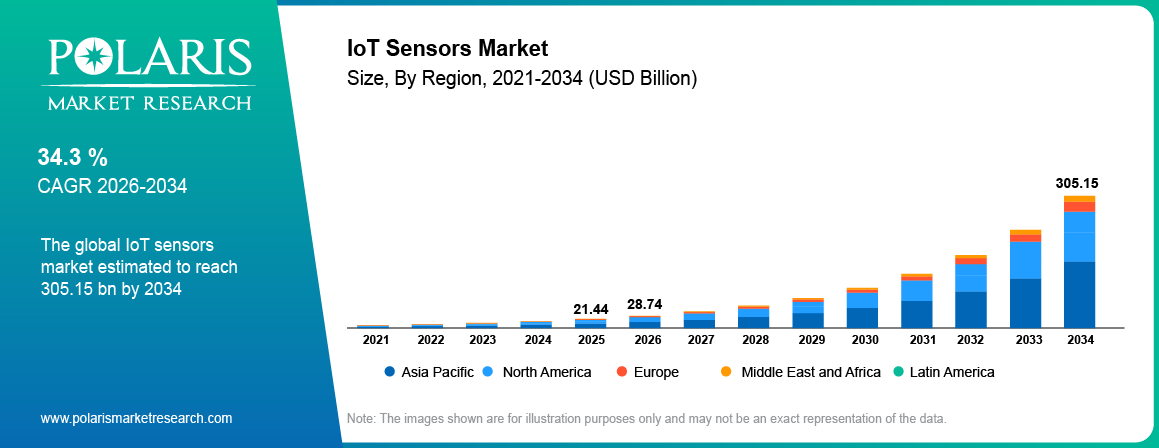
The global IoT sensors market was valued at USD 21.44 billion in 2025 and is anticipated to register a CAGR of 34.3% from 2026 to 2034. The increasing adoption across smart cities, healthcare, and industrial automation propels the industry growth. Advancements in sensor technologies are expected to boost the market expansion in the coming years.
Market Statistics
Key Takeaways
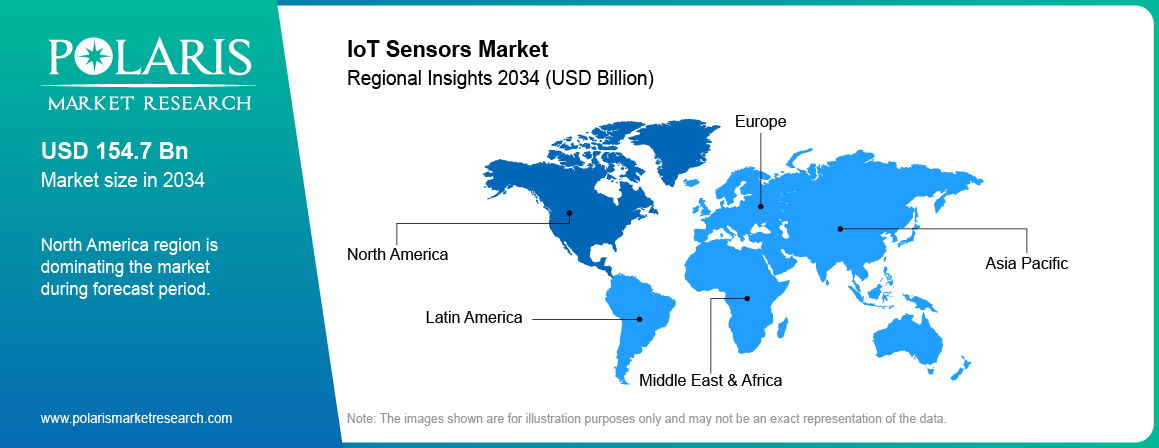
- North America dominated with a 40.4% share in 2025, driven by growing demand for IoT solutions in smart homes, cities, industrial automation, and healthcare applications.
- Asia Pacific is expected to experience significant growth of CAGR 37.8% during 2026–2034. Rapid urbanization in Asia Pacific is driving the adoption of IoT technologies to address urban challenges.
- The pressure sensors segment held the significant revenue share of 28.6% in 2025, due to their wide applications across industries, including automotive, aerospace, and healthcare.
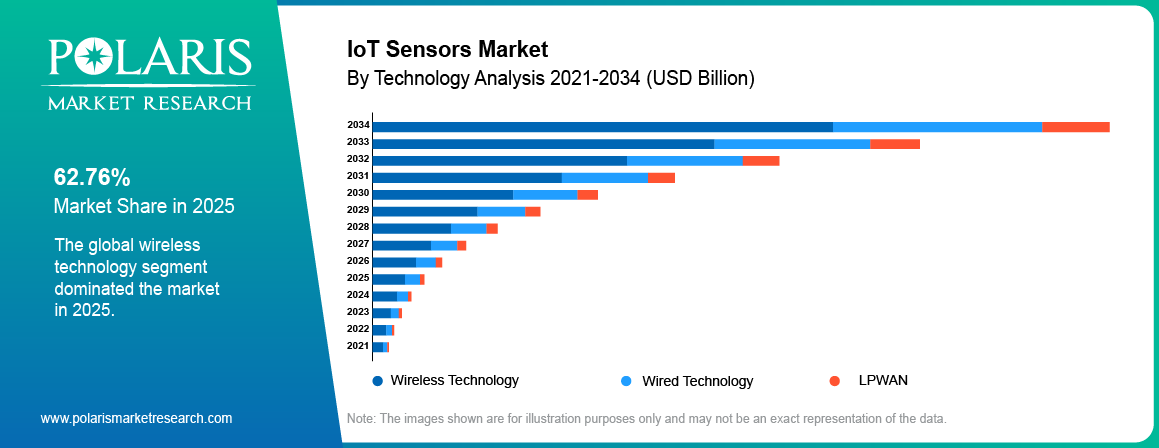
- The wireless technology segment held a significant revenue share of 62.76% in 2025, supported by its scalability, flexibility, and cost-effectiveness.
- The commercial segment held a significant revenue share of 36.8% in 2025. Enterprises across industries, including retail and hospitality, widely adopt IoT sensors to streamline operations and improve customer experiences.
Note: Figures and projections outlined in this report are the result of Polaris Market Research’s proprietary analytical processes, grounded in the latest available datasets and market observations
What are IoT Sensors?
Internet of Things (IoT) sensors are small network-coupled devices. They relay the respective signals through a wireless or hard-wired IoT network to a gateway, edge device, or cloud system for subsequent processing, analysis and automated response. Unlike generic sensors, IoT sensors are always equipped with a processing unit and communication module. They ensure continuous data acquisition and transmission with minimal or no human interference.
IoT sensors serve as the foundational components of data collection, providing continuous streams of information from various physical assets and environments. This data is then processed and analyzed in real time, enabling organizations to gain valuable insights into their operations, identify trends, and make data-driven decisions promptly. From predictive maintenance in manufacturing plants to remote patient monitoring in healthcare facilities, IoT sensors play a crucial role in enabling proactive and informed actions.
The IoT sensors market is witnessing significant growth fueled by the increasing demand for real-time data analytics and insights. In addition, companies operating in the market are introducing new products to expand market reach and strengthen presence. Advancements in sensor technologies include improvements in sensor accuracy, miniaturization, energy efficiency, and integration capabilities. As sensors become more sophisticated and versatile, they can capture a broader range of data with higher precision, enabling more accurate monitoring and analysis in various applications.
Advancements in wireless communication protocols and low-power consumption technologies have made it easier to deploy and maintain large-scale IoT sensor networks. These advancements have opened up opportunities for IoT sensors in diverse industries such as manufacturing, healthcare, agriculture, smart cities, and environmental monitoring. Furthermore, ongoing research and development efforts continue to drive innovation in sensor technologies, leading to the emergence of novel sensor types and functionalities.
How do IoT Sensors Work?
- Sensor captures data: The IoT sensor detects a physical change, such as temperature, pressure, motion, humidity, or light. It converts this change into data.
- Microcontroller processes the data: The microcontroller receives the sensor data. It processes and organizes the information. It may also remove unnecessary data before sending it further.
- Wireless transmission: The processed data is sent through a wireless network. Common options include Wi-Fi, Bluetooth, Zigbee, LoRaWAN, and cellular networks.
- Cloud or edge analytics: The data is analyzed in the cloud or on a nearby edge device. The system looks for patterns, unusual changes, or specific conditions.
- Automated action: Based on the analysis, the system can take action automatically. For example, it can turn on a machine, adjust room temperature, send an alert, or stop equipment when a problem is detected.
IoT Sensors vs Traditional Sensors
IoT sensors can collect and share information in real-time over connected systems. Compared to traditional sensors that usually just detect or measure data, IoT sensors can also transmit and carry out remote monitoring and automated functions. IoT sensors can perform remote monitoring as well as data collection and sharing over networks. This is different from traditional sensors which have to be connected to a separate system for data collection and monitoring.
| Dimension | Traditional sensors | IoT sensors |
| Connectivity | Standalone or hard-wired to a local controller | Networked over Wi-Fi, cellular, or LPWAN to cloud/edge platforms |
| Data access | Local readout or periodic manual logging | Continuous remote monitoring and real-time dashboards |
| Analytics | None built in; requires separate systems | Native integration with cloud/edge analytics and AI models |
| Automation | Manual response to readings | Triggers automated alerts and actions without human intervention |
| Scalability | Costly to network at scale (cabling, individual wiring) | Designed for large-scale, low-cost wireless deployment |
Source: Polaris Market Research Analysis
AI Impact on IoT Sensors Market
- Rapid urbanization across the world fuels the demand for AI-enabled IoT sensors in energy grids, traffic systems, and building automation. The sensors are used to reduce emissions, manage traffic congestion, and improve public safety.
- Artificial intelligence transforms sensors from reactive tools into predictive systems. They adapt to environmental changes and predict failures.
- In agriculture, AI-integrated sensors are used to forecast irrigation requirements based on soil and weather data.
- AI platform providers and IoT sensor makers partner to offer end-to-end ML pipelines.
Market Dynamics
Driver: Increasing Adoption of IoT Technologies Across Industries
The IoT sensors market experiences significant growth due to the increasing adoption of IoT technologies across various industries. These sensors are integrated into devices, machinery, infrastructure, and even consumer products. They enable the monitoring of various parameters such as temperature, humidity, pressure, motion, and more. Industries leverage IoT sensors to optimize operations, improve decision-making, and enhance user experiences. With the proliferation of connected sensor devices and the advancement of wireless communication technologies, the Internet of Things sensors market continues to expand rapidly. Moreover, ongoing innovations in sensor technology, including miniaturization, enhanced accuracy, and reduced costs, further drive the adoption of IoT sensors across diverse applications and industries.
Driver: Proliferation of Connected Devices and Smart Systems
The IoT sensors market is experiencing substantial growth driven by the proliferation of connected devices and smart monitoring systems. According to the IoT Analytics, the number of connected IoT devices grew by 14% in 2025 and is expected to reach 39 billion by 2030. As industries embrace digital transformation, the deployment of IoT sensors becomes integral for gathering real-time data across diverse applications. These sensors facilitate remote monitoring, automation, and predictive analytics. In sectors such as manufacturing, healthcare Analytics, agriculture, and transportation, IoT sensors play a pivotal role in optimizing processes, improving efficiency, and enhancing decision-making. Additionally, the advent of 5G technology accelerates IoT sensor adoption by enabling high-speed, low-latency communication networks, facilitating the transmission of vast amounts of data in real time (Source: iot-analytic s.com).
Driver: 5G/Connectivity Acceleration
The proliferation of wireless networks, such as 5G, and the constant evolution of new communication standards fuels the need for IoT sensors. According to the International Telecommunication Union (ITU), 5G coverage has expanded to 55% of the world population as of 2025. Rapid transmission of data with greater reliability reduces delays in receiving information from sensors. It enables use cases in industrial IoT, connected cars, healthcare, and smart cities. Moreover, improved cellular network capabilities enable massive sensor connectivity. The more coverage networks have, the more devices can be connected. Therefore, with the adoption of 5G networks, businesses are encouraged to use IoT sensors and benefit from real-time data insights. These factors are driving the adoption of 5G IoT sensors (Source: itu.int).
Restraint: High Costs and Uncertain Return on Investment
The initial cost of IoT deployment can be a major barrier for businesses. These costs can include sensors, connectivity, software, installation, maintenance, and management. Therefore, the adoption in the small and medium-sized enterprises can be limited. Additional expenditures on infrastructure can arise during the expansion of IoT infrastructure. Thus, the benefits of IoT for a company may be limited, which as a result limit the market adoption.
Challenge: Growing Concerns Related to Security, Privacy, and Interoperability
IoT sensor security and privacy concerns are restraining the market growth. IoT sensors require a large amount of data for their proper functioning. The data collected by these sensors could be highly sensitive, and improper security measures could lead to a data breach, resulting in the data being misused. Moreover, the level of interoperability further limits the growth. It refers to the ability of these sensors to communicate with one another. Sometimes the sensors manufactured by different companies do not match. This might require organizations to buy other equipment, which is compatible with the sensors. As a result, this adds to the cost of manufacturing and might slow down the adoption rate, especially in large organizations.
Opportunity: Increasing Use in Healthcare and Remote Monitoring
Rising adoption in healthcare is creating strong opportunities for IoT sensors. It is possible to monitor and track vitals, activity, medication administration, and other relevant metrics. IoT sensors in healthcare promote telehealth and reduce the need for patient visits. The growing demand for home-based care and remote healthcare services is increasing the use of connected sensors. Connected sensors combined with AI further help detect patterns and trends by which health professionals can respond faster to situations.
Opportunity: Rising Emphasis on Energy Management, Smart Grid, and AIoT
IoT sensors can play a significant role in the energy management space. It is possible to monitor and track energy consumption, equipment performance, and other relevant metrics with the help of IoT sensors. This promotes optimized usage and reduced waste. Moreover, AI algorithms help analyze the data from the IoT devices and spot trends and patterns. AIoT (Artificial Intelligence of Things) can lead to proactive maintenance and increased efficiency. Therefore, increasing emphasis on energy management, smart grid, and AIoT would create lucrative market opportunities.
Report Segmentation
By Type Analysis
The pressure sensors segment held a significant revenue share of 28.6% in 2025. Their versatile applications across diverse industries, including automotive, aerospace, healthcare, and manufacturing, contribute to their widespread adoption. Pressure sensors play a crucial role in industrial automation and smart manufacturing processes, ensuring optimal equipment performance and minimizing downtime. Additionally, their integration into automotive systems for monitoring tire pressure, engine performance, and airbag deployment further drives their significant revenue share. Pressure sensors are essential components in medical devices such as ventilators and blood pressure monitors, aligning with the increasing demand for remote patient monitoring and telemedicine solutions in the healthcare sector.
The temperature sensors segment is expected to record a CAGR of 35.7% during the forecast period. This is due to their extensive application in industrial, healthcare, food and beverage, and smart building sectors. These sensors can effectively monitor the temperature of a machine or product and prevent damage. Moreover, the rising need for automation and remote access in these end-use industries is further expected to fuel the temperature sensor segment growth.
The humidity sensors segment is expected to exhibit a CAGR of 34.9% during the forecast period. Growth is driven by rising demand for humidity sensors across the agricultural, healthcare, manufacturing, and smart building industries. These sensors help in maintaining optimal moisture levels and prevent damage to products and equipment. Furthermore, the rising need for climate monitoring and control and their increased application in IoT-enabled devices is expected to propel the adoption of humidity sensors.
The motion sensors is expected to record a CAGR of 36.2% during the forecast period due to the rising need for surveillance and automation. These sensors can detect motion and trigger an alert. They are majorly used in smart buildings, commercial establishments, residential buildings, and manufacturing units. Moreover, the rising need for IoT-connected solutions in commercial and residential buildings is expected to further drive the demand for motion sensors.
Sensor Type Comparison
| Sensor type | Primary use case | Growth outlook | Dominant connectivity |
| Pressure sensors | Automotive, aerospace, healthcare, industrial process monitoring | Largest revenue share (2025); steady leader through the forecast period | Wired & wireless |
| Temperature sensors | Cold-chain, HVAC, industrial process control, wearables | High-volume, broad-based growth | Wireless-led |
| Humidity sensors | Smart buildings, agriculture, consumer electronics | Above-average growth on Wi-Fi-enabled device attach rates | Wireless |
| Motion sensors | Smart homes, security, mobile devices, retail | Steady growth tied to smart-home and retail-analytics adoption | Wireless |
| Proximity sensors | Smartphones, consumer electronics, automotive driver assistance, industrial automation, retail | Steady growth on touchless interfaces and automation adoption | Wired in industrial and automotive; wireless in consumer |
| Accelerometers | Smartphones, wearables, automotive safety, industrial vibration and predictive maintenance | Above-average growth on wearables and condition-monitoring deployments | Wired & wireless |
| Gyroscopes | Navigation, image stabilization, AR/VR, drones, automotive | Steady growth supported by AR/VR, drones and ADAS | Wired (embedded IMU); wireless via host device |
| Light sensors | Display brightness control, smart lighting, agriculture, automotive | Steady growth tied to display and smart-lighting adoption | Wireless-led in smart lighting; embedded in consumer devices |
| Gas sensors | Industrial safety, environmental monitoring, air-quality management | Among the fastest-growing niche segments | Wireless & LPWAN |
| Sound sensors | Voice assistants, smart speakers, acoustic monitoring, security | Above-average growth on voice interfaces and acoustic analytics | Wireless (Wi-Fi, Bluetooth) |
| Biometric sensors | Healthcare wearables, access control, consumer authentication | Among the fastest-growing niche segments | Wireless (Bluetooth, Wi-Fi) & LPWAN |
| Others | Flow, level, magnetic and image sensing across industrial and consumer applications | Mixed; varies by sub-type and end market | Mixed |
Source: Polaris Market Research Analysis
By Technology Analysis
The wireless technology segment held a significant revenue share of 62.76% in 2025 due to its scalability, flexibility, and cost-effectiveness. Wireless sensors can be deployed easily in large-scale networks without complex cabling, lowering upfront costs and enabling rapid integration. They also require minimal maintenance, reducing operational expenses and downtime. Additionally, wireless technologies are compatible with various devices and protocols, ensuring interoperability and seamless integration within existing IoT ecosystems. These advantages make wireless sensors the preferred choice for businesses seeking efficient and adaptable solutions for data collection and monitoring, thereby driving their widespread adoption and dominance in the IoT sensors market.
The LPWAN segment is estimated to record a CAGR of 34.75% over the forecast period, owing to the increasing demand for connecting IoT sensors over long distances with low power consumption. It powers battery-operated devices and requires less maintenance. The increasing use of IoT sensors in smart cities, agriculture, utilities, and asset tracking is fueling the demand for low-power wide-area network (LPWAN) sensors.
By End Use Analysis
The commercial segment dominated the IoT sensor market share with 36.8% in 2025. Enterprises across various industries, including offices, retail, and hospitality, are widely adopting IoT sensors to streamline operations and improve customer experiences. These sensors are integral to smart building solutions, facilitating efficient management of lighting, HVAC systems, security, and occupancy. Moreover, businesses utilize IoT sensors for asset tracking and inventory management, improving asset visibility and reducing losses. Retailers leverage sensor data for foot traffic monitoring, shelf stocking, and customer behavior analysis to optimize store layouts and marketing strategies.
The consumer segment is expected to register a 32.8% CAGR during the projected period, due to the growing trend of smart homes and connected devices. These sensors find their applications in home security, energy management, lighting control, and climate regulation. Moreover, rising need for convenience, safety, and energy efficiency among consumers propels the demand for connected sensors. The rising popularity of smart homes and connected devices fuels the growth of this segment.
The industrial segment is expected to witness a CAGR of 36.5% during the forecast period, driven by the growing need for automation and real-time monitoring of production assets. IoT sensors are used in the industrial sector to monitor machines’ operating conditions, temperature, pressure, and motion. This data helps ensure the efficient use of equipment and reduce losses due to breakdowns. Moreover, the development of automated and connected systems and the rise of Industry 4.0 concept contribute to the growing demand for industrial smart sensors.
Real World Application of IoT Sensors
| Application area | example | IoT sensors used | How the system works | Primary value |
| Industry 4.0 & Smart Manufacturing | Siemens Senseye Predictive Maintenance | Vibration, temperature, acoustic, pressure, current and energy sensors | Sensors continuously capture machine-condition data and identify abnormal patterns such as bearing wear, overheating or misalignment before equipment failure. | Reduced unplanned downtime, optimized maintenance scheduling, longer asset life and lower maintenance costs. |
| Healthcare & Remote Patient Monitoring | Biofourmis remote patient monitoring platform | Heart-rate, ECG, blood-oxygen, temperature, respiratory-rate, blood-pressure and motion sensors | Wearable or home-based devices collect vital-sign data and transmit it to clinicians for continuous monitoring and alerts when readings exceed defined thresholds. | Earlier intervention, improved chronic-disease management, fewer hospital visits and enhanced post-discharge care. |
| Smart Cities & Urban Infrastructure | SFpark smart parking program in San Francisco | In-ground parking-occupancy, magnetic, payment and communication sensors | Parking sensors detect whether individual spaces are occupied and provide availability information through mobile applications, digital signage or parking-management platforms. | Less time spent searching for parking, improved parking utilization, better traffic management and reduced vehicle emissions. |
| Connected & Autonomous Vehicles | Tesla Autopilot and connected-vehicle diagnostics | Camera, radar, ultrasonic, wheel-speed, tire-pressure, temperature, GPS and battery sensors | Vehicle sensors perceive road conditions, support ADAS functions such as lane keeping and collision warning, and transmit diagnostic data for maintenance and fleet analysis. | Improved driver assistance, real-time vehicle-health monitoring, predictive servicing and enhanced fleet visibility. |
| Smart Agriculture & Precision Farming | Netafim precision irrigation systems | Soil-moisture, soil-temperature, electrical-conductivity, weather, flow and pressure sensors | Field sensors measure soil and weather conditions, while flow and pressure sensors verify irrigation performance. Data is used to adjust irrigation timing and water volumes. | Lower water consumption, improved crop productivity, reduced fertilizer loss and more consistent field management. |
| Smart Homes, Wearables & Consumer Electronics | Google Nest Learning Thermostat and Fitbit wearable ecosystem | Temperature, humidity, occupancy, motion, heart-rate, blood-oxygen, accelerometer and GPS sensors | Home sensors detect occupancy and environmental conditions to automate heating or cooling. Wearable sensors track activity, sleep and selected health metrics through connected applications. | Energy savings, convenience, personalized health insights, safety alerts and improved user engagement. |
| Retail, Logistics & Supply Chain | DHL temperature- and location-monitored shipments | GPS, temperature, humidity, shock, tilt, light and door-opening sensors | Sensors attached to packages, pallets, containers or vehicles record shipment conditions and send alerts when temperature, location or handling thresholds are breached. | Reduced spoilage and theft, improved inventory visibility, stronger cold-chain compliance and more reliable delivery performance. |
| Smart Buildings & Energy Management | Honeywell building-management systems | Temperature, humidity, carbon-dioxide, occupancy, motion, airflow, pressure, energy and equipment-current sensors | Building sensors measure occupancy and indoor conditions, allowing control systems to adjust HVAC operation, ventilation, lighting and equipment schedules. | Lower energy consumption, improved occupant comfort, predictive HVAC maintenance and better indoor-air quality. |
| Environmental & Air-Quality Monitoring | Clarity Movement air-quality monitoring network | Particulate-matter, nitrogen-dioxide, ozone, carbon-monoxide, temperature, humidity and atmospheric-pressure sensors | Distributed sensor nodes collect local pollution and weather data and transmit it to cloud platforms for mapping, trend analysis and public alerts. | Faster identification of pollution hotspots, improved urban planning, climate and environmental research, and better public-health communication. |
Source: Polaris Market Research Analysis
Technology Trends
Edge Computing & Real-Time Analytics
Edge computing is becoming important in the IoT sensors market because it enables efficient data processing closer to data sources. This enables faster execution and analysis. Real-time IoT analytics provide insights into equipment malfunctions, security threats, or environmental changes, which are critical in different verticals. The growing need for faster decision-making in industrial automation, healthcare, smart buildings, and connected cars is expected to drive demand for edge-based IoT sensors.
Cloud IoT Platforms & Data Analytics
Enterprises are adopting IoT cloud platforms to store, monitor, analyze, and manage sensor data. IoT data analytics help businesses extract actionable insights in the cloud, enabling them to monitor and control systems from remote locations. Increasing demand for cloud-based data storage and management is anticipated to drive the IoT sensors market. Enterprises are adopting IoT cloud platforms due to growing need for remote data monitoring, management, and analytics. Moreover, the rising need for connected devices is expected to fuel the market growth.
Semiconductor & MEMS Advancements
Advancements in semiconductor and MEMS technologies are driving IoT sensor market growth, as manufacturers focus on developing smaller, high-performance sensors to meet rising demand for compact, energy-efficient IoT devices. These technologies further play a significant role in reducing the power consumption of these sensors, thereby increasing their adoption in various electronic devices. The rising demand for MEMS and smaller IoT sensors is fueling the need for semiconductors and MEMS in industrial, consumer electronics, healthcare, and automotive verticals.
Regional Insights
North America
North America dominated the global IoT sensors market share with 40.4% in 2025. The leading share is driven by technological innovation, fostering a rich ecosystem of research institutions and tech companies. North America demonstrates early adoption of IoT solutions across diverse industries like healthcare, manufacturing, automotive, and agriculture. Its robust digital infrastructure, including high-speed internet and extensive IoT networks, supports widespread sensor deployment. The growing demand for IoT solutions in smart homes, cities, industrial automation, and healthcare amplifies the North America IoT sensors market growth.
Asia-Pacific
Asia-Pacific is expected to register the highest CAGR of 37.8% during the forecast period. Rapid urbanization across the region prompts increased adoption of IoT technologies to tackle urban challenges. Additionally, emerging economies such as China and India will offer lucrative opportunities for IoT deployment across sectors. The proliferation of mobile devices, improved internet connectivity, and the advent of 5G networks further bolster IoT sensor adoption. Supportive government policies and initiatives aimed at digitalization and smart infrastructure development are catalyzing market growth in the region.
The India IoT sensors market is expected to record a CAGR of 38.5% during the projected period. The growth is supported by rapid digitalization and the expansion of smart city projects. Growing investments in manufacturing, healthcare, agriculture, and connected infrastructure are creating new opportunities for IoT sensor deployment across the country.
Europe
Europe IoT sensors market is expected to witness a CAGR of 32.6% during the forecast period, driven by the growing adoption of smart manufacturing, connected infrastructure, and energy-efficient technologies. The region is witnessing a rise in the demand for sensors that enable industrial automation, predictive maintenance, and real-time monitoring. Growing smart city initiatives are also contributing to the demand for IoT sensors. Additionally, the need for connected and energy-efficient buildings is on the rise, which is supported by the region's focus on sustainability. The proliferation of 5G connectivity and digitization across diverse industries is further propelling the IoT sensors market in the region.
Middle East and Africa
The Middle East and Africa IoT sensors market is expected to witness a CAGR of 32.67% during the forecast period, driven by smart city initiatives and the growing need for connected infrastructure and automation. The Middle East is capitalizing on the increased need for connected solutions in transport, utilities, oil & gas, and building construction across the countries. Moreover, growing focus on energy management and automation fuels the demand for IoT sensors. African countries are also witnessing growth in IoT sensors, driven by improved internet penetration and smart city projects. Furthermore, government-led smart city initiatives and an increase in connected devices across the region are also expected to propel the IoT sensors market.
Latin America
Latin America IoT sensors market is expected to exhibit a CAGR of 31.2% during the forecast period, driven by the region’s digitization and increasing need for connected devices and solutions. Smart city projects are gaining considerable traction, driving a demand for IoT sensors. These sensors have diverse applications in traffic management, security, utilities, smart buildings, and connected vehicles. Moreover, the rising need for connected devices in agricultural practices is expected to augment the demand for IoT sensors in the region. Industrial automation and energy management are some of the other major end-use applications driving the Latin American IoT sensors market.
Key Market Players & Competitive Insights
The IoT sensors market involves a diverse array of players, and the expected arrival of new contenders is poised to intensify rivalry. Established IoT sensor market leaders continuously enhance their technologies to maintain a competitive advantage, emphasizing effectiveness, reliability, and safety. These firms prioritize strategic actions such as establishing collaborations, improving product portfolios, and participating in cooperative endeavors. Their aim is to outperform competitors within the field, securing a significant IoT sensors market share.
List of Major IoT Sensor Companies
- ABB Ltd
- Aeris
- Analog Devices, Inc.
- Bosch Sensortec GmbH
- Broadcom Inc.
- Honeywell International Inc.
- Infineon Technologies AG
- Murata Manufacturing Co., Ltd.
- NXP Semiconductors N.V.
- Omron Corporation
- Schneider Electric SE
- Sensata Technologies
- Sensirion AG
- Siemens AG
- STMicroelectronics N.V.
- TDK Corporation
- TE Connectivity Ltd.
- Texas Instruments Incorporated
IoT Sensors Market Vendor Positioning
| Company | Positioning Archetype | Core Strength / Positioning | Key Sensing & Technology Focus | Primary End Markets |
| Texas Instruments | Broad-line analog & sensing IC leader | Broad analog & sensing IC portfolio; leading market-share position among sensor IC suppliers | Hall-effect, temperature, current, inductive and mmWave radar sensors paired with analog/embedded processing | Industrial, automotive, personal electronics |
| STMicroelectronics N.V. | MEMS & motion-sensing leader | MEMS and motion-sensing leadership across automotive and consumer electronics | MEMS accelerometers, gyroscopes, environmental and time-of-flight sensors; smart sensors with embedded intelligence | Automotive, consumer, industrial IoT |
| Analog Devices, Inc.* | High-performance precision sensing & signal chain | Precision analog and signal-conditioning leader extending into MEMS inertial and condition-monitoring sensing | Precision MEMS inertial/vibration sensors, data converters, sensor interface and signal-chain ICs | Industrial (condition-based monitoring), automotive, healthcare, aerospace & defense |
| Infineon Technologies AG | Industrial & automotive-grade sensing platforms | Industrial and automotive-grade sensing platforms (e.g., XENSIV connected sensor kit) | Magnetic, 60 GHz radar, pressure, MEMS microphone and gas (CO2) sensors under XENSIV | Automotive, industrial, smart home/building |
| NXP Semiconductors N.V. | Sensing + connectivity integrator | Automotive and IIoT sensors/connectivity integration | Pressure, magnetic and inertial sensors, radar, alongside MCUs, secure connectivity (NFC, UWB) | Automotive, industrial IoT |
| Bosch Sensortec GmbH | High-volume MEMS specialist | High-volume MEMS sensors for consumer and wearable devices | IMUs, pressure, geomagnetic and environmental (incl. gas) sensors with on-sensor AI capability | Smartphones, wearables, hearables, smart home |
| TDK Corporation | MEMS, inertial & component-integration player | MEMS and inertial sensors for consumer electronics and automotive | Inertial (IMU), MEMS microphone, ultrasonic ToF, magnetic (Hall/TMR) and temperature sensors | Consumer electronics, automotive, industrial |
| Murata Manufacturing Co., Ltd.* | Component & module specialist with MEMS sensing | Passive-components leader with automotive-grade MEMS inertial sensing and sensor/connectivity modules | MEMS inertial, pressure and environmental sensors; combo and wireless modules | Automotive, industrial, consumer/wearables, healthcare |
| Broadcom Inc. | Optical & RF sensing component supplier | Optical and RF sensing components for connectivity-heavy applications | Optical encoders, proximity/ambient-light sensors, RF and wireless components | Industrial automation, consumer, connectivity-driven devices |
| Sensirion AG | Precision environmental sensing specialist | Precision environmental sensing (humidity, gas, flow) for consumer and medical devices | Digital humidity/temperature, CO2, VOC, particulate and liquid/gas flow sensors | HVAC/building, consumer, medical, automotive |
| TE Connectivity Ltd. | Ruggedized sensing specialist | Ruggedized sensing for automotive, industrial and medical applications | Pressure, position, temperature, humidity and force sensors; custom sensor assemblies | Automotive, industrial, medical, aerospace |
| Sensata Technologies | Safety-critical sensing specialist | Safety-critical sensing for automotive and industrial end markets | Pressure, temperature and position sensors; electrification-related components | Automotive (incl. EV), heavy vehicle, industrial |
| Honeywell International Inc. | Industrial process & safety sensing leader | Industrial-grade pressure, gas and safety sensing for process industries | Pressure, gas detection, flow, position and safety sensors | Process industries, oil & gas, aerospace, buildings |
| Siemens AG | Automation-led sensor integrator | Industrial automation and smart-building sensor integration | Industrial and building sensors feeding PLC, building-management and digital-twin platforms | Factory automation, smart buildings, infrastructure |
| ABB Ltd | Process automation & robotics-integrated sensing | Industrial process and robotics-integrated sensing | Condition-monitoring, process instrumentation and robot-embedded sensors | Process industries, robotics, motors and drives |
| Schneider Electric SE | Energy-management sensor integrator | Building and energy-management sensor integration | Power, environmental and occupancy sensing within energy-management platforms | Buildings, data centers, industrial energy |
| Omron Corporation | Factory-floor, healthcare & building sensing | Industrial automation, healthcare and building-automation sensing | Photoelectric, proximity, thermal/MEMS and vision sensors; healthcare monitoring devices | Factory automation, healthcare, building automation |
| Aeris* | IoT connectivity & solutions enabler (sensor-agnostic) | IoT connectivity and managed-services provider that connects deployed sensors and devices to the cloud rather than manufacturing sensing elements | Cellular/global IoT connectivity, device and data-management platform | Automotive/telematics, asset tracking, energy and utilities, industrial IoT |
Recent Developments
- September 2026: Huawei launched its all-new iFTTO solution in September 2026, combining connectivity, IoT, sensing, and intelligent operations for AI-powered campuses. The solution introduced new offerings for education, healthcare, and hotels, supporting smart sensing, energy savings, automated monitoring, and improved campus network management. (Source: e.huawei.com)
- September 2026: Aqara announced the availability of the Spatial Multi-Sensor FP400. The sensor combined 60GHz mmWave radar, AI-based spatial sensing, and Thread and Zigbee connectivity to enable precise occupancy tracking, movement detection, and smart home automation. (Source: via.tt.se)
- September 2026: Renesas Electronics launched the RZ/G3L and RZ/G3SE 64-bit microprocessors for HMI and IoT edge systems. The new devices offered low standby power, fast connectivity, and scalable designs, supporting applications such as smart retail terminals, EV chargers, industrial gateways, and smart home systems. (Source: renesas.com)
- September 2026: STMicroelectronics launched the ST SafeSense VD56GA, a compact 1.1 MP automotive image sensor designed for driver and occupant monitoring. The sensor offered improved image sharpness, higher infrared sensitivity, and embedded image-processing features, helping automakers develop affordable in-cabin sensing systems for high-volume vehicle platforms. (Source: newsroom.st.com)
Why Enterprises are Investing in IoT Sensors?
Enterprises are adopting Internet of Things (IoT) sensors to monitor equipment, assets, and other functions. It helps them ensure improved performance, increased productivity, and reduced operating costs and downtimes. The adoption also enables predictive maintenance and early warning of issues. The growing need for automation, predictive maintenance sensors, smart factories, and data-driven decision-making has stimulated the adoption of IoT sensors in various industrial applications.
IoT Sensors Market Segmentation
By Type Outlook (Revenue – USD Billion, 2021–2034)
- Pressure Sensors
- Temperature Sensors
- Humidity Sensors
- Motion Sensors
- Proximity Sensors
- Accelerometers
- Gyroscopes
- Light Sensors
- Gas Sensors
- Sound Sensors
- Biometric Sensors
- Others
By Technology Outlook (Revenue – USD Billion, 2021–2034)
- Wired Technology
- Wireless Technology
- LPWAN
By End Use Outlook (Revenue – USD Billion, 2021–2034)
- Commercial
- Consumer
- Industrial
- Others
By Regional Outlook (Revenue – USD Billion, 2021–2034)
- North America
- U.S.
- Canada
- Europe
- Germany
- France
- UK
- Italy
- Spain
- Netherlands
- Russia
- Rest of Europe
- Asia Pacific
- China
- Japan
- India
- Malaysia
- South Korea
- Indonesia
- Australia
- Rest of Asia Pacific
- Middle East & Africa
- Saudi Arabia
- UAE
- Israel
- South Africa
- Rest of Middle East & Africa
- Latin America
- Mexico
- Brazil
- Argentina
- Rest of Latin America
Report Coverage
The IoT sensors market report emphasizes on key regions across the globe to provide better understanding of the product to the users. Also, the report provides market insights into recent developments, trends, and analyzes the technologies that are gaining traction around the globe. Furthermore, the report covers in-depth qualitative analysis pertaining to various paradigm shifts associated with the transformation of these solutions.
The report provides detailed analysis of the market while focusing on various key aspects such as competitive analysis, IoT sensor types, technologies, end uses, and their futuristic growth opportunities.
Future Outlook
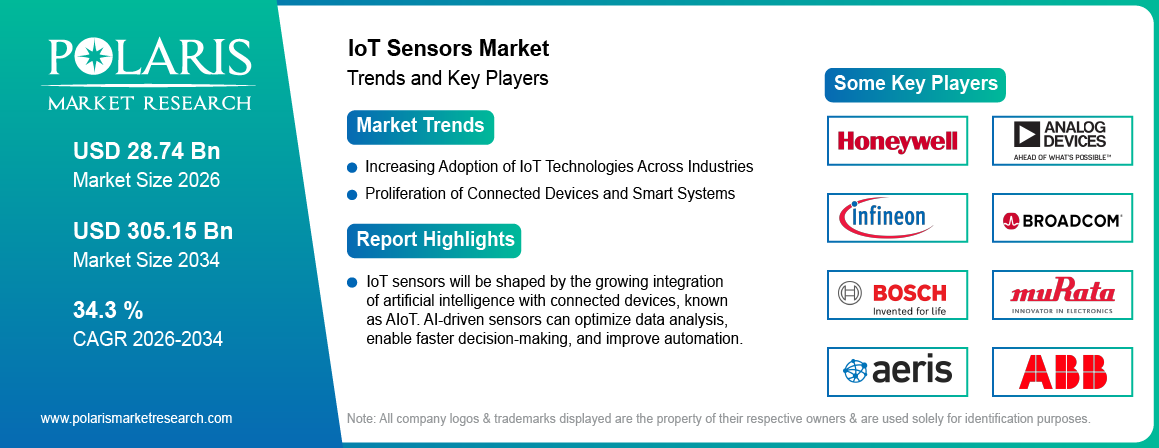
The future of IoT sensors will be shaped by the growing integration of artificial intelligence with connected devices, known as AIoT. AI-driven sensors can optimize data analysis, enable faster decision-making, and improve automation. It is expected that businesses will invest heavily in AIoT to create products and services that leverage the power of AI-driven sensors for predictive maintenance, energy management, security, healthcare, and other high-level applications. The technologies enabling low-power sensors, edge computing, and wireless communications are expected to fuel the IoT sensors market growth.
Research Methodology
- Market estimates are derived using a blend of primary and secondary research, validated through weighted-average and combined top-down/bottom-up modeling approaches.
- Secondary research covers vendor filings, semiconductor and MEMS sensor production data, IoT connectivity and standards development, industry journals, and paid third-party databases to build baseline estimates.
- Primary research includes interviews with key industry participants such as sensor manufacturers, semiconductor suppliers, IoT device OEMs, and industrial automation integrators, to validate accuracy and capture forward-looking insights.
- Base year considered is 2025, with a forecast provided through 2034; revenues are expressed in USD Billion.
- Parent market is identified as the global IoT and sensor technology market; the addressable segment is narrowed using connected sensor adoption rates across consumer, commercial, and industrial applications.
- Bottom-up model aggregates regional IoT sensor demand across type, technology, and end use, validated against vendor revenue disclosures from Bosch Sensortec, Texas Instruments, Honeywell, STMicroelectronics, TE Connectivity, and others.
- Regional coverage spans North America, Europe, Asia Pacific, the tMiddle East & Africa, and Latin America, further segmented by major countries.
- Projected 34.3% CAGR (2026–2034) reflects weighted analysis of proliferating connected devices, declining sensor manufacturing costs, expanding smart manufacturing and Industry 4.0 adoption, and rising deployment of LPWAN and wireless sensor networks across industrial and consumer applications.
- Findings are cross-validated across multiple estimation methods to ensure consistency, accuracy, and reliability of the final market sizing.
IoT Sensors Market Report Scope
| Report Attributes | Details |
| Market size in 2025 | USD 21.44 billion |
| Market size in 2026 | USD 28.74 billion |
| Revenue forecast in 2034 | USD 305.15 billion |
| CAGR | 34.3% from 2026 – 2034 |
| Base year | 2025 |
| Historical data | 2021 – 2024 |
| Forecast period | 2026 – 2034 |
| Quantitative units | Revenue in USD billion and CAGR from 2026 to 2034 |
| Segments covered |
|
| Regional scope |
|
| Competitive Landscape |
|
| Report Format |
|
| Customization | Report customization as per your requirements with respect to countries, region, and segmentation. |
Source: Polaris Market Research Analysis
IoT Sensors Market FAQ's
The IoT Sensors Market report covering key segments are type, technology, end use, and region.
The global IoT sensors market size is expected to reach USD 305.15 billion by 2034
IoT Sensors Market exhibiting the CAGR of 34.3% during the forecast period.
North America dominated with a 40.4% share in 2025.
key driving factors in IoT Sensors Market are Increasing adoption of IoT technologies
IoT sensors are connected devices that collect real-time data and transmit it to systems for monitoring, analysis, and automated actions.
IoT sensors detect physical conditions, collect data, process information, and transmit it through connected networks for further analysis.
IoT sensors provide connected, real-time data sharing, while traditional sensors mainly measure conditions without direct network connectivity.
AI helps IoT sensors analyze collected data, identify patterns, detect problems, and support faster automated decision-making.
IoT sensors help businesses monitor operations, improve efficiency, reduce downtime, control costs, and make faster data-based decisions.

Download Sample Report of IoT Sensors Market
Please fill out the form to request a customized copy of the research report.


