
Laser Tracker Market Share, Size, Trends, Industry Analysis Report, 2022 - 2030
REPORT DETAILS
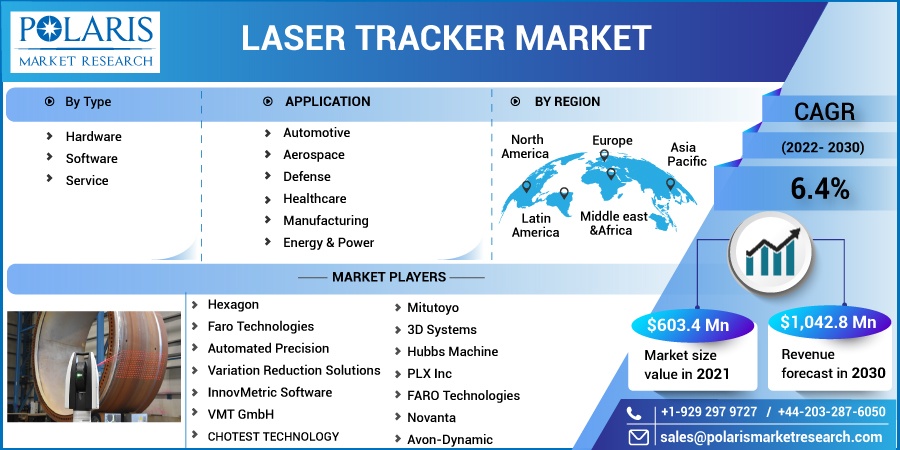
The global laser tracker market was valued at USD 603.4 million in 2021 and is expected to grow at a CAGR of 6.4% during the forecast period. The global laser tracker market is projected to expand quickly in the following period. The development of distance measurement technology and the increasing use of laser-based technology in various industries such as manufacturing, healthcare, defense, and others are the main drivers propelling the market.
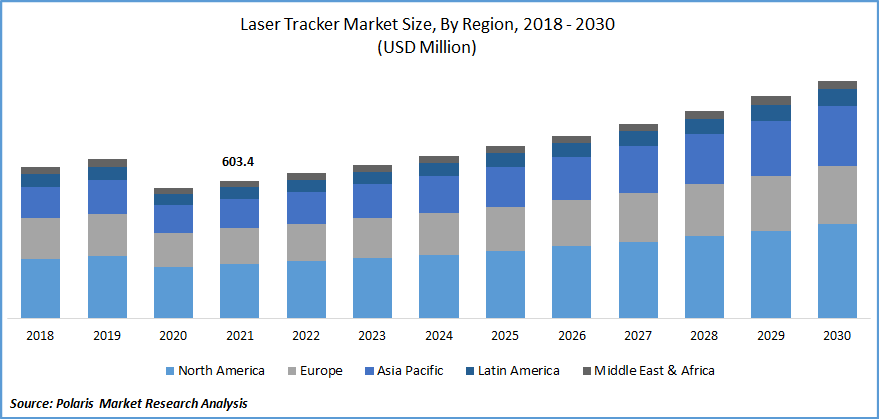
Source: Polaris Market Research Analysis
Know more about this report: Download Sample Report
Additionally, introducing new products and solutions and the continuous increase in investment in laser tracker technology would drive the market demand for laser trackers throughout the forecast period. For instance, in June 2022, Hexagon's Intelligence business introduced the “Leica Absolute Tracker AT500 and B-Probeplus”. The AT500 has an extended operating temperature range, a new integrated controller architecture, and enhanced reflector and probing measurement performance. It is also entirely IP54-rated for environmental protection.
The laser tracker's ability to measure massive objects in three dimensions is a benefit. An arm-type CMM has a constrained measuring range, and three-dimensional measurements and accuracy might be challenging when using a hand instrument like a caliper or a tape measure. These scenarios call for the employment of laser trackers.
The COVID-19 pandemic has had some negative consequences on the market. Government-imposed lockdowns in different regions of the world have logically decreased demand. Manufacturing, supply chain operations, and other elements are blamed for it. Due to the pandemic, supply chain disruptions have allowed users to realize damaging repercussions on their manufacturing and business processes.
Source: Polaris Market Research Analysis
Know more about this report: Download Sample ReportIndustry Dynamics
Growth Drivers
Laser trackers are highly portable and contain an inbuilt battery that enables them to operate in challenging conditions while retaining the highest precision level. Modern lasers are portable and highly accurate when used within a practical measurement range. Additionally, current systems are Wi-Fi enabled, allowing even more fluid communication between sensors to speed up data transfer.
The growing demand for three-dimensional measurement solutions in various industries, such as defense, aerospace, automotive, and energy, automation of robotic systems, and an increase in the number of advancements in distance measurement technology are some of the significant factors that are anticipated to boost the growth of the market over the forecast period.
Also contributing to the expansion of the laser tracker market during the aforementioned anticipated timeframe will be the rising number of car and aviation manufacturers and the rising demand for research and development activities in 3D measurement techniques.
The market growth of laser trackers within the previously mentioned anticipated timeframe will likely be constrained by the availability of replacements for inspection and the requirement to address alignment faults.
Report Segmentation
The market is primarily segmented based on type, application, and region.
| By Type | By Application | By Region |
|
|
|
Source: Polaris Market Research Analysis
Know more about this report: Download Sample Report
The Hardware segment is expected to witness the fastest growth
In 2021, the hardware segment will have a significant share. The hardware has been divided into a laser tracker head, controller, retroreflector, computer system, and necessary peripherals. The following subcategories have been added: stands, tripods, interfaces; power supply units; power cables; battery chargers and sets; and others. Rental and installation, and training are additional service segments.
A laser tracker measurement system consists of a collection of hardware and sensors handled by the machine in order to measure position and orientation in real time. Accurate definition or updating of these positions requires information from various sources, including linear encoders, inertial measurement units (IMU), and laser trackers (optical devices). The actual measurement system used in CALS is a computer-aided laser tracker measurement system. A laser tracker, a tripod, a measurement arm, and other components make up the hardware of this instrument.
The Manufacturing segment accounted for the second-largest market share in 2021
The manufacturing segment is expected to dominate the market during the projection period. In the manufacturing industry, laser-based technologies give robust welding or cutting capabilities with extreme precision. They are ideally suited for the robotics, automotive, and industrial sectors because of their capacity to modify and manipulate materials.
Additionally, it makes it possible to produce goods with greater accuracy faster while utilizing fewer resources and materials. The healthcare industry is expected to grow rapidly over the next few years. The expanding use of laser technology for ontogenetic research, dynamic contrast-enhanced MRI, confocal microscopy, laser vision correction, and dermatological treatment.
Moreover, Laser trackers integrate data into production processes, which facilitates better quality control, increases throughput or output rates, decreases cycle times, and ultimately aids the companies that manufacture large-scale precision machining equipment.
The demand in the Asia Pacific is expected to witness significant growth
As laser trackers are used for quality control and inspection, calibration, and alignment reasons in various industries, including automotive, aerospace & defense, general manufacturing, and energy & power, the Asia-Pacific market is seeing growth. Another factor contributing to expanding the laser tracker market in this area is the development of smart factories in nations like China and India.
The region is the center of the world's semiconductor, car, and other consumer industry manufacturing. Additionally, India is anticipated to have the highest growth in the market over the study period. By 2028, India is predicted to be the third-largest automobile market in the world in terms of volume. Laser trackers have enormous growth potential in these industries for applications due to the rising penetration of electric vehicles and the concerning production of solar modules.
Competitive Insight
Some of the major players operating in the global market include:
- Hexagon,
- Faro Technologies,
- Automated Precision,
- Variation Reduction Solutions.,
- InnovMetric Software,
- VMT GmbH,
- CHOTEST TECHNOLOGY,
- Mitutoyo,
- 3D Systems,
- Hubbs Machine.,
- PLX Inc,
- FARO Technologies,
- Novanta,
- Avon-Dynamic.
Recent Developments
In May 2025, Hexagon launched the Leica ATS800, combining laser tracking and radar for high-precision, non-contact measurement of large structures, supporting automated workflows.
In April 2025, API introduced the iLT, the smallest, lightest laser tracker with onboard controller, Wi-Fi, and AI-enhanced GPU, designed for portable measurements in diverse sites.
In September 2024, Nikon Metrology’s APDIS Laser Radar met VDA 5.1 standards, enabling automated, non-contact inline measurements for automotive certification without targets.
In April 2024, InnovMetric released PolyWorks 2024, a 3D metrology platform improving cloud data access, real-time collaboration, and integration with Excel and Power BI.
In April 2022, The most recent version of InnovMetric's intelligent “3D metrology digital ecosystem, PolyWorks 2022”, was released. It significantly increases the potential of the environment in which it is built. At any later in the process, users can deploy a CAD model with nominal features and employ these changes to the already-measured items.
In May 2021, API Metrology partnered with Mitutoyo Corporation to make available through Mitutoyo's global network API's portable dimensional metrology, particularly laser measurement.
Laser Tracker Market Report Scope
| Report Attributes | Details |
| Market size value in 2022 | USD 636.1 million |
| Revenue forecast in 2030 | USD 1,042.8 million |
| CAGR | 6.4% from 2022 – 2030 |
| Base year | 2021 |
| Historical data | 2018 – 2020 |
| Forecast period | 2022 – 2030 |
| Quantitative units | Revenue in USD million and CAGR from 2022 to 2030 |
| Segments Covered | By Type, By Application, By Region |
| Regional scope | North America, Europe, Asia Pacific, Latin America; Middle East & Africa |
| Key Companies | Hexagon, Faro Technologies, Automated Precision, Variation Reduction Solutions., InnovMetric Software, VMT GmbH, CHOTEST TECHNOLOGY, Mitutoyo, 3D Systems, Hubbs Machine., PLX Inc, FARO Technologies, Novanta, and Avon-Dynamic. |
Source: Polaris Market Research Analysis
Laser Tracker Market FAQ's
The global laser tracker market was valued at around USD?603.4?million in 2021 and is projected to reach approximately USD?1,042.8?million by 2030, expanding at a CAGR of 6.4% over the forecast period.
Advancements in distance measurement technologies and the integration of more sophisticated laser systems are increasing precision, expanding use cases, and driving demand for laser tracker solutions in industrial environments.
The market includes hardware, software, and services, with hardware expected to grow rapidly due to its crucial role in precision alignment, calibration, and inspection tasks across industries.
Applications in automotive, aerospace, defense, healthcare, manufacturing, and energy & power industries are major contributors, with manufacturing particularly notable for leveraging laser trackers to improve quality control and operational accuracy.
The Asia Pacific region is anticipated to experience the highest growth rate, driven by expanding automotive and aerospace sectors and increasing adoption of laser tracker systems for precision measurement in production facilities.
Laser trackers are valued for their ability to rapidly and accurately measure three dimensional coordinates of large objects without physical contact, offering superior accuracy and efficiency compared to traditional tools like tape measures or arm type coordinate measuring machines.
Prominent players in the market include Hexagon AB, FARO Technologies, Automated Precision, Variation Reduction Solutions, InnovMetric Software, VMT GmbH, CHOTEST TECHNOLOGY, Mitutoyo Corp., 3D Systems, Hubbs Machine and Manufacturing, PLX Inc, Novanta, and Avon Dynamic calibration.
Download Sample Report of Laser Tracker Market
Please fill out the form to request a customized copy of the research report.


