
Low-E Glass Market Demand, Industry Trends, 2026-2034
REPORT DETAILS
Low-E Glass Market Summary
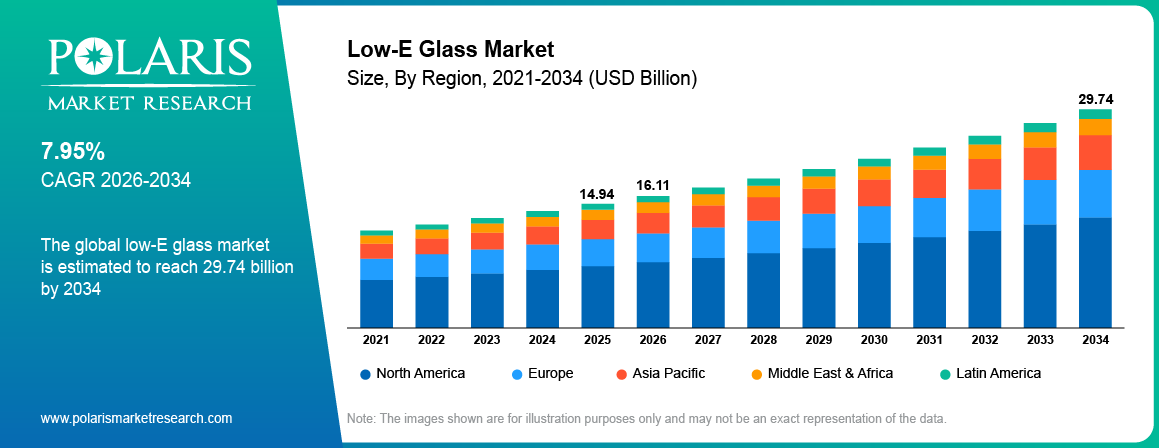
The global low-E glass market is estimated around USD 14.94 Billion in 2025,with consistent growth anticipated during 2026–2034. Rising demand for energy-efficient materials, stricter emission regulations, and growing urban infrastructure projects are supporting market growth. The market is projected to grow at a CAGR of 7.95% during the forecast period.
Market Statistics
Key Takeaways
-
Soft-coated Low-E glass segment dominated the Low-E glass market in 2025, accounting for approximately 58.42% of total revenue, due to its superior thermal insulation performance, higher energy efficiency, and growing use in advanced glazing systems.
-
The architectural segment dominated the market in 2025 with a revenue share of 67.85%, driven by high adoption of Low-E glass in commercial and residential buildings for improved energy savings and indoor comfort.
-
The commercial buildings segment dominated the market in 2025, capturing approximately 46.73% of total revenue, owing to rising green building construction, stricter energy-efficiency standards, and increasing use of high-performance façades.
-
The automotive segment is projected to grow at the fastest CAGR of 8.94% during the forecast period, supported by rising EV production, increasing demand for heat-control glazing, and growing focus on passenger comfort.
-
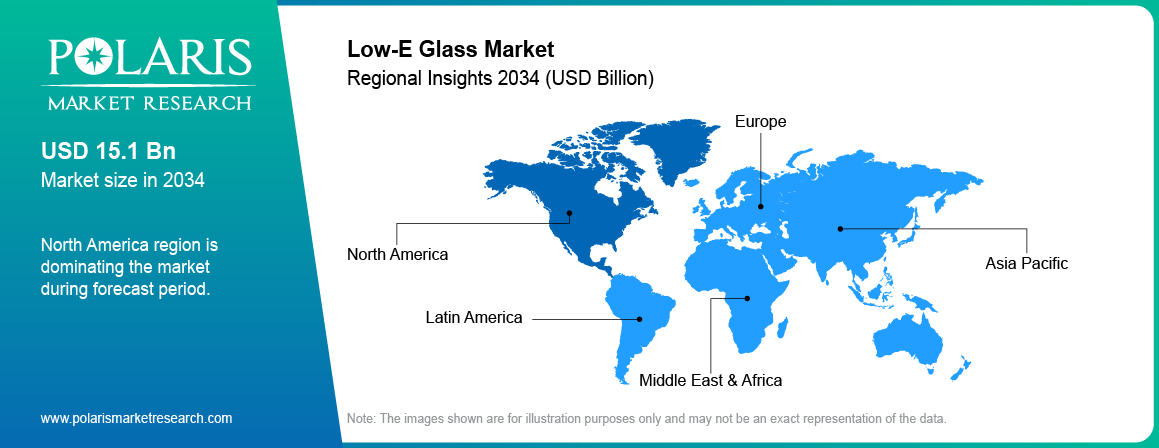
North America dominated the global Low-E glass market in 2025, accounting for approximately 36.58% of total revenue, driven by strong green building adoption, energy codes, and renovation demand.
-
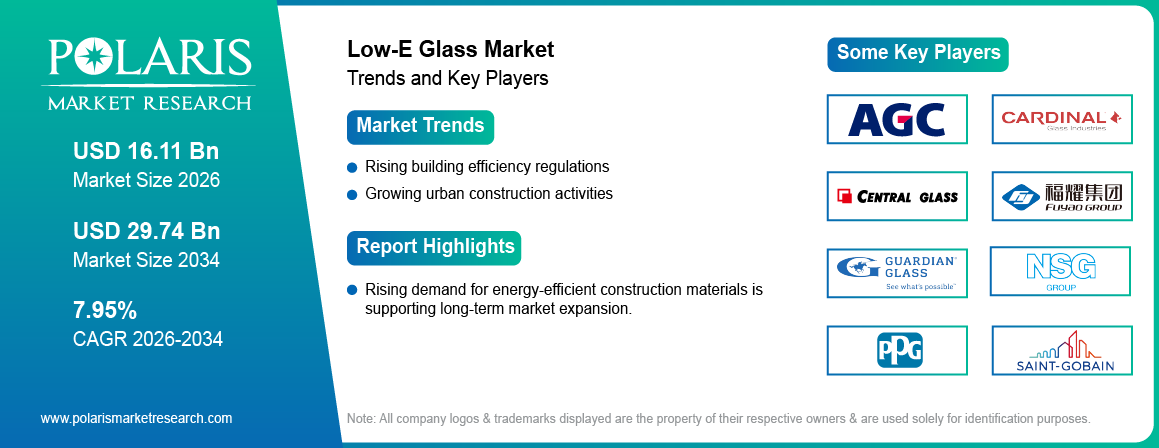
Major companies operating in the market include Saint-Gobain, AGC Inc., Guardian Glass, NSG Group, and others.
Industry Dynamics
- Rising green building regulations are increasing Low-E glass adoption globally.
- Growing commercial construction projects are supporting market demand.
- High installation and manufacturing costs remain a major challenge.
- Smart glass integration is creating new growth opportunities.
What is Low-E Glass?
Low-emissivity glass is a specialized glass product designed with thin metallic coatings that reduce infrared and ultraviolet light transmission while allowing visible light to pass through. It enhances thermal insulation and minimizes energy loss in buildings and automobiles. This product is extensively applied in residential structures, commercial buildings, and auto windshields.
The value chain starts from the suppliers of the raw material, coating technique suppliers, glass producers, processors, distributors, and users. The raw material like silica sand and metal coating materials undergo processing at the manufacturing level. The final products are delivered to the construction firms, automobile manufacturers, and infrastructural projects.
Source: Polaris Market Research Analysis
The growing need for sustainable building materials is increasing the product market worldwide. The escalating cost of energy has led to increased installation of energy-efficient windows by real estate developers. Green building initiatives by the government are driving the adoption of such products.
Drivers & Opportunities
Rising Energy Efficiency Regulations Are Increasing Product Demand: Regulations related to building efficiency are introduced in North America and Europe. The use of low-emissivity glass products is becoming increasingly popular among builders due to their ability to comply with green building specifications. The U.S. Department of Energy mandates the adherence to energy-efficient building codes in all new constructions under 10 CFR 433 and 435, including specifications requiring at least 30% reduction in energy use.
Rapid Urban Infrastructure Development Is Supporting Market Growth: There is an accelerated trend in China, India, and Southeast Asia in terms of building constructions. Commercial centers, smart cities, and residential constructions are fueling the need for glazing products with modern coatings. India Brand Equity Foundation, India’s USD 1.3 trillion Gati Shakti infrastructure plan is accelerating large-scale construction development and supporting demand for advanced building materials.Thus, developers are focusing on reducing operational energy costs. This trend is increasing Low-E glass adoption.
Restraints & Challenges
High Product Costs Are Limiting Adoption: Low-E glass is costlier than conventional glass due to its advanced coating technology and special manufacturing process. In small construction projects, expensive materials tend to be avoided in economically sensitive areas. Thus, installation charges add to the cost of the whole project.
Opportunity
Smart Glass Integration Is Creating Growth Opportunities: Low-E coatings are incorporated into smart glass technology. The rise in electrochromic glass and automated glazing systems is creating opportunity for the market. This is expected to result in higher energy efficiency and better living conditions. Innovation are expected to be seen as a means of earning income over time. For example, NxLite released L80 in July 2025, the first low-E sputter coating designed specifically for polycarbonate and acrylic, which extends the application of energy-efficient windows beyond conventional glass.
Source: Polaris Market Research Analysis
Segmental Insights
The report provides a comprehensive analysis of the low-E glass market by coating type, application, and end use to pinpoint the key revenue generating and growth segments.
By Coating Type
-
Soft-Coated Low-E Glass
The soft-coated Low-E glass segment dominated the market in 2025 due to superior insulation performance. These products provide better solar control and heat retention. Commercial buildings widely use these products for energy savings.
-
Hard-Coated Low-E Glass
The hard-coated Low-E glass segment is projected to grow at the fastest CAGR during the forecast period due to higher durability. These products perform well in harsh environments. Rising industrial applications are supporting segment growth.
By Application
-
Architectural
The architectural segment dominated the market in 2025 due to high adoption across residential and commercial construction. Green building initiatives are increasing product demand. Rising urban infrastructure investments are supporting segment growth.
-
Automotive
The automotive segment is projected to grow at the fastest CAGR during the forecast period due to rising electric vehicle production. Automakers are adopting advanced glazing systems for better cabin temperature control. This trend is increasing product demand.
By End Use
-
Commercial Buildings
The commercial buildings segment dominated the market in 2025 due to increasing construction of offices, malls, airports, and hotels. Developers are focusing on reducing long-term energy costs. This is increasing adoption. In July 2025, Better Glass Technologies launched multi-color low-E glass technology in the year 2025. The glass was energy-efficient and aesthetically designed.
-
Residential Buildings
The residential buildings segment is projected to grow at the fastest CAGR during the forecast period due to rising smart housing projects. Consumers are adopting energy-efficient materials to reduce electricity expenses.
Source: Polaris Market Research Analysis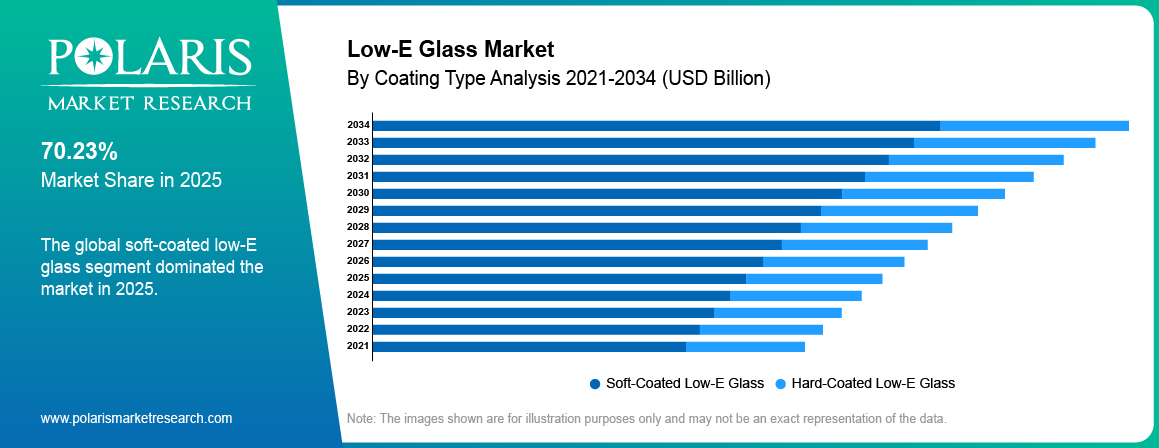
Regional Analysis
North America Low-E Glass Market Overview
North America dominated the market in 2025 due to strict energy efficiency building regulations and strong green building adoption. The US and Canada are major contributors due to high commercial construction spending. In July 2025, Scientists from Rice University have innovated a novel type of glass coating in 2025 to enhance the efficacy of low-E windows, which is contributing to energy savings.The increase in retrofits is contributing towards an increase in product demand. Energy-efficient windows' rising usage in residential structures is adding towards regional growth opportunities.
Europe Low-E Glass Market Insights
Europe represents a dominant market share owing to stringent carbon emission regulations and extensive use of sustainable building materials. In November 2025, Europe is accelerating sustainable construction through the LIFE Programme, which has funded 75 green building and renovation projects with nearly USD 325 million since 2021.Also, nations such as Germany, France, and the UK are major contributors to regional growing due to renovation projects and government initiatives focused on net-zero buildings.
Asia Pacific Low-E Glass Market Insights
Asia Pacific is projected to grow at the fastest CAGR during the forecast period due to rapid urbanization and infrastructure development. In March 2025, UNESCAP stated that Asia’s urban population is projected to grow by 50% by 2050, adding nearly 1.2 billion people.This helps to increase demand for modern construction materials such as low-E glasses in this region. Moreover, countries including China, India, Japan, and South Korea are major contributors due to rising residential construction and expanding smart city projects.
Middle East & Africa Low-E Glass Market Insights
The Middle East & Africa market is witnessing steady growth due to rising infrastructure development and increasing commercial construction activities. Saudi Arabia’s Vision 2030 aims to increase non-oil revenue from USD 43.5 billion to USD 266.6 billion.This is driving infrastructure projects that support demand for advanced construction materials, including low-E glasses. Additionally, Saudi Arabia, UAE, and South Africa are key markets for product adoption owing to government investments and growing hospitality and tourism projects.
Source: Polaris Market Research Analysis
Competitive Landscape & Key Players
The low-E glass market is moderately fragmented due to the presence of global manufacturers and regional suppliers. The main factors that influence competition involve price, innovation in product, coating effectiveness, and distribution coverage. There are efforts put by organizations towards acquisition, collaboration, and increasing production.
Some of the major companies operating in the market include AGC Inc., Cardinal Glass Industries, Central Glass Co., Ltd., Fuyao Glass Industry Group, Guardian Glass, Nippon Sheet Glass Co., Ltd., PPG Industries, Saint-Gobain, SCHOTT AG, Sisecam, Vitro Architectural Glass, Xinyi Glass Holdings Limited, and others.
Company Benchmarking Table
| Company | Strength | Strategy |
| Saint-Gobain | Global manufacturing presence | Innovation and acquisitions |
| AGC Inc. | Strong R&D capabilities | Product diversification |
| Guardian Glass | Advanced coating technology | Premium product positioning |
| NSG Group | Wide global distribution network | Cost competitiveness |
Source: Polaris Market Research Analysis
Pricing & Supply Chain Insights
- The average pricing of low-E glasses is from USD 8 to USD 15 per square foot, based on the type and efficiency of coating used.
- The primary ingredients required include silica sand, soda ash, metallic oxide coatings, and float glasses substrates.
- Increasing energy costs and rising costs of materials have been influencing manufacturing costs.
- Paints & Coating material supply chain and logistics costs have been affecting the price stability.
Premium Insights
ROI Analysis
The use of Low-E glass results in saving up to 20% to 30% of energy usage by the buildings, resulting in substantial savings in costs over time for both domestic and commercial buildings. Most major construction projects have a payback period of three to five years due to lower heating and cooling bills.
Investment Opportunities
- Increasing numbers of infrastructure projects in Asia Pacific and the Middle East
- Rising usage of smart glass technology
- Growing demand for automotive glazing products due to increased EV manufacturing
Strategic Outlook
The companies that have invested in technologies and regional collaborations are expected to gain a prominent position in the market during the forecast period.
Key Players
- AGC Inc.
- Cardinal Glass Industries
- Central Glass Co., Ltd.
- Fuyao Glass Industry Group
- Guardian Glass
- Nippon Sheet Glass Co., Ltd.
- PPG Industries
- Saint-Gobain
- SCHOTT AG
- Sisecam
- Vitro Architectural Glass
- Xinyi Glass Holdings Limited
Industry Developments
- January 2026: Vitro Architectural Glass introduced the Solarban Champane low-E glass in 2026 in order to increase energy efficiency and meet the growing requirement for sustainable buildings. [source: www.vitroglazings.com]
- April 2025: NxLite started operations at its manufacturing plant in Michigan in 2025 to increase the production of innovative low-E glass coatings for energy-efficient windows. [source: www.nxlite.com]
Low-E Glass Market Segmentation
By Coating Type Outlook (Revenue, USD Billion, 2021-2034)
- Soft-Coated Low-E Glass
- Hard-Coated Low-E Glass
By Application Outlook (Revenue, USD Billion, 2021-2034)
- Architectural
- Automotive
- Industrial
- Solar
By End Use Outlook (Revenue, USD Billion, 2021-2034)
- Commercial Buildings
- Residential Buildings
- Industrial Facilities
By Regional Outlook (Revenue, USD Billion, 2021-2034)
- North America
- US
- Canada
- Europe
- Germany
- France
- UK
- Italy
- Spain
- Netherlands
- Russia
- Rest of Europe
- Asia Pacific
- China
- Japan
- India
- Malaysia
- South Korea
- Indonesia
- Australia
- Vietnam
- Rest of Asia Pacific
- Middle East & Africa
- Saudi Arabia
- UAE
- Israel
- South Africa
- Rest of Middle East & Africa
- Latin America
- Mexico
- Brazil
- Argentina
- Rest of Latin America
Low-E Glass Market Report Scope
| Report Attributes | Details |
| Market Size in 2025 | USD 14.94 Billion |
| Market Size in 2026 | USD 16.11 Billion |
| Revenue Forecast by 2034 | USD 29.74 Billion |
| CAGR | 7.95% from 2026 to 2034 |
| Base Year | 2025 |
| Historical Data | 2021–2024 |
| Forecast Period | 2026–2034 |
| Quantitative Units | Revenue in USD Billion and CAGR from 2026 to 2034 |
| Report Coverage | Revenue Forecast, Competitive Landscape, Growth Factors, and Industry Trends |
| Segments Covered |
|
| Regional Scope |
|
| Competitive Landscape |
|
| Report Format |
|
| Customization | Report customization as per your requirements with respect to countries, regions, and segmentation. |
Source: Polaris Market Research Analysis
Low-E Glass Market FAQ's
The global market size was valued at USD 14.94 Billion in 2025 and is projected to grow to USD 29.74 Billion by 2034.
North America led the market in 2025 owing to strong regulatory backing and widespread green building practices.
Architectural applications dominated the market in 2025 due to rising demand from residential and commercial construction projects.
A few of the key players in the market are AGC Inc., Cardinal Glass Industries, Central Glass Co., Ltd., Fuyao Glass Industry Group, Guardian Glass, Nippon Sheet Glass Co., Ltd., PPG Industries, Saint-Gobain, SCHOTT AG, Sisecam, Vitro Architectural Glass, Xinyi Glass Holdings Limited, and others.
Energy efficiency regulations and rising urban construction activities are supporting market growth.
Automotive applications are projected to grow at the fastest CAGR during the forecast period due to rising EV production.
Smart glass integration and rising demand for sustainable construction materials are expected to support long-term market growth.
Download Sample Report of Low-E Glass Market
Please fill out the form to request a customized copy of the research report.


