
ModelOps Market Size, Share, Trends & Forecast, 2026–2034
REPORT DETAILS
ModelOps Market Summary
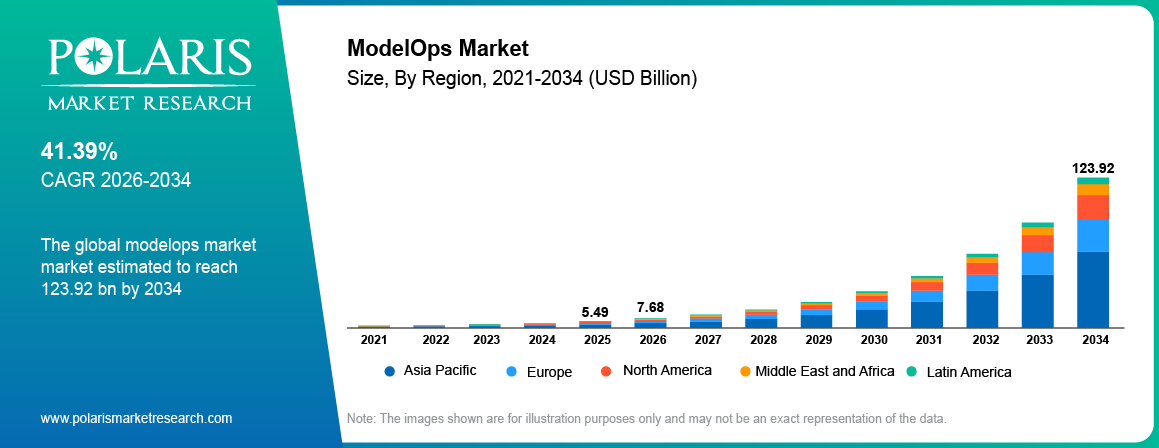
The global ModelOps market size was valued at USD 5.49 billion in 2025. The market is projected to grow at a CAGR of 41.39% from 2026 to 2034. The rising adoption of artificial intelligence (AI) and machine learning (ML) across industries has increased the demand for ModelOps. Increasing AI governance and compliance requirements are also shaping the market landscape.
Market Statistics
Key Takeaways
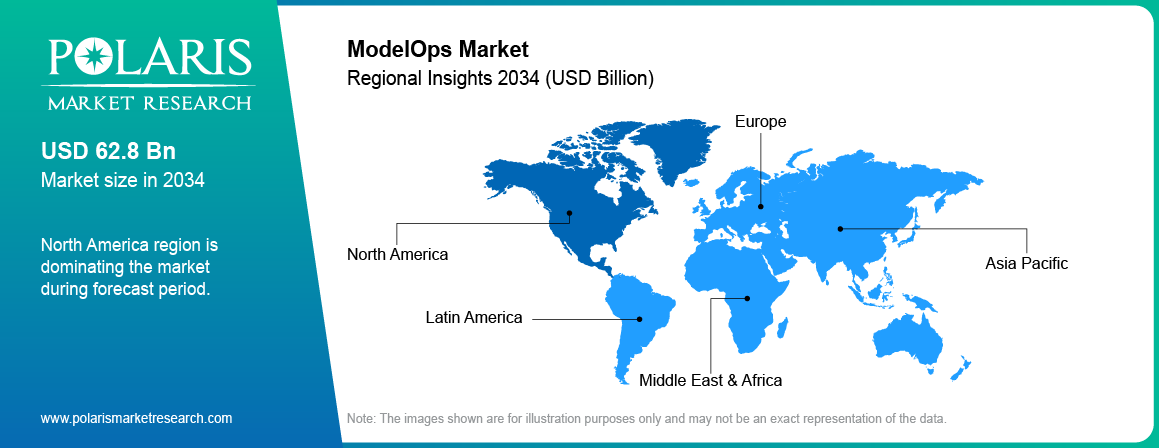
- North America led the global ModelOps market with a 37.83% share in 2025. The presence of several established and emerging ModelOps companies drives the region’s leading market position.
- Asia Pacific is projected to account for the highest CAGR of 45.37%. This is due to the region witnessing increased adoption of AI and ML.
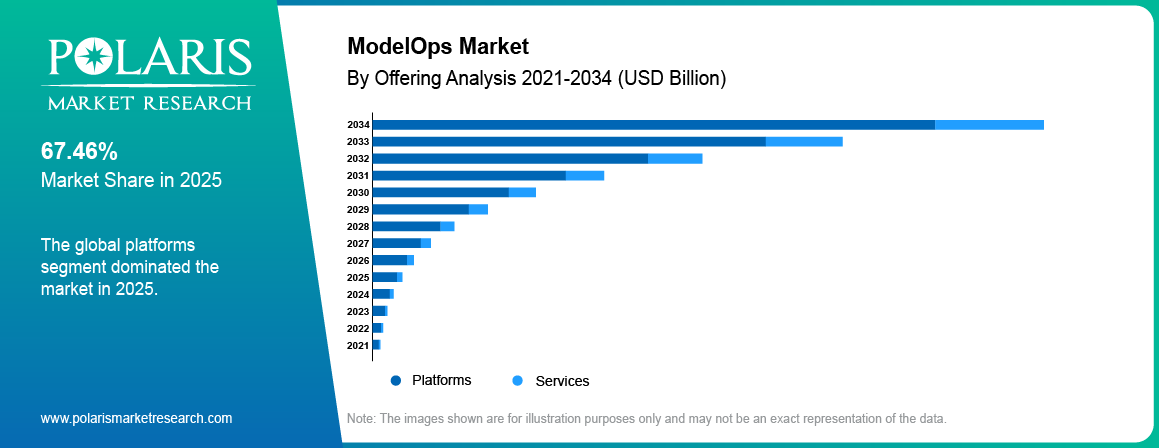
- By offering, the platforms segment held the largest market share of 67.46% in 2025. Increased model complexity has created the need for robust ModelOps platforms.
- By deployment mode, the on-premises segment is projected to grow at an 43.28% CAGR. On-premises deployment give organizations more control over the platform.
- By application, the continuous integration/continuous deployment (CI/CD) segment led with an 28.63% share in 2025. This is due to the increased adoption of CI/CD practices by organizations to enhance operational efficiency.
Note: Figures and projections outlined in this report are the result of Polaris Market Research’s proprietary analytical processes, grounded in the latest available datasets and market observations.
What Is ModelOps?
Model operations refer to the processes for handling AI models post-development. AI model lifecycle management ensures there is an effective way of managing models throughout their operational life cycle. ModelOps helps businesses maintain the reliability of the models after deployment. It also facilitates oversight as models are used in production.
How Does ModelOps Work?
Model Operations Planning: Model operations define the steps needed to take the models from development into actual business practice.
Model Validation: Model validation is performed against their performance criteria prior to taking them into production.
Production Deployment: Models are released in the appropriate business or technical context.
Performance Monitoring: Performance of the models is monitored as they are actually used. This allows detection of any changes in their performance.
Lifecycle Management: AI model lifecycle management is applied when the models need to be retrained or replaced.
Governance and Retirement: Model documentation and control are kept for the duration of their operation. The models can then be retired when they no longer meet operational requirements.
ModelOps Market Dynamics
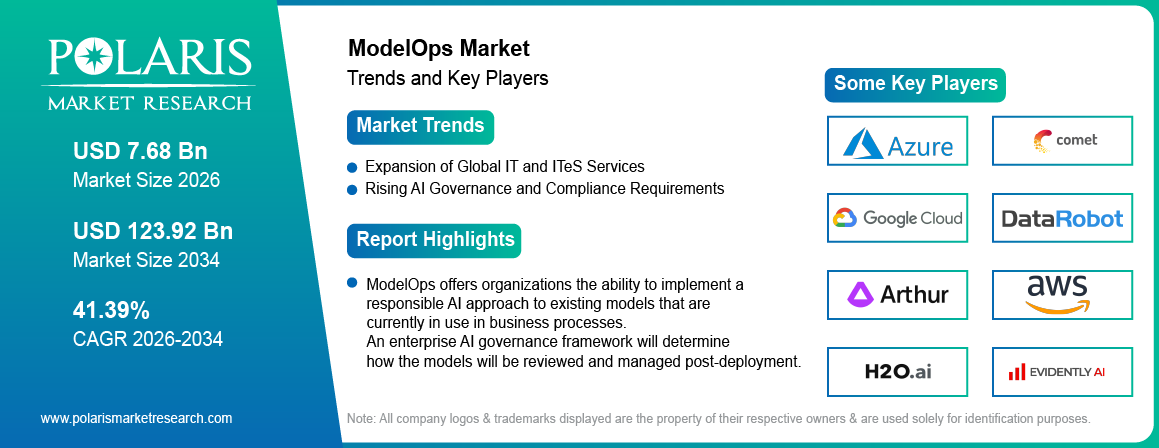
Market Drivers : Expansion of Global IT and ITeS Services
The rise of global IT and ITeS services has led to the adoption of AI applications in enterprise settings. IT and ITeS service providers are assisting enterprises in deploying the developed AI applications into the production stage. This raises the importance of adopting structured model management processes in the post-deployment stage. The scale of such services also leads to the deployment of more AI applications within enterprises. In March 2026, TCS introduced its Rapid Outcome AI platform with NVIDIA to assist enterprises in accelerating AI deployment in different sectors. The platform supports the deployment of AI applications in operational settings and utilizes NVIDIA AI infrastructure for scaling (source: tcs.com). Such adoption of AI applications in the enterprise setting raises the operational workload associated with deployed models. Therefore, enterprises require ModelOps processes for effective model management.
Market Drivers : Rising AI Governance and Compliance Requirements
AI use across various industries is making it imperative for organizations to have better governance over their deployed models. An enterprise AI governance framework can offer a systematic way of dealing with these requirements. There are also regulatory mandates, which are stressing the importance of accountability, documentation, risk assessment, and monitoring. This makes model governance an integral aspect of the lifecycle of AI models. There is a need for processes that will help ensure transparency over the performance of models and regular checks for compliance. The requirement becomes more complicated as businesses deploy increasing numbers of models within various corporate settings. In April 2026, the Ministry of Electronics and Information Technology of India formed the AI Governance and Economic Group to oversee national policy implementation related to AI governance (source: pib.gov.in). These developments indicate a shift towards a focus on the operationalization of AI governance, which can boost the ModelOps market demand.
Market Trends : Growing Adoption of AutoML Platforms
AutoML systems are changing the approach organizations adopt when developing and deploying models. AutoML systems automate certain aspects of model building, thus enabling users to carry out operations with minimal human effort. The usage of these platforms is also shifting from just specialist data science teams to business units as well. This shift has made it possible to use AutoML systems to fulfill particular analysis and prediction requirements. This increased accessibility results in more models being brought into enterprise settings. With an increasing number of models, companies must have proper procedures to manage these models after their development. The concept of ModelOps could offer this operational framework to accommodate models generated by various AutoML pipelines. It also helps in maintaining visibility as models move from the development phase to production. Thus, the increasing usage of AutoML is driving the demand for ModelOps platforms.
Market Trends : Generative AI & LLM Operations Reshaping ModelOps
The evolution of generative AI has transformed the operational requirements for AI models. There may be frequent changes to large language models (LLMs) based on different kinds of data, prompts, and new versions of models. In addition, the output needs to be monitored to detect problems with performance and behavior. These requirements have made LLMOps more popular, where the operations management of LLM-based applications is involved. The ModelOps tools are improving to support such modern workloads along with traditional ML models. Generative AI governance is yet another factor that comes into play as firms adopt these technologies within their customer-facing and internal applications. For generative AI governance, companies need to ensure control over how models are used, managed, and monitored. With the adoption of generative AI into the firm’s workflow, ModelOps solutions are broadening beyond traditional ML lifecycle management.
Market Opportunities : Expanding ModelOps for Edge and Distributed AI
Increased adoption of AI beyond cloud-based infrastructures presents opportunities for ModelOps companies. Companies are deploying their models closer to devices, machines, and other data sources. The environment may not have the same computing and networking infrastructure as in the traditional data center. ModelOps tools can be adapted to work across these distributed settings. They can even provide visibility into all the models that are running at different locations. ModelOps providers can cater to the requirement for model versioning in diverse hardware environments. Edge computing in manufacturing, retail, transportation, and telecommunications provides application potential. As AI moves closer to operational environments, vendors can design their products for the distributed model ecosystem.
Market Opportunities : Integration With Enterprise Data and Analytics Platforms
Integration with preexisting enterprise applications could be another possibility for ModelOps vendors. Enterprises might already have data platforms, business intelligence applications, and analytics solutions they use to run daily operations. Integrating ModelOps functionality with such systems can help decrease the number of workflow processes teams must run. Additionally, integration provides teams with a unified workspace for all modeling-related tasks. Vendors can create connectors to widely used data warehousing solutions, analytics applications, and even development platforms. In turn, integration is highly important for enterprises that operate their models on multiple tech stacks. At the same time, integration makes it possible for ModelOps vendors to integrate into existing enterprise infrastructures without requiring a completely different technology infrastructure.
Market Restraints and Challenges : Shortage of Skilled Professionals for ModelOps Management
Finding experts with ModelOps skills can be difficult. This poses a challenge for firms looking to implement such platforms. The field involves understanding MLOps, data workflows, cloud systems, and model governance. It is challenging to find professionals who can operate across all these competencies. The current data science groups may also not be well-versed in operationalizing models. Training is often necessary before the team is ready to handle ModelOps processes. More time may be required in the process of establishing the skills. Small organizations may struggle as they often lack technical teams.
ModelOps vs. MLOps
MLOps and ModelOps are related but not identical. This is because MLOps is more specific about supporting activities related to the productionization of machine learning models, while ModelOps is broader and addresses more types of models with a focus on using them inside an organization. This distinction becomes more practical when there are multiple models maintained by different teams inside a company. The differences are summarized in the table below.
| Feature | ModelOps | MLOps |
| Scope | All decision models (ML, rules, graphs, agents, linguistic) | Primarily machine learning models |
| Governance depth | Extensive — built for enterprise risk/compliance | Moderate — engineering-centric |
| Compliance focus | High | Medium |
| Primary buyer | Risk, compliance, and platform teams | Data science and ML engineering teams |
| Enterprise adoption pattern | Broad, cross-functional | ML-centric, team-level |
Source: Polaris Market Research Analysis
ModelOps Market Segmentation
The ModelOps market is primarily segmented on the basis of offering, deployment mode, model type, application, vertical, and region:
| Category | Segments |
| Offering | Platforms · Services |
| Deployment Mode | Cloud · On-Premises |
| Model Type | ML Models · Graph-Based Models · Rule & Heuristic Models · Linguistic Models · Agent-Based Models · Bring Your Own Models |
| Application | Batch Scoring · Continuous Integration/Continuous Deployment (CI/CD) · Dashboard & Reporting · Governance, Risk, and Compliance · Model Lifecycle Management · Monitoring & Alerting · Parallelization & Distributed Computing |
| Vertical | BFSI · Energy & Utilities · Government & Defense · Healthcare & Life Sciences · IT/ITeS · Manufacturing · Retail & eCommerce · Telecommunications · Transportation & Logistics |
| Region | North America (US, Canada) · Europe (Germany, France, UK, Italy, Spain, Netherlands, Russia, Rest of Europe) · Asia Pacific (China, Japan, India, Malaysia, South Korea, Indonesia, Australia, Rest of Asia Pacific) · Middle East & Africa (Saudi Arabia, UAE, Israel, South Africa, Rest of Middle East & Africa) · Latin America (Mexico, Brazil, Argentina, Rest of Latin America) |
Source: Polaris Market Research Analysis
By Offering
The platforms segment led with 7.46% share in 2025. Organizations are moving towards ModelOps platforms as the use of models increases within various business functions. They enable organizations to have an integrated platform where models are managed, as opposed to having separate systems to manage models. The platform can help in tracking models that are created, deployed, or modified. This is because organizations with multiple teams may have different process flows. The platforms can help improve coordination between the data science teams, IT, and the business teams. They can also assist in having proper documentation of the model versioning and operational changes. As organizations expand their use of artificial intelligence and machine learning, the need for a more consistent approach continues to increase. These factors are supporting the implementation of ModelOps platforms in different enterprise applications.
The services segment is projected to grow at an 43.16% CAGR. Organizations often require external assistance in implementing ModelOps procedures across their current AI setups. The external service provider can help implement the ModelOps process based on the organizational model portfolio and operational requirements. External assistance can also extend to configuring the workflow and integrating the platform, as well as managing models. The demand is especially relevant for organizations without any ModelOps team in place. The use of external services saves time during the implementation process as well as cuts down the internal effort in developing the capability in-house. It can also allow organizations to leverage expert help in consulting and managed services as their model operations get more complex.
By Deployment Mode
The cloud segment led the ModelOps market with an 61.72% share in 2025. With cloud-based deployment, companies get access to ModelOps services without having to maintain the complete infrastructure by themselves. Moreover, cloud solutions can be easily integrated into current workflows, which is characteristic of modern enterprises, especially when developing and implementing artificial intelligence applications. Using cloud-based infrastructure, teams can manage their models in different locations and departments. It is possible to implement flexible allocation of resources based on the fluctuating workloads of models. At the same time, it also makes ModelOps tools easier to expand. Another important factor is the ability to use ModelOps services from leading cloud providers and software vendors. Thus, companies have more opportunities to choose a deployment environment that fits their technology stack. Flexible infrastructure and wide use of cloud-based solutions contribute to the segment’s leading market position.
The on-premises segment is projected to register at 43.28% CAGR. Some organizations continue to deploy ModelOps solutions in-house within their internal IT systems. The need for such solution deployment becomes important for firms that have adopted a policy on the management of enterprise software and data. In-house deployment can help organizations gain more control over the configuration and access to the system. For organizations with regular demand patterns and a need for stable operations, this solution can be a good fit. Demand may also come from firms that prefer to control software updates and system management. Firms with large technology departments are likely to continue managing in-house ModelOps infrastructure for certain applications. The demand for such solutions is expected to grow steadily during the forecast period.
By Model Type
The ML models segment dominated the ModelOps market with an 36.84% share in 2025. Machine learning continues to be applied broadly in enterprise settings. This creates a significant number of models that must be maintained. These models are being utilized for such purposes as forecasting, classification, recommendation, and analysis. Moreover, using them over a long period of time necessitates having solutions that would allow teams to maintain models already implemented. The performance of some models might also need to be reviewed regularly. Organizations with large model portfolios may need consistent management of such models. The utilization of machine learning solutions in enterprise settings additionally fuels the need for ModelOps solutions. As companies grow their ML implementations, the demand to manage their models after the development phase is rising as well.
The graph-based models segment is projected to grow at an 44.61% CAGR. Graph models are utilized for modeling relations between interconnected entities in a data set. This is applicable in scenarios where relations between customers, transactions, products, or any other entity should be analyzed. Graph models can be utilized by banks to analyze relations between transactions and find any unusual patterns. They can be used by retailers to model relations between their customers and products. The same methodology can be adopted to build recommendation and network analysis applications. As the applications of graph models increase, organizations need an operational approach for models dealing with evolving relationships and networks. The ModelOps platform is instrumental for managing the models post-deployment. Increasing interest in relation-based analytics is thus driving the growth of the graph-based models segment.
By Application
The continuous integration/continuous deployment (CI/CD) segment led with an 28.63% market share in 2025. CI/CD practices can be used to manage the flow of changes through a structured development and release cycle process for AI models. It allows teams to test model changes prior to making the changes available for use by the business. It is beneficial where models are continuously being updated, or multiple development teams are working on an AI environment. Automated testing can also identify problems prior to releasing a new version of the model. Version control tracks the changes made to the models during development. These features can make CI/CD beneficial for organizations looking for more consistent model release processes. The use of ModelOps platforms can facilitate these processes by giving organizations control over model releases. The established use of CI/CD processes in software and AI development environments supports the segment’s leading position in the ModelOps market.
The governance, risk, and compliance segment is projected to grow at 45.16% CAGR. ModelOps platforms use these capabilities to bring governance closer to everyday model operations. These platforms enable organizations to design approval workflows prior to launching a model in production. Rules for different types of models can also be specified, while riskier models can be sent for further assessment. Policy checks can be implemented at certain points in the lifecycle of models instead of being performed separately by teams. The segment may also be useful for managing exceptions when a model does not fulfill a certain requirement. This allows organizations to develop a unified approach to dealing with models. This segment is also relevant for organizations that need governance controls to operate along with their existing model management tools. With the growing number of governance functionalities implemented by ModelOps platforms, there will be an increasing demand for GRC capabilities.
By Vertical
The BFSI segment accounted for the largest market share of 24.68% in 2025. AI models are used in a variety of operations within financial institutions. These models support areas such as credit scoring, fraud detection, and financial forecasting. Financial institutions work with vast amounts of data, which leads to a diverse set of models that are applied in various areas of their operations. Banks and financial service providers usually have several teams working with models for different business requirements. This makes a more uniform approach to monitoring model usage and performance vital for organizations in the industry. ModelOps helps financial institutions maintain such an environment without creating independent processes for each individual team. The high adoption rate of AI-powered applications in banking and financial services continues to strengthen the sector’s demand for model risk management software and ModelOps solutions.
The healthcare & life sciences segment is projected to grow at an 44.73% CAGR. Healthcare organizations have been leveraging AI models for clinical and operational processes. The use cases may include medical imaging, patient risk scoring, drug discovery, and treatment exploration. Life sciences firms leverage models in complex dataset analysis during the research and development process. The increase in the number of AI use cases is leading to an increasing number of models used in various healthcare applications. ModelOps can enable healthcare organizations to effectively manage these models when integrated into their various workflows. It can also offer a systematic way to work with models for teams in research and clinical roles. Healthcare organizations may need more control over the changes made to models since the results of the models can influence important decision-making. This has made the importance of model management relevant in both the healthcare and life sciences domains.
ModelOps Use Cases by Industry
ModelOps has varied use cases depending on the industry vertical. The use case varies from one industry vertical to another depending on the specific needs of the industry.
| Industry | Use Cases |
| BFSI | Model Management for Credit Models: ModelOps can be applied by banks for credit model management. |
| Energy & Utilities | Demand Forecasting: Utilities can apply ModelOps for electricity demand models. |
| Government & Defense | Mission Analytics: Defense organizations can apply ModelOps to mission analytics models. |
| Healthcare & Life Sciences | Clinical Research: Researchers can use ModelOps to manage models used in their clinical researches. |
| IT/ITeS | AI projects for Clients: IT service providers can apply ModelOps for all client-specific AI projects. |
| Manufacturing | Quality Control: Manufacturing organizations can apply ModelOps for models used in product inspection. |
| Retail & eCommerce | Customer Recommendations: Retailers can apply ModelOps for customer recommendations on digital platforms. |
| Telecommunications | Network Planning: Telecommunication organizations can apply ModelOps for network planning models. |
| Transportation & Logistics | Demand Planning: Logistics organizations can apply ModelOps for shipping demand forecasting models. |
Source: Polaris Market Research Analysis
Regional Insights
North America
North America led the ModelOps market with 37.83% share in 2025. Many companies in the region leverage AI and machine learning across various business processes. Companies are also adopting platforms that will enable them to manage the models used by various departments. The availability of well-known technology firms in the region has enabled the adoption of ModelOps solutions in the region. Firms in the finance, healthcare, retail, and technology sectors are leveraging AI technology in business processes. This has led to a rising requirement for model management within corporate settings. The U.S. holds a significant share of regional demand because it has a robust technology base and a significant number of AI firms. Canada is also increasing the deployment of AI in both corporate and governmental activities. This has enabled North America to retain its leading position in the ModelOps market.
Asia Pacific
The Asia Pacific ModelOps market is projected to account for 45.37% CAGR during forecast period. Enterprises within the region are increasingly adopting AI in business analytics and digital services. China, Japan, India, South Korea, and Australia are countries within the region that have thriving technology ecosystems for the development and implementation of AI. Furthermore, the presence of a large number of technology service providers that cater to different industries in enterprises has created an increasingly complex ecosystem for managing AI models. Models are being used by financial services firms for customer analytics and risk management purposes. Manufacturing firms are using AI for production and quality management purposes. Likewise, other sectors such as healthcare and telecoms are using AI models for operational requirements. All these varied applications of models are leading to a variety of model environments. The increasing adoption of AI across the region is expected to fuel demand for ModelOps, which already has strong growth potential.
Europe
Europe accounted for an 26.47% ModelOps market share in 2025. AI is increasingly being utilized by organizations in industries like finance, manufacturing, healthcare, and public sector management in the region. Organizations in Europe are paying more attention to the integration of AI models into the processes of their businesses. There has been an increased interest in tools that can help provide structure to the processes of implementing the models in various parts of the business process. Countries like Germany, the UK, France, and the Netherlands have established technology ecosystems that enable the implementation of AI. The ModelOps platforms can aid such enterprises in managing the increasing number of models being used by them in their operations. Large organizations also need consistent model processes, which have contributed to Europe’s strong position in the ModelOps market.
Latin America
The Latin America ModelOps market is projected to grow at an 40.74% CAGR. Many organizations in the region have begun using AI for financial services, customer analysis, retail, and automation purposes. Areas like credit analysis and fraud detection are where AI is being used by financial firms. The use of models in understanding consumer behavior and forecasting is also done by retail and eCommerce firms. Since AI has become an integral part of doing business, the need for management of models in various applications becomes essential. Brazil and Mexico are countries that offer strong opportunities for the growth of the ModelOps market due to their strong business environments and the increasing adoption of digital technology.
Middle East & Africa
The Middle East & Africa ModelOps market is projected to grow at an 39.83% CAGR. Organizations across this region have been increasing the use of AI in banking, telecommunications, governmental services, and energy sector operations. The growth of digital transformation projects will also generate more use cases for predictive and analytical models. Enterprises are building their capabilities for AI usage in business processes where manual analytics were used before. This creates the necessity for structured model management. Countries such as Saudi Arabia and the UAE also invest in national AI projects and the development of their digital infrastructure. This makes the environment in these countries more favorable for enterprise AI adoption. South Africa is another country developing capabilities to use AI in financial services and other technology-dependent industries.
Enterprise AI Governance & Compliance
ModelOps offers organizations the ability to implement a responsible AI approach to existing models that are currently in use in business processes. An enterprise AI governance framework will determine how the models will be reviewed and managed post-deployment. One such framework that organizations can utilize for the purpose of AI risk management is the NIST AI Risk Management Framework. Additionally, another regulatory guidance that can be taken into consideration by organizations operating in the EU region is the EU AI Act.
Explainable AI also relevant when business teams require the ability to explain the outputs of the model. In such cases, the ModelOps approach ensures that the information remains tied to the particular model and the corresponding operational process.
Furthermore, ModelOps can help in the implementation of AI compliance management in regard to models created by multiple teams. The adoption of an appropriate process can eliminate the need for the individual management of AI projects. In relation to financial institutions, there are already guidelines like SR 11-7 that have been adopted in model risk management. These guidelines include the development, validation, governance, and controls of models in banks. ModelOps can incorporate such guidelines into the model lifecycle.
Also, the connection with AI security operations is pertinent when dealing with models that work within a security environment. Collectively, these functions provide an organization with a structured way of managing AI models post-deployment.
Key Market Players & Competitive Insights
The ModelOps market consists of large technology players and niche companies. There is a shift towards vendors developing ModelOps platforms, which allow managing models’ lifecycles within the AI environments of enterprises. These solutions vary in the aspects of deployment, model monitoring, governance, and compatibility with the enterprise’s current technological stack.
Large technology players are using their cloud and AI platforms for the delivery of ModelOps capabilities as part of wider enterprise platforms. Niche companies are concentrating on the governance, workflow, and portfolio management of models. Partnerships combine ModelOps platforms with cloud infrastructure or AI development technologies. Competition is defined by the ability to work with different types of models and compatibility with the enterprise environment.
Vendor Positioning
| Vendor | Primary Focus | Notable For |
| AI observability and governance | Monitoring and evaluation of models and AI agents, with policy-based evaluation and governance workflows. | |
| AWS | Cloud-based machine learning operations | SageMaker governance, model documentation, centralized model dashboards, and production monitoring. |
| Comet ML | ML experiment management and production monitoring | Model Production Monitoring for tracking production performance, data drift, custom metrics, and alerts. |
| DataRobot | Enterprise AI platform and governance | AI governance, deployment controls, lineage, compliance documentation, and production observability. |
| Evidently AI | AI evaluation and observability | Open-source evaluation and monitoring for data quality, data drift, model quality, and LLM applications. |
| Google Cloud | Cloud AI and machine learning platform | Vertex AI capabilities for model development, deployment, monitoring, and lifecycle management. |
| Automated machine learning and MLOps | H2O MLOps for production deployment and model monitoring and observability, including model drift detection and alerts. | |
| Microsoft Azure | Enterprise AI and machine learning | Azure Machine Learning model monitoring, lineage tracking, and Responsible AI capabilities. |
| ModelOp | Enterprise-wide ModelOps and AI governance | Centralized AI system of record, lifecycle management, governance, and portfolio visibility across ML, GenAI, and agentic AI. |
| Oracle | Enterprise AI and cloud infrastructure | AI and machine learning capabilities integrated with Oracle Cloud Infrastructure and enterprise data environments. |
| Teradata | Enterprise analytics and ModelOps | Teradata AI Studio ModelOps for planning, deploying, managing, and operating models across their lifecycle. |
| Weights & Biases | ML experiment and development management | Experiment tracking, model management, and tools connecting model development with production workflows. |
Source: Polaris Market Research Analysis
ModelOps Industry Developments
- September 2026: ModelOp partnered with Carahsoft to make its AI Delivery and Governance Platform available to public-sector organizations through government contract vehicles. The offering covers AI delivery, lifecycle management, governance, and operational intelligence. (source: modelop.com)
- August 2026: H2O.ai released version 1.2.0 of H2O MLOps. The update included fixes for deployment handling and the Python client. Earlier August releases added self-hosted LLM serving, external deployments, deployment scheduling, and scale-to-zero. (source: h2o.ai)
- July 2026: DataRobot expanded its AI governance offering beyond public cloud environments. The company added support for on-premises, edge, air-gapped, and sovereign environments. (source: datarobot.com)
Research Methodology
This ModelOps market report estimates draw on a blended primary and secondary research design. Secondary research canvasses company annual reports, investor presentations, press releases, technology and analyst publications, and government and industry-body data sources to map the ModelOps vendor landscape, its offerings, deployment modes, and regional footprint. This stage establishes the market's structural boundaries (segment definitions, vendor universe, and historical revenue trends) before quantitative modeling begins.
Primary research follows. It comprises structured interviews with supply-side stakeholders (platform vendors, system integrators, and professional-services firms) and demand-side stakeholders (enterprise CIOs, CTOs, and data-science leaders). They are used to validate adoption drivers, pricing behavior, and forecast assumptions. Market sizing is triangulated using both top-down (aggregating vendor revenue across the identified universe) and bottom-up (enterprise adoption rate x average spend, by region and vertical) approaches, with the two cross-checked for consistency. Base-year figures and the forecast CAGR are re-verified at each refresh cycle against newly published financial disclosures and primary interview data.
ModelOps Report Scope
| Report Attributes | Details |
| Market Size Value in 2025 | USD 5.49 billion |
| Market Size Value in 2026 | USD 7.68 billion |
| ModelOps Market Forecast 2034 | USD 123.92 billion |
| CAGR | 41.39% from 2026 to 2034 |
| Base Year | 2025 |
| Historical Data | 2021–2024 |
| Forecast Period | 2026–2034 |
| Quantitative Units | Revenue in USD billion and CAGR from 2026 to 2034 |
| Report Coverage | Revenue Forecast, Market Competitive Landscape, Growth Factors, and Industry Trends |
| Segments Covered |
|
| Regional Scope |
|
| Competitive Landscape |
|
| Report Format |
|
| Customization | Report customization as per your requirements with respect to countries, regions, and segmentation. |
Source: Polaris Market Research Analysis
ModelOps Market FAQ's
The ModelOps market size was valued at USD 5.49 billion in 2025. The market is projected to reach USD 123.92 billion by 2034.
The market is projected to account for an 41.39% CAGR from 2026 to 2034.
North America accounted for the largest market share of 37.83% in 2025. This is owing to the presence of several established and emerging ModelOps companies in the region.
The on-premises segment is projected to grow at 43.28% CAGR. This is because on-premises solutions enable more control over the platform.
A few of the key players include Arthur AI; AWS; Comet ML; DataRobot; Evidently AI; Google Cloud; H2O.ai; Microsoft Azure; ModelOp; Oracle; Teradata; Weights & Biases.
ModelOps facilitates the management of models created by the organization. This method ensures that models are managed systematically.
ModelOps becomes useful when an organization has many models in production. It helps teams maintain these models through a common process.
ModelOps can manage various types of models that might be used by an organization. These include machine learning models, graph models, Linguistic models, rule-based models and bring your own models.
ModelOps has a broader scope than MLOps. MLOps mainly focuses on the development and operation of machine learning models. ModelOps covers a wider range of models used across an organization.
ModelOps is used across areas such as credit model management in BFSI, demand forecasting in energy, and quality control in manufacturing. It can also support clinical research in healthcare and network planning in telecommunications.

Download Sample Report of ModelOps Market
Please fill out the form to request a customized copy of the research report.


