
Organic Acid Market Size, & Growth Analysis Report, 2026-2034
REPORT DETAILS
Organic Acid Market Summary
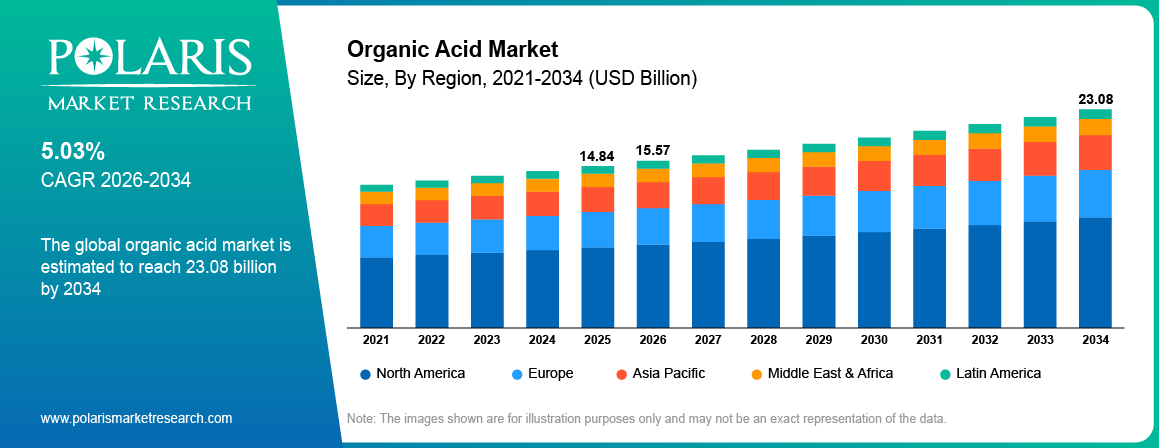
The global organic acid market is estimated around USD 14.84 Billion in 2025,with consistent growth anticipated during 2026–2034. This growth is driven by rising demand for food preservation ingredients and increasing usage of organic acids across animal feed and industrial applications. The market is projected to grow at a CAGR of 5.03% during the forecast period.
Market Statistics
Key Takeaways
- Citric acid segment dominated in 2025 due to high usage in food preservation and beverages.
- Food and beverage segment dominated in 2025 due to rising demand for preservatives and acidity regulators.
- Animal feed segment is anticipated to witness rapid growth due to increasing demand for livestock nutrition additives.
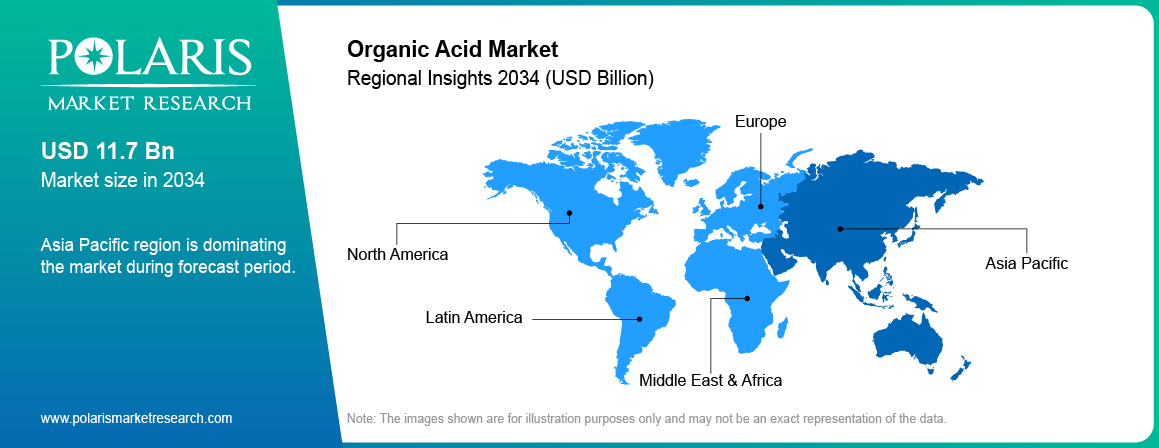
- Asia Pacific dominated the market due to large-scale food processing activities and growing chemical production capacity.
- Major companies operating in the market include BASF SE, Cargill Incorporated, Archer Daniels Midland Company, Jungbunzlauer, Corbion N.V., and others.
Industry Dynamics
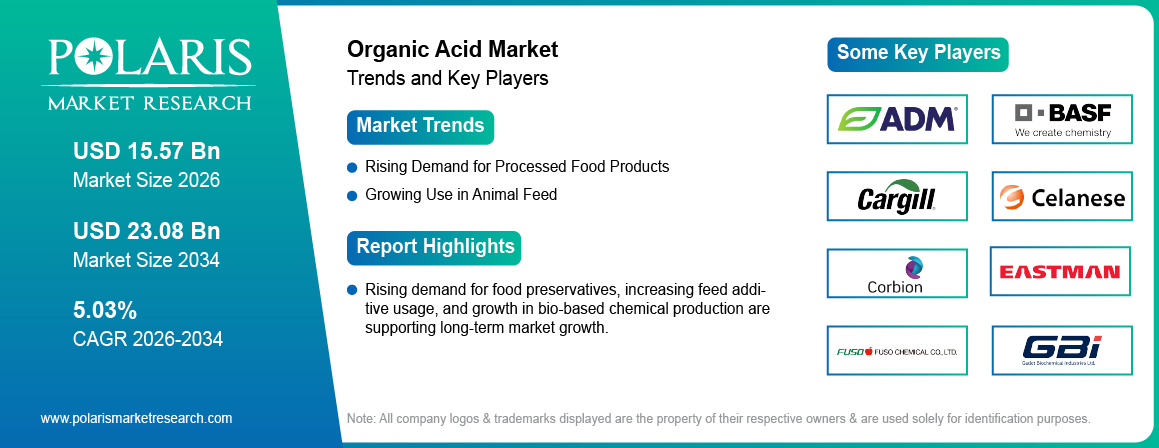
- Rising demand for processed food products is increasing demand for organic acids.
- Growing usage in animal feed additives is supporting market expansion.
- Fluctuation in raw material prices creates challenges for manufacturers.
- Bio-based production technologies are creating new growth opportunities.
Market Statistics
- 2025 Market Size: USD 14.84 Billion
- 2034 Projected Market Size: USD 23.08 Billion
- CAGR (2026-2034): 5.03%
- Asia Pacific: Largest market in 2025
What is Organic Acid?
Organic acids are carbon-based acids widely used across food processing, pharmaceuticals, feed additives, industrial chemicals, and personal care applications. These acids function as preservatives, acidulants, pH regulators, antimicrobial additives, and chemical intermediates across multiple industries. Among the commonly used organic compounds are citric acid, acetic acid, lactic acid, and propionic acid since they have multiple applications.
The supply chain for organic acids comprises suppliers of raw materials, fermenters, chemical manufacturers, distributors, food producers, pharmaceutical firms, and ultimate users. The raw materials utilized for the production via fermentation include corn, sugar, molasses, and starch. Growing consumer preference for organic labels in the food industry and sustainable chemical manufacturing processes is fueling market growth.
Source: Polaris Market Research Analysis
The market is witnessing growth due to increasing usage of organic acids in packaged foods, animal feed, manufacturing applications, drugs, and personal care products. Rising consumption trends of preserving product shelf-life and stability continue to drive the adoption rate in various industries around the globe.
Drivers & Opportunities
Rising Demand for Processed Food Products Is Increasing Demand for Organic Acids: There has been an increase in consumption of beverages, baked products, milk products, sweets, and precooked meals, which has created a higher demand for preservatives and acidity regulators. As per the statistics of the U.S. CDC, ultra-processed food constitutes about 61.9% of calorie intake for children and 53% for adults.This explains the need for organic acids that are consumed in food items.
Growing Use in Animal Feed Is Supporting Market Growth: Organic acids are gradually gaining popularity in feeds for poultry, swine, cattle, and aquatic animals to increase their efficiency in digestion and prevent contamination by bacterial pathogens. As per data by the International Feed Industry Federation, the yearly output of feeds from all around the world exceeds 1 billion metric tons.Hence, there is a significant demand for organic acid feed additives.
Restraints & Challenges
Fluctuation in Raw Material Prices Is Limiting Market Growth: Organic acids are produced using agricultural crops like sugar, corn, molasses, wheat, and starch. Price instability in the agricultural market is expected to increase the cost of production and affect the margin for companies competing in price-sensitive markets. Fluctuations in supply chains and agricultural output pose problems in sourcing for manufacturing companies. This is especially the case for smaller manufacturers.
Opportunity
Rising Adoption of Bio-Based Production Technologies Is Creating Growth Opportunities: Manufacturers are adopting fermentation-based production technology as it helps to lessen their dependence on petrochemicals for production purposes. Bio-based production technology enables the organizations to achieve higher levels of sustainability and cut down their carbon footprint through sustainable manufacturing processes. The EU-funded CORDIS VIVALDI program announced to turn industrial CO₂ into organic acids at a reduced cost of carbon capture by 25% in November 2025.
Source: Polaris Market Research Analysis
Segmental Insights
The report provides a comprehensive analysis of the organic acid market by type and application to pinpoint the key revenue generating and growth segments.
By Type
-
Citric Acid
The citric acid segment dominated the market in 2025 due to strong demand from food processing, beverages, pharmaceuticals, and personal care applications. Citric acid is often utilized as a preservative, pH regulator, and flavoring agent in various processed foods. High production numbers in China along with increased global consumption of packaged beverages are expected to fuel the growth of the segment.
-
Propionic Acid
The propionic acid segment is expected to witness the highest CAGR growth during the forecast period due to increasing demand for application in animal feed preservative and grains storage uses. Propionic acid is commonly used to avoid the growth of molds in feeds for increased shelf life. Increasing usage of feed additives and increased livestock production worldwide is driving the segment’s growth.
By Application
-
Food and Beverage
The food & beverages segment held the leading market share in 2025 owing to growing demand for preservatives, acidulants, and shelf-life extender ingredients in processed foods. Organic acids are used in beverages, dairy products, bakery products, confectionery products, and packaged food products. Rising global demand for convenience foods continues to support segment growth.
-
Animal Feed
The animal feed segment is projected to grow at the fastest CAGR during the forecast period due to rising demand for feed preservatives and livestock nutrition additives. Organic acids are able to be effective in improving the digestive process, reducing bacterial infection, and increasing the rate of conversion of feed into useful materials. Rising commercial livestock production and restrictions on antibiotic feed additives are supporting segment growth.
Source: Polaris Market Research Analysis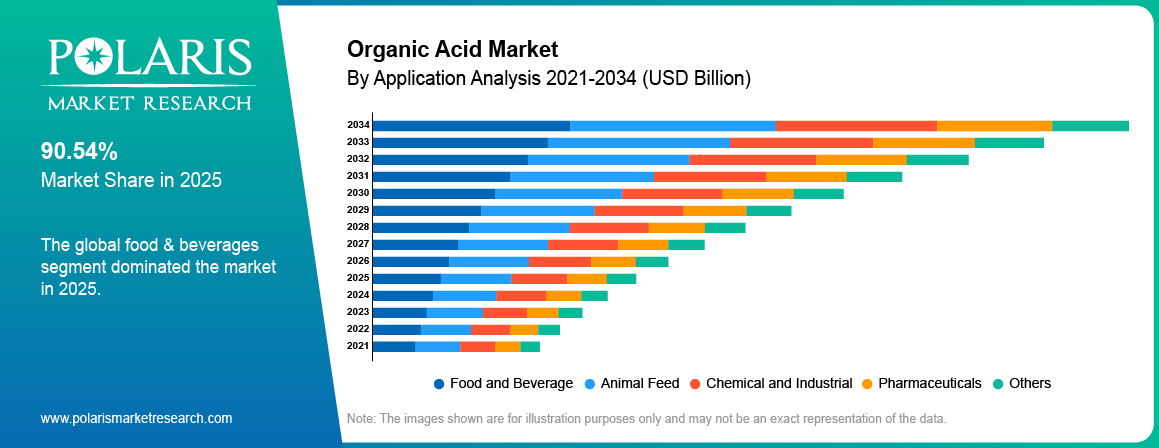
Regional Analysis
Asia Pacific Organic Acid Market Overview
Asia Pacific held a dominant market share due to strong food processing industries in China, India, Japan, and Southeast Asia. The increase in the consumption of processed foods, the rise in chemical manufacturing, and high fermentation production are propelling the region’s growth. For example, in April 2026, Novonesis made an investment of USD 50 million for acquiring a fermentation plant in Thailand, which boosted the capacity for producing bio-ingredients for organic acid production.
North America Organic Acid Market Insights
North America is projected to grow at a significant CAGR during the forecast period due to rising demand for clean-label food ingredients and increasing usage in pharmaceutical applications. The US has strong demand from food manufacturers, animal feed producers, and industrial chemical companies. According to the American Feed Industry Association, there was a feed consumption of 283.6 million tons in the US in 2023.Thus, this is leading to rising consumption of organic acid feed additives.
Europe Market Insights
Europe accounts for a significant market share owing to the rising demand for sustainable chemicals and the presence of strict regulations governing the safety of food. Bio-based content usage in Germany, France, the UK, and Italy is fueling the regional growth in the industry. In November 2025, the European Commission launched its new bioeconomy strategy to use more renewable sources of materials and reduce fossil fuel dependence.
Source: Polaris Market Research Analysis
Competitive Landscape & Key Players
The organic acid industry shows a moderate level of fragmentation due to the existence of large-scale chemical manufacturing organizations, fermentation organizations, and regional competitors. The competitive factors that exist within the industry are the production capabilities, quality of goods, price, and distribution routes. Businesses are making efforts to increase capacity, collaborate strategically, merge, and acquire technologies to manufacture biologically sourced products.
There are various major companies within the industry, including BASF SE, Cargill Incorporated, Archer Daniels Midland Company, Jungbunzlauer Suisse AG, Corbion N.V., Eastman Chemical Company, Celanese Corporation, Tate & Lyle PLC, Fuso Chemical Co., Ltd., Henan Jindan Lactic Acid Technology Co., Ltd., Gadot Biochemical Industries Ltd., TTCA Co., Ltd., and others.
Premium Insights
Trends & Future Outlook
Sustainability: Corporations are choosing to employ bio-based fermentation technology to minimize their dependency on petrochemical input usage and emissions. The sustainability of corporate functions, along with the increasing demand for sustainable food ingredients, is motivating corporations to adopt greener methods of manufacturing organic acids.
Innovation: Product innovation is promoted to enhance purity, production efficiency, and application within the food/feed, pharmaceutical, and industrial sectors. Fermentation process innovations, along with the innovative nature of organic acid specialties are expected to unlock new avenues for growth.
Key Players
- Archer Daniels Midland Company
- BASF SE
- Cargill Incorporated
- Celanese Corporation
- Corbion N.V.
- Eastman Chemical Company
- Fuso Chemical Co., Ltd.
- Gadot Biochemical Industries Ltd.
- Henan Jindan Lactic Acid Technology Co., Ltd.
- Jungbunzlauer Suisse AG
- Tate & Lyle PLC
- TTCA Co., Ltd.
Industry Developments
- January 2026: DuPont introduced AmberLite FPA57 resin to enhance the efficiency of the organic acid purification process while reducing down time during the operation. [source: www.dupont.com]
- August 2024: Bluejais upgraded their Resillox line of organic acids using proprietary BMPE technology for improved feed efficiency and animal health performance. [source: bluejais.com]
Organic Acid Market Segmentation
By Type Outlook (Revenue, USD Billion, 2021-2034)
- Acetic Acid
- Citric Acid
- Formic Acid
- Lactic Acid
- Propionic Acid
- Malic Acid
- Other Types
By Application Outlook (Revenue, USD Billion, 2021-2034)
- Food and Beverage
- Animal Feed
- Chemical and Industrial
- Pharmaceuticals
- Others
By Regional Outlook (Revenue, USD Billion, 2021-2034)
- North America
- US
- Canada
- Europe
- Germany
- France
- UK
- Italy
- Spain
- Netherlands
- Russia
- Rest of Europe
- Asia Pacific
- China
- Japan
- India
- Malaysia
- South Korea
- Indonesia
- Australia
- Vietnam
- Rest of Asia Pacific
- Middle East & Africa
- Saudi Arabia
- UAE
- Israel
- South Africa
- Rest of Middle East & Africa
- Latin America
- Mexico
- Brazil
- Argentina
- Rest of Latin America
Organic Acid Market Report Scope
| Report Attributes | Details |
| Market Size in 2025 | USD 14.84 Billion |
| Market Size in 2026 | USD 15.57 Billion |
| Revenue Forecast by 2034 | USD 23.08 Billion |
| CAGR | 5.03% from 2026 to 2034 |
| Base Year | 2025 |
| Historical Data | 2021–2024 |
| Forecast Period | 2026–2034 |
| Quantitative Units | Revenue in USD Billion and CAGR from 2026 to 2034 |
| Report Coverage | Revenue Forecast, Competitive Landscape, Growth Factors, and Industry Trends |
| Segments Covered |
|
| Regional Scope |
|
| Competitive Landscape |
|
| Report Format |
|
| Customization | Report customization as per your requirements with respect to countries, regions, and segmentation. |
Source: Polaris Market Research Analysis
Organic Acid Market FAQ's
The global market size was valued at USD 14.84 Billion in 2025 and is projected to grow to USD 23.08 Billion by 2034.
Asia Pacific dominates the market due to strong food processing and chemical manufacturing activities.
Major applications include food preservation, animal feed additives, pharmaceuticals, and industrial chemicals.
A few of the key players in the market are BASF SE, Cargill Incorporated, Archer Daniels Midland Company, Jungbunzlauer Suisse AG, Corbion N.V., Eastman Chemical Company, Celanese Corporation, Tate & Lyle PLC, Fuso Chemical Co., Ltd., Henan Jindan Lactic Acid Technology Co., Ltd., Gadot Biochemical Industries Ltd., TTCA Co., Ltd., and others.
Growth is driven by rising processed food demand and increasing use in animal feed applications.
The major demand is observed from food and beverage industry.
The market outlook remains positive due to rising bio-based production and increasing demand across end-use industries.
Download Sample Report of Organic Acid Market
Please fill out the form to request a customized copy of the research report.


