
Organic Chocolate Spreads Market Demand and Growth Driver 2026-2034
REPORT DETAILS
Organic Chocolate Spreads Market Summary
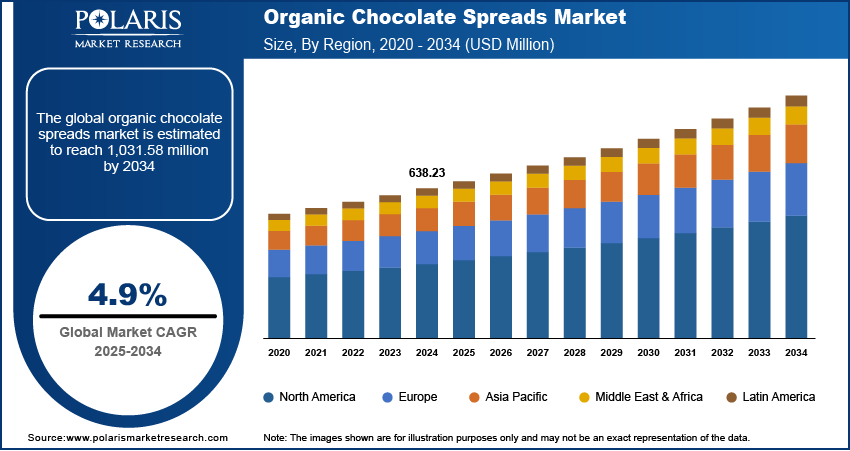
The global organic chocolate spreads market was valued at USD 719.80 million in 2025, at a CAGR of 5.13% during the forecast period. The market growth is driven by rising consumer demand for healthier, plant-based, organic products, increasing health awareness, urbanization, technological advancements, and growing retail accessibility.
Market Statistics
Key Takeaways
-
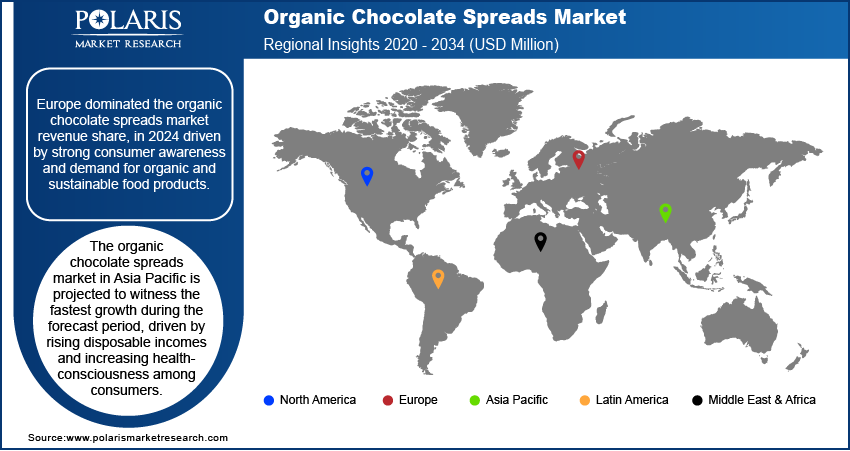
Europe leads the market with a 35.74% share in 2025, driven by strong consumer demand for organic foods, certified regulations, and a preference for premium products.
-
Asia Pacific is projected to grow the fastest at a 9.26% CAGR during forecast period, supported by rising disposable incomes, health awareness, and the growing popularity of organic foods in urban areas.
-
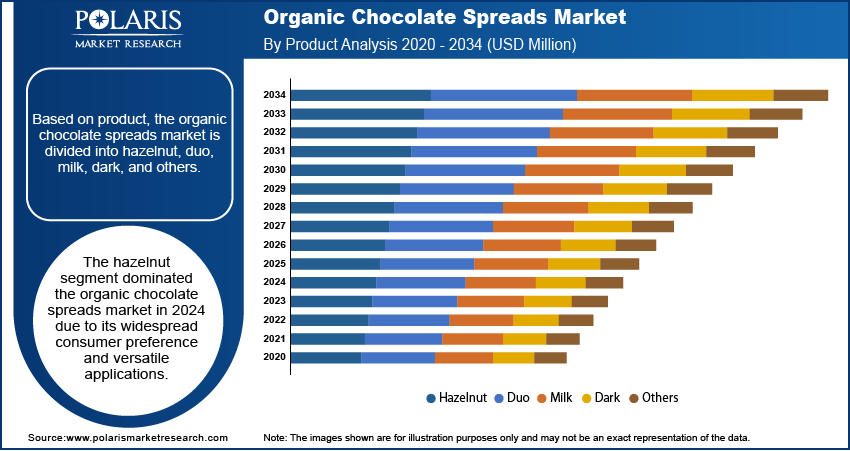
The hazelnut segment dominates the market with a 42.68% share in 2025 due to its rich texture, versatility, and premium appeal among health-conscious consumers.
-
The online distribution channel is growing rapidly at a 10.14% CAGR during forecast period, offering access to a wide variety of organic spreads and niche brands.
Industry Dynamics
- Rising consumer awareness of health and sustainability is driving demand for organic alternatives and clean-label ingredients in chocolate spreads.
- Technological advancements in product quality and packaging are improving the nutritional value, shelf life, and appeal of organic chocolate spreads.
- The expanding middle class in developing countries, particularly in urban centers, is driving growth for organic chocolate spreads.
- Innovations in processing techniques are reducing sugar content and improving nutritional profiles, broadening product offerings and consumer appeal.
- The higher cost of organic chocolate spreads compared to conventional spreads may limit adoption in price-sensitive markets.
Source: Polaris Market Research Analysis
To Understand More About this Research: Download Sample Report
Organic chocolate spread is a confectionery product made from organic cocoa, sugar, and other natural ingredients, free from synthetic additives and pesticides. The organic chocolate spreads market growth is driven by increasing consumer awareness of health and sustainability. Consumers are actively seeking healthier alternatives to conventional spreads with a shift toward organic and clean-label ingredients. For instance, in a February 2022 report, the Ministry of Agriculture & Farmers Welfare highlighted that the Indian government promotes organic food through schemes such as PKVY and MOVCDNER, providing financial aid for inputs, training, certification, and marketing. Initiatives such as large-area certification and online platforms such as Jaivikkheti, supported by RKVY, MIDH, and ICAR programs, reflect the growing emphasis on organic products. This rising demand is further fueled by concerns over artificial ingredients, leading to higher adoption of organic chocolate spreads. The expanding availability of these products in mainstream retail channels has also contributed to their market penetration, making them more accessible to health-conscious buyers.
Another driver increasing demand in organic chocolate spread market is growing adoption of western diet and lifestyle and urban living. Dietary trends are changing as rural and urban consumers increasingly adopt global food culture trends such as premium organic spreads. For example, the U.S Centers for Disease Control and Prevention’s National Center for Health Statistics report of February 2026 revealed that 40.3% of U.S adults aged 20 and above were obese, and 9.7% of them were extremely obese, signifying growing focus on healthier eating habits.(Source: cdc.gov) This growing awareness of health risks has further fueled the demand for organic and clean-label products such as organic chocolate spreads. Exposure to Western lifestyles, particularly in developing economies, has led to greater acceptance of organic and gourmet food products. Additionally, the growth of e-commerce and modern retail formats has further facilitated the accessibility of organic chocolate spreads, reinforcing their demand among urban populations. This shift in consumer behavior, combined with the broader trend of health-conscious consumption, continues to drive market expansion.
Market Driver Dynamics
Growing Adoption of Plant-Based Diets
Rising consumer preference for plant-based products is prompting the availability of organic chocolate spreads prepared using non-dairy milk variants such as almond milk, coconut milk, oats milk, and more, driven by growing health awareness and ethical considerations in using animal products. The US plant-based food retail market reached USD 7.9 billion in 2025, and 60% of US households purchased plant-based foods during the year, according to the Good Food Institute’s 2026 State of the Industry report. (Source: gfi.org) Companies have innovated and invested, and consumers have responded with more opportunities to purchase plant-based dairy, beverages, desserts, and beyond. This transformation is in tune with the increasing clean-label and minimally processed food movement that customers value treat has helped to identify the majority preference for organic. Hence, with plant-based diets going more mainstream, producers are diversifying their product ranges to tap into this expanding customer base, thus offering growth prospects for the organic chocolate spreads market.
Technological Advancements and Product Innovation
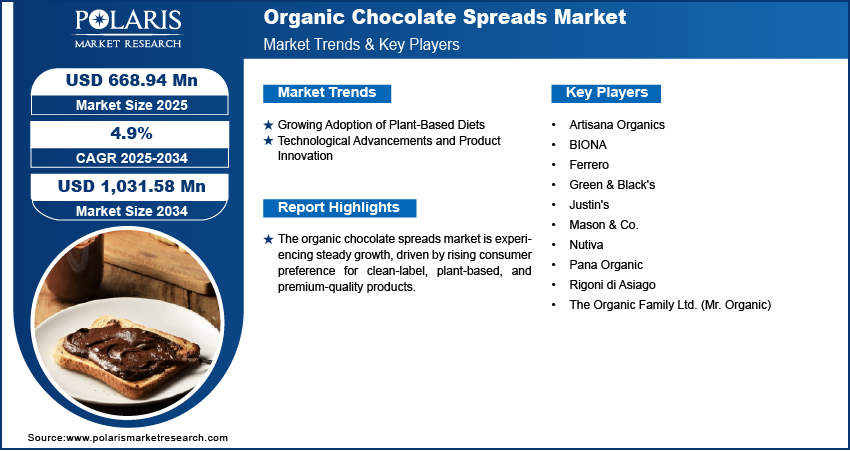
The organic chocolate spreads market is largely influenced by technological development and product innovation in product quality, texture and shelf life. Improvements in processing techniques have also allowed manufacturers to create spreads with better texture, less sugar, and more appealing nutritional content without sacrificing flavor. For example in July 2026, Veraila launched a three-ingredient chocolate hazelnut spread that contains 68% roasted hazelnuts, organic cocoa mass and uses dates as a natural sweetener, no added sugar, no palm oil or emulsifiers. (Source: veraila.com) Further, the developments in sustainable packaging and sourcing of ingredients have contributed the demand for organic chocolate spreads. Businesses are also utilizing R&D to develop functional ingredients, alternative sweeteners and clean-label products to meet changing consumer demands. These innovations not only help products stand out in a crowded market but also lead to an increased overall demand for organic chocolate spreads.
Technological Advancements & Product Innovation
| Technological Advancement / Product Innovation | Description | Market Impact |
| Sugar-Free Organic Chocolate Spreads | Formulated using natural sweeteners such as stevia, monk fruit, or erythritol instead of refined sugar | Expands appeal among diabetic, health-conscious, and low-sugar consumers |
| High-Protein Chocolate Spreads | Enriched with plant-based or dairy-derived proteins to enhance nutritional value | Supports growing demand for functional and sports nutrition products |
| Functional Spreads with Added Nutrients | Fortified with vitamins, minerals, fiber, probiotics, or superfood ingredients | Creates additional health benefits and strengthens premium product positioning |
| Clean-Label Formulations | Made with simple, recognizable ingredients and free from artificial additives, colors, and preservatives | Increases consumer trust and aligns with natural food preferences |
| Sustainable Packaging Innovations | Adoption of recyclable, biodegradable, compostable, and reduced-plastic packaging materials | Supports sustainability goals and enhances brand differentiation |
| Low-Calorie and Keto-Friendly Products | Developed with reduced carbohydrate content and healthy fats to meet specialized dietary needs | Attracts consumers following weight-management, ketogenic, and low-carb lifestyles |
| Organic Plant-Based Formulations | Utilizes dairy-free ingredients such as almond, oat, or coconut-based alternatives | Addresses rising demand for vegan and lactose-free products |
| Premium Cocoa Sourcing & Traceability | Incorporates ethically sourced organic cocoa with digital supply-chain transparency | Improves product authenticity, sustainability credentials, and consumer confidence |
Source: Polaris Market Research Analysis
Segment Analysis
Market Assessment by Product
The global organic chocolate spreads market segmentation, based on product, includes hazelnut, duo, milk, dark, and others. The hazelnut segment dominates the market with a 42.68% share in 2025 due to its widespread consumer preference and versatile applications. Hazelnut-based spreads offer a rich and creamy texture, enhancing their appeal among health-conscious consumers seeking organic alternatives to conventional chocolate spreads. The natural compatibility of hazelnuts with cocoa results in a distinctive flavor profile that is both indulgent and nutritious. Additionally, hazelnut-based spreads are often positioned as premium products, attracting consumers willing to pay a premium for organic and high-quality offerings. The strong association of hazelnuts with traditional chocolate spreads further reinforces their dominance, making them the preferred choice in the organic segment.
Market Evaluation by Distribution Channel
The global organic chocolate spreads market segmentation, based on distribution channel, includes supermarkets & hypermarkets, online, and others. The online distribution channel is growing rapidly at a 10.14% CAGR during the forecast period due to increasing e-commerce penetration and shifting consumer shopping behavior. The convenience of online platforms allows consumers to access a wider variety of organic chocolate spreads, including niche and specialty brands that may not be available in physical stores. Additionally, the rise of direct-to-consumer (DTC) strategies by organic brands has strengthened online sales, offering consumers personalized recommendations and subscription-based purchasing options. Competitive pricing, discounts, and easy home delivery further enhance the appeal of online channels, making them a key driver of market expansion.
Comparison Between Organic vs. Conventional Chocolate Spreads
| Aspect | Organic Chocolate Spreads | Conventional Chocolate Spreads |
| Ingredients | Made with certified organic cocoa, sugar, and other agricultural ingredients | Use of conventionally grown ingredients and synthetic additives |
| Additives & Preservatives | Typically free from artificial preservatives, colors, and flavors | May contain artificial preservatives, flavors, emulsifiers, and additives |
| Consumer Appeal | Strongly aligned with clean-label, natural, and health-conscious food trends | Appeals to price-sensitive consumers seeking familiar products |
| Production Standards | Produced according to certified organic farming and processing regulations | Manufactured under standard agricultural and food processing practices |
| Price Point | Generally higher-priced due to organic certification and sourcing costs | Usually more affordable and widely available |
| Sustainability Perception | Often associated with environmentally friendly and sustainable farming practices | Sustainability depends on manufacturer practices and sourcing policies |
| Market Positioning | Premium segment focused on quality, transparency, and wellness | Mass-market segment focused on affordability and convenience |
| Target Consumers | Health-conscious, eco-conscious, and clean-label consumers | Mainstream consumers seeking cost-effective chocolate spread options |
Source: Polaris Market Research Analysis
Regional Insights
By region, the report provides the organic chocolate spreads market insights into North America, Europe, Asia Pacific, Latin America, and the Middle East & Africa. Europe holds the largest share of the market with 35.74% in 2025, owing to high consumer awareness and demand for organic and sustainable food products. The region has a well-defined set of regulations that organic certification organic authenticity and build consumer confidence. Italy-based Rigoni di Asiago offers its Nocciolata line of organic chocolate and hazelnut spreads, Original, Dark, Crunchy, and Bianca varieties, with products made using certified organic ingredients and marketed with natural taste and clean-label attributes, as of 2026. (Source: rigonidiasiago.com) Moreover, European consumers have a strong affinity for premium and clean-label food products, which is a major driver for the high penetration of organic chocolate spreads. The Market is also driven by the high penetration of chocolate consumption in countries like Germany, France, and Italy. The organic food manufacturers and wide retail distribution networks also played a significant role in Europe Market leadership.
Asia Pacific is projected to grow the fastest at a 9.26% CAGR during the forecast period, driven by rising disposable incomes and increasing health-consciousness among consumers. The region is experiencing a shift in dietary preferences, with growing demand for organic and plant-based food products, particularly in urban centers. The expanding middle-class population, coupled with greater exposure to Western food trends, has accelerated the adoption of organic chocolate spreads. Additionally, the rapid expansion of e-commerce and modern retail infrastructure in countries such as China, India, and Japan has improved market accessibility. These factors collectively contribute to the strong growth of the market in Asia Pacific.
Source: Polaris Market Research Analysis
Key Market Players & Competitive Analysis Report
The competitive landscape features global leaders and regional players competing for organic chocolate spreads market share through innovation, strategic alliances, and regional expansion. Global players utilize strong R&D capabilities, technological advancements, and extensive distribution networks to deliver advanced solutions, meeting the growing demand for disruptive technologies and sustainable value chains. Organic chocolate spreads market trends highlight rising demand for emerging technologies, digitalization, and business transformation driven by economic growth, geopolitical shifts, and macroeconomic trends. Global players focus on strategic investments, mergers and acquisitions, and joint ventures to strengthen their market position. Post-merger integration and strategic alliances are key strategies to improve competitive positioning and expand regional footprints. Regional companies, meanwhile, address localized needs by offering cost-effective solutions and leveraging economic landscapes.
Competitive benchmarking includes market entry assessments, expansion opportunities, and partnership ecosystems to meet the demand for innovative products and future-ready solutions. The market is experiencing technological advancements, such as disruptive technologies and digital transformation, reshaping industry ecosystems. Companies are investing in supply chain management, procurement strategies, and sustainability transformations to align with organic chocolate spreads market demand, trends, and future development strategies. Pricing insights, revenue growth analysis, and competitive intelligence are critical for identifying opportunities and driving long-term profitability. In conclusion, the organic chocolate spread industry's growth is driven by technological innovation, market adaptability, and regional investments. Major players focus on strategic developments, market penetration, and competitive benchmarking to address economic and geopolitical shifts, assuring sustained growth in a hypercompetitive global market. A few key major players are Artisana Organics, BIONA, Ferrero, Green & Black's, Justin's, Mason & Co., Nutiva, Pana Organic, Rigoni di Asiago, and The Organic Family Ltd. (Mr. Organic).
Artisana Organics is a company in the organic food industry specializing in the artisanal production of raw, vegan, and organic products. Founded in 2002 and headquartered in Oakland, California, Artisana Organics is renowned for its high-quality nut butter and seed butter, including organic raw cashew, coconut, pecan, and walnut butter. While primarily focused on nut butter, Artisana Organics also offers a hazelnut cacao spread, which serves as a healthier alternative to traditional chocolate hazelnut spreads such as Nutella. This spread combines hazelnuts with cacao, providing a rich and delicious taste without excessive sugar. Artisana Organics emphasizes sustainability and environmental responsibility, sourcing ingredients from trusted farmers worldwide. Their products are crafted in small batches to preserve natural flavors and nutrients, ensuring that every bite is both nutritious and delicious. Artisana Organics appeals to consumers seeking healthier and more environmentally friendly food options by offering organic and sustainably sourced ingredients, making their hazelnut cacao spread a notable choice in the organic chocolate spreads market.
Justin's is an American brand known for its natural and organic nut butter, peanut butter cups, and other snacks. Founded by Justin Gold in 2004, the company started by making unique nut butter flavors in a home kitchen in Boulder, Colorado. Justin's gained popularity for its innovative products, including organic peanut butter cups made with Rainforest Alliance Certified cocoa. They offer a Chocolate Hazelnut Butter that combines hazelnut butter with chocolate, providing a delicious and nutritious alternative to traditional chocolate spreads. This product is part of their commitment to using organic ingredients whenever possible and aligns with their mission to source ingredients mindfully. Justin's products are widely distributed across the US through retailers such as Whole Foods Market and Target. The company's dedication to sustainability and social responsibility, such as supporting organic farming practices, positions it well in the market for consumers seeking organic and natural food options.
List of Key Companies
- Artisana Organics
- BIONA
- Ferrero
- Green & Black's
- Justin's
- Mason & Co.
- Nutiva
- Pana Organic
- Rigoni di Asiago
- The Organic Family Ltd. (Mr. Organic)
Organic Chocolate Spreads Industry Development
- January 2026: Sweet Freedom announced the launch of CHOC POT Hazelnot, exclusively at Asda. CHOC POT Hazelnot is a nut-free chocolate spread. (Source: foodanddrinknetwork.co.uk)
- In May 2025: Ferrero International S.A. announced a new flavor variant of its flagship spread, Nutella Peanut, combining its classic cocoa-hazelnut base with roasted peanuts. The product is aimed at the U.S. market, with a planned rollout in spring 2026. (Source: ferrero.com)
Organic Chocolate Spreads Market Segmentation
By Product Outlook (Volume, Thousand Units; Revenue, USD Million, 2021 - 2034)
- Hazelnut
- Duo
- Milk
- Dark
- Others
By Distribution Channel Outlook (Volume, Thousand Units; Revenue, USD Million, 2021 - 2034)
- Supermarkets & Hypermarkets
- Online
- Others
By Market Nature Outlook (Volume, Thousand Units; Revenue, USD Million, 2021 - 2034)
- Certified Organic
- Non-certified Organic
By Sweetening Agent Outlook (Volume, Thousand Units; Revenue, USD Million, 2021 - 2034)
- Cane Sugar
- Coconut Sugar
- Date Sugar
- Honey
By Packaging Outlook (Volume, Thousand Units; Revenue, USD Million, 2021 - 2034)
- Jar
- Tube
- Sachet
By Regional Outlook (Volume, Thousand Units; Revenue, USD Million, 2021 - 2034)
- North America
- US
- Canada
- Europe
- Germany
- France
- UK
- Italy
- Spain
- Netherlands
- Russia
- Rest of Europe
- Asia Pacific
- China
- Japan
- India
- Malaysia
- South Korea
- Indonesia
- Australia
- Vietnam
- Rest of Asia Pacific
- Middle East & Africa
- Saudi Arabia
- UAE
- Israel
- South Africa
- Rest of Middle East & Africa
- Latin America
- Mexico
- Brazil
- Argentina
- Rest of Latin America
Organic Chocolate Spreads Market Report Scope
| Report Attributes | Details |
| Market Size Value in 2025 | USD 719.80 million |
| Market Size Value in 2026 | USD 756.03 million |
| Revenue Forecast in 2034 | USD 1,129.41 million |
| CAGR | 5.13% from 2026 to 2034 |
| Base Year | 2025 |
| Historical Data | 2021– 2024 |
| Forecast Period | 2026 – 2034 |
| Quantitative Units | Volume, Thousand Units; Revenue in USD Million, and CAGR from 2026 to 2034 |
| Report Coverage | Revenue Forecast, Market Competitive Landscape, Growth Factors, and Industry Trends |
| Segments Covered |
|
| Regional Scope |
|
| Competitive Landscape |
|
| Report Format |
|
| Customization | Report customization as per your requirements with respect to countries, regions, and segmentation. |
Source: Polaris Market Research Analysis
Organic Chocolate Spreads Market FAQ's
The global organic chocolate spreads market size was valued at USD 719.80 million in 2025 and is projected to grow to USD 1,129.41 million by 2034.
The global market is projected to register a CAGR of 5.13% during the forecast period.
Europe leads the market with a 35.74% share in 2025.
Some of the key players in the market are Artisana Organics, BIONA, Ferrero, Green & Black's, Justin's, Mason & Co., Nutiva, Pana Organic, Rigoni di Asiago, and The Organic Family Ltd. (Mr. Organic).
The hazelnut segment dominates the market with a 42.68% share in 2025 due to increasing e-commerce penetration and shifting consumer shopping behavior.
• The online distribution channel is growing rapidly at a 10.14% CAGR during the forecast period due to increasing e-commerce penetration and shifting consumer shopping behavior.
The growth of the market is attributed to the increasing awareness regarding health,?changing lifestyle, and growing favorability towards clean label foods. Consumers are looking for high-grade?butters with less sugar, natural sweeteners and ingredients obtained under sustainable conditions.
Manufacturers are bringing formulations based on alternative dairy sources, functional ingredients, high nut content and natural sweeteners to the market?in response to evolving consumer demands. These and other developments can be used to add nutritional value, improve texture and flavor, and differentiate?products.
Download Sample Report of Organic Chocolate Spreads Market
Please fill out the form to request a customized copy of the research report.


