
Pharmacy Benefit Management Market Growth Statistics and Revenue Projections, 2026-2034
REPORT DETAILS
Pharmacy Benefit Management Market Summary
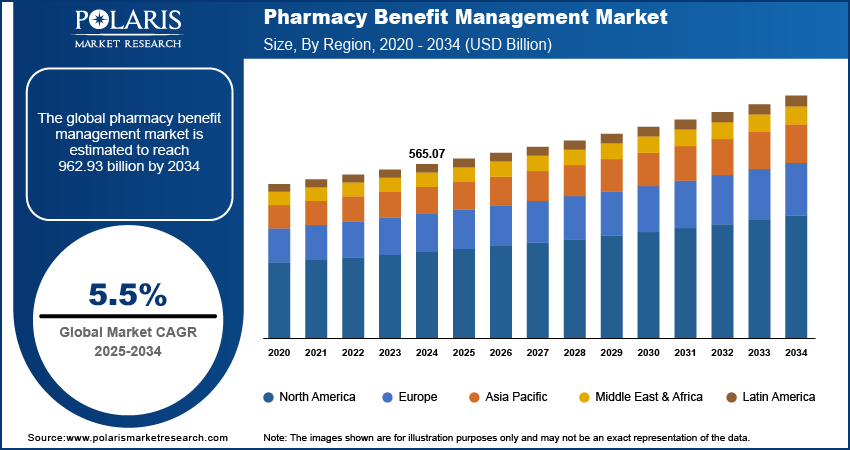
The global pharmacy benefit management market size was valued at USD 593.30 billion in 2025, growing at a CAGR of 5.5% from 2026 to 2034. Growing chronic disease burden and expanding retail and online pharmacies are driving PBM adoption.
Market Statistics
Key Takeaways
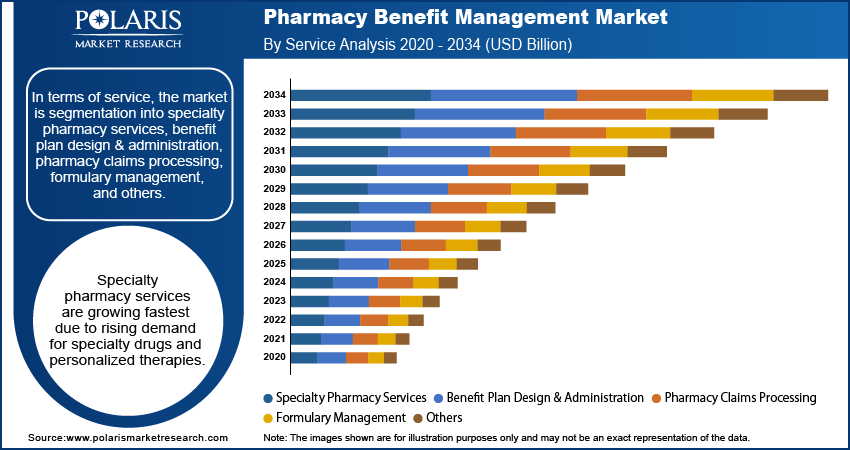
- Pharmacy claims processing segment held 25.6% of global revenue share in the pharmacy benefit management market in 2025.
- Specialty pharmacy services segment is projected to grow fastest rate at 6.3% due to rising demand for specialty drugs and personalized therapies.
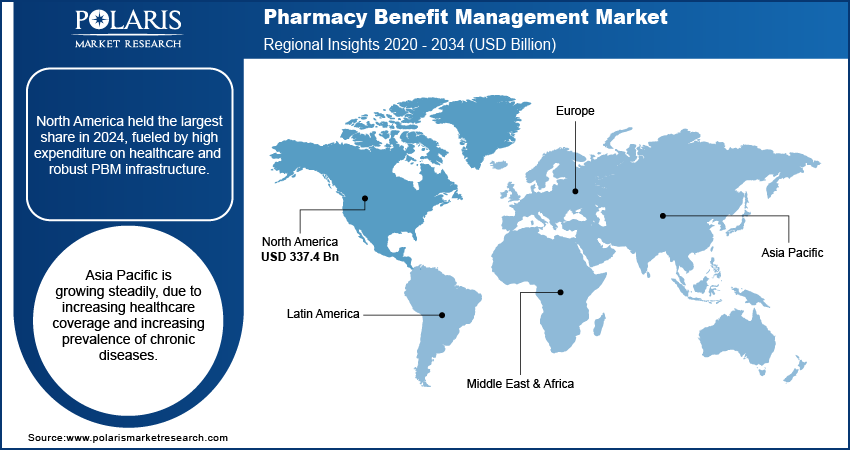
- North America held the largest share of the pharmacy benefit management market in 2025, holding approximately 57.95% share.
- The U.S. held largest market share of 78% within NA region and is expected to remain dominant due to high healthcare expenditure and widespread adoption of managed care and digital PBM solutions.
- Asia Pacific market is expected to grow at 6.6% CAGR from 2026 to 2034 due to expanding healthcare coverage and rising chronic disease prevalence.
- China and Japan lead regional expansion through increasing adoption of PBM solutions and growing retail and online pharmacy networks.
Note: Figures and projections outlined in this report are the result of Polaris Market Research’s proprietary analytical processes, grounded in the latest available datasets and market observations
Industry Dynamics
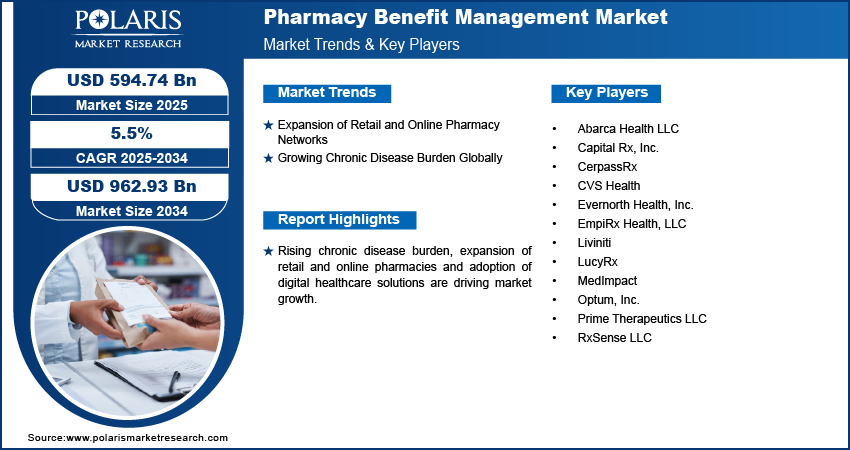
- Expansion of retail and online pharmacy networks is supporting wider adoption of PBM solutions.
- Growing chronic disease burden is increasing demand for efficient pharmacy benefit management services.
- Development of AI-driven predictive analytics for prescription optimization is creating new growth opportunities.
- Regulatory scrutiny over drug pricing transparency continues to restrain market expansion.
What is Pharmacy Benefit Management Market?
The pharmacy benefit management (PBM) market provides solutions for managing prescription drug programs, optimizing formularies, and controlling healthcare costs for insurers, employers, and patients. PBMs function on the basis of collaborations with pharmacies, healthcare providers, and pharmaceutical companies to simplify claims handling, increase drug availability, and achieve better medication compliance.
Increasing occurrences of chronic diseases and the growth of retail and online pharmacy chains are compelling the implementation of PBM solutions. According to the American Lung Association, over 35 million people in the U.S. have a chronic lung disease, with 26.8 million affected by asthma (including 4.5 million children) and about 11.7 million adults (4.6%) diagnosed with COPD. Higher healthcare spending, insurance coverage, and transition to value-based care models are further enhancing market growth.
Large companies are emphasizing mergers, acquisitions, and strategic collaborations with insurers and pharmacies to diversify their service offerings. Investments in digital platforms, AI-powered analytics, and patient-centric solutions are enhancing operational efficiency and transparency.
PBM Service Comparison Table
| Parameter | Formulary Management | Claims Processing | Specialty Pharmacy Services |
| Definition | Management of drug lists and coverage policies | Processing and validation of prescription drug claims | Handling of high-cost, complex specialty medications |
| Core function | Selects approved drugs and controls access | Verifies, adjudicates, and reimburses claims | Manages distribution and care for specialty drugs |
| Focus Area | Cost control and drug optimization | Administrative efficiency and payment accuracy | Patient support and complex therapy management |
| Complexity | Moderate | High volume but standardized | High complexity and personalized care |
| Technology Use | Analytics for drug selection and pricing | Automated claims systems and real-time adjudication | Advanced tracking, cold chain logistics, patient monitoring |
| Cost Impact | Reduces drug spending through formulary design | Reduces admin cost and fraud | High cost but improves outcomes for chronic conditions |
| Market Position | Essential supporting function | Dominant segment (largest share) | Fastest growing segment |
| End Users | Insurers, PBMs, employers | Pharmacies, insurers, PBMs | Hospitals, specialty pharmacies, patients |
| Examples | Preferred drug lists, tiered pricing | Insurance claim approvals, billing systems | Oncology drugs, biologics, rare disease treatments |
Source: Polaris Market Research Analysis
Drivers & Opportunities
Which are the factors driving pharmacy benefit management market growth?
Expansion of Retail and Online Pharmacy Networks: Retail and online pharmacy network expansion is assisting broader PBM solution adoption as the platforms are boosting prescription availability, making pricing more transparent, and streamlining claims processing in healthcare systems. For example, in May 2025, HealthEZ introduced EZrx, a PBM solution that assists self-funded employers in saving up to 50% on prescription medicine by leveraging various cost-reduction measures and digital applications.
Growing Chronic Disease Burden Globally: The expanding chronic disease burden is driving demand for effective pharmacy benefit management services to maintain uninterrupted supply of drugs and compliance. PBMs optimize formulary strategy, track prescription use, and contain long-term therapy expenditures, facilitating improved patient outcomes and healthcare effectiveness.
Segmental Insights
Service Analysis
By service, the market is divided into specialty pharmacy services, benefit plan design & administration, pharmacy claims processing, formulary management, and others. The pharmacy claims processing segment led the market in 2025 as a result of its essential function in simplifying prescription management and decreasing administrative expenses.
The specialty pharmacy services segment is expected to expand at the highest CAGR over the forecast period with increasing demand for specialty medicines and customized treatments.
Service Providers Analysis
Based on service providers, the market is segmented into insurance companies, retail pharmacies, and standalone PBMs. Insurance companies dominated the industry in 2025 due to their wider networks and ability to offer PBM services as part of health plans. In addition, increasing healthcare coverage and cost-containment efforts are further driving their industry dominance across the world.
Standalone PBMs witnessed the highest growth throughout the forecast period as they offer specialized interest in pharmacy benefit management solutions. Furthermore, investments in digital platforms and AI-powered analytics are driving their operational efficiency and adoption. Judi Health raised USD 400 million in September 2025 to scale up its AI-driven platform to manage pharmacy and other health benefits effectively.
Real-World Examples
Insurance drug plans: Formulary management used to create approved drug lists and tier-based pricing in health insurance plans.
Employer healthcare benefits: Claims processing used to process employee prescriptions and manage reimbursements.
Cost negotiation with pharma companies: PBMs negotiate drug prices and rebates to control overall healthcare costs.
Specialty drug distribution: Specialty pharmacy services manage high-cost drugs like oncology and biologics with patient monitoring.
Chronic disease management: PBMs support long-term therapies (diabetes, asthma, COPD) with adherence programs and cost control.
Retail and online pharmacy integration: Claims processing and PBM platforms connect pharmacies for faster prescription approvals and fulfillment.
Regional Analysis
North America led the market in 2025 owing to excessive healthcare spending and extensive use of managed care systems. The U.S. Centers for Medicare & Medicaid Services stated that healthcare spending in the U.S. rose 7.5% in 2023, reaching USD 4.9 trillion or USD 14,570 per person, representing 17.6% of the country’s GDP. Moreover, extensive presence of major PBM companies and advanced digital health infrastructure is driving market growth.
The U.S. Pharmacy Benefit Management Market Insights
The U.S. dominated the North America market owing to large insured population and significant healthcare R&D investments. Moreover, advanced pharmacy networks and strong regulatory frameworks are pushing PBM adoption. Furthermore, increasing specialty drug use further favors market growth.
Europe Pharmacy Benefit Management Market Assessments
Europe is expected to hold a significant share of the market by 2034 driven by government initiatives promoting cost-efficient healthcare and growing awareness of prescription drug management. Moreover, increasing adoption of digital healthcare platforms is enhancing operational efficiency. In addition, rising chronic disease burden contributes to market growth.
Asia Pacific Pharmacy Benefit Management Market Trends
Asia Pacific is projected to grow at the fastest CAGR during the forecast period fueled by expanding healthcare coverage and increasing retail pharmacy networks. Moreover, rising prevalence of chronic diseases and growing middle-class population are accelerating PBM adoption. The World Health Organization states that chronic disease such as heart disease, chronic lung disease, diabetes, and cancer, are the main causes of death in the South-East Asia Region, causing about 8.5 million deaths each year.
Japan Pharmacy Benefit Management Market Overview
Japan is expanding rapidly due to aging population and strong healthcare infrastructure. Moreover, government support for drug cost management and advanced pharmacy networks is encouraging PBM uptake Moreover, rising demand for specialty therapies further favors further market growth.
Key Players & Competitive Analysis
The pharmacy benefit management market is moderately competitive, with businesses concentrating on developing digital platforms, analytics driven by AI, and specialty pharmacy solutions. Furthermore, partnerships among PBMs, insurers, and pharmacies are improving service efficiencies and facilitating adoption in major regions worldwide.
Some of the leading players in the pharmacy benefit management sector include Evernorth Health, Inc., CVS Health, Optum, Inc., Prime Therapeutics LLC, MedImpact, Capital Rx, Inc., EmpiRx Health, LLC., Liviniti, RxSense LLC, LucyRx, CerpassRx, and Abarca Health LLC.
Key Players
- Abarca Health LLC
- Capital Rx, Inc.
- CerpassRx
- CVS Health
- Evernorth Health, Inc.
- EmpiRx Health, LLC
- Liviniti
- LucyRx
- MedImpact
- Optum, Inc.
- Prime Therapeutics LLC
- RxSense LLC
Pharmacy Benefit Management Industry Developments
- May 2025: HealthEZ introduced “EZrx,” a next-generation PBM solution. It targets to minimize pharmacy costs by up to 50% compared to traditional models. Source: businesswire.com
- May 2025: Waltz Health and WellDyne introduced a transparent specialty pharmacy option powered by Waltz Connect. It is designed for health plans and self-insured employers. Source: waltzhealth.com
- September 2025: RxBenefits added Illuminate Rx to its PBM marketplace, offering employers more flexible and cost-effective pharmacy plan options, including specialty and GLP-1 medications. Source: rxbenefits.com
Pharmacy Benefit Management Market Segmentation
By Service Outlook (Revenue, USD Billion, 2021–2034)
- Specialty Pharmacy Services
- Benefit Plan Design & Administration
- Pharmacy Claims Processing
- Formulary Management
- Others
By Service Providers Outlook (Revenue, USD Billion, 2021–2034)
- Insurance Companies
- Retail Pharmacies
- Standalone PBMs
By Regional Outlook (Revenue, USD Billion, 2021–2034)
- North America
- U.S.
- Canada
- Europe
- Germany
- France
- UK
- Italy
- Spain
- Netherlands
- Russia
- Rest of Europe
- Asia Pacific
- China
- Japan
- India
- Malaysia
- South Korea
- Indonesia
- Australia
- Vietnam
- Rest of Asia Pacific
- Middle East & Africa
- Saudi Arabia
- UAE
- Israel
- South Africa
- Rest of Middle East & Africa
- Latin America
- Mexico
- Brazil
- Argentina
- Rest of Latin America
Future of PBM Market
PBM market shifting toward value-based care models focusing on patient outcomes over volume. Digital health integration and AI analytics improving prescription management and efficiency. Increasing demand for cost transparency pushing PBMs to adopt clearer pricing and rebate structures. Customized medicine and specialty drugs increasing need for developed PBM services and patient-specific plans. Collectively, the market will continue to move toward more transparent, tech-driven, and patient-centric pharmacy benefit solutions.
Pharmacy Benefit Management Market Report Scope
| Report Attributes | Details |
| Market Size in 2025 | USD 593.30 Billion |
| Market Size in 2026 | USD 623.48 Billion |
| Revenue Forecast by 2034 | USD 956.95 Billion |
| CAGR | 5.5% from 2026 to 2034 |
| Base Year | 2025 |
| Historical Data | 2021–2024 |
| Forecast Period | 2026–2034 |
| Quantitative Units | Revenue in USD Billion and CAGR from 2026 to 2034 |
| Report Coverage | Revenue Forecast, Competitive Landscape, Growth Factors, and Industry Trends |
| Segments Covered |
|
| Regional Scope |
|
| Competitive Landscape |
|
| Report Format |
|
| Customization | Report customization as per your requirements with respect to countries, regions, and segmentation. |
Source: Polaris Market Research Analysis
Pharmacy Benefit Management Market FAQ's
The global market size was valued at USD 593.30 billion in 2025 and is projected to grow to USD 956.95 billion by 2034.
The global market is projected to register a CAGR of 5.5% during the forecast period.
North America led the market in 2025 due to high healthcare expenditure and widespread adoption of managed care and digital PBM solutions.
A few of the key players in the market are Evernorth Health, Inc., CVS Health, Optum, Inc., Prime Therapeutics LLC, MedImpact, Capital Rx, Inc., EmpiRx Health, LLC., Liviniti, RxSense LLC, LucyRx, CerpassRx, and Abarca Health LLC.
Pharmacy claims processing is the largest segment in 2025, due to its lower administrative expenses for insurers and patients.
Standalone PBMs expected to grow rapidly owing to its targeted expertise in cost-effective and technology-oriented pharmacy benefit management solutions.
AI is driving significant innovation in PBM by enabling predictive analytics for prescription optimization, automating claims processing, and improving formulary management. AI-powered tools help reduce medication errors, detect fraud, and support personalized therapy recommendations, improving overall efficiency and patient outcomes across the healthcare value chain.
Download Sample Report of Pharmacy Benefit Management Market
Please fill out the form to request a customized copy of the research report.


