
Polyhexamethylene Biguanide Dressing Market Size, Share, and Forecast 2027 to 2035
REPORT DETAILS
Polyhexamethylene Biguanide Dressing Market Summary
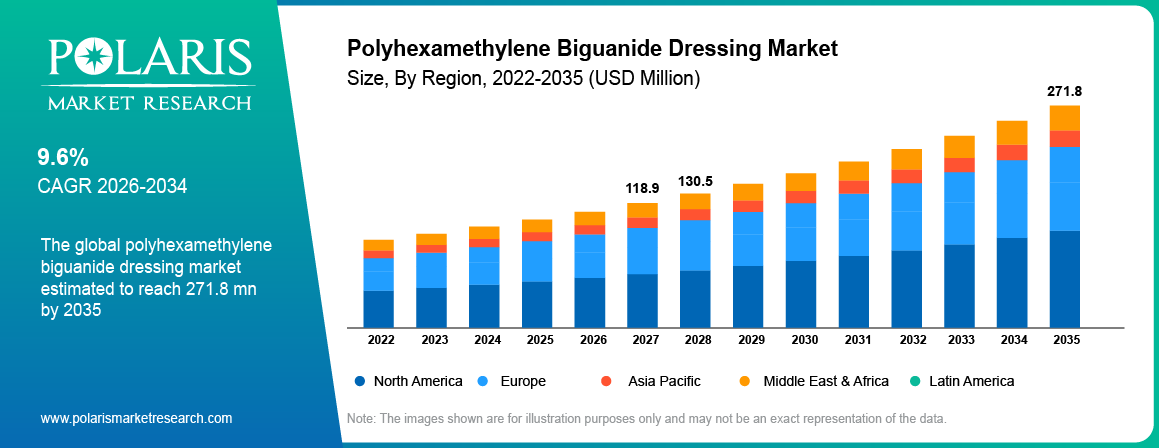
According to Polaris Market Research analysis, the polyhexamethylene biguanide dressing market was valued at USD 118.9 Million in 2026. It is projected to reach USD 271.8 Million by 2035, growing at a CAGR of 9.6% from 2027 to 2035. Demand is driven by hospital infection control, rising chronic wound caseloads, and wider use of foam and cellulose formats that hold the agent against the wound bed. Gauze dressings bring in the most revenue, while bacterial cellulose formats grow quickest. The market covers dressings that carry the antimicrobial polymer in the pad, foam, or fiber itself, and it excludes cleansers and irrigation liquids. North America is the leading market. Asia Pacific is the fastest growing region.
Market Statistics
Key Takeaways
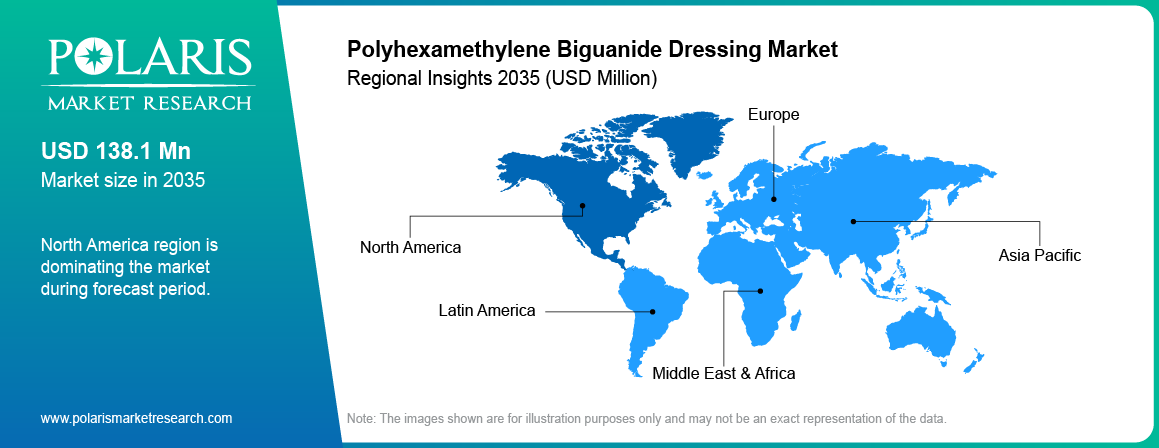
- In 2027, 42.6% of revenue came from North America, where hospital infection control programs and a large chronic wound population maintain antimicrobial dressings in routine use.
- Asia Pacific has the highest growth, with a CAGR of 12.8% from 2027 to 2035, owing to rising diabetes caseloads in India and domestic dressing manufacturers in China.
- Gauze formats hold a 35.4% share of 2027 revenue because hospitals already stock them for packing and primary contact use.
- Bacterial cellulose dressings are the quickest growing product, with a CAGR of 15.1% through 2035, as manufacturers pair the polymer with a moist, conformable base.
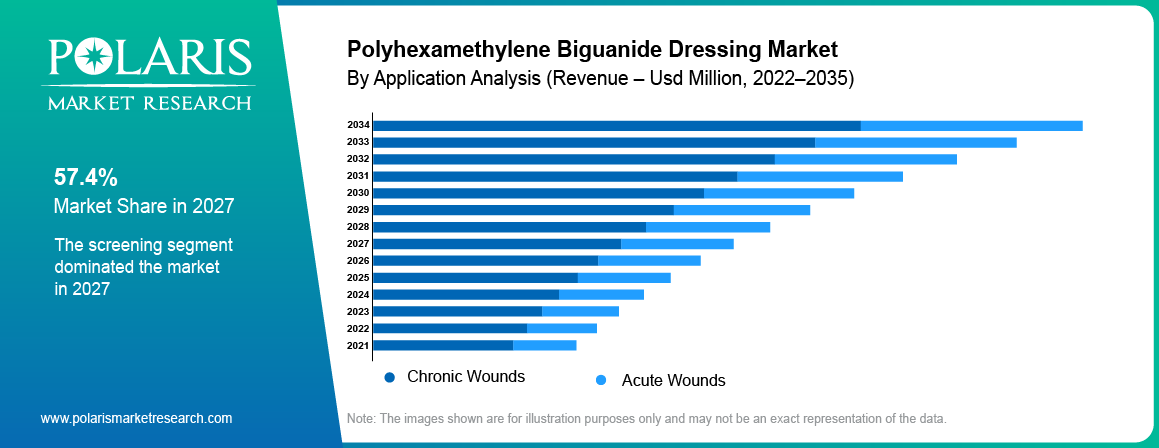
- Chronic Wounds led applications with USD 75.0 Million of 2027 revenue, since venous, diabetic, and pressure ulcers require repeated dressing changes over numerous weeks.
- Acute wounds are projected to grow at a CAGR of 10.8% from 2027 to 2035, since surgical and trauma care adds volume where infection prevention is a stated goal.
- Hospitals account for 50.2% of 2027 revenue, supported by procurement contracts and infection prevention protocols that can specify antimicrobial products.
- Home Healthcare is projected to expand at a CAGR of 12.5% from 2027 to 2035, the fastest end use, as longer wear dressings let nurses visit less often.
- Wound Care Clinics generated USD 28.6 Million in 2027, driven by outpatient programs that treat ulcers over repeated visits.
Note: Figures and projections outlined in this report are the result of Polaris Market Research’s proprietary analytical processes, grounded in the latest available datasets and market observations.
Polyhexamethylene Biguanide Dressing Market Definition
The polyhexamethylene biguanide dressing market covers wound dressings that carry polyhexamethylene biguanide (PHMB), also called polihexanide, as the antimicrobial agent inside the dressing pad, foam, fiber, or gel. It includes gauze, foam, bacterial cellulose, and other impregnated formats sold for chronic and acute wounds, and it excludes cleansers, irrigation liquids, and dressings that rely on other agents.
Revenue counted here is what manufacturers earn from finished PHMB dressings sold to hospitals, clinics, and home care channels. Silver, iodine, and honey dressings are excluded, as are PHMB wound washes and sprays. This market is therefore a small slice of the wider wound care market. Contact lens solutions and other uses of the same polymer are not counted.
PHMB is a cationic polymer that binds bacterial membranes and causes cell disruption, according to a February 2026 Wounds UK meeting report. The report records an in vitro reduction in bacterial load of 99.99% within 30 minutes, and it also notes that the symposium was supported by Advanced Medical Solutions; as a result, the figures are manufacturer linked.
Dressings differ in how they hold the agent. A gauze pad is soaked or coated, a foam carries the polymer in its cells, and a cellulose sheet binds it to a hydrated fiber network. Manufacturers then publish a wear time, often seven days on product pages, that depends on the load of fluid and bacteria in each wound.
Market share inside the broader antimicrobial dressing field is hard to isolate. Publishers define the category in different ways, and numerous suppliers sell PHMB gauze and foam under private labels; as a result, Polaris counts finished dressings by their stated antimicrobial agent and not by brand.
PHMB Dressing vs Silver Dressing: Key Differences
| Attribute | PHMB Dressing | Silver Dressing |
| Antimicrobial agent | Polyhexamethylene biguanide, a cationic polymer | Ionic or nanocrystalline silver |
| Common formats | Gauze, foam, bacterial cellulose, and gel | Alginate, foam, hydrofiber, and film |
| Market scale | USD 118.9 Million in 2026 (Polaris estimate) | USD 998.07 Million in 2024 (Polaris estimate) |
| Growth outlook | 9.6% CAGR from 2027 to 2035 | 4.4% CAGR from 2025 to 2034 (Polaris estimate) |
| Typical purchasing argument | Stewardship and wear time claims from manufacturers | Established agent with long clinical use |
Source: Polaris Market Research Analysis
The comparison above sets the PHMB market next to its closest rival. It also demonstrates that the silver wound dressing market is larger in absolute terms. Buyers often pick between the two on price, supplier contracts, and clinical habit, not on a published head to head result.
Porter's Five Forces Analysis
| Force | Intensity | Rationale |
| Bargaining power of suppliers | Moderate | The polymer is available from several chemical manufacturers, although medical grade supply and sterilization capacity are limited to qualified sites. |
| Bargaining power of purchasers | High | Hospital groups and national tenders purchase in volume and can switch between antimicrobial agents on price. |
| Threat of new entrants | Moderate | Regulatory clearance and sterile production take time, yet contract manufacturers lower the barrier for private label entrants. |
| Threat of substitutes | High | Silver, iodine, honey, and chlorhexidine dressings compete for the same wounds, and systemic antibiotics treat some infections. |
| Competitive rivalry | Moderate to High | Global dressing groups, Asian volume manufacturers, and small specialists compete on price, format, and tender access. |
Source: Polaris Market Research Analysis
Substitution is the sharpest pressure. A hospital pharmacy that already stocks a silver foam can usually meet most requires without adding a PHMB line; as a result, manufacturers lean on cost, wear time, and stewardship arguments to win a place on the formulary.
Market Dynamics
Driver Impact Analysis
| Driver | Impact on Market Growth | Time Horizon |
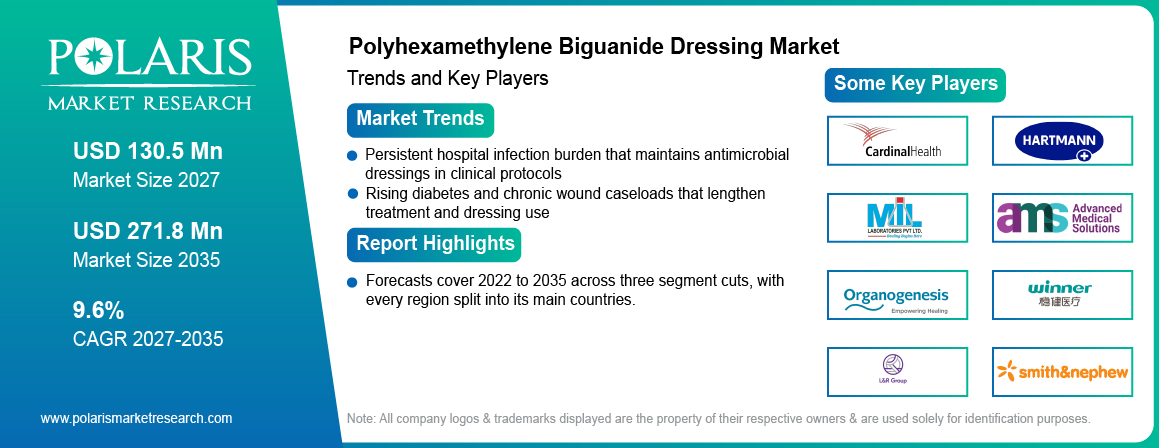
| Persistent hospital infection burden that maintains antimicrobial dressings in clinical protocols | High | Short to Medium Term |
| Rising diabetes and chronic wound caseloads that lengthen treatment and dressing use | High | Medium to Long Term |
Source: Polaris Market Research Analysis
Driver: Hospital Infection Burden Is Keeping Antimicrobial Dressings in Clinical Protocols, Creating Market Demand
Infection control is the strongest reason a hospital purchases an antimicrobial dressing. Surgical wounds, pressure injuries, and leg ulcers all carry a risk of colonization. Clinical teams may prefer a product that holds the agent at the wound surface over repeated applications of a liquid.
For example, in July 2026, the US Centers for Disease Control and Prevention reported about 518,000 healthcare associated infections in US hospitals in 2023, and noted that surgical site infection rates showed little change between survey years (Source: CDC). Procurement teams can read that result as a reason to maintain wound level controls in place.
North America is projected to grow at a CAGR of 8.4% from 2027 to 2035, the slowest region, as the base is large and numerous hospitals already use antimicrobial dressings. Polaris expects growth there to rest on replacement of older gauze with higher value formats.
Driver: Rising Diabetes and Chronic Wound Caseloads Are Lengthening Dressing Use, Creating Market Demand
Longer treatment courses add dressings per patient. A diabetic foot ulcer or a venous leg ulcer can require weekly or twice weekly changes for months, and each change is a unit of demand for the maker. Population growth in diabetes therefore feeds the market directly.
For example, in April 2025, the 11th edition of the International Diabetes Federation Atlas reported 589 million adults aged 20 to 79 with diabetes, and 853 million are projected for 2050. Three in four of them live in low and middle income countries, where dressing manufacturers with lower priced ranges can reach new purchasers.
Diabetes also shifts the age and risk profile of wound patients. Nerve damage, poor circulation, and slow healing raise the odds that a small foot injury becomes a long course of care, and clinics that see these patients tend to stock dressings that control bacterial load.
Chronic Wounds lead the application split in 2027, with Acute Wounds second. Acute Wounds is projected to grow faster, at 10.8% against 8.6%, since the chronic base is already mature in the largest regions.
Restraint: Mixed Clinical Evidence and Open Safety Questions Are Slowing Adoption of PHMB Dressings
Evidence for PHMB dressings is uneven, and purchasers who weigh cost against outcome notice it. Trial designs differ, sample sizes are small, and several of the larger reports are funded by manufacturers; as a result, clinical committees often ask for more before they change a formulary.
For example, in September 2025, a systematic review in Wound Practice and Research covered 18 studies of polyhexanide. It found no statistically significant pooled healing benefit, with very high heterogeneity, and it called for further safety evaluation (Source: Wound Practice and Research). A cautious committee can cite that result against a switch.
The projected CAGR for Other PHMB Dressings is 7.3% from 2027 to 2035, the lowest product rate, since mixed formats lack a clear evidence story. Manufacturers with their own trial data hold the stronger hand in tenders.
Hospitals and wound centers also carry the cost of complications. A dressing that lowers the chance of an infected surgical wound saves bed days; as a result, purchasing teams weigh a few extra cents per dressing against the cost of readmission.
Opportunity: New Clearances for Foam, Matrix, and Gel Formats Are Widening the Product Range
Clearance of new formats gives manufacturers fresh products to take to hospital purchasers. Matrices, foams, and gels widen the use cases from simple contact dressings to deeper and more complex wounds. Each clearance resets the sales conversation with clinicians.
For example, in February 2026, the FDA cleared the Redermax Antibacterial Wound Matrix from Beijing Kreate Medical. The device contains PHMB at 2.5 weight percent to reduce bacterial growth within the matrix for up to seven days (Source: FDA 510(k) record). The clearance covers partial and full thickness wounds, diabetic and pressure ulcers, and surgical wounds.
In 2027, PHMB Bacterial Cellulose Dressings earned USD 16.9 Million against USD 37.0 Million for PHMB Foam Dressings. The smaller cellulose base explains the CAGR of 15.1%, the highest among products, since each new launch adds a large share of a small total.
Opportunity: Long Wear Dressings Are Opening the Home Care Channel
Home care shifts the buying point from the ward to the community nurse and the patient. A dressing that stays in place longer means fewer visits, and payers who want to cut visit costs favor products with a documented wear time.
For example, in February 2026, a Wounds UK meeting report described a single arm study of 185 patients who used a PHMB foam for six weeks. The authors reported that 81.4% had no signs of infection at exit and that 72.9% stepped down from antimicrobial dressings, although the study was uncontrolled, ran at one site, and had manufacturer support.
In the home channel, the projected CAGR is 12.5% from 2027 to 2035, faster than Hospitals at 7.8%. Hospitals still carry the larger base, whereas home channels add incremental volume in later years.
Overall, the main mix of growth levers differs by buyer type. Hospitals respond to infection control data, clinics to ulcer programs, and home care purchasers to wear time; as a result, the same dressing is sold with a different message in each channel.
Trend: Manufacturers Are Moving Production and Registrations Closer to Regional Customers
Manufacturing capacity for medical dressings is moving beyond a few clusters. Manufacturers want shorter supply lines, lower tariff exposure, and nearby stock for tender customers, and they are pairing new sites with local product registrations.
For example, in May 2026, Winner Medical announced the groundbreaking of a USD 60 million production base in Quang Ninh Province, Vietnam, for advanced medical dressings, with mass production of core lines planned for the third quarter of 2027. The company framed the plant as a way to improve supply stability for international customers.
Local registration then decides who benefits from the new capacity. Manufacturers that file early in each country secure tender access sooner, and Asia Pacific is projected to grow at a CAGR of 12.8% from 2027 to 2035, the fastest region.
Value Chain Analysis
| Stage | Activities | Representative Participants |
| Raw materials | Producing the polymer, gauze, foam, and cellulose bases | Specialty chemical manufacturers and textile and foam suppliers |
| Dressing manufacturing | Impregnating, coating, cutting, and sterilizing finished dressings | Winner Medical, Advanced Medical Solutions, and Beijing Kreate Medical |
| Regulatory and quality | Product clearance, labeling, and plant audits | US FDA, notified bodies, and national regulators such as ANVISA |
| Distribution | Selling to hospitals, clinics, pharmacies, and home care suppliers | Cardinal Health, Paul Hartmann AG, and regional distributors |
| Clinical use | Applying and changing dressings in wards, clinics, and homes | Hospitals, wound care clinics, and community nursing teams |
Source: Polaris Market Research Analysis
Value concentrates in manufacturing and distribution. A maker that controls impregnation and sterilization sets quality and cost, while distributors earn margin from tender access. The same logic ties into the advanced wound care management market, where dressings sit beside devices and topical agents.
Margins differ by stage. Volume manufacturers earn thin margins per dressing but gain scale, branded manufacturers earn premiums for evidence and clinician education, and distributors earn recurring income from supply contracts that cover numerous product lines.
Regulation sits across the chain. A maker that sells in the United States requires clearance for each dressing. A European seller requires a conformity mark, and numerous other countries run their own registration; as a result, the cost of each new format rises with the number of markets it enters.
Pricing power sits with purchasers that pool demand. Extra volume lets them negotiate hard. National tenders and hospital groups push for volume discounts, whereas niche formats sold to specialist clinics carry higher prices because fewer products compete for the same clinical need.
Polyhexamethylene Biguanide Dressing Market Segmentation Analysis
Three cuts organize the segmentation, and each reflects a separate buying decision: the dressing format, the wound setting, and the care channel.
Product Insights
PHMB Gauze Dressings accounted for 35.4% of product revenue in 2027, owing to hospital stock lists that already carry gauze for packing, covering, and primary contact use. Gauze is simple to impregnate; as a result, volume manufacturers can sell it at a lower price per piece than foam.
For example, in January 2023, Winner Medical received 510(k) clearance for a PHMB wound dressing with 0.2% PHMB by weight in the absorbent pad. The label covers prescription use on surgical wounds, ulcers, and burns, plus over the counter use on minor cuts and scalds; as a result, the format reaches both clinical and retail channels.
PHMB Foam Dressings earned USD 37.0 Million in 2027, driven by demand for absorbent dressings that manage exudate and carry the agent in the foam cells. Winner Medical lists a nonadhesive foam with about 0.5% PHMB by weight on its product page, and the page states in vitro activity within the dressing for up to seven days.
PHMB Bacterial Cellulose Dressings are projected to grow at a CAGR of 15.1% from 2027 to 2035, the fastest product, as manufacturers seek a conformable base that stays moist against the wound bed. The starting revenue is small; as a result, the format adds more to growth than to the current total.
Other PHMB Dressings, including gel and matrix formats, earned USD 30.5 Million in 2027. Product teams use these formats for deep or irregular wounds where a flat pad fits poorly.
Buyers often maintain two formats on the formulary. Gauze serves general and low cost use, while foam and cellulose serve higher exudate or longer wear cases; as a result, manufacturers with a broad range win larger supply contracts.
Format choice also follows wound depth. Gauze packs cavities, foam covers shallow exuding wounds, and cellulose or matrix sheets conform to uneven beds; as a result, clinicians often ask suppliers for a short guide that links each format to a wound type.
Supply contracts reward breadth. A hospital that purchases gauze, foam, and cellulose from one maker gains a single price list and one set of training material, and that convenience often counts as much as the unit price in tender scoring.
Application Insights
Chronic Wounds earned USD 75.0 Million in 2027, the larger application, owing to the fact that venous, diabetic, and pressure ulcers stay open for weeks and require repeated dressings. Antimicrobial dressings are chosen for these wounds when signs of local infection or heavy bacterial load are present.
For example, in June 2025, the National Institute for Health and Care Excellence last reviewed its late stage assessment of topical antimicrobial dressings for locally infected leg ulcers. The assessment compares price differences between dressing categories already in widespread NHS use.
Acute Wounds are projected to grow at a CAGR of 10.8% from 2027 to 2035, faster than Chronic Wounds at 8.6%, since surgical volumes and trauma care expand in parallel with hospital capacity. Dressings that reduce bacterial growth within the pad appeal to surgical teams that want fewer wound complications.
In 2027, the application split was 57.4% for Chronic Wounds and 42.6% for Acute Wounds. The gap narrows through 2035 as acute use spreads to outpatient surgery.
Acute care teams also value predictable results. Surgeons judge dressings on how well they protect incisions in the first days, while ulcer clinics judge them over weeks, and the same maker must therefore supply evidence for two different time frames.
Market share by application is stable in the near term. Chronic use rests on a large installed base of ulcer patients, whereas acute use depends on surgical volumes that rise slowly; as a result, shifts between the two come from new product launches and not from sudden demand changes.
End Use Insights
Hospitals accounted for 50.2% of end use revenue in 2027, owing to ward protocols, operating room supply, and group purchasing contracts that can specify antimicrobial dressings. A hospital buyer weighs price per dressing against the cost of a wound complication.
The projected CAGR for Home Healthcare is 12.5% from 2027 to 2035, the fastest end use, as community nurses and patients choose dressings that remain in place for most of a week. Fewer visits lower the cost of care for payers.
Pain at dressing changes matters to home users. The same Wounds UK report noted that mean pain scores fell from 4.6 to 2.0 within one week. The study had no control group and was supported by the manufacturer; as a result, purchasers treat it as supportive and not conclusive.
Wound Care Clinics earned USD 28.6 Million in 2027, supported by outpatient programs for ulcers that require weekly dressing changes. Clinics also train patients and family carers, a step that feeds later home use.
Channel mix is changing the sales model. Hospital contracts remain the base, yet manufacturers are building programs for community nurses and online pharmacies, and they supply short training sessions that help patients and family carers apply dressings correctly.
Reimbursement shapes home use. Where payers cover dressings supplied through a community nurse, home demand grows faster, whereas in systems with limited home coverage patients purchase simple dressings from retail shelves, and that limits uptake of higher value formats.
Polyhexamethylene Biguanide Dressing Market Regional Analysis
Three forces set regional demand: the burden of hospital infection, the spread of diabetes, and the pace at which new dressings are registered. The largest revenue base sits in North America, whereas Asia Pacific grows faster from a smaller starting point.
North America Market
In 2027, North America generated 42.6% of global revenue, ahead of every other region, with demand driven by hospital infection prevention programs and a large chronic wound population. Its projected CAGR of 8.4% from 2027 to 2035 is the lowest growth rate among all five regions.
Canada is expected to expand faster than its larger neighbor, at 9.4% from 2027 to 2035, as provincial programs widen access to advanced dressings. For the United States, the projected CAGR is 8.3% on a 2027 base of USD 48.8 Million.
For example, in August 2019, Advanced Medical Solutions announced FDA clearance of a silicone PHMB foam dressing and said it expected to gain share in an estimated USD 100 million US antimicrobial foam market. The figure is a company estimate from 2019 and not a current market size.
US demand is led by hospitals and outpatient wound centers. Buyers favor products with 510(k) clearance and a stated wear time, and payers push for fewer dressing changes where clinical records support it.
Canada adds a different pattern. Provincial health systems negotiate supply through group contracts, and a maker that wins a contract gains stable volume for several years, though price pressure is steady across renewal rounds.
Europe Market
Europe accounted for 26.8% of 2027 revenue and is projected to grow at a CAGR of 8.7% from 2027 to 2035. Germany leads the national tables with USD 9.0 Million in 2027, and the United Kingdom comes next at USD 7.7 Million.
For example, in May 2026, Smith & Nephew presented new wound care products at the European Wound Management Association conference in Bremen, and its release cited chronic wound figures for Europe of up to 14.9 million people. Large caseloads, attributed to ageing populations and diabetes, maintain hospital and community purchasers active in the antimicrobial segment.
Buyers in the region compare dressings through national assessment bodies and tenders. Public purchasers weigh price against clinical benefit, and a dressing without published trial data finds it harder to hold a premium.
Several European tenders compare a dressing on cost per wound healed, not on cost per piece. That method favors products with documented wear times and clear instructions, and it explains why manufacturers invest in clinical communication across the region.
Asia Pacific Market
Asia Pacific posts the quickest growth among the five regions, with a CAGR of 12.8% from 2027 to 2035, as diabetes caseloads rise and domestic dressing manufacturers expand capacity, owing to government attention to chronic disease. India is projected to grow quickest among major countries, at 16.6%, while China leads by revenue at USD 8.4 Million in 2027.
For example, in November 2025, the Diabetic Foot Society of India announced WoundSights, a yearlong national certification program in complex wound and diabetic foot management for doctors and nurses. The society states that about 25% of people with diabetes in India face a risk of a foot ulcer, and that about 85% of amputations follow preventable ulcers.
Chinese manufacturers now target regulated markets. Beijing Kreate Medical received FDA clearance in February 2026 for a PHMB matrix, and Winner Medical, also based in China, is building capacity in Vietnam to serve overseas customers.
Japan earned USD 5.0 Million in 2027 and South Korea USD 2.2 Million, with demand centered on hospitals. Australia, at USD 2.4 Million, benefits from established community wound care services.
Home care is gaining attention in Asia Pacific as populations age. Japan and Australia already run community wound services, while India and China are building them, and a longer wear dressing eases the load on nurses who cover wide areas.
Latin America Market
Latin America is projected to grow at a CAGR of 10.1% from 2027 to 2035, placing second on growth rate, from a 5.2% share of 2027 revenue. Brazil earns the most among Latin American countries, at USD 3.5 Million, while Mexico is projected to grow quickest, at 10.7%.
For example, in July 2026, Brazil began phase two of a backlog reduction plan for medical materials, and the agency ANVISA regrouped petitions into 81 technological groupings for parallel review. Registrations are the main gate for imported dressings, owing to the require for local approval; as a result, faster review supports supply.
Purchasing in the region is split between public systems and private hospitals, driven by uneven coverage. A November 2025 poster at ISPOR Europe reported a panel of 12 wound care experts in Mexico that judged several advanced dressings to offer clinical and operational benefits, a view that supports value based buying.
Argentina and the rest of the region follow Brazil in the dressing mix, with public hospitals leading demand. Currency swings raise import costs; as a result, distributors with local stock and flexible pricing hold an advantage over those that import on request.
Middle East & Africa Market
Middle East & Africa accounted for 4.8% of 2027 revenue, with a projected CAGR of 9.1% from 2027 to 2035. Saudi Arabia leads and grows quickest among the larger countries, at 10.3%, driven by national diabetes and foot care programs.
The Saudi Ministry of Health, with the Saudi Interventional Radiology Society, the Saudi Diabetic Foot Association, and Boston Scientific, runs a two year national program called Walk Safe. It aims to improve screening and referral, with plans to reach more than 36 diabetes centers, and it widens the pool of patients who reach dressing care.
The United Arab Emirates earned USD 1.4 Million in 2027 and South Africa USD 1.4 Million. Imports serve most of the region; as a result, distributors with registration and dependable logistics hold an edge.
Gulf purchasers favor suppliers that offer clinical training alongside dressings. Programs that train nursing teams on screening and referral raise the number of patients who reach dressing care, and suppliers that support the training build goodwill with ministries.
Local capacity is limited; as a result, hospitals depend on imports for most antimicrobial dressings. African purchasers often rely on donor funded or national tenders, and price per dressing, shelf life, and simple storage requires carry more weight there than premium features.
Polyhexamethylene Biguanide Dressing Market Competitive Landscape
Three groups make up the field. Global wound care companies sell broad dressing ranges through hospital contracts, Asian volume manufacturers sell PHMB gauze and foam at lower prices, and small specialists introduce new formats such as cellulose and matrix dressings.
Advanced Medical Solutions sells PHMB foam under the ActivHeal brand, and it received FDA clearance for a silicone PHMB foam in August 2019. In its July 2026 trading update, the group reported first half revenue of about GBP 115.2 million and said sales in Europe were reduced by destocking linked to its move into direct selling.
Winner Medical holds several clearances for PHMB dressings, including a foam listed under 510(k) K192463 and a PHMB wound dressing cleared in January 2023. Its Vietnam plant, announced in May 2026, aims to serve international customers, and mass production of core lines is planned for the third quarter of 2027.
Smaller entrants focus on formats. Beijing Kreate Medical cleared a PHMB matrix in February 2026, and InnovaCorium received clearance for IWD-Gel in April 2026, a device that uses PHMB as one of its preservatives. Silver dressings provide the competing benchmark that all of these entrants target.
Share is hard to measure, since companies rarely report PHMB sales alone. Observers rely on clearances, tender wins, and product listings, and these signals favor manufacturers with several formats and registrations in numerous countries.
Distribution is the other lever. Cardinal Health and similar distributors bundle dressings with other medical supplies and sell through hospital contracts, and a PHMB product that sits in such a catalog gains reach without a large field team.
Market share by company is concentrated at the top of the tender list but fragmented at the edges. A few manufacturers win most hospital contracts, whereas dozens of smaller suppliers sell to clinics and retail channels, and mergers among distributors could change those positions.
Vendor Landscape Snapshot
| Company | Vendor Positioning | Role |
| Advanced Medical Solutions Group plc | Leader | Maker of ActivHeal PHMB foam and a silicone PHMB foam cleared by the FDA in August 2019 |
| Winner Medical Co., Ltd. | Leader | Volume maker of PHMB gauze and foam dressings, with a Vietnam plant announced in May 2026 |
| Paul Hartmann AG | Challenger | European wound care group |
| L&R Group | Challenger | Dressing maker |
| Cardinal Health | Challenger | Distributor and own brand supplier of dressings to hospitals |
| Smith & Nephew plc | Challenger | Global wound care company present across foam and antimicrobial dressing ranges |
| Organogenesis Holdings Inc. | Niche Player | Regenerative wound care company |
| Mil Laboratories Pvt. Ltd. | Niche Player | Indian wound care maker |
| Plastod | Niche Player | Specialist dressing maker |
| Kairos Biosciences | Emerging Player | Developer of the PurForm AM PHMB silicone foam listed in the FDA device identifier database |
| Beijing Kreate Medical Co., Ltd. | Emerging Player | Maker of the Redermax matrix with PHMB, cleared by the FDA in February 2026 |
Source: Polaris Market Research Analysis
Polyhexamethylene Biguanide Dressing Market Technology and Innovation Landscape
Innovation centers on how the polymer is held in the dressing and how long it stays active. Manufacturers coat gauze, load foam cells, bind the agent to cellulose, or blend it into a matrix, and each route changes the wear time, the comfort, and the cost.
Advanced Medical Solutions describes a proprietary technology called Raponic as enhancing biofilm disruption and giving antimicrobial effect for up to seven days, and these are manufacturer claims. The Redermax matrix from Beijing Kreate Medical carries PHMB at 2.5 weight percent and is designed to limit bacterial activity inside the matrix over a seven day window.
Regulatory classification shapes design. Several PHMB products are reviewed by the FDA as a drug dressing, and that brings labeling about the agent and a preservative or protectant claim. Manufacturers therefore word claims with care and tie them to in vitro data.
Evidence generation is the second theme. Single arm studies and symposium reports are common, while controlled trials are fewer, and manufacturers that fund randomized studies may secure a stronger place in tenders and clinical guidelines.
Process control matters as much as chemistry. Even loading of the polymer across a pad or a foam sheet decides whether every dressing meets its stated activity; as a result, manufacturers invest in coating lines, drying steps, and batch testing before sterilization.
Sterilization adds a further constraint. Gamma and ethylene oxide cycles can alter foams and cellulose. A maker must prove that the agent and the base survive the cycle, and that is one reason new formats take months to move from the bench to the clinic.
Digital tools are starting to appear around the dressing. Photo based wound tracking and electronic records let clinics see how a wound responds over weeks, and manufacturers that link their products to such records can offer proof of outcomes that tender committees increasingly request.
Sustainability is a smaller but growing design point. Hospitals ask about packaging waste and the energy used in sterilization, and manufacturers respond with lighter packs and recycled cartons while keeping the sterile barrier intact.
Technology and Innovation Landscape Snapshot
| Area | Role | Status and Representative Developers |
| Impregnated gauze | Low cost antimicrobial contact and packing dressing | Production, with Winner Medical and other volume manufacturers |
| Antimicrobial foam | Absorbent dressing that carries the agent in the foam cells | Production, with Advanced Medical Solutions and Winner Medical |
| Bacterial cellulose | Conformable, moist base that binds the polymer | Early commercial use, with Kairos Biosciences and smaller specialists |
| Antimicrobial matrix | Deep wound dressing with the agent as a protectant | Launched in 2026, with Beijing Kreate Medical |
| Antimicrobial gel | Gel dressing with a preservative that includes the polymer | Cleared in 2026, with InnovaCorium |
Source: Polaris Market Research Analysis
Use Case Analysis
Surgical Wound Care
Surgical teams use antimicrobial dressings to protect closed incisions and open surgical wounds. The goal is to lower bacterial load at the wound surface during the first days after surgery, and the choice sits in hospital infection prevention protocols. Surgeons also weigh comfort, seal, and the number of visits needed for removal.
Venous and Diabetic Ulcer Management
Leg and foot ulcers account for most chronic use. Dressings stay on for several days and are changed on a schedule that nurses can plan; as a result, wear time and exudate handling decide the product choice beyond the antimicrobial label. Offloading and compression remain the main therapy, and the dressing supports them.
Pressure Injury Care
Pressure injuries occur in hospital and aged care settings and often require absorbent dressings with a gentle adhesive. Foam formats that carry the agent fit this use, since they manage fluid while limiting growth within the dressing. Skin protection under the dressing is also a purchasing point for aged care homes.
Burns and Donor Sites
Product pages for PHMB foam list first and second degree burns and donor sites among the indications, because these wounds are open and prone to colonization. Non adhesive dressings reduce pain at changes, a point that burn teams weigh carefully. Burn centers also tend to purchase in bulk, a habit that favors manufacturers with large pack sizes.
Community and Home Nursing
Community nurses prefer dressings that stay in place for several days, as each visit costs time and travel. Home settings also require clear patient instructions, and distributors that bundle supplies and training win repeat orders. Packaging that is easy to open with one hand also matters to older patients.
Buyer Needs and Decision Criteria
| Buyer Need | Decision Criteria | Why It Matters |
| Clinical evidence | Published studies and guideline mentions | Committees want proof beyond in vitro data before they switch |
| Regulatory standing | 510(k) clearance, CE marking, or local registration | Unregistered products cannot be bought through tenders |
| Wear time and handling | Stated days of wear and exudate capacity | Longer wear lowers nursing time per patient |
| Price per dressing | Tender price and total cost per wound | Buyers compare PHMB with silver and iodine products |
| Supply reliability | Plant locations and inventory | A stock out forces a switch of agent |
Source: Polaris Market Research Analysis
Entry barriers include product clearance, sterile manufacturing, and tender experience. Comparing suppliers is hard because wear time claims rest on different test methods; as a result, purchasers ask for the test conditions and the clinical data behind each claim.
Procurement staff tend to ask four things before adding a new PHMB product. They want to know what the clinical record shows, whether the dressing is registered in the country, how long it can stay on the wound, and what it costs per wound treated. Suppliers that answer all four on one page shorten the sales cycle.
Evidence requirements steer product choice. Wound care committees look for trial data, safety records, and clear instructions on how long a dressing may stay in place. Makers that publish clinical results and train nurses on correct use build trust more quickly than makers that rely on brand names alone, and that habit shapes the dressings placed on approved product lists.
Premium Insights and Forward Outlook
Evidence Will Separate Leaders From Followers
Manufacturers that publish controlled data will gain preference in tenders and guidelines. The current record is a mix of single arm studies, symposium reports, and a meta analysis with high heterogeneity; as a result, any maker that adds a clean trial gains an edge over rivals. Real world registries that track healing time and antibiotic use would add further weight.
Cellulose and Matrix Formats Will Lift the Premium Tier
Higher value formats allow price points above gauze and foam. Their success depends on proof of wear time and comfort, and on suppliers able to scale production without losing quality. Early movers can lock in clinician habits before price competition arrives.
Regional Production Will Pressure Prices
New plants in Southeast Asia and local registrations in Latin America widen supply. More supply lowers entry prices for gauze and foam, and branded manufacturers will respond with bundles, training, and evidence. Importers will respond by trimming costs in packaging and logistics.
Stewardship Arguments Will Shape Buying
Hospitals want to limit systemic antibiotic use, and topical agents fit that aim. Manufacturers who document reduced antibiotic use, rather than only bacterial counts, can speak to pharmacy and infection control committees as well as wound teams.
Consolidation is a further possibility. Larger wound care groups may purchase specialist manufacturers that hold clearances for cellulose or matrix formats, because buying a cleared product is faster than building one, and distributors may add private label PHMB ranges to defend their margin.
Key Players in the Polyhexamethylene Biguanide Dressing Market
- Advanced Medical Solutions Group plc
- Winner Medical Co., Ltd.
- Paul Hartmann AG
- L&R Group
- Cardinal Health
- Smith & Nephew plc
- Organogenesis Holdings Inc.
- Mil Laboratories Pvt. Ltd.
- Plastod
- Kairos Biosciences
- Beijing Kreate Medical Co., Ltd.
Industry Developments
- July 2026: ANVISA, the Brazilian regulator, opened phase two of its backlog plan for medical materials and sorted 310 petitions from the second half of 2025 into 81 groups for parallel analysis.
- May 2026: Winner Medical announced a USD 60 million plant in Quang Ninh Province, Vietnam, to improve supply stability for international customers (Santelog).
- April 2026: InnovaCorium received FDA clearance for IWD-Gel on April 7, a gel with PHMB among its preservatives, adding a new format to the category (FDA 510(k) record).
- February 2026: Wounds UK published a meeting report on a PHMB foam used in 185 patients, supported by Advanced Medical Solutions, giving purchasers new but manufacturer linked evidence.
- February 2026: Beijing Kreate Medical received FDA clearance for the Redermax Antibacterial Wound Matrix, with PHMB loaded at 2.5 weight percent as a protectant for the matrix itself.
- November 2025: Indian diabetic foot specialists launched WoundSights, a national certification program, in response to the high share of preventable amputations.
- September 2025: A systematic review of 18 polyhexanide studies in Wound Practice and Research found no significant pooled healing benefit and called for further safety evaluation.
Polyhexamethylene Biguanide Dressing Market Report Segmentation
By Product Outlook (Revenue, USD Million, 2022 to 2035)
- PHMB Gauze Dressings
- PHMB Foam Dressings
- PHMB Bacterial Cellulose Dressings
- Other PHMB Dressings
By Application Outlook (Revenue, USD Million, 2022 to 2035)
- Chronic Wounds
- Acute Wounds
By End Use Outlook (Revenue, USD Million, 2022 to 2035)
- Hospitals
- Wound Care Clinics
- Home Healthcare
By Regional Outlook (Revenue, USD Million, 2022 to 2035)
- North America
- United States
- Canada
- Europe
- United Kingdom
- Germany
- France
- Italy
- Spain
- Rest of Europe
- Asia Pacific
- China
- Japan
- India
- South Korea
- Australia
- Rest of Asia Pacific
- Latin America
- Brazil
- Mexico
- Argentina
- Rest of Latin America
- Middle East & Africa
- Saudi Arabia
- United Arab Emirates
- South Africa
- Rest of Middle East & Africa
Polyhexamethylene Biguanide Dressing Market Report Scope
| Report Attribute | Details |
| Market Size in 2026 | USD 118.9 Million |
| Market Size in 2027 | USD 130.5 Million |
| Revenue Forecast by 2035 | USD 271.8 Million |
| CAGR | 9.6% (2027 to 2035) |
| Base Year | 2026 |
| Historical Data | 2022 to 2025 |
| Forecast Period | 2027 to 2035 |
| Quantitative Units | Revenue in USD Million, and CAGR in percent |
| Report Coverage | Revenue Forecast, Growth Factors, Competitive Landscape, Industry Trends, and Strategic Analysis of the polyhexamethylene biguanide dressing market |
| Segments Covered | By Product, By Application, By End Use, and By Region |
| Regional Scope | North America, Europe, Asia Pacific, Latin America, Middle East & Africa |
| Competitive Landscape | Company Profiling, Product Benchmarking, Financial Analysis, Market Developments, and Strategic Initiatives |
| Report Format | PDF and Excel |
| Customization | Available by Country, Region, and Segment |
| Research Team | Polaris Market Research & Consulting, Inc. research team |
| Last Updated | 20 November 2026 |
Source: Polaris Market Research Analysis
Why Choose Polaris Market Research
Every figure traces to one bottom up model. It starts from twenty two country lines and rolls them into five regions, which lets a reader follow each regional number back to the product, application, and end use cuts behind it.
What sets this study apart is the split of revenue by dressing format and by care channel; as a result, a reader can see how spending shifts between gauze, foam, and cellulose and between wards, clinics, and homes.
Outside facts carry the name of the publisher and, where it is known, the date; as a result, a reader can tell a company claim from an agency statement or a press report.
Polaris can adapt the work to one country, one format, or a short list of manufacturers. To buy this report or request customization, contact Polaris Market Research & Consulting, Inc.
Research Methodology
Research Approach
Revenue counted here comes from finished PHMB dressings sold by manufacturers. Cleansers, irrigation liquids, and dressings built on other agents are left out. The study uses 2026 as its base year, runs from 2022 to 2035, reports in USD Million, and splits the market three ways across 22 country lines grouped into five regions.
Secondary Research
Desk research captured 17 dated facts: 7 from agencies or international bodies, 3 from companies, and 7 from journals, trade titles, or the press. External facts are attributed by source name, with the date where available. Most items date from the last two years, and older ones are marked as such.
Primary Research
Polaris follows its standard process of primary interviews. These interviews cover manufacturers, distributors and channel partners, and industry experts and consultants. They are used to validate secondary estimates, segment shares, regional trends, and growth drivers. Findings from both research streams feed one Polaris market model.
Data Structuring
Inputs were converted to USD for each year first, and the segment definitions were set before any sizing began. A dressing that fits more than one format is counted once under its main format, and cleansers, irrigation liquids, and dressings without PHMB stay out of the totals.
Market Size Estimation
Bottom up: every country received its own estimate for each dimension, and these were added into regional totals and then the global figure.
For the top down view, the 2026 global base of USD 118.9 Million was fixed from the market boundary and then set beside the few outside estimates that cover PHMB dressings specifically. Such estimates are scarce for this narrow category, and each draws its own boundary; as a result, the comparison carries wide uncertainty.
Forecasting
The forecast uses an annual growth path that eases year over year and produces the stated CAGR. The direction of the path reflects hospital infection burden, diabetes caseloads, uneven clinical evidence, new format clearances, home care adoption, and regional production. Regional and segment mixes shift gradually from 2026 to 2035.
Data Triangulation and Validation
Three checks ran on the finished model. Shares within each segment cut total 100% for every year, country figures reconcile to their regions and regions to the world total, and the years before and after 2026 lie on a single growth curve. The 2026 base was also compared with outside estimates, as described under Market Size Estimation.
Limitations
Companies rarely report PHMB dressing sales on their own; as a result, segment and regional splits rest on modeled shares and not on reported data. The category also overlaps with wider antimicrobial dressing counts, and that explains part of the gap to broader published sizes. Market figures in this report are Polaris estimates.
Research Methodology Phases
| Phase | Focus | Evidence / Output |
| Scope and Setup | Market boundary, segments, and regions | Fixed scope and segment list |
| Secondary Data Collection | Agency records, company releases, and journal and press articles | 17 sourced facts with dates |
| Primary Research | Interviews with manufacturers, channel partners, and industry experts | Validated segment shares, regional trends, and growth drivers |
| Data Structuring | USD conversion by year and fixed segment definitions | Inputs counted once |
| Bottom Up Estimate | Country and segment estimates | Regional and global totals |
| Top Down Estimate | Global base for 2026 and its segment mix | Base compared with outside estimates |
| Forecasting | Annual growth path to 2035 | Stated CAGR |
| Triangulation and Validation | Share, total, and growth path checks | Checks that passed |
| Output | Report tables and text | One data set that feeds every table |
Source: Polaris Market Research Analysis
Data Sources by Type
| Type of Source | Named Examples | Used For |
| Agencies and international bodies (7) | US Centers for Disease Control and Prevention; US Food and Drug Administration; International Diabetes Federation; National Institute for Health and Care Excellence | Infection burden, product clearances, diabetes caseloads, and assessment practice |
| Company statements (3) | Advanced Medical Solutions; Winner Medical; Smith & Nephew | Product ranges, capacity, and trading updates |
| Journal, trade, and press articles (7) | Wounds UK; Wound Practice and Research; Medical Dialogues; BioAccess LA | Clinical evidence, regional programs, and regulatory timelines |
Source: Polaris Market Research Analysis
Polyhexamethylene Biguanide Dressing Market FAQ's
Dressings whose pad, foam, fiber, or gel holds PHMB as the antimicrobial agent make up the market. Hospitals, clinics, and home care providers buy them to limit bacterial growth in chronic and acute wounds.
The polyhexamethylene biguanide dressing market size was valued at USD 118.9 Million in 2026, according to Polaris Market Research analysis. Revenue is projected to climb to USD 271.8 Million by 2035.
According to Polaris Market Research analysis, the polyhexamethylene biguanide dressing market should reach USD 271.8 Million by 2035, with a CAGR of 9.6% from 2027 to 2035.
North America is the leading market, with 42.6% of revenue in 2027. Infection prevention in US hospitals and the size of its chronic wound population support the lead.
Asia Pacific is the fastest growing region, at 12.8% a year from 2027 to 2035. India leads growth among the larger countries there.
PHMB Gauze Dressings lead, with a 35.4% share of 2027 revenue, though PHMB Foam Dressings follow at 28.3%. PHMB Bacterial Cellulose Dressings grow quickest, at 15.1% a year.
The key players include Advanced Medical Solutions Group plc, Winner Medical Co., Ltd., Paul Hartmann AG, L&R Group, Cardinal Health, and Smith & Nephew plc. Smaller names include Organogenesis, Mil Laboratories, Plastod, Kairos Biosciences, and Beijing Kreate Medical.
Manufacturers are launching foam, cellulose, matrix, and gel formats, placing plants nearer to customers, and aiming longer wear dressings at home care. Clinical committees are also asking for stronger trial data before they switch products.
Clinical evidence is mixed, with a 2025 review of 18 studies finding no significant pooled healing benefit. Silver and iodine dressings also compete for the same wounds, and tender pricing limits margins.
A PHMB dressing carries a cationic polymer as the antimicrobial agent, whereas a silver dressing releases silver ions. Silver is the larger category today, with a 2024 market of USD 998.07 Million in the Polaris estimate.
Chronic Wounds earn the most, at USD 75.0 Million in 2027, as ulcers require repeated dressing changes. Acute Wounds grow quicker, at a CAGR of 10.8% from 2027 to 2035.
Home Healthcare grows fastest, at a CAGR of 12.5% from 2027 to 2035, as longer wear dressings reduce nurse visits. Hospitals remain the largest end use, with 50.2% of 2027 revenue.
Committees compare PHMB dressings with other agents on cost and outcome, and published trials remain limited. Manufacturers that add controlled data can win formulary places over rivals that rely on in vitro results.
By country, the United States earns the most, at USD 48.8 Million in 2027, followed by Germany and China. Large hospital systems and a deep chronic wound caseload support its position.
Infection control in hospitals, growing diabetes caseloads, and new product formats lift demand. The CDC estimated about 518,000 infections acquired in US hospital care during 2023, and surgical site rates changed little.

Download Sample Report of Polyhexamethylene Biguanide Dressing Market
Please fill out the form to request a customized copy of the research report.


