
Precision Guided Munition Market Share, Size, Trends, Industry Analysis Report, 2026 - 2034
REPORT DETAILS
Precision Guided Munition Market Summary
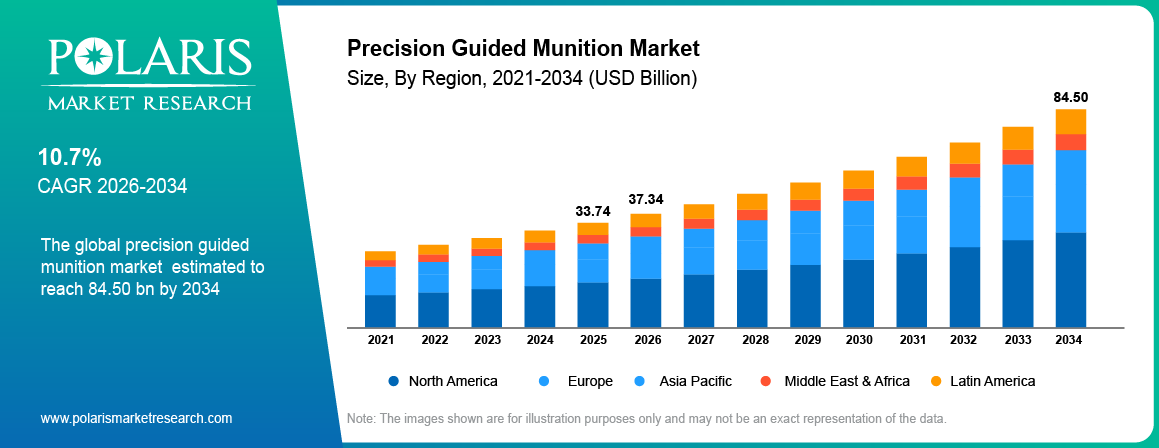
The global precision guided munition market was valued at USD 33.74 billion in 2025 and is expected to grow at a CAGR of 10.7% during the forecast period. The market is projected to reach USD 84.50 billion by 2034.
Market Statistics
Key Takeaways
- North America dominated the global precision guided munition market in 2025, accounting for 10.7% of revenue. Strong defense spending and military modernization support its leading position.
- Asia Pacific is projected to grow at a CAGR of 12.60% from 2026 to 2034. Rising defense modernization and regional security concerns are expected to drive growth.
- The subsonic segment held the significant market share of 36.00% in 2025. Its cost-effectiveness and compatibility with existing military platforms support its leading position.
- The supersonic segment is projected to grow at a CAGR of 9.60% during the forecast period. Demand for faster precision-strike capabilities is expected to support growth.
- The GPS segment accounted for the largest revenue share in 2025, at 26.00%. Its positioning accuracy and integration into modern guidance systems support demand.
- The infrared segment is projected to grow at a CAGR of 10.90% during the forecast period. Improved target detection and sensor miniaturization are expected to drive growth.
Note: Figures and projections outlined in this report are the result of Polaris Market Research’s proprietary analytical processes, grounded in the latest available datasets and market observations.
Market Definition & Market Overview
Precision-guided munitions (PGMs) are guided weapon systems that use onboard navigation, sensing, or homing technologies to improve accuracy compared with unguided munitions. The market includes tactical missiles, guided rockets, guided ammunition, torpedoes, and loitering munitions. These systems use advanced guidance technologies to improve targeting accuracy and reduce unintended impact areas.
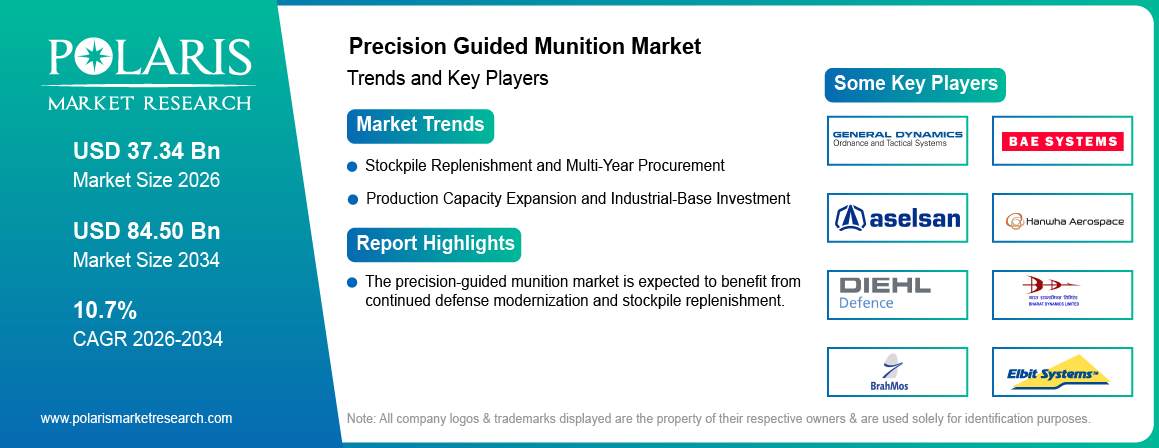
Market growth is driven by rising defense spending, military modernization, and increasing demand for advanced weapon systems. Governments are also prioritizing stockpile replenishment and multi-year procurement agreements to strengthen their defense capabilities.
The growing focus on production capacity is also shaping the market. In February 2026, RTX's Raytheon business signed five framework agreements with the U.S. Department of War. Some munitions are expected to reach two to four times their previous production rates (Source: rtx.com).
In March 2026, Lockheed Martin announced an agreement to quadruple Precision Strike Missile production capacity. MBDA also projected a 40% increase in guided weapon output for 2026 (Source: lockheedmartin.com)
Three major trends are shaping the market outlook: increased production capacity, demand for affordable precision systems, and advancements in resilient navigation technologies. Low-cost guidance kits and digital engineering are supporting efforts to improve affordability and production efficiency. Meanwhile, multi-mode guidance technologies are reducing dependence on a single positioning source.
Market Dynamics
The precision guided munition market is shaped by rising defense spending, military modernization, and increasing demand for accurate weapon systems. Growing geopolitical tensions and changing defense priorities are encouraging governments to strengthen military inventories. Stockpile replenishment, multi-year procurement agreements, and investments in munitions production capacity are supporting market growth. Additionally, advancements in digital engineering, guidance technologies, and modular weapon architectures are creating new market opportunities. However, production bottlenecks, export controls, and high manufacturing costs continue to challenge market expansion.
Driver: Stockpile Replenishment and Multi-Year Procurement
Stockpile replenishment is a major driver of the precision guided munition market. Military operations and defense support commitments have increased the need to rebuild depleted ammunition inventories. Governments are prioritizing long-term procurement strategies to maintain reliable weapon supplies. Multi-year procurement agreements and framework agreements are helping defense agencies secure production capacity and ensure consistent deliveries. These contracts also provide manufacturers with greater visibility into future demand. Increasing investments in guided missiles, guided rockets, and precision ammunition are further supporting market growth.
Driver: Production Capacity Expansion and Industrial-Base Investment
Increasing munitions production capacity is supporting the growth of the precision guided munition market. Defense manufacturers are expanding manufacturing facilities to meet rising military demand. Investments in the defense industrial base are strengthening supply chains for propulsion systems, guidance electronics, and other critical components. For instance, Lockheed Martin announced a framework agreement in March 2026 to quadruple Precision Strike Missile production capacity. MBDA also projected a 40% increase in guided weapon output for 2026. Such investments are encouraging manufacturers to expand production capabilities and support long-term defense procurement requirements (Source: mbda-systems.com).
Driver: Defense Modernization and Allied Interoperability
Defense modernization programs are increasing demand for advanced precision guided munitions. Countries are upgrading their military capabilities with modern missiles, guided rockets, and precision ammunition. NATO rearmament initiatives and allied defense cooperation are also supporting procurement activities. Military forces increasingly require weapon systems that can integrate with existing aircraft, naval platforms, and land-based launch systems. Interoperability between allied forces is encouraging investments in compatible guidance technologies and advanced weapon platforms. These developments are expected to support demand across the global precision guided munition market.
Opportunity: Affordable Precision, Digital Engineering and Modular Open Architectures
The growing demand for affordable precision weapons is creating opportunities for market participants. Defense manufacturers are exploring low-cost guidance kits and modular open architectures to improve affordability and production flexibility. Digital engineering is helping companies streamline weapon development and improve design efficiency. For instance, Raytheon UK introduced Red Kite in July 2026, a precision weapon designed and digitally engineered in the UK. Similarly, Boeing's JDAM Long Range program reflects efforts to develop extended-range guidance kit solutions. These advancements are creating opportunities for manufacturers to deliver cost-effective precision capabilities (Source: rtx.com).
Restraints & Challenges: Production Bottlenecks, Export Controls, Cost Pressure
Production bottlenecks remain a major challenge for the precision guided munition market. Manufacturing depends on specialized components, including propulsion systems, electronic guidance units, and advanced sensors. Supply chain disruptions can delay production and affect delivery schedules. Export controls also restrict the international movement of sensitive defense technologies and components. Additionally, the high cost of precision electronics, testing, and integration can increase manufacturing expenses. These challenges may affect procurement timelines and limit production scalability. Manufacturers must strengthen supply chains and improve production efficiency to meet growing defense requirements.
Precision-Guided vs. Unguided Munitions
Precision-guided munitions use onboard navigation and guidance technologies to improve targeting accuracy. In contrast, unguided munitions follow a ballistic or predetermined path without correcting their direction after launch. Precision-guided systems generally offer greater accuracy but involve higher costs and more complex integration. Both types serve different military requirements, depending on operational needs, procurement budgets, and inventory priorities. The following table highlights their key differences.
| Factor | Precision-Guided Munitions | Unguided Munitions |
| Guidance | Use onboard navigation systems or seekers to guide the munition. | Have no guidance system after launch. |
| Accuracy | Designed to achieve consistent accuracy against specific targets. | Accuracy is less predictable, with dispersion increasing over longer distances. |
| Unit Cost | Generally higher due to electronic components, sensors, and testing requirements. | Generally lower due to simpler designs and established high-volume production. |
| Integration | Require integration with platform software and control systems. | Require minimal platform integration. |
| Procurement Model | Often procured through multi-year framework and production contracts. | Commonly procured in bulk for stockpile replenishment. |
| Market Growth Drivers | Driven by military modernization, stockpile replenishment, and demand for affordable precision systems. | Driven by volume-based replenishment and training requirements. |
Source: Polaris Market Research Analysis
Guidance and Navigation Technologies
Guidance and navigation technologies help precision-guided munitions reach their intended targets with greater accuracy. These systems use satellite signals, onboard sensors, and seeker technologies to track position, detect targets, and adjust the munition’s path during flight. The choice of technology depends on the munition type, operating environment, target conditions, and mission requirements.
GNSS/GPS and Inertial Navigation
Global Navigation Satellite Systems (GNSS), including GPS, provide positioning information that helps guided munitions determine their location and follow a planned route. These systems support accurate navigation by using signals from satellites. However, their performance can be affected by signal jamming, interference, or limited satellite access.
Inertial Navigation Systems (INS) use onboard sensors to track movement, direction, and changes in position. Unlike satellite-based navigation, INS does not depend on external signals. It is commonly combined with GNSS/GPS to maintain navigation accuracy when satellite signals become weak or unavailable. This combination improves reliability across different operating conditions.
Seeker Technologies: Infrared, Laser and Radar
Seeker technologies help precision-guided munitions detect, track, or home in on a target. Infrared seekers identify targets through their heat signatures, while laser seekers use reflected laser energy to guide the munition toward a designated point. Radar seekers use radio-frequency signals to detect and track targets. Each technology has different operating requirements and performance characteristics.
Infrared seekers support target detection without requiring external laser designation. Laser seekers can provide accurate targeting but depend on a suitable designation source. Radar seekers can operate in different visibility conditions, although they generally involve higher system costs. The choice of seeker depends on target characteristics, environmental conditions, and mission requirements.
Major Guidance and Navigation Technologies
| Technology | Signal Source | External Dependence | Maturity | Market Note |
| GNSS / GPS | Satellite navigation signals | High; depends on satellite availability | Established | Low-cost guidance kits support demand for resilient receivers. |
| Inertial Navigation System (INS) | Onboard motion sensors | None | Established | Commonly paired with GNSS in modern guidance systems. |
| Laser Seeker | Reflected laser energy | Requires external laser designation | Established | Commonly used in guided rockets and bombs. |
| Infrared / Imaging IR | Target heat signatures | None | Established; ongoing miniaturisation | Smaller sensors help reduce system cost and weight. |
| Radar Seeker | Radio-frequency signals reflected from targets | None | Established | Supports operation in different weather and visibility conditions, but adds cost. |
| Passive RF (Anti-Radiation) | Emitted radio-frequency energy | Depends on the target's emissions | Established; niche use | Used in mission-specific applications. |
| Multi-Mode Guidance | Combination of two or more guidance technologies | Reduced dependence on a single source | Emerging to established | Supports navigation resilience across changing operating conditions. |
Source: Polaris Market Research Analysis
Multi-Mode Guidance and Resilient Navigation
Multi-mode guidance combines two or more navigation or seeker technologies within a single munition. For example, a system may combine GNSS/GPS with inertial navigation or use additional seeker inputs to support target tracking. This approach reduces dependence on a single guidance source.
Resilient navigation is becoming more important as electronic interference and signal disruption affect military operations. Combining different guidance methods can help maintain accuracy when one source becomes unavailable or unreliable. These systems also support the growing demand for precision-guided munitions that can operate across changing battlefield conditions.
Role of Electronics and Software
Electronics and software are central to the performance of modern precision-guided munitions. Onboard processors interpret navigation data, manage sensor inputs, and support guidance functions during flight. Electronic components also connect navigation systems, seekers, and control mechanisms.
Advances in digital engineering and modular designs are helping manufacturers improve system development and production efficiency. Modular architectures can support upgrades and integration across different platforms. Improvements in electronic components and software also contribute to more affordable guidance systems and wider production capacity.
Precision-Guided Munitions vs. Autonomous Weapon Systems
Precision-guided munitions use navigation and seeker technologies to improve targeting accuracy. Autonomous weapon systems can perform target identification and engagement with varying levels of human involvement. The key difference is the level of autonomy in decision-making and target engagement.
| Factor | Precision-Guided Munitions | Loitering Munitions | Autonomous Weapon Systems |
| Defining Attribute | Use guidance technologies to improve targeting accuracy. | Can remain airborne for a period before engaging a target. | Use onboard systems to perform certain functions with varying levels of machine control. |
| Autonomy | Guidance does not necessarily imply autonomous decision-making. | Typically operate with human supervision, depending on the system. | May perform target identification or engagement functions with varying levels of human involvement. |
| Relationship | Broad category of guided weapon systems. | A product category within the precision-guided munition market. | Overlaps with precision-guided munitions but is a separate market category. |
| Polaris Market Coverage | Precision Guided Munition Market |
Source: Polaris Market Research Analysis
Segment Analysis
By Product
The global precision-guided munition market segmentation, based on product, includes tactical missiles, guided rockets, guided ammunition, torpedoes, and loitering munitions. In 2025, the tactical missiles segment accounted for the largest market share of 48.60%. Its leading position is supported by increasing defense spending, military modernization programs, and the growing need for accurate strike capabilities. Tactical missiles are used in battlefield and theatre-level operations to engage specific targets. Their advanced guidance systems help improve targeting accuracy and support their use across different military platforms.
The loitering munitions segment is expected to grow at the fastest CAGR of 16.20% during 2026–2034. These systems can remain airborne for a certain period before engaging a target, combining surveillance capabilities with precision-strike functions. Their growing adoption is supported by demand for flexible weapon systems, advancements in onboard sensors, and improvements in guidance technologies. Increasing defense investments and the development of more affordable precision-strike solutions are also expected to support segment growth.
| Product | Market Definition | Scope Boundary |
| Tactical Missiles | Self-propelled guided missiles designed for battlefield and theatre-level missions. | Strategic ballistic missiles are excluded. |
| Guided Rockets | Rockets fitted with guidance packages, typically launched from multiple-launch or aircraft rocket systems. | Unguided rockets are excluded. |
| Guided Ammunition | Bombs, artillery projectiles, and mortar rounds designed or modified with guidance kits. | Unguided rounds are covered under the Ammunition Market. |
| Torpedoes | Self-propelled guided underwater weapons launched from ships, submarines, or aircraft. | Naval mines are excluded. |
| Loitering Munitions | Expendable uncrewed systems that can remain airborne before engaging a target. | Detailed coverage is provided in the specialist Loitering Munition Market report. |
Source: Polaris Market Research Analysis
By Speed
The global precision-guided munition market segmentation, based on speed, includes subsonic, supersonic, and hypersonic munitions. In 2025, the subsonic segment accounted for the significant market share of 36.00%. Its leading position is supported by the widespread use of conventional guided weapons across land, air, and naval platforms. These munitions are used in different military operations and benefit from established production capabilities. Their continued demand is also supported by military modernization programs and the replenishment of existing weapon inventories.
The supersonic segment is expected to grow at the CAGR of 9.60% during 2026–2034. These munitions travel faster than the speed of sound, helping reduce the time available for target detection and response. Growing demand for faster strike capabilities and improvements in propulsion, navigation, and guidance technologies are supporting this segment. Increasing defense investments and the development of advanced missile systems are also expected to contribute to its growth.
The hypersonic segment represents an emerging area of development in the precision-guided munition market. These systems travel at speeds above Mach 5 and are attracting attention through ongoing defense research and development programs. However, their high development costs and technical complexity make them a more specialized category compared with established subsonic and supersonic systems.
By Guidance & Navigation Technology
The global precision-guided munition market segmentation, based on guidance and navigation technology, includes infrared, laser, inertial navigation systems (INS), Global Positioning System (GPS), radar homing, and anti-radiation technologies. In 2025, the GPS segment accounted for the largest market share of 26.00%. Its leading position is supported by the widespread use of satellite navigation in modern guided weapon systems. GPS helps munitions determine their position and follow planned routes, improving targeting accuracy across different military applications.
The infrared segment is expected to grow at the fastest CAGR of 10.90% during 2026–2034. Infrared guidance uses heat signatures to detect and track targets. Improvements in imaging sensors and sensor miniaturisation are supporting the development of compact and efficient guidance systems. Growing demand for advanced targeting capabilities is also expected to support segment growth.
Other technologies also contribute to the market. Laser guidance uses reflected laser energy to direct munitions toward designated targets, while INS relies on onboard motion sensors for navigation. Radar homing uses radio-frequency signals to detect and track targets. Anti-radiation systems use signals emitted by electronic equipment to guide munitions toward specific sources.
By Launch Platform
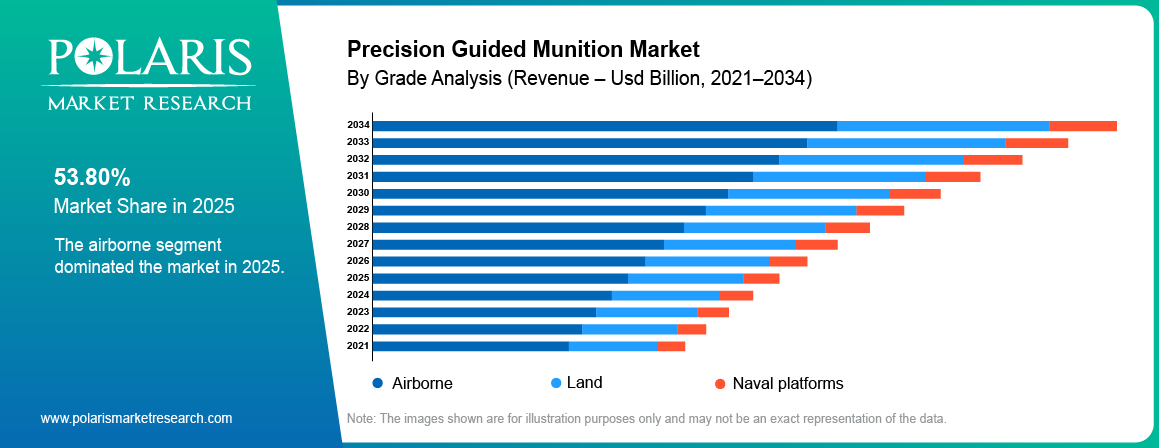
The global precision-guided munition market segmentation, based on launch platform, includes land, airborne, and naval platforms. In 2025, the airborne segment accounted for the largest market share of 53.80%. Its leading position is supported by the widespread use of aircraft-launched guided weapons, including precision-guided bombs and air-to-surface missiles. Military modernization programs and the growing adoption of advanced strike capabilities are also supporting demand. Airborne platforms offer flexibility in engaging targets across different operational environments.
The land segment is expected to grow at the CAGR of 10.50% during 2026–2034. Its growth is supported by rising demand for ground-based precision strike systems, guided rockets, and tactical missiles. Increasing investments in artillery modernization and the replenishment of military inventories are also contributing to segment growth.
The naval segment includes precision-guided weapons launched from ships and submarines. Demand is supported by naval modernization programs and the need to strengthen maritime defense capabilities.
| Factor | Land | Airborne | Naval |
| Typical Products | Guided rockets, tactical missiles, and guided artillery | Guided bombs and air-launched missiles | Ship- and submarine-launched missiles, and torpedoes |
| Integration | Requires compatibility with launchers and fire-control systems. | Requires aircraft certification and integration with onboard software. | Requires integration with vertical launch systems and naval combat systems. |
| Procurement | Army procurement programs, often involving high-volume rocket orders. | Air force procurement programs, including guidance kits and air-launched weapons. | Navy procurement programs, generally involving lower volumes and higher unit values. |
| 2026 Developments | Lockheed Martin's framework agreement to quadruple Precision Strike Missile (PrSM) production capacity. | Boeing received an initial production contract for JDAM Long Range (JDAM LR). | Kongsberg began construction of its first U.S. missile production facility for Naval Strike Missile (NSM) and Joint Strike Missile (JSM). |
Source: Polaris Market Research Analysis
Regional Analysis
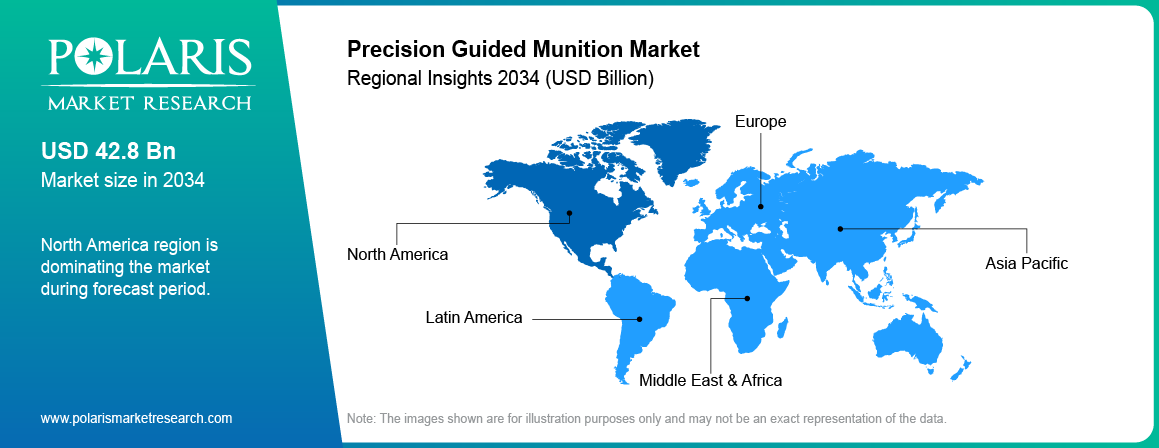
The global precision-guided munition market is analyzed across North America, Europe, Asia Pacific, the Middle East & Africa, and Latin America. Regional demand is shaped by defense spending, military modernization programs, security concerns, and the need to strengthen military capabilities. Procurement priorities and investments in domestic defense production also influence market growth across these regions.
North America
North America accounted for the largest share of the global precision-guided munition market in 2025, with a revenue share of 36.80%. The region's leading position is supported by high defense spending, advanced military capabilities, and continuous investments in weapon modernization. The United States represents a major contributor to regional demand through its procurement of guided missiles, precision-guided bombs, and advanced ammunition. Ongoing efforts to replenish military inventories and expand domestic production capacity are also supporting market growth. Canada further contributes through defense modernization and investments in advanced military technologies.
Europe
Europe is an important market for precision-guided munitions, supported by rising defense investments and efforts to strengthen regional security. NATO members are increasing their focus on military readiness, stockpile replenishment, and the modernization of existing weapon systems. Countries such as the United Kingdom, France, Germany, and Poland are investing in advanced defense capabilities. Regional manufacturers are also expanding production capacity to meet growing procurement requirements. These developments are supporting demand for guided missiles, precision ammunition, and other advanced weapon systems.
Asia Pacific
The Asia Pacific precision-guided munition market is expected to grow at the fastest CAGR of 12.60% during 2026–2034. Growth is supported by rising defense budgets, military modernization programs, and increasing demand for advanced weapon systems. Countries such as China, India, Japan, South Korea, and Australia are strengthening their defense capabilities through investments in guided missiles, precision ammunition, and advanced navigation technologies. Regional security concerns and territorial disputes are also encouraging governments to improve their military readiness. In addition, investments in domestic defense manufacturing and international technology partnerships are supporting the development of regional production capabilities.
Middle East & Africa
The Middle East & Africa market is supported by defense modernization programs and the need to strengthen national security. Countries in the Middle East are investing in advanced missile systems, guided ammunition, and precision-strike capabilities. Regional security concerns and ongoing military procurement programs are contributing to demand for modern weapon systems. In Africa, defense investments are focused on improving military equipment and strengthening security capabilities. However, differences in defense budgets and procurement priorities create varied growth opportunities across the region.
Latin America
The Latin America precision-guided munition market is developing as countries gradually modernize their military equipment and strengthen defense capabilities. Brazil, Mexico, Chile, and other regional countries are focusing on upgrading military platforms and improving operational readiness. Demand is supported by investments in defense equipment, border security, and naval modernization. However, limited defense budgets and competing public spending priorities may affect the pace of procurement. The adoption of advanced guided weapon systems is expected to depend on future defense spending and modernization requirements.
Key Players & Competitive Landscape
The global precision-guided munition market is highly competitive, with major defense manufacturers focusing on product development, production expansion, and advanced guidance technologies. Companies are strengthening their market positions through investments in research and development, strategic partnerships, and long-term defense contracts. Growing demand for precision-strike capabilities and stockpile replenishment is also encouraging manufacturers to expand production capacity and improve their product offerings.
Key players are developing guided missiles, precision-guided bombs, rockets, and advanced ammunition for land, airborne, and naval platforms. Companies are also investing in digital engineering, multi-mode guidance, and resilient navigation technologies to improve system performance. In addition, rising defense procurement and modernization programs across North America, Europe, and Asia Pacific are creating opportunities for established manufacturers and regional defense suppliers.
Major companies operating in the market include Lockheed Martin Corporation, RTX Corporation, Northrop Grumman Corporation, BAE Systems plc, MBDA, Thales Group, Saab AB, The Boeing Company, Kongsberg Defence & Aerospace, and Rafael Advanced Defense Systems.
Key Players
- ASELSAN A.Ş.
- BAE Systems plc
- Bharat Dynamics Limited
- BrahMos Aerospace
- Diehl Defence GmbH & Co. KG
- Elbit Systems Ltd.
- General Dynamics Corporation (Ordnance and Tactical Systems)
- Hanwha Aerospace
- Israel Aerospace Industries Ltd.
- Kongsberg Defence & Aerospace
- Leonardo S.p.A.
- Lockheed Martin Corporation
- MBDA
- Northrop Grumman Corporation
- Rafael Advanced Defense Systems Ltd.
- Rheinmetall AG
- Roketsan A.Ş.
- RTX Corporation (Raytheon)
- Saab AB
- Thales Group
- The Boeing Company
Vendor Positioning in the Precision-Guided Munition Market
| Company (Business Unit) | Headquarters | Primary PGM Categories | Representative Programs |
| Lockheed Martin (Missiles and Fire Control) | United States | Tactical missiles, guided rockets | PrSM, GMLRS, JAGM |
| RTX Corporation (Raytheon) | United States | Cruise missiles, air-to-air missiles, guided bombs | Tomahawk, AMRAAM, StormBreaker, Paveway IV, Red Kite |
| The Boeing Company (Defense, Space & Security) | United States | Guidance kits, guided bombs | JDAM, JDAM LR, SDB |
| Northrop Grumman Corporation | United States | Guidance kits, propulsion, anti-radiation missiles | Precision Guidance Kit, AARGM-ER |
| General Dynamics Corporation (Ordnance and Tactical Systems) | United States | Guided artillery projectiles, components | Extended-range 155mm projectile |
| BAE Systems plc | United Kingdom | Guided rockets, guided artillery | APKWS, Excalibur (with RTX) |
| MBDA | Europe | Cruise missiles, air-to-surface missiles, air-to-air missiles | Storm Shadow/SCALP, Brimstone, Meteor |
| Kongsberg Defence & Aerospace | Norway | Naval and air-launched strike missiles | NSM, JSM |
| Diehl Defence GmbH & Co. KG / Leonardo S.p.A. | Germany / Italy | Guided artillery ammunition, torpedoes (Leonardo) | VULCANO, Black Shark |
| Rafael Advanced Defense Systems Ltd. | Israel | Guidance kits, tactical missiles | SPICE |
| Israel Aerospace Industries Ltd. | Israel | Loitering munitions, missiles | Harop |
| Elbit Systems Ltd. | Israel | Loitering munitions, guided munitions | SkyStriker |
| Hanwha Aerospace | South Korea | Guided rockets | Chunmoo guided rockets |
| Bharat Dynamics Limited / Roketsan A.Ş. / ASELSAN A.Ş. | India / Türkiye | Regional missile and guidance systems | Indigenous programs |
Source: Polaris Market Research Analysis
Recent Developments
- August 2026: The U.S. Air Force awarded Boeing a USD 75 million contract for the initial production of JDAM Long Range (GBU-75). (Source: boeing.com)
- July 2026: Raytheon UK (RTX) unveiled Red Kite, its first sovereign precision weapon designed and digitally engineered in the UK using the Stormbreaker airframe. (Source: rtx.com)
- July 2026: The NATO Support and Procurement Agency awarded Diehl Defence a contract for 155mm VULCANO guided ammunition, with deliveries scheduled to begin in 2027. (Source: thedefensepost.com)
- March 2026: Lockheed Martin and the U.S. Department of War signed a framework agreement to quadruple Precision Strike Missile production capacity, building on a USD 4.94 billion Army award. (Source: lockheedmartin.com)
- March 2026: MBDA announced a planned 40% increase in guided weapon output for 2026 after doubling production since 2023. The increase is supported by a EUR 5 billion European investment plan for 2026–2030. (Source: mbda-systems.com)
- February 2026: Raytheon signed five framework agreements of up to seven years covering Tomahawk, AMRAAM, SM-3 IB/IIA, and SM-6. Some production lines are expected to increase output by two to four times their previous rates. (Source: rtx.com)
- January 2026: Kongsberg Defence & Aerospace broke ground on its first U.S. missile production facility in Virginia for Naval Strike Missile (NSM) and Joint Strike Missile (JSM) production. Manufacturing is expected to begin in late 2027. (Source: kongsberg.com)
Future Outlook
The precision-guided munition market is expected to benefit from continued defense modernization and stockpile replenishment. Governments are likely to prioritize long-term procurement agreements and investments in domestic production capacity. Demand for affordable precision systems, including low-cost guidance kits, may support wider adoption. Advances in digital engineering and modular designs are also expected to improve production efficiency. Meanwhile, multi-mode guidance and resilient navigation technologies may strengthen system performance in environments affected by signal interference.
Research Methodology
The precision-guided munition market report uses a combination of primary and secondary research to assess market trends, segment performance, and growth opportunities. The study covers tactical missiles, guided rockets, guided ammunition, torpedoes, and loitering munitions. It also examines guidance and navigation technologies, speed categories, launch platforms, and regional markets.
Secondary research includes defense budget documents, procurement announcements, company annual reports, investor materials, trade data, and policy updates from defense ministries, NATO agencies, and the European Defence Agency. Primary research involves discussions with manufacturers, component suppliers, system integrators, and procurement specialists. These inputs help validate market segmentation, pricing ranges, and production assumptions.
Market sizing follows a bottom-up approach based on program-level procurement and production capacity. The estimates are cross-checked against defense spending through a top-down approach. Forecasts consider defense budgets, multi-year procurement agreements, production expansion, supply-chain constraints, and export controls. Announced contracts are treated as backlog rather than completed sales.
The study also reconciles figures with related Polaris reports to avoid double counting. It uses 2025 as the base year, 2021–2024 as the historical period, and 2026–2034 as the forecast period.
Report Scope
| Report Attributes | Details |
| Market size value in 2025 | USD 33.74 billion |
| Market size value in 2026 | USD 37.34 billion |
| Revenue forecast in 2034 | USD 84.50 billion |
| CAGR | 10.7% from 2026 - 2034 |
| Base year | 2025 |
| Historical data | 2021 - 2024 |
| Forecast period | 2026 - 2034 |
| Quantitative units | Revenue in USD million/billion and CAGR from 2026 to 2034 |
| Segments covered |
|
| Regional scope |
|
Source: Polaris Market Research Analysis
Precision Guided Munition Market FAQ's
Precision-guided munitions are guided weapon systems that use navigation, sensors, or homing technologies to improve targeting accuracy compared with unguided weapons.
The market includes tactical missiles, guided rockets, guided ammunition, torpedoes, and loitering munitions.
Major technologies include GPS/GNSS, inertial navigation systems, infrared guidance, laser guidance, radar homing, and passive RF guidance.
Market growth is supported by rising defense spending, military modernization, stockpile replenishment, and investments in production capacity.
North America held the largest share of the market in 2025, supported by defense spending, advanced military capabilities, and ongoing modernization programs.
Asia Pacific is expected to register the fastest growth during 2026–2034, driven by rising defense budgets and military modernization.
Key players include Lockheed Martin Corporation, RTX Corporation, Northrop Grumman Corporation, BAE Systems plc, MBDA, The Boeing Company, and Kongsberg Defence & Aerospace.
Key trends include production capacity expansion, affordable precision systems, digital engineering, modular designs, and multi-mode guidance technologies.
The global precision-guided munition market is expected to grow at a CAGR of 10.7% from 2026 to 2034, supported by rising defense spending, military modernization, and increasing demand for precision-strike systems.

Download Sample Report of Precision Guided Munition Market
Please fill out the form to request a customized copy of the research report.


