
Autonomous Weapons Systems Market Size, Share, Trends & Forecast, 2026–2034
REPORT DETAILS
Autonomous Weapons Systems Market Summary
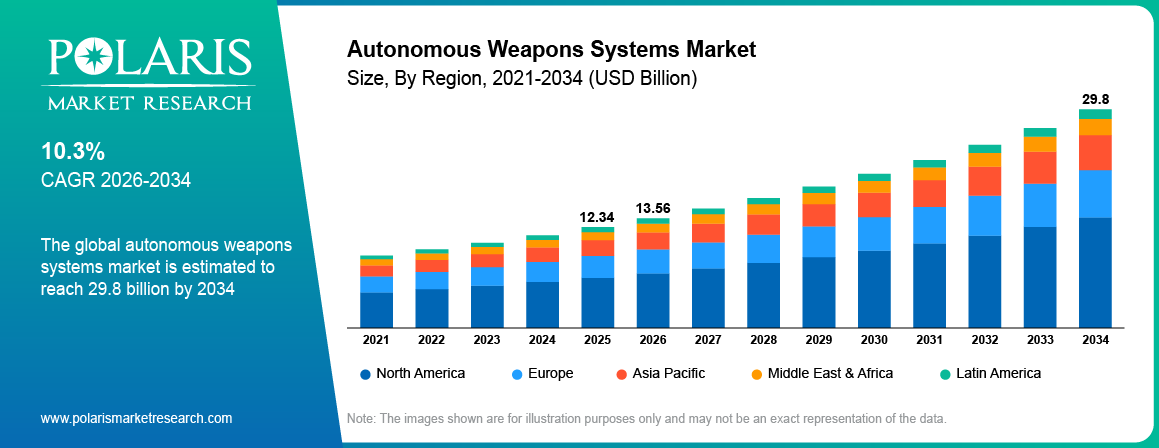
The autonomous weapons systems market size is projected to reach USD 12.3 Billion in 2025 and is expected to reach USD 29.8 Billion by 2034, growing at a CAGR of 10.3% from 2026 to 2034. The market is witnessing increasing momentum due to the rising defense agencies' investments in AI-driven technologies, mission autonomy software, and future-ready unmanned combat capabilities.
Market Statistics
Autonomous Weapons Systems Market Key Takeaways
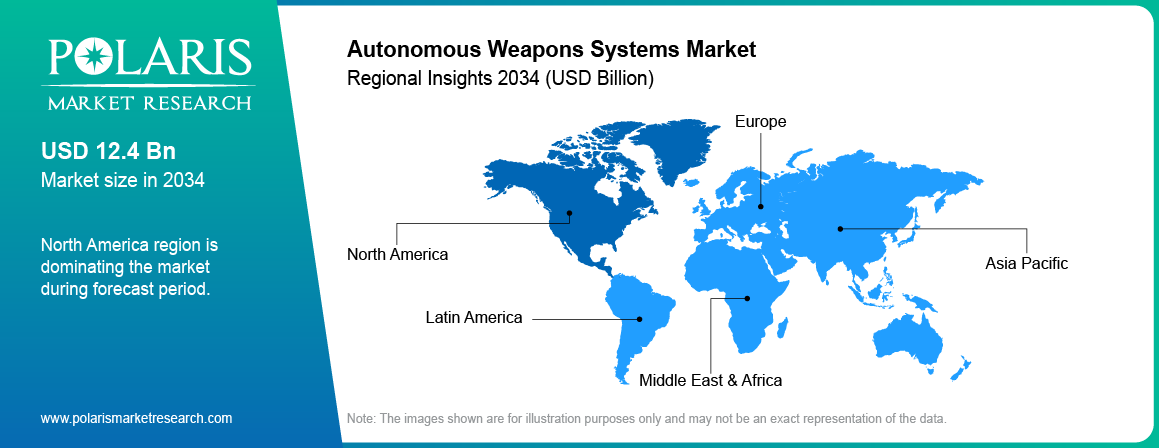
- North America dominated the market in 2025 with the market size of USD 5.1 billion. This growth was supported by sustained defense modernization, mission-autonomy programs, and strong investments in counter-UAS and collaborative autonomous technologies.
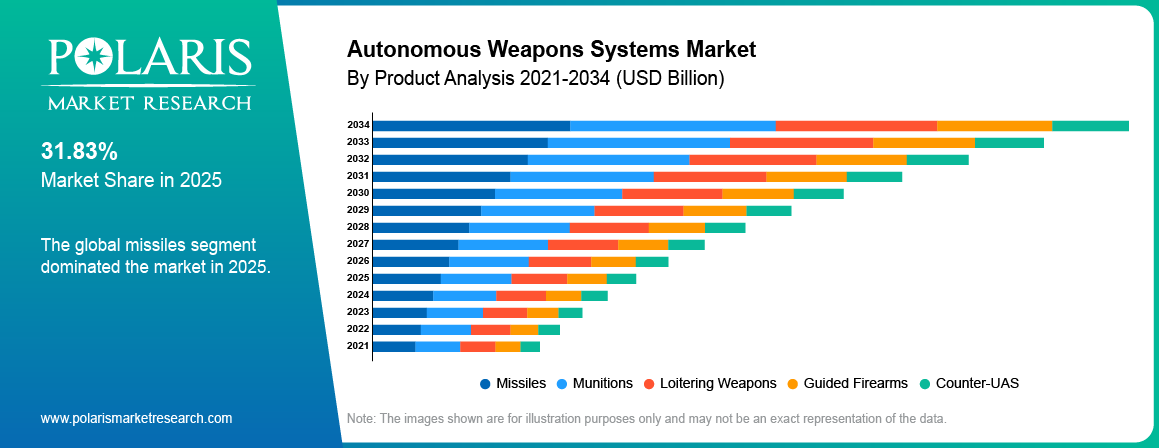
- The missiles category captured the largest market share of 31.83%, while counter-UAS systems are estimated to record the highest growth rate of more than 10.1% during the forecast period.
- The adoption of semi-autonomous systems is dominating the market due to fewer regulatory barriers to deployment
- The use of UN General Assembly Resolution A/RES/80/57 and DoD Directive 3000.09 is impacting product development, system validations, and procurement trends within the industry.
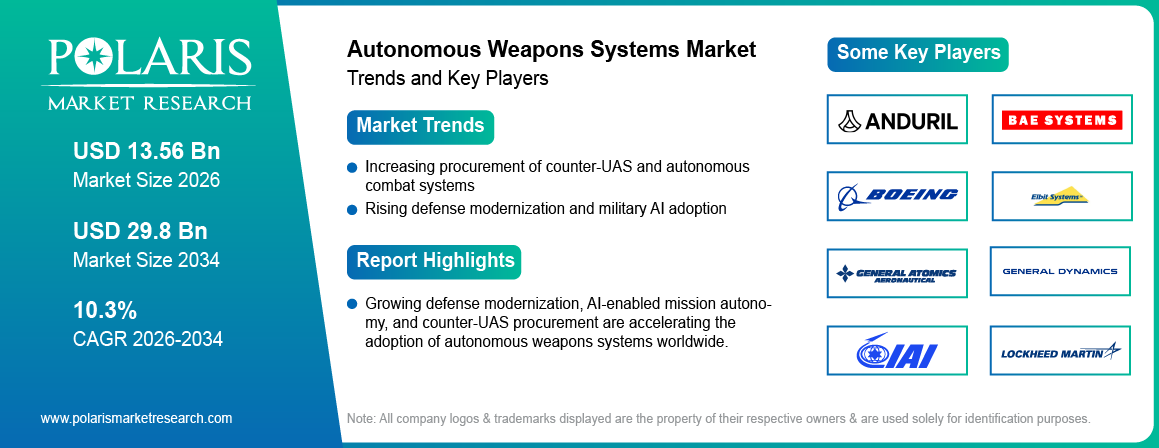
- Collaborations, production-scale efforts, and investments in modular autonomy software have been accelerating the move from the demonstration phase to the operations phase in the industry.
Note: Figures and projections outlined in this report are the result of Polaris Market Research’s proprietary analytical processes, grounded in the latest available datasets and market observations.
Market Definition and Growth Analysis
Autonomous weapons systems use sensors, artificial intelligence, mission control software, communications, and precise effectors to perform operations with limited human intervention but with command authority. The market is about autonomous weapons systems, which include semi-autonomous missiles, loitering weapons, counter-UAS, guided weapon stations, collaborative autonomous systems, and mission software.
Rising defense modernization spending continues to create favorable conditions for market expansion. Global military expenditure reached USD 2.887 trillion in 2025, with spending increasing by 14% in Europe and 8.1% across Asia and Oceania, supporting investments in autonomous combat systems, counter-UAS capabilities, precision strike technologies, and advanced command-and-control infrastructure (Source: sipri.org). At the same time, evolving regulatory frameworks such as UN General Assembly Resolution A/RES/80/57 and the U.S. Department of Defense Directive 3000.09 are encouraging manufacturers to strengthen system assurance, operational transparency, and responsible deployment practices (Source: digitallibrary.un.org).
Source: Polaris Market Research Analysis
Growing adoption of software-centric procurement models is reshaping revenue generation across the industry. Beyond platform acquisition, defense agencies are investing in mission software integration, autonomy upgrades, lifecycle support, and sustainment services. The USD 86 million USSOCOM mission-autonomy integration contract awarded to Anduril and Elbit Systems' USD 60 million ReDrone contract highlight increasing demand for software-enabled autonomous defense solutions and modular counter-UAS capabilities (Source: anduril.com)
The market is also witnessing a gradual shift from technology validation toward large-scale production. Companies are expanding manufacturing capacity while improving software interoperability, verification frameworks, and lifecycle affordability to meet evolving defense requirements. Anduril's production agreement targeting at least 1,000 Barracuda rounds annually demonstrates this transition toward scalable autonomous weapons manufacturing, although procurement timelines continue to be influenced by export controls, cybersecurity requirements, and system certification processes (Source: anduril.com)
Market Dynamics
Driver Impact Analysis
| Market Driver | Est. CAGR Impact | Geographic Relevance | Impact Timeline |
| Counter-UAS procurement | +2.8% | North America, Europe, Middle East | Short-term (ongoing) |
| Defense modernization | +3.2% | Global | Short to medium term |
| Reusable mission autonomy software | +1.8% | North America, Europe, Asia Pacific | Medium term (2-4 years) |
| Collaborative autonomous operations | +1.2% | US and allied markets | Medium to long term |
| Scaled autonomous weapons production | +1.0% | North America & Europe | Medium term (2-4 years) |
| Governance and assurance requirements | +0.4% | Global | Long-term structural |
Source: Polaris Market Research Analysis
Driver: Defense Modernization
Defense modernization efforts are leading to an increase in the deployment of autonomous weapons platforms in air, ground, and maritime warfare scenarios. Defense agencies are making increasing use of AI-based technologies that improve operational efficiency and speed while minimizing risk to personnel. This environment of defense procurement remains favorable for investment in autonomous combat platforms, precision strike weapons, counter-UAS solutions, and command and control networks.
Driver: Increased demand for counter-UAS solutions
The increasing demand for counter-UAS solutions is offering new possibilities for the use of autonomous weapon technologies. The increasing use of unmanned aerial systems on modern battlefields has necessitated autonomous detection, tracking, recognition, and engagement capabilities. The counter-UAS systems make use of radar technology, electro-optical sensors, electronic warfare technologies, command-and-control software, and autonomous interceptors to enable a quick response to threats.
For instance, Elbit Systems received a USD 60 million contract for providing its ReDrone counter-UAS system to a NATO European nation (Source: elbitsystems.com) The Lockheed Martin company also introduced an innovative counter-UAS system that includes sensors and a command-and-control system.
Opportunity: Modular Mission-Autonomy Software Expanding Commercial Applications
Developments in mission-autonomy software is increasing the commercial applications of autonomous weapon systems. Defense entities are increasingly opting for modular software that is employed on a range of platforms, including vehicles, sensor arrays, launcher systems, and weapon systems instead of having dedicated control systems for each specific platform. This enhances interoperability and reduces deployment time and overall costs.
RTX's collaboration with Shield AI in integrating Hivemind autonomy software on loitering munitions and Northrop Grumman's demonstrations of Talon IQ autonomous flight operations demonstrate the trend toward reusable autonomy systems (Source: rtx.com). Increasing instances of collaborative autonomy are set to create further need for edge computing, simulation, digital twins, and software testing environments.
Restraints: Regulatory and Governance Requirements
The challenges associated with regulatory oversight, system verification needs, and cybersecurity persist for players in the market. Governance models are tightened by governments so that autonomous weapons systems run in well-defined legal and operational parameters. UN General Assembly resolution A/RES/80/57 and DoD Directive 3000.09 have necessitated that manufacturers prove system predictability, transparency, human oversight, and rigorous testing in the process of development.
In addition, autonomous systems must maintain reliable performance under contested communications, electronic warfare conditions, and rapidly evolving battlefield environments. Meeting these technical and regulatory requirements increases development costs, extends procurement timelines, and raises barriers for new entrants, particularly those lacking large-scale testing, certification, and long-term sustainment capabilities.
Source: Polaris Market Research Analysis
Market Segment Analysis
The report provides a comprehensive analysis of the autonomous weapons systems market by product, platform, level of autonomy, technology, application, and region to identify the major revenue-generating and fastest-growing market segments.
Product Insights
The missiles segment dominated the market in 2025 with the estimated market size of USD 3.9 billion, owing to its ability to combine intelligence, surveillance, target acquisition, and precision strike capabilities within a single platform. Growing demand for persistent battlefield awareness, improved target engagement accuracy, and reduced operator exposure has accelerated procurement of loitering munitions across modern defense programs.
The counter-UAS segment is expected to register the fastest growth of more than 10% CAGR during the forecast period. The rising need for autonomous detection, identification, tracking, and interception systems in conjunction with unmanned aerial systems being used in various military operations is the key driver behind the growing requirement for counter-drone systems. Various defense organizations are developing multi-layered approaches that utilize radars, electro-optical systems, electronic warfare, command and control software, and autonomous drones in order to address emerging aerial threats.
Platform Insights
The airborne segment held the largest share of 42.7% in 2025, owing to the widespread use of unmanned aerial systems in various operations including surveillance, reconnaissance, precision strike, and intelligence gathering. The ongoing developments in terms of autonomous navigation, mission planning, and collaboration among drones are improving the performance of airborne drones.
The land segment is expected to be the fastest growing with the CAGR of 10.6% during the forecast period. The rise in usage of autonomous ground vehicles for logistics applications, perimeter protection, explosive ordnance disposal, and combat support activities is fueling the growth of the segment. Recent trials with autonomous mobile launchers are another example of investment in the land-based combat capabilities enabled by artificial intelligence.
Level of Autonomy insights
The semi-autonomous segment held the largest market share of 55.9% in 2025. These systems remain dominant within the procurement process as they enable automation of tasks like navigation, tracking, and targeting while monitoring the engagement process under human authorization. This system fits into current military doctrines and laws and are used in defense-related applications on a wider scale.
The highly autonomous category is likely to witness the highest growth rate of approximately 11% over the forecast period. The rise in the use of reusable mission-autonomy software and networked warfare is helping to facilitate coordination among several autonomous systems in performing missions. Development in edge computing, AI-based decision-making, and secure communication is helping to develop collaborative autonomous systems that can perform in combat environments.
Technology Insights
Sensor fusion represented the leading technology segment in 2025 with the market size of USD 3.5 billion. Modern autonomous weapon systems rely on the integration of radar, electro-optical, infrared, navigation, and communication data to improve target identification, situational awareness, and operational reliability. Continuous progress in multisensory processing is allowing for better decision-making amid dynamic battlefield conditions.
Edge AI technology is estimated to grow at a CAGR of 10.9% during the forecast period. This technology allows for the processing of data without relying much on other communication technologies and allows for decision-making at a faster pace in a contested environment. Growing investments in edge computing, mission autonomy, and resilient battlefield communications are expected to accelerate adoption across next-generation autonomous defense systems.
Application Insights
The precision strike segment accounted for the largest market share of 28.9% in 2025 owing to increasing deployment of autonomous weapons for high-accuracy engagement of time-sensitive targets. Technology advancements in AI-based targeting, navigation, and mission planning have enhanced effectiveness in missions while reducing collateral damage and workload for operators. Investments in precision autonomous technology are likely to drive the demand over the forecast period.
The counter-UAS application is anticipated to grow at the compound annual growth rate of more than 10.9% during the forecast period. Rising drone incursions across military installations and critical infrastructure are increasing demand for autonomous systems capable of rapidly detecting, tracking, classifying, and neutralizing aerial threats. Continuous investments in integrated air defense architectures and AI-enabled command-and-control platforms are expected to support long-term growth of this segment.
Market Segment Performance Summary
| Segment Category | Segment | Base-Year Status | Key Driver |
| Product | Missiles | Largest segment (31.83%) | Sustained precision-strike procurement |
| Product | Munitions | Fastest growing (second-largest segment) | Rising munitions modernization spending |
| Platform | Airborne | Largest segment | Mature unmanned aviation ecosystem |
| Platform | Land | Fastest growing | Autonomous mobility and ground combat modernization |
| Level of Autonomy | Semi-autonomous | Largest segment | Lower regulatory and operational barriers |
| Level of Autonomy | Highly Autonomous | Fastest growing | Reusable mission-autonomy software |
| Technology | Sensor Fusion | Largest segment | Multi-sensor battlefield awareness |
| Technology | Edge AI | Fastest growing | Faster onboard decision-making |
| Application | Precision Strike | Largest segment | Growing precision engagement requirements |
| Application | Counter-UAS | Fastest growing | Rising counter-drone procurement |
Source: Polaris Market Research Analysis.
Source: Polaris Market Research Analysis
Regional Insights
North America Autonomous Weapons Systems Market Trends
North America dominated the autonomous weapons systems market in 2025. The market size was estimated to be USD 5.1 billion. This market was driven by robust defense modernization programs, increasing procurement of autonomous combat capabilities, and continuous investment in mission-autonomy software. According to the Stockholm International Peace Research Institute (SIPRI), as of April 2026, the U.S. increased investment in nuclear and conventional defense capabilities to strengthen strategic deterrence and maintain its military position in the Western Hemisphere and Indo-Pacific (Source: sipri.org). The US remains the primary contributor to regional growth, supported by large-scale defense budgets, extensive research and development activities, and growing adoption of counter-UAS technologies across military operations.
The region is also experiencing rapid advances in cooperative autonomy and software-defined defenses. Canada plays an important role in promoting regional growth with involvement in NATO defense programs and aerospace manufacturing.
Europe Autonomous Weapons Systems Market Trends
Europe occupied a considerable share of approximately 28% in 2025 owing to the rise in defense expenditure, military modernization and investment in autonomous and counter-drone systems. The UK, Germany, France, Poland, and the Netherlands are improving their autonomous capabilities by procuring autonomous military systems and forming defense partnerships.
The European countries witnessed a rise of 14% in military expenditure in 2025, which makes the situation conducive to procuring autonomous weapons (Source: sipri.org). Moreover, Elbit Systems received a contract worth about USD 1.4 billion to modernize autonomous defense systems. Growing emphasis on indigenous defense production and regional security is expected to sustain market growth throughout the forecast period.
Asia Pacific Autonomous Weapons Systems Market Trends
Asia Pacific is projected to register the fastest growth of more than 11.5% during the forecast period owing to increasing military modernization, rising geopolitical tensions, and growing investments in indigenous defense manufacturing. China, India, Japan, South Korea, and Australia continue expanding investments in autonomous combat systems, missile defense, unmanned platforms, and AI-enabled battlefield technologies.
In Asia-Pacific & Oceania, military spending grew 8.1% in 2025 to support the acquisition of autonomous reconnaissance, precision attack, and counter-UAS weapons (Source: sipri.org). National governments in Asia-Pacific are increasingly focused on the indigenous development of mission-autonomy software, secure communication technology, and sensors to enhance defense systems and reduce the importation of foreign military systems.
Latin America Autonomous Weapons Systems Market Trends
The Latin American region is gaining popularity as an emerging market for autonomous weapons due to the growing investments made in border security, maritime security, and infrastructure security in the region. Brazil, Mexico, Colombia, and Chile are increasingly deploying unmanned systems and autonomous surveillance systems to improve operational efficiency in defense as well as homeland security applications.
However, the procurement of fully autonomous fighting systems in the region is still minimal; the demand for semi-autonomous surveillance systems, remote weapon systems, and counter-drone technology is likely to grow steadily. Initiatives taken by governments in order to enhance national security and modernize defense infrastructure are likely to contribute towards future growth in the market.
Middle East & Africa Autonomous Weapons Systems Market Trends
The Middle East & Africa market is showing consistent growth as a result of growing investments in defense modernization, border security, and counter-UAS solutions. Nations like Israel, Saudi Arabia, and the UAE are continuously investing in autonomous surveillance systems, precision attack systems, and air defense systems to tackle emerging security threats.
Rising use of artificial intelligence-based defense technologies and rising importance of homegrown defense manufacturing are anticipated to create new business opportunities for autonomous weapon makers.
Regulatory Heatmap Analysis
| Region/Country | Policy Environment | Key Regulations/Programs | Market Implication | Trend |
| US | Favorable with controls | DoD Directive 3000.09 | Responsible development, testing, and deployment of autonomous weapon systems | Expanding |
| Global | Developing | UNGA Resolution A/RES/80/57 | Increased regulatory scrutiny and governance discussions | Developing |
| Europe | Moderate | National weapons review frameworks | Compliance and procurement vary by country | Stable |
| United Kingdom | Moderate | Article 36 weapons review | Case-by-case authorization for autonomous capabilities | Stable |
| Israel | Favorable | Export licensing and defense procurement regulations | Strong domestic development with export oversight | Expanding |
| India | Developing | Indigenous defense procurement initiatives | Growing opportunities for domestic suppliers | Expanding |
| Japan | Moderate | Defense acquisition framework | Focus on supervised autonomous systems | Developing |
| Australia | Favorable | Responsible AI and defense assurance initiatives | Greater interoperability across allied defense programs | Expanding |
Source: Polaris Market Research Analysis.
Source: Polaris Market Research Analysis
Autonomous Weapons Systems Market Competitive Landscape
The autonomous weapons systems market is characterized by the presence of established defense contractors, autonomous software developers, missile manufacturers, and advanced sensor technology providers. Competition is primarily based on technological innovation, mission-autonomy capabilities, software interoperability, production capacity, and long-term government contracts.
Strategic partnerships continue to reshape the competitive landscape. Collaborations between RTX and Shield AI, Lockheed Martin and Red Hat, and Northrop Grumman's integration of Hivemind mission-autonomy software demonstrate the industry's growing focus on reusable software architectures and cross-platform interoperability. Meanwhile, Anduril's production agreement targeting at least 1,000 Barracuda rounds annually reflects the industry's transition from prototype development toward scalable manufacturing.
Competitive Landscape Snapshot
| Company | Estimated Market Position | Primary Strength | Geographic Focus |
| Lockheed Martin | Top Tier | Platform integration and mission autonomy | North America & Allied Nations |
| RTX | Top Tier | Missiles, sensors, collaborative autonomy | Global |
| Northrop Grumman | Leading | Autonomous mission systems | North America |
| BAE Systems | Leading | Combat-air and autonomous platform integration | Europe & Allied Markets |
| Elbit Systems | Leading | Counter-UAS and autonomy software | Europe, Israel, Global |
| Thales | Leading | Autonomous sensors, defense electronics | Europe & Global |
| General Dynamics | Leading | Land systems and mission autonomy | North America & Allied |
| Saab | Leading | Autonomous naval and airborne systems | Europe & Global |
| Anduril Industries | Emerging Leader | Mission autonomy and scalable autonomous systems | US & Europe |
| Shield AI | Emerging Leader | AI-enabled mission autonomy software | North America |
| General Atomics | Emerging Leader | Unmanned aerial systems and mission autonomy software | North America & Allied |
| Israel Aerospace Industries | Major Participant | Autonomous defense platforms | Middle East & Global |
| Boeing | Major Participant | Autonomous aircraft and unmanned combat systems | Global |
Source: Company publications and Polaris Market Research Analysis
Autonomous Weapons Systems Market Technology and Innovation Landscape
The autonomous weapons systems market is evolving through rapid advancements in mission-autonomy software, collaborative autonomy, sensor fusion, edge AI, and secure communication technologies. Defense organizations are increasingly prioritizing modular software architectures that enable autonomous capabilities to be deployed across multiple platforms while reducing integration complexity and lifecycle costs.
Collaborative autonomy is emerging as one of the most significant technology trends in the market. Partnerships such as RTX's integration of Shield AI's Hivemind software and Lockheed Martin's collaboration with Red Hat demonstrate the growing adoption of reusable mission software capable of supporting coordinated operations among multiple autonomous platforms.
Technology and Innovation Landscape Snapshot
| Technology | Adoption Stage | Key Development | Market Impact |
| Collaborative Autonomy | Early commercial deployment | RTX–Shield AI Hivemind integration | Cross-platform autonomous coordination |
| Autonomous Mobile Launchers | Pilot deployment | DeepStrike live-fire demonstration | Reduced operator exposure |
| Edge AI | Growing adoption | Containerized battlefield software | Faster tactical decision-making |
| Mission Autonomy Software | Growing deployment | Talon IQ autonomous mission software | Improved software interoperability |
| Sensor Fusion | Commercial adoption | Multi-sensor battlefield integration | Enhanced targeting accuracy |
| Scalable Autonomous Production | Early commercial deployment | Barracuda production agreement | Higher manufacturing capacity |
Source: Polaris Market Research Analysis.
Buyer Analysis
Autonomous weapons systems are primarily procured by defense ministries, armed forces, homeland security agencies, and government acquisition organizations seeking to modernize military capabilities and improve operational effectiveness. Market intelligence is increasingly used by defense contractors, technology developers, investors, and component manufacturers to evaluate procurement trends, competitive positioning, regulatory developments, and future investment opportunities.
Growing adoption of software-defined defense capabilities is also increasing demand for market intelligence related to mission autonomy, collaborative operations, production scalability, and long-term sustainment. As procurement strategies continue shifting toward integrated autonomy ecosystems, buyers are placing greater emphasis on software portability, system assurance, cybersecurity, and lifecycle affordability alongside conventional platform performance.
Buyer Analysis Framework
| Buyer Type | Primary Use Case | Key Insight Sought | Decision Horizon |
| Defense Ministries | Procurement planning | Technology maturity and operational capability | 3–7 Years |
| Armed Forces | Capability modernization | Mission effectiveness and interoperability | 2–5 Years |
| Defense Contractors | Product development | Competitive positioning and technology roadmap | 2–5 Years |
| Institutional Investors | Investment evaluation | Production scalability and market growth | 3–7 Years |
| Component Suppliers | Business expansion | Procurement pipeline and supplier opportunities | 2–5 Years |
| System Integrators | Platform integration | Software compatibility and lifecycle support | 2–5 Years |
Source: Polaris Market Research Analysis.
Barriers to Market Entry
- High capital investment required for research, testing, manufacturing, and certification.
- Complex regulatory and defense procurement requirements.
- Extensive verification and validation needed for autonomous decision-making systems.
- Cybersecurity and secure communication requirements throughout the product lifecycle.
- Long procurement cycles and dependence on government defense contracts.
- High technical complexity associated with AI, sensor fusion, mission software, and systems integration.
Premium Insights and Forward Outlook
The Autonomous Weapons Systems Market is expected to witness continued transformation as defense organizations increasingly separate mission-autonomy software from individual platforms. Future procurement strategies are likely to prioritize reusable software architectures capable of supporting multiple autonomous vehicles, sensors, and weapon systems while maintaining secure command authority and operational flexibility.
Counter-UAS technologies and collaborative autonomous systems are expected to generate significant near-term opportunities owing to rising asymmetric threats and increasing demand for layered defense capabilities. At the same time, scalable manufacturing, open-system architectures, and software interoperability will remain key competitive differentiators as governments continue expanding investments in AI-enabled defense modernization programs.
Cost and Pricing Benchmarking Analysis
Pricing across the Autonomous Weapons Systems Market varies considerably depending on system complexity, operational requirements, software integration, and procurement scale. Unlike conventional defense platforms, autonomous weapon solutions are frequently acquired as integrated capability packages comprising mission-autonomy software, sensors, communications, command-and-control systems, training, and lifecycle support.
Growing adoption of software-defined defense capabilities is also increasing the commercial value of mission-autonomy integration, software upgrades, and verification services. Large-scale modernization programs continue to generate higher contract values than standalone platform acquisitions, reflecting the increasing importance of interoperability and lifecycle support within autonomous defense ecosystems.
Cost and Pricing Benchmarking Analysis Snapshot
| Product/Service Type | Estimated Price Range | Key Cost Driver | Complexity Tier |
| Mission autonomy integration | USD 20–100 Million | Software scope and platform integration | High |
| Modular counter-UAS deployment | USD 25–75 Million | Sensor configuration and interception capability | High |
| Defense modernization program | USD 500 Million–1.5 Billion | Multi-domain integration and localization | Very High |
| Mission autonomy software | Pricing varies by deployment | Fleet size and software capability | Medium |
| Autonomous weapon platform | Pricing varies by configuration | Platform type, payload, and production volume | High |
Source: Polaris Market Research Analysis.
Key Players in the Autonomous Weapons System Market
- Anduril Industries, Inc.
- BAE Systems plc
- The Boeing Company
- Elbit Systems Ltd.
- General Atomics Aeronautical Systems, Inc.
- General Dynamics Corporation
- Israel Aerospace Industries (IAI)
- Lockheed Martin Corporation
- Northrop Grumman Corporation
- RTX Corporation
- Saab AB
- Shield AI, Inc.
- Thales Group
Industry Developments
- August 6, 2026: Shield AI and Taiwan's National Chung-Shan Institute of Science and Technology (NCSIST) completed a live demonstration of a coordinated autonomous search mission using three NCSIST-built Mighty Hornet III drones, powered by Shield AI's Hivemind software, with no human pilots involved.(Source: shield.ai)
- August 4, 2026: IMPACT Drones launched Air Defense as a Service, a containerized system of autonomous interceptor drones designed to protect critical infrastructure such as data centers, airports, and power grids from hostile drone attacks. (Source: edrmagazine.eu)
- June 17, 2026: The U.S. Air Force awarded production contracts to Anduril (FQ-44) and General Atomics (FQ-42) for the first Collaborative Combat Aircraft fleet, and awarded mission-autonomy software contracts to a six-vendor pool including Anduril, General Atomics, Lockheed Martin, Northrop Grumman, RTX's Collins Aerospace, and Shield AI. (Source: usnews.com)
- March 24, 2026: The U.S. Army awarded Anduril a $20 billion, ten-year enterprise contract establishing its Lattice platform as the Army's software backbone for counter-drone and autonomous operations. (Source: overtdefense.com)
- March 2026: Shield AI raised a $1.5 billion Series G at a $12.7 billion valuation after its Hivemind autonomy software was selected for Anduril's Fury fighter jet program with the U.S. Air Force. (Source: techbuzz.ai)
Global Autonomous Weapons Systems Market Report Segmentation
By Product Outlook (Revenue, USD Billion, 2021–2034)
- Missiles
- Munitions
- Loitering Weapons
- Guided Firearms
- Counter-UAS
By Platform Outlook (Revenue, USD Billion, 2021–2034)
- Airborne
- Land
- Naval
- Space-enabled
By Level of Autonomy Outlook (Revenue, USD Billion, 2021–2034)
- Semi-autonomous
- Supervised Autonomous
- Highly Autonomous
By Technology Outlook (Revenue, USD Billion, 2021–2034)
- Sensor Fusion
- Edge AI
- Mission Autonomy Software
- Collaborative Autonomy
- Computer Vision
By Application Outlook (Revenue, USD Billion, 2021–2034)
- Precision Strike
- Counter-UAS
- Intelligence, Surveillance & Reconnaissance
- Air & Missile Defense
- Electronic Warfare
- Force Protection
By Regional Outlook (Revenue, USD Billion, 2021–2034)
- North America
- US
- Canada
- Europe
- Germany
- France
- UK
- Italy
- Spain
- Netherlands
- Rest of Europe
- Asia Pacific
- China
- Japan
- India
- South Korea
- Taiwan
- Australia
- Rest of Asia Pacific
- Latin America
- Brazil
- Mexico
- Argentina
- Rest of Latin America
- Middle East & Africa
- Saudi Arabia
- UAE
- South Africa
- Rest of Middle East & Africa
Report Scope
| Report Attributes | Details |
| Market Size in 2025 | USD 12.34 Billion |
| Market Size in 2026 | USD 13.56 Billion |
| Revenue Forecast by 2034 | USD 29.8 Billion |
| CAGR | 10.3% from 2026–2034 |
| Base Year | 2025 |
| Historical Data | 2021–2024 |
| Forecast Period | 2026–2034 |
| Quantitative Units | Revenue in USD Billion and CAGR |
| Report Coverage | Revenue Forecast, Growth Factors, Competitive Landscape, Industry Trends, and Strategic Analysis |
| Segments Covered | By Product, Platform, Level of Autonomy, Technology, Application, and Region |
| Regional Scope | North America, Europe, Asia Pacific, Latin America, Middle East & Africa |
| Competitive Landscape | Company Profiling, Product Benchmarking, Financial Analysis, Market Developments, and Strategic Initiatives |
| Report Format | PDF + Excel |
| Customization | Available by Country, Region, and Segment |
Source: Polaris Market Research Analysis
Autonomous Weapons System Market – Research Methodology Overview
The research methodology for the Autonomous Weapons System Market follows Polaris Market Research's structured, multi-stage process, combining primary and secondary research with top-down and bottom-up estimation to deliver a validated, defensible market size and forecast through 2034.
The project began with defining market scope, aligning segmentation across product, platform, level of autonomy, technology, application, and region, and establishing the 2020-2024 historical period against which the 2025 base year and 2026-2034 forecast were built. Secondary research formed the primary data foundation, drawing on more than 60 sources including defense contractor 10-K filings and annual reports, government defense budget and procurement databases, SIPRI military expenditure data, and paid intelligence platforms, contributing roughly 60-70% of total data inputs. This was supplemented by primary research, more than 25 interviews with defense procurement officials, autonomous systems manufacturers, and industry consultants, providing 30-40% validation weight and grounding the analysis in current program-level realities rather than published estimates alone.
Collected data was structured and standardized into a consistent format across all segments and regions, with values converted to USD billion and cross-checked for consistency, maintaining a variance threshold below 5% wherever inputs from multiple sources overlapped.
Market sizing combined two approaches. The top-down method began with total global defense modernization and unmanned systems spending, then narrowed the scope by applying autonomy-relevant penetration rates and splitting the result across regions and segments. The bottom-up method independently built the market from company-level data across 20-25 leading autonomous weapons manufacturers and integrators, aggregating segment-level revenues and adjusting for coverage gaps using industry benchmarks. Both approaches were reconciled within a ±5-10% variance range to arrive at the final market size.
Forecasting incorporated historical growth patterns, defense procurement cycles, and pricing trends, validated against supply-side inputs on manufacturing capacity and demand-side inputs on defense budget allocations. Regulatory developments, including UN General Assembly Resolution A/RES/80/57 and U.S. DoD Directive 3000.09, were assessed for their potential influence on procurement timelines and market growth.
All estimates were validated through a triangulation framework, cross-verifying company-level data, primary interview inputs, and secondary benchmarks, with segment totals checked against the overall market structure and regional estimates aligned to the global total.
| Research Phase | Key Activities | Data Sources |
| Project setup & secondary research | Scope definition, segmentation alignment, review of over 60 sources | Contractor filings, defense budget databases, SIPRI data |
| Primary research | 25+ interviews with procurement officials and manufacturers | Defense agencies, industry consultants, systems integrators |
| Market sizing | Top-down and bottom-up estimation, reconciled within ±5-10% variance | Company revenues, penetration rates, regional splits |
| Forecasting & validation | Triangulation across company, primary, and secondary data | Procurement cycles, regulatory developments, pricing trends |
Source: Polaris Market Research Analysis
Autonomous Weapons Systems Market FAQ's
The global Autonomous Weapons Systems Market was valued at USD 12.34 Billion in 2025 and is projected to reach USD 29.8 Billion by 2034, growing at a CAGR of 10.3% during the forecast period.
Increasing defense modernization, rising investments in AI-enabled military technologies, growing adoption of mission-autonomy software, and expanding deployment of counter-UAS systems are driving market growth.
North America dominates the market, valued at USD 5.10 billion in 2025 with a 41.30% share, due to significant defense spending, strong government support, advanced military technology development, and extensive deployment of autonomous defense systems.
Asia Pacific is projected to register the fastest growth, at a CAGR of approximately 10.9%, supported by increasing defense modernization, indigenous military production, and rising investments in autonomous combat technologies.
Missiles account for the largest market share, at 31.83% in 2025, owing to sustained precision-strike procurement and integration of autonomous targeting capabilities.
Among applications, counter-UAS systems are projected to grow at the fastest CAGR of 10.9%, driven by increasing drone threats and expanding investments in layered air defense capabilities.
Major market participants include Anduril Industries, Inc., BAE Systems plc, The Boeing Company, Elbit Systems Ltd., General Atomics Aeronautical Systems, Inc., General Dynamics Corporation, Israel Aerospace Industries (IAI), Lockheed Martin Corporation, Northrop Grumman Corporation, RTX Corporation, Saab AB, Shield AI, Inc., and Thales Group.
Growing adoption of collaborative autonomy, mission-autonomy software, edge AI, sensor fusion, software-defined defense architectures, and scalable autonomous manufacturing is expected to create significant growth opportunities throughout the forecast period.
Semi-autonomous systems accounted for the largest market share, at 55.94% in 2025, due to ease of integration with current military doctrine and human-authorized engagement requirements. Highly autonomous systems are projected to grow fastest, at a CAGR of 10.9%, supported by advances in reusable mission-autonomy software.
Sensor fusion represented the leading technology segment, with a 28.03% share in 2025, due to its role in integrating radar, electro-optical, and navigation data for improved targeting accuracy. Edge AI is projected to grow fastest, at a CAGR of 10.85%, as autonomous systems increasingly require onboard, low-latency decision-making.
Download Sample Report of Autonomous Weapons Systems Market
Please fill out the form to request a customized copy of the research report.


