
Loitering Munition Market Size, Share, Trends & Forecast, 2026–2034
REPORT DETAILS
Loitering Munition Market Summary
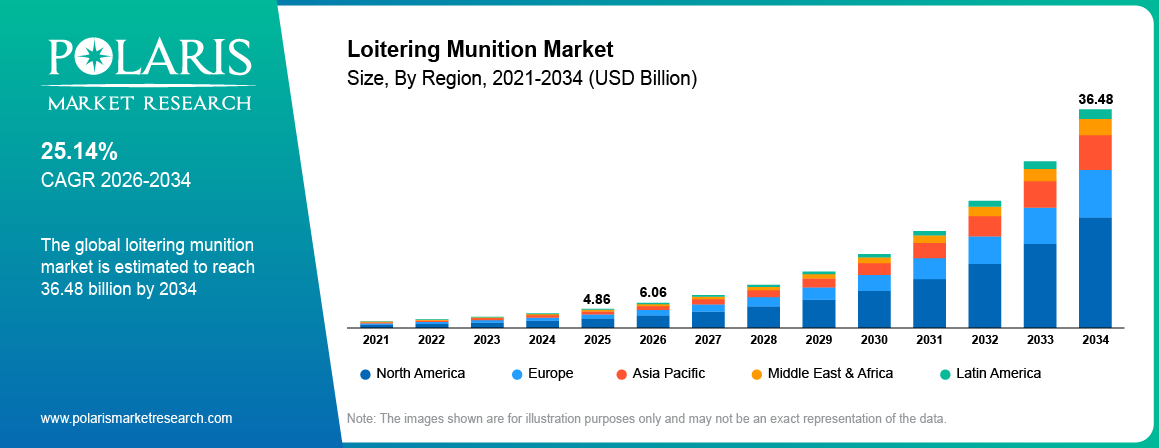
The loitering munition market size was valued at USD 4.86 billion in 2025. The market is projected to register a CAGR of 25.14% from 2026 to 2034. The need for cost-effective precision strikes and the integration of artificial intelligence (AI) are among the key factors driving market growth.
Market Statistics
Loitering Munition Market Key Takeaways
- North America held the largest market share of 41.6% in 2025. This is due to advanced technology and substantial defense budgets, particularly in the U.S.
- Europe maintains a strong position with a 26.8% share. The regional market is driven by defense modernization efforts in countries such as the UK, France, and Germany.
- The expendable segment dominated the market. The segment is expected to register a higher CAGR of 20.8% during the forecast period. The growth will be driven by rising demand for quick, tactical strike capabilities, especially in situations where precision and low-cost solutions are required.
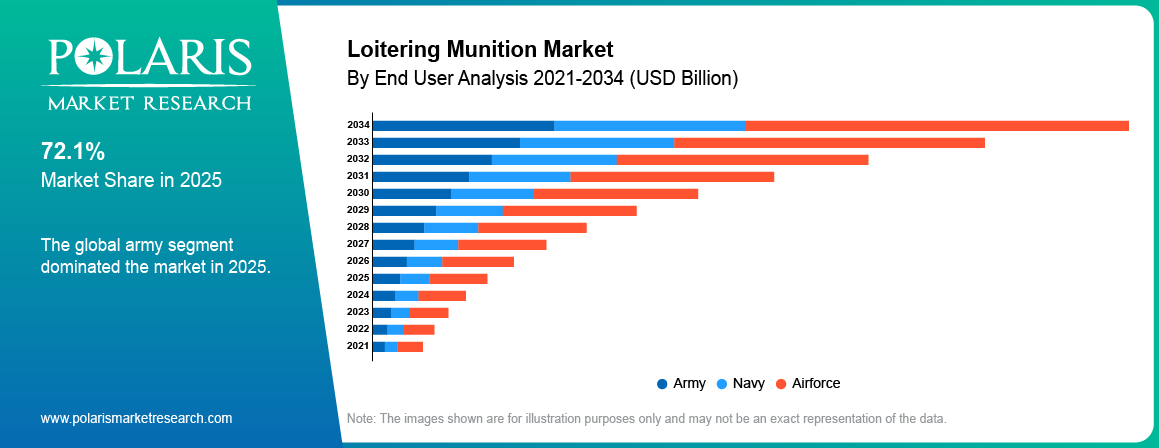
- The army segment led with a 72.1% share in 2025. The segment’s growth is fueled by growing demand for ground-based precision strike capabilities.
- As per our loitering munition market forecast, the airforce segment will register the highest CAGR of 25.8%. Air forces are increasingly adopting loitering munitions for surveillance and strike missions.
Note: Figures and projections outlined in this report are the result of Polaris Market Research’s proprietary analytical processes, grounded in the latest available datasets and market observations.
What Is a Loitering Munition?
A loitering munition, also known as a kamikaze drone or suicide drone, is a single-use unmanned aerial weapon system that carries an onboard explosive payload. Once launched, it flies to the target area, hovers or "loiters" while scanning for viable targets, and then dives into the target to detonate on impact. This ability to loiter—often under remote operator control—allows the optimal moment of attack to be chosen, distinguishing it from conventional one-shot munitions. The loitering munition market refers to the defense technology segment covering these one-way attack (OWA) drone systems, which combine surveillance, target identification, and strike capability in a single platform.
How Do Loitering Munitions Work?
Loitering munitions are unmanned weapon systems that can remain airborne over a target area while using onboard sensors to detect and monitor potential targets. Once a target is identified and confirmed, either by an operator or through supported autonomous functions, the system transitions from surveillance to precision engagement. This ability to combine reconnaissance, target identification, and strike in a single platform makes loitering munitions particularly suitable for mobile and time-sensitive targets.
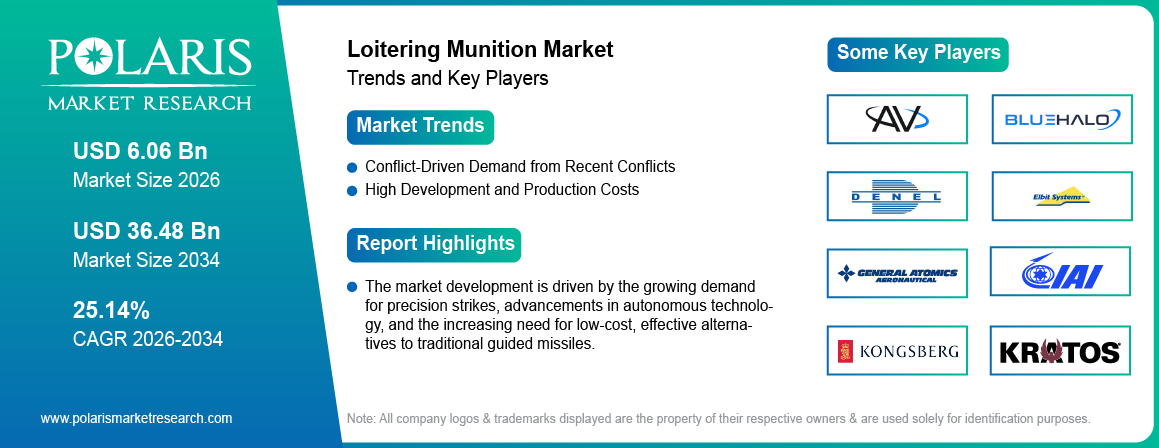
The market development is driven by the growing demand for precision strikes, advancements in autonomous technology, and the increasing need for low-cost, effective alternatives to traditional guided missiles. Key trends include the integration of artificial intelligence for target identification and autonomous decision-making, as well as an increased focus on miniaturized systems for tactical operations. Rising defense budgets, especially in countries focused on modernizing their military forces, also contribute to the expansion of this market.
The loitering munition market refers to the segment of defense technology that involves weapons designed to loiter over a target area for an extended period before striking the target, often with the ability to be controlled remotely. These munitions are typically equipped with surveillance capabilities, allowing operators to choose the optimal moment for attack.
Loitering Munitions vs Conventional Missiles vs Combat Drones
| Feature | Loitering Munitions | Conventional Missiles | Combat Drones |
| Main Functionality | Search and destroy targets by loitering above a certain area. | Destruction of a predetermined target soon after launch | Reconnaissance, surveillance, and precision strikes |
| Target Identification and Destruction | Ability to search and attack a target during flight | Aiming at a target before or just after the launch | Operator-guided and remotely piloted to perform various missions |
| Loitering Capabilities | Loitering is available during flight. | Does not involve loitering but flies on a straight course | Has loitering capability to patrol and return after a mission |
| Duration of Mission | High endurance until engaging a target or running out of fuel | Short-duration mission to deliver a strike | High-endurance mission to conduct surveillance and repeated strikes |
| Recoverability and Reusability | In most cases disposable; advanced loitering munitions may be recovered. | Recovery of conventional missiles is not possible | Reusable after completion of missions |
| Typical Applications | Precision strikes, border security, SEAD, counter-terrorism | Long-range strategic and battlefield strikes | Intelligence surveillance and reconnaissance (ISR), target surveillance and precision strikes |
Source: Polaris Market Research Analysis
Source: Polaris Market Research Analysis
To Understand More About this Research: Download Sample Report
AI Impact on the Loitering Munition Market
- AI technology assists in improving the capability of loitering munitions through increased ability in target acquisition, object identification, and navigation.
- It helps in processing data from sensors quickly to make efficient mission plans and situational awareness.
- AI assists in optimizing testing, maintenance scheduling, and reliability of the platforms through predictive analytics.
- AI allows for efficient analysis and simulation of operational data. That way, it contributes to the continuous improvement of products.
Loitering Munition Market Dynamics
Driver: Growing Demand for Precision Strikes
Military operations emphasize accuracy and minimized collateral damage. Loitering munitions, which can remain in the air for an extended period and strike only when the target is identified, offer a highly precise alternative to traditional artillery or missile systems. These munitions can engage targets with high accuracy, which is especially important in urban warfare and counterterrorism operations. According to a report by the International Institute for Strategic Studies (IISS), precision-guided munitions are becoming more prevalent in military arsenals, which increases the adoption of loitering munitions as a complementary weapon system. Hence, the increasing demand for precision strikes in modern warfare drives the industry's growth.
Driver: Advancements in Autonomous Technology
Modern loitering munitions are increasingly equipped with autonomous capabilities, allowing them to identify and engage targets without human intervention. AI algorithms enhance their ability to differentiate between potential targets and reduce the risk of misidentification. As per a 2024 report from the Defense Innovation Unit, the integration of AI into defense technologies is expected to revolutionize precision strike capabilities, making autonomous loitering munitions a strategic asset for many armed forces. The continued development of machine learning platform, sensor fusion, and real-time data processing will further strengthen the capabilities of these systems. Therefore, technological advancements in autonomy and artificial intelligence (AI) are significantly contributing to the market demand.
Driver: Rising Defense Budgets and Military Modernization
With defense budgets on the rise, particularly in emerging economies and countries seeking to upgrade their military capabilities, governments are investing in advanced weaponry systems. Loitering munitions offer a cost-effective solution compared to more expensive guided missile systems, making them an attractive option for military planners. According to the Stockholm International Peace Research Institute, defense spending will reach USD 2.88 trillion in 2025, with significant portions allocated to technological advancements and unmanned systems. This surge in defense spending is expected to fuel further demand for loitering munitions as part of modern military arsenals. Thus, the modernization of military forces worldwide is driving the market development.
Conflict-Driven Demand from Recent Conflicts
The Russia–Ukraine war and ongoing conflicts in the Middle East have accelerated demand for loitering munitions by demonstrating their effectiveness in precision strikes against armored vehicles, artillery, air-defense systems, and other time-sensitive targets. High battlefield consumption has also increased the need for rapid procurement and inventory replenishment, encouraging armed forces to invest in scalable and cost-effective unmanned strike systems.
Restraints: High Development and Production Costs
Loitering munitions require advanced technologies such as sensors, communication systems, navigation equipment, software, and specialized manufacturing capabilities. Developing and producing these systems can require significant investment. The high cost of research, testing, production facilities, and skilled personnel can make it difficult for smaller companies to enter the market. Moreover, it also increases the overall procurement cost for defense organizations, particularly when large quantities are required. As a result, budget limitations and the need for continuous investment in technology can slow the adoption of loitering munitions in some markets.
Restraints: Strict Regulations and Export Controls
Strict government regulations and export controls can also restrain the growth of the loitering munition market. Since these systems are defense-related products, manufacturers often need government approvals and export licenses before selling them to international customers. Different countries have different rules regarding the sale and transfer of military technologies. This can increase paperwork, compliance requirements, and transaction time for manufacturers. Export restrictions may also limit access to certain international markets, reducing opportunities for companies to expand their customer base and increase sales
Opportunities: Rising Focus on Autonomy & Sovereign Production
Defense forces worldwide are increasing their focus on domestic production. This rise in focus is due to the rise in the need for secure, resilient supply chains, to prevent foreign interference, and to reduce geopolitical dependency. To achieve this, governments have increased the defense spending. For instance, according to the Press Information Bureau Research Unit of India, the country increased its defense spending from ₹2.53 lakh crore (USD 265,010 million) in 2013–14 to ₹7.85 lakh crore (USD 822,749 million) in 2026–2027. This creates opportunities for domestic defense manufacturers, technology companies, and research institutions to develop locally controlled platforms and critical components. Moreover, the rise in partnerships between the government and defense companies is further creating an opportunity for domestic production and capacity expansion, thereby driving industry expansion (Source: pib.gov.in).
AI and Autonomy in Loitering Munitions
AI and autonomy are increasingly being used to improve the capabilities of loitering munitions. Artificial intelligence (AI) enables these systems to process information collected through cameras, sensors, and other onboard technologies. This helps them understand their surroundings and identify objects more efficiently. Autonomy allows certain functions to be performed with limited direct human input. For example, autonomous technologies can support navigation, route planning, object recognition, and real-time responses to changes in the operating environment. The integration of AI and autonomy can improve situational awareness, operational efficiency, response speed, and precision. These technologies also help reduce the workload on operators by automating routine functions and processing large amounts of information quickly. Defense organizations are increasingly investing in AI-enabled loitering munition technologies as part of broader efforts to modernize military capabilities. Continued advancements in sensors, computing power, and AI algorithms are expected to further support the development and adoption of autonomous systems
Real-World Applications of Loitering Munitions
| Application Area | Real-World Use | Main Advantage |
| Border Surveillance and Precision Strikes | Detection of border zones and engagement of detected threats | Increases border security with quick reaction capability |
| Anti-Armor Loitering Munition | Engagement of tanks and armored vehicles in the battlefield | Provides precise destruction of heavily fortified objects |
| Anti-Terrorism Operations | Neutralization of valuable targets in remote or urban areas | Minimizes collateral damage due to precision strikes |
| Suppression of Enemy Air Defenses (SEAD) | Strikes against radars and air defense installations | Establishes favorable conditions for subsequent military actions |
| Urban Warfare | Precision strikes in populated areas | Increases precision of strikes while minimizing risks for civilians |
| Intelligence, Surveillance and Reconnaissance (ISR) | Surveillance of enemy activities prior to striking the confirmed target | Offers both surveillance and strike capabilities in one system |
Source: Polaris Market Research Analysis
Source: Polaris Market Research Analysis
Loitering Munition Market Segmental Insights
By Type-Based Insights
The loitering munition market, by type, can be bifurcated into recoverable and expendable. The expendable segment dominated the market and is registering a higher growth rate of CAGR 20.8%. Expendable loitering munitions are designed for one-time use and offer the advantage of being simpler and less expensive to manufacture. The increasing demand for quick, tactical strike capabilities, especially in situations where precision and low-cost solutions are needed, is driving the growth of expendable loitering munitions. These systems are becoming more attractive due to their suitability for low-intensity conflicts, counterterrorism operations, and rapid-response scenarios. The trend toward more specialized and affordable munitions for a range of military applications is expected to sustain the growth of this segment in the coming years.
The recoverable segment, which involves loitering munitions that can be retrieved after a mission, is expected to witness a significant growth rate. This is due to their capability to be reused in multiple operations, providing higher operational efficiency and cost-effectiveness for military forces. Recoverable loitering munitions are particularly favored in extended surveillance and reconnaissance missions, where the ability to reuse the system contributes to lower overall costs. This segment is also supported by advancements in design, which focus on ensuring the durability and reusability of these systems.
Recoverable vs. Expendable Loitering Munitions
| Parameter | Recoverable Systems | Expendable Systems |
| Mission profile | ISR strike, surveillance, reusable strike support | One-way precision strike drones |
| Reusability | Can return if the mission is aborted | Consumed during engagement |
| Cost profile | Higher initial cost, reusable | Lower unit cost, recurring procurement |
| Typical advantage | Mission flexibility and repeated use | Rapid deployment and precision attack |
| Key limitation | Recovery and maintenance requirements | Single-use nature |
Source: Polaris Market Research Analysis
By End User-Based Insights
The loitering munition market, by end user, is segmented into army, navy, and airforce. The army segment holds the largest revenue share during the forecast period, driven by the increasing demand for ground-based precision strike capabilities. Loitering munitions in the army are mainly used for close combat, counterinsurgency, and tactical support, where they can provide real-time surveillance and engage targets with high accuracy. The army's focus on modernizing its capabilities with autonomous systems that can operate in complex terrains has made loitering munitions an integral part of its arsenal. This segment continues to benefit from advancements in AI and automation, enhancing its operational effectiveness and cost-efficiency.
The air force segment is registering the highest growth, as air forces are increasingly adopting loitering munitions for surveillance and strike missions. Air forces are leveraging loitering munitions for their extended range, precision targeting, and ability to strike high-value targets with minimal collateral damage. These systems are especially useful for intelligence, surveillance, and reconnaissance (ISR) operations, which are crucial in modern warfare. The rapid technological advancements in autonomous flight and miniaturization of loitering munition systems are expected to further drive the adoption in airforce operations, making it one of the fastest-growing segments in the market.
End User Insights: Army, Airforce, and Navy
| End User | Primary Role | Growth Profile | Key Requirement |
| Army | Ground-based precision strike, counterinsurgency, close combat support | Largest revenue share | Portability, real-time surveillance-to-strike handoff |
| Airforce | Extended-range ISR and strike, high-value target engagement | Fastest-growing segment | Range, precision guidance, minimal collateral damage |
| Navy | Maritime domain awareness, coastal defense, anti-ship/asymmetric threat response | Emerging / early-stage adoption | Ship or shore launch compatibility, littoral operating range |
Source: Polaris Market Research Analysis
By Launch Platform
The naval-launched segment is expected to register the fastest growth during the projected period. Naval-launched loitering munitions are systems that are launched from ships or other naval platforms. They can be used to monitor large sea areas and attack enemy ships, coastal targets, or other important locations. Their ability to provide long-range surveillance and precision strikes makes them useful for modern naval operations. This segment is expected to grow the fastest as navies are increasingly adopting unmanned systems to improve their combat capabilities to reduce risks to their personnel.
Ground-Launched vs Air-Launched vs Naval-Launched Loitering Munitions
| Feature | Ground-Launched | Air-Launched | Naval-Launched |
| Launching Platform | Vehicle-mounted launchers, mobile launch systems, or fixed ground sites | Fighter jets, helicopters, transport planes, or unmanned aerial vehicles | Warships, patrol craft, frigates, and other naval vessels |
| Operating Strength | Rapid land-based launching with flexible positioning near battlefields | Increased range through launching from locations near distant targets | Increased range and precision for maritime surveillance and strikes against coastal and open-sea targets |
| Mission Type | Border security, tactical battlefield operations, and anti-armor campaigns | Direct strikes, reconnaissance operations, and destruction of enemy defensive systems | Maritime security, fleet protection, and strikes against maritime targets |
| Operating Environment | Land borders, urban battlefields, deserts, forest, and mountainous regions | Contested airspace and distant combat environments | Offshore waterways and maritime theaters of operation |
| Main Advantages | Efficient, highly mobile, and responsive to fast battlefield deployment | Increased coverage, rapid access to targets, and increased flexibility | Long-range maritime surveillance and expansion of the strike capability of naval forces |
| Common Users | Army and ground combat formations | Air force and joint air combat commands | Navy, Coast Guard, and maritime security agencies |
Source: Polaris Market Research Analysis
By Guidance & Targeting Technology
The GPS/INS-guided segment is expected to register the fastest growth during the forecast period. GPS/INS-guided loitering munitions use two navigation technologies. GPS provides location information and INS helps the munition maintain its direction and position during flight. Together, they allow the munition to travel accurately toward the target, even when GPS signals are weak or unavailable for short periods. This technology is gaining popularity because it offers reliable navigation, better accuracy, and improved performance in complex combat environments. Therefore, GPS/INS-guided systems are expected to witness the fastest growth in the market.
Source: Polaris Market Research Analysis
Loitering Munition Market Regional Insights
North America
By region, the study covers North America, Europe, Asia Pacific, Latin America, and the Middle East & Africa. North America led the global industry with a 41.6% revenue share in 2025, primarily due to the advanced technological capabilities and significant defense budgets of countries such as the US. The US military’s focus on modernization, particularly the adoption of autonomous systems and precision strike technologies, has led to a high demand for loitering munitions. Additionally, the region's robust defense infrastructure, ongoing investments in military research and development, and strategic defense initiatives contribute to North America's dominance in the market. While Europe and Asia Pacific also show growth potential, driven by military modernization and defense spending, North America's lead remains strong due to its continued emphasis on technological superiority and operational flexibility in defense systems.
Europe
Europe holds a significant share of 26.8% in 2025 in the global market, driven by the ongoing defense modernization efforts across several key nations, including the UK, France, and Germany. The rising focus on precision strikes, counterterrorism, and border security has accelerated the adoption of loitering munitions, particularly by armed forces seeking cost-effective solutions to address complex security challenges. Additionally, collaborations between European defense contractors and technology developers are promoting the integration of innovative AI and autonomous capabilities into loitering munition systems, further supporting market growth in the region.
Asia Pacific
The Asia Pacific loitering munition market is projected to witness the fastest growth at a 25.7% CAGR, with countries such as China, India, and Japan leading the adoption. The increasing military expenditure in this region, particularly in China and India, is contributing to the demand for more advanced and precise weaponry, including loitering munitions. These countries are modernizing their armed forces to maintain strategic military advantage and address regional security threats. The rise of defense partnerships and joint military exercises in the Asia Pacific is also promoting the development and deployment of loitering munitions. Furthermore, the region’s focus on enhancing technological capabilities in unmanned systems, coupled with the increasing need for low-cost, high-efficiency weaponry, is driving the growth of the regional market.
Middle East and Africa
The Middle East and Africa loitering munition market is expected to grow as countries increase defense modernization and adopt advanced unmanned technologies. Countries such as Saudi Arabia, the UAE, and Israel are investing in advanced defense systems to strengthen domestic manufacturing capabilities. According to the Saudi Vision 2030, the GAMI announced to localize the defense budget by 2030. Rising security concerns, border protection requirements, and the need to monitor large and difficult terrains are further supporting the demand for unmanned systems. Moreover, the region is also focusing on developing local defense industries to reduce dependence on imports. Increasing partnerships between governments and defense manufacturers are creating additional opportunities, thereby driving the growth.
Latin America
The Latin America loitering munition market is developing as countries increase investments in modern defense and unmanned technologies. Brazil, Colombia, Argentina, and other countries are showing greater interest in drones and advanced military systems. Large borders, remote areas, and challenging terrain are creating demand for unmanned technologies that support surveillance and military operations. Governments are further working to strengthen domestic defense capabilities and reduce dependence on imported technologies. Growing investments in drone and counter-drone systems are supporting the development of the regional unmanned defense industry, thereby driving the growth of the industry.
Named Platforms & Use Cases
The loitering munition market includes several well-known platforms designed for different operational needs. Systems such as AeroVironment Switchblade, Israel Aerospace Industries Harop, and UVision Hero are examples of platforms used by defense forces. These systems are generally designed to provide extended surveillance, target identification, and precision strike capabilities. Smaller platforms can support infantry units and tactical operations, while larger systems can be used for longer-range missions and broader battlefield coverage. Loitering munitions are also being explored for use in border security, surveillance, and protection of critical military assets. Their ability to remain in an area before engaging a designated target makes them different from conventional guided weapons.

Source: Polaris Market Research Analysis
Key Players and Competitive Insights
Key players in the market include companies such as AeroVironment, Inc.; Elbit Systems Ltd.; Israel Aerospace Industries Ltd. (IAI); and Rheinmetall AG. AeroVironment is known for its Switchblade loitering munitions, which are used for tactical operations. Elbit Systems offers the Harop and the upcoming Hammer loitering munitions, both of which are designed for precision strikes. Israel Aerospace Industries Ltd. (IAI) provides the Roket loitering munition, which is used for both surveillance and attack missions. Rheinmetall produces the Riegel system, which is focused on tactical support. Other notable players include UVision Air Ltd. (UVision), providing the Hero series, and Northrop Grumman Corporation (Northrop Grumman), which has introduced its Bat loitering munition system.
Kratos Defense & Security Solutions, Inc. (Kratos) provides the Mako loitering munition, and Denel Dynamics (Denel), a South African defense contractor, has developed the ZT3 loitering munition. Other players are MBDA, with its FIREBEE system, and Dynamics Group (Dynamics), known for the Dynamit loitering munition system. Also, companies such as Kongsberg Gruppen ASA (Kongsberg), with its Joint Strike Missile systems, and Takyon Systems (Takyon) add to the variety of systems available in the market. Additionally, industries such as Raytheon Technologies Corporation (Raytheon) are working on advanced loitering munition solutions for various military applications.
The overall market is competitive, with companies focusing on differentiating their products through technological advancements, such as autonomous flight capabilities, precision targeting systems, and AI integration. Players such as AeroVironment and Elbit Systems dominate with a variety of solutions catering to both tactical and strategic military needs. Newer entrants, including UVision and Kratos, are focusing on providing cost-effective and highly specialized loitering munition systems designed for rapid deployment and high precision. The ongoing development of AI, autonomy, and enhanced targeting systems is leading to product diversification, with companies aiming to integrate these capabilities to meet the evolving demands of modern warfare. As a result, the market is seeing an increasing focus on both performance efficiency and cost-effectiveness, with a growing number of defense contractors entering the market to cater to the rising demand for loitering munitions across different military branches.
Competitive Intensity and Substitute Technologies
The loitering munition market faces growing competitive pressure from FPV and one-way attack drones, armed UAVs, precision artillery and rocket systems, and tactical missiles. These alternatives compete on cost, range, payload, response time, and mission requirements, while loitering munitions differentiate by combining target search, tracking, and precision engagement within a single platform. The U.S. Army increasingly views these systems as complementary to conventional artillery rather than direct replacements, while rapid procurement of low-cost attritable drones is intensifying pressure on manufacturers to improve affordability and production scale. Consequently, competition is increasingly centered on electronic-warfare resilience, autonomy, sensor performance, range, launch flexibility, and cost per engagement.
List of Key Companies
- AeroVironment, Inc. (AeroVironment)
- BlueHalo (BlueHalo)
- Denel Dynamics (Denel)
- Dynamics Group (Dynamics)
- Elbit Systems Ltd. (Elbit Systems)
- General Atomics Aeronautical Systems, Inc. (GA-ASI)
- Israel Aerospace Industries Ltd. (IAI)
- Kongsberg Gruppen ASA (Kongsberg)
- Kratos Defense & Security Solutions, Inc. (Kratos)
- MBDA (MBDA)
- Northrop Grumman Corporation (Northrop Grumman)
- Raytheon Technologies Corporation (Raytheon)
- Rheinmetall AG (Rheinmetall)
- Takyon Systems (Takyon)
- UVision Air Ltd. (UVision)
Vendor Positioning
The competitive landscape is led by established specialists with differentiated positioning across range, payload, and mission profile. AeroVironment is strongly positioned in portable and tactical precision strike through its Switchblade family, while IAI focuses on longer-range engagements against high-value and air-defense targets through HAROP and Mini Harpy. Elbit Systems competes through the autonomous SkyStriker platform, while UVision offers one of the broadest product families through its HERO series, spanning dismounted tactical to longer-range missions. Rheinmetall strengthens its European positioning through its partnership with UVision and an expanding European loitering-munition portfolio.
| Key Player | Flagship System | Positioning | Primary Use Case |
| AeroVironment | Switchblade 300 / 600 | Leading tactical precision-strike / portable LM provider | Switchblade 300 for BLOS tactical strikes; Switchblade 600 for anti-armor and hardened targets |
| IAI | HAROP/Mini Harpy | Long-range, high-value-target, and SEAD-oriented specialist | Air-defense systems, command posts, tanks and other high-value/time-sensitive targets |
| Elbit Systems | SkyStriker | Autonomous, cost-effective tactical precision strike | Long-range precision engagement of operator-designated targets |
| UVision | HERO family | Broad LM portfolio spanning tactical to strategic missions | Dismounted strike, anti-armor, fortified targets and longer-range missions |
| Rheinmetall | HERO / FV-014 | European-focused LM integration and industrialization | Tactical precision strike for European/NATO land forces |
Source: Polaris Market Research Analysis
Future Outlook
The rising need for precision-based warfare, autonomous combat, and military modernization worldwide will drive future growth in the loitering munitions industry. Innovations in areas such as artificial intelligence, sensors, swarming drones, and secure communication channels could lead to more accurate, durable, and efficient loitering munitions. The rising need for cost-effective precision strikes and intelligent battles would also drive industry development. The future relevance of these weapons in military missions would increase as militaries continue to focus on fast, technologically advanced combat systems.
Industry Developments
- June 2026: Kratos Defense & Security Solutions, Inc. announced its plans to significantly expand production capacity for its Spartan line of turbojet engines. It is expected to support the rising demand across missile and loitering munition programs. (Source: kratosdefense.com)
- June 2026: MBDA and French UAV maker Fly-R finalized a co-development contract at the Eurosatory 2026 defense expo. According to Fly-R, the contract is for the Diamond Shape loitering munition. The munition is derived from FLY-R’s RAIJIN and intended to be developed and industrialized in the UAE. (Source: flyr-uas.com)
- May 2026: Johnnette Technologies Pvt. Ltd. announced the signing of a strategic Memorandum of Understanding (MoU) with Munitions India Limited (MIL). Under the agreement, Johnnette Technologies and MIL will collaborate on the tactical integration of advanced warheads for Johnnette’s JM series Loitering Munitions platforms. (source: businesswireindia.com)
- May 2025: AeroVironment, Inc., introduced its software-defined unmanned aircraft system, Red Dragon. The company revealed that the system is fully autonomous and is designed for one-way attack missions in environments with degraded communications. (Source: avinc.com)
Market Segmentation Outlook
By Launch Platform
-
Ground-Based
-
Man-Portable
-
Vehicle-Mounted
-
Artillery/Mortar-Integrated
-
-
Air-Launched
-
Naval-Launched
-
Surface-Launched
-
Submarine-Launched
-
By Guidance/Targeting Technology
-
GPS/INS Guided
-
EO/IR Guided
-
Laser Guided
-
RF/Emitter Seeking
-
Radar Guided
-
Multi-Mode Guided
By Type Outlook
-
Recoverable
-
Expendable
By End User Outlook
-
Army
-
Navy
-
Air Force
By Regional Outlook
-
North America
-
US
-
Canada
-
-
Europe
-
Germany
-
France
-
UK
-
Italy
-
Spain
-
Netherlands
-
Russia
-
Rest of Europe
-
-
Asia Pacific
-
China
-
Japan
-
India
-
Malaysia
-
South Korea
-
Indonesia
-
Australia
-
Vietnam
-
Rest of Asia Pacific
-
-
Middle East & Africa
-
Saudi Arabia
-
UAE
-
Israel
-
South Africa
-
Rest of Middle East & Africa
-
-
Latin America
-
Mexico
-
Brazil
-
Argentina
-
Rest of Latin America
-
Loitering Munition Market Report Scope
| Report Attributes | Details |
| Market Size Value in 2025 | USD 4.86 Billion |
| Market Size Value in 2026 | USD 6.06 Billion |
| Revenue Forecast by 2034 | USD 36.48 Billion |
| CAGR | 25.14% from 2026 to 2034 |
| Base Year | 2025 |
| Historical Data | 2021–2024 |
| Forecast Period | 2026–2034 |
| Quantitative Units | Revenue in USD million and CAGR from 2026 to 2034 |
| Report Coverage | Revenue Forecast, Market Competitive Landscape, Growth Factors, and Trends |
| Segments Covered |
|
| Regional Scope |
|
| Competitive Landscape |
|
| Report Format |
|
| Customization | Report customization as per your requirements with respect to countries, regions, and segmentation. |
Source: Polaris Market Research Analysis
How is the report valuable for an organization?
Workflow/Innovation Strategy
The loitering munition market has been segmented into detailed segments of type and end user. Moreover, the study provides the reader with a detailed understanding of the different segments at both the global and regional levels.
Growth/Marketing Strategy
The loitering munition market growth and marketing strategy is focused on technological advancements, cost efficiency, and meeting the evolving needs of modern warfare. Key players are investing heavily in research and development to enhance the capabilities of their systems, particularly in autonomous flight, precision targeting, and AI integration. Collaborations with military forces and defense contractors are also driving market expansion by ensuring that loitering munitions meet specific operational requirements. Companies are also expanding their product portfolios and offering tailored solutions to cater to the needs of different military branches, including the army, airforce, and navy. Additionally, market players are targeting emerging economies, where increased defense spending and modernization efforts present growth opportunities.
Workflow/Innovation Strategy
The study can support product development and innovation planning by helping companies benchmark capabilities such as autonomy, range, payload, precision targeting, sensor integration, and electronic-warfare resilience. It also enables defense manufacturers and suppliers to identify capability gaps, emerging operational requirements, and areas where future R&D investment may create competitive differentiation.
Loitering Munition Market FAQ's
The loitering munition market size was valued at USD 4.86 Billion in 2025 and is projected to grow to USD 36.48 Billion by 2034.
The market is projected to register a CAGR of 25.14% during the forecast period.
North America held the largest market share of 41.6% in 2025, driven by strong market demand and advanced infrastructure.
A few key players in the loitering munition market include AeroVironment, Inc.; BlueHalo; Denel Dynamics; Dynamics Group; Elbit Systems Ltd.; General Atomics; Aeronautical Systems, Inc.; Israel Aerospace Industries Ltd.; Kongsberg Gruppen ASA; Kratos Defense & Security Solutions, Inc.; MBDA; Northrop Grumman Corporation; Raytheon Technologies Corporation; Rheinmetall AG; Takyon Systems; and UVision Air Ltd.
The expendable segment accounted for the largest market share of 20.8% in 2025, driven by its increasing adoption across various applications.
The army segment accounted for the largest market share of 72.1% in 2025, driven by rising defense spending and modernization initiatives.
Loitering munition refers to a type of weapon system designed to remain in the air over a target area for an extended period, gathering intelligence or waiting for a target to appear before striking. These systems combine the features of a missile and a drone, allowing them to loiter in the air, making real-time targeting decisions, and delivering a precision strike when the target is identified. Unlike traditional missiles, loitering munitions can be either recoverable or expendable, depending on the design, and are primarily used for precision strikes in tactical or counterterrorism operations. They are often equipped with advanced sensors, including cameras and other targeting systems, to improve targeting accuracy.
A few key trends in the market are described below: Advancements in AI and Autonomy: The integration of artificial intelligence and autonomous systems is enhancing the capabilities of loitering munitions, enabling autonomous target identification and strike decision-making. Miniaturization and Enhanced Mobility: Smaller, more portable systems are being developed to enable rapid deployment and use in diverse military operations. Integration with ISR Systems: Loitering munitions are increasingly being used for both surveillance and strike missions, contributing to their growing use in intelligence, surveillance, and reconnaissance (ISR) operations. Cost-effective Solutions: A growing demand for low-cost, expendable loitering munitions as an alternative to more expensive, traditional missile systems.
A new company entering the loitering munition market must focus on developing advanced autonomous systems with AI-driven target identification and decision-making to enhance the precision and efficiency of operations. Focusing on cost-effective, expendable loitering munitions could also cater to the rising demand for affordable alternatives to traditional missile systems. Additionally, investing in miniaturization to create highly portable systems and improving range and endurance would make the products more versatile across different military operations. Building strong partnerships with defense contractors and offering tailored solutions to various military branches could further differentiate the company from competitors. Exploring opportunities in emerging economies with growing defense budgets would present a valuable market expansion opportunity.
Companies manufacturing, distributing, or purchasing loitering munition and related products and other consulting firms must buy the report.
Yes, many modern loitering munitions incorporate AI and autonomous technologies to support navigation, target detection, and mission operations.
Rising defense spending, increasing demand for precision weapons, and growing adoption of unmanned systems are driving market growth.
Asia Pacific is expected to witness significant growth due to increasing defense modernization and investments in advanced unmanned technologies.
Major applications include precision strikes, battlefield surveillance, intelligence gathering, target identification, and tactical military operations.
Download Sample Report of Loitering Munition Market
Please fill out the form to request a customized copy of the research report.


