
Modular Substation Market Size, Share, and Forecast 2026 to 2034
REPORT DETAILS
Modular Substation Market Summary
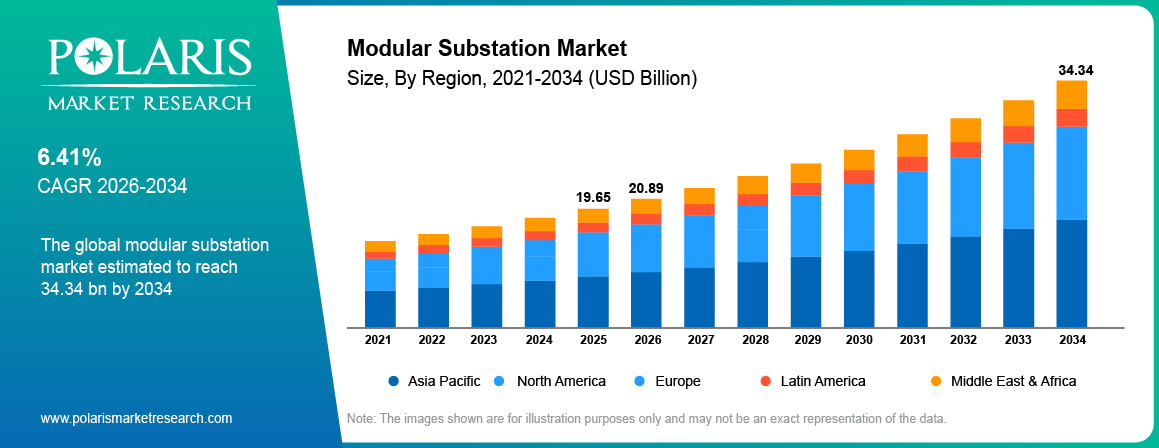
The global modular substation market was valued at USD 19.65 Billion in 2025. The market is expected to grow at a CAGR of 6.41% from 2026 to 2034. Growth is driven by expanding electricity transmission and distribution networks, increasing renewable energy grid connections, and rising demand for factory-assembled electrical infrastructure across utilities, industrial facilities, and data centers.
Market Statistics
Key Takeaways
- North America accounted for 24.30% share in 2025, fueled by grid upgrades, data-center power demand, and utility investments.
- Asia Pacific is projected to grow at a 7.52% CAGR, driven by renewable energy connections and utility procurement programmes.
- Fixed Prefabricated substations accounted for 44.80% share of the type segment in 2025, propelled by demand for integrated, factory-assembled electrical infrastructure.
- Containerized substations are expected to grow at a 7.31% CAGR, driven by demand for transportable, space-efficient power infrastructure and faster deployment.
- Power Utilities accounted for 50.80% share of the end-user segment in 2025, supported by grid reinforcement, renewable connections, and infrastructure replacement.
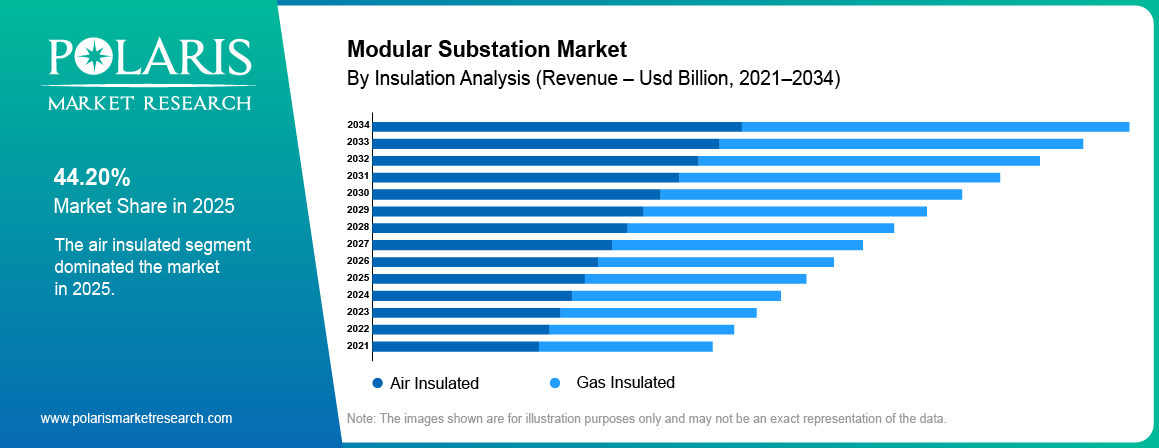
- Air insulated substations accounted for 44.20% share of the insulation segment in 2025, while gas insulated substations are projected to grow at a 7.01% CAGR.
- Medium voltage substations accounted for 42.50% share of the voltage segment in 2025, while high voltage substations are projected to grow at a 6.83% CAGR.
- Data centers are projected to grow at a 9.18% CAGR as operators add high density computing capacity and factory built power infrastructure.
Note: Figures and projections outlined in this report are the result of Polaris Market Research’s proprietary analytical processes, grounded in the latest available datasets and market observation
What Is the Modular Substation Market?
The modular substation market covers factory-built, preassembled substations delivered as one or more transportable modules. These systems integrate equipment such as switchgear, protection and control systems, and, in many configurations, transformers within a prefabricated enclosure or skid-mounted structure. The modular substation technology enables equipment integration and testing before shipment, shifting selected assembly activities from the project site to the factory. The market therefore focuses on the finished substation module rather than the standalone electrical components installed within it. The report includes modules that carry a transformer and medium voltage switchgear, and excludes conventional site built substations, standalone transformers, switchgear sold as components, and data center power modules that hold only distribution equipment. Compared with a conventional site built substation, a modular substation is claimed by SSEN Transmission to reduce time on site and site footprint (Source: Switchgear Magazine).
The prefabricated substation market includes fixed prefabricated, skid-mounted, containerized, and mobile or transportable substations. These configurations address different requirements related to site footprint, equipment access, transport, installation, and commissioning. A prefabricated enclosure that contains only uninterruptible power supply equipment and low-voltage distribution gear does not automatically qualify as a modular substation. The defining factor is whether the delivered package performs the substation function within the report's scope (Source: Hitachi Energy; VEO).
Modular substations are used in utility grid connections, renewable energy projects, industrial power systems, and selected data-center applications. A UK transmission operator's announced program covers modular substations at 132 kV and 33 kV to connect renewable generation. The programme illustrates how factory-integrated substations can form part of a broader grid connection and network expansion project (Source: SSEN Transmission).
The market's development is closely linked to transformer availability, switchgear technology, digital protection and control, and the coordination of factory and site activities. Modular construction does not eliminate foundations, cable connections, grid studies, or commissioning requirements. Instead, it changes where equipment integration takes place and how the work is sequenced. Factory acceptance testing, equipment compatibility, transport planning and early procurement remain important to buyers evaluating modular substation technology (Source: TGOOD).
Market Dynamics
Driver Impact Analysis
| Driver | Impact | Timeframe | Key Segment | Key Region |
| Utility grid expansion and renewable connections | High | Long Term | Power Utilities | Europe |
| Demand for factory integrated equipment | Medium | Medium Term | Fixed Prefabricated | North America |
| Rising data center power demand | High | Medium Term | Data Centers | North America |
| SF₆ free switchgear regulation and adoption | Medium | Short Term | Gas Insulated | Europe |
| Industrial electrification and remote site power | Medium | Long Term | Containerized | Asia Pacific |
Source: Polaris Market Research Analysis
Driver: Expanding Utility Grid Connections and Renewable Energy Infrastructure
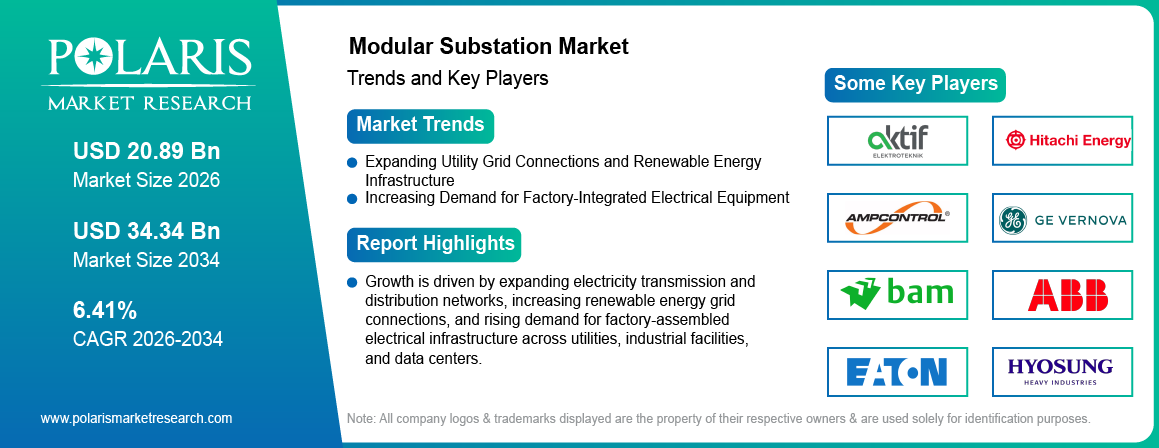
The expansion of electricity transmission and distribution networks, comprising new grid connections, renewable energy integration and utility capacity upgrades are fueling the demand for modular substations. Factory-built configurations allow integration and testing of large electrical equipment before shipment, assisting project developers with the coordination of installation activities and decreasing the amount of site assembly. A UK transmission operator said in August 2026 that it expects to order 15 modular substations for its 132kV and 33kV networks, representing more than 1GW of renewable generation capacity. The program shows how modular designs can help make grid expansion easier and at the same time meet the connection requirements of renewable energy projects. Framework agreements were awarded to Hitachi Energy UK Limited and GE Vernova in May 2026 after a year long tender, with first energizations expected from autumn 2028. Until those units are energized, this driver reflects an order book and not a measured result (Source: SSEN Transmission; Switchgear Magazine).
Driver: Increasing Demand for Factory-Integrated Electrical Equipment
Utilities and industrial operators are requesting more factory-integrated electrical infrastructure for better coordinated equipment delivery, predictable installation and consistent quality control. Modular substations are pre-engineered assemblies of switchgear, protection and control systems and, depending on the configuration, transformers. Integrating and testing, including the factory acceptance test, before shipping can help identify equipment or interface problems earlier in the project life cycle and reduce the amount of on-site installation work. Skid-mounted and containerized designs also offer the flexibility for space-constrained projects or aggressive deployment schedules. These features enable modular arrangements to be used in utility networks, industrial plants, and specific data-center power applications (Source: Ampcontrol).
Driver: Rising Data Center Power Demand
Data center operators are expanding electrical infrastructure to support high density computing, and modular substations can form part of that infrastructure when the supplied package includes substation equipment. Eaton reported in January 2026 that modular data center systems reduce deployment schedules by 35% on average, reflecting the shift toward factory-built power and compute infrastructure. Powell Industries stated in August 2026 that data centers account for about one third of its USD 2.4 billion backlog, indicating the scale of electrical equipment demand from this segment. Powell Industries also booked a data center order above USD 400 million, which is phase one of a behind the meter power island design, so it supports the demand case but is not a modular substation revenue figure (Source: Motley Fool). Schneider Electric states that its prefabricated power modules of 2 MW to 2.5 MW can shorten deployment to as little as six months, a vendor claim, and these modules hold UPS and distribution equipment and sit outside this report's scope (Source: Schneider Electric; Eaton; Yahoo Finance)
Restraint: Extended Transformer Lead Times and Component Supply Constraints
Procurement of high-capacity transformers and other critical electrical equipment can take a long time, delaying the manufacture, delivery and commissioning of modular substations. Factory integration may reduce some on-site work, but it cannot compensate for shortages of essential components or delays in the production of equipment. A May 2026 industry report noted that the U.S. was experiencing transformer lead times of up to four years for high-capacity transformers, illustrating how supply constraints were impacting power infrastructure projects. Therefore, manufacturers and project developers have to procure transformers and switchgear sooner, coordinate component specifications between suppliers and align factory production schedules with construction milestones. This increases the complexity of planning and leads to delays in procurement and uncertainty in costs. Siemens Energy reported a record Grid Technologies order backlog of EUR 51 billion at 30 June 2026, with transformer demand a key driver (Source: Turbomachinery Magazine; pv magazine USA).
Opportunity: Adoption of SF₆-Free Switchgear Technologies
The transition to alternatives to sulfur hexafluoride (SF₆) insulation creates opportunities for modular substation designs that incorporate lower-emission electrical equipment. Pure-air insulation and vacuum switching technology are used by manufacturers to create fully enclosed substation systems that enable utilities to consider SF₆ free switchgear configurations for new installations and grid capacity upgrades. Schneider Electric and Southern California Edison said in June 2026 that they plan to use SF₆-free substation technology in two initial projects in 2027 to add capacity at existing sites. This development shows the potential of modular designs to combine factory integration, space-efficient layouts and evolving environmental requirements (Source: T&D World).
Opportunity: Expansion of Modular Substations for Industrial and Renewable Energy Projects
The growing need to connect renewable generation, upgrade the electricity networks and supply power to industrial facilities are expected to create future opportunities. Prefabricated arrangements can be customized for project specific voltage levels, equipment configurations, transport limitations and installation conditions. Their factory-based assembly model also helps project teams co-ordinate equipment integration with wider construction schedules, particularly where multiple substations are required across a network or generation program. Utility deployment plans involving several modular units demonstrate the potential for repeatable designs to support larger infrastructure rollouts. Demand in the containerized substation market will depend on project economics, equipment availability, technical specifications, and the suitability of modular configurations for each site. Capacity additions close to buyers include Eaton's investment of more than USD 242 million in a new North Little Rock, Arkansas facility for modular electrical enclosures, Schneider Electric's expanded Barcelona factory for modular data center infrastructure, Virginia Transformer's USD 40 million expansion in Georgia and CG Power and Industrial Solutions Limited's INR 748 crore switchgear plant, due to commission around July 2028. These announcements cover enclosure, transformer and switchgear capacity and none names a modular substation line, so the opening is for an assembler that sits beside such plants (Source: GRID; Arkansas Economic Development Commission; Schneider Electric; Georgia Department of Economic Development ;T&D India).
Market Segmentation Analysis
The modular substation market is segmented by type, insulation, voltage, end user, and region. These categories distinguish substation delivery configurations, insulation technologies, operating voltage levels, customer requirements, and regional demand patterns. Purchasing decisions for these segments are influenced by factory integration, grid-connection requirements, equipment availability and site constraints. Application was dropped as a variable because it duplicates end user.
Type Insights
The fixed prefabricated segment is leading the market with 44.80% share of the modular substation market in 2025. These substations house electrical equipment within a purpose-built building or enclosure and are ideal for projects requiring a complete, coordinated substation package. They are designed to take project specific switchgear, protection systems and control equipment and facilitate factory-based assembly. Utilities and industrial operators can select these units according to site layout, equipment requirements, and installation conditions. The format is particularly relevant in the prefabricated substation market where an integrated structure is preferred over separate equipment assemblies.
The containerized substation market segment is projected to register the fastest growth, with a CAGR of 7.31% during the forecast period. Substations contain electrical equipment in portable enclosures, supporting projects where site access, installation space and deployment schedules influence equipment selection. Their packaged design is useful for utility, renewable energy, and industrial networks requiring coordinated electrical infrastructure. Containerized configurations also allow for flexibility in transporting assembled equipment to project sites, within weight, dimensional and site-access restrictions. Demand is driven by project specifications, component availability and suitability of the enclosed equipment for the local operating conditions.
Insulation Insights
In 2025, the air insulated substation segment accounted for a 44.20% share of the modular substation market and was the largest insulation category in the market. Air-insulated arrangements use air as the major insulation medium surrounding the relevant switchgear components and are suitable for projects where there is plenty of space and suitable environmental conditions. Equipment layout, operating voltage, maintenance access and clearances required determine suitability. These substations can serve utility distribution networks and industrial facilities where project requirements accommodate the physical dimensions of air-insulated equipment and the associated enclosure design.
The gas insulated substation segment is projected to grow at a CAGR of 7.01% during the forecast period. The use of gas-insulated equipment eases the design of compact substation layouts, particularly at sites where space limitations or equipment-clearance requirements affect the design. The integration in a modular construction allows the electrical equipment to be placed into a more limited footprint. At the same time, changing environmental requirements are stimulating interest in alternative insulation and switching technologies. In June 2026, Schneider Electric announced plans to build substation systems using pure-air insulation and vacuum technology at two California sites, with projects planned for 2027 (Source: PR Newswire).
Voltage Insights
The medium voltage substation segment contributed 42.50% of the modular substation market in 2025, reflecting the demand for electrical infrastructure across distribution networks, industrial facilities, renewable energy projects and select data-center applications. Medium voltage modular substations are a factory integrated package consisting of the relevant switchgear, protection and control systems and other specified equipment. Their configuration depends on load requirements, grid connection specifications, operation conditions and protection coordination. Utilities and industrial operators can use these systems for network reinforcement, facility connections, and power distribution where the selected voltage rating and equipment arrangement meet project requirements. Polaris sets the kV thresholds for the low, medium, high and extra high voltage classes used in this report. VEO states that its modular substation solutions serve regional and national grids up to 400 kV (Source: VEO), whereas the 380 kV Middle East award to Larsen & Toubro Limited is conventional engineering, procurement and construction work and is not stated to be modular.
The High Voltage segment is projected to record a CAGR of 6.83% during the forecast period, supported by the need to connect generation assets and reinforce transmission infrastructure. High voltage modular substations require careful coordination of insulation, protection systems, equipment clearances, transport dimensions, and commissioning procedures. In Scotland, a transmission operator announced a program involving modular substations operating at 132 kV and 33 kV to connect renewable generation. The program demonstrates how modular configurations are used across utility-scale grid infrastructure, especially where renewable projects require coordinated connection to existing or extended electricity networks (Source: Electrical News).
End User Insights
The power utilities segment dominated the modular substation market, holding 50.80% share in 2025, driven by the requirement for reinforcement of transmission and distribution, new customer connections, network replacement and upgrades to electricity infrastructure. Utilities require substations to comply with technical standards, reliability requirements, protection specifications and commissioning schedules. Integrated factory configurations can assist in coordinating equipment assembly and delivery for multi-site or standard design projects. Operating voltage, available space, maintenance needs, and the necessity to integrate the substation with existing grid infrastructure also guide procurement decisions. These requirements make power utilities a primary customer group for modular substation suppliers.
The data centers segment is anticipated to expand at a CAGR of 9.18% during the forecast period as operators expand electrical infrastructure to support high-density computing and reliable campus operations. Data centers require dependable power connections, redundancy, and the careful coordination of utility infrastructure with building schedules. Modular substations for data centers support these requirements when the supplied package includes qualifying substation equipment, such as switchgear and protection systems. Design choices depend on power demand, voltage requirements, site layout, equipment availability, and the commissioning sequence of the wider data-center project (Source: Siemens).
Regional Analysis
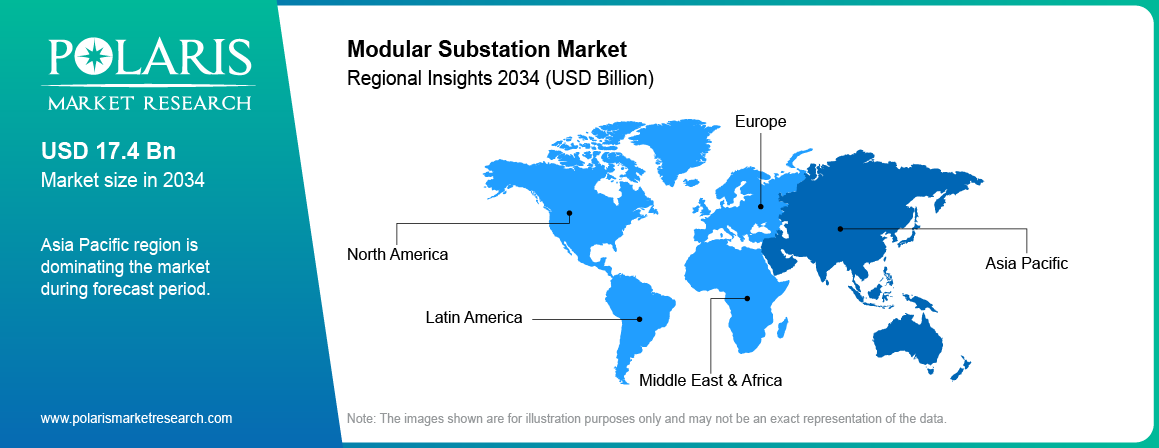
The modular substation market spans North America, Europe, Asia Pacific, Latin America, and the Middle East and Africa. Regional demand reflects investment in electricity transmission and distribution, renewable energy connections, industrial power infrastructure, data-center development, and the availability of electrical equipment.
North America Modular Substation Market Trends
North America held 24.30% of the modular substation market share in 2025 due to utility infrastructure upgrades, electricity network capacity requirements, and investments in data-center power systems. Two planned substation projects in California in 2027 using preassembled, SF₆-free equipment are intended to increase capacity within existing sites. Another consideration for regional projects is the availability of transformers, as long lead times for procurement impact equipment delivery and commissioning schedules. Powell Industries reported a record backlog of USD 2.4 billion at 30 June 2026, led by electric utility and data center demand (Source: Motley Fool). Most other North American orders in this research cycle were for components or on-site generation, so Southern California Edison's two projects are the clearest modular substation evidence. Utilities and industrial operators are turning to factory-integrated substation configurations for projects requiring coordinated installation and reliable power infrastructure (Source: Energy Digital; National Laboratory of the Rockies).
Europe Modular Substation Market Trends
Europe accounted for 21.70% share of the modular substation market in 2025 driven by renewable energy integration, transmission investment and utility procurement programs. A prime example of modular-substation deployment is in Scotland where a transmission operator intends to deploy modules on 132 kV and 33 kV networks to connect renewable generation. The program covers equipment supply and installation related activities and illustrates the role of prefabricated infrastructure in utility scale grid development. Schneider Electric launched its prefabricated power modules in Europe first, with North America to follow later in 2026 (Source: Schneider Electric). VEO is an approved A class supplier of substations to Finland's transmission system operator Fingrid (Source: VEO). European evidence rests largely on one utility program, so a second program would strengthen the regional outlook. Renewable project connections and coordinated equipment procurement are likely to remain important considerations for modular substation suppliers across European electricity networks (Source: Windtech International).
Asia Pacific Modular Substation Market Trends
Asia Pacific represented 34.00% of the modular substation market in 2025. The region’s demand was shaped by electricity-infrastructure development, industrial power needs, renewable-energy integration, and investment in electrical-equipment manufacturing. Investment in transformer and switchgear capacity supports the broader electrical infrastructure industry in India and the country’s role in the regional supply chain for equipment. But modular substation demand depends on projects that require finished prefabricated, containerized, skid-mounted or mobile substations. The applicability of these arrangements for local use depends upon the needs of utilities, the integration capabilities of the factories, availability of equipment and the voltage requirements of the project. In India, CG Power and Industrial Solutions Limited approved an INR 748 crore greenfield switchgear plant due to commission around July 2028 (Source: T&D India).
Middle East and Africa Modular Substation Market Trends
The Middle East and Africa modular substation market held a 11.90% share in 2025, a region where the demand for substation equipment is influenced by the development of electricity networks and the investment in high-voltage infrastructure. In May 2026 Larsen & Toubro Limited secured engineering, procurement and construction orders for Middle East substations for one 380 kV and two 132 kV projects. The announcement names no country and does not state that the substations are modular. TGOOD reported supplier qualification from Saudi Electricity Company for 380 kV prefabricated substations. These projects are representative of investment into regional grid infrastructure. The larger opportunity for modular solutions is contingent on adoption of qualifying factory-built substation packages. Utilities and industrial project developers may consider modular configurations where installation schedules, site conditions, equipment coordination, and commissioning requirements impact project planning (Source: Global Business Magazine; SaudiGulf Projects; Global Times).
Latin America Modular Substation Market Trends
Latin America held 8.10% market share in 2025. This is driven by upgrades to the electricity network, connections to renewable energy, industrial facilities and power distribution infrastructure. The solution is the modular substation that is integrated in the factory for projects that require coordinated delivery and installation of equipment within the constraints of the project site. Their suitability is governed by the voltage requirements, the availability of transport, availability of transformers and switchgear and the technical standards applied to each installation. Renewable energy development and industrial electrification are relevant areas for regional demand evaluation, especially when grid connections and project timelines influence the selection of prefabricated electrical infrastructure. No sourced modular substation project was identified for Latin America in this research cycle.
Competitive Landscape
Vendor Landscape Snapshot
| Vendor | Country | Modular Offering | Market Position |
| ABB Ltd. | Switzerland | eHouse and skid modules up to 40.5 kV | Leader |
| Hitachi Energy Ltd. | Switzerland | Modular, mobile and skid mounted substations up to 420 kV | Leader |
| Schneider Electric SE | France | Prefabricated MV and LV substations and eHouse systems | Leader |
| Eaton Corporation plc | Ireland | Modular electrical enclosures through Fibrebond | Challenger |
| GE Vernova Inc. | United States | SF₆ free modular substations for utilities | Challenger |
| Powell Industries, Inc. | United States | Mobile substations and control center packages | Challenger |
| Siemens Energy AG | Germany | Prefabricated power solutions and mobile substations | Challenger |
| TGOOD Global Limited | China | High voltage prefabricated substations and eHouses | Challenger |
| Aktif Elektroteknik Sanayi ve Ticaret A.Ş. | Türkiye | Prefabricated MV and LV and compact substations | Niche Player |
| Ampcontrol Limited | Australia | Modular, relocatable and transportable substations | Niche Player |
| Hyosung Heavy Industries Corporation | South Korea | Mobile substations as eHouses up to 420 kV | Niche Player |
| VEO Oy | Finland | Modular substations and eHouse buildings | Niche Player |
| Wasco Berhad | Malaysia | eHouse and substation modules for oil and gas | Niche Player |
| Koninklijke BAM Groep nv | Netherlands | Plug and play compact substation | Emerging Player |
Source: Polaris Market Research Analysis
Competition in the modular substation market is shaped by suppliers' ability to deliver integrated, factory-tested systems, coordinate transformer and switchgear procurement, and support installation and commissioning. The compact secondary substation market includes suppliers of prefabricated medium-voltage and low-voltage systems, while the broader competitive landscape also includes mobile substations, containerized substations, and modular power solutions. Supplier comparisons distinguish complete substation packages from E-Houses, individual electrical components, and automation systems. Hitachi Energy and GE Vernova won SSEN Transmission's framework agreements in May 2026 after a year long tender (Source: SSEN Transmission), while Schneider Electric's Southern California Edison projects and Powell Industries' record backlog are the other supplier positions with dated evidence. Vendors in the table below are classified by dated evidence and not by market share, because Polaris market share figures are still to be confirmed.
Investment and Capacity Expansion Analysis
| Company | Date | Scale | Focus | Region |
| Eaton Corporation plc | Sep 2026 | USD 242 Million+ | Modular enclosure plant | United States |
| Powell Industries, Inc. | Aug 2026 | 335,000 Sq Ft | Fabrication yard expansion | United States |
| ABB Ltd. | May 2026 | USD 200 Million | Medium voltage capacity | Europe |
| GE Vernova Inc. | Feb 2026 | USD 5.275 Billion | Prolec GE transformer acquisition | Americas |
Source: Polaris Market Research Analysis, based on the company announcements listed under Industry Developments
Technology and Innovation Landscape
Modular substations combine factory integration with project-specific electrical design. Important technical considerations include transformer integration, protection and control, enclosure design, digital communications, transportability, and the factory acceptance test, which verifies equipment performance and integration before shipment. Factory assembly moves wiring and equipment integration into controlled conditions, while site work still involves foundations, cable connections, grid checks, and commissioning.
SF6-free switchgear is gaining attention as utilities evaluate alternatives to conventional sulfur hexafluoride-insulated equipment. Air-insulated switchgear and vacuum-interruption technologies provide alternatives for suitable applications, depending on voltage class, design requirements, and operating conditions. Announced systems for Southern California Edison use pure-air and vacuum technology and are planned for 2027 (Source: Switchgear Magazine).
The choice between gas insulated switchgear and air insulated switchgear depends on available installation space, environmental conditions, maintenance requirements, and project specifications. Gas-insulated designs can support compact layouts, while air-insulated configurations are suitable for projects with sufficient space and appropriate environmental conditions. The selected technology affects substation footprint, integration requirements, and equipment costs.
Digital substation designs can use IEC 61850 communication architecture to coordinate protection, monitoring, and control. Medium voltage switchgear is an important component in distribution substations and industrial power systems, where it supports switching, protection, and isolation. In data-center applications, modular designs can incorporate dual-feed or ring-bus arrangements to support power redundancy. Performance and delivery benefits depend on project design, equipment availability, and commissioning results (Source: POWER Magazine).
The technology roadmap focuses on compact layouts, factory integration, digital protection and control, SF₆-free options, and coordination of long-lead equipment. Product claims should be evaluated against voltage ratings, project configuration, and demonstrated site outcomes. At utility scale, SF₆ free modular units are due at Southern California Edison in 2027 and at SSEN Transmission from autumn 2028, so the technology remains at a pre commercial adoption stage for utility programs (Source: Schneider Electric; SSEN Transmission).
Technology and Innovation Landscape Snapshot
| Technology | Function | Maturity | Example Players | Driver |
| SF₆ free switchgear | Clean air and vacuum insulation | Commercial | Schneider Electric, Hitachi Energy, GE Vernova | EU Regulation 2024/573 |
| Integrated GIS Assembly | Containerized gas insulated switchgear | Commercial | Hitachi Energy | Compact footprint |
| IEC 61850 digital protection and control | Fiber optic links replace hard wiring | Commercial | Multiple vendors | Lower site wiring |
| Plug and play connection | Plug in grid connection of compact substations | Early Stage | BAM | Faster installation |
| High voltage prefabricated substations | Factory built units up to 400 kV | Commercial | TGOOD | Delivery speed |
| AC/DC prefabricated substations | Units designed for AI computing sites | Early Stage | TGOOD | AI power demand |
Source: Polaris Market Research Analysis
Use Case Analysis
Power Utilities: Constrained Substation Footprints
Utilities can use preassembled substation systems when increasing capacity within an existing site would otherwise require extensive reconstruction. The planned Great Lakes and Running Springs installations for Southern California Edison are intended to increase capacity within existing footprints. These projects illustrate how modular designs can address space constraints while supporting grid modernization (Source: Sustainability Magazine).
Data Centers: Coordinated Campus Power
Data-center campuses require high-capacity electrical systems and redundancy coordinated with construction schedules. Modular substations can form part of this infrastructure when the delivered package includes the substation function, including a power control room. Prefabricated power modules containing only UPS and distribution equipment remain outside this report's scope. Dual-feed and ring-bus configurations can support redundancy, while delivery outcomes depend on component lead times and site integration (Source: GlobeNewswire).
Renewable Energy: Grid Connection
Renewable-generation projects require substations to connect generation assets to transmission and distribution networks. SSEN Transmission's program specifies modules at 132 kV and 33 kV to connect renewable generation. Modular substation systems can support the integration of wind and other renewable assets, while a collector substation aggregates electrical output from multiple generation units before transferring it toward the grid connection point (Source: Construction.co.uk).
Industrial Applications
Industrial facilities can require integrated power rooms and substation packages for process loads, remote sites, and staged capacity expansion. Purchasing criteria include voltage and load requirements, environmental conditions, equipment access, service coverage, and integration with the site's electrical protection scheme. Modular designs can support industrial power distribution where factory integration and coordinated installation are important to project delivery. No dated 2025 or 2026 industrial modular substation deployment with a stated outcome was identified in this research cycle.
Buyer Analysis and Barriers to Market Entry
| Buyer group | Typical need | Decision criteria |
| Transmission and distribution utilities | Repeatable substations and grid connections | Technical qualification, reliability, supply scope, installation and commissioning |
| Data-center developers and operators | High-capacity power and redundancy | Schedule, power architecture, redundancy, coordination with campus build |
| Renewable-energy developers | Grid connection for generation assets | Connection schedule, voltage requirements, utility approval |
| Industrial operators | Integrated site power systems | Load and environmental requirements, local service, maintainability |
Source: Polaris Market Research Analysis
Supplier entry barriers include technical qualification, utility approval, transformer access, factory capacity, transport constraints, and coordination of equipment from multiple vendors. SSEN's framework procurement followed a year-long tender process before awards in 2026, illustrating the time required to qualify suppliers for a major utility program. Fingrid approved A class supplier status, held by VEO, is a further qualification hurdle. IEC 61850 based digital architectures replace hard wired copper with fiber optic links, which raises engineering content for suppliers (Source: POWER Magazine; ProjectScot; VEO)
Transformer procurement is another barrier. High-capacity units in the United States have faced lead times of up to four years, with prices reported to have increased approximately 80% over five years. Suppliers that cannot secure transformer capacity may struggle to maintain delivery schedules for completed modular substations (Source: Transformer Magazine).
Pricing transparency remains limited because public vendor quotations for smaller prefabricated units are not directly comparable with installed utility-grade modules. Quotes may exclude freight, civil works, protection engineering, commissioning, and project-specific specifications. Buyers should compare equipment scope, voltage class, capacity, delivery terms, testing, warranty, and installation obligations when evaluating the modular substation price.
Premium Insights and Forward Outlook
Factory Integration Changes the Project Sequence
The commercial case for modular substations rests on moving selected assembly and testing activities into a factory and reducing the work required at the project site. This approach can improve coordination for repeatable designs and constrained sites, but the benefit depends on design freeze, transport access, component readiness, civil works, and commissioning. Utility program outcomes should be assessed against a defined conventional-project baseline rather than supplier claims alone.
Transformer Availability Remains a Critical Schedule Variable
Transformers are often long-lead components in high-capacity substation projects. When procurement lead times exceed the time needed to assemble the enclosure and integrate other equipment, reserving transformer capacity becomes an early project decision. The factory acceptance test occurs later in the project sequence, so component specification and allocation must happen early to protect delivery schedules.
Modular-Substation Pricing Requires a Consistent Cost Basis
A credible cost comparison distinguishes factory-gate prices from installed project costs. Relevant items include the transformer and switchgear configuration, enclosure, protection and control, transport, foundations, cable works, testing, installation, commissioning, and site conditions. A low vendor export quotation does not establish that a utility-grade modular substation is cheaper than a conventional site-built alternative unless both prices covers comparable scopes.
Industry Forecast Considerations
The modular substation industry forecast depends on grid modernization, renewable-energy connections, data-center power requirements, industrial electrification, and the need to expand capacity at space-constrained sites. Forecast assessments should also consider transformer availability, switchgear technology, utility qualification timelines, factory capacity, and the proportion of projects suited to prefabricated delivery.
Key Players in the Modular Substation Market
- ABB Ltd.
- Aktif Elektroteknik Sanayi ve Ticaret A.Ş.
- Ampcontrol Limited
- Eaton Corporation plc
- GE Vernova Inc.
- Hitachi Energy Ltd.
- Hyosung Heavy Industries Corporation
- Koninklijke BAM Groep nv
- Powell Industries, Inc.
- Schneider Electric SE
- Siemens Energy AG
- TGOOD Global Limited
- VEO Oy
- Wasco Berhad
Industry Developments
- September 2026: Schneider Electric introduced prefabricated power modules and power skids of 2 MW, 2.25 MW and 2.5 MW for AI data centers, with deployment in as little as six months by its own account, available in Europe first and in North America later in 2026. (Source: Schneider Electric)
- September 2026: Eaton announced an investment of more than USD 242 million in a new 1 million square foot facility in North Little Rock, Arkansas, expected to double U.S. manufacturing capacity for the modular electrical enclosures of its Fibrebond business. (Source: Eaton)
- August 2026: SSEN Transmission placed its first orders under its modular substation frameworks with Hitachi Energy and GE Vernova and expects to order 15 modules representing more than 1 GW of renewable generation by the end of 2026. (Source: Switchgear Magazine)
- August 2026: Powell Industries reported record new orders of USD 934 million and a backlog of USD 2.4 billion for its fiscal third quarter and said the expansion of its Jacintoport fabrication yard is expected to be completed by the close of fiscal 2026. (Source: Powell Industries)
- August 2026: Siemens Energy reported Grid Technologies orders of EUR 5.4 billion, up 28%, and a record backlog of EUR 51 billion, led by transformer demand. (Source: Turbomachinery Magazine)
- July 2026: In the Netherlands, BAM introduced a plug-and-play multifunctional substation that shortens the installation time by 75% and halves the need for specialized personnel. (Source: BAM)
- June 2026: Schneider Electric announced a collaboration with Southern California Edison to deploy SF₆ free medium voltage switchgear integrated into compact, preassembled substation systems at the Great Lakes and Running Springs substations, with installation scheduled to begin in 2027. (Source: Schneider Electric)
- June 2026: Qingdao TGOOD Electric Co., Ltd. began operating in Qingdao a factory built high voltage AC/DC prefabricated substation for AI computing infrastructure, reported as the first of its kind. (Source: China Daily)
- May 2026: Larsen & Toubro Limited secured Middle East engineering, procurement and construction orders for one 380 kV and two 132 kV substations, not stated to be modular. (Source: SaudiGulf Projects)
- May 2026: SSEN Transmission announced the rollout of modular substations designed for 132kV and 33kV grid connections, including renewable energy projects. Developed with Hitachi Energy and GE Vernova under framework agreements, the approach takes assembly, wiring and testing off site to reduce construction time and disruption on site. (Source: Energy Live News)
- May 2026: ABB announced an investment of approximately USD 200 million over three years to expand medium voltage manufacturing capacity in Europe, covering SF₆ free switchgear, gas insulated switchgear and protection relays. (Source: Yahoo Finance)
- February 2026: GE Vernova completed the acquisition of the remaining 50% stake in Prolec GE for USD 5.275 billion, adding transformer manufacturing capacity in the Americas. (Source: GE Vernova)
- January 2026: The prohibition under Regulation (EU) 2024/573 took effect on putting into operation new medium voltage switchgear up to and including 24 kV that relies on fluorinated gases such as SF₆. (Source: ESB Networks)
Modular Substation Market Report Segmentation
By Type Outlook (Revenue, USD Billion, 2021–2034)
- Fixed Prefabricated
- Skid Mounted
- Containerized
- Mobile and Transportable
By Insulation Outlook (Revenue, USD Billion, 2021–2034)
- Air Insulated
- Gas Insulated
By Voltage Outlook (Revenue, USD Billion, 2021–2034)
- Low Voltage
- Medium Voltage
- High Voltage
- Extra High Voltage
By End User Outlook (Revenue, USD Billion, 2021–2034)
- Power Utilities
- Data Centers
- Renewable Energy
- Industrial
- Others
By Region Outlook (Revenue, USD Billion, 2021–2034)
- North America
- US
- Canada
- Europe
- Germany
- France
- UK
- Italy
- Spain
- Netherlands
- Rest of Europe
- Asia Pacific
- China
- Japan
- India
- South Korea
- Taiwan
- Australia
- Rest of Asia Pacific
- Latin America
- Brazil
- Mexico
- Argentina
- Rest of Latin America
- Middle East & Africa
- Saudi Arabia
- UAE
- South Africa
- Rest of Middle East & Africa
Modular Substation Market Report Scope
| Report Attributes | Details |
| Market Size in 2025 | USD 19.65 Billion |
| Market Size in 2026 | USD 20.89 Billion |
| Revenue Forecast by 2034 | USD 34.34 Billion |
| CAGR | 6.41% from 2026 to 2034 |
| Base Year | 2025 |
| Historical Data | 2021–2024 |
| Forecast Period | 2026–2034 |
| Quantitative Units | Revenue in USD Billion and CAGR |
| Report Coverage | Revenue Forecast, Growth Factors, Competitive Landscape, Industry Trends, and Strategic Analysis |
| Segments Covered | By Type, Insulation, Voltage, End User, and Region |
| Regional Scope | North America, Europe, Asia Pacific, Latin America, Middle East & Africa |
| Competitive Landscape | Company Profiling, Product Benchmarking, Financial Analysis, Market Developments, and Strategic Initiatives |
| Report Format | PDF + Excel |
| Customization | Available by Country, Region, and Segment |
Source: Polaris Market Research Analysis
Why Choose Polaris Market Research
Polaris Market Research & Consulting, Inc. provides a structured modular substation market analysis across prefabricated configurations, insulation technologies, voltage classes, end-user industries, and regional markets. The analysis distinguishes finished modular substations from standalone transformers, switchgear components, and data-center power modules that fall outside the defined scope. This distinction allows buyers to evaluate market demand at the finished-system level while exploring the impact of utility procurement, renewable energy tie-ins, industrial power needs, and data-center development on purchasing decisions.
The research can be customized by substation type, insulation, voltage class, end user, or geography. Additional analysis can cover fixed prefabricated units, skid-mounted systems, containerized substations, mobile substations, air-insulated and gas-insulated configurations, transformer availability, factory acceptance testing, and grid-connection requirements. Buyers can also examine demand across power utilities, renewable energy projects, data centers, and industrial facilities to understand how technical specifications, installation conditions, and project schedules shape equipment selection.
A further strength is the separation of market demand from adjacent electrical-equipment activity. A transformer order, switchgear investment, or conventional substation engineering contract does not automatically represent modular-substation revenue. The research reviews dated product announcements, utility procurement programs, and industry developments within the framework of the report, allowing readers to differentiate between direct modular-substation evidence and broader power-infrastructure trends. This method supports modular substation industry analysis by helping to assess supplier capabilities, procurement conditions and emerging opportunities more effectively.
Research Methodology
Modular substation market research begins by defining the market at the finished-module level. The scope includes fixed prefabricated, skid-mounted, containerized, and mobile or transportable substations. Standalone transformers, individual switchgear components, conventional site-built substations, and data-center power modules containing only UPS and distribution equipment are excluded. This boundary keeps the analysis focused on complete modular substation systems rather than overlapping component markets.
Secondary research draws on utility announcements, company disclosures, product documentation, industry publications, and other sources included in the Polaris research register. The evidence is assessed for its relevance to finished modular substations, including product configuration, voltage capability, procurement activity, installation requirements, and technology developments. Announced equipment investments and conventional substation contracts are treated as broader industry context unless the source identifies a qualifying modular or prefabricated substation.
Market estimation evaluates revenue across type, insulation, voltage, end user, and region. Each category represents a different market dimension and thus the analysis can investigate variations in equipment configuration, technical requirements, customer demand and geographic activity. Market developments are interpreted and estimation is done taking into account transformer availability, switchgear supply, factory integration and project schedules. Modular substation market forecast assumptions and proprietary market figures are derived through the proprietary Polaris model.
Five-Phase Research Methodology
| Phase | Activity | Output |
| 1. Scope Definition | Define the finished-module market and exclusions | Market boundary and segmentation |
| 2. Secondary Research | Review utility announcements, company disclosures, product pages, and industry sources | Source register |
| 3. Market Estimation | Assess revenue across type, insulation, voltage, end user, and region | Market model |
| 4. Validation | Cross-check estimates against product, procurement, pricing, and supply-chain evidence | Validated market assumptions |
| 5. Quality Review | Check source accuracy, scope consistency, terminology, and formatting | Final report and forecast |
Source: Polaris Market Research Analysis
Forecast construction considers the relationship between grid investment, renewable energy connections, industrial power requirements, data-center development, and the procurement of complete modular substation systems. Equipment announcements and project awards are assessed according to their relevance to the defined market, rather than being treated as direct measures of modular-substation revenue.
Modular Substation Market FAQ's
The modular substation market covers factory-built, preassembled substations integrating switchgear, protection and control equipment, and, in many configurations, transformers.
The global modular substation market size was valued at USD 19.65 Billion in 2025 and is expected to reach USD 34.34 Billion by 2034, at a CAGR of 6.41% during the forecast period.
Asia Pacific is leading the market, due to utility upgrades, increasing power demand and investments in data center infrastructure.
The fixed prefabricated substations segment is leading the market and accounted for a share of 44.80% in 2025, driven by integrated enclosure-based designs.
Gas insulated substations to grow at CAGR of 7.01% during forecast period due to demand for compact equipment arrangements.
Modular substations differ from conventional substations in factory assembly, pre-shipment testing, and reduced on-site integration. Conventional substations typically require more site-based construction and equipment assembly.
Modular substation cost per MVA depends on voltage rating, capacity, transformer and switchgear specifications, transport, civil works, and commissioning. A reliable estimate requires project-specific quotations.
Modular substation lead time varies by equipment availability, engineering complexity, manufacturing schedules, and site readiness. Factory assembly and testing can reduce on-site installation and commissioning time.
An SF?-free modular substation uses switching and insulation technologies that avoid sulfur hexafluoride in the relevant equipment. Solutions using clean air and vacuum technology can support compact substation upgrades.
A modular substation for data centers supplies integrated electrical infrastructure to support high-capacity power demand, reliable distribution, and planned capacity expansion.
A modular substation for solar farms integrates prefabricated electrical equipment to connect solar generation and associated power conversion systems to the grid.
Examples covered in the report's competitive landscape include ABB Ltd., Aktif Elektroteknik Sanayi ve Ticaret A.?., Ampcontrol Limited, Eaton Corporation plc, GE Vernova Inc., Hitachi Energy Ltd., Hyosung Heavy Industries Corporation, Koninklijke BAM Groep nv, Powell Industries, Inc., Schneider Electric SE, Siemens Energy AG, TGOOD Global Limited, VEO Oy, and Wasco Berhad. Product scope varies by supplier.
A comparison of mobile and modular substations distinguishes mobility from construction method. Mobile substations are designed for relocation, while modular substations use prefabricated assemblies; some solutions offer both features.
Yes. Modular substation 132 kV applications can support transmission and renewable energy grid connections. A Scottish transmission program includes modular systems designed for 132 kV and 33 kV networks.
Modular substation market trends in 2026 include factory-integrated construction, renewable energy grid connections, compact substation upgrades, SF?-free switching technologies, and rising demand for reliable electrical infrastructure.
Download Sample Report of Modular Substation Market
Please fill out the form to request a customized copy of the research report.


