
Nuclear Fusion Market Size, Share, and Forecast 2026 to 2034
REPORT DETAILS
Nuclear Fusion Market Summary
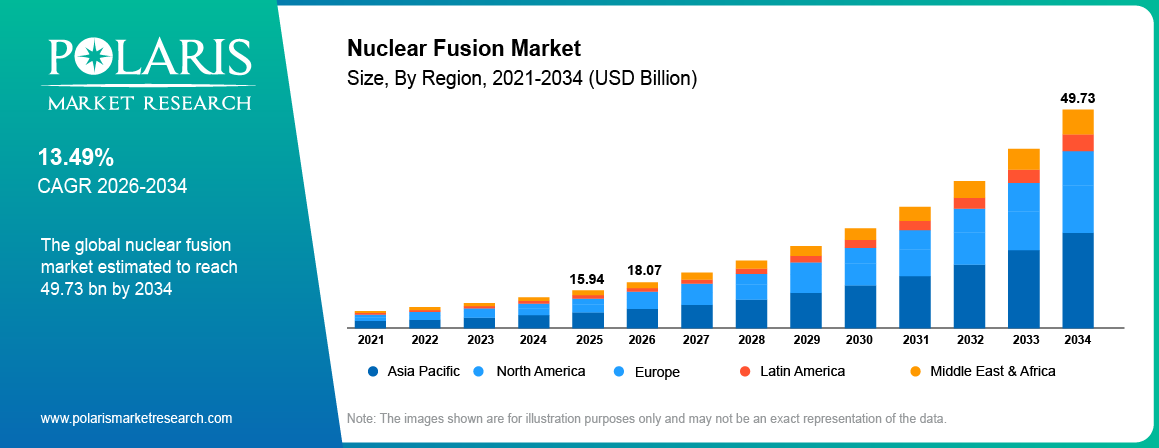
The nuclear fusion market size was valued at USD 15.94 Billion in 2025. The market is expected to grow at a CAGR of 13.49% from 2026 to 2034. Growth is driven by increasing commercialization efforts for controlled nuclear fusion, private investment, pilot-plant development, and advances in enabling technologies.
Market Statistics
Key Takeaways
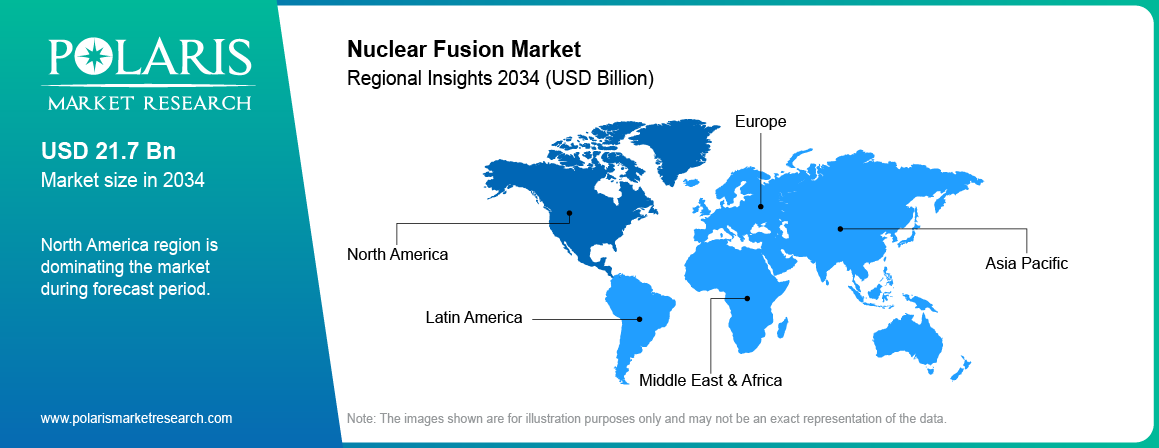
- North America accounted for 36.82% of the global market in 2025, supported by private fusion developers, government programs, and investment activity.
- Asia Pacific is expected to register 13.95% CAGR during the forecast period owing to presence of major fusion research and manufacturing programs.
- Tokamak held a share of 64.48% in 2025, driven by robust research infrastructure and large-scale projects like ITER.
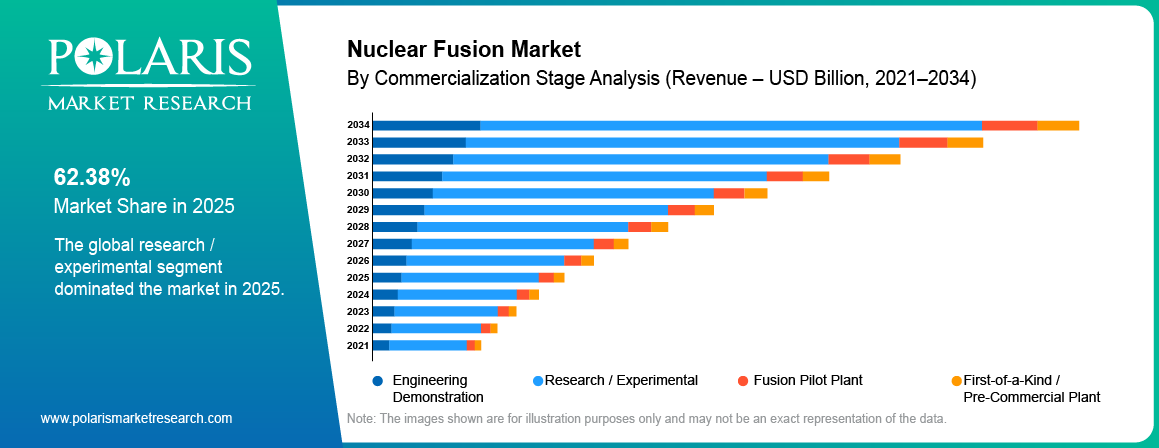
- The Fusion Pilot Plant is anticipated to grow at a CAGR of 21.38% until 2034 due to increasing commercialization and development of integrated pilot systems.
- Deuterium-Tritium was 66.42% of the fuel segment in 2025, underscoring its importance for near-term fusion development and related fuel-cycle technologies.
Note: Figures and projections outlined in this report are the result of Polaris Market Research’s proprietary analytical processes, grounded in the latest available datasets and market observations.
Nuclear Fusion Market Definition
The nuclear fusion market includes the technologies, equipment, engineering, fuels, materials, research programs, demonstration systems, pilot-plant development, and services required to achieve controlled fusion and convert fusion energy into useful power. It includes magnetic, inertial, magnetized-target, pulsed, and alternative confinement approaches together with enabling systems such as superconducting magnets, diagnostics, tritium systems, plasma heating, vacuum systems, blankets, materials, control systems, and plant integration.
The DOE’s June 2026 roadmap provides a more robust structure for commercialization by linking fusion science, technology, infrastructure, workforce development, and commercial deployment objectives. That expands the advanced nuclear power market opportunity beyond reactor development, as specialized suppliers can participate in component qualification, testing, engineering, materials development, fuel-cycle systems and plant preparation prior to the start of commercial electricity generation.
The construction of the sixth tokamak sector module for ITER in July 2026 is a demonstration of the scale of infrastructure needed for large magnetic plasma confinement systems. The approximately 1,100-tonne sector was installed through a 30-hour operation, bringing two-thirds of the torus-shaped core into place. Such projects create demand for specialized manufacturing, welding, magnets, cryogenics, diagnostics, remote handling, metrology, and precision engineering.
Commercialization also changes the nature of market demand. Experimental systems may purchase highly customized components, whereas pilot plants require repeatable manufacturing, qualification documentation, spares, commissioning support, service contracts, and lifecycle planning. Polaris therefore treats technical milestone progression as a leading indicator for future equipment and engineering orders across the fusion reactor market rather than assuming that research expenditure converts directly into utility-scale revenue.
Market Dynamics
Driver Impact Analysis
| Factor | Impact | Horizon | Evidence |
| Commercialization focus | High | Short to medium term | DOE roadmap targets pilot plants in the mid 2030s |
| Private fusion investment | High | Short term | USD 4.48 billion raised in 12 months to July 2026 |
| ITER assembly progress | Medium | Medium term | Six of nine sector modules installed by July 2026 |
| HTS magnet demand | High | Medium term | Compact tokamak and stellarator programs |
Source: Polaris Market Research Analysis
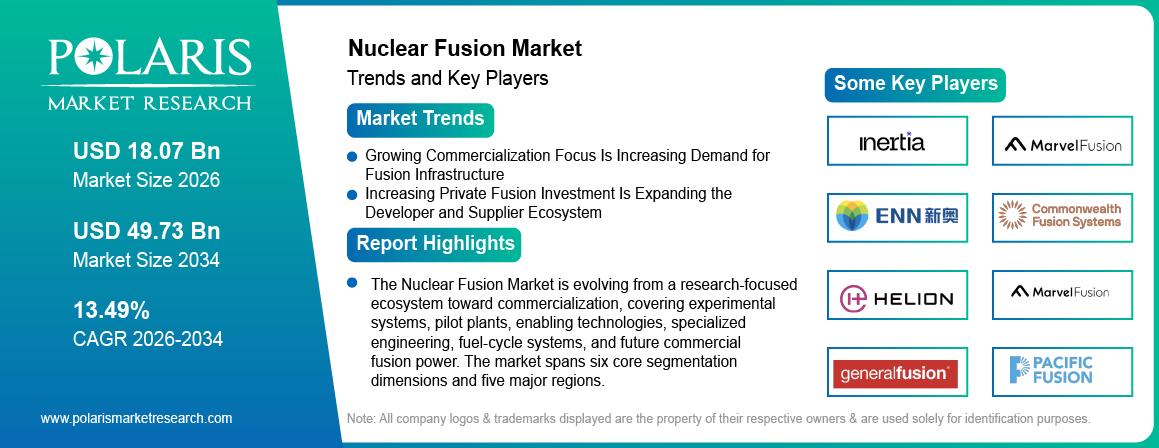
Driver: Growing Commercialization Focus Is Increasing Demand for Fusion Infrastructure
The increasing focus on moving fusion from experimental research toward pilot-plant development is creating demand for equipment, engineering, testing, and specialized infrastructure across the fusion value chain. Developers need to demonstrate plasma performance along with the reliability of magnets, vacuum systems, diagnostics, power systems, materials, fuel-cycle equipment, and plant integration before commercial deployment can begin. This is expanding the addressable nuclear fusion market beyond experimental reactors toward industrial suppliers and engineering organizations that can support pilot-plant development.
DOE's finalized Fusion Science and Technology Roadmap, released in June 2026, targets fusion pilot plants and commercial fusion power in the mid-2030s. It also outlines public infrastructure necessary to facilitate private-sector timing for development and identifies technical, infrastructure, workforce, and commercialization needs. This provides suppliers with clearer signals regarding the equipment and engineering capabilities that will be required as projects move from laboratory demonstrations toward integrated pilot systems (Source: energy.gov).
The commercialization focus is also increasing demand for suppliers capable of meeting higher qualification and documentation requirements. Experimental systems rely on customized components, whereas pilot plants require repeatable manufacturing, quality assurance, maintenance planning, commissioning support, and lifecycle services. This transition increases spending on fusion reactor market components such as superconducting magnets, cryogenics, diagnostics, vacuum systems, power electronics, materials, and plant engineering before commercial electricity becomes a significant revenue source.
Driver: Increasing Private Fusion Investment Is Expanding the Developer and Supplier Ecosystem
The increase in private fusion investment is expanding the number of companies developing different confinement approaches and increasing demand for specialized technologies across multiple programs. A broader developer base creates opportunities for suppliers because magnets, diagnostics, power systems, simulation tools, vacuum equipment, materials, and engineering services can be supplied to more than one reactor concept. This diversification is strengthening the commercial ecosystem surrounding the fusion power industry.
The Fusion Industry Association reported that fusion companies raised USD 4.48 billion in the 12 months to July 2026, while the DOE Milestone Program includes eight private developers (Source: fusionindustryassociation.org). (Source: energy.gov) At the same time, private developers in the commercial fusion market continued advancing different technical pathways. Helion reported measurable deuterium-tritium fusion and a plasma temperature of 150 million degrees Celsius in Polaris in February 2026. General Fusion reported approximately 0.72 keV electron temperature from LM26 compression in June 2026 (Source: helionenergy.com) (Source: generalfusion.com).
The presence of multiple development pathways increases demand for technologies that serve several architectures rather than a single reactor design. Suppliers of high-temperature superconducting magnets, vacuum systems, power electronics, diagnostics, cryogenics, advanced materials, controls, and engineering services can therefore address research institutions as well as private developers. This broadens the potential customer base for the nuclear fusion market analysis and reduces dependence on the commercial success of one confinement approach.
Restraint: High Technical Requirements Continue to Delay Commercial Fusion Economics
The need to demonstrate integrated plant performance remains a major constraint as achieving fusion reactions or high plasma temperatures does not by itself establish commercial electricity generation. Fusion developers must simultaneously address plasma gain, repetition rate, materials lifetime, heat extraction, deuterium tritium fuel management, plant availability, maintenance, and recirculating power. These requirements increase development times and capital requirements, which limits the conversion of experimental progress into commercial orders.
The remaining technical requirements delay the transition from prototype procurement to repeatable commercial equipment orders. Suppliers therefore face uneven demand while developers move through different engineering milestones, particularly for specialized components that require significant qualification or depend on a specific reactor architecture. This uncertainty remains a constraint on the broader commercial fusion market until pilot plants demonstrate integrated performance and more predictable project economics.
Opportunity: ITER Progress Is Expanding the Industrial Supply Chain for Fusion Projects
The increasing scale of fusion construction activity is creating opportunities for companies that transfer experience from large research projects into private fusion programs and future pilot plants. Large fusion systems require specialized manufacturing, welding, superconducting technology, cryogenics, diagnostics, remote handling, metrology, vacuum equipment, and nuclear-grade engineering. The development of this industrial capability can generate supplier opportunities even before commercial fusion plants begin operation, a trend that this nuclear fusion market analysis tracks.
ITER installed its sixth of nine tokamak sector modules in July 2026, bringing approximately two-thirds of the tokamak core into place. The installed sector weighs about 1,100 tonnes, illustrating the scale of manufacturing, transport, assembly, and integration required for large magnetic confinement fusion systems. ITER had also completed its central solenoid stack in June 2026 (Source: iter.org) (Source: iter.org).
The international nature of the ITER supply chain also creates opportunities for suppliers that serve multiple fusion programs. Vacuum-vessel components, superconducting magnets, divertor systems, diagnostics, robotics, power supplies, controls, and precision manufacturing capabilities developed for large research programs can be adapted for private machines and future pilot plants. This creates an addressable fusion power industry supply chain before commercial electricity sales become material.
Opportunity: High-Temperature Superconducting Magnets Are Creating New Component Demand
The need to achieve stronger magnetic fields in more compact fusion systems is creating opportunities across the high-temperature superconducting magnet supply chain. Stronger magnetic fields support higher plasma performance and enable smaller magnetic confinement systems, increasing demand for superconducting conductors and also for cables, joints, cryogenic systems, structural materials, power supplies, and quench protection equipment.
The opportunity is particularly relevant to compact tokamak and stellarator concepts moving toward engineering demonstrations and future pilot plants. Developers require magnet systems that can operate reliably under high magnetic fields while meeting demanding mechanical, thermal, and electrical requirements. Progress in this area therefore creates commercial opportunities across several layers of the fusion reactor market rather than being limited to complete reactor developers.
The opportunity also extends to supporting technologies because magnet performance depends on the wider cryogenic and electrical infrastructure. Suppliers that provide qualified conductor materials, cable assemblies, cryogenic equipment, power electronics, structural components, and protection systems can participate in multiple fusion programs. This creates an opportunity for specialized suppliers to establish revenue streams before full-scale fusion pilot plant deployment.
Nuclear Fusion Market Segmentation Analysis
The nuclear fusion market is segmented by confinement technology, system architecture, fuel, commercialization stage, enabling technology, and end user. These dimensions distinguish the technical approach from the plant architecture, development maturity, equipment requirements, and customer profile.
Confinement Technology Insights
The Tokamak segment accounted for 64.48% of the market in 2025, supported by its extensive experimental base and large international research infrastructure. Tokamaks confine plasma in a toroidal chamber by using magnetic fields and plasma current, and require large scale magnets, vacuum vessels, heating systems, diagnostics, cooling systems and plasma-control technologies.
The Stellarator segment is anticipated to grow at a CAGR of 14.28% over the forecast period owing to the interest in steady-state plasma operation without requiring a large plasma current. Stellarators create the desired confinement geometry using externally generated magnetic fields, but the complex 3D coil geometry increases the burdens on manufacturing and engineering. Advances in optimization, superconducting magnet technology, precision manufacturing and component fabrication are enabling further progress in magnetic confinement fusion, with inertial confinement fusion being a separate technology path within the broader fusion market.
System Architecture Insights
The Steady-State Magnetic segment held 75.82% of the market in 2025, due to the need to develop fusion systems capable of continuous operation and sustained heat removal. Steady state architectures require a greater focus on magnet reliability, plasma control, heating efficiency, cooling, component lifetime and maintenance because the equipment must operate for long periods of time rather than short pulses. These requirements increase the demand for durable components and integrated plasma confinement systems.
The Pulsed Magnetic segment is projected to grow at a CAGR of 16.18% during the forecast period, due to ongoing advancements in fusion concepts that employ repetitive compression or pulsed magnetic fields. Pulsed architectures place greater requirements on energy storage, switching systems, structural durability, thermal cycling, repetition rate, and power conversion. The commercial potential therefore depends on plasma performance and on whether components can withstand repeated operating cycles.
Fuel Insights
The Deuterium-Tritium segment accounted for 66.42% of the market in 2025, supported by the comparatively lower plasma conditions required for D-T fusion and its position as the principal near-term deuterium tritium fuel pathway for many fusion programs. D-T systems also create additional equipment requirements as fusion reactions generate high-energy neutrons and require tritium handling, storage, purification, breeding, accountancy, shielding, and neutron-resistant materials.
The Deuterium-Deuterium segment is expected to register a CAGR of 14.25% during the forecast period as research programs in the nuclear fusion market continue evaluating alternative fuel pathways and plasma conditions. D-D fusion reduces dependence on externally supplied tritium, but the higher reaction requirements and associated neutron production create additional technical challenges. Development therefore remains closely linked to improvements in plasma performance and fuel-cycle technologies.
Commercialization Stage Insights
The Research / Experimental segment accounted for 62.38% of the market in 2025, propelled by continued spending on plasma research, experimental machines, diagnostics, magnets, heating systems, and scientific infrastructure. Research facilities primarily focus on validating plasma confinement behavior and individual technologies, creating demand for highly specialized equipment even before integrated plant requirements become dominant.
The Engineering Demonstration segment is projected to register a CAGR of 17.46% during the forecast period, driven by the transition from individual physics experiments toward integrated hardware validation. Private systems such as Helion's Polaris and General Fusion's LM26 illustrate this stage, where developers increasingly test machine-scale components and system performance rather than focusing only on laboratory plasma experiments.
The Fusion Pilot Plant segment is expected to be important as the DOE targets pilot plants and commercial fusion power in the mid-2030s. Pilot plants must show integrated operation, maintainability, safety, heat extraction, fuel-cycle performance and grid relevant output. This phase can increase demand for standard equipment, engineering services, commissioning, spares, maintenance and plant level systems.
Enabling Technology Insights
The Superconducting Magnets & Cryogenics segment held 23.42% of the market in 2025, due to the significance of high-field magnets and low-temperature infrastructure across magnetic confinement systems. ITER's central-solenoid and sector-assembly milestones illustrate the scale of magnet and cryogenic engineering required for large fusion systems. Compact private systems are also increasing interest in high-temperature superconducting magnets.
The Plasma Heating & Power segment is projected to register a CAGR of 13.48% during the forecast period, driven by the need to heat plasma to fusion-relevant conditions and manage the electrical requirements of experimental and pilot systems. Heating systems, pulsed power, radio-frequency technologies, neutral beams, switching equipment, and power conversion can therefore generate demand across several confinement architectures in the fusion power industry.
The Diagnostics, Control & Simulation segment continues to support market expansion as the developers need real-time measurements and advanced control systems to manage plasma confinement stability and machine performance. Simulation and digital tools can also reduce experimental cycles by allowing developers to evaluate plasma behavior, component performance, and operating scenarios before physical testing.
The Vacuum & Fuel Cycle segment is gaining importance as fusion systems move toward longer operating periods and greater fuel-management requirements. Vacuum systems maintain the environment needed for plasma confinement, while D-T systems require more and more complex infrastructure for tritium storage, purification, accountancy and recycling. The requirements expand the role of specialized suppliers in the deuterium tritium fuel ecosystem.
The Blankets, Materials & Shielding segment is expected to become important as developers work on neutron exposure, heat management, structural lifetime and tritium breeding blanket performance. Materials must survive severe thermal and radiation environments. Blankets and shielding are increasingly important in D-T pilot plants. This opens doors to cutting-edge materials, nuclear engineering, remote maintenance and fuel cycle technologies.
The Plant Engineering / Balance of Plant segment supports commercialization by connecting the fusion system to cooling, heat extraction, power conversion, buildings, controls, water systems, electrical infrastructure, and other plant requirements. Demand can increase substantially when projects move from experimental machines toward integrated fusion pilot plant designs.
End User Insights
The National Laboratories & Research Institutes segment accounted for 62.55% of the market in 2025, supported by their role in plasma research, experimental facilities, materials testing, diagnostics, supercomputing, and technology development. These organizations create demand in the nuclear fusion market for specialized equipment and services even when commercial fusion plants remain under development.
The Private Fusion Developers segment is projected to register a CAGR of 18.72% during the forecast period, supported by increasing private investment in the commercial fusion market and the transition of several concepts toward engineering demonstrations and pilot-plant planning. Private developers require a broad range of technologies, including magnets, heating systems, diagnostics, power electronics, vacuum equipment, materials, fuel-cycle systems, and engineering services.
The Utilities & Energy Companies segment is expected to gain importance as fusion developers move closer to future electricity-producing facilities. Utilities participate through project development, site planning, power offtake, grid integration, engineering partnerships, and future power-purchase arrangements. Their involvement becomes more relevant as projects move from technology validation toward advanced nuclear power deployment.
The Industrial / Supply-Chain Customers segment continues to support demand as suppliers purchase or develop specialized equipment, manufacturing capabilities, materials, and engineering services required by fusion programs. Companies serving several fusion developers can diversify their exposure across different reactor architectures and commercialization stages, allowing the fusion power industry supply chain to generate revenue before a single commercial fusion plant reaches operation.
Regional Analysis
The nuclear fusion market spans North America, Europe, Asia Pacific, Latin America, and Middle East & Africa, with regional development shaped by private capital, public research infrastructure, regulatory frameworks, manufacturing capabilities, and national energy strategies.
North America Nuclear Fusion Market Trends
North America held a share of 36.82% in the nuclear fusion market in 2025 propelled by private fusion developers, national laboratories, venture investment, and a growing regulatory framework for fusion machine licensing. In September 2026, the American Leadership in Fusion Act was introduced by U.S. lawmakers, proposing USD 10 billion to support fusion commercialization. The move is intended to spur public-private investment and speed up growth in the U.S. nuclear fusion industry (Source: trahan.house.gov).
Continued fusion pilot plant development and increasing demand for specialized fusion infrastructure is further boosting the market growth. The U.S. regulatory framework and Canada's fusion engineering capabilities support demand for superconducting magnets, plasma systems, diagnostics, vacuum equipment, fuel-cycle technologies, and plant engineering. The diversity of reactor approaches also creates opportunities for suppliers serving multiple development programs.
Europe Nuclear Fusion Market Trends
In 2025, Europe held 29.24% of the global nuclear fusion market, driven by ITER, national research programs, manufacturing specialization, and the growth of private developers. In April 2026, Spain announced Project WISER, a stellarator project with expected investment of about EUR 500 million to develop a reduced-scale fusion device and technologies for future reactors. Private developers in Europe include Tokamak Energy, Proxima Fusion, Marvel Fusion, Gauss Fusion and Renaissance Fusion (Source: euro-fusion.org).
Rising demand for advanced fusion components and engineering services is further fueling market growth. European companies and research institutes contribute to vacuum-vessel fabrication, superconducting technology, robotics, diagnostics, tritium systems, materials, remote handling, and precision manufacturing. These capabilities create opportunities across the fusion supply chain before commercial fusion electricity becomes material.
Asia Pacific Nuclear Fusion Market Trends
Asia Pacific accounted for 26.10% of the global nuclear fusion market in 2025. This is propelled by large national fusion programs, advanced manufacturing capabilities, and strong expertise in superconducting systems and precision engineering. India’s contribution to the specialized assembly components was showcased in the progress of ITER in 2026, while China, Japan and South Korea continue to have large fusion research programs. The region also includes private developers such as Helical Fusion in the commercial fusion market.
The growing investment in experimental systems and future commercial supply chains is boosting the market across the region. China is building experimental infrastructure for the fusion power industry, Japan has developed expertise in tokamaks and stellarators, and South Korea has a strong superconducting tokamak program. For instance, in July 2025, China announced the formation of China Fusion Energy Co. backed by USD 1.6 billion in funding from state-owned enterprises to develop fusion engineering and commercialization (Source: caixinglobal.com).
Latin America Nuclear Fusion Market Trends
Latin America accounted for 3.82% of the global nuclear fusion market in 2025, fueled by universities, research institutions, energy companies, and opportunities across materials and plasma research. The region has a smaller private fusion-development base than North America, Europe, and Asia Pacific. Initial participation is therefore more closely linked to research, engineering, materials supply, and future demand for clean firm power than to the development of early fusion pilot plants.
Brazil, Argentina, Mexico, and other markets participate through research capabilities, industrial supply chains, and future energy applications. In the fusion energy industry forecast, adoption depends on project economics, grid requirements, capital availability, and whether fusion plants achieve commercially viable availability and electricity costs.
Middle East & Africa Nuclear Fusion Market Trends
Middle East & Africa accounted for 4.02% of the global nuclear fusion market in 2025, driven by interest in advanced energy technologies, sovereign investment, and future opportunities in project finance and energy infrastructure. The fusion R&D base in the region is still smaller than in North America, Europe and East Asia. Near-term involvement in Africa is more related to research collaboration and materials and engineering capabilities.
Middle East markets participate with project finance and utility applications, Africa markets with research and industrial supply chains. Grid structure, industrial demand, water availability, and capital requirements will influence the development of future fusion pilot plant projects.
Regulatory and Policy Snapshot
| Jurisdiction | Measure | Date | Status | Relevance |
| United States | NRC proposed rule for fusion machines | 26 Feb 2026 | Proposed, comments closed 27 May 2026 | Licensing basis for suppliers |
| United States | DOE Fusion Science and Technology Roadmap | 9 Jun 2026 | Final | Pilot plants in the mid 2030s |
| United States | American Leadership in Fusion Act | 24 Sep 2026 | Introduced | USD 10 billion proposed |
| Germany | National fusion hubs | Jul 2026 | Funded | EUR 125 million initial funding |
| Germany | SPRIND milestone program | 7 Oct 2026 | Launched | EUR 500 million through 2029 |
| Spain | Project WISER | 30 Apr 2026 | Announced | About EUR 500 million |
| China | China Fusion Energy Co., Ltd. | 22 Jul 2025 | Established | RMB 15 billion registered capital |
Source: federalregister.gov; fusionindustryassociation.org (roadmap); fusionindustryassociation.org (Act); world-nuclear-news.org (hubs); ans.org (SPRIND); ifmif-dones.es (WISER); ans.org (China); Polaris Market Research Analysis
Nuclear Fusion Market Competitive Landscape
The nuclear fusion market remains competitively diverse across tokamaks, stellarators, field-reversed configurations, Z-pinch, magnetized target fusion, inertial fusion, and other concepts. Commercial fusion company benchmarking requires normalization because technical milestones differ substantially between architectures. Relevant metrics include plasma temperature, fusion gain or equivalent performance, confinement time, repetition rate, magnetic field, pulse duration, neutron load, plant architecture, tritium strategy, materials lifetime, maintainability, power conversion, recirculating power, licensing, site readiness, supply-chain capability, financing, and utility or industrial partnerships.
Nuclear Fusion Vendor Landscape Snapshot
| Vendor | Approach | Region | Market Position |
| Commonwealth Fusion Systems | High field tokamak | US | Leader |
| Helion Energy | Pulsed field reversed configuration | US | Leader |
| General Fusion | Magnetized target fusion | Canada | Challenger |
| TAE Technologies | Field reversed configuration | US | Challenger |
| Proxima Fusion | Stellarator | Germany | Challenger |
| Pacific Fusion | Pulsed power inertial fusion | US | Challenger |
| Focused Energy | Laser inertial fusion | Germany | Challenger |
| Tokamak Energy | Spherical tokamak with HTS magnets | UK | Challenger |
| China Fusion Energy Co., Ltd. | State backed fusion programs | China | Challenger |
| Type One Energy | Stellarator | US | Niche Player |
| Zap Energy | Sheared flow Z pinch | US | Niche Player |
| Thea Energy | Stellarator | US | Niche Player |
| Realta Fusion | Magnetic mirror | US | Niche Player |
| Xcimer Energy | Laser inertial fusion | US | Niche Player |
| SHINE Technologies | Fusion neutron applications | US | Niche Player |
| ENN Group | Hydrogen boron spherical torus | China | Niche Player |
| Marvel Fusion | Laser fusion | Germany | Emerging Player |
| Inertia Enterprises | Laser fusion | US | Emerging Player |
Market position reflects Polaris assessment of capital raised, technical milestones, and commercialization stage. Leader: most capital and nearest commercial milestones. Challenger: strong capital or technical progress. Niche Player: focused technology or application. Emerging Player: early funding stage.
Source: Polaris Market Research Analysis
Commercial fusion company benchmarking shows that competitive strategy also differs in vertical integration. Some developers seek control over magnets, plasma controls, machine construction, and core intellectual property, while others rely on established industrial partners. Vertical integration can accelerate prototype iteration but increases capital requirements, while partnership-led models reduce manufacturing burden but create supplier and interface dependencies.
Nuclear Fusion Market Technology and Innovation Landscape
High temperature superconducting magnets are among the most commercially consequential enabling technologies for compact magnetic fusion. Stronger magnetic fields support higher confinement performance and potentially reduce machine size, increasing the importance of superconducting tape, cable, cryogenics, structural supports, joints, and quench protection.
Tritium breeding blankets are another critical technology for D-T fusion power plants. Commercial systems need mechanisms to generate replacement tritium from lithium while also absorbing neutron energy, protecting magnets, surviving neutron exposure, and supporting maintainable fuel extraction. This creates opportunities in lithium materials, ceramics, liquid metals, structural alloys, tritium processing, remote maintenance, and nuclear accountancy.
The Lawson criterion remains a useful measure of the combination of plasma temperature, density, and energy-confinement time required for useful fusion performance. Commercial development increasingly extends beyond this physics metric toward repetition rate, component lifetime, heat extraction, availability, maintenance duration, recirculating power, and conversion efficiency.
Plant architecture also determines the balance-of-plant opportunity. Continuous systems can potentially use conventional thermal-generation equipment, while pulsed systems may require energy storage and advanced power electronics to smooth output. Direct-conversion approaches could shift value toward high-voltage electrical systems. These differences make architecture-specific component modeling important for estimating supplier opportunities in the fusion reactor market.
Technology and Innovation Landscape Snapshot
| Technology | Main Users | Maturity | Key Enablers | Key Challenge |
| HTS magnets | CFS, Tokamak Energy, Proxima Fusion | Demonstration | HTS tape, cryogenics | Conductor volume and quality |
| Tritium breeding blankets | Deuterium tritium developers | Research | Lithium, liquid metals, alloys | Neutron exposure and qualification |
| Pulsed compression | Helion Energy, General Fusion | Demonstration | Pulsed power, energy storage | Repetition rate and durability |
| Laser inertial drivers | Focused Energy, Xcimer Energy, Marvel Fusion | Research | Lasers, target fabrication | Repetition rate and target supply |
| Stellarator coils | Type One Energy, Proxima Fusion, Thea Energy | Design stage | Precision coil manufacturing | Complex 3D coil geometry |
| Fuel cycle systems | All deuterium tritium developers | Research | Tritium handling, purification | Inventory and accountancy |
| Digital twins and AI control | CFS, Siemens, Nvidia | Early deployment | Simulation, control software | Model validation |
Source: Polaris Market Research Analysis
Use Case Analysis
National Laboratories and Public Research
DOE's 2026 roadmap coordinates public infrastructure around private fusion pilot plant timelines while the DOE Milestone Program includes eight companies. National laboratories provide shared neutron sources, materials testing, diagnostics, computing, tritium facilities, and other infrastructure that individual developers may not economically duplicate.
Private Fusion Pilot Plants
Helion's Polaris milestone and General Fusion's LM26 progress illustrate the transition from individual physics experiments toward integrated plant development. Pilot plants combine plasma confinement systems, magnets or compression systems, fuel cycle, controls, shielding, thermal systems, power conversion, and plant engineering.
Utilities and Power Buyers
DOE's mid-2030s commercialization objective gives utilities a potential planning horizon for future clean firm power. Early utility participation includes site assessment, grid studies, interconnection planning, technical diligence, and future offtake arrangements before a final fleet deployment decision.
Enabling Technology Suppliers
ITER's large-scale assembly requires a broad supplier base spanning vacuum systems, superconducting magnets, cryogenics, diagnostics, robotics, precision lifting, welding, and engineering. Similar requirements will emerge across private pilot plants, allowing specialized suppliers to generate revenue before widespread fusion electricity sales.
Buyer Analysis and Barriers to Market Entry
The NRC's 2026 fusion machine licensing work makes licensing capability increasingly relevant to procurement decisions for safety-significant equipment. Providers of tritium systems, activated materials, confinement barriers, radiation monitoring and safety systems may need better traceability, documentation, quality assurance and regulatory expertise.
Deuterium tritium fuel strategy creates another barrier. Developers must address tritium availability, storage, processing, accountancy, breeding, containment, and inventory management. These requirements connect fuel-cycle engineering with materials selection, licensing, remote maintenance, and plant design.
High temperature superconducting magnets create market opportunity and supply-chain risk. Buyers need reliable conductor volume, repeatable quality, large-scale coil manufacturing, cryogenic systems, robust joints, and structures capable of managing electromagnetic forces.
Fusion developers also face long capital cycles. Procurement decisions can depend on financing runway, milestone progress, government support, intellectual property, site readiness, supplier commitments, and future customer relationships. Suppliers may need to participate through prototype development, milestone payments, or non-recurring engineering before larger commercial orders materialize.
Intellectual-property and interface risk can also delay procurement. Developers need external suppliers to understand loads, tolerances, radiation environments, maintenance requirements, cybersecurity, export controls, and configuration interfaces without compromising proprietary technology. Stable interfaces and controlled design changes therefore become indicators of increasing commercial maturity.
Nuclear Fusion Market Premium Insights and Forward Outlook
DOE's mid-2030s fusion pilot plant objective places integrated pilot-facility procurement ahead of meaningful commercial electricity revenue. Suppliers that achieve qualification for magnets, tritium systems, diagnostics, power electronics, vacuum systems, blankets, controls, and remote maintenance can establish reference positions before wider plant deployment.
Multiple fusion architectures are likely to coexist in the commercial fusion market during the commercialization period. Tokamaks have the deepest experimental base, stellarators emphasize steady-state operation, pulsed concepts pursue alternative plant configurations, and inertial approaches use a different driver-and-target architecture. This diversity allows common suppliers of materials, diagnostics, controls, power systems, and engineering services to participate across technologies.
The fusion energy industry forecast should distinguish scientific achievement from commercial repeatability. Important future indicators include component lifetime, maintenance duration, tritium self-sufficiency, recirculating power, construction cost, commissioning duration, availability, and capacity factor.
A major future inflection point will be the transition from bespoke components to standardized product families. Repeated orders for superconducting cable, vacuum hardware, power electronics, diagnostics, and fuel-cycle systems could encourage suppliers to invest in dedicated production lines and lower unit costs.
Revenue timing will also differ across the ecosystem. Engineering firms can recognize revenue during design, equipment suppliers during fabrication, commissioning providers during plant integration, software and diagnostics companies during operation, and utilities only after electricity generation begins. Polaris therefore models procurement timing by component and commercialization stage rather than applying a single growth rate to the entire ecosystem.
Major Fusion Funding Rounds, 2025 to 2026
| Company | Date | Round | Amount | Notes |
| Commonwealth Fusion Systems | Aug 2025 | Series B2 | USD 863 million | Reported in FIA 2026 report |
| Inertia Enterprises | Feb 2026 | Series A | USD 450 million | Laser fusion developer |
| Focused Energy | May 2026 | Series A | USD 240 million | RWE among investors |
| Helion Energy | Jun 2026 | Series G | USD 465 million | Led by Thrive Capital |
| Proxima Fusion | Jul 2026 | Financing round | EUR 411 million | Google and RWE among investors |
| Commonwealth Fusion Systems | Jul 2026 | Equity round | USD 1 billion | Total raised USD 4 billion |
Source: fusionindustryassociation.org; powermag.com; techcrunch.com; esgtoday.com; businesswire.com; eu-startups.com; Polaris Market Research Analysis
Key Players in the Nuclear Fusion Market
- China Fusion Energy Co., Ltd.
- Commonwealth Fusion Systems
- ENN Group
- Focused Energy
- General Fusion
- Helion Energy
- Inertia Enterprises
- Marvel Fusion
- Pacific Fusion
- Proxima Fusion
- Realta Fusion
- SHINE Technologies
- TAE Technologies
- Thea Energy
- Tokamak Energy
- Type One Energy
- Xcimer Energy
- Zap Energy
Industry Developments
- October 2026: Germany's SPRIND launched a milestone based fusion program on behalf of the Federal Ministry of Research, Technology and Space, creating a new public funding pathway to accelerate private sector fusion commercialization. The program provides EUR 500 million through 2029, with total public funding expected to increase to EUR 2.5 billion. (Source: fusionindustryassociation.org)
- September 2026: Commonwealth Fusion Systems placed its largest single purchase order of high temperature superconducting tape with Fujikura to accelerate development of its ARC power plants. (Source: cfs.energy)
- September 2026: ENN Group held a groundbreaking ceremony on 15 September for Helong 2, a hydrogen boron fusion platform at Langfang in Hebei Province. ENN targets first hydrogen boron fusion power generation in 2030. (Source: world-nuclear-news.org)
- July 2026: Commonwealth Fusion Systems raised USD 1 billion in equity financing, bringing its total capital raised to USD 4 billion. The funding will support development of its SPARC demonstration machine and ARC fusion power plant. (Source: cfs.energy) In September 2026, Hyundai Motor Group became an investor in the round, with the amount undisclosed. (Source: cfs.energy)
- July 2026: Germany launched three fusion hubs covering laser fusion, magnetic fusion, fuel cycles, and materials, backed by EUR 125 million (about USD 144 million) in initial government funding. The hubs are designed to bring research institutions and industry together to develop fusion technologies. (Source: optics.org)
- July 2026: General Fusion began trading on the Nasdaq under the ticker GFUZ on 13 July after completing its business combination with Spring Valley Acquisition Corp. III, becoming the first publicly listed fusion company. (Source: nasdaq.com)
- July 2026: Proxima Fusion raised EUR 411 million (USD 468 million) at a valuation of EUR 2.4 billion, which the company described as making it the best funded fusion company in Europe. (Source: proximafusion.com)
- June 2026: Helion raised USD 465 million in a Series G round led by Thrive Capital at a post money valuation of USD 15.5 billion, as it races to complete its Orion power plant in Malaga, Washington. (Source: techcrunch.com)
- May 2026: Focused Energy closed USD 240 million in Series A financing, the largest fully secured Series A round in the global fusion industry at the time. The funding will back its laser-fusion program and planned commercial fusion power plant in Germany, underscoring rising private investment in nuclear fusion. (Source: focused-energy.co)
- February 2026: The U.S. Nuclear Regulatory Commission published a proposed rule on 26 February for a technology neutral regulatory framework for fusion machines under its byproduct material framework, with public comments accepted until 27 May 2026. (Source: nrc.gov)
- December 2025: TAE Technologies and Trump Media & Technology Group announced a definitive all stock merger valued at more than USD 6 billion. (Source: tae.com) The companies have targeted closing in the fourth quarter of 2026, and the transaction remains pending. (Source: sec.gov)
Nuclear Fusion Market Report Segmentation
By Confinement Technology Outlook (Revenue, USD Billion, 2021–2034)
-
Tokamak
-
Stellarator
-
Field-Reversed Configuration
-
Z-Pinch / Sheared Flow
-
Magnetized Target Fusion
-
Inertial / Laser Fusion
-
Other
By System Architecture Outlook (Revenue, USD Billion, 2021–2034)
-
Steady-State Magnetic
-
Pulsed Magnetic
-
Inertial / Target-Based Pulsed
-
Hybrid / Alternative Pulsed
By Fuel Outlook (Revenue, USD Billion, 2021–2034)
-
Deuterium-Tritium
-
Deuterium-Deuterium
-
Deuterium-Helium-3
-
Proton-Boron / Other
By Commercialization Stage Outlook (Revenue, USD Billion, 2021–2034)
-
Research / Experimental
-
Engineering Demonstration
-
Fusion Pilot Plant
-
First-of-a-Kind / Pre-Commercial Plant
By Enabling Technology Outlook (Revenue, USD Billion, 2021–2034)
-
Superconducting Magnets & Cryogenics
-
Plasma Heating & Power
-
Diagnostics, Control & Simulation
-
Vacuum & Fuel Cycle
-
Blankets, Materials & Shielding
-
Plant Engineering / Balance of Plant
By End User Outlook (Revenue, USD Billion, 2021–2034)
-
National Laboratories & Research Institutes
-
Private Fusion Developers
-
Utilities & Energy Companies
-
Industrial / Supply-Chain Customers
By Region Outlook (Revenue, USD Billion, 2021–2034)
- North America
- US
- Canada
- Europe
- Germany
- France
- UK
- Italy
- Spain
- Netherlands
- Rest of Europe
- Asia Pacific
- China
- Japan
- India
- South Korea
- Taiwan
- Australia
- Rest of Asia Pacific
- Latin America
- Brazil
- Mexico
- Argentina
- Rest of Latin America
- Middle East & Africa
- Saudi Arabia
- UAE
- South Africa
- Rest of Middle East & Africa
Nuclear Fusion Market Report Scope
| Report Attributes | Details |
| Market Size in 2025 | USD 15.94 Billion |
| Market Size in 2026 | USD 18.07 Billion |
| Revenue Forecast by 2034 | USD 49.73 Billion |
| CAGR | 13.49% from 2026–2034 |
| Base Year | 2025 |
| Historical Data | 2021–2024 |
| Forecast Period | 2026–2034 |
| Quantitative Units | Revenue in USD Billion and CAGR |
| Report Coverage | Revenue Forecast, Growth Factors, Competitive Landscape, Industry Trends, and Strategic Analysis |
| Segments Covered | By Confinement Technology, System Architecture, Fuel, Commercialization Stage, Enabling Technology, End User, and Region |
| Regional Scope | North America, Europe, Asia Pacific, Latin America, Middle East & Africa |
| Competitive Landscape | Company Profiling, Product Benchmarking, Financial Analysis, Market Developments, and Strategic Initiatives |
| Report Format | PDF + Excel |
| Customization | Available by Country, Region, and Segment |
Source: Polaris Market Research Analysis
Why Choose Polaris Market Research
Polaris Market Research & Consulting, Inc. applies a commercialization-stage model that separates research infrastructure, prototype systems, enabling components, pilot plants, and future grid assets rather than treating every fusion activity as an equivalent market. The nuclear fusion market analysis triangulates government policy, NRC regulatory developments, ITER construction, company milestones, component supply chains, public procurement, and primary research.
The research can be customized by confinement approach, fuel, commercialization stage, enabling component, company, or geography. Additional analysis can cover commercial fusion company benchmarking, milestone readiness, magnet strategy, tritium systems, licensing pathways, pilot-plant schedules, capital requirements, supplier concentration, utility partnerships, project finance, and technology-specific revenue scenarios.
A further differentiator is milestone normalization. A tokamak plasma-duration milestone, pulsed-machine temperature result, and inertial-fusion target result are not treated as equivalent indicators. Each development is assessed according to what it demonstrates about eventual plant performance and which commercial risks remain unresolved.
Nuclear Fusion Market Research Methodology
Fusion energy market research begins with a defined scope covering controlled-fusion systems and directly enabling equipment, engineering, and services while excluding conventional fission, generic nuclear construction, and unrelated plasma equipment. Secondary research prioritizes government roadmaps, regulatory publications, ITER releases, company disclosures, technical research, procurement evidence, and public partnerships.
Primary research can include fusion developers, national laboratories, utilities, superconducting magnet suppliers, tritium specialists, vacuum and cryogenic vendors, materials companies, EPC firms, regulators, investors, and power-system experts. Research evaluates commercialization stage, component content, project schedules, fuel pathways, licensing, pilot-plant capital requirements, supplier qualification, construction timing, and conversion of demonstration spending into repeatable orders.
Plasma confinement pathways are modeled separately before being reconciled into an ecosystem forecast. This prevents a research tokamak, private prototype, and utility pilot plant from being treated as economically equivalent assets. Senior analysts then review source quality, scope consistency, assumptions, segmentation, commercialization stage, and forecast logic.
Five-Phase Research Methodology
| Phase | Activity | Output |
| 1. Scope Definition | Separate fusion ecosystem revenue from adjacent nuclear and plasma markets | Market boundary |
| 2. Secondary Research | Government, ITER, company, technical and procurement evidence | Source log |
| 3. Primary Research | Developer, supplier, utility, regulator and investor interviews | Assumption validation |
| 4. Modeling | Technology, stage, component, end-user and regional triangulation | Polaris internal model |
| 5. Review | Senior analyst source and commercialization check | Final report and forecast |
Source: Polaris Market Research Analysis
Forecast construction uses staged probability weighting. Experimental devices, financed demonstrations, permitted pilot plants, and projects with credible utility or industrial customers receive different treatment. Supplier revenue is linked to expected procurement timing by component, while future power-plant revenue is introduced only when project maturity supports it.
Nuclear Fusion Market FAQ's
The Nuclear Fusion Market covers technologies, equipment, engineering, fuels, materials, research programs, pilot plants, and related services for controlled fusion.
The Nuclear Fusion Market was valued at USD 15.94 Billion in 2025 and is forecast to reach USD 49.73 Billion by 2034, growing at a CAGR of 13.49% from 2026 to 2034.
North America is the leading region, supported by private developers, government programs, and specialized fusion infrastructure.
Tokamak is the leading confinement technology segment, supported by its extensive research base and large-scale projects such as ITER.
Nuclear fusion occurs when light atomic nuclei combine under extreme conditions and release energy, which fusion systems aim to convert into useful power.
DOE's 2026 roadmap targets fusion pilot plants and commercial fusion power in the mid-2030s, subject to technical and regulatory progress.
Tokamaks use external magnets and plasma current, while stellarators primarily use complex three-dimensional external magnetic fields for plasma confinement.
Deuterium-tritium (D-T) is the principal near-term fuel pathway, while other concepts explore D-D, D-He3, and proton-boron fuels.
Fusion experiments have achieved major plasma and energy milestones, but commercially viable net electricity remains a development objective.
The NRC proposed a technology-neutral fusion-machine regulatory framework in February 2026 under the materials regulatory framework, with public comments accepted until 27 May 2026.
Companies pursuing fusion power include Helion Energy, Commonwealth Fusion Systems, General Fusion, Tokamak Energy, Type One Energy, Zap Energy, and TAE Technologies, among others.
Major barriers include plasma control, materials durability, tritium management, heat extraction, component maintenance, recirculating power, and reliable plant operation.
Superconducting magnets provide strong magnetic fields for plasma confinement while reducing electrical losses and supporting compact fusion designs.
A fusion pilot plant is an integrated facility designed to demonstrate fusion power generation beyond the experimental-device stage.
Fusion companies raised USD 4.48 billion in the 12 months to July 2026, bringing cumulative funding reported by the Fusion Industry Association to USD 14.24 billion.
Download Sample Report of Nuclear Fusion Market
Please fill out the form to request a customized copy of the research report.


