
Single-Cell Multiomics Market Size, Share, Trends and Forecast, 2026–2034
REPORT DETAILS
Single-Cell Multiomics Market Summary
Single-cell multiomics market size was valued at USD 1.25 billion in 2025. The market is expected to register a CAGR of 19.49% from 2026 to 2034. Growth is supported by continued development of multi-layer single-cell workflows and increasing demand for higher-resolution biological data. Direct multiomics capture is gaining attention as it is designed to perform multiple molecular measurements from a single sample preparation rather than relying on separate workflows for each data type.
Market Statistics
Key Takeaways
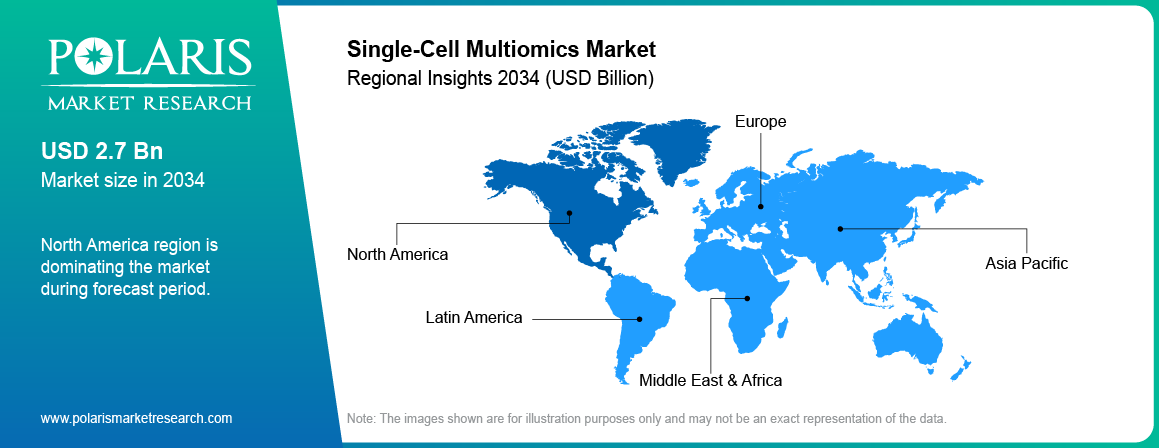
- North America dominated the global single cell multiomics market share with 41.28% in 2025, supported by the concentration of platform developers, research institutions, and NIH-funded multimodal data initiatives.
- The market in Asia Pacific is expected to record a CAGR of 23.16% during the forecast year. The growing single cell multiomics market size in the region is attributed to its increasing pharmaceutical research activities and national genomics initiatives.
- Droplet-based segment held the largest market share of 57.62% in 2025, due to their established commercial track record and broad academic application.
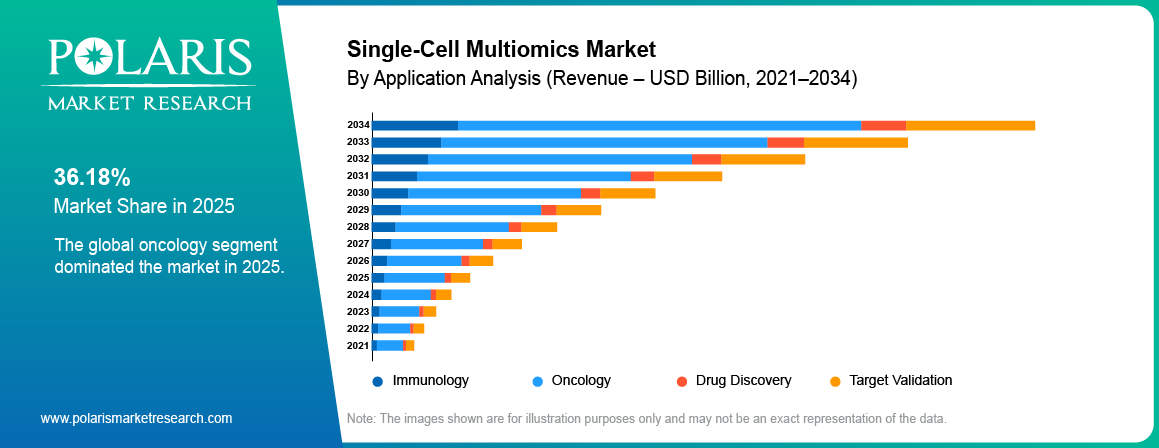
- Oncology accounted for the largest share of 36.18% in 2025, due to established single-cell research activities for cancer management.
- Academic and government institutions held the largest share of 50.54% in 2025. Rising government initiatives focused on multimodal biomedical data, including Bridge2AI, drive the segment growth.
Note: Figures and projections outlined in this report are the result of Polaris Market Research’s proprietary analytical processes, grounded in the latest available datasets and market observations.
Single-Cell Multiomics Market Definition
The single-cell multiomics market focuses on technologies that measure two or more molecular layers from the same individual cell rather than averaging molecular signals across a bulk population. These layers can include transcriptome, genome, proteome, or epigenome data. The market therefore differs from conventional single-cell RNA sequencing, which generally captures one molecular layer, and from spatial multiomics, where molecular information is combined with tissue-location context.
The market ecosystem includes instruments, consumables, software, and analytical services supporting droplet-based, combinatorial-indexing, and direct multiomics workflows. Academic and translational research institutions remain important users. Pharmaceutical and biotechnology companies are increasingly evaluating these platforms for drug discovery, target validation, and perturbation-scale studies. Service-provider networks are also becoming more relevant by allowing laboratories to access single-cell capabilities without immediately purchasing dedicated instrumentation.
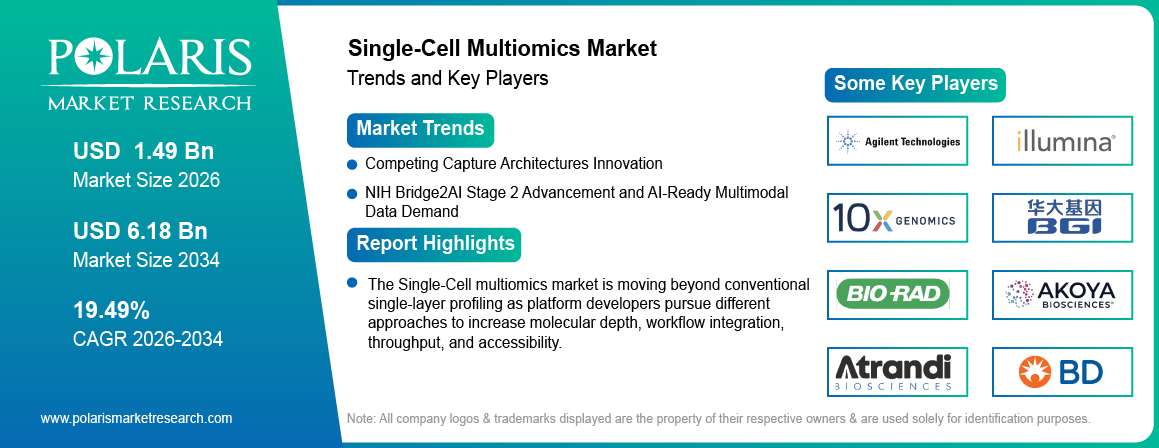
Technology development is advancing through multiple technical approaches rather than a single platform architecture. These developments indicate that competition is increasingly centered on throughput, workflow integration, molecular resolution, and the ability to generate richer datasets from limited biological material.
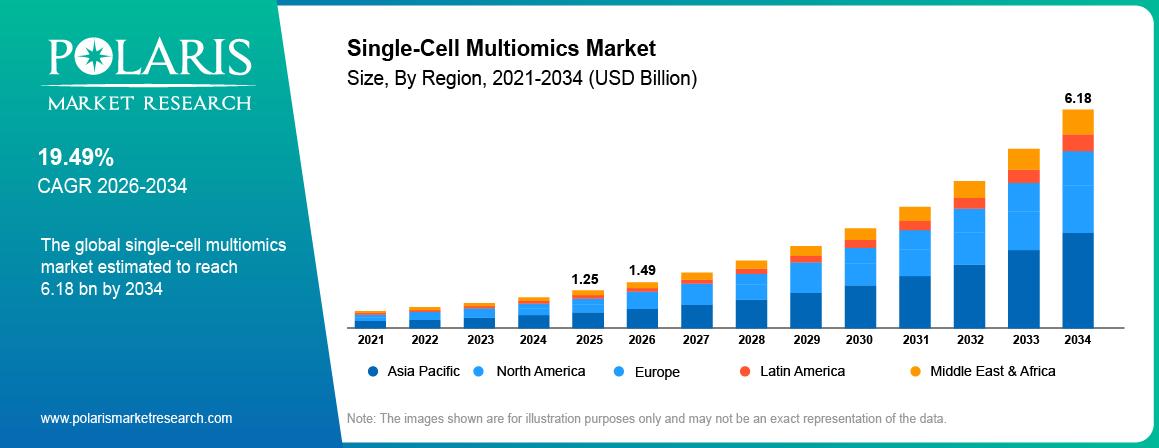
Single-Cell Multiomics Market Size and Growth Analysis
Commercial expansion is moving beyond direct instrument placements. Parse Biosciences announced certified Single-cell Discoveries in September 2025 as a member of its Certified Service Provider program. It will help expand access to its single-cell technology across Europe (Source: parsebiosciences.com). Such service models can lower the initial adoption barrier for laboratories that lack the capital, workflow infrastructure, or specialized personnel required to operate dedicated platforms.
As per our single cell multi-omics market forecast, the demand will be supported by investment in AI-ready biomedical data. Bridge2AI's advancement to a second stage moves the program beyond initial multimodal dataset generation toward development of deployable AI in multiomics tools. This creates a stronger demand-side rationale for technologies capable of generating integrated, high-dimensional molecular datasets, particularly where the resulting information can support drug discovery and broader biomedical research.
Single-Cell Multiomics Market Drivers, Restraints and Opportunities
Impact Analysis of Single-cell Multiomics Market Growth Drivers
| Market Driver | Est. CAGR Impact | Geographic Relevance | Impact Timeline |
| Competing capture architecture innovation | +X.X% | Global, led by North America | Short to medium term |
| NIH Bridge2AI Stage 2 advancement and AI-ready multimodal data demand | +X.X% | US, with global spillover | Short to medium term |
| Certified service provider network expansion | +X.X% | Global, led by Europe expansion | Medium term, 2–4 years |
Source: Polaris Market Research Analysis.
Driver: Competing Capture Architectures Innovation
Illumina and Atrandi Biosciences are pursuing materially different technology strategies. Illumina's Perturb-seq solution and Constellation mapped-reads technology extend sequencing-based workflows into new single-cell applications, including large-scale CRISPR perturbation studies. Atrandi's Semi-Permeable Capsule technology instead focuses on the physical architecture of single-cell processing and is positioned to enable true multi-step workflows at scale. The availability of different technical approaches gives laboratories greater flexibility when selecting platforms according to workflow complexity, throughput, and research objectives.
Driver: NIH Bridge2AI Stage 2 Advancement and AI-Ready Multimodal Data Demand
In January 2026, the NIH Council of Councils announced the approval for the Bridge to Artificial Intelligence (Bridge2AI) program to continue to its next stage. The advancement of Bridge2AI to a second stage strengthens the connection between federal data infrastructure and demand for multimodal research technologies. The first stage generated new biomedical datasets combining different data types for AI use, while the next stage focuses on building deployable tools around that foundation. Single-cell multiomics platforms can generate precisely the type of rich, multimodal data required for advanced computational analysis, making government investment an increasingly relevant demand signal (Source: commonfund.nih.gov).
Driver: Certified Service Provider Network Expansion
The expansion of outsourced research capabilities is lowering the entry barrier for laboratories that want to adopt single-cell multiomics without immediately investing in dedicated infrastructure. Access to external processing allows researchers to evaluate complex workflows, manage specialized analytical requirements, and scale projects according to research needs before making larger in-house technology investments.
Restraint: Analytical Complexities and Lack of Expertise
The key restraint is increasingly concentrated in downstream analytical complexity. Multiomics workflows generate multiple molecular layers from individual cells, creating a computational burden that exceed the capabilities of smaller academic laboratories. Service-provider expansion address sample-processing constraints, but it does not completely eliminate the need for specialized bioinformatics expertise to integrate and interpret multimodal data.
Opportunity: Downstream Computational Analysis Complexity
Complexity of downstream computational analysis is expected to create lucrative market opportunities. Integrating transcriptomic, proteomic, epigenomic, and other molecular layers from individual cells generates high-dimensional datasets. It requires advanced scalable computing infrastructure, bioinformatics pipelines, and sophisticated analytical tools. The rising adoption of AI- and machine learning-enabled platforms, automated workflows, and user-friendly computational tools help researchers simplify multiomics analysis. This creates opportunities for vendors to offer integrated computational solutions tailored to increasingly complex single-cell datasets.
Single-Cell Multiomics Market Segmentation Analysis
The report provides a comprehensive analysis of the single-cell multi-omics market by technology, application, end user, and region to identify the major revenue-generating and fastest-growing market segments.
Technology Insights
Droplet-based segment account for the largest technology market share of 57.62% in 2025. The dominance is supported by their established commercial track record and broad academic use. These approaches provide laboratories with scalable workflows for capturing single-cell molecular information and remain important to the existing single-cell multiomics market infrastructure.
Direct multiomics capture is projected to record the highest CAGR of 23.76% during the forecast period. Atrandi Biosciences' Semi-Permeable Capsule platform is designed to support multi-step processing at scale, addressing workflow integration requirements that can become increasingly important as researchers seek to measure several molecular layers from the same cell.
Application Insights
Oncology represented the largest application share of 36.18% in 2025. Single-cell multiomics characterize tumor heterogeneity and immune-cell states at a level that population-based methods cannot provide. These applications build on established single-cell research activity while increasing the value of combining molecular layers within the same cellular context.
Drug discovery are expected to register the highest CAGR of 22.86% during the projected period. Illumina's Perturb-seq solution is specifically positioned for large-scale CRISPR perturbation studies, allowing researchers to examine cellular responses across multiple genetic interventions. This capability supports mechanism-of-action discovery and increases the scale at which drug-development hypotheses are evaluated.
End User Insights
Academic and government institutions accounted for the largest market share of 50.54% in 2025. Academic and government-funded research institutions have been early adopters of single-cell technologies and remain closely connected to government-funded initiatives focused on multimodal biomedical data, including Bridge2AI.
Pharmaceutical and biotechnology companies are expected to record the fastest CAGR of 21.58% from 2026 to 2034. Drug discovery teams increasingly require high-throughput perturbation studies and richer cellular datasets, while service-provider networks offer a lower-capital route to adoption for organizations that do not initially want to build complete in-house processing capabilities.
Single-Cell Multiomics Market Segment Performance Summary
| Segment | Category | Base-Year Status | Forecast CAGR | Key Driver |
| By Technology | Droplet-Based | Largest share (57.62%) | 19.48% | Established commercial track record |
| By Technology | Direct Multiomics Capture | Fastest growing | 23.76% | Multi-step, multi-modal single-sample processing |
| By Application | Oncology | Largest share (36.18%) | 20.28% | Tumor and immune cell-state heterogeneity |
| By Application | Drug Discovery | Fastest growing | 22.86% | Large-scale CRISPR perturbation studies |
| By End User | Academic and Government Institutions | Largest share (50.54%) | 19.72% | NIH-funded program participation |
| By End User | Pharma and Biotech Companies | Fastest growing | 21.58% | Certified service-provider network access |
Source: Polaris Market Research Analysis
Single-Cell Multiomics Market Regional Analysis
North America Single-Cell Multiomics Market Trends
North America held the largest single-cell multiomics market share of 41.28% in 2025, supported by the U.S. concentration of platform developers, research institutions, and federal biomedical research infrastructure. Illumina and Atrandi Biosciences are headquartered in the region, while NIH's Bridge2AI program provides an important source of federal support for multimodal biomedical data development. Atrandi's presentation of its Semi-Permeable Capsule technology at SLAS2026 in Boston also reflects the region's role as a center for technology commercialization and scientific exchange.
Europe Single-Cell Multiomics Market Trends
The market in Europe is expected to exhibit a CAGR of 20.18% during the forecast period. Europe is expanding through research activity and service-delivery infrastructure. Parse Biosciences' certification of Netherlands-based Single-Cell Discoveries as a Certified Service Provider is increasing regional access to single-cell technology without requiring every laboratory to make an immediate investment in dedicated instrumentation. This service model is particularly relevant for institutions evaluating the technology before establishing permanent in-house workflows.
UK Single-Cell Multiomics Market Trends
The UK dominated the regional single cell multiomics market in 2025. The UK maintains a strong academic research base in single-cell science and benefits from wider European development of service-provider access. Academic medical centers are participating in multinational cell-atlas and single-cell research collaborations, creating demand for platforms capable of producing interoperable and increasingly multimodal datasets.
Asia Pacific Single-Cell Multiomics Market Trends
The market in Asia Pacific is projected to register a CAGR of 23.16% during the forecast period. The rising single-cell multiomics market growth rate is supported by expanding pharmaceutical research activity and national genomics initiatives. China and Japan represent important regional markets as research organizations increasingly evaluate single-cell resolution alongside broader genomics programs. Service-provider partnerships also support adoption where institutions prefer to build research capability progressively rather than establish complete single-cell processing infrastructure immediately.
Middle East and Africa Single-Cell Multiomics Market Trends
The market in the Middle East & Africa is expected to record a CAGR of 22.08% during the forecast period. The Middle East, particularly the UAE and Saudi Arabia, represents an emerging market as biomedical research investment expands genomics and single-cell analytical capabilities. Africa remains at an earlier stage, with adoption concentrated in South Africa's academic research sector. Instrument cost and the availability of specialized bioinformatics capabilities remain important considerations for wider deployment.
Single-Cell Multiomics Market Regulatory Environment Heatmap
| Region / Country | Policy Environment | Key Regulations / Programs | Market Implication | Trend |
| U.S. | Favorable | NIH Bridge2AI Stage 2; USD 130M original four-year commitment | Supports generation of AI-ready multimodal single-cell datasets | Expanding |
| U.S. | Neutral | No single-cell-specific federal regulatory framework; research-use-only classification | Platforms remain research-use-only pending future clinical claims | Stable |
| European Union | Restrictive | GDPR data protection requirements | Requires data-governance architecture for multinational research and service networks | Stable |
| UK | Restrictive | UK GDPR-aligned data protection framework | Creates a compliance structure similar to the EU while operating under a distinct enforcement framework | Stable |
| China | Neutral | Domestic data governance and cross-border data-transfer requirements | Shapes platform and service-provider deployment for multinational programs | Developing |
Source: Polaris Market Research Analysis.
Single-Cell Multiomics Market Technology and Innovation Landscape
Perturbation-scale single-cell profiling represents one of the most commercially relevant technology developments for drug discovery. Illumina's Perturb-seq solution is designed to support large-scale CRISPR perturbation experiments and bring additional capabilities into its multiomics portfolio. The approach is relevant to mechanism-of-action discovery and research into complex genetic diseases where researchers need to observe cellular responses at scale.
Semi-Permeable Capsule technology represents a different innovation pathway. Atrandi Biosciences has positioned the technology around true multi-step processing at scale, making workflow architecture rather than only sequencing chemistry the focus of differentiation. The technology was presented at SLAS2026 and represents an emerging direct multiomics approach.
Single-Cell Multiomics Market Technology and Innovation Breakdown
| Technology | Adoption Stage | Key Development | Market Impact |
| Single-cell Perturb-seq for drug discovery | Early commercial deployment | Illumina Perturb-seq solution, commercial launch planned 2026 | Scales CRISPR perturbation studies for mechanism-of-action discovery |
| Semi-permeable capsule direct multiomics architecture | Early commercial deployment | Atrandi Biosciences SPC technology presented at SLAS2026 | Enables true multi-step single-cell processing at scale |
| Constellation mapped-reads sequencing | Pilot / early research | Illumina Constellation technology, commercial launch planned 2026 | Preserves long-range genomic structure information from short reads |
| AI-ready multimodal single-cell data generation | Growing deployment | NIH Bridge2AI Stage 2 approval, January 2026 | Directs federal funding toward richly multimodal per-cell datasets |
Source: Polaris Market Research Analysis.
Single-Cell Multiomics Market Competitive Landscape
The competitive landscape is divided across technology architecture, sequencing infrastructure, platform accessibility, and service delivery. Illumina is extending its sequencing ecosystem through Perturb-seq and Constellation, providing an established infrastructure base for new single-cell applications. 10x Genomics maintains a strong position in droplet-based single-cell multiome workflows, giving it an established platform ecosystem and installed-base advantage.
Atrandi Biosciences is pursuing architectural differentiation through its Semi-Permeable Capsule technology. Its strategy differs from other single cell multiomics vendors building on established droplet or indexing workflows. This is because the platform is designed around a different physical processing architecture. Parse Biosciences competes through distribution and accessibility, using its Certified Service Provider network to expand technology access without relying exclusively on direct instrument adoption.
Single-Cell Multiomics Market Competitive Landscape Snapshot
| Company | Est. Market Position | Primary Strength | Geographic Focus | In Report |
| Illumina, Inc. | Top 3 | Sequencing infrastructure leverage via Perturb-seq and Constellation | Global | Yes |
| 10x Genomics, Inc. | Top 3 | Established droplet-based single-cell multiome platform ecosystem | Global | Yes |
| Atrandi Biosciences | Niche leader | Semi-Permeable Capsule direct multiomics architecture | North America | Yes |
| Parse Biosciences | Regional leader | Certified Service Provider distribution network | Global, expanding in Europe | Yes |
| Standard BioTools (Fluidigm) | Regional leader | CyTOF and mass cytometry-based single-cell platforms | Global | Yes |
Source: Company publications and Polaris Market Research Analysis
Single-Cell Multiomics Buyer Use Cases and Market Entry Barriers
Who buys single cell multiomics platforms?
Buyer priorities vary according to research objective. Academic and translational research laboratories focus on resolving cell-state heterogeneity beyond bulk resolution and increasingly consider service-provider access when dedicated equipment is difficult to justify. Pharmaceutical drug discovery teams place greater emphasis on perturbation-scale throughput and data quality, while government-funded research consortia prioritize AI-readiness, interoperability, and alignment with federal data requirements.
Single-Cell Multiomics Buyer Decision Framework and Use Cases
| Buyer / Investor Type | Primary Use Case | Key Insight Sought | Decision Horizon |
| Academic/translational research lab | Resolve cell-state heterogeneity beyond bulk resolution | Instrument capability and service-provider access | 1–3 years |
| Pharmaceutical drug discovery team | Scale CRISPR perturbation screening | Perturbation-scale throughput and data quality | 2–5 years |
| Government-funded research consortium | Generate AI-ready multimodal datasets | Interoperability and federal data standards | 1–3 years |
| Biotech/life sciences investor | Assess platform differentiation and distribution reach | Architecture defensibility and service-network breadth | 3–7 years |
Source: Polaris Market Research Analysis.
Entry barriers are increasingly linked to technical credibility and commercial reach. A new platform must demonstrate that its architecture can operate reliably at meaningful scale, while a limited service network can restrict access to laboratories that prefer outsourced processing. Parse Biosciences' Certified Service Provider model illustrates how distribution infrastructure becomes a competitive asset alongside the underlying technology.
List of Single Cell Multiomics Market Key Players
- 10x Genomics, Inc.
- Illumina, Inc.
- Agilent Technologies, Inc.
- Akoya Biosciences, Inc.
- Atrandi Biosciences
- Becton, Dickinson and Company
- BGI Genomics Co., Ltd.
- Bio-Rad Laboratories, Inc.
- Bruker Corporation
- Danaher Corporation
- Dolomite Bio
- Mission Bio, Inc.
- Miltenyi Biotec B.V. & Co. KG
- NanoString Technologies, Inc.
- Olink Holding AB
- Pacific Biosciences of California, Inc.
- Parse Biosciences, Inc.
- QIAGEN N.V.
- Singular Genomics Systems, Inc.
- Standard BioTools Inc.
- Takara Bio Inc.
- Thermo Fisher Scientific Inc.
- Vizgen, Inc.
Vendor Positioning: Single-Cell Multiomics Market
| Vendor | Headquarters | Core Categories |
| 10x Genomics, Inc. | Pleasanton, California, USA | Single-cell gene expression, RNA sequencing, ATAC + gene expression multiomics, immune profiling, and spatial biology |
| Agilent Technologies, Inc. | Santa Clara, California, USA | Genomics research tools, sample preparation, analytical instruments, and molecular analysis solutions |
| Akoya Biosciences, Inc. | Marlborough, Massachusetts, USA | Multiplexed tissue imaging, spatial proteomics, and single-cell protein analysis |
| Atrandi Biosciences | Vilnius, Lithuania | Microfluidics, single-cell encapsulation, and high-throughput single-cell analysis technologies |
| Becton, Dickinson and Company (BD) | Franklin Lakes, New Jersey, USA | Single-cell genomics, cell analysis, flow cytometry, and sample preparation |
| BGI Genomics Co., Ltd. | Shenzhen, China | Genomic sequencing services, single-cell sequencing, and multiomics analysis |
| Bio-Rad Laboratories, Inc. | Hercules, California, USA | Droplet-based digital PCR, gene expression analysis, genomics reagents, and single-cell research tools |
| Bruker Corporation | Billerica, Massachusetts, USA | Mass spectrometry, proteomics, spatial biology, and molecular analysis technologies |
| Danaher Corporation | Washington, D.C., USA | Life science instruments, genomics, proteomics, and multiomics research solutions through its operating companies |
| Dolomite Bio | Royston, United Kingdom | Microfluidic single-cell encapsulation, droplet generation, and single-cell omics workflows |
| Illumina, Inc. | San Diego, California, USA | Next-generation sequencing systems, sequencing reagents, and genomic analysis for single-cell applications |
| Mission Bio, Inc. | South San Francisco, California, USA | Single-cell DNA sequencing, multiomic DNA and protein analysis, and clonal evolution research |
| Miltenyi Biotec B.V. & Co. KG | Bergisch Gladbach, Germany | Cell separation, cell processing, flow cytometry, and single-cell genomics solutions |
| NanoString Technologies, Inc. | Seattle, Washington, USA | Spatial gene expression and molecular profiling technologies; legacy GeoMx and nCounter platforms |
| Olink Holding AB | Uppsala, Sweden | High-throughput protein biomarker analysis and proteomics solutions supporting multiomics research |
| Pacific Biosciences of California, Inc. | Menlo Park, California, USA | Long-read sequencing, transcriptome characterization, and genomic analysis |
| Parse Biosciences, Inc. | Seattle, Washington, USA | High-throughput single-cell RNA sequencing, combinatorial barcoding, and scalable single-cell analysis |
| QIAGEN N.V. | Venlo, Netherlands | Sample preparation, nucleic acid extraction, molecular biology reagents, and bioinformatics |
| Singular Genomics Systems, Inc. | San Diego, California, USA | Next-generation sequencing systems and genomic analysis solutions |
| Standard BioTools Inc. | South San Francisco, California, USA | Single-cell protein analysis, mass cytometry, flow cytometry, and integrated multiomics research |
| Takara Bio Inc. | Kusatsu, Japan | Single-cell RNA sequencing, cDNA synthesis, library preparation, and molecular biology reagents |
| Thermo Fisher Scientific Inc. | Waltham, Massachusetts, USA | Sequencing, genomics, proteomics, cell analysis, and molecular biology reagents |
| Vizgen, Inc. | Cambridge, Massachusetts, USA | High-resolution spatial transcriptomics and multiplexed single-cell gene expression imaging |
Source: Polaris Market Research Analysis.
Industry Developments
- September 2026: Single Cell Discoveries (SCD) completed the acquisition of TATAA Biocenter. TATAA Biocenter is a global company offering qPCR, bioanalytical services, and molecular assay development solutions. With this deal, the company aims to create an end-to-end precision biology (Source: biotechnews.nl)
- September 2026: Creative Biolabs expanded advanced single-cell multi-omics and RNA sequencing solutions to to support increasingly complex biomedical research applications. (Source: 24-7pressrelease.com)
- September 2026: Mission Bio expanded Tapestri Platform with the launch of Tapestri Triomics for simultaneous DNA, RNA, and protein analysis at single-cell resolution. (Source: businesswire.com)
- February 2026: SeekGene joined the Human Cell Atlas (HCA) Commercial Discount Program for the expansion of global access to single-cell multi-omics technologies. (source: www.seekgene.com)
Single-Cell Multiomics Market Premium Insights and Forward Outlook
The competitive question is shifting from data quality alone toward the broader combination of capture technology, commercial accessibility, and compatibility with emerging data infrastructure. Vendors that can combine differentiated platform architecture with service-provider reach and support for AI-ready multimodal datasets may gain an advantage as institutional buyers place greater weight on workflow accessibility and downstream data utility.
Growth is expected to increasingly favor direct multiomics capture and drug-discovery-oriented perturbation-scale applications as platform development and multimodal data investment continue to progress. Continued federal investment in AI-ready biomedical data will remain an important factor in the market's longer-term demand environment.
Single-Cell Multiomics Market Report Segmentation
By Technology Outlook (Revenue, USD Billion, 2021–2034)
- Droplet-Based
- Combinatorial Indexing
- Direct Multiomics Capture
- Sequencing-Based Capture
By Application Outlook (Revenue, USD Billion, 2021–2034)
- Oncology
- Immunology
- Drug Discovery
- Target Validation
By End User Outlook (Revenue, USD Billion, 2021–2034)
- Academic and Government Institutions
- Pharmaceutical and Biotechnology Companies
By Regional Outlook (Revenue, USD Billion, 2021–2034)
- North America
- U.S.
- Canada
- Europe
- Germany
- France
- UK
- Italy
- Spain
- Netherlands
- Rest of Europe
- Asia Pacific
- China
- Japan
- India
- South Korea
- Taiwan
- Australia
- Rest of Asia Pacific
- Latin America
- Brazil
- Mexico
- Argentina
- Rest of Latin America
- Middle East & Africa
- Saudi Arabia
- UAE
- South Africa
- Rest of Middle East & Africa
Single-Cell Multiomics Market Report Scope
| Report Attributes | Details |
| Market Size in 2025 | USD 1.25 Billion |
| Market Size in 2026 | USD 1.49 Billion |
| Revenue Forecast by 2034 | USD 6.18 Billion |
| CAGR | 19.49% from 2026–2034 |
| Base Year | 2025 |
| Historical Data | 2021–2024 |
| Forecast Period | 2026–2034 |
| Quantitative Units | Revenue in USD Billion and CAGR |
| Report Coverage | Revenue Forecast, Growth Factors, Competitive Landscape, Industry Trends, and Strategic Analysis |
| Segments Covered |
|
| Regional Scope |
|
| Competitive Landscape | Single-Cell Multiomics Industry Trends (2025) Company Profiling, Product Benchmarking, Financial Analysis, Market Developments, and Strategic Initiatives |
| Report Format | PDF + Excel |
| Customization | Available by Country, Region, and Segment |
Source: Polaris Market Research Analysis
Single-Cell Multiomics Market Research Methodology
Polaris developed this report using a combination of secondary research, primary research, market triangulation, forecasting, and data validation. The source base includes government sources from the National Institutes of Health and company sources covering platform development and service-network expansion. The report does not rely on syndicated competitor market-sizing figures for its analytical conclusions.
Primary research inputs comprise structured discussions with single-cell platform vendor product and commercial leadership, academic and government-funded core facility directors, pharmaceutical drug discovery teams, and independent subject-matter experts. These inputs are used to validate adoption signals, technology positioning, and assumptions affecting the forecast.
Market sizing follows a triangulated approach. Top-down estimation begins with adjacent single-cell genomics and life-sciences tools markets, while bottom-up estimation considers vendor-level instruments, consumables, and service-network activity. The two approaches are cross-validated against primary research inputs to establish an internally consistent base-year estimate.
Forecasting is based on the validated base-year figure and adjusted for the specific drivers, restraints, technology developments, and regulatory considerations identified in the report. The methodology therefore emphasizes market-specific demand signals rather than relying solely on historical trend extrapolation. Data validation includes cross-checking research inputs, resolving discrepancies through follow-up validation, and analyst sign-off of externally sourced claims.
Research Methodology Overview
| Research Phase | Key Activities | Data Sources Used | Purpose / Output |
| Secondary Research | Government publication review and company release cross-referencing | Government publications and company press releases | Establish sourced drivers, regulatory context, and company actions |
| Primary Research | Structured interviews and validation calls | Vendor leadership, core facility directors, drug discovery teams, independent experts | Validate demand signals and technology adoption assumptions |
| Market Sizing & Triangulation | Top-down and bottom-up estimation | Adjacent market data, vendor-level data, primary research | Produce a proprietary, internally consistent base-year estimate |
| Forecasting | Driver- and regulation-adjusted projection | Report-specific market findings | Build a forecast grounded in sourced analysis |
| Data Validation | Cross-checking, discrepancy resolution, analyst sign-off | Source Log and primary research | Confirm externally sourced claims and analytical consistency |
Source: Polaris Market Research Analysis.
Single-Cell Multiomics Market FAQ's
The single-cell multiomics market is valued at USD 1.25 Billion in 2025 and is projected to reach USD 6.18 Billion by 2034, representing a CAGR of 19.49%.
Single-cell multiomics is a technology that analyzes multiple molecular layers, such as DNA, RNA, and proteins, within individual cells. It is used to understand cellular functions and heterogeneity.
No. Single-cell RNA sequencing measures transcripts, while multiomics combines two or more molecular layers from the same cell.
The cost ranges from USD3,000 to US$6,000 per sample for standard RNA + ATAC multiome profiling.
Atrandi uses Semi-Permeable Capsule technology for direct, multi-step single-cell multiomics workflows.
Yes. NIH's Bridge2AI program supports multimodal biomedical datasets and advanced to its second stage in January 2026.
No. The market includes multiple approaches led by companies such as Illumina, 10x Genomics, Atrandi, and Parse Biosciences.
Perturb-seq combines genetic perturbations with single-cell analysis, supporting large-scale CRISPR studies and drug discovery.
Polaris uses top-down and bottom-up market sizing, primary research, source validation, and market-specific forecasting.
North America led the market with 41.28% share in 2025, due to the presence of leading companies and rising investments in R&D.
Download Sample Report of Single-Cell Multiomics Market
Please fill out the form to request a customized copy of the research report.


