
AI-Powered Precision Medicine Market Size, Share, Trends & Forecast, 2026–2034
REPORT DETAILS
AI-Powered Precision Medicine Market Summary
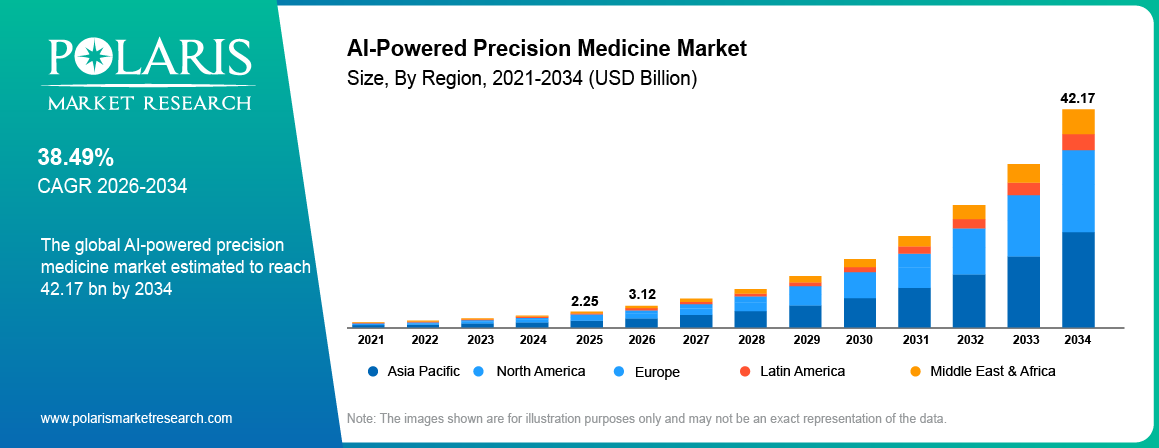
AI-powered precision medicine market size was valued at USD 2.25 Billion in 2025 and is expected to record a CAGR of 38.49% from 2026 to 2034. Rising availability of population-scale genomic and electronic health record (EHR) datasets drives the market growth. Growing regulatory focus on AI credibility and evidence generation is improving confidence in clinical applications, propelling the market expansion.
Market Statistics
Key Takeaways
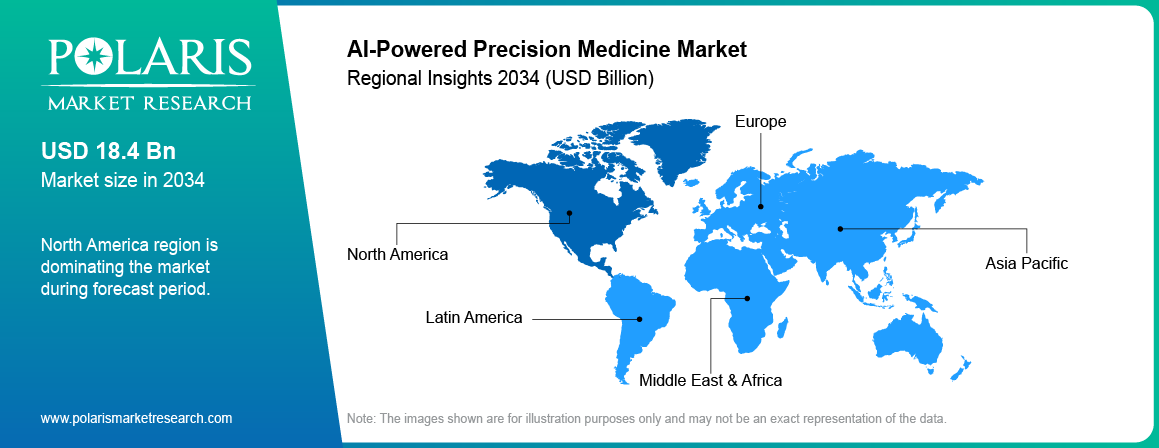
- North America held the largest AI-powered precision medicine market share with 41.28% in 2025. The dominance is attributed to its strong genomic and clinical data infrastructure and high adoption of AI-enabled diagnostics and precision oncology.
- The market in Asia Pacific is expected to record the highest CAGR of 42.63% during the forecast period. The rising AI precision medicine market size in Asia Pacific is driven by rapid healthcare digitization and genomic testing.
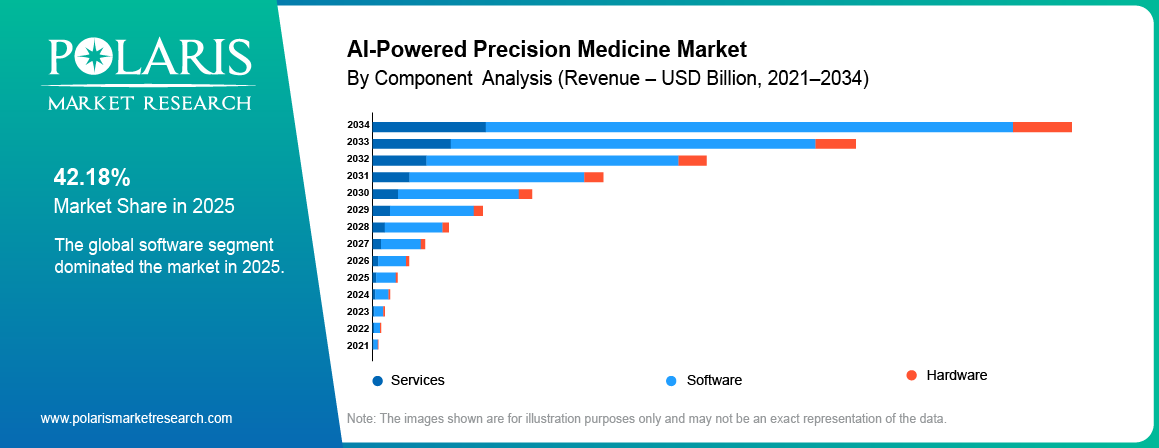
- Software represented the largest market share of 42.18% in 2025. Increasing demand for AI algorithms and clinical decision-support platforms fuels the segment growth.
- Therapy selection accounted for 18.34% share in 2025. This is supported by the rising need for personalized treatment matching and growing use of AI for treatment-response prediction and patient stratification.
- Oncology accounted for the largest share of 30.42% in 2025. High cancer burden and treatment complexity bolster the segment growth.
Note: Figures and projections outlined in this report are the result of Polaris Market Research’s proprietary analytical processes, grounded in the latest available datasets and market observations.
AI-Powered Precision Medicine Market Definition
The AI-powered precision medicine market combines machine learning, multimodal patient data, and molecular testing to support treatment, diagnostic, research, and drug-development decisions tailored to individual patient characteristics. The market includes software platforms, analytics services, data infrastructure, and AI-enabled diagnostics used for biomarker discovery, patient stratification, therapy selection, outcome prediction, and disease monitoring. The market is moving from standalone algorithms toward integrated data and analytics systems.
Revenue comes from software subscriptions, analytics services, testing-related platform fees, data licensing, and enterprise partnerships. The market opportunity extends beyond software, as the same data can support diagnostic testing, pharmaceutical research, biomarker discovery, and AI development.
Market growth depends on how effectively research capabilities are converted into regular business use. A model may perform well in a controlled research setting but have limited commercial value if its results are not used in clinical workflows, clinical trials, testing programs, or evidence generation. Platforms that support patient matching, biomarker discovery, molecular testing, or treatment decisions have stronger potential to generate recurring revenue.
AI-Powered Precision Medicine Market Dynamics
AI-Powered Precision Medicine Market Driver Impact Analysis
| Market Driver | Est. CAGR Impact | Geographic Relevance | Impact Timeline |
| Population-scale linked genomic/EHR data | 8.45% | US; transferable globally | Short-term, ongoing |
| FDA AI credibility framework | 5.80% | US; global regulatory reference | Short to medium term |
| Multimodal foundation-model partnerships | 7.25% | North America and Europe | Short to medium term |
| AI-enabled longitudinal oncology monitoring | 6.65% | US and advanced oncology systems | Medium term, 2–4 years |
Source: Polaris Market Research Analysis
Driver: Population Scale Linked Genomic/EHR Data
Population-scale datasets are also expanding the development base. In June 2026, the NIH reported that the All of Us Research Program had data from more than 747,000 participants, including more than 535,000 whole genomes linked to nearly 482,000 electronic health records. (Source: nih.gov) The scale provides greater scope for population-aware genomic algorithms while raising expectations around performance across different ancestries, disease stages, and care settings.
Population-scale linked data is giving precision medicine developers a deeper view of how molecular information relates to patient outcomes. The value comes from having more records and from linking genomic data with long-term clinical information to understand how molecular characteristics perform across different treatments, health conditions, and stages of care. Data diversity is also important for commercial use. This increases the need for vendors to demonstrate that their solutions perform reliably across different patient groups and populations. AI tools help analyze the vast database efficiently.
Driver: FDA AI Credibility Framework
Rising regulatory emphasis on the credibility, transparency, validation, and lifecycle monitoring of AI models is supporting more structured adoption of AI-enabled precision healthcare. FDA guidance is increasing the importance of context-of-use definition, model validation, data governance, and lifecycle monitoring in AI-enabled drug development. The FDA's 2025 draft guidance introduces a risk-based credibility framework tied to a defined context of use. A model used for a narrow research question requires a different evidence package from a model whose output contributes directly to a regulatory decision. This approach makes validation strategy part of product architecture and procurement.
The framework increases the importance of data provenance, training and testing separation, performance limitations, and lifecycle controls. FDA and EMA good-AI-practice principles also emphasize human-centered design, governance, multidisciplinary expertise, risk assessment, and lifecycle management. Vendors that incorporate these controls early can reduce the burden of demonstrating credibility when moving from research into regulated applications.
Driver: Multimodal Foundation-Model Partnerships
Partnerships among pharmaceutical companies, technology providers, healthcare organizations, and AI developers propel the development of multimodal foundation models. These models can analyze genomic, clinical, imaging, pathology, and other biological datasets simultaneously. These collaborations provide access to specialized datasets, computing infrastructure, domain expertise, and model-development capabilities. The resulting platforms can support biomarker discovery, patient stratification, clinical-trial matching, diagnosis, and treatment-response prediction, expanding the commercial applications of AI-powered precision medicine.
In April 2025, Pathos AI, Inc. signed a multi-year, strategic collaboration with AstraZeneca and Tempus AI, Inc. In this deal, the companies aim to build a multimodal foundation model in oncology. The arrangement connects clinical and molecular datasets with model development and pharmaceutical applications, expanding the revenue opportunity beyond diagnostic testing (Source: pathos.com).
Foundation models support several downstream activities using a common data and model infrastructure, including biomarker discovery, cohort identification, and target prioritization. Tempus's Loop platform adds real-world data, human biological models, and CRISPR screens to the target-discovery workflow, strengthening the connection between observational evidence and experimental validation.
Restraint: Model Portability and Data Access
Model portability remains a major restraint. A system trained in one hospital, assay workflow, or demographic population can lose performance when clinical definitions, disease prevalence, or operating practices change. Local validation can increase implementation costs and lengthen procurement cycles, favoring platforms that can demonstrate performance across broader and better-characterized populations.
Data access creates another constraint. Genomic, imaging, and longitudinal clinical records require strong privacy and governance controls. The European Health Data Space provides a future structure for secondary use. However, its implementation is staged. Thus, vendors need to build controlled-access and interoperability capabilities before the full opportunity becomes available. Workflow friction also remains important, as accurate prediction has limited value if it reaches clinicians outside the decision window.
Opportunity: AI-Enabled Longitudinal Oncology Monitoring
AI-based longitudinal oncology monitoring is expected to represent a significant opportunity during the forecast period. Cancer care increasingly relies on continuous assessment of disease progression, recurrence risk, treatment response, and patient outcomes. AI can integrate imaging, pathology, molecular profiles, EHR information, and patient-generated data over time. It is used to identify subtle changes that may indicate progression or treatment resistance. Such systems could support earlier intervention, remote monitoring, dynamic treatment adjustment, and personalized follow-up. Rising adoption of precision oncology and increasing availability of longitudinal cancer datasets are creating favorable conditions for these solutions.
AI-Powered Precision Medicine Market Segmentation Analysis
The report provides a comprehensive analysis of the AI-powered precision medicine market by component, application, therapeutic area, end user, and region to identify the major revenue-generating and fastest-growing market segments.
Component Insights
Software held the largest share of 42.18% in 2025. The dominance is attributed to the growing demand for AI algorithms, clinical decision-support platforms, and data analytics tools is driving adoption of software solutions that integrate genomic, clinical, imaging, and real-world data. It includes algorithms, orchestration, molecular interpretation, analytics, and clinical decision-support capabilities. Software benefits from scalable deployment across laboratories, research environments, pharmaceutical organizations and healthcare systems, although enterprise implementation commonly requires supporting integration and validation services.
Services are projected to register 37.85% of CAGR during the forecast period. Buyers require model development, validation, biomarker analytics, evidence generation, implementation, and managed interpretation. Hardware remains relevant where sequencing, imaging, and high-performance computing are sold as part of an integrated workflow, but its market boundary is narrower because many organizations rely on external cloud or institutional computing infrastructure.
Application Insights
Therapy selection accounted for 18.34% share in 2025. Rising need to match patients with the most effective therapies and growing adoption of AI for treatment-response prediction and biomarker-based patient stratification boost segment growth. Molecular profiling and biomarker-driven treatment decisions create repeated points at which AI compares patient characteristics with available evidence. The application also has a direct connection to clinical workflow, making integration with testing, EHR, and decision-support systems important to commercialization.
Monitoring & prognosis is expected to record 36.65% of CAGR during the forecast period. Longitudinal molecular profiling and minimal residual disease monitoring create recurring analytical requirements as patient status changes across treatment. The Tempus-Personalis transaction reinforces the commercial relevance of personalized MRD monitoring and longitudinal oncology data.
Therapeutic Area Insights
Oncology accounted for the largest share of 30.42% in 2025 because molecular profiling, targeted therapies, biomarker discovery, trial matching, and longitudinal monitoring already generate multiple decision points. The Tempus-AstraZeneca-Pathos foundation-model collaboration and the Personalis transaction center on oncology data and biomarkers. High cancer burden and treatment complexity propel the segment's dominance. Also, rapid adoption of AI for biomarker discovery, patient stratification, and personalized cancer treatment drives the segment growth.
Neurology is projected to record the 38.25% of CAGR during the projected period. Research moves toward molecular and genomic disease subtypes. Tempus's collaboration with Northwestern applies its platform to neurogenomics and Alzheimer’s research, illustrating how genomic repositories support therapeutic development. Cardiology, immunology, and rare disease also provide opportunities, but commercialization depends on disease-specific endpoints and clinical evidence.
End User Insights
Pharmaceutical & biotechnology companies represented the largest share of 42.75% in 2025. These organizations use AI for biomarker discovery, cohort analytics, evidence generation, target discovery, and clinical-trial optimization. A single platform supports several therapeutic programs, increasing the potential value of enterprise collaborations.
Healthcare providers are projected to exhibit 37.46% of CAGR during the forecast period as AI-enabled therapy selection, molecular interpretation and care-pathway alerts move closer to routine clinical workflows. Procurement depends heavily on EHR, pathology, radiology and laboratory integration. Research institutes and diagnostic laboratories remain important users, particularly where population-scale data access, reproducible research environments and repeat molecular monitoring are required.
AI-Powered Precision Medicine Market Segment Performance Summary
| Category | Segment | Base-Year Status | Forecast CAGR | Key Driver |
| Component | Software | Largest share (42.18%) | 39.65% | Scalable model deployment |
| Application | Drug Discovery | Largest share (31.68%) | 39.82% | Biomarker-linked decisions |
| Therapeutic Area | Oncology | Largest share (30.42%) | 39.10% | Mature profiling workflows |
| End User | Pharma & Biotechnology | Largest share (42.75%) | 40.22% | Portfolio-level analytics |
Source: Polaris Market Research Analysis
AI-Powered Precision Medicine Market Regional Analysis
North America AI-Powered Precision Medicine Market Trends
North America held the dominant market share of 41.28% in 2025. The leading share is propelled by strong genomic and clinical data infrastructure. High adoption of AI-enabled diagnostics and precision oncology across healthcare systems and pharmaceutical companies also supports regional market leadership. The U.S. combines population-scale NIH data, FDA guidance, major academic medical centers, and a concentrated ecosystem of AI, sequencing, and diagnostics companies. Tempus, Illumina and Personalis demonstrate the convergence of testing, data and AI, while Canada contributes genomics research and public health infrastructure.
Procurement in the region increasingly emphasizes regulatory evidence, model validation, and clinical workflow integration. The U.S. also has the clearest public evidence base linking population data, AI guidance, and commercial platform development, creating favorable conditions for enterprise adoption.
Europe AI Powered Precision Medicine Market Trends
Europe held a 26.14% revenue share in 2025. The regional market share is supported by its rising focus on health data infrastructure and regulated data sharing. The European Health Data Space (EHDS) entered into force in March 2025, creating a framework for the secondary use of health data. Most secondary-use provisions are expected to begin in 2029, while provisions covering genomic data will follow in 2031. This development is encouraging vendors to strengthen data governance, interoperability, and controlled-access capabilities ahead of broader implementation (Source: health.ec.europa.eu).
The UK has a separate genomics ecosystem supported by NHS infrastructure and local data-governance frameworks. As the use of AI in precision medicine expands, European buyers are expected to place greater importance on data rights, privacy, interoperability, and evidence quality when selecting AI-powered precision medicine platforms.
Asia Pacific AI Powered Precision Medicine Market Trends
The market in Asia Pacific is projected to record the highest CAGR of 42.63% during the forecast period. Rapid expansion of healthcare digitization and genomic testing drive the regional market growth. Rising government investments in AI, biotechnology, and precision medicine infrastructure are expected to boost regional growth. China, Japan, South Korea, Singapore, Australia, and India are developing genomic and digital-health capabilities at different rates. Large populations provide significant data opportunities, but localization, language, consent, and cross-border data requirements make deployment more complex than replicating a U.S. model.
Singapore is positioned as a controlled-data and regional research hub, while India combines a large population opportunity with developing infrastructure. China presents significant data potential but operates under more restrictive data and human genetic resource controls.
Latin America's AI-Powered Precision Medicine Market Trends
The Latin America market is projected to exhibit a CAGR of 39.72% during the projected period. It is supported by expanding healthcare research and diagnostic capabilities. Brazil and Mexico have important healthcare provider and research systems, while uneven access to sequencing technologies and fragmented EHR infrastructure continue to limit wider adoption. Growing use of cloud-based interpretation, oncology partnerships, and multi-institution research networks is creating practical opportunities for precision medicine platforms.
Data governance and access will remain important factors for regional adoption. Vendors that can support multiple institutions while limiting the unnecessary sharing of identifiable patient data can help reduce implementation challenges and improve adoption.
Middle East and Africa AI-Powered Precision Medicine Market Trends
The Middle East and Africa market is expected to record a CAGR of 40.18% during the projected period. It is fueled by growing investment in genomics and digital-health infrastructure, particularly in the Gulf states. These developments are creating opportunities in population screening and precision oncology, while South Africa adds value through its genomic diversity and research capabilities. Adoption remains concentrated among major healthcare systems, while limited availability of specialized talent increases demand for managed services. Solutions that combine software with implementation, analytics, and ongoing support are therefore likely to face fewer adoption barriers than standalone platforms.
AI-Powered Precision Medicine Market Regulatory Environment Heatmap
| Region/Country | Policy Environment | Key Regulations/Programs | Market Implication | Trend |
| US | Favorable | FDA 2025 AI drug-development draft guidance; NIH All of Us | Credibility evidence and population validation become procurement requirements | Expanding |
| European Union | Developing | Regulation (EU) 2025/327, European Health Data Space | Staged access to EHR and genomic data through 2031 | Developing |
| United Kingdom | Favorable | UK GDPR; NHS genomic medicine infrastructure | Strong public-system channel with local governance | Stable |
| Canada | Neutral | Provincial health privacy laws; national genomics programs | Province-by-province deployment and validation | Stable |
| Japan | Developing | APPI and national genomic medicine initiatives | Local evidence and language-specific data needs | Developing |
| China | Restrictive | Personal Information Protection Law; human genetic resources controls | Data localization and partnership requirements | Uncertain |
| Singapore | Favorable | National Precision Medicine program; PDPA | Regional research and controlled-data hub | Expanding |
| India | Developing | Digital Personal Data Protection Act; national genomics initiatives | Large population opportunity with maturing infrastructure | Early stage |
Source: Polaris Market Research Analysis.
AI-Powered Precision Medicine Market Technology and Innovation Landscape
Technology development is moving toward systems capable of combining genomic sequences, pathology images, radiology, structured clinical events, and unstructured clinical notes. Multimodal AI can identify relationships that are difficult to capture from a single data type, but deployment requires careful handling of differences in timing, missingness, resolution, and measurement quality.
Whole-genome sequencing is expanding the feature space available for AI interpretation. Tempus announced its xH assay as its first whole-genome sequencing test, initially focused on hematologic oncology. Foundation models create reusable representations for multiple downstream tasks, while longitudinal models add time as a variable to distinguish stable patient characteristics from changes associated with treatment or progression.
Technology and Innovation Landscape
| Technology | Adoption Stage | Key Development [2025–2026] | Market Impact |
| Multimodal genomic AI | Growing deployment | Illumina-Tempus collaboration, April 2025 | Broader molecular testing adoption |
| Oncology foundation models | Early commercial deployment | USD 200 million Tempus-AstraZeneca-Pathos agreements, April 2025 | Data/model monetization |
| AI target discovery with CRISPR | Early commercial deployment | Tempus Loop launch, April 2025 | Human-data-led target validation |
| Whole-genome AI interpretation | Pilot or early research | Tempus xH announcement, January 2025 | Expanded variant coverage |
| Longitudinal molecular profiling | Pilot or early research | NYU Langone prospective study, January 2026 | Treatment monitoring evidence |
| Personalized MRD analytics | Growing deployment | Tempus-Personalis transaction, July 2026 | Recurrence monitoring scale |
Source: Polaris Market Research Analysis.
AI-Powered Precision Medicine Market Competitive Landscape
Competition is increasingly organized around access to multimodal data, diagnostic reach, model development, and workflow control. Tempus represents an integrated model linking molecular testing, clinical data, and pharmaceutical analytics. Illumina provides sequencing and genomic AI capabilities, while pharmaceutical companies increasingly participate directly in model development and data partnerships.
Data scale is becoming an important competitive advantage, but having large datasets alone is not enough. Linked and longitudinal data can provide greater value when molecular information is connected with clinical history and treatment outcomes. Companies are therefore increasingly competing through data quality, workflow integration, clinical evidence, and strategic partnerships rather than relying only on their algorithms.
Competition also extends to infrastructure providers and specialized AI companies. Microsoft and NVIDIA provide cloud, accelerated computing and AI tooling, while Owkin focuses on federated AI and biopharma analytics. The market is therefore likely to remain layered, with partnerships connecting infrastructure, proprietary data, diagnostics and clinical channels.
AI-Powered Precision Medicine Market – Vendor Positioning
| Company | Estimated Market Position | Primary Strength | Geographic Focus |
| AstraZeneca | Top 10 ecosystem participant | Oncology drug development, biomarker-led trials, and clinical programs | Global |
| Caris Life Sciences | Specialized precision medicine leader | Molecular profiling, AI-enabled diagnostics, and tumor intelligence | North America; expanding globally |
| Guardant Health | Leading liquid-biopsy participant | Liquid biopsy, genomic profiling, and AI-supported cancer testing | North America; global partnerships |
| Illumina | Top 3 ecosystem participant | Next-generation sequencing, multiomics, and genomic data infrastructure | Global |
| Microsoft | Top 5 infrastructure participant | Cloud computing, healthcare AI, data platforms, and enterprise solutions | Global |
| NVIDIA | Top 5 infrastructure participant | Accelerated computing, AI platforms, and healthcare/biomedical AI infrastructure | Global |
| Owkin | Niche leader | Federated AI, multimodal biomedical data, and biopharma analytics | Europe and North America |
| PathAI | Specialized AI participant | AI-powered pathology, digital diagnostics, and biomarker development | North America; global partnerships |
| Personalis | Niche leader | Personalized cancer genomics and minimal residual disease monitoring | US; global partnerships |
| QIAGEN | Major precision medicine participant | Molecular diagnostics, genomic workflows, and bioinformatics | Global |
| Recursion Pharmaceuticals | Emerging AI-native leader | AI-enabled drug discovery, biological data, and precision therapeutics | North America; global partnerships |
| Roche (Foundation Medicine) | Top 5 ecosystem participant | Comprehensive genomic profiling, companion diagnostics, and oncology | Global |
| SOPHiA GENETICS | Specialized platform participant | AI-driven genomic data analysis and clinical decision support | Global; strong Europe and North America presence |
| Tempus AI | Top 3 ecosystem participant | Multimodal clinical/genomic data, AI-enabled diagnostics, and precision oncology | North America; partnerships globally |
Source: Polaris Market Research Analysis.
AI-Powered Precision Medicine Market Buyer Use Cases and Entry Barriers
Pharmaceutical buyers use AI precision medicine platforms to identify targets, define biomarker strategies, and select trial cohorts. Healthcare providers focus on whether an output changes treatment decisions and fits existing governance. Laboratories evaluate analytical performance, interpretation workflow and repeat-testing requirements, while investors assess data defensibility, recurring contracts and the ability to expand across indications.
Buyer Use Cases and Decision Framework
| Buyer/Investor Type | Primary Use Case | Key Insight Sought | Decision Horizon |
| Oncology pharmaceutical R&D leaders | Biomarker and target discovery | Human-data evidence and cohort availability | 3–7 years |
| Clinical development executives | Trial enrichment and patient matching | Enrollment impact and endpoint relevance | 2–5 years |
| Molecular diagnostics laboratories | AI-assisted interpretation and monitoring | Turnaround, sensitivity and workflow fit | 1–3 years |
| Academic medical centers | Prospective molecular profiling | Research access and clinical translation | 3–7 years |
| Health-system oncology leaders | Therapy selection and care-pathway alerts | Clinical utility and EHR integration | 1–3 years |
| Healthcare-focused investors | Platform and diagnostics consolidation | Data defensibility and recurring revenue | 3–7 years |
Source: Polaris Market Research Analysis.
Entry barriers are cumulative. New vendors require relevant data, secure infrastructure, disease expertise, validation partners, and a path into clinical or research workflows. Large datasets alone do not solve the problem when labels are incomplete or outcomes are inconsistent. Clinical partnerships also take time, while regulatory documentation must develop alongside the model.
Interoperability adds another barrier. Molecular laboratories, EHRs, imaging systems, and research databases often use different identifiers and data structures. Vendors must absorb integration work before producing a usable prediction. Platforms that standardize data ingestion while retaining local governance controls can reduce deployment friction over time.
Key Players
- AstraZeneca
- Caris Life Sciences
- Guardant Health
- Illumina
- Microsoft
- NVIDIA
- Owkin
- PathAI
- Personalis
- QIAGEN
- Recursion Pharmaceuticals
- Roche (Foundation Medicine)
- SOPHiA GENETICS
- Tempus AI
Industry Developments
- August 2026: Genedata launched an AI agent within Genedata Profiler to accelerate biomarker discovery using translational and clinical research data, with its capabilities demonstrated in Alzheimer’s disease research. (source: genedata.com)
- July 2025: PathAI launched the Precision Pathology Network, connecting digital pathology laboratories through its AISight platform and providing access to AI-powered pathology and biomarker tools.(source: pathai.com)
- April 2025: Illumina Inc. and Tempus AI, Inc. announced a collaboration to boost the clinical adoption of next-generation sequencing tests through novel evidence generation. (Source: illumina.com)
AI-Powered Precision Medicine Market Premium Insights and Forward Outlook
- Discovery-to-care integration: Platforms that connect biomarker discovery with treatment decisions and patient monitoring will gain traction.
- European data access: EHDS creates a staged opportunity, with broader secondary-use provisions beginning in 2029 and genomic-data provisions in 2031.
- M&A activity: Deals are likely to target complementary assets such as diagnostic capabilities, longitudinal data, assays, and clinical channels. The Tempus-Personalis transaction reflects this trend.
- Clinical validation: Prospective studies and real-world deployments will become increasingly important for demonstrating clinical utility beyond retrospective model performance.
- Data rights and governance: Buyers will increasingly assess data provenance, usage rights, consent, privacy, and cybersecurity alongside model accuracy.
- Testing economics: Revenue models will span testing, software, analytics, and clinical services, making validation and integration costs important to buyers and investors.
- Disease-specific validation: Foundation models can reduce development costs, but individual clinical applications will still require disease- and workflow-specific validation.
AI-Powered Precision Medicine Market Report Segmentation
By Component Outlook (Revenue, USD Billion, 2021–2034)
- Software
- Hardware
- Services
By Application Outlook (Revenue, USD Billion, 2021–2034)
- Drug Discovery
- Diagnosis & Screening
- Therapy Selection
- Monitoring & Prognosis
- Clinical Trial Optimization
By Therapeutic Area Outlook (Revenue, USD Billion, 2021–2034)
- Oncology
- Neurology
- Cardiology
- Immunology
- Rare Disease
By End User Outlook (Revenue, USD Billion, 2021–2034)
- Pharma & Biotechnology
- Healthcare Providers
- Research Institutes
- Diagnostic Laboratories
By Regional Outlook (Revenue, USD Billion, 2021–2034)
- North America
- U.S.
- Canada
- Europe
- Germany
- France
- UK
- Italy
- Spain
- Netherlands
- Rest of Europe
- Asia Pacific
- China
- Japan
- India
- South Korea
- Taiwan
- Australia
- Rest of Asia Pacific
- Latin America
- Brazil
- Mexico
- Argentina
- Rest of Latin America
- Middle East & Africa
- Saudi Arabia
- UAE
- South Africa
- Rest of Middle East & Africa
AI-Powered Precision Medicine Market Report Scope
| Report Attributes | Details |
| Market Size in 2025 | USD 2.25 Billion |
| Market Size in 2026 | USD 3.12 Billion |
| Revenue Forecast by 2034 | USD 42.17 Billion |
| CAGR | 38.49% from 2026–2034 |
| Base Year | 2025 |
| Historical Data | 2021–2024 |
| Forecast Period | 2026–2034 |
| Quantitative Units | Revenue in USD Billion and CAGR |
| Report Coverage | Revenue Forecast, Growth Factors, Competitive Landscape, Industry Trends, and Strategic Analysis |
| Segments Covered |
|
| Regional Scope |
|
| Competitive Landscape |
|
| Report Format | PDF + Excel |
| Customization | Available by Country, Region, and Segment |
Source: Polaris Market Research Analysis
AI Powered Precision Medicine Market Research Methodology
The report draws on 15 market evidence sources, comprising six Tier A government or peer-reviewed sources and nine Tier B company or trade sources. The Tier A evidence base includes the U.S. Food and Drug Administration, National Institutes of Health, European Commission, and peer-reviewed research concerning the All of Us genomic dataset. Tier B sources include dated releases from Tempus, Illumina, and trade reporting on the Tempus-Personalis transaction. Competitor research pages were reviewed for structure and content gaps only and were excluded from report citations.
Primary research for Polaris sizing uses structured discussions with precision-medicine platform executives, molecular diagnostics leaders, pharmaceutical R&D and clinical-development teams, healthcare-provider decision makers, laboratory operators and subject-matter experts. Interviews are used to test market definitions, revenue boundaries, adoption barriers, contract structures, and purchasing expectations. Validation calls challenge preliminary findings and identify differences between public evidence and operating practice.
Polaris applies both top-down and bottom-up market sizing. The top-down approach begins with adjacent healthcare AI, clinical genomics, diagnostics, and data-analytics activity and isolates revenue attributable to AI-powered precision medicine. The bottom-up approach aggregates company revenue, testing activity, platform contracts, data licensing and services across segments and regions. Primary research is used to reconcile differences and reduce double counting.
Research Methodology Overview
| Research Phase | Key Activities | Data Sources Used | Purpose / Output |
| Secondary Research | Source discovery, extraction and claim verification | FDA and NIH publications; EU regulation; peer-reviewed literature; company releases; Reuters | Build evidence base and source log |
| Primary Research | Structured interviews and expert validation calls | Executives, product managers, pharma R&D, providers, laboratories, end users | Validate definitions, adoption, and revenue assumptions |
| Market Sizing & Triangulation | Top-down and bottom-up reconciliation | Adjacent markets, company revenue, unit activity, contract evidence, interviews | Confirmed base-year market and segment values |
| Forecasting | Scenario and driver adjustment | Validated base year; drivers and restraints | Forecast by segment and region |
| Data Validation | Cross-checks, discrepancy resolution and analyst sign-off | Named dated sources, interview evidence and internal QC | Publication-ready dataset and narrative |
Source: Polaris Market Research Analysis.
Forecasts begin with the validated base-year value and apply segment-specific assumptions tied to market mechanisms. Dataset expansion, regulatory credibility requirements, EHDS implementation, workflow integration, and industry consolidation influence adoption differently by geography and use case. Polaris therefore models these factors independently rather than applying one uniform growth rate across all segments. Data validation compares primary and secondary inputs, identifies contradictions and resolves them through additional research or analyst judgment.
AI-Powered Precision Medicine Market FAQ's
The AI powered precision medicine market was valued at USD 2.25 Billion in 2025 and is projected to reach USD 42.17 Billion by 2034, representing a CAGR of 38.49%.
Population-scale data is a major near-term driver. The NIH's All of Us program provides data from more than 747,000 participants, including over 535,000 whole genomes linked to nearly 482,000 EHRs.
The practical change is stronger evidence discipline. The FDA's 2025 draft framework uses a risk-based credibility approach tied to a defined context of use, increasing the importance of validation, data provenance, and lifecycle controls.
The oncology segment already has established molecular testing, targeted therapies, biomarker strategies, and longitudinal monitoring workflows. The segment is also supported by growing activity around personalized MRD monitoring.
North America is the dominant regional market with 41.28% share in 2025. This is supported by its combination of FDA regulatory activity, NIH population-scale data, academic medical centers, and a concentrated ecosystem of AI, sequencing and diagnostics companies.
The approximately USD 1.5 billion transaction links AI-enabled data infrastructure with personalized MRD testing. It signals increasing commercial value for longitudinal molecular information and repeated monitoring rather than one-time genomic analysis.
The EHDS creates a phased opportunity for precision medicine AI vendors. It entered into force in March 2025, while most secondary-use provisions begin in 2029 and genomic-data provisions begin in 2031.
Services, Monitoring & Prognosis, Neurology and Healthcare Providers are identified as the fastest-growing categories across their respective segmentation dimensions.
Download Sample Report of AI-Powered Precision Medicine Market
Please fill out the form to request a customized copy of the research report.


