
AI Inference Software Market Size, Share, and Forecast 2026 to 2034
REPORT DETAILS
AI Inference Software Market Summary
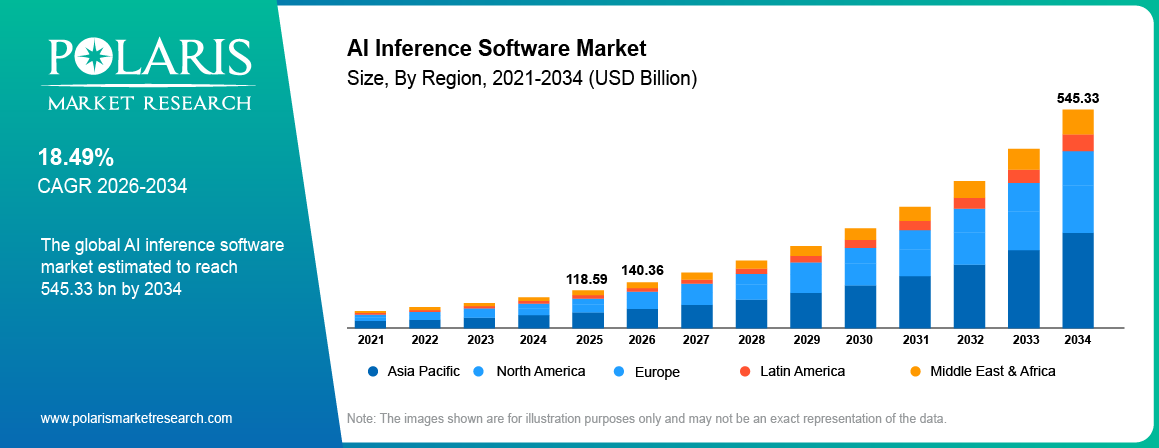
The AI inference software market size was valued at USD 118.59 Billion in 2025. The market is expected to grow at a CAGR of 18.49% from 2026 to 2034. Growth is supported by rising deployment of generative AI, increasing demand for efficient model serving, wider use of distributed inference, and the need to reduce latency and inference costs across cloud, private, and edge environments.
Market Statistics
Key Takeaways
- North America accounted for 36.18% of the global AI inference software market in 2025, supported by strong cloud infrastructure, AI software vendors, and enterprise deployment.
- The Asia Pacific region is expected to record a CAGR of 21.34% during the forecast period, driven by increasing AI infrastructure and improved access to accelerator capacity.
- Inference Runtime & Optimization led the component segment, accounting for 28.42% of the market in 2025.This is driven by demand for model optimization, quantization, compilation and hardware specific execution.
- Distributed Orchestration & Routing is anticipated to demonstrate a 21.35% CAGR till 2034, fueled by the escalating demand for inference workload management across multiple accelerators and locations.
- LLM & Reasoning represented 33.46% in 2025, as large language models become more prominent in production use cases for AI inference software.
Note: Figures and projections outlined in this report are the result of Polaris Market Research’s proprietary analytical processes, grounded in the latest available datasets and market observations.
What is AI Inference Software Market?
The AI inference software market covers the software layer that turns trained machine learning models into reliable production services. It includes inference runtimes, compilers and optimization engines, model servers, distributed inference frameworks, request routing, batching, cache management, autoscaling, endpoint control, managed serving, observability, and inference operations. Training revenue, accelerator hardware, generic cloud compute, foundation model licensing, and broader MLOps functionality are excluded unless revenue can be specifically attributed to inference execution and serving.
NVIDIA Triton Inference Server 26.07 illustrates the distinction between execution and serving layers. The release packaged several backends, including TensorRT, ONNX Runtime, OpenVINO, TensorRT-LLM, and vLLM, allowing a model server to operate above multiple execution engines and hardware targets. The economic value of model serving therefore centers on converting available compute into predictable requests per second, tokens per second, latency, uptime, and resource utilization (Source: nvidia.com).
Red Hat's expansion of AI Inference to managed Kubernetes demonstrates the distinction between inference software and broader MLOps platforms. MLOps can cover model registration, training, experimentation, CI/CD, evaluation, governance, and monitoring, whereas production inference must determine request placement, cache reuse, replica scaling, memory allocation, failure handling, and service-level performance. (Source: Red Hat)
The market boundary also separates inference software from foundation model API services. Hosted APIs can combine model intellectual property, accelerator capacity, serving software, safety systems, and provider margins within one token price. This report captures only the software or managed inference value attributable to inference runtime, model execution, deployment, optimization, orchestration, and operations.
Market Dynamics
Driver Impact Analysis
The table ranks the main demand drivers by their estimated impact on market growth across the forecast period.
| Market Driver | Impact Level | Geographic Relevance | Impact Timeline |
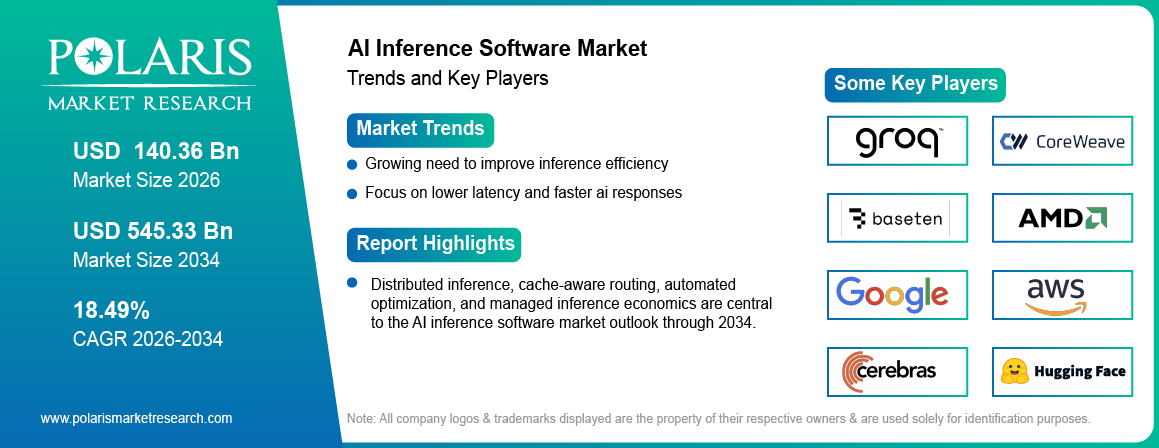
| Growing need to improve inference efficiency | High | North America, Europe, Asia Pacific | Short to medium term |
| Focus on lower latency and faster AI responses | High | Global | Short term (ongoing) |
| Automated inference optimization | Medium | North America, Europe | Medium term |
| Managed deployment of inference | Medium | Global | Medium to long term |
| Sovereign and hybrid AI infrastructure investment | Medium | Europe, Middle East, Asia Pacific | Medium to long term |
Source: Polaris Market Research Analysis
Driver: Growing Need to Improve Inference Efficiency
The increasing complexity of production AI workloads is creating demand for software that manages inference across multiple computing resources. Large language models, reasoning models, and multimodal applications can place significant pressure on memory and processing capacity. In March 2026, NVIDIA released Dynamo 1.0, which supports distributed inference across serving engines and infrastructure components. Its architecture has routing, cache management and workload coordination functions. Such capabilities enable enterprises to handle larger workloads without treating every inference request as a separate, isolated process, and fuel demand for specialized solutions in the AI inference software market (Source: nvidia.com).
Another factor that supports demand for inference software is improving hardware utilization. NVIDIA's Dynamo architecture includes disaggregated serving, KV-aware routing, topology-aware scheduling and multi-node operation. Such features allow workloads to be distributed based on available resources and not simply on request balancing. Better placement allows organizations to use installed accelerator capacity more effectively and to manage production traffic across multiple nodes. These functions are becoming more important and the software is becoming crucial for companies with larger inference fleets in managing GPU utilization.
Driver: Focus on Lower Latency and Faster AI Responses
Inference performance has become a key consideration as users increasingly expect AI applications to respond quickly. Tests cited by Google Cloud showed its GKE Inference Gateway delivered AI responses up to 92% faster, including a 92.8% shorter time to first token, by using prefix-cache data and model-aware routing. These techniques cut down unnecessary computation when a request contains repeated information or long prompts that can be reused. The result highlights the commercial value of software-level optimization, particularly for applications where response speed directly affects user experience and service quality (Source: google.com).
The growing complexity of model deployment is also increasing demand for automated performance evaluation. AWS introduced generative AI inference recommendations in SageMaker AI to compare deployment configurations against objectives such as latency, throughput, and cost. The service evaluates combinations of instance types, serving containers, parallelism, and optimization approaches. These tools reduce the manual testing burden of enterprise teams and make performance benchmarking part of the deployment process. This is a good sign for wider adoption of AI model serving software as organizations face more models and hardware configurations (Source: aws.amazon.com).
Restraint: Integration Complexity Across Inference Software Stacks
As enterprises are becoming more dependent on software and infrastructure, deploying inference is challenging. In June 2026, Red Hat’s component matrix for OpenShift AI, Red Hat AI Inference Server, llm-d and vLLM tied them together under specific APIs and accelerator environments. Each layer may have its own version requirements and compatibility boundaries. Enterprise teams therefore need to validate serving software, drivers, accelerators, Kubernetes components, routing, monitoring, and security together. This increases implementation effort and can make upgrades more difficult, creating a constraint for the wider adoption of KV cache management and other advanced inference capabilities (Source: docs.redhat.com).
Model features, optimization methods, and hardware support vary between backends. Such differences can increase testing requirements before a new model or software version is moved into production. The resulting maintenance effort can slow deployment decisions and increase the operational burden associated with speculative decoding and other performance optimization methods.
Opportunity: Automated Inference Optimization
Automated inference optimization is creating opportunities for software vendors to turn performance tuning into repeatable workflows that can be integrated into production environments. Enterprises increasingly need to evaluate configuration choices across workload characteristics, model architecture, and available compute resources without relying entirely on manual performance testing. Software that can automate these evaluations can help teams identify suitable combinations of quantization, compilation, batching, caching, and parallelism while reducing engineering effort. The increasing adoption of model aware routing also opens opportunities for software platforms to optimize placement of workloads based on model requirements, latency targets and available infrastructure.
Managed deployment models also represent a new opportunity for vendors to generate recurring software revenue from enterprises that don’t want to run the full inference stack themselves. Managed platforms include model packaging, deployment automation, autoscaling, monitoring, security and performance management in one single service. This model can appeal to organizations looking for faster production deployment while limiting the operational burden around accelerator infrastructure and serving frameworks. This is especially relevant in AI inference software market analysis, as vendors can add value in software capabilities, managed operations and enterprise support rather than compete solely on underlying compute capacity.
AI Inference Software Market Segmentation Analysis
The AI inference software market is segmented by component, deployment mode, workload type, commercial model, management model, and end use industry. These dimensions capture differences in software functionality, infrastructure deployment, workload requirements, purchasing structures, and enterprise operating models.
Component Insights
The Inference Runtime & Optimization segment held the largest market share of 28.42% in 2025, owing to growing demand for optimizing model execution on different accelerators and computing environments. Through techniques including compilation, quantization, and kernel optimization, runtime software enhances throughput, latency, memory utilization, and hardware compatibility. Intel’s 2026 OpenVINO releases include the introduction of INT8 and INT4 weight compression, memory enhancements, KV cache improvements and the addition of speculative decoding support, to enable optimization software across multiple inference workloads (Source: openvino.ai).
The Distributed Orchestration & Routing segment is expected to register a CAGR of 21.35% during the forecast period. This is due to the increasing adoption of large-scale reasoning, multimodal, and agentic workloads. These workloads require inference to be coordinated across multiple servers, accelerators, and processing stages rather than relying on a single model server. NVIDIA Dynamo and Red Hat's llm-d provide distributed inference capabilities covering routing, cache management, workload coordination, and multi-node deployment. The increasing use of these capabilities is expected to support demand for advanced inference orchestration software.
The Model Serving segment represented 19.65% of the market in the base year, owing to the continued need to expose trained models through reliable production endpoints. Model serving software handles requests, model instances and execution backends, and supports requirements such as batching and distributed deployment. The documentation for Google’s GKE supports deployment of vLLM with PagedAttention, continuous batching, tensor parallelism and distributed serving. The NVIDIA Triton supports multiple inference backends. These capabilities enable the growth of AI model serving software for enterprise AI applications.
Deployment Mode Insights
In 2025, the Public Cloud segment held a market share of 42.36% owing to access to scalable accelerator capacity, managed AI services, and rapidly growing inference infrastructure. Public cloud platforms permit enterprises to deploy models without requiring the full upfront investment needed for dedicated infrastructure. The availability of managed inference services from major cloud providers further simplifies model deployment, scaling and performance optimization, enabling the continued use of cloud-based distributed inference environments.
Hybrid Cloud segment is anticipated to register a CAGR of 20.55% over the forecast period owing to the demand to balance the control over the infrastructure, data requirements, latency and access to scalable computing resources. Google announced multi-cluster GKE Inference Gateway capabilities to route AI workloads across Kubernetes clusters and regions, signaling the growing need to coordinate distributed inference across multiple environments. With hybrid deployments companies can keep sensitive workloads in controlled infrastructure, and leverage public cloud capacity for variable demand (Source: google.com).
The On-Premises / Private Cloud and Edge segments are also emerging as important for workloads needing data control, low latency, or localized processing. Private deployments allow enterprises to have more control over model weights, prompts, retrieval data and operational logs, while edge deployments need to execute efficiently under tighter memory and computing constraints. These requirements increase demand for software that can maintain consistent model deployment across different infrastructure environments and support edge AI inference applications.
Workload Type Insights
The LLM & Reasoning segment accounted for 33.46% of the market in the base year, driven by the increasing use of large language models, reasoning systems, and agentic applications in enterprise environments. These workloads place greater demands on memory, request scheduling, batching, caching, and accelerator utilization than many conventional AI applications. The growing deployment of distributed inference frameworks and optimized serving engines is supporting software demand around these workloads. This trend is also expanding the role of inference platforms in enterprise AI deployments.
The Multimodal Generative AI segment is expected to grow at a CAGR of 23.60% during the forecast period due to the increase in the adoption of applications working with combinations of text, image, audio, and other data types. Multimodal workloads require different processing stages and resource profiles, which increases the need for flexible serving and optimization. AWS’s 2026 collaboration, using Trainium for prefill and Cerebras CS-3 for decode, shows how inference workloads can be split across different hardware resources to improve performance (Source: datacenterdynamics.com).
Commercial Model Insights
Open-Source segment accounted for 30.84% share in 2025. Open-source inference software removes the initial licensing barriers and allows development teams to tailor, integrate, and optimize serving environments as needed. There is still commercial value that can be built around these frameworks with managed hosting, enterprise support, security, integration and performance engineering, to sustain the ongoing development of the enterprise AI inference platform ecosystem.
The Usage-Based Managed Service segment is projected to grow at a CAGR of 21.62% during the forecast period owing to the demand from enterprises that are looking for production inference through an enterprise AI inference platform without managing the entire underlying infrastructure stack. Managed providers can charge based on model usage, tokens or dedicated accelerator capacity, while also providing deployment, scaling, monitoring and operational support. Baseten’s public pricing, including model API rates and dedicated GPU deployments, demonstrates the spectrum of commercial structures in managed inference.
Management Model Insights
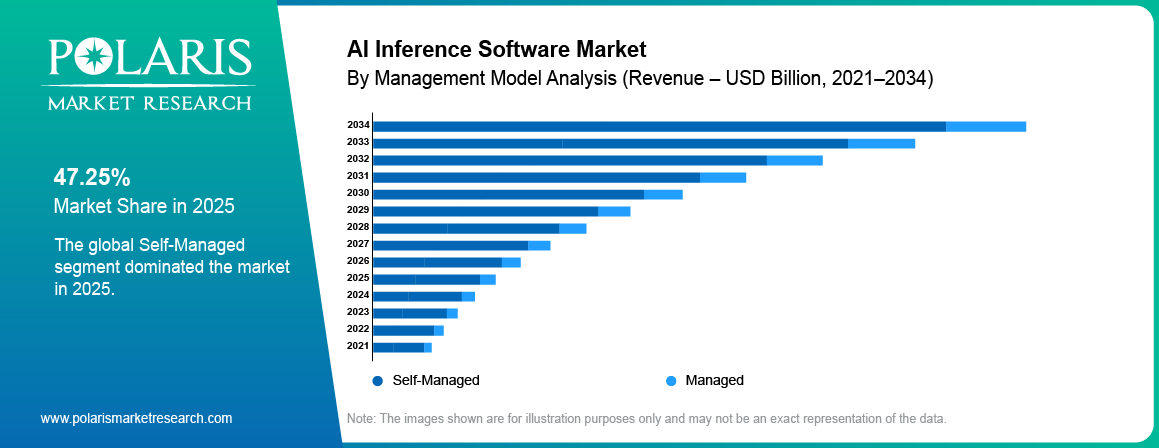
Self-Managed accounted for 47.25% of the market in 2025. This is driven by enterprises wanting more control over infrastructure, model placement, security policies and performance optimization. Self-managed machine learning inference software is particularly pertinent to organizations with mature AI platform engineering teams and dedicated compute infrastructure. Enterprises can pick their own runtimes, serving engines, routing policies and monitoring tools. This model requires more responsibility for deployment and ongoing maintenance.
The Managed segment is expected to grow at a CAGR of 20.42% during the forecast period owing to the growing demand for simplified deployment and automated inference operations. AWS has brought automated inference recommendations to SageMaker AI Studio, while Red Hat has brought AI Inference with llm-d to managed Kubernetes environments. These developments demonstrate the growing availability of enterprise AI inference platform services that reduce the technical effort required to benchmark, deploy, scale, and operate production inference workloads (Source: aws.amazon.com, docs.redhat.com).
End Use Industry Insights
The IT & Cloud Services segment accounted for 32.46% of the market in the base year, supported by the large volume of AI workloads deployed by cloud providers, technology companies, and AI infrastructure operators. These organizations require high-throughput model serving, distributed orchestration, quantization, accelerator optimization, and real-time observability to support production applications. The growing deployment of inference gateways and distributed serving frameworks is increasing demand for software capable of managing complex AI infrastructure environments.
The BFSI sector is estimated to grow at a CAGR of 18.65% during the forecast period. The growing adoption of AI for customer service, document processing, fraud detection, analytics, and other enterprise applications is expected to drive the growth of the BFSI sector. Financial institutions usually require good control of access, auditability, data security and flexible deployment. These requirements create demand for private and hybrid inference environments, especially when sensitive information must stay within controlled infrastructure.
Regional Analysis
The AI inference software market regional analysis includes North America, Europe, Asia Pacific, Latin America, and Middle East & Africa. Regional demand is influenced by AI infrastructure availability, accelerator capacity, enterprise AI adoption, software development capabilities, data sovereignty requirements, regulation, and sovereign computing investments.
North America AI Inference Software Market Trends
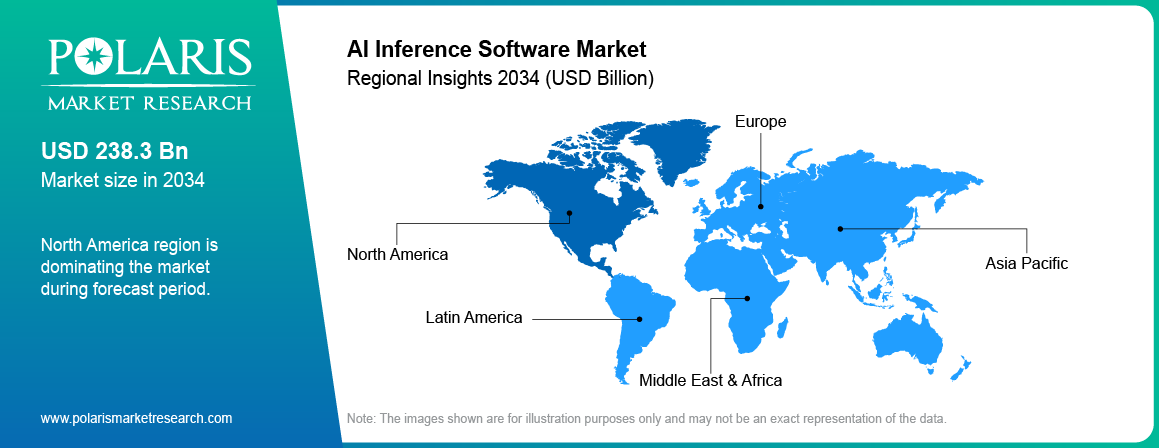
North America dominated the AI inference software market with a share of 36.18% in 2025, propelled by its large concentration of hyperscale cloud providers, AI infrastructure companies, inference software vendors, and open-source development activity. The U.S. remains the major market in the region, with NVIDIA, AWS, Microsoft Azure, Google Cloud, Oracle Cloud, CoreWeave, and other providers supporting a broad production AI ecosystem.
The region is expected to continue its dominance during the forecast period owing to the ongoing commercialization of generative AI and the rising demand for generative AI applications. Microsoft's Maia 200, an AI inference accelerator, and the Maia SDK, for optimizing, profiling and deploying models, were introduced in January 2026, first in U.S. Azure data centers. The launch strengthens the U.S. AI inference software ecosystem by pairing custom inference hardware with tools such as PyTorch support and the Triton compiler (Source: microsoft.com).
Europe AI Inference Software Market Trends
Europe accounted for 25.24% of the global AI inference software market in 2025. The growth is due to the increasing enterprise AI adoption, data governance requirements, and investment in sovereign and hybrid infrastructure managed through Kubernetes orchestration. Countries including Germany, the UK, France, and other major European economies are developing enterprise AI capabilities while organizations increasingly evaluate where models, prompts, and inference data are processed. According to the European Commission, enforcement and transparency rules under the AI Act took effect on 2 August 2026, making the ability to govern and deploy AI in a controlled manner even more important (Source: europa.eu).
The regional market is expected to grow steadily through the forecast period as enterprises seek portable AI infrastructure that can operate across private and public environments. The European Commission launched a call for tenders on 30 July 2026 to establish up to seven AI Gigafactories across Europe, backed by up to EUR 10 billion in public funding and expected to mobilize at least EUR 20 billion in private investment. The facilities will expand access to advanced computing for AI inference, model training, and fine-tuning, strengthening Europe’s AI infrastructure (Source: ec.europa.eu).
Asia Pacific AI Inference Software Market Trends
Asia Pacific is projected to register the fastest CAGR of 21.34% during the forecast period. This is due to expanding AI infrastructure, growing access to accelerators, and increasing adoption of AI applications across major economies, which supports demand for AI model serving software. India, China, Japan, South Korea, Singapore, and Australia are developing AI capabilities across cloud, industrial, consumer, and sovereign applications. India’s Ministry of Electronics and IT announced in February 2026 that the IndiaAI Mission had onboarded more than 38,000 GPUs for common compute access and shortlisted 12 teams for indigenous foundation models (Source: pib.gov.in).
The region's heterogeneous technology landscape also is driving the need for portable and hardware-agnostic inference solutions. Enterprises are running AI workloads on an increasingly diverse mix of CPUs, GPUs, accelerators and edge processors and software is needed to maximize model execution across these different computing environments. The adoption of Edge AI inference will be further boosted by growing applications in manufacturing, telecommunication, robotics, consumer technology and multilingual AI, especially in situations where localized processing, lower latency and efficient utilization of resources are important.
Latin America AI Inference Software Market Trends
Latin America represented 5.62% of the global AI inference software market in 2025, driven by increasing AI adoption in financial services, retail, telecom, media, and government applications. Brazil and Mexico are core enterprise markets in the region and organizations are increasingly looking at cloud and managed AI infrastructure to reduce the technical requirements to run an enterprise AI inference platform internally. The broad deployment of multi-cluster inference capabilities is also enabling regional needs such as latency, infrastructure availability and workload continuity.
The market is expected to grow during the forecast period owing to availability of more cloud and AI computing power for organizations. Google’s multi-cluster GKE Inference Gateway routes inference workloads across clusters and regions, allowing deployments that require more flexibility in infrastructure placement. Managed inference services also help to solve the shortage of specialized platform engineering resources by providing deployment, scaling, monitoring and infrastructure management via a single enterprise AI inference platform.
Middle East and Africa AI Inference Software Market Trends
Middle East and Africa accounted for 5.10% of the global AI inference software market in 2025, while investment in regional AI infrastructure is creating additional opportunities for inference deployment, supporting the AI inference software industry forecast for the region. Saudi Arabia is emerging as an important regional AI infrastructure market. AWS stated in September 2026 that its first Saudi Arabia Region remained on track for December 2026, while its collaboration with HUMAIN could make up to 50 MW available in a Saudi AI Zone by 2028. In January 2026, HUMAIN and the National Infrastructure Fund separately announced a non-binding financing framework supporting up to 250 MW of hyperscale AI data center capacity. (Source: aboutamazon.com, humain.com, datacenterdynamics.com)
The regional market is expected to benefit from continued development of sovereign computing, cloud regions, and enterprise AI infrastructure. New capacity support government, enterprise, and regional model-hosting requirements, while managed platforms provide access to inference capabilities where specialized engineering resources remain limited. The combination of sovereign infrastructure and managed services can therefore create demand for distributed inference solutions capable of coordinating workloads across data centers, cloud environments, and regional infrastructure.
Regulatory Heatmap
The table summarizes policy settings that influence demand for governed and portable inference software.
| Region | Policy Environment | Key Regulation or Program | Market Implication | Trend |
| European Union | Structured | AI Act enforcement and transparency rules from 2 August 2026 | Raises demand for governed, controlled deployment | Expanding |
| European Union | Supportive | AI Gigafactories call for tenders opened 30 July 2026 | Expands regional computing capacity for inference | Expanding |
| India | Supportive | IndiaAI Mission compute and foundation model programs | Widens access to GPU capacity for inference | Expanding |
| Saudi Arabia | Supportive | Vision 2030 AI infrastructure and sovereign AI zone investment | Adds regional cloud and inference capacity | Expanding |
Source: Polaris Market Research Analysis
AI Inference Software Market Competitive Landscape and Key Players
The AI inference software market spans hardware vendors, cloud providers, enterprise software companies, open-source communities, and specialist inference platforms. Competition increasingly centers on reliable application throughput, total cost of ownership, infrastructure flexibility, model compatibility, and production operations.
In an AI inference platform vendor comparison, NVIDIA competes through Dynamo, Triton, TensorRT, TensorRT-LLM, and NIM; Red Hat combines AI Inference, llm-d, OpenShift AI, and vLLM integration; Google Cloud operates GKE Inference Gateway; AWS combines SageMaker inference optimization with managed services; Intel uses OpenVINO; and Baseten focuses on managed production inference. Open-source projects can simultaneously compete with and provide foundations for commercial platforms.
AI Inference Software Vendor Landscape Snapshot
Vendors are classified as Leader, Challenger, Niche Player, or Emerging Player based on product breadth, deployment footprint, commercial scale, and ecosystem adoption.
| Vendor | Representative Software | Market Position | Primary Focus | Delivery Model |
| NVIDIA Corporation | Dynamo, Triton, TensorRT-LLM, NIM | Leader | GPU optimized serving and orchestration | Open source plus enterprise software |
| Amazon Web Services, Inc. | SageMaker AI inference, Amazon Bedrock | Leader | Managed serving and automated benchmarking | Managed cloud service |
| Google LLC | GKE Inference Gateway | Leader | Model aware routing and multi cluster serving | Managed cloud and Kubernetes |
| Microsoft Corporation | Maia SDK, Azure Kubernetes Service | Challenger | Custom inference silicon with Azure tooling | Managed cloud service |
| Red Hat, Inc. | Red Hat AI Inference, llm-d, OpenShift AI | Challenger | Hybrid cloud and Kubernetes native inference | Subscription plus open source |
| Intel Corporation | OpenVINO Runtime and Model Server | Challenger | Cross hardware inference optimization | Open source |
| Advanced Micro Devices, Inc. | ROCm | Challenger | Open software stack for AMD accelerators | Open source plus hardware |
| Baseten Labs, Inc. | Inference Stack, Truss, Model APIs | Challenger | Managed production inference | Usage based managed service |
| Together Computer, Inc. | Together AI inference platform | Challenger | Managed inference for open models | Usage based managed service |
| Fireworks AI, Inc. | Fireworks inference platform | Emerging Player | Managed inference for open models | Usage based managed service |
| Inferact Inc. | vLLM | Emerging Player | Commercial support for vLLM | Open source plus commercial |
| Hugging Face, Inc. | Inference Endpoints | Niche Player | Managed deployment of Hub models | Managed service |
| CoreWeave, Inc. | CoreWeave Kubernetes Service | Niche Player | Kubernetes based GPU cloud | Managed cloud service |
| Cerebras Systems, Inc. | Cerebras Inference | Niche Player | Wafer scale decode acceleration | Hardware plus cloud API |
| SambaNova Systems, Inc. | SambaCloud | Niche Player | Inference chips and cloud | Hardware plus cloud API |
| Groq, Inc. | GroqCloud | Niche Player | Low latency inference chips | Hardware plus cloud API |
| International Business Machines Corporation | llm-d contributor | Niche Player | Open source inference research | Enterprise software |
Source: Polaris Market Research Analysis. Market position reflects Polaris analyst assessment.
OpenAI-compatible endpoints also provide an interoperability layer across model serving stacks. This enables applications to change backend systems with less code modification while vendors differentiate through routing, scheduling, cache efficiency, observability, security, and hardware economics.
AI Inference Software Market Technology and Innovation Landscape
NVIDIA's Dynamo architecture has elevated KV cache management from a local optimization issue into a distributed systems concern. Cache location affects routing, accelerator memory pressure, prefill scheduling, and latency, creating a role for software that identifies where useful context already resides. (Source: nvidia.com)
Google Cloud's vLLM deployment guidance identifies PagedAttention and continuous batching as important mechanisms for serving throughput. Continuous batching dynamically combines requests at different execution stages, while PagedAttention manages KV cache memory in blocks to reduce fragmentation. (Source: cloud.google.com)
AWS's inference optimization tooling incorporates speculative decoding and kernel tuning alongside other optimization techniques. Quantization, compilation, tensor parallelism, disaggregated prefill and decode, prefix caching, and model-aware routing are increasingly being coordinated through workload-specific optimization pipelines.
Disaggregated prefill and decode is also emerging because prompt processing and token generation can place different demands on computing systems. AWS and Cerebras announced a 2026 collaboration using Trainium for prefill and Cerebras CS-3 for decode through Bedrock, illustrating the potential for inference software to treat serving as a multi-stage pipeline. (Source: aboutamazon.com)
Technology and Innovation Landscape Snapshot
The table summarizes the main technology layers shaping inference software performance and cost.
| Technology | Adoption Stage | Key Development | Market Impact |
| KV cache aware routing | Early commercial deployment | Requests routed to accelerators holding relevant cache | Lower latency and higher utilization |
| Prefix caching | Growing deployment | Reuse of repeated prompt data across requests | Shorter time to first token |
| Continuous batching and PagedAttention | Mainstream | Dynamic batching and block based KV cache memory | Higher throughput per accelerator |
| Speculative decoding | Early commercial deployment | Support added to runtimes and tuning services | Higher tokens per second |
| Quantization and compilation | Mainstream | INT8 and INT4 weight compression in runtimes | Lower memory use and cost per token |
| Disaggregated prefill and decode | Emerging | Prefill and decode split across hardware | Better efficiency by workload stage |
| Automated inference recommendations | Early commercial deployment | Benchmark driven configuration selection | Lower manual tuning effort |
| Multi cluster inference gateways | Growing deployment | Routing across clusters and regions | Hybrid and regional workload placement |
Source: Polaris Market Research Analysis
Use Case Analysis
Customer Service and Virtual Agents
Cache-aware routing can support customer-service applications that repeatedly process system prompts, policy documents, and conversation history. A generative AI inference platform can combine cache-aware routing, autoscaling, continuous batching, and endpoint observability to manage uneven request lengths and improve interactive response performance.
Software Engineering Assistants
Inference recommendation systems for AI model serving software can benchmark coding workloads across deployment configurations, hardware, serving containers, quantization, caching, and scaling policies. The commercial outcome is faster interactive completion and lower cost per developer request.
BFSI and Regulated Private AI
Financial institutions can use on-premises or hybrid serving for document intelligence, fraud, risk, and private generative AI workloads. Authentication, policy enforcement, request logging, hardware-aware optimization, and observability can support controlled production environments.
Industrial and Edge Operations
Industrial cameras, robots, gateways, and inspection systems require inference close to equipment where memory, power, and network connectivity may be constrained. Machine learning inference software can use low-precision optimization, compilation, and local model serving to reduce latency and bandwidth requirements.
Across these use cases, software value is increasingly measured through business outcomes such as cost per interaction, latency per coding request, controlled transactions processed, or decisions per device. Improvements in batching, caching, routing, and quantization become commercially relevant when they affect these operating metrics. Machine learning inference software can help translate these optimization capabilities into measurable production performance.
Buyer Analysis and Barriers to Market Entry
Platform engineering teams generally focus on cost per request, latency, concurrency, autoscaling, and GPU utilization, while application teams prioritize stable APIs and model onboarding. Security teams focus on access control, auditability, private networking, and data protection, while finance teams evaluate unit economics.
Inference orchestration must remain compatible with rapidly changing Kubernetes, model servers, accelerator libraries, drivers, and APIs. New vendors therefore face an integration challenge alongside the requirement to support multiple hardware, model, cloud, and security environments. Source: Red Hat.
Managed inference pricing can combine software, infrastructure, support, and service-level functionality. Buyers therefore need to distinguish standalone AI inference software costs from bundled infrastructure and assess normalized cost per useful output rather than relying solely on license price.
Inference optimization also requires workload-specific benchmarking and telemetry. Buyers increasingly need evidence around queueing, cache hit rates, time to first token, token latency, failures, scaling, and hardware utilization before selecting a production configuration. Source: AWS.
Security and governance add another entry barrier because inference endpoints sit between enterprise data and model output. Authentication, authorization, encryption, network isolation, tenant boundaries, logging, model provenance, content policies, and software supply-chain controls must operate without undermining latency.
AI Inference Software Market Premium Insights and Forward Outlook
Distributed inference is becoming an important software layer for large reasoning and mixture-of-experts workloads. The combination of routing, disaggregation, cache coordination, topology awareness, and workload placement can address production requirements that cannot always be met by a single inference server.
Model-aware routing can evolve into an economic optimization layer by considering model identity, cache location, prompt characteristics, service objectives, tenant, and accelerator state before assigning requests. This creates a software value proposition based on extracting more productive output from installed infrastructure.
The AI inference software industry forecast should also account for declining model prices and rapid open-source innovation. Lower token prices can coexist with increasing software demand if inference volumes, private deployments, enterprise management, optimization, support, and managed services expand.
Open-source projects such as vLLM, llm-d, Triton, OpenVINO, and Dynamo can reduce licensing barriers for distributed inference while supporting commercial revenue through integration, hosting, enterprise support, security, monitoring, and guaranteed capacity. Commercial differentiation can therefore move upward from basic serving toward orchestration, governance, observability, automated tuning, portability, and service assurance.
Key Players in the AI Inference Software Market
-
Advanced Micro Devices, Inc.
-
Baseten Labs, Inc.
-
Cerebras Systems, Inc.
-
CoreWeave, Inc.
-
Google LLC
-
Groq, Inc.
-
Hugging Face, Inc.
-
Inferact Inc.
-
International Business Machines Corporation
-
Microsoft Corporation
-
NVIDIA Corporation
-
Red Hat, Inc.
-
SambaNova Systems, Inc.
-
Together Computer, Inc.
-
Fireworks AI, Inc.
Industry Developments
- September 2026: Gimlet Labs partnered with Cerebras to bring wafer-scale computing into its inference cloud, targeting speeds of up to 3,000 tokens per second for real-time and agentic AI applications. (Source: hpcwire.com)
- September 2026: Baseten acquired Blaxel, a provider of secure execution environments for AI agents, to extend its inference platform to long running agent workloads. (Source: wsgr.com)
- August 2026: The European Commission began enforcing the EU AI Act, and its transparency rules for certain AI systems started to apply on 2 August 2026. (Source: europa.eu)
- July 2026: The European Commission opened a call for tenders for up to seven AI Gigafactories, backed by up to EUR 10 billion in EU and national funding and expected to unlock at least EUR 20 billion in private investment. (Source: whbl.com)
- July 2026: SambaNova Systems raised USD 1 billion at a USD 11 billion valuation in the first close of its Series F round led by General Atlantic, following a USD 350 million round and an Intel partnership in February 2026. (Source: techcrunch.com)
- June 2026: Baseten raised USD 1.5 billion in a Series F round led by Altimeter Capital, Conviction, and Spark Capital, structured in two tranches priced at USD 11 billion and USD 13 billion. (Source: businesswire.com)
- May 2026: Red Hat added distributed inference with llm-d to Red Hat AI Inference on third party Kubernetes distributions, with initial availability on CoreWeave and Azure managed Kubernetes services as a technology preview. (Source: redhat.com)
- April 2026: AWS launched optimized generative AI inference recommendations in Amazon SageMaker AI, automating model benchmarking and deployment optimization for cost, latency, and throughput. (Source: aws.amazon.com)
- April 2026: DigitalOcean launched its Inference Engine, adding serverless, batch, dedicated inference, and an Inference Router that automatically matches AI requests with suitable models based on cost and performance. (Source: digitalocean.com)
- March 2026: NVIDIA announced Dynamo 1.0, open source software for generative and agentic inference at scale, adopted by cloud service providers and inference endpoint providers including Baseten, Deep Infra, and Fireworks. (Source: hpcwire.com)
- March 2026: AWS and Cerebras announced a collaboration to deploy Cerebras CS-3 systems in AWS data centers and offer them through Amazon Bedrock, pairing AWS Trainium for prefill with Cerebras CS-3 for decode. (Source: cerebras.ai)
- February 2026: Cloudera expanded Cloudera AI Inference to on-premises environments, allowing enterprises to run AI inference closer to their data across data centers, edge, and multi-cloud environments. (Source: cloudera.com)
- January 2026: Inferact launched with USD 150 million in seed funding led by Andreessen Horowitz and Lightspeed to commercialize the vLLM open source inference engine. (Source: siliconangle.com)
- December 2025: NVIDIA signed a non exclusive licensing agreement for Groq inference technology, reportedly valued at about USD 20 billion, while GroqCloud continues to operate and Groq leaders joined NVIDIA. (Source: techrepublic.com)
- May 2025: Red Hat launched the llm-d community with CoreWeave, Google Cloud, IBM Research, and NVIDIA as founding contributors to support distributed generative AI inference on Kubernetes. (Source: redhat.com)
AI Inference Software Market Segmentation
By Component Outlook (Revenue, USD Billion, 2021–2034)
-
Inference Runtime & Optimization
-
Model Serving
-
Distributed Orchestration & Routing
-
Managed Inference Platforms
-
Inference Operations & Observability
By Deployment Mode Outlook (Revenue, USD Billion, 2021–2034)
-
Public Cloud
-
Hybrid Cloud
-
On-Premises / Private Cloud
-
Edge
By Workload Type Outlook (Revenue, USD Billion, 2021–2034)
-
LLM & Reasoning
-
Multimodal Generative AI
-
Computer Vision
-
Speech & Audio
-
Classical Predictive / Recommendation
By Commercial Model Outlook (Revenue, USD Billion, 2021–2034)
-
Open Source
-
Subscription / Licensed Commercial Software
-
Usage-Based Managed Service
By Management Model Outlook (Revenue, USD Billion, 2021–2034)
-
Self-Managed
-
Managed
By End Use Industry Outlook (Revenue, USD Billion, 2021–2034)
-
IT & Cloud Services
-
BFSI
-
Healthcare & Life Sciences
-
Retail & E-Commerce
-
Telecom
-
Manufacturing
-
Government
-
Other Enterprises
By Region Outlook (Revenue, USD Billion, 2021–2034)
- North America
- US
- Canada
- Europe
- Germany
- France
- UK
- Italy
- Spain
- Netherlands
- Rest of Europe
- Asia Pacific
- China
- Japan
- India
- South Korea
- Taiwan
- Australia
- Rest of Asia Pacific
- Latin America
- Brazil
- Mexico
- Argentina
- Rest of Latin America
- Middle East & Africa
- Saudi Arabia
- UAE
- South Africa
- Rest of Middle East & Africa
AI Inference Software Market Report Scope
| Report Attributes | Details |
| Market Size in 2025 | USD 118.59 Billion |
| Market Size in 2026 | USD 140.36 Billion |
| Revenue Forecast by 2034 | USD 545.33 Billion |
| CAGR | 18.49% from 2026-2034 |
| Base Year | 2025 |
| Historical Data | 2021–2024 |
| Forecast Period | 2026–2034 |
| Quantitative Units | Revenue in USD Billion and CAGR |
| Report Coverage | Revenue Forecast, Growth Factors, Competitive Landscape, Industry Trends, and Strategic Analysis |
| Segments Covered | By Component, Deployment Mode, Workload Type, Commercial Model, Management Model, End Use Industry, and Region |
| Regional Scope | North America, Europe, Asia Pacific, Latin America, Middle East & Africa |
| Competitive Landscape | Company Profiling, Product Benchmarking, Financial Analysis, Market Developments, and Strategic Initiatives |
| Report Format | PDF + Excel |
| Customization | Available by Country, Region, and Segment |
Source: Polaris Market Research Analysis
Why Choose Polaris Market Research
Polaris Market Research & Consulting, Inc. applies a controlled market definition in its AI inference software market analysis that separates inference software revenue from accelerator hardware, foundation model API revenue, and the broader MLOps lifecycle. The approach combines first-party product releases, cloud documentation, open-source framework behavior, deployment patterns, pricing, and workload economics.
Clients can request customized analysis by software layer, deployment mode, model workload, open-source versus commercial model, end use industry, or vendor. Custom analysis can also include an AI inference platform vendor comparison covering time to first token, tokens per second, cache strategy, model-aware routing, hardware support, cloud pricing, self-managed versus managed economics, and distributed serving maturity.
Revenue capture is separated across software, model, accelerator, and cloud components so that market estimates represent the inference software layer rather than the complete AI compute bill.
AI Inference Software Market Research Methodology
AI inference software research begins with a controlled scope that identifies revenue attributable to model execution, optimization, serving, orchestration, managed inference, and inference operations. Secondary research prioritizes official vendor documentation, product releases, cloud documentation, open-source projects, pricing pages, government AI programs, and technical benchmark disclosures. Syndicated reports are used only for competitor segmentation analysis and not as the basis for Polaris market figures.
Primary validation covers AI platform engineers, MLOps leaders, inference software vendors, cloud providers, AI infrastructure companies, application developers, FinOps teams, enterprise buyers, and system integrators. Interviews assess purchasing decisions, latency and cost metrics, and the features buyers consider paid software.
Inference runtime revenue is modeled using vendor and buyer evidence and triangulated against installed accelerator capacity, cloud inference consumption, model deployment growth, end-use adoption, open-source penetration, managed platform pricing, and enterprise software contracts. A multidisciplinary review covers AI software, cloud infrastructure, semiconductors, data centers, enterprise applications, and quantitative forecasting.
Research Methodology Phases
| Phase | Activity | Output |
| 1. Scope Definition | Separate inference software from training, hardware, model licensing, and broad MLOps | Market boundary |
| 2. Secondary Research | Official product, documentation, pricing, government and technical evidence | Source log and fact base |
| 3. Primary Research | Vendor, platform engineer, buyer and integrator interviews | Assumption validation |
| 4. Modeling | Component, deployment, workload, monetization and regional triangulation | Polaris internal model |
| 5. Review | Senior analyst source, logic and consistency checks | Final Report and forecast |
Source: Polaris Market Research Analysis
A final modeling step reconciles monetization across open-source software, enterprise subscriptions, and usage-based managed inference. The same technical stack can generate different revenue structures depending on whether it is self-operated, commercially supported, or delivered as a managed endpoint.
AI Inference Software Market FAQ's
The AI inference software market was valued at USD 118.59 Billion in 2025 and is forecast to reach USD 545.33 Billion by 2034.
The AI inference software market is expected to register a CAGR of 18.49% from 2026 to 2034.
North America is the leading region, supported by strong AI infrastructure, cloud deployment, and the presence of major inference software and technology providers.
Key players include NVIDIA Corporation, Red Hat, Inc., Google LLC, Amazon Web Services, Inc., Microsoft Corporation, Intel Corporation, Baseten Labs, Inc., and Inferact Inc.
AI inference software comprises runtimes, model serving tools, optimization solutions, orchestration, and operational software used to run trained AI models in production.
Model serving handles production inference requests, while MLOps covers the wider model lifecycle, including development, deployment, governance, and monitoring.
Common software includes vLLM, NVIDIA Triton Inference Server, TensorRT-LLM, llm-d, and other model-serving runtimes.
vLLM uses PagedAttention, continuous batching, and optimized request scheduling to improve the efficiency of large language model serving.
Distributed inference runs model workloads across multiple accelerators or servers when a single system cannot meet performance or capacity needs.
Companies can reduce inference costs by improving accelerator utilization, using batching and caching, applying quantization, and selecting suitable hardware and serving configurations.
KV cache stores attention data from earlier tokens, reducing repeated computation during text generation and helping improve inference efficiency.
Model-aware routing directs inference requests based on model, workload, or infrastructure requirements, helping improve resource utilization and response performance.
Time to first token measures the time between submitting a generative AI request and receiving its first output token.
Quantization uses lower-precision representations for model weights or activations, which can reduce memory use and improve inference efficiency.
Inference Runtime & Optimization leads the component segment, supported by demand for model optimization, quantization, compilation, and hardware specific execution across accelerators.
Download Sample Report of AI Inference Software Market
Please fill out the form to request a customized copy of the research report.


