
AI Accelerator Market Size, Share, and Forecast 2026 to 2034
REPORT DETAILS
AI Accelerator Market Summary
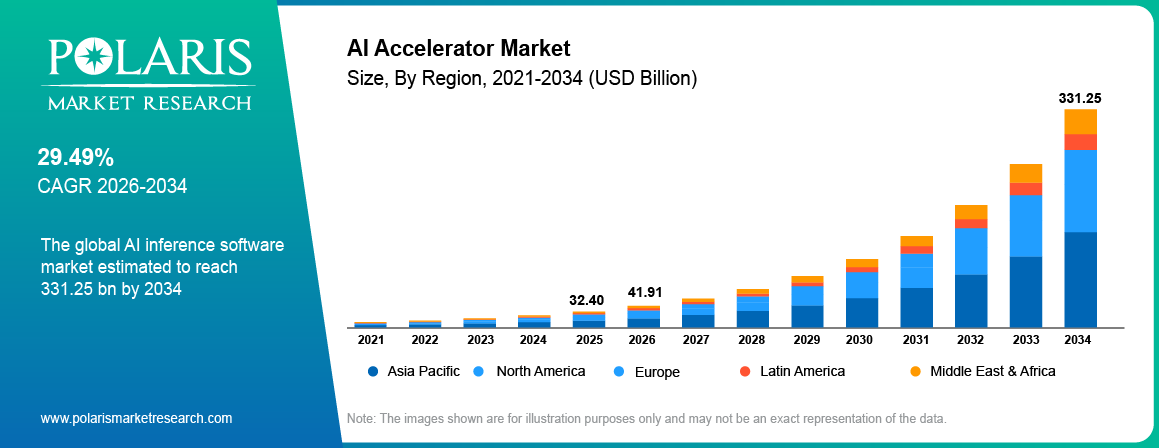
The AI Accelerator market size was valued at USD 32.40 billion in 2025. The market is expected to grow at a CAGR of 29.49% from 2026 to 2034. Growth is driven by rising generative and agentic AI workloads, expanding AI inference requirements, increasing demand for high bandwidth memory and advanced interconnects, and broader deployment of accelerated computing across cloud, enterprise, and edge environments.
Market Statistics
Key Takeaways
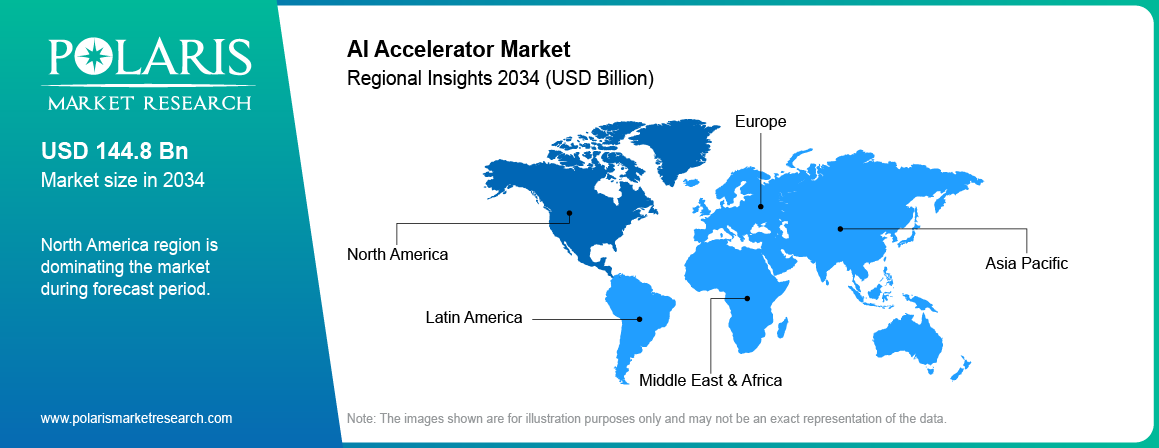
- North America accounted for 42.86% share of the global AI accelerator market in 2025, fueled by strong investment in AI infrastructure, hyperscale data centers, and accelerated computing.
- Asia Pacific is expected to register the fastest growth, at a CAGR of 33.24%, during the forecast period, supported by expanding AI infrastructure, data center investments, and increasing adoption of AI compute technologies.
- The GPU segment accounted for 59.08% share of the AI accelerator market in 2025, supported by broad programmability, high parallel compute performance, HBM capacity, and mature software ecosystems.
- The inference segment is projected to record rapid growth, at a CAGR of 32.42%, during the forecast period, driven by increasing demand for high-volume AI workloads, low-latency processing, and cost-efficient AI inference hardware.
Note: Figures and projections outlined in this report are the result of Polaris Market Research’s proprietary analytical processes, grounded in the latest available datasets and market observations.
AI Accelerator Market Definition
The AI accelerator market includes hardware architectures explicitly designed to accelerate machine learning operations through parallel throughput, tensor or matrix performance, memory bandwidth, data movement efficiency and low precision compute. Discrete GPUs, TPUs and other ASICs, FPGAs, NPUs, accelerator cards, embedded modules and cloud exposed custom silicon fall within the report scope.
The distinction from the wider AI chips market is commercially important. General purpose processors and support silicon may contribute to AI systems without functioning as dedicated accelerators, while data center GPU revenue may also reflect non-AI graphics and scientific workloads. The report therefore isolates accelerator demand linked to model training and inference.
Accelerated computing is gaining importance as enterprises move AI workloads from experimentation into production. Continuous serving, retrieval, reasoning, video, recommendation and embedded inference create recurring compute requirements across cloud and device environments. The resulting demand extends beyond peak training performance toward memory capacity, interconnect, power efficiency and software utilization.
Market Dynamics
AI Accelerator Market Driver Impact Analysis
| Market Dynamic | Market Implication | Impact Level | Impact Timeline |
| Generative and agentic AI compute intensity | Higher accelerator utilization | High | Short term |
| Inference specialization | Greater custom silicon relevance | High | Short term |
| Cost optimized inference | Broader production adoption | Medium | Medium term |
| Open software and multi vendor architectures | Lower migration friction | Medium | Long term |
Source: Polaris Market Research Analysis
Driver: Generative and Agentic AI Are Multiplying Accelerator Compute Intensity
Generative and agentic AI are increasing demand for the AI accelerator market as models become larger, more interactive, and more computationally intensive. Training frontier models requires large-scale parallel processing, while reasoning, multimodal generation, tool use, and agentic workflows increase the amount of inference performed after model deployment. This creates recurring accelerator utilization across cloud platforms and enterprise AI infrastructure.
The growing workload intensity is also increasing investment in AI data center infrastructure. Accelerator clusters require high bandwidth memory, high-speed interconnects, power delivery, advanced cooling, storage, and software orchestration to maintain utilization. NVIDIA combines accelerator hardware, NVLink, networking and software capabilities, and Google has built TPU systems to connect large numbers of accelerator chips. As AI workloads scale, system-level optimization becomes even more critical because of these integrated infrastructure requirements (Source: nvidia.com; datacenterdynamics.com).
The development of large models depends on synchronized computation over large fleets of accelerators, so AI training hardware continues to be an important part of this growth. In April 2026, Google announced TPU 8t, a training architecture that scales to 9,600 TPUs and two petabytes of shared HBM in a superpod. Large-scale training therefore places strong demands on memory bandwidth, collective communication, checkpointing, and system reliability, supporting continued investment in high-performance accelerator infrastructure (Source: blog.google).
Driver: Inference Specialization Is Opening the Market to Custom Silicon
Inference specialization is creating a broader market for AI inference hardware as production workloads place greater emphasis on latency, throughput, memory efficiency, and cost per token. Unlike model training, inference occurs repeatedly after deployment, so improvements in serving efficiency directly affect the economics of AI applications. That move is prompting cloud providers and technology companies to build accelerators for specific kinds of inference needs.
This move to inference-optimized architectures is embodied in the Microsoft Maia 200. The accelerator features 216 GB of high bandwidth memory (HBM3e) and 7 TB/s memory bandwidth and is built around high-volume inference needs. Ironwood has also been optimized for high-volume inference and Google has since introduced TPU 8i for inference-oriented workloads. These developments show that workload specific optimization is driving further demand for custom silicon besides merchant GPUs (Source: microsoft.com; blog.google).
High bandwidth memory is becoming more important as accelerator workloads process larger models and volumes of inference data. This explains why HBM is important for AI, especially when quick data movement is needed for model parameters, activations, and inference cache. More memory capacity and bandwidth enables more workload throughput. Optimizations in caching, compression, lower precision computation, and interconnect technology further improve accelerator utilization. Rising HBM requirements also increase the importance of advanced packaging and memory availability within the accelerator supply chain. (Source: spectrum.ieee.org)
Restraint: Power, Packaging, Memory and Supply Constraints Hinder Deployment
High-performance AI accelerators require advanced semiconductor manufacturing, sophisticated packaging, high bandwidth memory, substrates, power delivery, and thermal management. These requirements raise the importance of custom AI ASICs as buyers seek workload-specific efficiency and system-level optimization. The growing complexity of these components increases the number of dependencies involved in bringing accelerator capacity into production.
NVIDIA's filings highlight strong Data Center demand alongside ongoing supply planning and product transitions across its accelerated computing portfolio. These supply and deployment conditions are important inputs to the AI accelerator industry forecast because accelerator availability depends on more than chip production alone. The deployment of an accelerator also extends to server integration, networking, power capacity, and cooling infrastructure (Source: sec.gov).
Scale out interconnect represents another potential constraint as accelerator clusters expand. Large training and inference workloads distribute computation and data across multiple devices, making communication efficiency important to overall system utilization. Intel Gaudi 3 is targeting Ethernet based scale out while NVIDIA uses NVLink with InfiniBand and Ethernet. Efficient interconnect thus reduces communication overhead and allows for higher effective workload throughput for large accelerator clusters (Source: intel.com; nvidia.com).
Opportunity: Cost-Optimized Inference Creates New Adoption Opportunities
Cost-optimized inference is opening opportunities for AI accelerator market analysis as buyers look at recurrent production workloads through cost per token, throughput, power efficiency and infrastructure utilization. Enterprises increasingly require continuous model serving for applications such as copilots, search, recommendation, content generation, and AI agents. Specialized silicon, lower precision computation, memory optimization, and workload-specific scheduling improve the economics of repeated inference.
Google's Ironwood and Microsoft's Maia 200 are examples of the growing focus on inference economics. Both platforms are designed around AI inference hardware requirements such as high-volume serving, low latency, and efficient token generation. These architectures show how accelerator designs optimized for recurring production workloads are expanding the addressable opportunity beyond large-scale model training (Source: investing.com; theregister.com).
Edge AI inference provides another avenue for market expansion as organizations seek local processing for applications where latency, privacy, connectivity, and power efficiency are important. NPUs and embedded accelerators support workloads such as computer vision, speech processing, industrial inspection, robotics, driver assistance, and local generative AI. As processing moves closer to the device, accelerator demand extends into PCs, vehicles, cameras, industrial systems, medical equipment, and other connected devices.
Opportunity: Open Software and Multi-Vendor Architectures Reduce Switching Friction
Software compatibility is becoming an important consideration in AI accelerator supplier benchmarking as buyers increasingly evaluate usable workload performance rather than theoretical compute specifications. Framework support, compilers, optimized kernels, model libraries, developer tools, and migration requirements influence how quickly an accelerator platform can be deployed. Broader software compatibility therefore reduces the technical effort associated with evaluating alternative accelerator architectures.
Intel is looking at PyTorch integration and Ethernet-based scale out with Gaudi 3, while AMD is pushing ROCm as an open software ecosystem. These approaches provide more options for high-speed computing on a variety of hardware platforms. Improved compiler support, optimized libraries, and portable inference frameworks further reduce migration effort and increase the practical accessibility of alternative accelerator solutions (Source: intel.com; amd.com).
The commercial value of accelerated computing is also influenced by the requirements of individual buyer groups. These requirements create demand for a range of machine learning accelerators, including GPUs, custom ASICs, NPUs, FPGAs, and AI-optimized processors rather than a single accelerator architecture across all applications.
AI Accelerator Market Porter's Five Forces Analysis
| Force | Intensity | Key Factor | Market Implication |
| Supplier power | High | Limited HBM and packaging capacity | Supply sets deployment pace |
| Buyer power | High | Hyperscalers can design custom silicon | Pricing pressure on merchant vendors |
| Threat of new entrants | Low | Software, capital and node access | Few credible new vendors |
| Threat of substitutes | Medium | Custom ASICs versus merchant GPUs | Workload mix shifts demand |
| Competitive rivalry | High | Annual platform release cycles | Rapid product turnover |
Source: Polaris Market Research Analysis
AI Accelerator Market Segmentation Analysis
The report analyzes the AI accelerator market across accelerator architecture, workload, deployment environment, sourcing model, form factor and end use industry. These dimensions distinguish processor design, workload requirements, deployment location, silicon ownership and the way accelerator capacity reaches buyers.
Accelerator Architecture Insights
The GPU segment accounted for 59.08% of the AI accelerator market share in 2025. GPUs remain widely deployed as they combine parallel processing capability, established software ecosystems, high-bandwidth memory support, and broad availability across cloud and enterprise infrastructure. Their flexibility means that the same architecture is used for model training, inference, high-performance computing and other demanding workloads. AMD’s Instinct MI350 accelerators focus on generative AI, inference and HPC workloads, highlighting the ongoing relevance of merchant GPUs in accelerated computing (Source: amd.com).
The TPU & Custom ASIC segment is anticipated to register 34.86% share during the forecast period. The growth is fueled by rising interest in workload-specific silicon to boost compute efficiency, memory behavior, data movement and system-level economics for repetitive AI workloads. Big cloud providers are building more custom silicon to address their own infrastructure needs, especially around large-scale inference and training. This specialization is reflected in the Google TPU 8 family, with separate training and inference architectures to cater to different workloads and scales of deployment (Source: techzine.eu).
Workload Insights
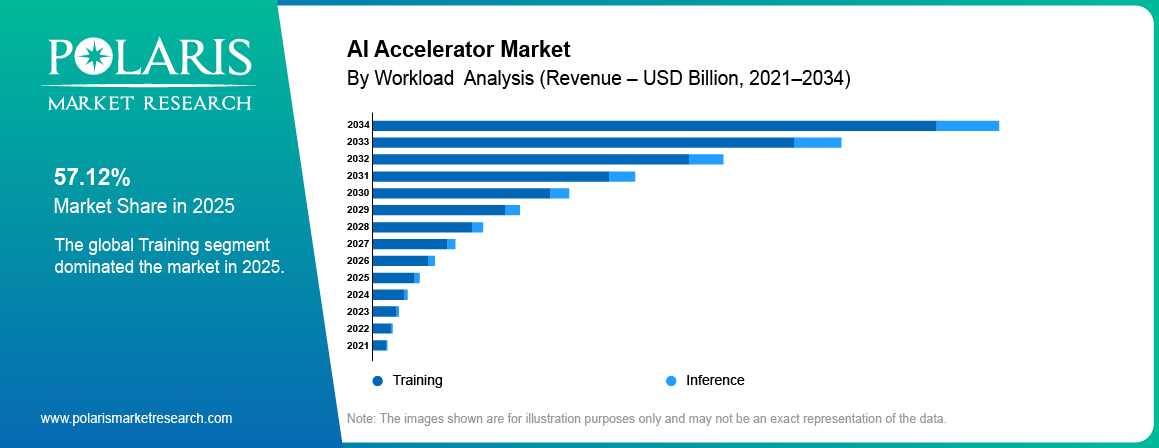
In 2025, training segment accounted for 57.12% in the AI accelerator market. Large-scale model development, fine-tuning, and foundation model training require substantial parallel compute, memory bandwidth, synchronization, and high-speed communication between accelerator devices. These requirements support continued demand for high-performance accelerator clusters in cloud and data center environments. In order to maintain the efficiency of data movement as model sizes and computational requirements expand across enterprise and hyperscale deployments, training architectures are increasingly integrating high-bandwidth memory and high-speed interconnect technologies.
The inference segment is anticipated to expand at a 32.42% CAGR from 2026 to 2034, making it the fastest-growing workload segment. After models are deployed, production AI applications generate recurring inference requirements, including but not limited to conversational AI, recommendation systems, search, content generation, enterprise applications, and agentic workloads. Buyers are evaluating inference hardware on criteria such as latency, throughput, memory efficiency, power consumption and cost per workload. Google’s TPU 8i and Microsoft Maia 200 illustrate the growing prominence of dedicated inference architectures designed to support high-volume production AI workloads (Source: cloud.google.com).
Deployment Environment Insights
The data center and cloud segment accounted for 74.12% share of the AI accelerator market in 2025. Centralized environments remain the primary location for large-scale model training, enterprise AI services, cloud inference, and high-performance computing. These deployments require accelerator clusters supported by high-bandwidth memory, networking, power delivery, cooling, and software orchestration. The continued expansion of accelerated computing across hyperscale infrastructure is strengthening demand for integrated accelerator platforms rather than standalone chips, particularly where large workloads require coordinated multi-device processing and high system utilization.
The edge and device segment is expected to grow at 34.26% CAGR from 2026 to 2034. As AI processing moves closer to users, machines, vehicles and connected devices, demand is growing for architectures that must consider factors such as latency, privacy, connectivity and power efficiency. Automotive systems, industrial equipment, cameras, robotics, PCs and more deploy NPUs, embedded GPUs, FPGAs and custom accelerators at the edge. The move to on-device inference heightens the demand for small accelerator designs that provide meaningful AI performance within thermal and power constraints.
Sourcing Model Insights
The merchant silicon segment had 72.68% of the AI accelerator market in 2025. Merchant accelerators are provided to different customer segments such as cloud providers, enterprises, OEMs, research organizations, and system integrators. Their broad availability, proven software support and compatibility with a variety of infrastructure environments also eliminates the need for customers to pay for custom silicon development. Merchant products also enable buyers to scale capacity to workload requirements, supporting continued adoption in both training and inference deployments.
The hyperscaler and custom silicon segment is expected to register a CAGR of 36.44% during the forecast period. Large cloud providers justify dedicated accelerator development when recurring workloads reach sufficient scale and the utilization can be predicted. The silicon is custom, so operators optimize processor architecture, memory behavior, networking, software integration, and power consumption for specific workloads. Google's TPU programs and Microsoft's Maia accelerator are examples of hyperscalers creating internal silicon to meet workload-specific needs, particularly with the growth of inference volumes and infrastructure costs. (Source: cloud.google.com)
Form Factor Insights
The PCIe add-in card segment held 26.84% share of the AI accelerator market in 2025. Existing server platforms integrate PCIe-based accelerators, providing customers a relatively flexible way to increase AI compute capacity without re-architecting the entire server. This form factor still matters across enterprise and data center deployments where compatibility, serviceability and upgrade flexibility impact procurement. Intel Gaudi 3 is available as a PCIe card that enables you to run AI workloads on your existing server infrastructure (Source: intel.com).
The integrated accelerator system segment is the fastest growing form factor, with a 30.18% CAGR expected from 2026 to 2034. These systems combine accelerator compute with networking, power delivery, cooling and other infrastructure components to optimize performance at the system or rack level. This approach becomes more relevant as AI workloads require clusters of coordinated accelerators rather than isolated processing cards. High-density AI environments benefit from integrated platforms that improve deployment consistency and ease infrastructure planning. AMD’s broader accelerator portfolio also includes rack-scale infrastructure concepts designed around integrated AI and HPC deployment requirements (Source: amd.com).
End Use Industry Insights
The Cloud & Hyperscale segment accounted for 52.18% share of the AI accelerator market in 2025. Hyperscale and cloud providers operate large accelerator fleets to support model training, inference, cloud AI services, and enterprise workloads delivered through centralized infrastructure. Their scale allows them to invest in advanced accelerator architectures, networking, memory, and custom silicon. The increasing deployment of large AI infrastructure programs continues to support accelerator demand across cloud platforms and centralized AI computing environments.
The Automotive & Robotics segment is projected to register a 35.12% CAGR from 2026 to 2034. Vehicles and robots increasingly require local processing for perception, sensor fusion, path planning, driver assistance, navigation, and other latency-sensitive workloads. These applications create demand for embedded GPUs, NPUs, ASICs, and other specialized accelerators capable of operating under power, thermal, and space constraints. Growth in physical AI and intelligent machines is also expanding accelerator requirements beyond centralized data centers toward systems that must process information directly where the activity occurs.
AI Accelerator Market Segment Performance Summary
| Segment Category | Dominant Segment | Fastest Growing Segment | Key Driver |
| Accelerator Architecture | GPU | TPU / Custom ASIC | Workload specific compute |
| Workload | Training | Inference | Continuous AI serving |
| Deployment Environment | Data Center / Cloud | Edge / Device | Latency and power requirements |
| Sourcing Model | Merchant Silicon | Hyperscaler / Custom Silicon | Fleet specific economics |
| Form Factor | PCIe Add in Card | Integrated Accelerator System | System level deployment |
| End Use Industry | Cloud & Hyperscale | Automotive & Robotics | Production AI deployment |
Source: Polaris Market Research Analysis.
Regional Analysis
North America AI Accelerator Market Trends
The North America AI accelerator market is benefiting from continued expansion of high-performance computing infrastructure and increasing competition among accelerator suppliers. In July 2026, AMD launched the Instinct MI455X GPU as part of its Helios rack-scale AI infrastructure platform. The platform is designed for frontier AI, large-scale inference, and foundation-model training, integrating MI455X GPUs with EPYC server CPUs, Pensando networking, and ROCm software. The launch broadens the options for hyperscalers and AI infrastructure operators in the region, and puts competitive pressure on suppliers to meet the needs of demanding data center workloads. This is likely to help the AI accelerator market, with more high-performance accelerator capacity and a stronger North American supplier ecosystem (Source: siliconangle.com).
Europe AI Accelerator Market Trends
Europe held 23.48% share of the AI accelerator market in 2025, driven by sovereign AI initiatives, controlled cloud environments, automotive development, industrial computing, research workloads, and enterprise AI adoption. Buyers are also concerned about data residency, energy efficiency, infrastructure resilience and supplier diversification. Accelerator deployment remains connected to data center investment and access to advanced semiconductor components, while automotive and industrial users create additional demand for high-performance computing. Sovereign infrastructure programs can further encourage regional investment in controlled AI compute capacity.
Asia Pacific AI Accelerator Market Trends
Asia Pacific is expected to record a 33.24% CAGR from 2026 to 2034. The region combines major semiconductor manufacturing capabilities with advanced packaging, memory production, electronics assembly, cloud infrastructure, and expanding domestic AI deployment. Taiwan, South Korea, Japan, and China contribute substantially to the regional technology supply chain, while India, Singapore, and Southeast Asian markets are expanding AI infrastructure and enterprise adoption.
Regional investment in AI research is also strengthening the foundations for accelerator demand. In January 2026, Singapore committed more than USD 0.78 billion, from 2025 to 2030 under its National AI Research and Development Plan to support fundamental AI research, applied AI research, and talent development. The initiative includes resource-efficient AI research and aims to strengthen AI capabilities, creating additional requirements for computing resources and supporting the broader AI accelerator industry forecast across Asia Pacific (Source: mddi.gov.sg).
Latin America AI Accelerator Market Trends
Latin America represented 3.64% share of the AI accelerator market. The region remains a smaller market base but offers opportunities through cloud region expansion, enterprise digitization, and gradual development of local AI infrastructure. Brazil and Mexico represent important markets for cloud services and enterprise technology adoption, while financial services, telecommunications, mining, retail, and public-sector applications create demand for AI computing. Accelerator deployment is also influenced by imported hardware availability, colocation investment, foreign exchange conditions, power access, and the ability of enterprises to obtain scalable cloud capacity.
Middle East & Africa AI Accelerator Market Trends
The Middle East & Africa accounted for 4.40% share of the AI accelerator market in 2025. Growth opportunities are concentrated around sovereign AI initiatives, hyperscale data center development, and government-backed investment in advanced computing infrastructure. Gulf markets are emerging as important locations for large AI infrastructure programs, while South Africa and other African markets contribute enterprise and cloud demand. Adoption remains influenced by access to high-end accelerator hardware, power availability, cooling infrastructure, and technical expertise. Consequently, accelerator deployment is concentrated in better-funded technology and data center hubs across the region.
AI Accelerator Market Competitive Landscape
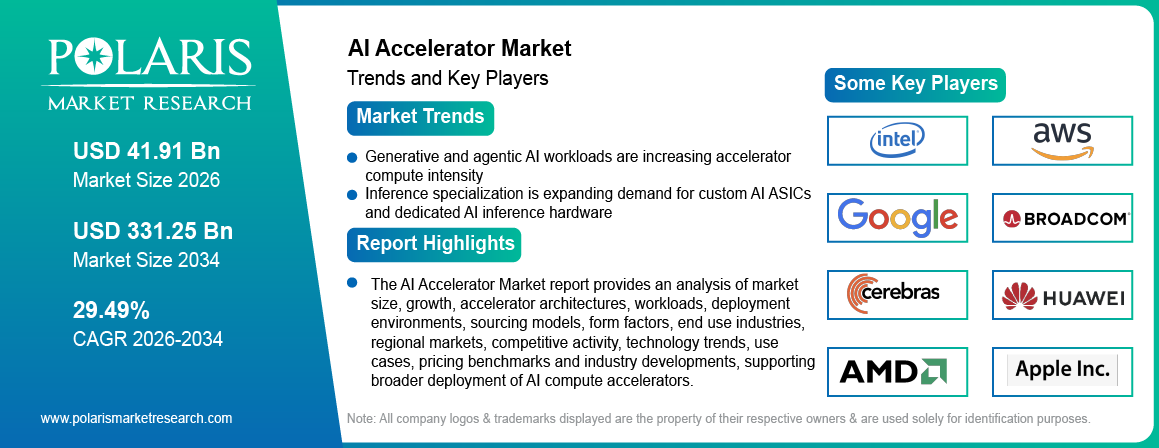
The AI accelerator market is concentrated among companies with the intellectual property, software relationships, manufacturing access and capital required to develop advanced compute platforms. Competition increasingly extends beyond processor specifications to software ecosystems, memory capacity, networking, packaging, power efficiency, system integration and supply availability, making high bandwidth memory increasingly important.
AI Accelerator Market Vendor Landscape Snapshot
| Vendor | Key Platforms | Focus Area | Market Position |
| NVIDIA Corporation | Blackwell, Vera Rubin | Data center GPUs and systems | Leader |
| Broadcom Inc. | Custom XPUs | Hyperscaler ASIC design | Leader |
| Google LLC | Ironwood, TPU 8t, TPU 8i | Cloud training and inference | Leader |
| Advanced Micro Devices, Inc. | Instinct MI350, MI455X, Helios | Data center GPUs and racks | Challenger |
| Amazon Web Services, Inc. | Trainium3, Inferentia | Cloud training and inference | Challenger |
| Microsoft Corporation | Maia 200, Maia 300 | Cloud inference | Challenger |
| Huawei Technologies Co., Ltd. | Ascend 950 series | Domestic China supply | Challenger |
| Intel Corporation | Gaudi 3, Crescent Island | Enterprise inference | Niche Player |
| Meta Platforms, Inc. | MTIA | Inference and recommendation | Niche Player |
| Marvell Technology, Inc. | Custom XPU, XPU attach | Custom silicon and interconnect | Niche Player |
| Apple Inc. | Apple silicon | Client devices | Niche Player |
| MediaTek Inc. | Edge and client NPUs | Client and edge devices | Niche Player |
| Qualcomm Incorporated | AI200, AI250, Snapdragon | Inference racks and edge | Emerging Player |
| Cerebras Systems Inc. | Wafer Scale Engine | Training and inference systems | Emerging Player |
| Groq, Inc. | LPU, GroqCloud | Low latency inference | Emerging Player |
Source: Company publications and Polaris Market Research Analysis. Market position reflects Polaris Market Research assessment
NVIDIA maintains a broad accelerated computing ecosystem that combines GPUs, networking and software. AMD competes through Instinct accelerators and ROCm, while Intel positions Gaudi around Ethernet scale out and open software. These platforms target different combinations of training, inference, enterprise and cloud requirements, increasing demand for AI inference hardware.
Hyperscaler custom silicon adds another competitive layer. Google, Microsoft, Amazon and Meta develop accelerators around internal and cloud workloads, while Qualcomm, Apple and MediaTek extend AI acceleration into client and edge devices. The result is a heterogeneous market rather than a single architecture competition, shaping investment in AI data center infrastructure.
Additional participants widen the competitive set. Broadcom Inc. designs custom AI accelerators for large cloud and AI customers and reported AI semiconductor revenue of USD 16.7 billion in its third fiscal quarter of 2026 (Source: sec.gov). Cerebras Systems Inc. develops wafer scale AI systems and listed on the Nasdaq in May 2026 (Source: cerebras.ai). Groq, Inc. licensed its inference technology to NVIDIA in December 2025 and continues to operate GroqCloud (Source: groq.com). Huawei Technologies Co., Ltd. has published an Ascend roadmap through 2028 that supports domestic AI chip supply in China (Source: rcrwireless.com). Marvell Technology, Inc. supplies custom silicon and XPU attach products for data center customers (Source: futurumgroup.com). Samsung Electronics Co., Ltd. and SK hynix Inc. supply the HBM that accelerators depend on, and SK hynix reported a 56.4% share of HBM revenue in the first quarter of 2026 (Source: sec.gov).
AI Accelerator Value Chain Analysis
| Stage | Representative Participants | Key Dependency | Constraint |
| Chip design | NVIDIA, AMD, Google, Broadcom | Architecture and software | Design cost and talent |
| Foundry | TSMC | Advanced process nodes | Capacity access |
| Memory | SK hynix, Samsung, Micron | HBM supply | HBM availability |
| Packaging and systems | Server OEMs and ODMs | Advanced packaging and racks | Integration complexity |
| Deployment | Cloud providers and enterprises | Power and cooling | Data center capacity |
Source: Polaris Market Research Analysis
Technology and Innovation Landscape
High bandwidth memory has become a core accelerator technology as model parameters, activations and inference cache require rapid access. Memory capacity and bandwidth increasingly influence effective throughput alongside compute capability, increasing demand for AI inference hardware. (Source: trendforce.com)
Microsoft Maia 200 combines 216 GB of HBM3e with 7 TB/s bandwidth. The specification demonstrates the increasing importance of memory subsystem design in inference-oriented accelerator architectures, making high bandwidth memory increasingly important. (Source: notebookcheck.net)
Scale out interconnect is another important technology layer. Large AI workloads distribute computation across many devices, making network topology, collective communication, latency and congestion management important to cluster utilization. (Source: docs.nvidia.com, intel.com)
Intel Gaudi 3 uses Ethernet based scale out, while NVIDIA combines NVLink with high-speed networking across its accelerator platform. These approaches show how accelerator performance increasingly depends on system level communication, increasing the importance of scale out interconnect for distributed workloads. (Source: amcompute.com)
Advanced packaging is becoming a major performance scaling technique. Modern accelerator systems combine compute dies, chiplets, HBM stacks, interposers and high density substrates within constrained thermal and signal integrity envelopes.
Chiplet architectures provide a path to combine compute, I/O, cache, networking and specialized engines across different process technologies. The approach also increases packaging complexity and places greater importance on die to die communication and supply chain coordination, raising the importance of advanced packaging. (Source: amd.com)
Numeric precision is another important innovation lever. FP8, FP4, INT8 and other reduced precision formats improve throughput and reduce memory traffic when model quality remains within required limits. Microsoft Maia 200 includes FP8 and FP4 tensor capability, highlighting the link between hardware formats and inference economics. (Source: microsoft.com)
AI Accelerator Technology and Innovation Landscape Snapshot
| Technology | Role | Representative Example | Maturity |
| High bandwidth memory | Memory capacity and bandwidth | Maia 200: 216 GB HBM3e at 7 TB/s | Commercial |
| HBM4 | Next generation memory stack | Samsung HBM4 at 11.7 Gbps | Early commercial |
| Scale out interconnect | Cluster communication | Gaudi 3 Ethernet and NVLink | Commercial |
| Rack scale systems | Integrated compute and network | AMD Helios with 72 GPUs | Early commercial |
| Advanced packaging and chiplets | Combine dies and memory stacks | AMD chiplet architectures | Commercial |
| Low precision formats | Throughput and memory savings | FP8 and FP4 in Maia 200 | Commercial |
| Custom AI ASICs | Workload specific silicon | TPU 8t, TPU 8i, Trainium3 | Commercial |
Source: Polaris Market Research Analysis
Use Case Analysis
Cloud and Hyperscale AI
The operational problem for cloud providers is serving large volumes of generative and agentic requests while maintaining acceptable latency and cost. The accelerator application combines dense GPU or custom ASIC clusters, HBM, fast interconnect, model parallelism, low precision inference and fleet scheduling.
Google designed Ironwood around inference at scale, while Microsoft Maia 200 targets token generation economics. The stated outcome is higher throughput and lower cost per useful inference within a defined power envelope.
BFSI
Financial institutions use accelerators for fraud scoring, market analytics, document intelligence, recommendation workloads and private generative AI. AI inference hardware supports transformer, anomaly detection and recommendation workloads inside controlled cloud or enterprise environments, while GPUs remain important for training.
Governance, data residency, response time and transaction processing capacity shape deployment choices across financial services. Accelerator value is therefore linked to useful workload throughput rather than peak specifications alone.
Automotive and Robotics
Vehicles and robots process camera, radar, lidar, language and other sensor streams at low latency, often in environments where cloud connectivity is unavailable. Edge AI inference uses NPUs, embedded GPUs and custom ASICs for perception, sensor fusion, path planning, driver monitoring and in cabin AI.
The operating outcome is deterministic local response within a constrained power and thermal envelope. Training remains data center intensive, while deployed systems emphasize performance per watt, latency and reliability.
Healthcare and Life Sciences
Healthcare and life sciences organizations apply machine learning accelerators to medical imaging, molecular simulation, genomics, pathology and generative models. Accelerator capacity supports larger datasets and more complex modeling within research and clinical development workflows.
AWS identifies pharmaceutical discovery among HPC uses for accelerator instances, demonstrating the relevance of accelerated computing to scientific workloads.
Enterprise Retrieval Augmented Generation
Enterprise retrieval augmented generation connects language models to internal documents, databases, code repositories and workflow tools. Accelerators support embedding generation, reranking, language model inference and local fine tuning.
Memory capacity, batching, cache reuse and serving software are important for long prompts and concurrent users. The relevant commercial measure is useful task throughput within a defined infrastructure budget.
Industrial Visual Inspection
Industrial visual inspection provides an edge deployment where high resolution images must be processed before the next production step. Edge accelerators run computer vision models locally to classify surface defects, verify assembly, read markings and trigger process controls, expanding the role of edge AI inference.
The application places emphasis on sustained performance per watt, ruggedness, camera interface support and deterministic operation rather than the large HBM capacity associated with data center training.
Buyer Analysis and Barriers to Market Entry
GPU acceleration buyers increasingly evaluate effective workload throughput rather than theoretical peak specifications. The buyer group includes hyperscalers, AI clouds, enterprises, research laboratories, governments, OEMs, automakers and device manufacturers. Procurement teams compare model benchmarks, memory capacity, supported precision, networking, software compatibility, availability, power density, service contracts and cloud pricing.
Custom AI ASICs create a high entry barrier. A competitive accelerator requires architecture design, verification, compiler tooling, advanced node access, packaging, HBM, system integration and extensive software development. Hyperscalers have the workload scale to support these investments, while smaller vendors generally require a focused use case or differentiated efficiency proposition.
AI accelerator chips also face ecosystem lock in. CUDA has accumulated libraries, optimized kernels, tooling and model support, while alternative platforms need credible migration paths. Software portability, documentation, debugging tools and engineering talent influence whether a proof of concept becomes production.
Buyer Decision Framework
| Buyer | Primary Need | Key KPI | Main Constraint |
| Hyperscaler or AI cloud | Fleet throughput | Cost per token and utilization | Power, network and supply |
| Enterprise | Production AI deployment | Time to deploy and TCO | Skills and utilization |
| Automotive and robotics | Local intelligence | Performance per watt and latency | Thermal and safety |
| Healthcare and life sciences | Scientific compute | Time to result and memory | Validation and governance |
| Government and sovereign AI | Controlled compute capacity | Capacity and security | Budget and export controls |
Source: Polaris Market Research Analysis
Accelerated computing also faces infrastructure barriers after the chip is purchased. High end clusters require power, liquid cooling, high speed networking, storage, physical space and specialized operations. Export controls and data center interconnection constraints add further procurement considerations.
Benchmark credibility is another barrier for emerging suppliers. Buyers require evidence across their own workloads, batch sizes, context lengths, accuracy targets and software environments. Proof of concept clusters, reference customers, repeatable benchmarks and transparent power measurements influence production decisions.
Premium Insights and Forward Outlook
AI inference hardware is becoming an increasingly important source of incremental compute demand as every production interaction consumes accelerator capacity. The market is therefore placing greater emphasis on tokens per dollar, tokens per watt, cache management, memory capacity, low precision formats and scheduling.
Custom AI ASICs are gaining strategic relevance without removing merchant GPUs from the market. Hyperscalers use custom silicon to address recurring workloads, while GPUs retain value through programmability, model portability, broad availability and rapid support for new workloads.
The AI accelerator industry forecast also depends on infrastructure supply. Power, advanced packaging, HBM, networking and cooling influence the speed at which accelerator capacity becomes productive compute. Vendors that coordinate hardware, systems and software are positioned across more of the deployment value chain.
Cost and Pricing Benchmarking Analysis
Public cloud pricing provides a practical benchmark for accelerator economics as it converts hardware, infrastructure and provider margin into an hourly consumption price. These figures are not direct chip selling prices and are not used as market size proxies.
Cost and Pricing Benchmarking
| Accelerator or Service | Public 2026 Price | Unit | Interpretation |
| Google Cloud Ironwood in us central1 | USD 12.00 | Per chip hour | On demand benchmark |
| Google Ironwood three-year commitment | USD 5.40 | Per chip hour | Commitment benchmark |
| Google Trillium on demand | USD 2.70 | Per chip hour | Prior generation benchmark |
| AWS P6 B200 Capacity Block | USD 12.355 | Per B200 accelerator hour | Capacity block benchmark |
| AWS P5 H100 in the U.S. | USD 5.191 | Per H100 accelerator hour | Cloud accelerator benchmark |
| AWS P5 H100 in Mumbai, London and Tokyo | USD 4.720 | Per H100 accelerator hour | Regional capacity benchmark |
Source: Polaris Market Research Analysis
The pricing spread shows the effect of accelerator generation, architecture, geography and commitment structure on buyer economics. Cloud consumption prices should be evaluated alongside utilization, memory capacity, networking and system requirements when comparing merchant and custom solutions.
Key Players in the AI Accelerator Market
- Advanced Micro Devices, Inc. (AMD)
- Amazon Web Services, Inc. (AWS)
- Apple Inc.
- Broadcom Inc.
- Cerebras Systems Inc.
- Google LLC
- Groq, Inc.
- Huawei Technologies Co., Ltd.
- Intel Corporation
- Marvell Technology, Inc.
- MediaTek Inc.
- Meta Platforms, Inc.
- Microsoft Corporation
- NVIDIA Corporation
- Qualcomm Incorporated
- Samsung Electronics Co., Ltd.
- SK hynix Inc.
Industry Developments
- October 2026: Microsoft announced Maia 300, the next generation of its Azure inference accelerator, and plans to scale the Maia family to multi gigawatt deployments from 2027. A full 96 accelerator configuration is designed to deliver up to seven times the rack scale token throughput of Maia 200. (Source: microsoft.com)
- July 2026: AMD launched the Helios rack scale platform, which combines 72 Instinct MI455X GPUs with 18 sixth generation EPYC Venice CPUs, Pensando networking and ROCm software, and stated that it is in production. (Source: amd.com)
- July 2026: AMD announced plans to supply up to two gigawatts of Instinct MI450 chips to Anthropic from the first half of 2027, alongside an investment of up to USD 5 billion in the company. (Source: finance.yahoo.com)
- May 2026: Cerebras Systems Inc. listed on the Nasdaq, raising USD 5.55 billion in its initial public offering at a price of USD 185 per share, after reporting 2025 revenue of USD 510 million. (Source: nasdaq.com)
- May 2026: NVIDIA announced that the Vera Rubin platform is ramping into full production, with production shipments set to begin in the fall of 2026. (Source: nvidia.com)
- April 2026: Google introduced its eighth generation TPUs, TPU 8t for training and TPU 8i for inference, with a TPU 8t superpod that scales to 9,600 chips and two petabytes of shared HBM. (Source: nextplatform.com)
- February 2026: Samsung Electronics began mass production and commercial shipments of HBM4 with a data rate of 11.7 Gbps. (Source: samsung.com)
- January 2026: The US Bureau of Industry and Security moved license review for exports of NVIDIA H200 and AMD MI325X chips to China from a presumption of denial to case by case review, effective January 15, under conditions that include a 25% tariff on the covered chips. (Source: bakermckenzie.com)
- December 2025: NVIDIA entered a non exclusive license agreement with Groq, Inc. for its language processing unit technology and hired certain Groq employees, with USD 13.0 billion paid at closing. (Source: sec.gov)
- December 2025: AWS announced general availability of Amazon EC2 Trn3 UltraServers, built on the Trainium3 chip on a 3 nm process and scaling to 144 chips per system. (Source: aboutamazon.com)
- October 2025: Qualcomm launched the AI200 and AI250 data center inference accelerators, and HUMAIN announced a target of 200 megawatts of AI200 and AI250 rack solutions starting in 2026. (Source: qualcomm.com)
AI Accelerator Market Segmentation
By Accelerator Architecture Outlook (Revenue, USD Billion, 2021-2034)
- GPU
- Tensor Processing Unit (TPU)/ Custom ASIC
- FPGA
- Neural Processing Unit (NPU)
- AI Optimized CPU / Hybrid Processor
By Workload Outlook (Revenue, USD Billion, 2021-2034)
- Training
- Inference
By Deployment Environment Outlook (Revenue, USD Billion, 2021-2034)
- Data Center
- Cloud
- Edge / Device
By Sourcing Model Outlook (Revenue, USD Billion, 2021-2034)
- Merchant Silicon
- Hyperscaler / Custom Silicon
By Form Factor Outlook (Revenue, USD Billion, 2021-2034)
- PCIe Add in Card
- Server Module / Baseboard
- Integrated Accelerator System
- Embedded SoC
- Cloud Virtualized Capacity
By End Use Industry Outlook (Revenue, USD Billion, 2021-2034)
- Cloud & Hyperscale
- IT & Telecom
- BFSI
- Automotive & Robotics
- Healthcare & Life Sciences
- Retail & Media
- Manufacturing
- Government & Research
- Other
By Regional Outlook (Revenue, USD Billion, 2021–2034)
- North America
- US
- Canada
- Europe
- Germany
- France
- UK
- Italy
- Spain
- Netherlands
- Rest of Europe
- Asia Pacific
- China
- Japan
- India
- South Korea
- Taiwan
- Australia
- Rest of Asia Pacific
- Latin America
- Brazil
- Mexico
- Argentina
- Rest of Latin America
- Middle East & Africa
- Saudi Arabia
- UAE
- South Africa
- Rest of Middle East & Africa
AI Accelerator Market Report Scope
| Report Attributes | Details |
| Market Size in 2025 | |
| Market Size in 2026 | USD 41.91 Billion |
| Revenue Forecast by 2034 | USD331.25 Billion |
| CAGR | 29.49% from 2026–2034 |
| Base Year | 2025 |
| Historical Data | 2021–2024 |
| Forecast Period | 2026–2034 |
| Quantitative Units | Revenue in USD Billion and CAGR |
| Report Coverage | Revenue Forecast, Growth Factors, Competitive Landscape, Industry Trends, and Strategic Analysis |
| Segments Covered | By Architecture, Workload, Deployment, Sourcing Model, Form Factor, End Use, and Region |
| Regional Scope | North America, Europe, Asia Pacific, Latin America, Middle East & Africa |
| Competitive Landscape | Company Profiling, Product Benchmarking, Financial Analysis, Market Developments, and Strategic Initiatives |
| Report Format | PDF + Excel |
| Customization | Available by Country, Region, and Segment |
Source: Polaris Market Research Analysis
Why Choose Polaris Market Research
Polaris Market Research applies a workload and architecture led research approach that separates merchant accelerators from custom hyperscaler silicon and training demand from production inference. The approach brings together company filings, product specifications, cloud pricing, supply chain indicators, system architecture, customer deployment patterns and primary research. The AI accelerator market analysis also evaluates workload economics, architecture mix and deployment conditions.
Clients are able to request a customized cut by accelerator architecture, training versus inference, hyperscaler, cloud provider, end use industry or geography. Custom analysis also covers HBM capacity, bandwidth, interconnect, software ecosystem, public cloud pricing, system power, supplier concentration and custom silicon exposure.
Research Methodology
AI accelerators are researched through a five phase process beginning with market boundary control. Secondary research prioritizes SEC filings, company investor disclosures, official product specifications, hyperscaler infrastructure announcements, cloud pricing pages, foundry and memory disclosures, technical papers, OEM documentation and government sources, shaping investment in AI data center infrastructure.
Artificial intelligence accelerators require primary research across chip vendors, hyperscalers, AI clouds, server OEMs, data center operators, enterprises, system integrators, foundries, packaging providers, memory suppliers, network vendors, software engineers and end users. Interviews examine utilization, training versus inference mix, cloud consumption, replacement cycles, software switching costs, HBM availability, power limits and deployment timelines.
AI accelerator chips are modeled through bottom up vendor and deployment evidence, then triangulated against workload growth, cloud capacity, AI data center infrastructure, edge device adoption and supply chain constraints. The final forecast is reviewed by a multidisciplinary technology and quantitative research team with senior analyst oversight.
AI Accelerator Market FAQ's
AI accelerators are dedicated processors designed to execute machine learning operations efficiently through parallel compute, specialized memory, lower precision arithmetic, and optimized data movement.
The AI Accelerator Market was valued at USD 32.40 Billion in 2025 and is forecast to reach USD 331.25 Billion by 2034.
GPUs provide programmable parallel compute, while TPUs and other ASICs are more specialized, and NPUs generally focus on power-efficient local inference.
Generative and agentic AI workloads, inference specialization, and demand for HBM and advanced interconnects are the main growth drivers.
High bandwidth memory provides fast access to model parameters, activations, and inference cache, making memory capacity and bandwidth important for accelerator performance.
Performance depends on memory bandwidth, interconnect, software efficiency, power, cooling, data feeding, network congestion, and model parallelism.
Major suppliers and designers include NVIDIA, AMD, Intel, Google, Amazon Web Services, Microsoft, Meta, Qualcomm, Apple, MediaTek, Broadcom, Huawei, Marvell, and Cerebras.
Custom AI chips target specific workloads and fleet economics, while GPUs offer broader programmability, software support, model portability, and merchant availability.
Leading accelerators require advanced process nodes, HBM, complex packaging, high-speed networking, dense servers, power delivery, cooling, and supporting software infrastructure.
North America accounted for a major share in 2025, while Asia Pacific is expected to record the fastest growth from 2026 to 2034.
Training accelerators build AI models, while inference accelerators run trained models efficiently.
US licensing rules determine which advanced accelerators can be shipped to China. Since January 15, 2026, exports of NVIDIA H200 and AMD MI325X chips are reviewed case by case.
NVIDIA leads the data center GPU space, while Google, Amazon Web Services, and Microsoft build custom accelerators for their own clouds.
Download Sample Report of AI Accelerator Market
Please fill out the form to request a customized copy of the research report.


