
Lithium Hexafluorophosphate Market Size, Share, and Forecast 2025 to 2034
REPORT DETAILS
Lithium Hexafluorophosphate Market Summary
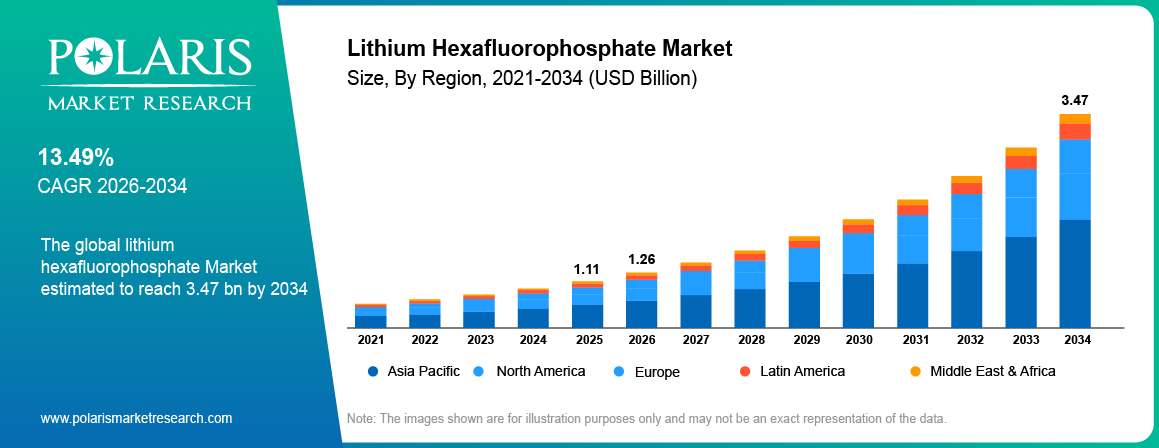
The lithium hexafluorophosphate market was valued at USD 1.11 Billion in 2025 and is projected to reach USD 3.47 Billion by 2034, expanding at a CAGR of 13.49% from 2026 to 2034. Demand for lithium-ion battery electrolyte used in electric vehicles and energy storage systems is supporting growth, while capacity additions, supply concentration and price volatility continue to shape the outlook for the market.
Market Statistics
Key Takeaways
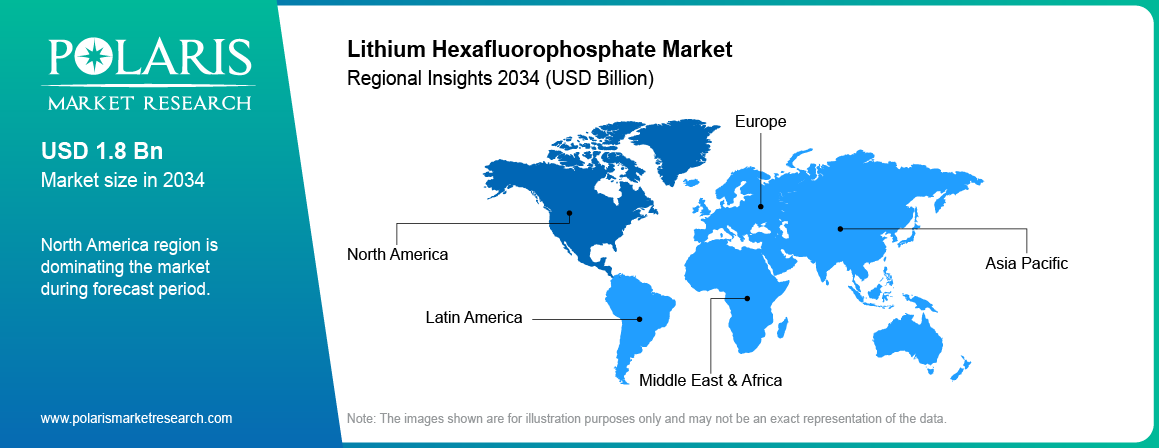
- Asia Pacific accounted for 47.46% of the global lithium hexafluorophosphate industry in 2025, supported by the concentration of LiPF6 production capacity and battery-electrolyte manufacturing in China.
- Europe is projected to register the fastest growth during the forecast period, reflecting import demand for LiPF6 and the search for qualified supply from established battery-materials producers.
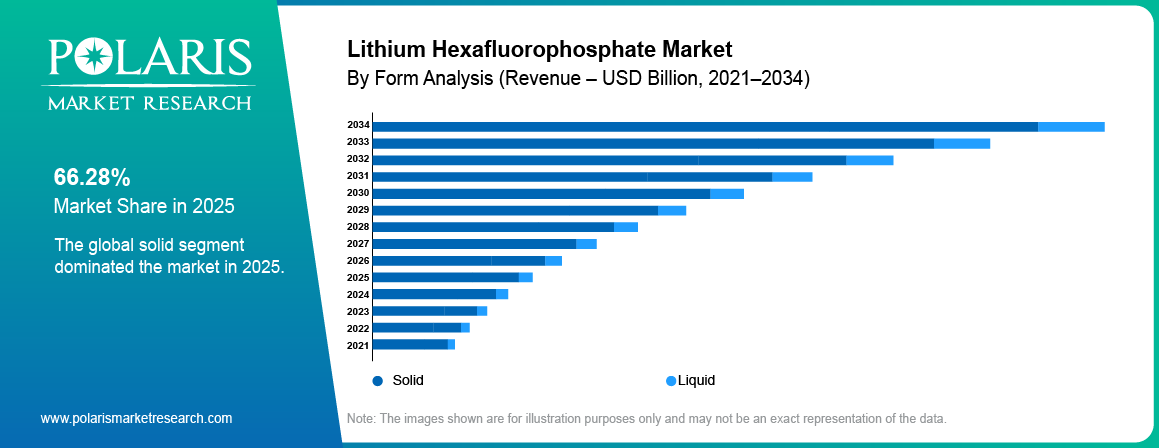
- Solid crystalline accounted for 66.28% of the lithium hexafluorophosphate market in 2025, representing the dominant form segment for downstream electrolyte preparation.
- The energy storage systems segment is expected to grow at a CAGR of 15.18% during the forecast period, due to the rising demand for storage-battery electrolyte and stationary lithium-ion battery applications.
- Electric vehicles represented 46.58% of the lithium hexafluorophosphate market in 2025, due to the use of LiPF6 in the electrolyte formulations of lithium-ion traction batteries.
- Supply competition is driven by production scale, battery-grade purity, integration with electrolyte manufacturing, and the ability to serve customers outside of China.
Note: Figures and projections outlined in this report are the result of Polaris Market Research’s proprietary analytical processes, grounded in the latest available datasets and market observations.
Lithium Hexafluorophosphate Market Definition
The lithium hexafluorophosphate market, part of the broader battery electrolyte salt market, comprises the supply of LiPF6, a lithium salt used in the electrolyte of lithium-ion batteries. The salt is dissolved in carbonate-based solvents to enable ionic transport within a cell. The market includes LiPF6 sold as a solid crystalline product and as a solution prepared for electrolyte applications. It covers the salt itself rather than the complete electrolyte formulation, which also contains solvents and may include additives. The product is used in battery supply chains that support electric vehicles, energy storage systems and other lithium-ion battery uses. Lithium hexafluorophosphate is a key electrolyte salt used in the battery market, where it helps to transport ions and improve battery performance.
For this lithium hexafluorophosphate market analysis, the scope is distinct from the broader battery materials market, finished electrolyte, other electrolyte salts such as LiFSI, carbonate solvents, additives, and sodium-based salts including NaPF6. This boundary matters because sales of a finished electrolyte cannot be counted as LiPF6 revenue without separating the salt component. The market also excludes finished batteries and battery packs.
A disclosed manufacturing route reacts lithium fluoride with phosphorus pentafluoride to produce LiPF6, with the cited patent specifying a purity of at least 99.90%. LiPF6 is sensitive to moisture and decomposes completely in air within one day under the conditions studied. The salt is used to promote ion transport in lithium-ion cells, but the way it is handled, its purity and the conditions under which it is formulated influence its suitability for industrial electrolyte production (Source: pubs.rsc.org).
Market Dynamics
Driver Impact Analysis
| Factor | Type | Impact Level | Time Horizon | Market Effect |
| Energy storage electrolyte demand | Driver | High | Short to medium term | Rising storage-battery electrolyte output lifts LiPF6 consumption |
| Price signals and lithium feedstock movements | Driver | Medium | Short term | Shapes procurement timing and producer revenue expectations |
| Supply diversification outside China | Opportunity | Medium | Medium to long term | Opens volume for qualified non-Chinese producers |
| European import demand | Opportunity | Medium | Medium term | Provides a route for alternative suppliers into battery hubs |
Source: Polaris Market Research Analysis. Impact levels reflect a qualitative assessment.
Driver: Energy Storage Electrolyte Demand Supports Salt Consumption
LiPF6 is one of the important salts used in the formulation of conventional lithium-ion battery electrolytes. Thus, the lithium hexafluorophosphate market gains when electrolyte manufacturers increase the shipment of electrolytes to battery customers. Beyond electric vehicle batteries, the demand for energy storage systems offers another growth avenue. The growing deployment of stationary battery systems is driving the demand for electrolyte materials, with suppliers ramping up production and increasing their position in the battery materials value chain.
Tinci Materials reported that its first-half 2026 electrolyte shipments exceeded 440,000 tons, up roughly 41%, with storage-battery electrolyte sales increasing by over 100%. These trends point to the increasing significance of energy storage applications in the electrolyte supply chain and imply that suppliers of battery materials are reacting to increasing demand in a number of end-use markets (Source: metal.com).
China’s LiPF6 production in the first half of 2026 was about 166,600 tons, up 46.2% year on year. The growth in domestic production and in sales of storage-battery electrolyte for energy storage systems are indicative of the importance of downstream battery materials manufacturing as a driver of salt demand. However, higher output does not necessarily mean equal export growth as much of the LiPF6 can be utilized by domestic electrolyte manufacturers. (Source: metal.com)
For LiPF6 suppliers, these developments underscore, in any lithium hexafluorophosphate market analysis, the importance of tracking electrolyte production and application demand rather than simply tracking announced battery manufacturing capacity. The battery electrolyte for storage can be a source of incremental salt consumption.
Driver: Price Signals and Lithium Feedstock Movements Shape Procurement
The demand for lithium hexafluorophosphate is fueled by supply availability, procurement expectations throughout the battery materials industry, and price fluctuations related to upstream lithium. Changes in the lithium hexafluorophosphate price can be an indicator of changes in the cost of raw materials and the balance between available production capacity and downstream purchasing requirements. These price movements influence the purchasing decisions of the electrolyte manufacturers and revenue expectations of LiPF6 producers.
Benchmark Source stated that LiPF6 prices started to climb from late October to November 2025 (a 108% rise between October 29 and November 26), prior to a 52% rally in lithium carbonate prices between late December 2025 and late January 2026. The sequence suggests that the pricing of LiPF6 can be a leading indicator of changing conditions in the lithium-ion battery materials supply chain. However, the relationship does not establish a fixed pass-through between the prices of lithium carbonate and LiPF6, as production capacity, inventory and procurement conditions also move the market (Source: source.benchmarkminerals.com).
Following that, in 2026, average prices of LiPF6 in China fell. The quarterly average prices fell to RMB 108,200 per ton in the second quarter from RMB 131,800 per ton in the first quarter and to RMB 103,400 per ton in the third quarter as of August 2026. Fastmarkets also launched a battery-grade LiPF6 price assessment on a FOB China basis, with a minimum purity of 99.9%. These benchmarks give market participants a way to put price action in context and differentiate between product grades and commercial pricing conditions (Source: 10jqka.com.cn, fastmarkets.com).
Restraint: Capacity Additions and Price Declines Increase Oversupply Risk
The market for lithium hexafluorophosphate is subject to supply-side pressure when lithium hexafluorophosphate production capacity grows more quickly than downstream consumption. Excessive capacity additions increase competition between manufacturers, reduce selling prices and compress producer margins. These conditions create uncertainty for companies planning new facilities, especially when market demand and capacity utilization do not develop at the same pace.
Several Chinese manufacturers have also disclosed capacity expansion and upgrade plans. Shaowu Yongtai High-Tech New Materials disclosed an environmental impact assessment for a project intended to add 32,600 tonnes and bring its stated capacity to 50,000 tonnes. Tinci Materials reported that its Phase II project, adding 15,000 tonnes annually, had completed commissioning ahead of trial production, with stated capacity of 52,000 tonnes per year after commissioning. Shenzhen Capchem Technology disclosed that its investee Jiangxi Shilei Fluorine Material would upgrade from 24,000 to 36,000 tonnes, while Do-Fluoride New Materials reported LiPF6 capacity of 65,000 tonnes (Source: mysteel.net, metal.com).
Existing capacity, planned additions, and technical improvements are all included in the reported figures, which also cover various project stages and capacity definitions. They should not be combined without checking project scope and commissioning status. Nevertheless, the scale of disclosed investments increases the risk of price pressure in the LiPF6 market if downstream demand fails to absorb additional supply. Lower prices can benefit electrolyte customers, but can also erode producer profitability and impact the commercial viability of less competitive facilities.
Opportunity: Supply Diversification Outside China
Supply diversification gives LiPF6 producers the chance to support battery and electrolyte manufacturers looking for alternatives to concentrated Chinese supply. To make their sourcing more flexible and to reduce their dependence on a limited number of production locations, customers look for other suppliers. This presents opportunities for manufacturers outside of mainland China that are able to meet battery-grade specifications and are able to put in place reliable commercial supply arrangements, further strengthening the availability of LiPF6 electrolyte salt supply for global battery manufacturing.
Foosung Co., Ltd. signed a contract to supply LiPF6 to a U.S. company in October 2025. The contract was expected to account for 20% to 30% of Foosung’s domestic capacity. Foosung was identified as the only domestic producer of LiPF6 in South Korea, which predicted an improvement in operating performance from 2026. This development is a demonstration of the commercial relevance of alternative suppliers in the cross-border sourcing of battery materials in the lithium hexafluorophosphate market (Source: asiae.co.kr).
The supply diversification opportunity also extends to India through the Neogen Morita New Materials joint venture established by Neogen Ionics and Morita Chemical Industries. Neogen Ionics is to hold at least 80%, with Morita Chemical Industries holding up to 20%. The venture targets solid crystalline LiPF6 and provides a potential additional source outside mainland China. However, the available announcement does not establish confirmed annual production volumes or the timing of commercial-scale output (Source: mercomindia.com).
The opportunity remains dependent on production readiness, customer qualification, product consistency, and competitive pricing. The disclosed developments do not provide sufficiently comparable production volumes to calculate the future share of non-Chinese supply in the lithium hexafluorophosphate industry forecast. Manufacturers seeking to benefit from diversification will need to demonstrate reliable deliveries and consistent battery-grade purity before securing larger commercial contracts.
Trade policy has also drawn attention to this opportunity. In March 2026, Orbia Fluor & Energy Materials petitioned U.S. authorities for antidumping and countervailing duties on LiPF6 imports from China, with alleged dumping margins of 145.27% to 200.50%, but withdrew the petitions on April 14, 2026, before Commerce had initiated investigations. No U.S. duties therefore apply under that case. Orbia has also proposed a LiPF6 plant of up to 10,000 tonnes per year at St. Gabriel, Louisiana. The plant, if built, would keep qualified supply outside China on the agenda for U.S. buyers (Source: federalregister.gov, kouraglobal.com).
Opportunity: European Import Demand Creates a Route for Alternative Suppliers
LiPF6 suppliers that meet battery-grade specifications and establish strong distribution channels have a chance to take advantage of European import demand. Trade activity involving Poland and Hungary indicates that these markets participate in imports of Chinese LiPF6. This creates a potential commercial opening for suppliers outside China, although monthly trade figures alone cannot establish the size or long-term growth rate of the European lithium hexafluorophosphate market.
Poland received 307.41 tons of China’s LiPF6 exports in July 2026, with Hungary importing 165 tons. Hungary had a significant month-on-month increase, while Poland’s shipments declined. These movements show the changing distribution of monthly export volumes (Source: metal.com).
Earlier trade data showed 371.404 tons of electrolyte salt shipped to Poland and 225 tons to Hungary in April 2025. The fact that destinations appear in two separate reporting periods, supports their relevance for the import channel. However, these figures do not establish the annual consumption, local production levels, or the proportion of the European LiPF6 demand that either country represents (Source: metal.com).
Lithium Hexafluorophosphate Market Segmentation Analysis
The lithium hexafluorophosphate market report segments the market by form, application, and region. These categories distinguish the commercial form of LiPF6 supplied to downstream manufacturers, the battery applications driving salt consumption, and the geographical distribution of production, trade, and demand.
Form Insights
The Solid Crystalline segment accounted for 66.28% share of the lithium hexafluorophosphate market in 2025, reflecting its use as a salt supplied for downstream processing and dissolution into battery electrolyte formulations. Solid crystalline LiPF6 is sensitive to moisture and air exposure and needs to be packaged, stored and handled under controlled conditions. The Neogen Morita New Materials joint venture in India, which is set to produce solid LiPF6, is one such example, and the commercial importance of this form is underlined here within the framework of supply diversification (Source: indianchemicalnews.com, pubs.rsc.org).
The Liquid Solution segment is projected to witness a CAGR of 15.72% during the forecast period, due to the use of liquid LiPF6 solution and other LiPF6-containing formulations in downstream electrolyte manufacturing. Tinci Materials’ Chizhou project covers LiPF6-related formulations such as ethyl methyl carbonate, dimethyl carbonate and ethyl acetate. These formulations indicate the relation between the salt and the solvent systems used in the preparation of electrolyte. The demand for liquid formulations is driven by customer processing requirements, product concentration, solvent composition and compatibility with the intended electrolyte application (Source: mysteel.net).
Application Insights
The Electric Vehicles segment held a 46.58% share of the lithium hexafluorophosphate market in 2025, owing to the utilization of LiPF6 in electrolyte formulations for lithium-ion traction batteries. The production of battery cells, consumption of electrolytes, formulation requirements and supplier qualifications drive the demand for electric vehicle battery manufacturing. The demand for LiPF6 in this segment represents the value of the salt consumed by the electrolyte manufacturers serving electric vehicle batteries.
The Energy Storage Systems segment is projected to witness a 15.18% CAGR over the forecast period, owing to the growing demand for electrolyte materials for stationary lithium-ion batteries. Electric vehicle batteries and applications in energy storage are boosting the demand. Battery systems provide backup power, support grid flexibility and integrate renewable energy. Tinci Materials said sales of its storage-battery electrolyte more than doubled in the first half of 2026. This development indicates strong growth in the downstream electrolyte market (Source: metal.com).
The Consumer Electronics segment is projected to witness a CAGR of 10.86% during the forecast period, owing to the use of lithium-ion batteries in phones, computers, and portable equipment. LiPF6 may be included in the electrolyte formulation depending on cell design and supplier specifications, so demand for the salt follows the electrolyte volumes consumed by portable-battery manufacturers rather than the value of the devices themselves.
Regional Analysis
The lithium hexafluorophosphate market spans Asia Pacific, Europe, North America, Latin America, and the Middle East & Africa. Regional market development is shaped by LiPF6 production capacity, electrolyte manufacturing, lithium-ion battery demand, international trade flows, and investment in battery-material supply chains.
Asia Pacific Lithium Hexafluorophosphate Market Trends
In 2025, the Asia Pacific region held 47.46% of the lithium hexafluorophosphate market share owing to China’s concentrated LiPF6 production capacity, well-established electrolyte manufacturing industry, and large lithium-ion battery supply chain. In the first half of 2026, China’s output of LiPF6 was around 166,600 tons, up 46.2% from a year earlier. China’s LiPF6 exports to South Korea totaled 428.441 tons in July 2026 and to Japan were 189 tons, illustrating existing regional trade connections (Source: metal.com).
Domestic suppliers’ capacity expansion and technical upgrades have supported China’s manufacturing base. Tinci Materials has completed commissioning of its Phase II LiPF6 project ahead of trial production, and Capchem has disclosed a technical upgrade at its investee Jiangxi Shilei Fluorine Material that will lift LiPF6 capacity from 24,000 tons per year to 36,000 tons per year. India is also developing its battery-material supply chain with the Neogen Ionics-Morita joint venture developing solid LiPF6. These trends bolster the Asia Pacific’s standing in production, supply diversification, LiPF6 electrolyte salt supply and downstream battery-materials manufacturing (Source: metal.com, mysteel.net, specchemonline.com).
China's policies on battery-material exports remain significant to regional sourcing and procurement strategies. The restrictions announced in October 2025, covered specified battery-related items, while the published control list did not include LiPF6 itself among the controlled items. China subsequently suspended the specified controls until November 10, 2026. Regulatory developments are important considerations for manufacturers and buyers in the Asia Pacific lithium hexafluorophosphate industry in planning the material sourcing and cross-border supply arrangements (Source: adamasintel.com, metal.com, hsfkramer.com).
Europe Lithium Hexafluorophosphate Market Trends
Europe accounted for 20.84% of the lithium hexafluorophosphate market share in 2025, owing to the demand for battery production, electrolyte purchasing, and imports of battery-grade materials. In July 2026, China shipped 307.41 tons of LiPF6 to Poland, while Hungary imported 165 tons of the material in the same month. These shipments indicate ongoing supply routes to European battery-material buyers. Poland’s center for making electrolytes also links the region with the broader supply chain for batteries (Source: metal.com).
The production of electrolytes, battery cells, and reliable supplies of battery-grade salt all affect the demand for LiPF6 in Europe. Chinese trade data showed exports of 371.404 tons to Poland and 225 tons to Hungary in April 2025, demonstrating that these markets have preserved import links through different reporting periods. Regional buying needs are influenced by the sourcing of battery materials, electrolyte salt supply and the emergence of local electrolyte manufacturing capabilities (Source: metal.com).
The Europe lithium hexafluorophosphate market forecast reflects the region’s battery manufacturing activity, demand for electrolyte materials and supply relationships with international producers. Increased use of lithium-ion batteries and their electrolyte inputs are driven by expanding electric vehicle production and stationary energy storage, anchoring the lithium hexafluorophosphate industry forecast for the region.
North America Lithium Hexafluorophosphate Market Trends
North America accounted for 18.72% share of the lithium hexafluorophosphate market in 2025. The growth is attributed to the procurement of battery materials for electric vehicles, energy storage systems, and other lithium-ion battery applications. Exports to the US from China stood at 120.431 tons in July 2026. The region’s supply chain also includes commercial ties with producers outside of China, which give battery and electrolyte manufacturers more sourcing choices (Source: metal.com).
China’s LiPF6 shipments to the United States more than doubled from 120.431 tons in July to 247.526 tons in August 2026, indicating the significance of international suppliers to the regional market. Foosung has also reported to have secured a supply contract with an unnamed US company, indicating a commercial link between a Korean producer and the North American market. Import activity and cross-border supply agreements influence procurement strategies for battery-material buyers and shape LiPF6 electrolyte salt supply in the region (Source: metal.com, asiae.co.kr).
The North American lithium hexafluorophosphate market outlook is heavily tied to domestic battery manufacturing, electric vehicle manufacturing, energy storage deployment, and the development of regional battery-material supply chains. Manufacturers in the region, as tracked in this lithium hexafluorophosphate market report, evaluate suppliers based on product quality, qualification requirements, delivery reliability, and procurement costs.
Middle East & Africa Lithium Hexafluorophosphate Market Trends
The Middle East & Africa lithium hexafluorophosphate market is gaining a potential downstream demand base through investment in battery manufacturing and electric mobility. Morocco is developing an integrated lithium iron phosphate battery gigafactory with an initial planned capacity of 10 GWh, while its battery-material industry is also expanding through production of cathode precursors. For lithium hexafluorophosphate market analysis, these investments enhance the region’s position in the lithium-ion battery value chain and establish a foundation for future demand for electrolyte materials, including LiPF6 (Source: afdb.org, maroc.ma).
Saudi Arabia's investment in lithium production and electric vehicle supply chains adds another complication for regional battery sector development. In October 2026, National Energy Services Reunited and Saudi Aramco announced plans to develop a lithium demonstration project to produce battery-grade lithium carbonate. Lithium carbonate is an upstream battery material, not LiPF6, but the project is emblematic of efforts to build out regional capabilities across the battery supply chain that could eventually support the LiPF6 market (Source: reuters.com).
Latin America Lithium Hexafluorophosphate Market Trends
The Latin American market for lithium hexafluorophosphate is fueled by the growth of electric vehicle manufacturing, battery assembly and investment in energy storage. The strengthening of Brazil’s domestic battery supply chain is prompting BYD to expand battery production and consider further investment in battery energy storage systems in Brazil. These developments also boost the region's participation in lithium-ion battery manufacturing and create potential demand for electrolyte materials used in rechargeable batteries, which supports the LiPF6 market (Source: reuters.com).
Latin America’s battery industry remains focused on developing local manufacturing capacity and extracting more value from its lithium resources. The investments in battery production in Brazil and the existing lithium resource base in the region provide opportunities to further develop battery materials, cell production and energy storage supply chains. As these activities grow, the demand for LiPF6 will depend on the degree of local cell production, the choices made regarding electrolyte sourcing, and the balance between imported and domestic batteries, all of which will shape the lithium hexafluorophosphate industry forecast for the region (Source: oecd.org, reuters.com).
Lithium Hexafluorophosphate Export and Import Data Analysis
China exported approximately 1,130.8 tonnes of LiPF6 in August 2026, a useful indicator of global LiPF6 electrolyte salt supply. The total fell about 14.6% month over month and about 10.4% year over year, and the available data report volumes rather than customs values. The data are monthly snapshots, not annual totals, and should not be interpreted as a full measure of global trade (Source: metal.com).
China LiPF6 Exports by Destination, August 2026
| Rank | Importing Country | Volume (mt), Aug 2026 | Share of China's Exports | Change vs. July |
| 1 | South Korea | 287.626 | 25.4% | Down 32.87% |
| 2 | United States | 247.526 | 21.9% | Up 105.53% |
| 3 | Poland | 185.81 | 16.4% | Down 39.56% |
| 4 | Japan | 111.555 | 9.9% | Down 40.98% |
| - | Other destinations (calculated balance) | 298.283 | 26.4% | Not reported |
|
| Total exports | 1,130.8 | 100% | Down 14.6% MoM; down 10.4% YoY |
Source: Polaris Market Research Analysis, based on SMM export data. The balance row is calculated from the reported total.
South Korea, the United States, and Poland were the largest destinations among the country figures reported for August, while shipments to the United States more than doubled month on month. Export controls on battery-related items add a policy dimension to these flows, as outlined below. China’s LiPF6 imports were only about 24 tonnes in August 2026, underscoring the export-oriented role of Chinese LiPF6 supply (Source: metal.com). Exports also surged ahead of the abolition of the export VAT rebate on April 1, 2026, reaching 4,554 tonnes in March before falling to 868 tonnes in April (Source: metal.com).
China’s October 9, 2025 control list did not include LiPF6, and restrictions on the listed battery-related items were suspended on November 7, 2025, until November 10, 2026. The November 10, 2026 expiry is a policy-monitoring point rather than evidence of a later policy change, and it could influence the lithium hexafluorophosphate market share of Chinese exporters if controls resume. (Source: hsfkramer.com, adamasintel.com, metal.com)
In the United States, a separate trade case was opened and then dropped. Following a March 2026 petition by Orbia Fluor & Energy Materials, the U.S. International Trade Commission began preliminary antidumping and countervailing duty investigations into LiPF6 imports from China. Orbia withdrew the petitions on April 14, 2026, before Commerce initiated investigations, and the Commission discontinued its case. Shipments to the United States nonetheless doubled from 120.431 tons in July 2026 to 247.526 tons in August 2026 (Source: federalregister.gov, metal.com).
The broader trade implication for the battery electrolyte salt market is that the export channel is smaller than the output implied by domestic production, while electrolyte shipments can represent a more significant international commercial flow. Tinci Materials’ overseas electrolyte sales increased by more than 126%, according to the cited interim-results coverage, illustrating the distinction between exports of the salt and exports of downstream electrolyte (Source: metal.com).
Lithium Hexafluorophosphate Market Competitive Landscape
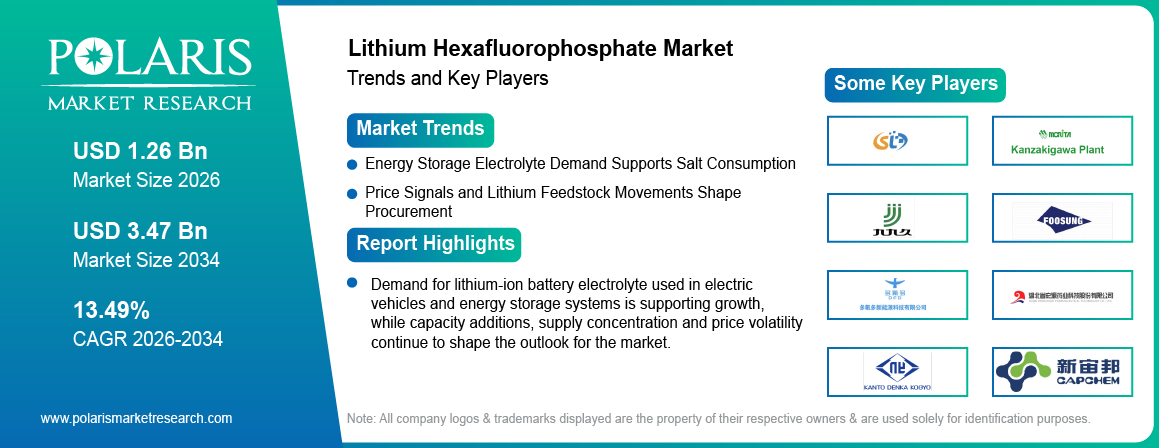
The lithium hexafluorophosphate market is shaped by production scale, battery-grade quality, integration with electrolyte manufacturing, and the ability to supply customers across borders. Tinci Materials completed commissioning of its Phase II LiPF6 project ahead of trial production in June 2026, while several Chinese producers disclosed capacity upgrades or expansion plans. These announcements indicate an active race to expand lithium hexafluorophosphate production capacity (Source: metal.com).
Vendor Landscape Snapshot
| Company | Headquarters | Vendor Positioning | Key Strength / Focus |
| Guangzhou Tinci Materials Technology Co., Ltd. | China | Leader | Integrated electrolyte and LiPF6 producer; Phase II project lifts stated capacity to 52,000 tonnes per year (company-wide figures vary by source) |
| Do-Fluoride New Materials Co., Ltd. | China | Leader | Reported 65,000 tonnes per year capacity; integrated fluorine-to-LiPF6 chain |
| Shenzhen Capchem Technology Co., Ltd. | China | Challenger | Electrolyte maker securing LiPF6 through its stake in Jiangxi Shilei Fluorine Material |
| Zhejiang Yongtai Technology Co., Ltd. (Shaowu Yongtai) | China | Challenger | Stated expansion plan to reach 50,000 tonnes per year |
| Jiangxi Shilei Fluorine Material Co., Ltd. | China | Challenger | Fluorine-integrated supplier; upgrade to 36,000 tonnes per year |
| Tonze New Energy Technology Co., Ltd. | China | Challenger | Solid LiPF6 producer with fluorochemical by-product portfolio |
| Jiangsu Jiujiujiu Technology Co., Ltd. | China | Challenger | Supplier to large battery makers, including a supply agreement with BYD for 2021 to 2023 |
| Hubei Hongyuan Pharmaceutical Technology Co., Ltd. | China | Niche Specialist | Automotive-battery-grade LiPF6 within a diversified chemicals group |
| Morita Chemical Industries Co., Ltd. | Japan | Technology Specialist | LiPF6 know-how; 20% partner in the Neogen Morita venture in India |
| Kanto Denka Kogyo Co., Ltd. | Japan | Technology Specialist | LiPF6 technology licensor to Orbia's Louisiana project |
| Stella Chemifa Corporation | Japan | Niche Specialist | High-purity fluorine chemicals supplier with LiPF6 in its electrolyte-salt portfolio |
| Central Glass Co., Ltd. | Japan | Niche Specialist | Established fluorine chemicals producer listed among LiPF6 suppliers in third-party coverage |
| Foosung Co., Ltd. | South Korea | Emerging Non-China Supplier | Only domestic South Korean LiPF6 producer; U.S. supply contract signed in October 2025 |
| Orbia Fluor & Energy Materials (Koura) | United States | Emerging Entrant | Planned 10,000-tonne-per-year LiPF6 plant in Louisiana |
| Neogen Morita New Materials (Neogen Chemicals) | India | Emerging Entrant | Solid LiPF6 joint venture in Gujarat; volumes not yet disclosed |
Source: Polaris Market Research Analysis. Vendor positioning is a qualitative assessment of scale, integration, and geographic reach.
LiPF6 Capacity Expansion Tracker
| Company | Project / Plan | Capacity (tonnes per year) | Status |
| Guangzhou Tinci Materials Technology Co., Ltd. | Phase II LiPF6 project | +15,000 (total 52,000) | Commissioned; trial production due, June 2026 |
| Guangzhou Tinci Materials Technology Co., Ltd. | Planned expansion | 35,000 | Commissioning targeted for 2H 2026; figures differ by source |
| Zhejiang Yongtai Technology Co., Ltd. (Shaowu Yongtai) | Expansion project | +32,600 (total 50,000) | EIA disclosure, May 2026 |
| Jiangxi Shilei Fluorine Material Co., Ltd. | Technical upgrade | 24,000 to 36,000 | Targeted by end-2025 |
| Do-Fluoride New Materials Co., Ltd. | Reported LiPF6 capacity | 65,000 | Interim results, August 2026 |
| Orbia Fluor & Energy Materials (Koura) | St. Gabriel, Louisiana plant | 10,000 (planned) | Planned; start-up originally targeted for 2026 |
| Neogen Morita New Materials | Solid LiPF6 plant, Gujarat | Not disclosed | Joint venture finalized, November 2025 |
Source: Polaris Market Research Analysis. Capacity definitions differ by project and should not be summed.
Lithium Hexafluorophosphate Market Technology and Innovation Landscape
A documented manufacturing route reacts lithium fluoride with phosphorus pentafluoride to produce LiPF6. The cited patent specifies a product purity of at least 99.90%, highlighting purity control as a central manufacturing requirement for battery-grade material. Because phosphorus pentafluoride is reactive and LiPF6 is moisture-sensitive, process containment, drying, product handling, and quality control are important to production operations (Source: patents.google.com, pubs.rsc.org).
Downstream formulation also affects commercial handling. Tinci Materials’ Chizhou upgrade describes formulations involving dimethyl carbonate solvent, ethyl methyl carbonate, and ethyl acetate. These references connect the salt to solvent systems used in electrolyte production, but do not establish that the solvent itself belongs within the LiPF6 market boundary (Source: mysteel.net).
The solid-salt model represented by the Neogen Morita venture differs from a solution prepared or integrated within an electrolyte manufacturing operation. Buyers therefore assess not only purity, price and lithium hexafluorophosphate production capacity but also delivery form, storage conditions, and compatibility with their formulation process (Source: chemindigest.com).
Use Case Analysis
LiPF6 demand is linked to electrolyte preparation for lithium-ion cells. Demand spans three principal application contexts: electric vehicle batteries, stationary energy storage, and consumer electronics. The salt is an input to electrolyte rather than a stand-alone end-use product, so market sizing must follow the LiPF6 content consumed by electrolyte manufacturers rather than the total value of the application battery.
Electric Vehicles: Traction Battery Electrolyte
Electric vehicle batteries require electrolyte systems that enable lithium-ion movement between the cathode and anode during charging and discharging. LiPF6 is used as the electrolyte salt in many conventional lithium-ion formulations. Supplier demand is shaped by lithium ion battery demand, cell output, formulation specifications, and battery qualification processes.
Energy Storage: Stationary Battery Systems
Stationary energy storage systems provide an additional demand channel as battery installations support grid flexibility and renewable-energy integration. Interim-results disclosures point to strong growth in storage-battery electrolyte sales, but the figure applies to electrolyte rather than LiPF6 alone. Buyers and analysts should therefore treat it as directional evidence until salt-loading and application-volume data are available.
Consumer Electronics: Portable Battery Applications
Consumer electronics use lithium-ion batteries in devices such as phones, computers, and portable equipment. LiPF6 may be included in the electrolyte formulation, depending on cell design and supplier specifications, which links this application to the lithium hexafluorophosphate market.
Buyer Analysis and Barriers to Market Entry
LiPF6 buyers typically operate within battery-materials, electrolyte, or battery-cell supply chains. Purchasing decisions depend on battery grade purity, consistency between batches, safe handling, reliable supply, commercial pricing, and compatibility with the customer’s electrolyte formulation. Buyers also assess moisture control to minimize hydrolysis, which can degrade LiPF6 and affect electrolyte quality.
| Buyer Category | Primary Requirement | Typical Procurement Consideration |
| Electrolyte manufacturers | Consistent quality and formulation fit | Contract volumes, specification, delivery form, price basis |
| Battery-cell manufacturers | Qualified electrolyte and reliable supply | Supplier qualification, quality records, supply continuity |
| Regional distributors / importers | Safe transport and predictable availability | Packaging, storage, regulatory documentation, logistics |
Source: Polaris Market Research Analysis
Barriers to entry include process expertise, moisture-sensitive handling (hydrolysis control), the need for high and consistent battery grade purity, capital-intensive production, customer qualification cycles, and exposure to price volatility. New entrants must also establish reliable upstream input supply and demonstrate that their product performs consistently in the customer’s electrolyte formulation. Export-oriented suppliers face additional logistics and customer-qualification requirements, while projects announced by established producers can intensify competition before a new facility reaches stable operation.
Lithium Hexafluorophosphate Market Premium Insights and Forward Outlook
Capacity Execution Will Matter More Than Announcements
The market outlook depends on whether announced capacity additions enter stable commercial operation and whether downstream electrolyte demand absorbs the additional supply. Reported plans should be tracked against commissioning milestones, actual output, and customer qualification rather than added mechanically into a single installed-capacity total.
Supply Diversification Is a Strategic Opportunity
Non-Chinese production and supply arrangements may appeal to customers seeking a broader supplier base. However, the available announcements do not disclose comparable annual tonnage, so the scale of this opportunity remains unquantified until output and contract volumes are confirmed.
Policy Monitoring Remains Relevant
The one-year suspension of China’s battery-related export controls, announced in November 2025, creates a policy checkpoint on November 10, 2026. Market participants should track official announcements around that date, as any change in export controls could affect sourcing and contract terms in the lithium hexafluorophosphate market.
Cost and Pricing Benchmarking Analysis
Lithium hexafluorophosphate price is benchmarked using a clearly defined grade, delivery basis, geography, and time period. Fastmarkets introduced a battery-grade assessment for material with at least 99.9% purity on an FOB China basis. This provides a reference framework, but it should not be treated as directly interchangeable with a producer’s contract price or a downstream electrolyte price. (Source: fastmarkets.com)
| Pricing Indicator | Reported Value | Basis / Limitation | Change vs. Q1 2026 |
| Q1 2026 average | RMB 131,800 per tonne | China quarterly average | Baseline |
| Q2 2026 average | RMB 108,200 per tonne | China quarterly average | -17.9% |
| Q3 2026 average (to Aug. 20) | RMB 103,400 per tonne | Partial quarter; not a full-quarter average | -21.5% (partial quarter) |
| Battery-grade assessment | At least 99.9% purity | Fastmarkets assessment, FOB China | Not applicable |
Source: Polaris Market Research Analysis
The average price series fell by approximately 22% from Q1 to the Q3-to-August 20 observation. Because this report’s revenue is derived from volume multiplied by price, this lithium hexafluorophosphate market analysis applies a single defined price basis rather than mixing annual averages, spot assessments, and contract prices.
Key Players in the Lithium Hexafluorophosphate Market
- Shenzhen Capchem Technology Co., Ltd.
- Central Glass Co., Ltd.
- Do-Fluoride New Materials Co., Ltd.
- Foosung Co., Ltd.
- Hubei Hongyuan Pharmaceutical Technology Co., Ltd.
- Jiangsu Jiujiujiu Technology Co., Ltd.
- Jiangxi Shilei Fluorine Material Co., Ltd.
- Kanto Denka Kogyo Co., Ltd.
- Morita Chemical Industries Co., Ltd.
- Neogen Chemicals Ltd. (Neogen Ionics)
- Orbia Fluor & Energy Materials (Koura)
- Stella Chemifa Corporation
- Guangzhou Tinci Materials Technology Co., Ltd.
- Tonze New Energy Technology Co., Ltd.
- Zhejiang Yongtai Technology Co., Ltd. (Shaowu Yongtai High-Tech New Materials Co., Ltd.)
Industry Developments
- September 2026: The board of Neogen Morita New Materials approved a preferential allotment of 720,000 equity shares to Morita Investment Limited for INR 76.8 crore, giving Morita a 9.09% stake under the joint venture agreement signed on August 31, 2025. The capital supports the venture’s solid LiPF₆ project in India. (Source: sahi.com)
- July 2026: Tinci Materials stated that its electrolyte and LiPF₆ facilities were operating near full capacity, with a planned 35,000-tonne-per-year LiPF₆ expansion on track for commissioning in the second half of 2026. The company expects higher electrolyte output in the third quarter on continued energy storage battery demand. (Source: metal.com)
- June 2026: Tinci Materials announced that its Phase II project, adding 15,000 tonnes per year of LiPF₆ capacity, had completed construction and commissioning ahead of trial production. Total LiPF₆ capacity is expected to reach 52,000 tonnes per year after commissioning. (Source: metal.com)
- April 2026: Orbia Fluor & Energy Materials withdrew its March 2026 antidumping and countervailing duty petitions on LiPF₆ imports from China, which had alleged dumping margins of 145.27% to 200.50%. The U.S. International Trade Commission discontinued its preliminary-phase investigations, and Commerce had not initiated investigations. (Source: federalregister.gov)
- April 2026: China’s export VAT rebate on LiPF₆ was abolished effective April 1, 2026. Exporters shipped ahead of the change, lifting March exports to 4,554 tonnes, before shipments fell to 868 tonnes in April. (Source: metal.com)
- November 2025: Neogen Ionics finalized the joint venture agreement it executed on August 31, 2025 with Morita Investment Limited to form Neogen Morita New Materials, which will produce solid LiPF₆ salt in India. Neogen Ionics is to hold 80%, while Morita is to hold 20% by contributing USD 20 million. (Source: evreporter.com)
- November 2025: China’s Ministry of Commerce and General Administration of Customs suspended the export controls announced on October 9, 2025 for lithium batteries, cathode materials, and artificial graphite anode materials until November 10, 2026. (Source: hsfkramer.com)
- November 2025: Capchem stated that Jiangxi Shilei Fluorine Material, in which it holds a stake, would lift its LiPF₆ capacity from 24,000 to 36,000 tonnes per year after technical upgrades by the end of 2025. (Source: mysteel.net)
- October 2025: Foosung Co., Ltd. signed a multi-year LiPF₆ supply contract with a U.S. battery company, estimated at 20% to 30% of its domestic LiPF₆ capacity. Foosung is the only domestic LiPF₆ producer in South Korea. (Source: koreantechtexas.com)
- March 2025: Fastmarkets launched a new battery-grade lithium hexafluorophosphate (LiPF₆) price assessment for material with at least 99.9% purity, traded FOB China. The assessment improves price transparency across the lithium-ion battery electrolyte supply chain. (Source: fastmarkets.com)
- November 2024: Capchem announced around USD 52.6 million investment to acquire a 42.8% stake in Shileifluorine Material, a supplier of LiPF₆ and other fluorine-based materials. The investment supports upstream raw material integration and plans to expand the supplier’s LiPF₆ production capacity from 15,000 to 33,000 tonnes per year. (Source: capchem.com)
Lithium Hexafluorophosphate Market Report Segmentation
By Form Outlook (Revenue, USD Billion, 2021–2034)
- Solid Crystalline
- Liquid Solution
By Application Outlook (Revenue, USD Billion, 2021–2034)
- Electric Vehicles
- Energy Storage Systems
- Consumer Electronics
By Region Outlook (Revenue, USD Billion, 2021–2034)
- North America
- US
- Canada
- Europe
- Germany
- France
- UK
- Italy
- Spain
- Netherlands
- Poland
- Rest of Europe
- Asia Pacific
- China
- Japan
- India
- South Korea
- Taiwan
- Australia
- Rest of Asia Pacific
- Latin America
- Brazil
- Mexico
- Argentina
- Rest of Latin America
- Middle East & Africa
- Saudi Arabia
- UAE
- South Africa
- Rest of Middle East & Africa
Lithium Hexafluorophosphate Market Report Scope
| Report Attributes | Details |
| Market Size in 2025 | USD 1.11 Billion |
| Market Size in 2026 | USD 1.26 Billion |
| Revenue Forecast by 2034 | USD 3.47 Billion |
| CAGR | 13.49% from 2026–2034 |
| Base Year | 2025 |
| Historical Data | 2021–2024 |
| Forecast Period | 2026–2034 |
| Quantitative Units | Revenue in USD Billion and CAGR |
| Report Coverage | Revenue Forecast, Growth Factors, Competitive Landscape, Industry Trends, and Strategic Analysis |
| Segments Covered | By Form, Application, and Region |
| Regional Scope | North America, Europe, Asia Pacific, Latin America, Middle East & Africa |
| Competitive Landscape | Company Profiling, Product Benchmarking, Financial Analysis, Market Developments, and Strategic Initiatives |
| Report Format | PDF + Excel |
| Customization | Available by Country, Region, and Segment |
Source: Polaris Market Research Analysis
Why Choose Polaris Market Research
Polaris Market Research & Consulting, Inc. evaluates the lithium hexafluorophosphate market analysis across product forms, applications, regional markets, and competitive dynamics. The research distinguishes lithium hexafluorophosphate (LiPF6) salt from finished electrolyte formulations and other battery materials, maintaining a clear market scope while examining the material's role in lithium-ion battery manufacturing. The analysis also considers production capacity, supply concentration, pricing developments, and international trade to assess the commercial position of LiPF6 within the battery materials industry.
The research can be customized by product form, application, regional demand, supplier benchmarking, production capacity, and trade flows. Additional analysis can cover solid crystalline LiPF6, liquid LiPF6 solutions, electric vehicle batteries, energy storage systems, consumer electronics, battery-grade material requirements, supplier expansion plans, and the development of alternative sourcing arrangements. These dimensions help clients evaluate the lithium hexafluorophosphate market report according to their procurement, investment, competitive intelligence, and strategic planning requirements.
A further differentiator is the assessment of supply-chain developments according to their commercial significance. Announced production capacity, operational output, trial production, export shipments, and supply agreements represent different stages of market activity. Evaluating these developments separately helps distinguish planned manufacturing expansion from actual production and commercial availability. The approach to lithium hexafluorophosphate industry analysis also examines supplier concentration, price movements, and trade relationships to identify developments affecting LiPF6 availability and procurement strategies.
Lithium Hexafluorophosphate Market FAQ's
The lithium hexafluorophosphate market was valued at USD 1.11 Billion in 2025 and is forecast to reach USD 3.47 Billion by 2034. The market is expanding at a CAGR of 13.49% from 2026 to 2034.
Lithium hexafluorophosphate (LiPF6) is used as an electrolyte salt in lithium-ion batteries for electric vehicles, energy storage systems, and consumer electronics.
Asia Pacific leads the lithium hexafluorophosphate market, supported by China's concentrated manufacturing capacity and established battery supply chain. The region accounted for 47.46% of the global market in 2025.
Solid crystalline accounted for 66.28% of the market in 2025, supported by its role as a feedstock for downstream electrolyte manufacturing.
Key players include Guangzhou Tinci Materials Technology Co., Ltd., Do-Fluoride New Materials Co., Ltd., Shenzhen Capchem Technology Co., Ltd., Zhejiang Yongtai Technology Co., Ltd., Jiangxi Shilei Fluorine Material Co., Ltd., Morita Chemical Industries Co., Ltd., Kanto Denka Kogyo Co., Ltd., Stella Chemifa Corporation, and Foosung Co., Ltd. Orbia Fluor & Energy Materials and the Neogen Morita venture are emerging entrants outside China.
China’s quarterly average LiPF6 price fell from RMB 131,800 per tonne in Q1 2026 to RMB 108,200 in Q2 and RMB 103,400 in Q3 through August 20, a decline of about 22% from Q1. Fastmarkets also assesses battery-grade LiPF6 of at least 99.9% purity on an FOB China basis.
Battery demand, manufacturing capacity, raw material prices, supply-demand conditions, and international trade influence market development. Key 2026 trends include Chinese capacity expansion, production upgrades, price fluctuations, and supply-chain diversification.
Key challenges include price volatility, moisture sensitivity, production costs, capacity-driven oversupply risk, and concentrated manufacturing capacity.
LiPF6 remains one of the important salts in conventional lithium-ion electrolytes. Other salts, such as LiFSI, are used or explored alongside it, but they sit outside the scope of this report, which tracks LiPF6 salt only.
One manufacturing route involves reacting lithium fluoride with phosphorus pentafluoride under controlled conditions. Commercial production adds purification and moisture management to reach battery-grade quality.
Solid LiPF6 is supplied as a crystalline salt, while liquid LiPF6 consists of the salt dissolved in a compatible solvent.
China's August 2026 LiPF6 exports went mainly to South Korea, the United States, Poland, and Japan. South Korea led with 287.626 tons, or about 25% of the 1,130.8-ton monthly total.
Moisture can affect LiPF6 stability and electrolyte quality, making controlled storage, sealed packaging, and appropriate handling procedures essential.
China suspended its October 2025 export controls on lithium batteries, cathode materials, and graphite anode materials until November 10, 2026, and LiPF6 was not among the listed items. Separately, a March 2026 U.S. antidumping and countervailing duty petition on LiPF6 imports from China was withdrawn in April 2026, so no U.S. duties apply under that case.
Customized research can cover product forms, applications, regional demand, supplier benchmarking, production capacity, pricing, trade, and forecasts.
Download Sample Report of Lithium Hexafluorophosphate Market
Please fill out the form to request a customized copy of the research report.


