
Small Modular Reactor Market Size, Share Global Analysis Report, 2026-2034
REPORT DETAILS
Small Modular Reactor Market Summary
The global small modular reactor market was valued at USD 6.38 billion in 2025 and is projected to reach USD 15.87 billion by 2034, registering a CAGR of 10.66% during the forecast period. Growth of the market is influenced by increasing clean energy investment, rising focus on nuclear energy, and growing investments in advanced reactor technologies. North America dominated the market in 2025 due to increasing investments in advanced nuclear technologies, and the need for reliable low-carbon energy sources.
Market Statistics
Key Takeaways
- North America held the largest market share of 39.60% in 2025, driven by increasing investments in advanced nuclear technologies and the need for reliable low-carbon energy sources.
- Reactor Island Equipment occupied the majority segment share of 43.20% in 2025, due to the installed base concentration of critical reactor components.
- Pressurized Water Reactor accounted for the largest reactor type share of 69.40% in 2025, owing to its strong installed base across conventional nuclear power plants.
- Government is projected to register the fastest CAGR of 11.80% during the forecast period, due to increasing public investments and strategic efforts to develop advanced reactor technologies.
Note: Figures and projections outlined in this report are the result of Polaris Market Research’s proprietary analytical processes, grounded in the latest available datasets and market observation
What is Small Modular Reactor?
The small modular reactor (SMR) is a nuclear reactor that produces electricity using a lower capacity compared to conventional nuclear power stations. The reactors utilize the modular assembly method, making it possible for reactors to be assembled at the construction site after being fabricated in factory facilities.
SMRs are distinct from conventional reactors driven by their smaller sizes, higher levels of safety, and scalability in the deployment process. They support the transition toward low-carbon energy by providing reliable baseload power, integrating with renewable energy systems.
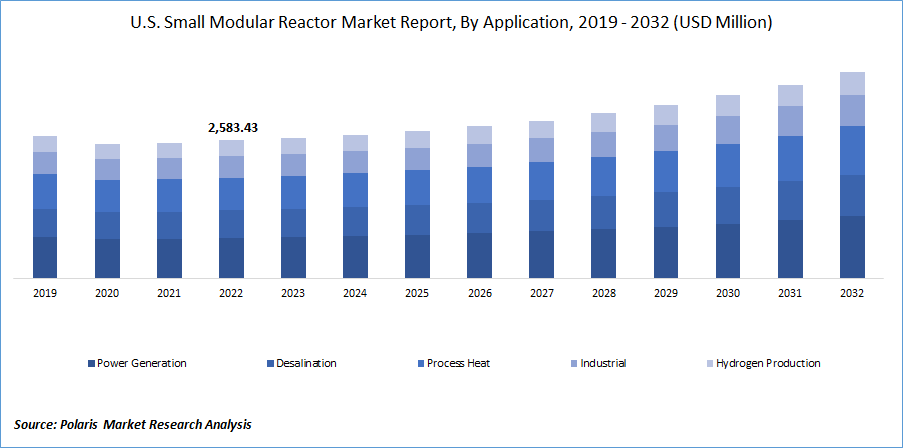
Source: Polaris Market Research Analysis
Small Modular Reactor Market Driver Impact Analysis
SMR market is expected to grow rapidly due to growing demand for clean energy, supportive government policies, and increasing investments in advanced nuclear technologies. The table below highlights the key factors driving market growth across major regions.
| Market Driver | Est. CAGR Impact | Geographic Relevance | Impact Timeline |
| Rising demand for low-carbon and clean energy generation | + 2.6% | Global | Medium to long term |
| Government funding and supportive nuclear energy policies | + 2.3% | US, Canada, Europe, Asia Pacific | Medium to long term |
| Increasing electricity demand from industrial and data center applications | +2.0% | US, Europe, Asia Pacific | Medium term |
| Advancements in SMR design, safety systems, and modular manufacturing | +1.7% | US, Canada, Europe, Japan | Short to medium term |
| Growing deployment for remote communities and off-grid power applications | +1.4% | Canada, Russia, Asia Pacific, Middle East | Long term |
* Indicative estimates based on market context and analyst judgment. Figures reflect relative driver weight, not additive CAGR contributions. Source: Polaris Market Research Analysis.
Industry Dynamics
- Increasing clean energy investment is boosting the demand for SMRs.
- Rising focus on nuclear energy is driving the market growth.
- High development cost and regulatory barrier remain a major challenge for SMR market.
- Growing investments in advanced reactor technologies is creating opportunities for SMR market.
Small Modular Reactor Market Drivers, Restraints and Opportunities
What is Driving Small Modular Reactor Market Growth? Increasing Clean Energy Investment
The increasing demand for clean energy is driving the growth of small modular reactor (SMR) market. The rising focus on reducing carbon emissions and transitioning toward low-carbon power generation is increasing the adoption of advanced nuclear technologies. Moreover, growing investments in renewable energy is supporting the adoption of SMR technology. For instance, in 2025, the International Energy Agency (IEA) reported that the global clean energy investment reached USD 2.15 trillion in 2025, an increase of 5.9% from USD 2.03 trillion in 2024(Source: www.iea.org).
How is Rising Focus on Nuclear Energy Reshaping the SMR Market?
The focus on nuclear power is transforming the SMR market through increasing the demand for clean power generation solutions. Governments are rapidly adopting nuclear energy to reduce dependency on crude-oils and meeting their carbon reduction targets. For example, the International Energy Agency (IEA) projected that the global nuclear energy investment is expected to reach USD 70 billion per year by 2030, increasing from USD 65 billion per year in 2025(Source: www.iea.org).
What Challenges Threaten Small Modular Reactor Market Expansion? High Development Cost and Regulatory Barriers
Higher development cost and regulatory challenges is limiting the adoption of small modular reactors. SMR market requires significant investment in developing reactors, and testing. Moreover, licensing complications, regulatory issues, and lengthy approval create challenges for wider market adoption.
What Opportunities Exist in the Small Modular Reactor Market? Growing Investments in Advanced Reactor Technologies
The increasing investments in advanced reactors are creating opportunities for the SMR industry. The increasing investment in research and developments, government funding, and private investment is contributing to the development of new generation SMRs. For instance, in 2026, the Government of India allocated USD 2.11 billion for design, development, and deployment of small modular reactors(Source: www.pib.gov.in). Advanced SMR designs with improved safety, efficiency, and modular construction capabilities are expected to support wider market adoption.
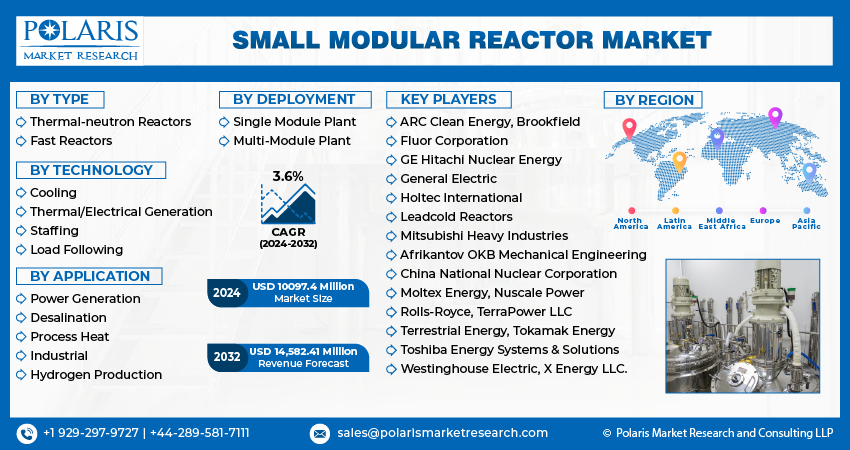
Source: Polaris Market Research Analysis
Segment and Regional Leaders at a Glance
According to Polaris Market Research, North America leads the market while Asia Pacific the fastest-growing region.
- Dominant Region: North America
- Fastest-Growing Region: Asia Pacific
- Largest Equipment Segment: Reactor Island Equipment
- Largest Reactor Type Segment: Pressurized Water Reactor
- Largest End User Segment: Utilities
Small Modular Reactor Market Segmentation Analysis
The report provides a comprehensive analysis of the small modular reactor market by equipment, reactor type, and end user to identify key revenue-generating and high-growth segments.
Small Modular Reactor Market by Equipment
What is the Largest Equipment Segment in the Small Modular Reactor Market?
The reactor island equipment dominated the SMR market in 2025 due to the installed base concentration of critical reactor components. Reactor island equipment, including reactor vessels, fuel systems, and safety-related components, plays a crucial role in ensuring efficient power generation.
Which Equipment Segment is Growing Fastest in the Small Modular Reactor Market?
The turbine island equipment is projected to grow at the fastest CAGR during the forecast period due to increasing procurement activities and rising demand for advanced power conversion systems. The expansion of SMR projects is driving demand for efficient micro turbine systems, generators, and supporting equipment to improve overall plant performance.
Small Modular Reactor Market by Reactor Type
Which Reactor Type Leads the Small Modular Reactor Market?
Pressurized Water Reactor (PWR) dominated the market in 2025 due to its large installed base in traditional nuclear power plants equipment. PWRs are highly demanding due to their safety features, scalability, and ability to integrate with existing nuclear power plants.
Which Reactor Type is Growing Fastest in the Small Modular Reactor Market?
Boiling Water Reactor (BWR) is projected to witness the highest CAGR during the forecast period due to rising procurement activities and increasing focus on simplified reactors. BWRs offers advantages including simple design, and effective heat transfer mechanism.
Small Modular Reactor Market by End User
Which End User Segment Leads the Small Modular Reactor Market?
Utilities held the largest share in the SMR industry in 2025 due to increasing investments in clean energy infrastructure, and grid modernization. The utilities are employing SMRs to enhance energy security, upgrade aged power systems, and achieve sustainable electricity production.
Which End User Segment is Growing Fastest in the Small Modular Reactor Market?
The government is projected to grow at the fastest CAGR during the forecast period due to increasing public investments, and strategic efforts to develop advanced reactor technologies. Governments are supporting SMR deployment through investment in nuclear reactor construction. For instance, in 2025, the International Energy Agency reported that 63 nuclear reactors were under construction during the end 2024, accounting for 71 GW additional capacity(Source: www.iea.org).
Segment Summary Table
| Segment | Category | 2025 Status | Forecast CAGR | Key Driver |
| Reactor Island Equipment | Equipment | Largest share | High | Higher adoption of core reactor systems and safety components |
| Turbine Island Equipment | Equipment | Fastest growing | High | Increasing deployment of power conversion systems in SMR projects |
| Pressurized Water Reactor | Reactor Type | Largest share | High | Proven technology and enhanced safety features |
| Boiling Water Reactor | Reactor Type | Fastest growing | High | Growing demand for simplified reactor designs and operational efficiency |
| Utilities | End User | Largest share | High | Rising need for reliable low-carbon electricity generation |
| Government | End User | Fastest growing | High | Increasing policy support and funding for advanced nuclear technologies |
Source: Polaris Market Research Analysis
Source: Polaris Market Research Analysis
Regional Analysis
North America Small Modular Reactor Market Size and Share
North America held the largest market share in 2025 due to the rising investment in nuclear technologies, and need for low-carbon energy sources. The development of SMR plants in countries such as the US and Canada is fueling the growth of the market. For example, in 2025, the US Department of Energy (DOE) re-issued a funding of USD 900 million to support the commercial deployment of small modular reactors in the US(Source: www.energy.gov).Increasing focus on energy security and grid reliability is further accelerating SMR adoption.
Europe Small Modular Reactor Market Analysis
Europe held a significant share of the global small modular reactor market due to increasing focus on clean energy transition, and carbon reduction targets. Countries across the region are exploring SMR deployment to strengthen energy security and complement renewable energy sources. For instance, the European Commission reported that the total SMR capacity in the Europe is estimated to reach between 17 GW and 53 GW by 2050, showing strong future growth of the SMR market in the region(Source: energy.ec.europa.eu).
Asia Pacific Small Modular Reactor Market Growth Rate and Forecast
Asia Pacific is projected to grow at the fastest CAGR during the forecast period due to rising electricity demand, and expanding nuclear power programs. Countries such as China, India, and Japan are focusing on nuclear innovation to improve energy security and achieve clean energy goals. The region benefits from government initiatives supporting next-generation nuclear reactors and increasing investments in clean energy generation. For instance, in 2025, the International Energy Agency (IEA) reported that China’s clean energy investment doubled from 2015 to USD 625 billion in 2024(Source: www.iea.org).
Latin America Small Modular Reactor Market Analysis
Latin America analysis covers Brazil, Mexico, Argentina, Chile, and Colombia. The SMR market in the region is influenced by increasing demand for reliable electricity, energy diversification strategies, and the need for low-carbon power solutions. Growing interest in advanced nuclear technologies and clean energy investments is creating opportunities for SMR adoption in the region.
Middle East and Africa Small Modular Reactor Market Analysis
Middle East and Africa analysis covers Saudi Arabia, UAE, Egypt, South Africa, and other emerging markets. The regional SMR market growth is supported by energy diversification initiatives, rising electricity demand, and investments in sustainable power infrastructure. Countries in the region are exploring SMRs for clean electricity generation, industrial energy supply, and reducing reliance on fossil fuels.
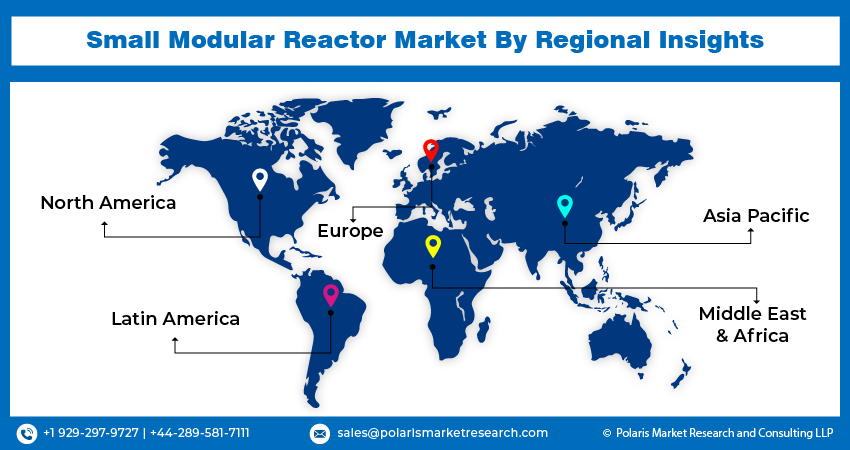
Source: Polaris Market Research Analysis
Regulatory Heatmap
| Country | Policy Environment | Key Regulations | Market Implication | Trend |
| US | Favorable | Federal funding, industrial policy, and agency programs relevant to small modular reactor market | Improves bankability for domestic projects | Expanding |
| European Union | Favorable | EU industrial and sustainability policy frameworks | Raises compliance requirements and local supply preferences | Expanding |
| China | Favorable | National manufacturing and technology deployment programs | Supports scale economics and supplier clustering | Stable |
| Japan | Neutral | Energy security and advanced manufacturing programs | Creates selective technology-entry opportunities | Developing |
| India | Developing | Make-in-India and energy transition programs | Supports local assembly and partnerships | Developing |
| Middle East | Developing | Industrial diversification and infrastructure investment programs | Creates project-led demand | Early stage |
| Latin America | Neutral | Resource and infrastructure policy programs | Supports selective upstream and utility demand | Uncertain |
Source: Polaris Market Research Analysis
Competitive Landscape and Key Players
The global SMR market is moderately challenging with companies involved in designing small modular reactors, advanced reactors, and nuclear engineering. Competitive factors involve the safety of reactors, technological innovation, approval process, manufacturing abilities, and project development knowledge.
The industry is changing rapidly due to increasing need for clean energy and investments in advanced nuclear technology. Partnerships, reactor design advancements, government collaborations, and development of next-generation nuclear systems continue to be major strategies for players in the industry.
Competitive Positioning Table
| Company | Est. Market Position | Primary Focus | Geographic Focus | In Report |
| NuScale Power, LLC. | Top 10 | Advanced SMR technology and regulatory progress | Global | Yes |
| GE Vernova Hitachi Nuclear Energy | Top 10 | BWRX-300 SMR development and nuclear expertise | Global | Yes |
| Rolls-Royce plc | Top 10 | Compact reactor design and engineering capabilities | Global | Yes |
| TerraPower, LLC | Niche leader | Advanced reactor technology and nuclear solutions | Global | Yes |
| X-energy | Niche leader | Advanced reactor innovation and next-generation nuclear systems | Regional | Yes |
| Westinghouse Electric Company LLC. | Niche leader | High-temperature gas reactor technology | Regional | Yes |
Source: Polaris Market Research Analysis
Who are the Key Players in the Market?
The leading companies operating in the market include NuScale Power, LLC., GE Vernova Hitachi Nuclear Energy, Rolls-Royce plc, TerraPower, LLC, X-energy, Westinghouse Electric Company LLC, BWX Technologies, Inc., ARC Clean Technology, Terrestrial Energy Inc., Mitsubishi Heavy Industries, Ltd., Holtec International, and Atomic Energy of Canada Limited, and other market participants.
Technology and Innovation Landscape 2025-2026
Small modular reactor technology is advancing through innovations in advanced reactor designs, modular manufacturing, enhanced safety systems, digital monitoring, and improved nuclear fuel technologies. These developments are improving reactor efficiency, reducing construction timelines, enhancing operational safety, and increasing the scalability of nuclear energy deployment.
| Technology | Adoption Stage | Key Development | Market Impact |
| AI-enabled monitoring | Growing deployment | Operators use analytics to improve uptime in small modular reactor market | Cost reduction |
| Advanced materials | Early commercial deployment | Suppliers qualify higher-performance materials and subsystems | Competitive displacement |
| Modular architecture | Growing deployment | Vendors standardize configurations to shorten delivery cycles | Capacity expansion |
| Digital twins | Pilot or early research | Engineering teams model operating scenarios before deployment | Risk reduction |
Source: Polaris Market Research Analysis
Who Buys Small Modular Reactor Market Research and Why?
The small modular reactor market report helps stakeholders identify growth opportunities, market trends, and competitive positioning.
| Buyer / Investor Type | Primary Use Case | Key Insight Sought | Decision Horizon |
| Corporate strategy teams | Market-entry planning | Where demand converts into contracted revenue | 2 to 5 years |
| Private equity investors | Platform screening | Which suppliers can consolidate fragmented demand | 3 to 7 years |
| Procurement leaders | Vendor shortlisting | Which technologies carry bankable proof points | 1 to 3 years |
| Government program teams | Policy design | Where incentives unlock domestic capacity | 3 to 7 years |
Source: Polaris Market Research Analysis
What are the Barriers to Entering the Market?
- High Capital Requirements: Development of SMR needs significant investment due to complicated designs, safety features, fabrication facilities, and infrastructures.
- Technology Complexity: Development of SMRs needs expertise in nuclear engineering, reactor physics, material sciences, and safety technologies.
- Regulatory Limitations: Stringent nuclear policies, licensing, and safety approvals are becoming barriers for newcomers to the industry.
- Intellectual Property Barriers: Nuclear reactor design needs extensive research and development and strong protection of intellectual property rights.
- Manufacturing Challenges: Standardization, quality of the parts, reduction in cost, and ensuring safety are the major issues for the SMR market.
- Skilled Workforce Requirement: Technical expertise in nuclear engineering, reactor operations, and project management is essential for the SMR industry.
- Infrastructure Requirements: Infrastructure requirements include nuclear plants, logistical networks, regulatory frameworks, and construction capabilities.
Premium Insights and Forward Outlook
Advanced Reactor Technology Development
The development of next-generation nuclear technology is becoming a major driver for the growth of the SMR market. Evolution in reactor designs, passive safety systems, digital monitoring systems, and innovative construction techniques are improving the efficiency and deployment of SMRs.
Clean Energy Transition and Nuclear Power Expansion
The growing number of clean energy programs is creating opportunities for SMR market. The rising need for reliable electricity sources and decreasing dependency on fossil fuels is driving the growth of the SMR market.
Cost Benchmarking Table
| Product | Est. Price Range | Key Cost Driver | Complexity Tier |
| Reactor island equipment | USD 100 million to USD 500 million/unit | Reactor design, nuclear safety systems, and core components | Premium |
| Turbine island equipment | USD 50 million to USD 300 million/unit | Power conversion capacity and balance-of-plant integration | Mid-tier |
| Pressurized Water Reactor | USD 300 million to USD 1 billion/unit | Reactor maturity, licensing, and construction complexity | Project-based |
Source: Polaris Market Research Analysis
Key Players
- NuScale Power,LLC.
- GE Vernova Hitachi Nuclear Energy
- Rolls-Royce plc
- TerraPower, LLC
- X-energy
- Westinghouse Electric Company LLC.
- BWX Technologies, Inc.
- ARC Clean Technology
- Terrestrial Energy Inc.
- Mitsubishi Heavy Industries, Ltd.
- Holtec International
- Atomic Energy of Canada Limited
Industry Developments
- June 2026: Holtec International and EDF submitted a joint proposal to the UK Government for the deployment of Holtec’s SMR-300 small modular reactors at Cottam in Nottinghamshire(source: holtecinternational.com).
- June 2026: GE Vernova Hitachi Nuclear Energy (GVH) announced a collaboration with Velan to supply Reactor Integral Isolation Valves (RIIV) and Containment Isolation Valves (CIV) for GVH's BWRX-300 SMR projects in Europe(source: www.gevernova.com).
Market Segmentation
By Equipment Outlook (Revenue, USD Billion, 2021–2034)
- Reactor Island Equipment
- Turbine Island Equipment
- Control and Instrumentation Systems
- Safety and Auxiliary Systems
By Reactor Type Outlook (Revenue, USD Billion, 2021–2034)
- Pressurized Water Reactor (PWR)
- Boiling Water Reactor (BWR)
- High-Temperature Gas Reactor (HTGR)
- Molten Salt Reactor (MSR)
- Fast Neutron Reactor
By End User Outlook (Revenue, USD Billion, 2021–2034)
- Utilities
- Government
- Industries
- Mining & Remote Operations
- Commercial & Residential Power Providers
- Defense & Military
By Regional Outlook (Revenue, USD Billion, 2021-2034)
- North America
- US
- Canada
- Europe
- Germany
- France
- UK
- Italy
- Spain
- Netherlands
- Russia
- Rest of Europe
- Asia Pacific
- China
- Japan
- India
- Malaysia
- South Korea
- Indonesia
- Australia
- Vietnam
- Rest of Asia Pacific
- Middle East & Africa
- Saudi Arabia
- UAE
- Israel
- South Africa
- Rest of Middle East & Africa
- Latin America
- Mexico
- Brazil
- Argentina
- Rest of Latin America
Report Scope
| Report Attributes | Details |
| Market Size in 2025 | USD 6.38 Billion |
| Market Size in 2026 | USD 7.05 Billion |
| Revenue Forecast by 2034 | USD 15.87 Billion |
| CAGR | 10.66% from 2026 to 2034 |
| Base Year | 2025 |
| Historical Data | 2021–2024 |
| Forecast Period | 2026–2034 |
| Quantitative Units | Revenue in USD Billion and CAGR from 2026 to 2034 |
| Report Coverage | Revenue Forecast, Competitive Landscape, Growth Factors, and Industry Trends |
| Segments Covered |
|
| Regional Scope |
|
| Competitive Landscape |
|
| Report Format |
|
| Customization | Report customization as per your requirements with respect to countries, regions, and segmentation. |
Small Modular Reactor Market FAQ's
• The global market size was valued at USD 6.38 Billion in 2025 and is projected to grow to USD 15.87 Billion by 2034.
• North America held the largest market share of 39.60% in 2025.
• Reactor Island Equipment occupied the majority segment share of 43.20% in 2025
• Key participants include NuScale Power, LLC., GE Vernova Hitachi Nuclear Energy, Rolls-Royce plc, TerraPower, LLC, X-energy, and others.
• Some of the key drivers include increasing clean energy investment, rising focus on nuclear energy, and growing investments in advanced reactor technologies.
• Pressurized Water Reactor accounted for the largest reactor type share of 69.40% in 2025
Small modular reactors are compact nuclear power reactors that produce clean, secure electricity with improved safety, lower capital expenses, and flexible installation using scalable, factory-fabricated modular designs.
Key trends include rising government policy incentives, growing low-carbon energy demand, AI and digital twin integration, hydrogen production applications, and increasing adoption for remote and decentralized power generation.
Download Sample Report of Small Modular Reactor Market
Please fill out the form to request a customized copy of the research report.


