
Nuclear Power Plant Equipment Market Growth & Industry Trend 2026-2034
REPORT DETAILS
Nuclear Power Plant Equipment Market Summary
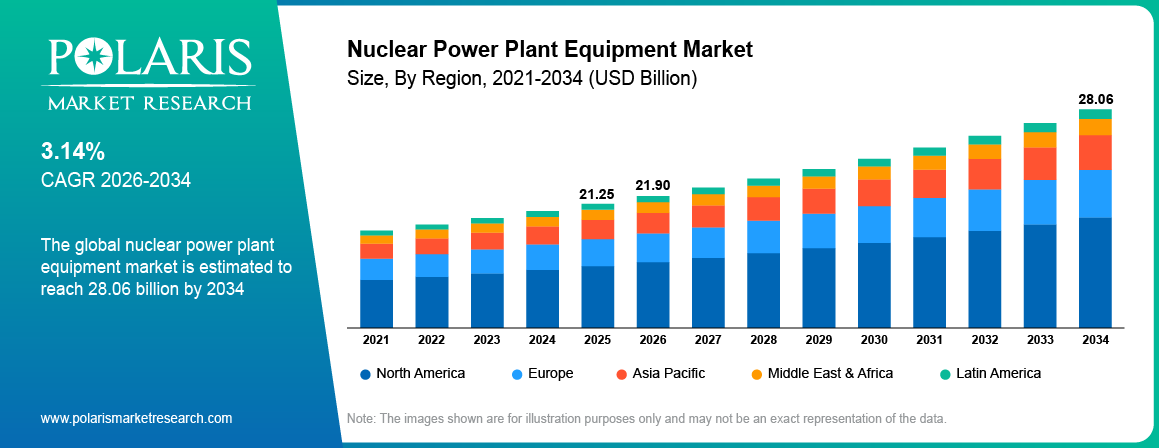
The global market of nuclear power plant equipment (TPD) was valued at USD 21.25 billion in 2025 and is expected to reach a value of USD 28.06 billion by 2034, growing at a CAGR of 3.14%. The global nuclear power plant equipment market has been demonstrating steady growth due to increasing investments by nations in low-carbon electricity production, energy security, and grid reliability.
Market Statistics
Nuclear Power Plant Equipment Market Key Takeaways
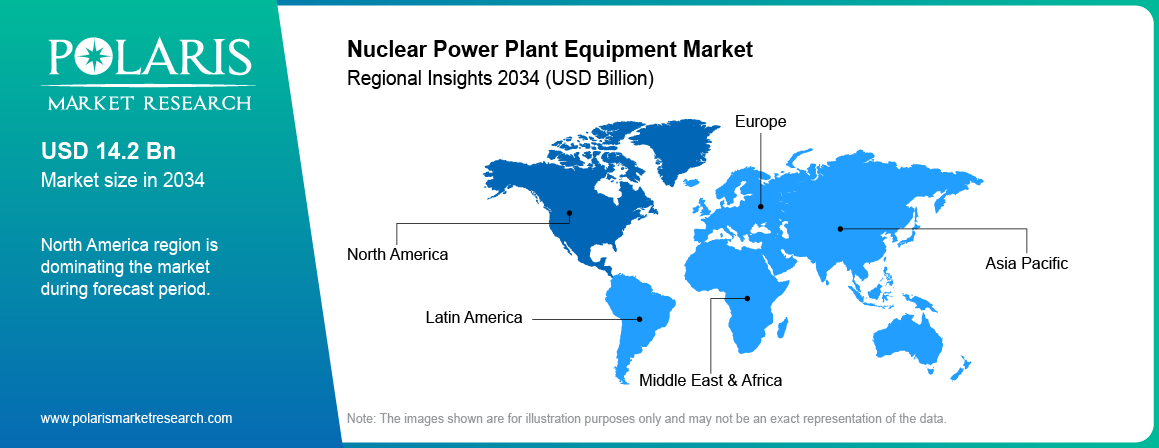
- North America held the largest share of 34.0% in the nuclear power plant equipment market in 2025, driven by continued investments in nuclear power generation, reactor modernization, and the presence of established nuclear engineering expertise.
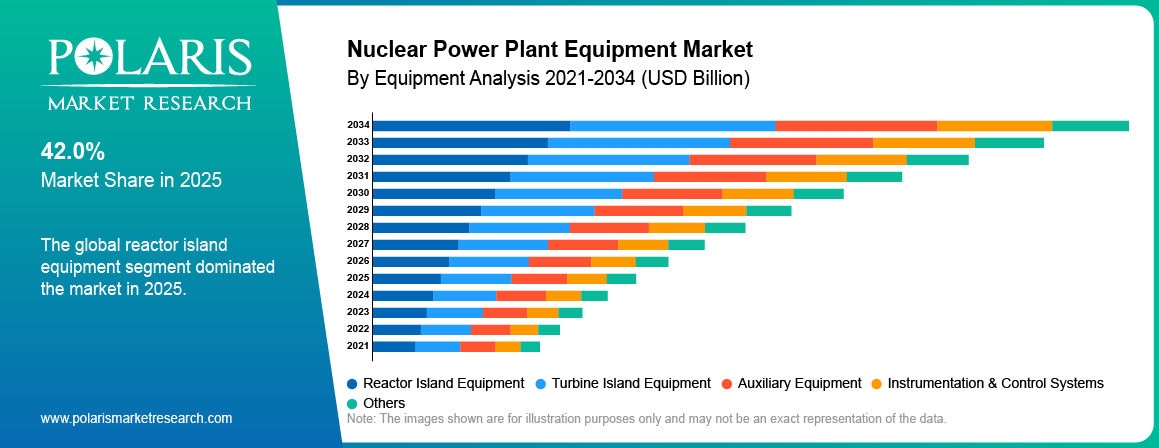
- Reactor island equipment accounted for the largest product segment with a market share of 42.0% in 2025, owing to its critical role in reactor performance, operational safety, and power generation efficiency.
- Pressurized Water Reactor (PWR) technology dominated the market with a share of 55.0% in 2025, supported by its widespread commercial deployment, proven operational reliability, and extensive global installed base.
- Utilities emerged as the leading end-user segment, accounting for a market share of 58.0% in 2025, due to substantial investments in new reactor construction, refurbishment projects, and lifetime extension of existing nuclear facilities.
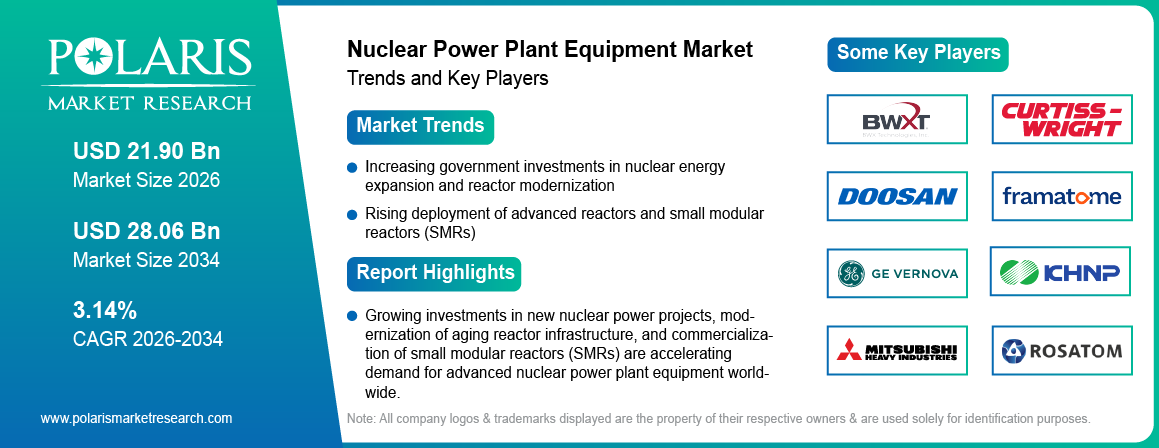
- Government-led nuclear energy programs, increasing deployment of Small Modular Reactors (SMRs), and modernization of aging nuclear infrastructure are expected to drive the market at a CAGR of 2.85% during the forecast period.
Note: Figures and projections outlined in this report are the result of Polaris Market Research’s proprietary analytical processes, grounded in the latest available datasets and market observation
What is Nuclear Power Plant Equipment?
Nuclear power plant equipment is described as the assembly of mechanical, electrical, instrumentation, and control equipment that is used during the construction, operation, maintenance, and safety management of nuclear power generation plants. Such equipment helps to ensure that nuclear reactors safely produce thermal energy from nuclear fission, which is then converted into electricity using steam turbines and power generation equipment.
Increasing investment in new nuclear technologies, modernization of the current nuclear power plant fleet, and development of infrastructure for clean energy further drive the demand for nuclear power plant equipment.
Source: Polaris Market Research Analysis
Nuclear Power Plant Equipment Market Driver Impact Analysis
The market is expected to show consistent growth over the forecast period driven by increasing spending on renewable energy generation along with growing demand for electricity and various government measures taken to reduce greenhouse gas emissions. Rising focus on energy independence and diversification in electricity generation has prompted many nations to increase their nuclear power generation capacities while maximizing the life span of existing nuclear reactors.
| Market Driver | Est. CAGR Impact | Geographic Relevance | Impact Timeline |
| Capacity expansion of nuclear power infrastructure | 6.8% | North America, Europe, Asia Pacific | Short to medium term |
| Government support for nuclear energy development | 6.4% | Global | Medium term |
| Modernization and refurbishment of aging nuclear reactors | 5.9% | North America, Europe | Medium to long term |
| Adoption of digital monitoring and automation technologies | 6.6% | Global | Ongoing |
| Commercial deployment of small modular reactors | 7.5% | North America, Europe, Asia Pacific | Long term |
* Indicative estimates based on market context and analyst judgment. Figures reflect relative driver weight, not additive CAGR contributions. Source: Polaris Market Research Analysis.
Industry Dynamics
- Increasing investment in new and refurbished nuclear power plants is fueling the demand for high-efficiency reactors, generators, turbines, and critical equipment in existing and upcoming nuclear countries.
- Implementation of digital instrumentation and control systems, predictive maintenance solutions, and advanced plant monitoring using artificial intelligence technology is enhancing operational efficiency and minimizing unplanned downtimes and maintenance cost.
- Stringent regulations related to nuclear safety, equipment certification, quality assurance, and material tracking are adding more complexity and time in the procurement process of nuclear equipment.
- Small modular reactors and innovative nuclear reactor technologies are creating fresh avenues for manufacturers of compact and pre-assembled nuclear equipment.
Nuclear Power Plant Equipment Market Drivers, Restraints and Opportunities
How Are Global Nuclear Energy Expansion Programs Driving Growth in the Market?
Growing investments in nuclear energy infrastructure remain one of the primary factors supporting the nuclear power plant equipment market. According to International Energy Agency (IEA), global investment in nuclear energy is expected to rise from USD 65 billion per year to USD 70 billion by 2030 on account of existing policies, contributing to the growth of global nuclear capacity from above 400 GW in 2020 to over 650 GW by 2050, a growth of more than 50%(Source: iea.org).Countries are building their nuclear power plants to improve energy security, decrease reliance on fossil fuel and to fulfill the long-term carbon reduction targets. Various countries have plans to build new nuclear power plants as well as extend the life of existing plants through modernization efforts.
How Is Digitalization Transforming the Market?
Digitalization is rapidly becoming a critical component of the modernization strategy of nuclear power plants. In July 2025, Hitachi introduced its Metaverse Platform for Nuclear Power Plants. This platform leverage artificial intelligence (AI), digital twin technology, and predictive analysis to enhance asset management, maintenance scheduling, and operational efficiency. Advanced instrumentation, digital control systems, predictive maintenance software, digital twin, and condition monitoring systems are incorporated in existing and new nuclear power plants.
What Challenges Limit Growth of the Market?
High Capital Investment and Complexity in Regulations
Construction of infrastructure based on nuclear energy needs significant capital investment, long time for building process, and approval from regulators before procurement of equipment begins. Each piece of equipment used in nuclear installations is required to comply with strict international safety standards, quality control requirements, and certification.
What Opportunities Exist in the Market?
Growing Commercialization of Small Modular Reactors
The growing adoption of small modular reactors is among the major factors driving the nuclear power plant equipment industry. In October 2025, the U.S. Department of the Army launched theJanus Program to advance the development of microreactors(Source: army.mil).Building on the foundation of Project Pele, the program aims to expand transportable nuclear reactor capabilities for electricity generation, with the same U.S. Compared to conventional large-scale reactors, SMRs emphasize modular construction, factory fabrication, standardized equipment, and shorter installation schedules.
Source: Polaris Market Research Analysis
Segment and Regional Leaders at a Glance
According to Polaris Market Research, North America leads the nuclear power plant market while Asia Pacific is the fastest-growing region.
- Dominant Region: North America
- Fastest Growing Region: Asia Pacific
- Largest Equipment Segment: Reactor Island Equipment
- Largest Reactor Type: Pressurized Water Reactor
- Largest End User: Utilities
Nuclear Power Plant Equipment Market Segmentation Analysis
The report provides a comprehensive analysis of the market by equipment, reactor type, and end user to identify major revenue-generating segments and emerging growth opportunities across the global nuclear industry.
Nuclear Power Plant Equipment Market by Equipment
Which Equipment Segment Dominates the Market?
Reactor island equipment accounted for the largest market share in 2025. This equipment segment is composed of key systems like reactor pressure vessel, steam generator, primary coolant pump, pressurizer, and the containment system, which serve to support the function of nuclear reactors. Given their capabilities of functioning under high temperature, pressure, and safety regulations, these systems rank among the most valuable in nuclear power plants.
Which Equipment Segment Is Expected to Register the Fastest Growth?
Turbine island equipment is projected to register the fastest CAGR during the forecast period. Increasing deployment of high-efficiency steam turbines, generators, condensers, feedwater systems, and associated auxiliary equipment is supporting segment expansion. Utilities are also upgrading conventional turbine systems to improve plant performance, reduce maintenance requirements, and enhance electricity generation efficiency.
Nuclear Power Plant Equipment Market by Reactor Type
Which Reactor Type Holds the Largest Share of the Market?
Pressurized water reactors represented the largest reactor type segment in 2025. Their widespread use in commercial applications, proven reliability, and acceptance from the authorities have made this technology the most popular reactor design globally.
Which Reactor Type Is Growing at the Fastest Rate?
Boiling water reactors are projected to witness highest growth rate during the forecast period. Programs related to modernizing, improving safety and enhancing the efficiency of plants are resulting in increasing demand for advanced reactor components and digital control systems in boiling water reactors.
Nuclear Power Plant Equipment Market by End User
Which End User Leads the Market?
Utilities accounted for the largest share of the market in 2025. Public and private electricity generation companies remain the primary purchasers of nuclear plant equipment for new construction projects, refurbishment programs, operational maintenance, and component replacement activities.
Which End User Segment Is Expected to Grow the Fastest?
The government segment is expected to see the highest growth rate in the forecast period. Governments of various countries are investing heavily in strategic nuclear infrastructure development, reactor demonstration projects, research centers, and domestic nuclear manufacturing. For example, an agreement has been signed between Russia and Kazakhstan to build the first nuclear power plant in Kazakhstan, worth USD 16.5 billion. The project will be supported in part through a major export loan provided by Russia. These initiatives are creating new procurement opportunities for equipment suppliers while strengthening national nuclear supply chains.
Segment Summary Table
| Segment | Category | 2025 Status | Forecast CAGR | Key Driver |
| Reactor Island Equipment | Equipment | Largest share | 4.7% | High demand for reactor core systems and safety-critical equipment |
| Turbine Island Equipment | Equipment | Fastest growing | 5.6% | Efficiency improvements and plant modernization |
| Pressurized Water Reactor | Reactor Type | Largest share | 4.6% | Extensive installed base and proven commercial performance |
| Boiling Water Reactor | Reactor Type | Fastest growing | 5.2% | Modernization and operational upgrades |
| Utilities | End User | Largest share | 4.8% | Expansion of nuclear electricity generation capacity |
| Government Programs | End User | Fastest growing | 6.1% | Public investment in advanced nuclear technologies |
Source: Polaris Market Research Analysis
Source: Polaris Market Research Analysis
Nuclear Power Plant Equipment Market Regional Analysis
North America Nuclear Power Plant Equipment Market Size and Share
North America accounted for the largest share of the market in 2025. The region benefits from a wide range of nuclear capacity installations and continuous investments in the extension of reactor lives and advanced nuclear technologies by governments. The World Nuclear Association states that the US is still the largest producer of nuclear power globally, producing close to 30% of the world’s nuclear energy. In 2024, the 94 commercial reactors in operation within the country were responsible for generating close to 816 TWh of electricity, contributing to 18% of the total electricity produced in the country(Source: worldnuclear.org).
Europe Nuclear Power Plant Equipment Market Analysis
Europe was the second-largest regional market in 2025 and is witnessing constant investments for upgrading its nuclear infrastructure. The European Commission approved the 2026-2027 Euratom Research and Training Programme in March 2026, making a budget allocation of USD 377.03 million for promoting fusion power, developing SMRs, and boosting research and innovation in Europe(Source: ec.europa.eu).Several European countries are extending reactor operating licenses while expanding investments in next-generation nuclear technologies to improve energy security and reduce greenhouse gas emissions.
Asia Pacific Nuclear Power Plant Equipment Market Growth Rate and Forecast
Asia Pacific is projected to register the fastest CAGR during the forecast period. Fast-paced growth is fueled by growing demand for electricity, increasing capacities of nuclear power production, and various government initiatives aimed at developing low-carbon energy. As stated in the National Development and Reform Commission and the National Energy Administration, China aims to build a green, low carbon, secure and efficient energy system by 2030, demonstrating its commitment to the energy shift and sustainability(Source: china.org).These developments are creating sustained demand for reactor components, steam generation systems, cooling technologies, electrical equipment, and advanced plant automation solutions.
Latin America Nuclear Power Plant Equipment Market
Latin American market is expected to grow steadily throughout the forecast period. Brazil and Argentina remain the primary regional markets due to their established nuclear power programs and continued investments in nuclear infrastructure modernization. Government initiatives related to enhancing capacity of electricity generation and diversification of energy sources have been driving the demand for the equipment procurement and maintenance.
Middle East & Africa Nuclear Power Plant Equipment Market
Middle East & Africa market is gradually expanding as several countries invest in nuclear energy to diversify electricity generation and strengthen long-term energy security. Growing investments in new nuclear projects are generating demand for reactor systems, balance-of-plant equipment, cooling technologies, and digital control infrastructure. As per World Nuclear Association, Saudi Arabia aims to develop 16 nuclear reactors by 2040, thereby indicating the country’s sustained effort in the development of its nuclear energy potential(Source: world-nuclear.org).
Source: Polaris Market Research Analysis
Regulatory Heatmap
| Country | Policy Environment | Key Regulations | Market Implication | Trend |
| United States | Favorable | Federal nuclear energy investment programs and licensing frameworks | Supports modernization, domestic manufacturing, and advanced reactor deployment | Expanding |
| European Union | Favorable | Nuclear safety directives and industrial decarbonization initiatives | Encourages equipment upgrades and regulatory compliance | Expanding |
| China | Favorable | National nuclear development strategy and domestic manufacturing policies | Strengthens local equipment production and reactor construction | Expanding |
| Japan | Favorable | Nuclear safety regulations and reactor restart framework | Supports modernization and replacement equipment demand | Stable |
| India | Developing | Nuclear expansion initiatives and domestic manufacturing programs | Creates long-term opportunities for equipment suppliers | Developing |
| Middle East | Developing | National nuclear energy development strategies | Encourages procurement for new reactor projects | Early Stage |
| Latin America | Neutral | National nuclear infrastructure development programs | Supports selective investments in modernization projects | Developing |
Source: Polaris Market Research Analysis
Competitive Landscape and Key Players
The nuclear power plant equipment market has remained moderately concentrated and competition revolves around technical expertise, manufacturing capabilities, adherence to regulations, and maintenance services. Competition exists among suppliers of equipment across various categories such as reactors, turbines, safety equipment, instrumentation and control, etc.
Competitiveness of equipment suppliers is based on the capability of manufacturers to provide components of nuclear grade meeting stringent international standards of safety. Long lifespan and reliability of equipment is another critical issue in competition. Companies possessing integrated manufacturing facilities, technical expertise and good relations with utilities and governmental authorities are improving their competitiveness.
Competitive Positioning Table
| Company | Est. Market Position | Primary Focus | Geographic Focus | In Report |
| GE Vernova | Top Market Participant | Broad nuclear equipment portfolio | Global | Yes |
| Framatome | Top Market Participant | Reactor engineering and fuel cycle expertise | Global | Yes |
| Westinghouse Electric Company | Top Market Participant | Advanced reactor technologies | Global | Yes |
| Mitsubishi Heavy Industries | Major Market Participant | Heavy engineering and nuclear systems | Asia Pacific, Global | Yes |
| Doosan Enerbility | Major Market Participant | Nuclear component manufacturing | Asia Pacific | Yes |
| BWX Technologies | Specialized Market Participant | Nuclear reactor components and services | North America | Yes |
Source: Polaris Market Research Analysis
Nuclear Power Plant Equipment Market Technology and Innovation Landscape
Innovations in technology are bringing changes in the nuclear power plant equipment industry as there is emphasis placed by energy producers and reactor designers to enhance efficiency, performance, and reliability in their operations. There are innovations in materials, monitoring systems, automation, and digital engineering incorporated in the new designs of nuclear plants.
Increasing funding into next-generation reactor technologies like small modular reactors and fourth-generation reactors is boosting the demand for standard equipment platforms that will make their production and assembly easier. Meanwhile, digitalization in the nuclear industry is providing more opportunities for predictive maintenance, asset management, and real-time monitoring.
| Technology | Adoption Stage | Key Development (2025–2026) | Market Impact |
| AI-enabled Equipment Monitoring | Growing Deployment | Integration of artificial intelligence for predictive maintenance and equipment diagnostics | Improves plant reliability while reducing maintenance costs |
| Advanced Nuclear-grade Materials | Early Commercial Deployment | Development of corrosion-resistant alloys and high-performance structural materials | Extends equipment lifespan and improves operational safety |
| Modular Equipment Manufacturing | Growing Deployment | Standardized manufacturing processes supporting modular reactor construction | Reduces installation time and project complexity |
| Digital Twins | Pilot to Early Commercial Stage | Virtual simulation of nuclear plant operations for performance optimization | Enhances operational planning and reduces engineering risks |
| Smart Instrumentation & Control Systems | Growing Deployment | Advanced digital control platforms with real-time monitoring capabilities | Improves operational efficiency and regulatory compliance |
Source: Polaris Market Research Analysis
Intelligent monitoring systems are used increasingly, which allow operators to diagnose equipment wear-and-tear in advance, reducing unscheduled downtimes. Advanced reactor parts that work at higher temperatures are now developed by manufacturers to facilitate the commercial use of next-generation nuclear reactors.
Nuclear Power Plant Equipment Market Buyer Use Cases and Market Entry Barriers
Requirements for nuclear power plant equipment come primarily from infrastructure development projects, meaning that purchasing depends heavily on qualification and reputation of suppliers and their compliance with safety regulations. Buyers usually consider engineering competence, production quality, project implementation experience, lifetime service support and compliance with international nuclear standards when selecting suppliers.
| Buyer / Investor Type | Primary Use Case | Key Insight Sought | Decision Horizon |
| Utility Companies | New reactor construction and plant modernization | Equipment reliability, operational efficiency, lifecycle cost | 5 to 15 years |
| Government Agencies | National nuclear infrastructure development | Regulatory compliance, domestic manufacturing capability | 10 to 20 years |
| EPC Contractors | Procurement for nuclear construction projects | Delivery capability, engineering support, project execution | 3 to 10 years |
| Private Investors | Infrastructure and technology investments | Long-term revenue potential, technology maturity | 5 to 15 years |
| Reactor Developers | Advanced reactor deployment | Technology compatibility, modular manufacturing capability | 5 to 12 years |
Source: Polaris Market Research Analysis
What are the Barriers to Entering the Nuclear Power Plant Equipment Market?
Several factors continue to limit market entry for new participants:
- Extensive regulatory approval and certification requirements.
- High capital investment for nuclear-grade manufacturing facilities.
- Long equipment qualification and testing cycles.
- Strict quality assurance and traceability standards.
- Limited availability of specialized nuclear engineering expertise.
- Long-term customer relationships between utilities and established suppliers.
- Complicated global logistics chain of nuclear grade materials and forged parts.
The suppliers which have managed to bypass all of these hurdles usually build up sustained relationships with utility firms, reactors developers and engineering companies, thus securing repeated possibilities of supplying, maintaining and updating the equipment.
Premium Insights and Future Prospects of Nuclear Power Plant Equipment Market
The outlook for development of the market of equipment for nuclear power plants look bright as governments around the world start understanding the importance of nuclear energy for reducing carbon emissions. Growing electricity demand, rising energy security concerns and ambitious decarbonization targets will drive investments into traditional nuclear reactors and also new types of reactors.
In addition, the trend towards localization of production of nuclear equipment in North America, Europe, and the Asia-Pacific region ensures the reliability of the domestic supply chain. Strategic collaborations among equipment manufacturers, engineering firms, utilities, and reactor developers are expected to accelerate technology commercialization and improve project execution over the coming years.
Cost Benchmarking Table
| Product / Service Type | Est. Price Range (USD) | Key Cost Driver | Complexity Tier |
| Reactor Island Equipment | USD 1.5–5.0 Billion | Engineering complexity, nuclear-grade materials, certification requirements | Premium |
| Turbine Island Equipment | USD 400 Million–1.5 Billion | Manufacturing scale and performance specifications | Mid to Premium |
| Pressurized Water Reactor Equipment | USD 2.0–6.0 Billion | System integration and safety requirements | Project Based |
| Instrumentation & Control Systems | USD 100–500 Million | Digital capabilities and cybersecurity features | Premium |
| Plant Modernization Services | USD 50 Million–1.0 Billion | Scope of refurbishment and installation complexity | Project Based |
Source: Polaris Market Research Analysis.
Key Players
- BWX Technologies
- Curtiss-Wright Corporation
- Doosan Enerbility
- Framatome
- GE Vernova
- Korea Hydro & Nuclear Power (KHNP)
- Mitsubishi Heavy Industries
- Rosatom
- Shanghai Electric Group
- Westinghouse Electric Company
Nuclear Power Plant Equipment Market Industry Developments
- June 2026: Holtec and EDF submitted a proposal to deploy the SMR-300 reactor at the Cottam site in the UK, advancing plans for commercial small modular reactor development(source: holtecinternational.com).
- April 2026: India's Prototype Fast Breeder Reactor (PFBR) at Kalpakkam achieved first criticality, marking a major milestone in the deployment of advanced nuclear reactor technology(source: dae.gov.in)
Market Segmentation
By Equipment Outlook (Revenue, USD Billion, 2021–2034)
- Reactor Island Equipment
- Turbine Island Equipment
- Auxiliary Equipment
- Instrumentation & Control Systems
- Others
By Reactor Type Outlook (Revenue, USD Billion, 2021–2034)
- Pressurized Water Reactor (PWR)
- Boiling Water Reactor (BWR)
- Pressurized Heavy Water Reactor (PHWR)
- Fast Breeder Reactor (FBR)
- Small Modular Reactor (SMR)
- Others
By End User Outlook (Revenue, USD Billion, 2021–2034)
- Utilities
- Government Programs
- Independent Power Producers (IPPs)
- Research Institutes
- Others
By Regional Outlook (Revenue, USD Billion, 2021–2034)
- North America
- US
- Canada
- Europe
- Germany
- France
- UK
- Italy
- Spain
- Netherlands
- Russia
- Rest of Europe
- Asia Pacific
- China
- Japan
- India
- Malaysia
- South Korea
- Indonesia
- Australia
- Vietnam
- Rest of Asia Pacific
- Middle East & Africa
- Saudi Arabia
- UAE
- Israel
- South Africa
- Rest of Middle East & Africa
- Latin America
- Mexico
- Brazil
- Argentina
- Rest of Latin America
Report Scope
| Report Attributes | Details |
| Market Size in 2025 | USD 21.25 Billion |
| Market Size in 2026 | USD 21.90 Billion |
| Revenue Forecast by 2034 | USD 28.06 Billion |
| CAGR | 3.14% from 2026 to 2034 |
| Base Year | 2025 |
| Historical Data | 2021–2024 |
| Forecast Period | 2026–2034 |
| Quantitative Units | Revenue in USD Billion and CAGR from 2026 to 2034 |
| Report Coverage | Revenue Forecast, Competitive Landscape, Growth Factors, Clinical Pipeline, Technology, and Industry Trends |
| Segments Covered | By Equipment, By Reactor Type, By End User, By Region |
| Regional Scope | North America, Europe, Asia Pacific, Latin America, Middle East & Africa; country detail for US, Canada, Germany, UK, France, China, Japan, India, South Korea, Australia |
| Competitive Landscape | Company Profiles including platform overview, clinical pipeline, partnerships, and recent developments |
| Report Format | PDF + Excel |
| Customization | Report customization available as per requirements with respect to countries, regions, modalities, and therapeutic areas. |
Nuclear Power Plant Equipment Market FAQ's
• The market was valued at USD 21.25 billion in 2025 and is projected to reach USD 28.06 billion by 2034.
• The market is expected to grow at a CAGR of approximately 3.14% from 2026 to 2034.
• Rising investments in nuclear power generation, modernization of reactors, advancement in reactor technology, and favorable government policies on clean energy infrastructure are the factors driving the growth of the market.
• Reactor island equipment accounted for the largest share of the market in 2025, owing to its significant contribution to reactor operations and safety systems.
• Pressurized water reactors led the market in 2025, propelled by their large installed base and high operational efficiency.
• North America was the leading region in the market in 2025, propelled by its robust nuclear infrastructure and government policies.
Download Sample Report of Nuclear Power Plant Equipment Market
Please fill out the form to request a customized copy of the research report.


